pith. machine review for the scientific record. sign in

cs.PF

Performance

Covers performance measurement and evaluation, queueing, and simulation. Roughly includes material in ACM Subject Classes D.4.8 and K.6.2.

0
cs.PF 2026-05-13 2 theorems

Adaptive packed layouts enable efficient VLA ML code

Scalable Packed Layouts for Vector-Length-Agnostic ML Code Generation

Layouts that respect runtime vector length let one compilation produce code that adapts across hardware and reaches 1.45 times the speed of
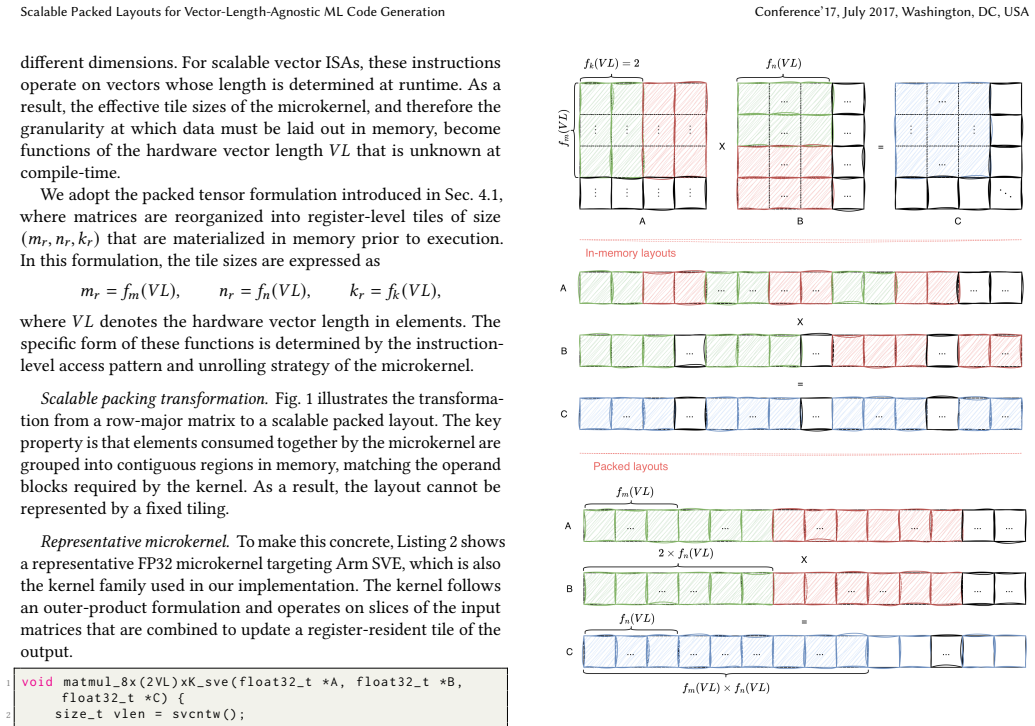
Figure from the paper full image
abstract click to expand
Scalable vector instruction sets such as Arm SVE enable vector-length-agnostic (VLA) execution, allowing a single implementation to adapt across hardware with different vector lengths. However, they complicate compiler code generation, as tiling and data layout decisions can no longer be fixed at compile time. We present an approach for enabling VLA code generation in an end-to-end ML compilation pipeline through vector-length-aware packed data layouts and corresponding compiler extensions. We integrate these mechanisms into MLIR/IREE and extend tiling, fusion, and vectorization to operate with scalable vector lengths. Evaluated on real-world ML workloads on Arm CPUs, our approach generates SVE code that is competitive with, and often outperforms, existing NEON-based code generation within IREE, achieving up to $1.45\times$ speedup. We also outperform PyTorch ecosystem frameworks, including ExecuTorch, TorchInductor, and eager execution, demonstrating the effectiveness of scalable vectorization in a production compiler setting. A simulator-based study further shows that the generated code scales with increasing SVE vector length on compute-bound workloads, supporting performance portability across hardware configurations.
0
0
cs.PF 2026-05-11 2 theorems

GPU speedups reach 10x despite 1.85x bandwidth limit in quantum simulation

A Controlled Study of Memory Hierarchy Transitions in Quantum Circuit Simulation on Apple M4 Pro Unified Memory Architecture

Direct-index methods outperform STREAM predictions by largest margin on M4 Pro shared DRAM as access patterns grow irregular.

Figure from the paper full image
abstract click to expand
State-vector quantum circuit simulation is memory-bandwidth bound, yet the interaction between memory hierarchy, access pattern, and hardware parallelism remains incompletely characterized. We address this using the Apple M4 Pro Unified Memory Architecture (UMA), where CPU and GPU share identical physical LPDDR5X DRAM ($\sim$224 GB/s STREAM bandwidth for both), eliminating memory-technology and interconnect confounds. Using a thermally isolated, multi-trial methodology across 11 simulation backends on GHZ and QFT circuits from 3 to 30 qubits, we make three central contributions. First, a Roofline analysis confirms all gate implementations have arithmetic intensity $\leq$0.38 FLOP/byte, well below the ridge point for any plausible peak compute on modern hardware, establishing structural memory-boundedness. Second, we identify a reproducible 4.46$\times$ timing discontinuity at the 28$\rightarrow$29 qubit transition, confirmed under thermally isolated conditions and cross-validated across GHZ and QFT circuits; tensordot backends exhibit the full discontinuity while direct-index backends maintain $\sim$2$\times$ per-qubit scaling throughout. Third, despite STREAM predicting only 1.85$\times$ GPU speedup (MLX CPU 119.9 GB/s vs. MLX GPU 221.9 GB/s), all three algorithm classes exceed this prediction: tensordot 3.1--4.1$\times$, flat-index 3.5--5.9$\times$, and direct-index 6--10$\times$, demonstrating that peak streaming bandwidth does not predict simulation speedup for non-contiguous memory access patterns, with the gap widening as access irregularity increases. These findings provide a hardware-characterization framework for quantum simulation workloads on UMA.
0
0
cs.PF 2026-05-11 3 theorems

4.46Γ— jump in quantum sim time at 29 qubits on M4 Pro

A Controlled Study of Memory Hierarchy Transitions in Quantum Circuit Simulation on Apple M4 Pro Unified Memory Architecture

Non-contiguous memory access makes actual GPU gains far exceed what STREAM bandwidth predicts.

Figure from the paper full image
abstract click to expand
State-vector quantum circuit simulation is memory-bandwidth bound, yet the interaction between memory hierarchy, access pattern, and hardware parallelism remains incompletely characterized. We address this using the Apple M4 Pro Unified Memory Architecture (UMA), where CPU and GPU share identical physical LPDDR5X DRAM ($\sim$224 GB/s STREAM bandwidth for both), eliminating memory-technology and interconnect confounds. Using a thermally isolated, multi-trial methodology across 11 simulation backends on GHZ and QFT circuits from 3 to 30 qubits, we make three central contributions. First, a Roofline analysis confirms all gate implementations have arithmetic intensity $\leq$0.38 FLOP/byte, well below the ridge point for any plausible peak compute on modern hardware, establishing structural memory-boundedness. Second, we identify a reproducible 4.46$\times$ timing discontinuity at the 28$\rightarrow$29 qubit transition, confirmed under thermally isolated conditions and cross-validated across GHZ and QFT circuits; tensordot backends exhibit the full discontinuity while direct-index backends maintain $\sim$2$\times$ per-qubit scaling throughout. Third, despite STREAM predicting only 1.85$\times$ GPU speedup (MLX CPU 119.9 GB/s vs. MLX GPU 221.9 GB/s), all three algorithm classes exceed this prediction: tensordot 3.1--4.1$\times$, flat-index 3.5--5.9$\times$, and direct-index 6--10$\times$, demonstrating that peak streaming bandwidth does not predict simulation speedup for non-contiguous memory access patterns, with the gap widening as access irregularity increases. These findings provide a hardware-characterization framework for quantum simulation workloads on UMA.
0
0
cs.PF 2026-05-11 2 theorems

Single-thread JPEG benchmarks misrank decoders for DataLoaders

Single-Thread JPEG Decoder Benchmarks Mis-Evaluate ML Data Loaders

Tests across five CPUs reveal that decoder rankings shift when run inside PyTorch workers, altering which library performs best.

Figure from the paper full image
abstract click to expand
JPEG decode is routine ML infrastructure, but Python decoder choices are often justified by single-process, single-thread microbenchmarks. We audit this evaluation assumption with twelve Python-accessible JPEG decode paths on five matched 16 vCPU Google Cloud CPUs: Intel Emerald Rapids, AMD Zen 4, AMD Zen 5, ARM Neoverse V2, and ARM Neoverse N1. ImageNet validation is the workload, not a new dataset contribution: each run decodes the full 50,000-image split from memory and reports single-thread throughput for all decoders, PyTorch DataLoader throughput for eligible decoders at worker counts {0,2,4,8}, and decoder skip behavior. The evaluation protocol changes the supported conclusion. On Neoverse V2, imageio is ninth in single-thread throughput yet lands in the top DataLoader tier with torchvision; on Zen 4, torchvision rises from seventh single-thread to the top measured DataLoader tier; on Neoverse N1, imagecodecs is the single-thread leader but fourth at peak DataLoader throughput. We also find that worker-count conclusions differ between Zen 4 and Zen 5, TensorFlow has a large single-thread ARM penalty, and strict libjpeg-turbo-family wrappers reject the same rare ImageNet JPEG. For PyTorch DataLoader workloads, torchvision and simplejpeg form the strongest measured zero-skip tier: torchvision has the highest mean normalized throughput, while simplejpeg has the highest minimum. OpenCV remains a robust general-purpose fallback above 90% of the platform-local winner on every tested CPU. We release raw JSON, generated tables/figures, and an executable local/cloud benchmark framework.
0
0
cs.PF 2026-05-08

Int4 KV cache outruns fp16 on Apple Silicon

When Quantization Is Free: An int4 KV Cache That Outruns fp16 on Apple Silicon

Fused kernel gives 3x memory compression plus faster generation with quality preserved for tested models and lengths

Figure from the paper full image
abstract click to expand
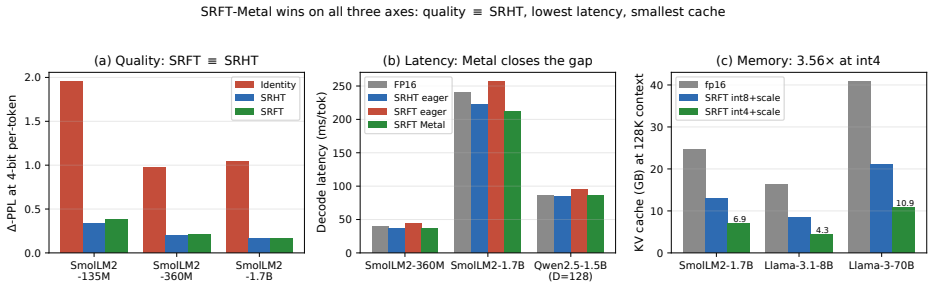
KV-cache quantization is framed as a quality--latency trade-off. We show it is \emph{inverted} on Apple Silicon's unified memory: a single fused Metal kernel (sign-randomized FFT $+$ per-channel $\lambda$ $+$ per-group abs-max $+$ int4 nibble pack), exposed as a HuggingFace \texttt{Cache} subclass, runs \emph{faster than fp16} across $256$--$4096$-token prefixes on Gemma-3 1B ($-3$ to $-8\%$ ms/tok) and at short context on Qwen2.5-1.5B ($-0.7$ to $-2.6\%$ through $1$K), with $3\times$ persistent memory compression and quality preserved ($\dPPL = 0.000$ Qwen short-prompt; $+3.6$ hook $\dPPL$ Gemma). The kernel's $\sim\!25$\,ns/vec overhead is below the bandwidth savings from $3\times$ compression. The fused kernel also closes Qwen's 4-bit per-token catastrophe ($\dPPL = +7975 \to +638.6$, $12.5\times$ reduction) at $182$\,GFLOPS / $D{=}128$. Supporting findings: $\SRFT$ and $\SRHT$ are statistically indistinguishable for KV quality (we pick $\SRFT$ for mixed-radix and matrix-multiply alignment); a learned-rotation ablation surfaces a regularization role for the fixed random SRFT base (learning $R+\lambda$ without SRFT lowers calibration MSE $84.9\%$ vs $50.3\%$ but yields worse PPL); Householder rotations at $k{=}d/2$ reflectors are effectively lossless at $d{=}256$.
0
0
cs.PF 2026-05-07

LLM agents turn GPU profiles into optimization advice

KEET: Explaining Performance of GPU Kernels Using LLM Agents

Explanations grounded in profile data improve LLM code optimizations and question answering on H100 GPUs.

Figure from the paper full image
abstract click to expand
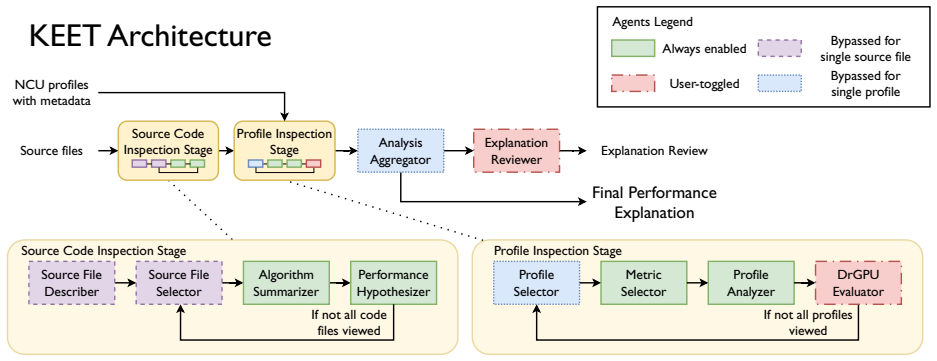
Performance profiles of GPU kernels generated by tools such as Nsight Compute are rich in detail but are often challenging to interpret. To achieve the best performance possible on a given GPU architecture, kernel developers need to spend significant time analyzing and comparing profiles in the tool's graphical interface to identify and understand kernel performance bottlenecks. Large Language Models (LLMs) have shown promise in understanding complex data and generating natural language explanations. In this paper, we propose the Kernel Execution Explanation Toolkit (KEET), an LLM-based agentic framework for interpreting Nsight Compute profiles to generate useful and data-grounded natural language explanations of performance issues in GPU kernels, and suggestions for optimizations. We evaluate \toolname using several CUDA kernels of varying complexity on NVIDIA H100 GPUs. We find that the generated explanations, when provided as context, improve the quality of LLM code optimization and multiple-choice question answering in downstream tasks. We further demonstrate that the tool can be used to interpret performance data from large sets of profiles to improve the quality of optimization suggestions.
0
0
cs.PF 2026-05-05

Same LLM name produces different services by host

When Is the Same Model Not the Same Service? A Measurement Study of Hosted Open-Weight LLM APIs

Q4 2025 traffic data show latency, price, and throughput vary across providers even for identical model variants

Figure from the paper full image
abstract click to expand
Open-weight large language models (LLMs) are usually named as model artifacts, but production users often consume them as hosted API services. This paper argues that the operational unit is a service object: a provider-specific, time-varying endpoint defined by model variant, protocol behavior, context capacity, listed price, latency and throughput distribution, reliability, and task feasibility. Using sampled request logs, provider metadata, compatibility probes, pricing snapshots, and continuous latency measurements collected by AI Ping during Q4 2025, we study how this service layer changes the meaning of "the same model." Three empirical patterns emerge. First, observed demand is concentrated but persistent across versions: in the displayed family aggregate, the largest family carries 32.0% of relative demand and the top five carry 87.4%, with a Gini coefficient of 0.693, while older variants remain active after newer releases. Second, supply and use separate: provider listing breadth does not imply realized adoption, and listed prices are more anchored than latency, throughput, context length, protocol support, and error semantics. Third, task mix matters: applications induce different token-length regimes, so provider choice is a constrained decision over provider-model-task-time tuples rather than a lookup by model name. In two representative counterfactuals under observed feasibility constraints, routing lowers Qwen3-32B cost by 37.8% and raises DeepSeek-V3.2 average throughput by about 90% relative to direct official access. The results support a measurement view of hosted open-weight LLMs as heterogeneous services, not static catalog entries. We open-source the measurement methodology and reproduction artifacts at https://github.com/haoruilee/llm_api_measurement_study to support result reproduction.
0
0
cs.PF 2026-05-05

Same model name yields different speed

When Is the Same Model Not the Same Service? A Measurement Study of Hosted Open-Weight LLM APIs

Measurements of real traffic show hosted open-weight LLMs form distinct services whose attributes vary across providers and time.

Figure from the paper full image
abstract click to expand
Open-weight large language models (LLMs) are usually named as model artifacts, but production users often consume them as hosted API services. This paper argues that the operational unit is a service object: a provider-specific, time-varying endpoint defined by model variant, protocol behavior, context capacity, listed price, latency and throughput distribution, reliability, and task feasibility. Using sampled request logs, provider metadata, compatibility probes, pricing snapshots, and continuous latency measurements collected by AI Ping during Q4 2025, we study how this service layer changes the meaning of "the same model." Three empirical patterns emerge. First, observed demand is concentrated but persistent across versions: in the displayed family aggregate, the largest family carries 32.0% of relative demand and the top five carry 87.4%, with a Gini coefficient of 0.693, while older variants remain active after newer releases. Second, supply and use separate: provider listing breadth does not imply realized adoption, and listed prices are more anchored than latency, throughput, context length, protocol support, and error semantics. Third, task mix matters: applications induce different token-length regimes, so provider choice is a constrained decision over provider-model-task-time tuples rather than a lookup by model name. In two representative counterfactuals under observed feasibility constraints, routing lowers Qwen3-32B cost by 37.8% and raises DeepSeek-V3.2 average throughput by about 90% relative to direct official access. The results support a measurement view of hosted open-weight LLMs as heterogeneous services, not static catalog entries. We open-source the measurement methodology and reproduction artifacts at https://github.com/haoruilee/llm_api_measurement_study to support result reproduction.
0
0
cs.PF 2026-05-04

SPEC CPU 2026 standardizes mixed-workload CPU benchmarking

SPEC CPU: The Next Generation

Rolling-Round-Robin Rate provides a consistent way to run heterogeneous multiprogrammed workloads on modern open-source applications.

Figure from the paper full image
abstract click to expand
The march toward developing relevant and robust CPU benchmarks continues with the introduction of SPEC CPU 2026, the next generation suite for measuring processor performance. This paper details the methodology behind its creation, showcasing a process centered on community collaboration and principled development. The suite is built upon a foundation of modern, open-source applications, selected and hardened through a process that emphasizes workload diversity, portability, and software longevity. A key contribution is Rolling-Round-Robin Rate, a novel and standardized approach to running heterogeneous, multiprogrammed workloads that addresses a long-standing gap in benchmarking practice. Additionally, the suite features an expanded set of multithreaded benchmarks and introduces workloads with distinct microarchitectural profiles, reflecting the demands of contemporary software. By detailing our principled approach to benchmark selection, adaptation, and validation, we demonstrate how the SPEC CPU 2026 suite sets the standard for performance evaluation in the next era of computer architecture research and development.
0
0
cs.PF 2026-05-04

Response time distributions derived for priority queues with preemption overhead

Priority Scheduling in the M/G/1 with Preemption Overhead

Recursive Laplace transform formula accounts for stochastic overhead on each pause and resume in class-based preemptive priority.

Figure from the paper full image
abstract click to expand
Virtually all practical settings where preemptive scheduling is employed are susceptible to preemption overhead, and accounting for these overheads is necessary to make informed scheduling design decisions. However, preemption overhead is almost never accounted for in queueing-theoretic analyses of preemptive scheduling policies. This is true even for simple preemptive policies in simple queueing models: even the stability region, let alone the response time distribution, is difficult to analyze under overhead. In this work, we give the first response time distribution analysis of an M/G/1 under a preemptive scheduling policy with preemption overhead. Specifically, we consider class-based preemptive priority, where a stochastic overhead is incurred when pausing or resuming a job. We derive a recursive formula for the Laplace transform of response time for jobs of any given class, from which all response time moments can be extracted. Beyond the specific policy and model we analyze, our broader aim is to provide a first step towards a general framework for analyzing queues with preemption overhead. To that end, we perform much of our analysis in a way that applies to a wide variety of overhead models by introducing a new theoretical tool called the job joint transform.
0
0
cs.PF 2026-05-04

Apple Silicon runs 80B LLMs at 23x Nvidia energy efficiency

Silicon Showdown: Performance, Efficiency, and Ecosystem Barriers in Consumer-Grade LLM Inference

Unified memory removes the VRAM bottlenecks that force Nvidia users to quantize heavily or accept 90 percent slower offloading.

Figure from the paper full image
abstract click to expand
The operational landscape of local Large Language Model (LLM) inference has shifted from lightweight models to datacenter-class weights exceeding 70B parameters, creating profound systems challenges for consumer hardware. This paper presents a systematic empirical analysis of the Nvidia and Apple Silicon ecosystems, specifically characterizing the distinct intra-architecture trade-offs required to deploy these massive models. On the Nvidia Blackwell architecture, we identify a critical "Backend Dichotomy" within the TensorRT-LLM stack: while the new NVFP4 quantization format delivers a 1.6x throughput advantage over optimized BF16 baselines (151 tokens/s vs. 92 tokens/s), realizing this performance requires navigating complex runtime constraints that trade startup latency for generation speed. Furthermore, we characterize the "VRAM Wall" for 70B+ models: on discrete GPUs, users face a destructive choice between aggressive quantization (e.g., Q2) that degrades model intelligence to fit in VRAM, or PCIe-bottlenecked CPU offloading, which reduces throughput by over 90% compared to full-GPU execution. Conversely, Apple's Unified Memory Architecture (UMA) circumvents these bottlenecks, enabling linear scaling for 80B parameter models at practical 4-bit precisions. This architectural divergence extends to operational sustainability, where Apple's SoC design demonstrates up to a 23x advantage in energy efficiency (tokens/joule). We conclude that for consumer-grade inference, the optimal hardware is defined by a complex interplay between compute density (Nvidia) and memory capacity (Apple), moderated by the significant "ecosystem friction" of proprietary quantization workflows.
0
0
cs.PF 2026-04-30

Watchpoint recovers full NVIDIA driver command streams

Revealing NVIDIA Closed-Source Driver Command Streams for CPU-GPU Runtime Behavior Insight

Kernel instrumentation plus a doorbell register watchpoint captures exact hardware commands to reveal CUDA data movement modes and graph sub

Figure from the paper full image
abstract click to expand
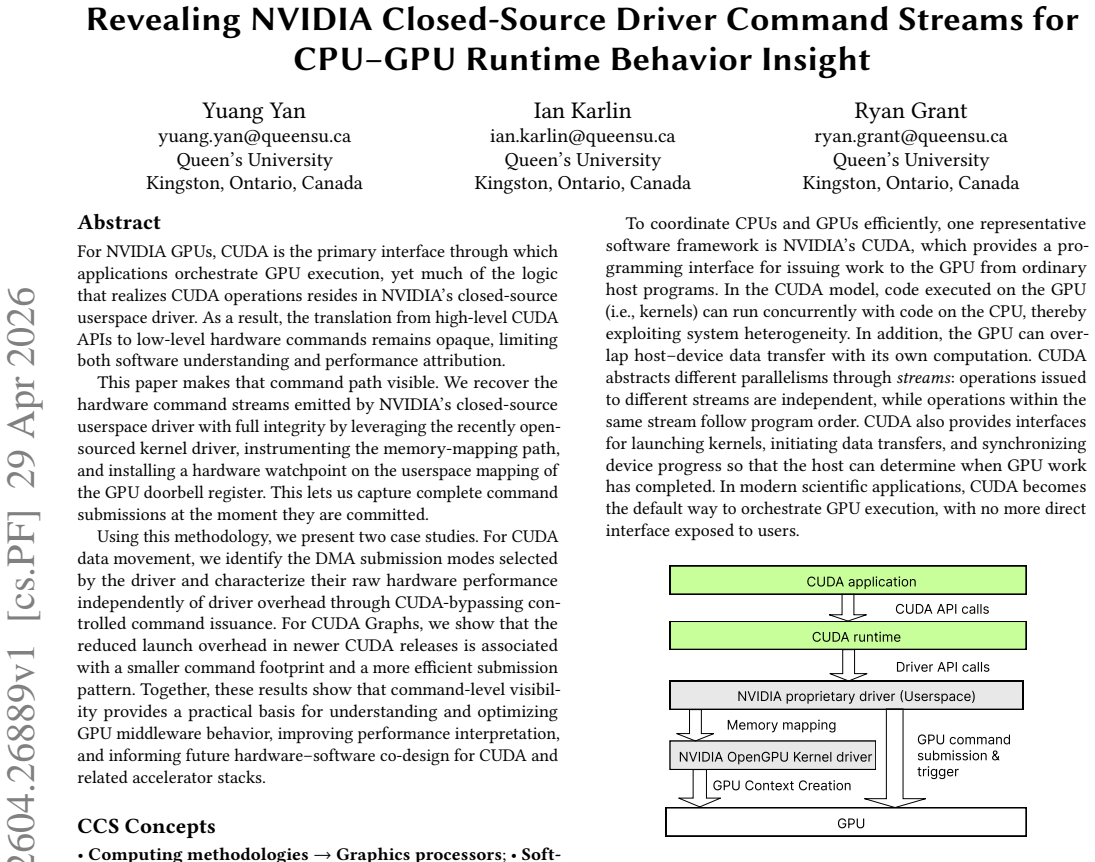
For NVIDIA GPUs, CUDA is the primary interface through which applications orchestrate GPU execution, yet much of the logic that realizes CUDA operations resides in NVIDIA's closed-source userspace driver. As a result, the translation from high-level CUDA APIs to low-level hardware commands remains opaque, limiting both software understanding and performance attribution. This paper makes that command path visible. We recover the hardware command streams emitted by NVIDIA's closed-source userspace driver with full integrity by leveraging the recently open-sourced kernel driver, instrumenting the memory-mapping path, and installing a hardware watchpoint on the userspace mapping of the GPU doorbell register. This lets us capture complete command submissions at the moment they are committed. Using this methodology, we present two case studies. For CUDA data movement, we identify the DMA submission modes selected by the driver and characterize their raw hardware performance independently of driver overhead through CUDA-bypassing controlled command issuance. For CUDA Graphs, we show that the reduced launch overhead in newer CUDA releases is associated with a smaller command footprint and a more efficient submission pattern. Together, these results show that command-level visibility provides a practical basis for understanding and optimizing GPU middleware behavior, improving performance interpretation, and informing future hardware--software co-design for CUDA and related accelerator stacks.
0
0
cs.PF 2026-04-27

Optimas automates GPU code optimization with 100% correctness

Optimas: An Intelligent Analytics-Informed Generative AI Framework for Performance Optimization

Multi-agent AI maps performance diagnostics to transformations, achieving speedups in 98.82% of 3410 experiments.

Figure from the paper full image
abstract click to expand
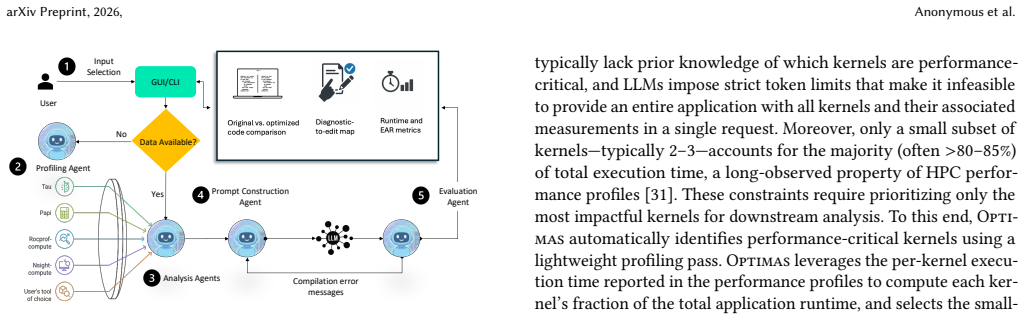
Large language models (LLMs) show promise for automated code optimization. However, without performance context, they struggle to produce correct and effective code transformations. Existing performance tools can identify bottlenecks but stop short of generating actionable code changes. Consequently, performance optimization continues to be a time-intensive and manual endeavor, typically undertaken only by experts with detailed architectural understanding. To bridge this gap, we introduce Optimas, a modular, fully automated, end-to-end generative AI framework built on a multi-agent workflow. Optimas uses LLMs to map performance diagnostics from multiple reports to established, literature-backed code transformations, while unifying insight extraction, code generation, execution, and validation within a single pipeline. Across 3,410 real-world experiments on 10 benchmarks and two HPC mini-applications, Optimas generates 100% correct code and improves performance in over 98.82% of those experiments, achieving average gains of 8.02%-79.09% on NVIDIA GPUs.
0
0
cs.PF 2026-04-27

COMPASS cuts HPC job turnaround time by 66% with trace ML

COMPASS: A Unified Decision-Intelligence System for Navigating Performance Trade-off in HPC

It converts configuration questions into ML tasks on operational traces and supplies uncertainty-aware advice for minimal fixes.

Figure from the paper full image
abstract click to expand
HPC systems expose many configuration parameters that jointly drive competing objectives. Existing tools such as autotuners recommend good configurations but do not identify minimal changes for a near-miss configuration to meet a performance objective, and they often ignore domain-specific constraints. To address this gap, we introduce COMPASS -- a modular, programmable engine that uses operational traces to generate HPC configuration recommendations and guide tuning decisions. This paper: (1) formalizes configuration questions into query patterns; (2) develops an interactive decision-making engine that formulates these queries as Machine Learning (ML) tasks; (3) quantifies the trustworthiness of its recommendations by providing evidence and quantifying uncertainty, and -- when confidence is low -- provides guidance on which configurations to run next. We validate COMPASS using analytical ground truth, reconstruction accuracy, reproduction of published findings, and when possible, running on real hardware. When integrated with an open-source HPC scheduling simulator, COMPASS cuts average job turnaround time by 65.93% and node usage by 80.93% relative to the state-of-the-art. Moreover, COMPASS achieves up to 100x faster training and 80x faster inference than state-of-the-art generative methods, and scales to traces with 1.3B samples and 126GB of data.
0
0
cs.PF 2026-04-21

CPU-GPU hybrid speeds long-context LLM inference 1.41x-3.2x

HybridGen: Efficient LLM Generative Inference via CPU-GPU Hybrid Computing

Parallel attention logits, dynamic scheduling, and semantic cache mapping let tiered memory systems handle growing KV caches without full-GP

Figure from the paper full image
abstract click to expand
As modern LLMs support thousands to millions of tokens, KV caches grow to hundreds of gigabytes, stressing memory capacity and bandwidth. Existing solutions, such as KV cache pruning and offloading, alleviate these but underutilize hardware by relying solely on either GPU or CPU for attention computing, and considering yet limited CPU local memory for KV cache storage. We propose HybridGen, an efficient hybrid attention framework for long-context LLM inference. HybridGen enables CPU-GPU collaborative attention on systems with expanded tiered memory (e.g., CXL memory), addressing three key challenges: (1) multi-dimensional attention dependencies, (2) intensifying CPU-GPU load imbalance with longer sequences, and (3) NUMA penalty of tiered memories. HybridGen tackles these by introducing attention logit parallelism, a feedback-driven scheduler, and semantic-aware KV cache mapping. Experiments with three LLM models with eleven different sizes on three GPU platforms with a CXL-expanded memory show that HybridGen outperforms six state-of-the-art KV cache management methods by 1.41x--3.2x on average while maintaining superior accuracy.
0
0
cs.PF 2026-04-17

The paper introduces Ragged Paged Attention (RPA)

Ragged Paged Attention: A High-Performance and Flexible LLM Inference Kernel for TPU

RPA kernel for TPUs achieves 86% MBU in decode and 73% MFU in prefill on Llama 3 8B via tiling for ragged memory, fused pipelines, and…

Figure from the paper full image
abstract click to expand
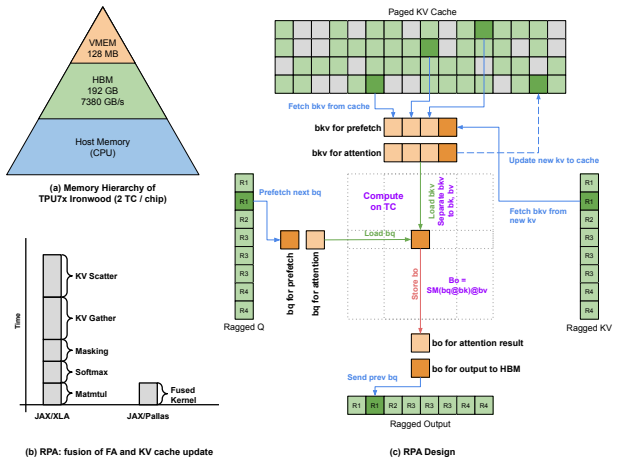
Large Language Model (LLM) deployment is increasingly shifting to cost-efficient accelerators like Google's Tensor Processing Units (TPUs), prioritizing both performance and total cost of ownership (TCO). However, existing LLM inference kernels and serving systems remain largely GPU-centric, and there is no well-established approach for efficiently mapping LLM workloads onto TPU architectures--particularly under the dynamic and ragged execution patterns common in modern serving. In this paper, we present Ragged Paged Attention (RPA), a high-performance and flexible attention kernel for TPUs, implemented using Pallas and Mosaic. RPA addresses these challenges through three key techniques: (1) fine-grained tiling to enable efficient dynamic slicing over ragged memory, (2) a custom software pipeline that fuses KV cache updates with attention computation, and (3) a distribution-aware compilation strategy that generates specialized kernels for decode, prefill, and mixed workloads. Evaluated on Llama 3 8B on TPU7x, RPA achieves up to 86% memory bandwidth utilization (MBU) in decode and 73% model FLOPs utilization (MFU) in prefill. Integrated as the primary TPU backend in vLLM and SGLang, RPA provides a production-grade foundation for efficient TPU inference and offers practical insights into kernel design.
0
0
cs.PF 2026-04-17

L4 GPU delivers up to 4.4x inference throughput over T4

DEEP-GAP: Deep-learning Evaluation of Execution Parallelism in GPU Architectural Performance

It peaks efficiency at batches of 16-32, improving latency tradeoffs while T4 holds for large-batch efficiency needs.

Figure from the paper full image
abstract click to expand
Modern datacenters increasingly rely on low-power, single-slot inference accelerators to balance performance, energy efficiency, and rack density constraints. The NVIDIA T4 GPU has become widely deployed due to strong performance per watt and mature software support. Its successor, the NVIDIA L4 GPU, introduces improvements in Tensor Core throughput, cache capacity, memory bandwidth, and parallel execution capability. However, limited empirical evidence quantifies the practical inference performance gap between these two generations under controlled and reproducible conditions. This work introduces DEEP-GAP, a systematic evaluation extending the GDEV-AI methodology to GPU inference. Using identical configurations and workloads, we evaluate ResNet18, ResNet50, and ResNet101 across FP32, FP16, and INT8 precision modes using PyTorch and TensorRT. Results show that reduced precision significantly improves performance, with INT8 achieving up to 58x throughput improvement over CPU baselines. L4 achieves up to 4.4x higher throughput than T4 while reaching peak efficiency at smaller batch sizes between 16 and 32, improving latency-throughput tradeoffs for latency-sensitive workloads. T4 remains competitive for large batch workloads where cost or power efficiency is important. DEEP-GAP provides practical guidance for selecting precision modes, batch sizes, and GPU architectures for modern inference deployments.
0
0
cs.PF 2026-04-14

H200 outperforms H100 for memory-bound tasks when power-capped

Architectural Trade-offs in the Energy-Efficient Era: A Comparative Study of power-capping NVIDIA H100 and H200

The H100 holds a slight edge on compute-bound work, shown by tests that vary power limits and isolate memory bandwidth effects.

Figure from the paper full image
abstract click to expand
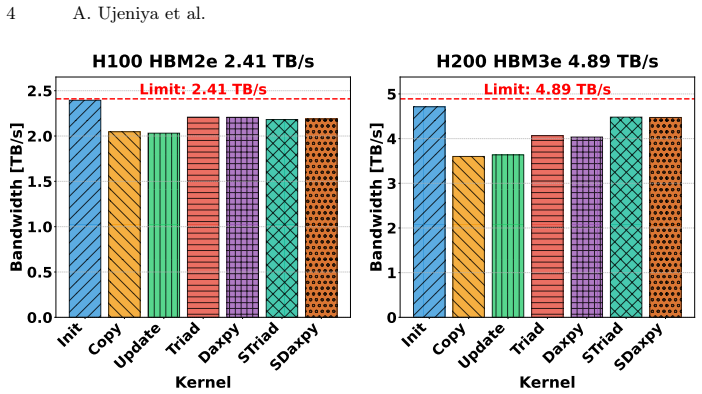
Modern NVIDIA GPUs like the H100 (HBM2e) and H200 (HBM3e) share similar compute characteristics but differ significantly in memory interface technology and bandwidth. By isolating memory bandwidth as a key variable, the power distribution between the memory and Streaming Multiprocessors (SM) changes notably between the two architectures. In the era of energy-efficient computing, analyzing how these hardware characteristics impact performance per watt is critical. This study investigates how the H100 and H200 manage memory power consumption at various power-cap levels. By a regression analysis, we study the memory power limit and uncover outliers consuming more memory power. To evaluate efficiency, we employ compute-bound (DGEMM) and memory-bound (TheBandwidthBenchmark) workloads, representing the two extremes of the Roof\-line model. Our observations indicate that across varying power caps, the H100 remains the slightly better choice for strictly compute-bound workloads, whereas the H200 demonstrates superior efficiency for memory-bound applications.
0
0
cs.PF 2026-04-13

Wave-aware model picks near-optimal GPU kernel settings fast

WaveTune: Wave-aware Bilinear Modeling for Efficient GPU Kernel Auto-tuning

Reduces tuning overhead by 100000x and boosts kernel speed by up to 1.83x on LLM workloads.

Figure from the paper full image
abstract click to expand
The rapid adoption of Large Language Models (LLMs) has made GPU inference efficiency an increasingly critical system concern. The runtime of LLM workloads is largely dominated by tile-based kernels, particularly General Matrix Multiplications (GEMMs). Although these kernels are highly optimized, their performance remains sensitive to a large space of runtime parameters, such as tile sizes and pipeline stages. The interaction between these parameters and hardware resources leads to a non-convex optimization landscape. Existing approaches to parameter configuration -- including search-based auto-tuning, heuristic rules, and learned cost models -- face a fundamental trade-off between performance optimality and runtime efficiency. In this paper, we present WaveTune, a wave-aware framework for runtime kernel auto-tuning. First, we introduce a unified mapping method to handle input diversity and decompose the configuration space to manage high dimensionality. Second, we develop an analytical wave-aware bilinear model that accurately predicts kernel latency. Third, we design a sparse sampling scheme based on wave structures and a lightweight dual-table retrieval mechanism to minimize runtime overhead. As a result, WaveTune enables precise and efficient runtime configuration for GPU kernels. Across three representative kernels and five GPU architectures, WaveTune consistently achieves near-optimal kernel performance, delivering up to 1.83x kernel-level speedup and up to 1.33x end-to-end TTFT reduction, while reducing runtime decision overhead by five orders of magnitude compared to exhaustive search. These results demonstrate that WaveTune effectively eliminates the traditional trade-off between configuration latency and execution optimality, providing a practical and robust solution for high-performance LLM inference.
0
0
cs.PF 2026-04-13

Mosaic clusters KVCache for faster streaming video VLMs

Mosaic: Cross-Modal Clustering for Efficient Video Understanding

Groups formed by visual coherence and semantic relevance reduce cache management overhead in continuous frame streams.

Figure from the paper full image
abstract click to expand
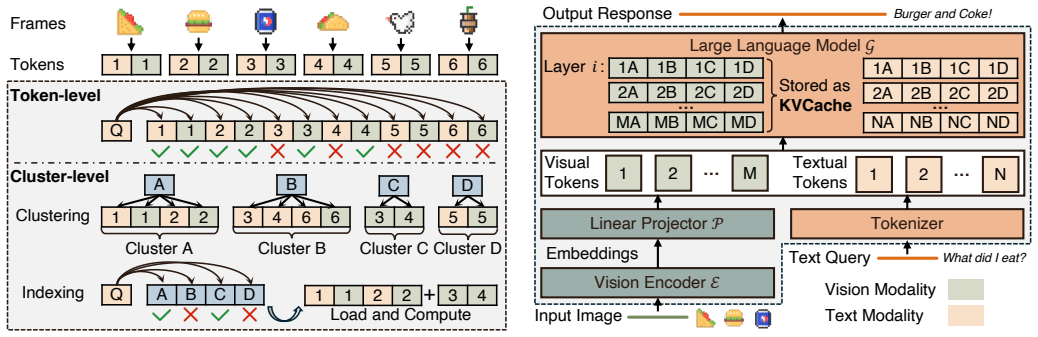
Large vision-language models (VLMs) are enabling interactive video reasoning, giving rise to streaming long-video understanding. In this setting, frames arrive continuously, while the system preserves long-term context and generates responses under strict latency constraints. A central challenge is KVCache management: as video streams grow, KVCache expands rapidly, increasing computation and memory overhead. Existing retrieval-based approaches exploit attention sparsity and offload inactive KVCache from GPU to CPU memory, but their token-level design causes high management overhead and fragmented data movement. We present Mosaic, the first cluster-driven VLM inference system for streaming long-video understanding. Our key insight is that VLM KVCache exhibits an implicit cross-modal clustering structure: retrieved KV states form groups jointly shaped by visual coherence and semantic relevance. Based on this observation, Mosaic uses cross-modal clusters as the basic unit of KVCache organization, maintenance, and retrieval. Evaluations show that Mosaic outperforms state-of-the-art baselines, achieving up to 1.38x speedup.
0
0
cs.PF 2026-04-08 Recognition

PTE metric predicts LLM tool-use latency better than token counts

Beyond Accuracy: Unveiling Inefficiency Patterns in Tool-Integrated Reasoning

It also finds that costlier reasoning paths tend to give wrong answers in benchmark tests and real deployments.

Figure from the paper full image
abstract click to expand
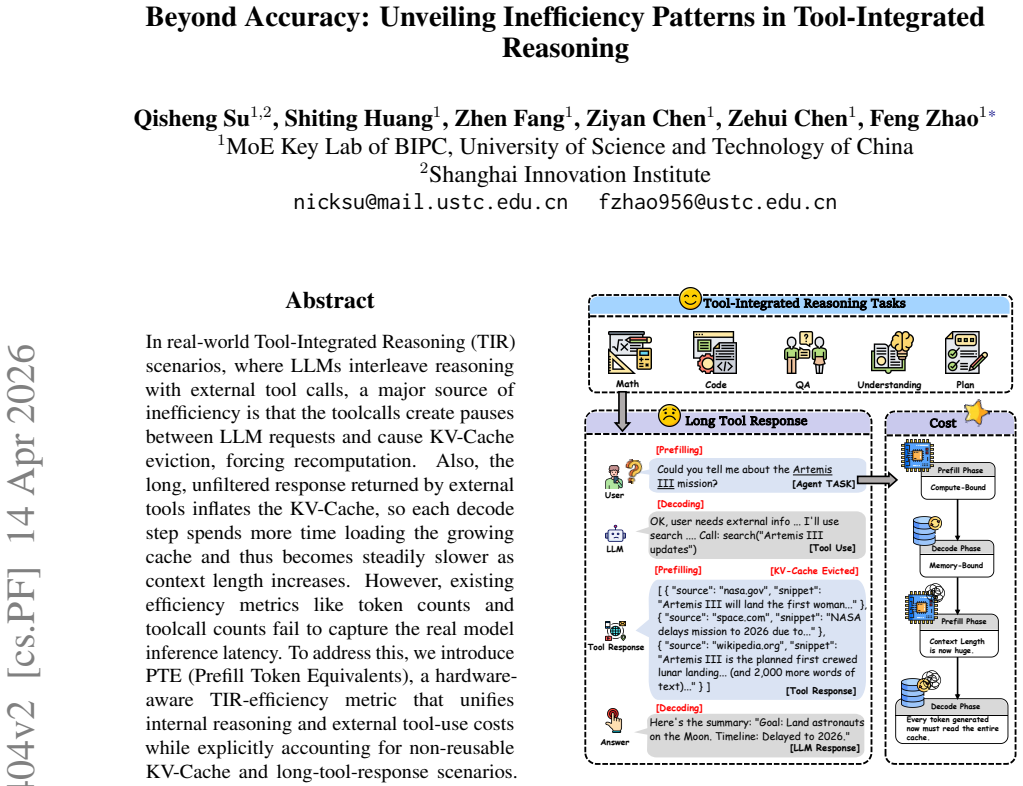
In real-world Tool-Integrated Reasoning (TIR) scenarios, where LLMs interleave reasoning with external tool calls, a major source of inefficiency is that the toolcalls create pauses between LLM requests and cause KV-Cache eviction, forcing recomputation. Also, the long, unfiltered response returned by external tools inflates the KV-Cache, so each decode step spends more time loading the growing cache and thus becomes steadily slower as context length increases. However, existing efficiency metrics like token counts and toolcall counts fail to capture the real model inference latency. To address this, we introduce PTE (Prefill Token Equivalents), a hardware-aware TIR-efficiency metric that unifies internal reasoning and external tool-use costs while explicitly accounting for non-reusable KV-Cache and long-tool-response scenarios. Validation in a high-concurrency industrial setting indicates that PTE aligns significantly better with wall-clock latency than standard token counts, while maintaining consistent efficiency rankings across diverse hardware profiles. We conduct extensive experiments across five TIR benchmarks, quantify their PTE costs, and identify four inefficiency patterns that appear in TIR. We also discover that trajectories with higher PTE costs tend to have lower reasoning correctness, indicating that simply using more tools does not improve the quality of the answer.
2 0
0
cs.PF 2026-04-07 3 theorems

Half the DCT coefficients train a transformer to near baseline loss

Training Transformers in Cosine Coefficient Space

At 50 percent parameters the validation loss gap is only 0.024 on Shakespeare data, outperforming LoRA due to preserved high-rank capacity.

Figure from the paper full image
abstract click to expand
Linear layers hold most of a transformer's parameters. We replace each linear layer with one that stores $K$ out of $mn$ two-dimensional DCT coefficients per weight matrix and reconstructs the full matrix through an inverse DCT at every forward pass; the $K$ coefficients are the trainable parameters. A 4-layer, 128-dim transformer trained from scratch on character-level Shakespeare reaches validation loss $1.604$ at $K = mn/2$, against $1.580$ for a standard dense baseline -- a gap of $+0.024$ at half the trainable parameter count, within the terminal-epoch variation of the dense run. A rank-48 LoRA factorization at the same trainable parameter count reaches only $1.801$ ($+0.221$). The structural advantage of sparse-coefficient over low-rank parameterizations at matched $K$ is qualitative. We identify rank flexibility as the mechanism. A random orthonormal basis matches the DCT within noise at $K = mn/2$, and a compression sweep through $K = mn/10$ and $K = mn/20$ shows that subspaces that can host high-rank matrices keep the loss low, while subspaces that flatten into a low-rank block (zigzag-selection variants) converge onto the observed stable rank \emph{and} the loss line of the rank-48 LoRA reference in lock-step. Among these orthonormal bases, the DCT is preferred because its separable fast transform admits a fused reconstruction kernel: the materialized weight matrix never leaves on-chip memory, so the parameter saving translates into a bandwidth saving as well.
0
0
cs.PF 2026-04-06 2 theorems

Bridges link blockchains but usage lags behind

The Price of Interoperability: Exploring Cross-Chain Bridges and Their Economic Consequences

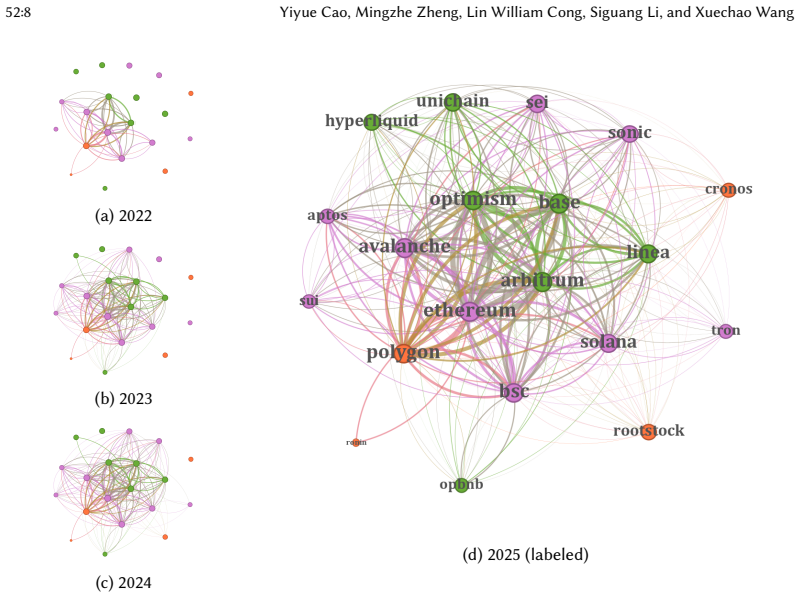
Data from 20 chains shows infrastructure expands faster than actual transfers, so connectivity does not deliver economic integration.

Figure from the paper full image
abstract click to expand
Modern blockchain ecosystems comprise many heterogeneous networks, creating a growing need for interoperability. Cross-chain bridges provide the core infrastructure for this interoperability by enabling verifiable state transitions that move assets and liquidity across chains. While prior work has focused mainly on bridge design and security, the system-level and economic consequences of cross-chain liquidity interoperability remain less understood. We present a large-scale empirical measurement study of cross-chain interoperability using a dataset spanning 20 blockchains and 16 major bridge protocols from 2022 to 2025. We model the multi-chain ecosystem as a time-varying weighted hypergraph and introduce two complementary metrics. Structural interoperability captures connectivity created by deployed bridge infrastructure, reflecting bridge coverage and redundancy independent of user behavior. Active interoperability captures realized cross-chain usage, measured by normalized transfer activity. This decomposition separates infrastructure capacity from actual utilization and yields several findings. The cross-chain network evolves from a sparse hub-and-spoke structure into a denser multi-hub core led by EVM-compatible chains. Bridge expansion and chain growth are uneven: some chains achieve broad structural access but limited realized usage, whereas others concentrate activity through a small set of routes. Overall, interoperability provision and interoperability use diverge substantially, showing that connectivity alone does not imply economically meaningful integration. These results provide a measurement framework for understanding how cross-chain infrastructure reshapes blockchain market structure and liquidity organization.
1 0

browse all of cs.PF β†’ full archive Β· search Β· sub-categories