Recognition: no theorem link
Deceptive Cookies: Consent by Design -- A Mixed Methods Study
Pith reviewed 2026-05-15 03:16 UTC · model grok-4.3
The pith
Cookie consent banners lead users to accept data collection despite their stated preference to reject it.
A machine-rendered reading of the paper's core claim, the machinery that carries it, and where it could break.
Core claim
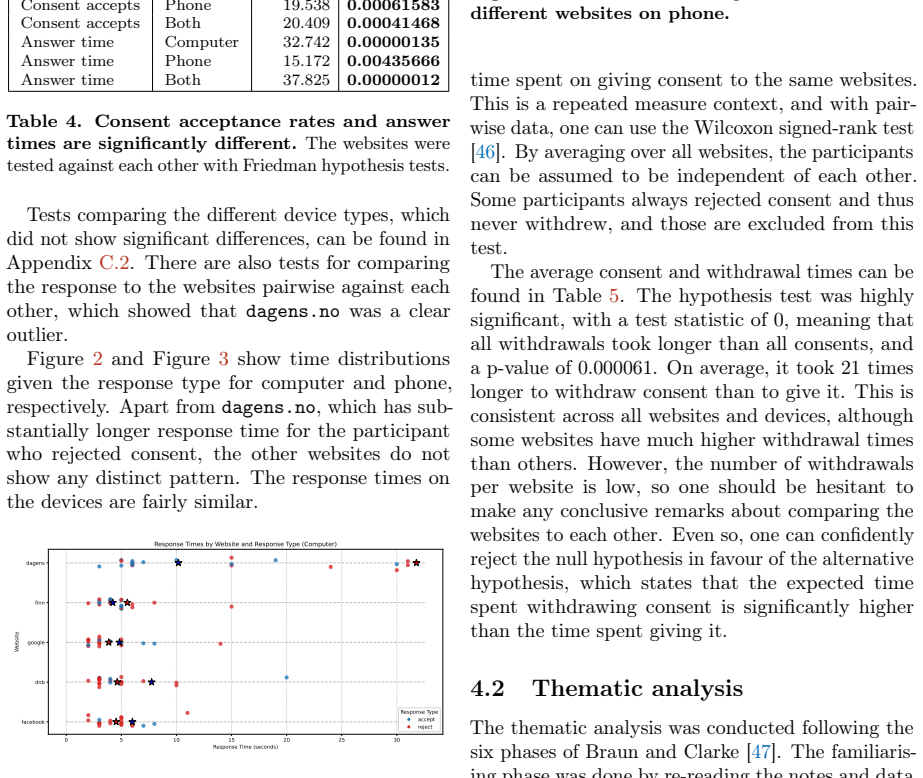
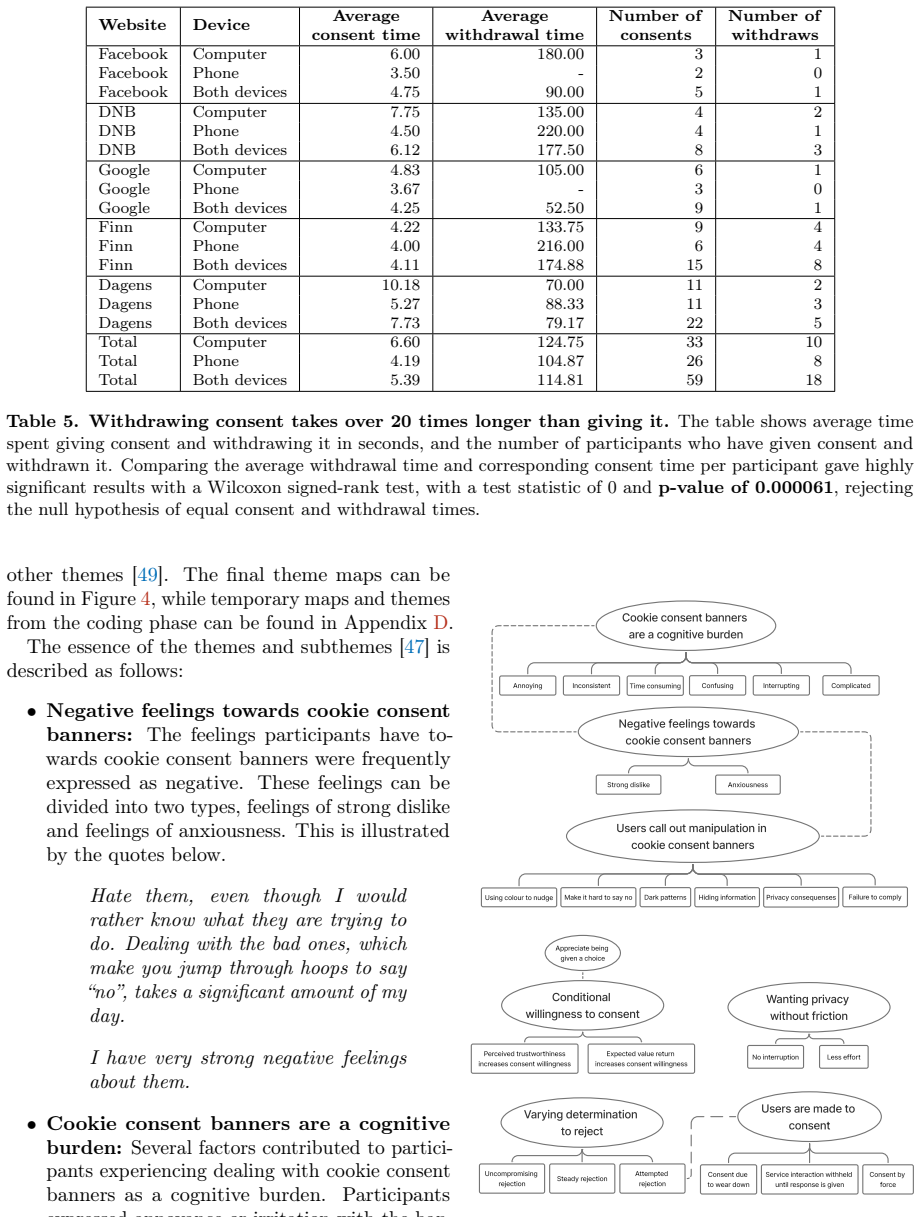
Although participants generally want to reject cookie collection, they often end up accepting because of deceptive patterns in the cookie consent banner design. They were more willing to consent to websites they trusted and if they expected it would improve their user experience. Withdrawing consent took on average more than 20 times longer than giving it, suggesting that cookie consent banners in their current form are not ideal with respect to user autonomy.
What carries the argument
Deceptive patterns in cookie consent banner design that create a gap between stated privacy preferences and actual acceptance actions.
If this is right
- Users consent more readily to sites they already trust.
- Expectations of better user experience increase the likelihood of acceptance.
- Withdrawing consent requires substantially more time and effort than granting it.
- Current banner designs produce consent by default rather than informed choice.
- The findings indicate that banners fail to deliver the equal ease of withdrawal required by EU rules.
Where Pith is reading between the lines
- Standardizing banner layouts to make rejection as prominent as acceptance could narrow the observed preference-action gap.
- Similar design pressures may appear in other digital consent flows such as app permissions or terms acceptance.
- Over time, repeated exposure to these patterns could reduce overall user trust in data-handling practices across the web.
Load-bearing premise
The gap between stated preferences and actions observed in a usability test with twenty participants accurately reflects how people behave when encountering real cookie banners on live websites.
What would settle it
A field study that records actual consent clicks and withdrawal times on popular live websites, then compares those outcomes to the same users' earlier self-reported privacy preferences.
Figures


read the original abstract
While companies increasingly rely on data, especially when it comes to targeted advertising, adapting content to users, selling data and training machine learning models, the collection of data raises privacy concerns. One way of collecting data is by using HTTP cookies when interacting with a website. Legal regulations require service providers to collect consent for some forms of cookie collection, which is often acquired through \emph{cookie consent banners}, but their effectiveness has been debated. This study aims to understand what influences users' experience and behaviour when managing their cookie consent, by investigating the gap between their stated privacy preferences and their actual actions. A mixed methods approach was used, collecting data from a usability test and a survey (N=20). The results showed that although participants generally want to reject cookie collection, they often end up accepting because of deceptive patterns in the cookie consent banner design. It also showed that they were more willing to consent to websites they trusted and if they expected it would improve their user experience. Although the current EU legislation states that withdrawing consent must be as easy as giving it, withdrawing consent took on average more than 20 times longer than giving it. This suggests that cookie consent banners in their current form are not ideal with respect to user autonomy, often leading users to \emph{consent by design}.
Editorial analysis
A structured set of objections, weighed in public.
Referee Report
Summary. The paper reports a mixed-methods study (usability test plus survey) with N=20 participants that examines the gap between users' stated privacy preferences and their observed behavior with cookie consent banners. Key claims are that participants generally prefer to reject non-essential cookies yet often accept them due to deceptive design patterns; willingness to consent increases for trusted sites or when UX benefits are expected; and withdrawing consent takes more than 20 times longer than giving it, indicating that current banners undermine user autonomy despite regulatory requirements.
Significance. If the core observations hold under better-controlled conditions, the work would usefully document a preference-action mismatch and time asymmetry in consent interfaces, adding to the literature on dark patterns and privacy UX. The mixed-methods design, which pairs behavioral timing data with qualitative reports, is a methodological strength that allows both measurement and interpretation of the consent process.
major comments (3)
- [Methods] The central claim that deceptive patterns produce 'consent by design' rests on a single usability study with N=20. The Methods section provides no details on recruitment (convenience vs. targeted), participant demographics, whether banners were live or mocked, task instructions, or any control conditions, leaving the preference-action gap vulnerable to selection bias and low task realism.
- [Results] Results section: the statement that 'withdrawing consent took on average more than 20 times longer' is presented without standard deviations, per-participant data, or any inferential statistics. With such a small sample this ratio cannot be treated as robust evidence that current designs violate the 'as easy as giving it' requirement of EU law.
- [Analysis] The coding of 'deceptive patterns' that supposedly drive acceptance behavior is not described (e.g., codebook, inter-rater reliability, or how patterns were identified in the tested banners). This omission directly weakens the causal attribution in the headline claim.
minor comments (1)
- [Abstract] Abstract: the N=20 figure is not broken down by usability test versus survey component; clarifying this would improve readability.
Simulated Author's Rebuttal
We thank the referee for the constructive and detailed feedback on our manuscript. We have reviewed each major comment carefully and provide point-by-point responses below. We agree that additional methodological transparency and more precise reporting of results will strengthen the paper, and we will revise accordingly while preserving the exploratory mixed-methods contribution.
read point-by-point responses
-
Referee: [Methods] The central claim that deceptive patterns produce 'consent by design' rests on a single usability study with N=20. The Methods section provides no details on recruitment (convenience vs. targeted), participant demographics, whether banners were live or mocked, task instructions, or any control conditions, leaving the preference-action gap vulnerable to selection bias and low task realism.
Authors: We agree that the Methods section requires expansion for transparency and to address potential biases. In the revised manuscript we will add: recruitment occurred via convenience sampling through university mailing lists, social media, and personal networks; full participant demographics (age range 18-45, gender distribution, education levels); clarification that banners were high-fidelity mocks derived from real-world examples of popular sites to maintain ecological validity while allowing controlled observation; verbatim task instructions provided to participants; and an explicit discussion of the absence of control conditions as a limitation of this exploratory study. These additions will directly mitigate concerns about selection bias and task realism. revision: yes
-
Referee: [Results] Results section: the statement that 'withdrawing consent took on average more than 20 times longer' is presented without standard deviations, per-participant data, or any inferential statistics. With such a small sample this ratio cannot be treated as robust evidence that current designs violate the 'as easy as giving it' requirement of EU law.
Authors: We accept that the timing result needs more rigorous presentation. The 'more than 20 times longer' figure is a descriptive average computed from observed task completion times in the usability test. In the revision we will report standard deviations, include a table or appendix with per-participant timing data, and explicitly state that this is an observational finding from a small sample rather than an inferential claim. We will revise the language around EU law to indicate that the results suggest potential difficulties in satisfying the 'as easy as' requirement while acknowledging the limitations of N=20 and the absence of statistical testing. revision: yes
-
Referee: [Analysis] The coding of 'deceptive patterns' that supposedly drive acceptance behavior is not described (e.g., codebook, inter-rater reliability, or how patterns were identified in the tested banners). This omission directly weakens the causal attribution in the headline claim.
Authors: We agree that the process for identifying deceptive patterns should be documented. The patterns were derived from a thematic analysis guided by established dark-pattern taxonomies in the literature. In the revised manuscript we will add a dedicated subsection describing the codebook (covering categories such as hidden reject options, pre-selected accept buttons, and asymmetric choice architecture), how each tested banner was mapped to these categories, and an acknowledgment that coding was performed by the lead researcher without inter-rater reliability checks. This limitation will be noted, and the analysis will be framed as interpretive rather than strictly causal. revision: yes
Circularity Check
No circularity: empirical mixed-methods study rests on primary observations
full rationale
The paper reports results from a usability test and survey (N=20) examining the gap between stated privacy preferences and actual cookie consent actions. No equations, fitted parameters, predictions, or derivation chains appear in the text. Claims of 'consent by design' and the >20x withdrawal-time asymmetry are presented as direct empirical findings from the collected data, without any reduction to self-citations, ansatzes, or renamed known results. The study is self-contained; its load-bearing evidence consists of observed participant behaviors and survey responses rather than any self-referential construction.
Axiom & Free-Parameter Ledger
axioms (2)
- domain assumption Survey responses reliably capture users' true privacy preferences
- domain assumption Usability test tasks and banner implementations are representative of typical website interactions
Reference graph
Works this paper leans on
-
[1]
The age of surveillance capitalism
S. Zuboff. “The age of surveillance capitalism”. In:Social theory re-wired. Routledge, 2023, pp. 203–213
work page 2023
-
[2]
Ethan Cramer-Flood.Worldwide ad spend- ing forecast 2025. Jan. 2025.url:https:// www . emarketer . com / content / worldwide - ad-spending-forecast-2025#page-report (visited on 04/08/2025)
work page 2025
-
[3]
Laion-5b: An open large-scale dataset for training next generation image-text mod- els
C. Schuhmann, R. Beaumont, R. Vencu, C. Gordon, R. Wightman, M. Cherti, T. Coombes, A. Katta, C. Mullis, M. Wortsman, et al. “Laion-5b: An open large-scale dataset for training next generation image-text mod- els”. In:Advances in neural information pro- cessing systems35 (2022), pp. 25278–25294
work page 2022
-
[4]
Gemini: A Family of Highly Capable Multimodal Models
G. Team, R. Anil, S. Borgeaud, J.-B. Alayrac, J. Yu, R. Soricut, J. Schalkwyk, A. M. Dai, A. Hauth, K. Millican, et al. “Gemini: a family of highly capable multimodal models”. In:arXiv preprint arXiv:2312.11805(2023)
work page internal anchor Pith review Pith/arXiv arXiv 2023
-
[5]
A. Grattafiori, A. Dubey, A. Jauhri, A. Pandey, A. Kadian, A. Al-Dahle, A. Let- man, A. Mathur, A. Schelten, A. Vaughan, et al. “The llama 3 herd of models”. In:arXiv preprint arXiv:2407.21783(2024)
work page internal anchor Pith review Pith/arXiv arXiv 2024
-
[6]
U. N. G. Assembly.Universal declaration of human rights. Vol. 3381. Department of State, United States of America, 1949
work page 1949
-
[7]
Samuel Warren, Louis Brandeis.The Right To Privacy. Dec. 1980.url: https : / / web . archive . org / web / 20081023033917 / http : / / www . law . louisville . edu / library / collections / brandeis / node / 225(visited on 05/11/2025)
work page 1980
-
[8]
Parliament.Charter of fundamental rights of the European Union
E. Parliament.Charter of fundamental rights of the European Union. Office for Official Pub- lications of the European Communities, 2000
work page 2000
-
[9]
European Parliament, Council of the Euro- pean Union.General Data Protection Regu- lation (GDPR) - Regulation (EU) 2016/679. May 2016.url: http : / / data . europa . eu / eli / reg / 2016 / 679 / oj (visited on 04/08/2025)
work page 2016
-
[10]
Datatilsynet.Record fine confirmed. Sept. 2023.url: https : / / www . datatilsynet . no / en / news / aktuelle - nyheter - 2023 / record - fine - grindr - confirmed/(visited on 04/11/2025)
work page 2023
-
[11]
The New York Times.The Secretive Com- pany That Might End Privacy as We Know It. Jan. 2020.url: https://www.nytimes. com/2020/01/18/technology/clearview- privacy - facial - recognition . html (vis- ited on 04/11/2025)
work page 2020
-
[12]
The Privacy Commissioner of Canada (OPC) and others.Joint investigation of Clearview AI, Inc.Feb. 2021.url: https://www.priv. gc . ca / en / opc - actions - and - decisions / investigations / investigations - into - businesses/2021/pipeda- 2021- 001/ (vis- ited on 04/11/2025)
work page 2021
-
[13]
The Autoriteit Persoonsgegevens (AP).Dutch DPA imposes a fine on Clearview be- cause of illegal data collection for facial recognition. Sept. 2024.url: https : / / autoriteitpersoonsgegevens . nl / en / current / dutch - dpa - imposes - a - fine - on-clearview-because-of-illegal-data- collection-for-facial-recognition (vis- ited on 04/11/2025)
work page 2024
-
[14]
CMS.GDPR Enforcement Tracker.url: https : / / www . enforcementtracker . com/ (visited on 04/11/2025)
work page 2025
-
[15]
Vedtak i Google Analytics-saken
The Norwegian Data Protection Authority. Vedtak i Google Analytics-saken. July 2023. url: https : / / www . datatilsynet . no / regelverk-og-verktoy/lover-og-regler/ avgjorelser - fra - datatilsynet / 2023 / vedtak- i- google- analytics- saken/ (vis- ited on 04/15/2025)
work page 2023
-
[16]
July 2023.url: https : / / www
The Norwegian Data Protection Author- ity.Nye regler for overføring av personop- plysninger til USA. July 2023.url: https : / / www . datatilsynet . no / aktuelt / aktuelle-nyheter-2023/nye-regler-for- overforing- av- personopplysninger- til- usa/(visited on 04/15/2025)
work page 2023
-
[17]
U.S. Department of Commerce.Data Privacy Framework Program (DPF).url: https:// www.dataprivacyframework.gov/Program- Overview(visited on 04/15/2025)
work page 2025
- [18]
-
[19]
We Value Your Pri- vacy... Now Take Some Cookies: Measuring the GDPR’s Impact on Web Privacy
M. Degeling, C. Utz, C. Lentzsch, H. Hosseini, F. Schaub, and T. Holz. “We Value Your Pri- vacy... Now Take Some Cookies: Measuring the GDPR’s Impact on Web Privacy”. In:Net- work and Distributed Systems Security (NDSS) Symposium. 2019
work page 2019
-
[20]
Cookie banners and privacy policies: Measur- ing the impact of the GDPR on the web
M. Kretschmer, J. Pennekamp, and K. Wehrle. “Cookie banners and privacy policies: Measur- ing the impact of the GDPR on the web”. In: ACM Transactions on the Web (TWEB)15.4 (2021), pp. 1–42
work page 2021
-
[21]
Barth.RFC 6265: HTTP state manage- ment mechanism
A. Barth.RFC 6265: HTTP state manage- ment mechanism. 2011
work page 2011
-
[22]
A survey on web track- ing: Mechanisms, implications, and defenses
T. Bujlow, V. Carela-Español, J. Sole-Pareta, and P. Barlet-Ros. “A survey on web track- ing: Mechanisms, implications, and defenses”. In:Proceedings of the IEEE105.8 (2017), pp. 1476–1510
work page 2017
-
[23]
July 2002.url: https://eur- lex.europa.eu/ eli / dir / 2002 / 58 / oj / eng (visited on 04/15/2025)
European Parliament, Council of the Eu- ropean Union.Directive 2002/58/EC. July 2002.url: https://eur- lex.europa.eu/ eli / dir / 2002 / 58 / oj / eng (visited on 04/15/2025)
work page 2002
-
[24]
European Parliament, Council of the Euro- pean Union.Directive 2009/136/EC. Dec. 2009.url: https://eur- lex.europa.eu/ eli/dir/2002/58/2009- 12- 19 (visited on 04/15/2025)
work page 2009
-
[25]
European Parliament, Council of the Euro- pean Union.Recital 32 Conditions for Con- sent*. Apr. 2016.url: https : / / gdpr - info . eu / recitals / no - 32/ (visited on 05/11/2025)
work page 2016
-
[26]
Digitaliserings- og forvaltningsdeparte- mentet.Lov om elektronisk kommunikasjon (ekomloven). Dec. 2024.url: https : //lovdata.no/dokument/NL/lov/2024-12- 13-76(visited on 05/11/2025)
work page 2024
-
[27]
Datatilsynet.Bruk av informasjon- skapsler og andre sporingsteknolo- gier. Apr. 2025.url: https : / / www . datatilsynet . no / personvern - pa - ulike - omrader / internett - og - apper / bruk - av - informasjonskapsler - og - andre - sporingsteknologier (visited on 05/11/2025)
work page 2025
-
[28]
Deceptive patterns – user interfaces designed to trick you
H.Brignull,M.Leiser,C.Santos,andK.Doshi. Deceptive patterns – user interfaces designed to trick you. Apr. 2023.url: https://www. deceptive.design/(visited on 04/15/2025)
work page 2023
-
[29]
Dark patterns after the GDPR: Scraping consent pop-ups and demonstrating their influence
M. Nouwens, I. Liccardi, M. Veale, D. Karger, and L. Kagal. “Dark patterns after the GDPR: Scraping consent pop-ups and demonstrating their influence”. In:Proceedings of the 2020 CHI conference on human factors in computing systems. 2020, pp. 1–13
work page 2020
-
[30]
C. R. Sunstein. “The ethics of nudging”. In: Yale J. on Reg.32 (2015), p. 413
work page 2015
-
[31]
(Un) informed consent: Studying GDPR consent notices in the field
C. Utz, M. Degeling, S. Fahl, F. Schaub, and T. Holz. “(Un) informed consent: Studying GDPR consent notices in the field”. In:Pro- ceedings of the 2019 ACM SIGSAC confer- ence on computer and communications secu- rity. 2019, pp. 973–990
work page 2019
-
[32]
This website uses cookies: Users’ percep- tions and reactions to the cookie disclaimer
O. Kulyk, A. Hilt, N. Gerber, and M. Volka- mer. “This website uses cookies: Users’ percep- tions and reactions to the cookie disclaimer”. In:European Workshop on Usable Security (EuroUSEC). Vol. 4. 2018
work page 2018
-
[33]
The privacy paradox: Personal infor- mation disclosure intentions versus behaviors
P. A. Norberg, D. R. Horne, and D. A. Horne. “The privacy paradox: Personal infor- mation disclosure intentions versus behaviors”. In:Journal of consumer affairs41.1 (2007), pp. 100–126
work page 2007
-
[34]
S. Kokolakis. “Privacy attitudes and privacy behaviour: A review of current research on the privacy paradox phenomenon”. In:Computers & security64 (2017), pp. 122–134
work page 2017
-
[35]
The myth of the privacy para- dox
D. J. Solove. “The myth of the privacy para- dox”. In:Geo. Wash. L. Rev.89 (2021), p. 1
work page 2021
-
[36]
J. W. Creswell and J. D. Creswell.Research design: Qualitative, quantitative, and mixed methods approaches. Sage publications, 2017
work page 2017
-
[37]
J. W. Creswell.A concise introduction to mixed methods research. SAGE publications, 2021
work page 2021
-
[38]
M. Vaismoradi, H. Turunen, and T. Bondas. “Content analysis and thematic analysis: Im- plications for conducting a qualitative descrip- tive study”. In:Nursing & health sciences15.3 (2013), pp. 398–405
work page 2013
-
[39]
Tranco: A Research-Oriented Top Sites Rank- ing Hardened Against Manipulation
V. Le Pochat, T. Van Goethem, S. Tajal- izadehkhoob, M. Korczyński, and W. Joosen. “Tranco: A Research-Oriented Top Sites Rank- ing Hardened Against Manipulation”. In:Pro- ceedings of the 26th Annual Network and Dis- tributed System Security Symposium. NDSS
-
[40]
Feb. 2019.doi: 10.14722/ndss.2019. 23386
-
[41]
eu / list / KJYLW(visited on 02/05/2025)
Tranco-list ID:KJYLW.url: https : / / tranco - list . eu / list / KJYLW(visited on 02/05/2025)
work page 2025
-
[42]
Nielsen.Quantitative Studies: How Many Users to Test?2006.url: https : / / www
J. Nielsen.Quantitative Studies: How Many Users to Test?2006.url: https : / / www . nngroup . com / articles / quantitative - studies - how - many - users/ (visited on 05/13/2025)
work page 2006
-
[43]
Understand- ing the Hawthorne effect
P. Sedgwick and N. Greenwood. “Understand- ing the Hawthorne effect”. In:Bmj351 (2015). 11
work page 2015
-
[44]
K. A. Ericsson and H. A. Simon. “Verbal re- ports as data.” In:Psychological review87.3 (1980), p. 215
work page 1980
-
[45]
Deception in the pursuit of science
D. Wendler and F. G. Miller. “Deception in the pursuit of science”. In:Archives of Internal Medicine164.6 (2004), pp. 597–600
work page 2004
-
[46]
The use of ranks to avoid the assumption of normality implicit in the anal- ysis of variance
M. Friedman. “The use of ranks to avoid the assumption of normality implicit in the anal- ysis of variance”. In:Journal of the american statistical association32.200 (1937), pp. 675– 701
work page 1937
-
[47]
Individual comparisons by rank- ing methods
F. Wilcoxon. “Individual comparisons by rank- ing methods”. In:Breakthroughs in statistics: Methodology and distribution. Springer, 1992, pp. 196–202
work page 1992
-
[48]
Using thematic anal- ysis in psychology
V. Braun and V. Clarke. “Using thematic anal- ysis in psychology”. In:Qualitative research in psychology3.2 (2006), pp. 77–101
work page 2006
-
[49]
U. Kelle. “Computer-Assisted Analysis of Qualitative Data Paper Prepared for the Dis- cussion Paper Series of the LSE Methodology Institute”. In:University of Bremen: Vechta, Germany(2004)
work page 2004
-
[50]
Qualitative evaluation check- list
M. Q. Patton. “Qualitative evaluation check- list”. In:Evaluation checklists project21 (2003), pp. 1–13
work page 2003
-
[51]
BI.Norsk kundebarometer 2024.url: https : / / www
H. BI.Norsk kundebarometer 2024.url: https : / / www . bi . no / forskning / norsk - kundebarometer / resultater - 2024/ (vis- ited on 04/28/2025)
work page 2024
-
[52]
N. McDonald, S. Schoenebeck, and A. Forte. “Reliability and inter-rater reliability in qual- itative research: Norms and guidelines for CSCW and HCI practice”. In:Proceedings of the ACM on human-computer interaction 3.CSCW (2019), pp. 1–23
work page 2019
-
[53]
The dark (patterns) side of UX design
C. M. Gray, Y. Kou, B. Battles, J. Hoggatt, and A. L. Toombs. “The dark (patterns) side of UX design”. In:Proceedings of the 2018 CHI conference on human factors in computing systems. 2018, pp. 1–14
work page 2018
- [54]
-
[55]
H.Brignull,M.Leiser,C.Santos,andK.Doshi. Obstruction. Apr. 2023.url: https://www. deceptive . design / types / obstruction (visited on 04/15/2025)
work page 2023
-
[56]
H.Brignull,M.Leiser,C.Santos,andK.Doshi. Forced action. Apr. 2023.url:https://www. deceptive . design / types / forced - action (visited on 04/15/2025)
work page 2023
-
[57]
Tales from the dark side: Pri- vacy dark strategies and privacy dark pat- terns
C. Bösch, B. Erb, F. Kargl, H. Kopp, and S. Pfattheicher. “Tales from the dark side: Pri- vacy dark strategies and privacy dark pat- terns”. In:Proceedings on Privacy Enhancing Technologies(2016)
work page 2016
-
[58]
H.Brignull,M.Leiser,C.Santos,andK.Doshi. Preselection. Apr. 2023.url: https://www. deceptive . design / types / preselection (visited on 04/15/2025)
work page 2023
-
[59]
H.Brignull,M.Leiser,C.Santos,andK.Doshi. Trick wording. Apr. 2023.url:https://www. deceptive . design / types / trick - wording (visited on 05/05/2025)
work page 2023
-
[60]
Bootstrap con- fidence intervals
T. J. DiCiccio and B. Efron. “Bootstrap con- fidence intervals”. In:Statistical science11.3 (1996), pp. 189–228. A Website Selection The websites included in the usability test were chosen based on two selection criteria, that they had a presence of diverse deceptive patterns and that they were representative. The first criterion was chosen to answer the ...
work page 1996
-
[61]
Find a chair for sale in Østfold for under 200NOK
-
[62]
Leave this tab standing, and open a new private tab. Facebook 1. Go tofacebook.com
-
[63]
Go to their “help” pages
- [64]
- [65]
- [66]
-
[67]
Find their search bar
-
[68]
Find an article about “Taco”
- [69]
-
[70]
Find a picture of Queen Sonja of Norway
-
[71]
Find out the name of her mother
-
[72]
Find a picture of her mother
-
[73]
Leave this tab standing, and open a new private tab. DNB 1. Go todnb.no
-
[74]
Find their contact pages
-
[75]
Start a conversation with their chatbot
-
[76]
Find out what the age limit for a BSU-account is
-
[77]
How do you feel about cookie consent banners?
Leave this tab standing, and open a new private tab. Table B.1. The tasks given to the participants in the usability tests. The instructions were handed out on paper to the participants. 14 but the facilitator could not see what the partici- pants answered. Once the survey was answered, a conversation with a debriefing session was held. B.2 Pilot testing ...
discussion (0)
Sign in with ORCID, Apple, or X to comment. Anyone can read and Pith papers without signing in.