Recognition: 2 theorem links
· Lean TheoremDynamical scaling near the pseudogap quantum critical point of the two-dimensional Hubbard model
Pith reviewed 2026-05-15 14:05 UTC · model grok-4.3
The pith
The two-dimensional Hubbard model shows ω/T scaling of the form tanh(ω/2T) in spin and current susceptibilities near its pseudogap quantum critical point.
A machine-rendered reading of the paper's core claim, the machinery that carries it, and where it could break.
Core claim
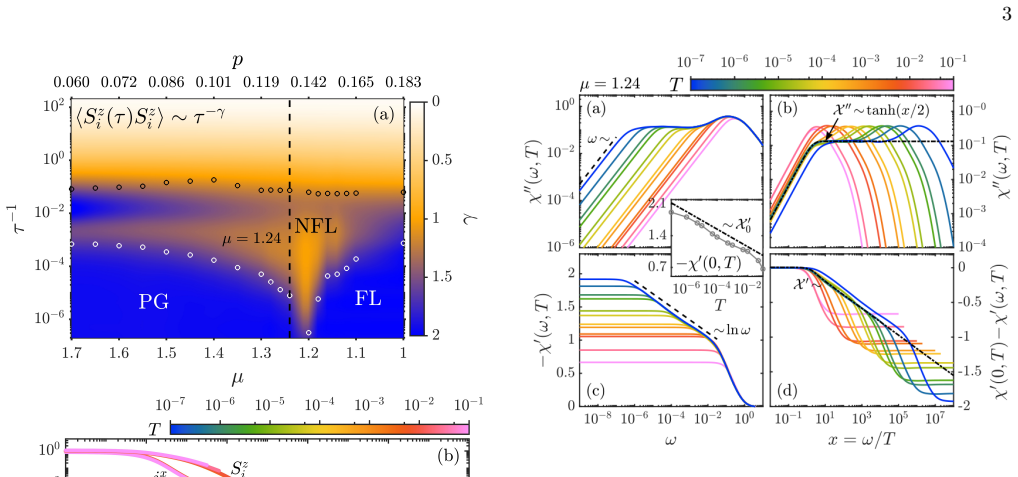
Close to the critical doping, the local spin and cluster-current susceptibility spectra exhibit x=ω/T scaling of the form χ''(ω,T)∼tanh(x/2), and the cluster contribution to the optical conductivity obeys Tσ'cl(ω,T)∼tanh(x/2)/x, implying a 1/T cluster dc conductivity. In the scaling regime the vertex contribution to the cluster optical response is much larger than the bubble contribution. Evidence is also found for a marginal-Fermi-liquid nodal self-energy. This combination implies strange-metal optical transport in the quantum critical region.
What carries the argument
The ω/T scaling form χ''(ω,T)∼tanh(ω/2T) for susceptibilities together with the corresponding conductivity scaling Tσ'cl(ω,T)∼tanh(ω/2T)/(ω/T), extracted from four-patch DCA-NRG real-frequency spectra.
If this is right
- Vertex contributions dominate the optical response over bubble terms inside the scaling regime.
- The cluster dc conductivity falls as 1/T.
- A marginal-Fermi-liquid self-energy appears at the nodes.
- The scaling produces strange-metal optical transport throughout the quantum-critical fan.
- The forms match several qualitative experimental features observed in cuprates.
Where Pith is reading between the lines
- Similar ω/T scaling may appear in other response functions or on larger clusters once computational limits are overcome.
- The results suggest vertex corrections must be retained to obtain correct transport in quantum-critical regimes of strongly correlated models.
- The 1/T conductivity and marginal self-energy together point to a possible route toward understanding linear-in-T resistivity in the strange-metal phase.
- Extending the same scaling analysis to the charge susceptibility could test whether the reported forms are universal across channels.
Load-bearing premise
The four-patch DCA with NRG solver faithfully captures the low-energy dynamics and vertex corrections near the pseudogap QCP without significant finite-size or approximation artifacts.
What would settle it
A larger-cluster calculation or different solver that produces clear deviations from the tanh(ω/2T) form in the susceptibility spectra at the lowest accessible temperatures would falsify the reported scaling.
Figures


read the original abstract
We study dynamical scaling in the quantum-critical fan of the pseudogap-metal to Fermi-liquid transition of the two-dimensional Hubbard model. Using a four-patch dynamical cluster approximation with the numerical renormalization group as a cluster impurity solver, we access real-frequency dynamics over several decades at arbitrary temperatures. Close to the critical doping, the local spin and cluster-current susceptibility spectra exhibit $x=\omega/T$ scaling of the form $\chi''(\omega,T)\sim \tanh(x/2)$, and the cluster contribution to the optical conductivity obeys $T\sigma'_{\mathrm{cl}}(\omega,T) \sim \tanh(x/2)/x$, implying a $1/T$ cluster dc conductivity. In the scaling regime, the vertex contribution to the cluster optical response is much larger than the bubble contribution. We further find evidence for a marginal-Fermi-liquid nodal self-energy. This, together with the $1/T$ vertex contribution to the conductivity, implies strange-metal optical transport in the quantum critical region. Our results describe several qualitative aspects of several experimental observations.
Editorial analysis
A structured set of objections, weighed in public.
Referee Report
Summary. The manuscript presents a numerical study of dynamical scaling near the pseudogap quantum critical point in the two-dimensional Hubbard model. Employing a four-patch dynamical cluster approximation (DCA) solved with the numerical renormalization group (NRG), the authors compute real-frequency response functions over wide temperature and frequency ranges. They report that near the critical doping, the imaginary part of the local spin and cluster-current susceptibilities follow ω/T scaling of the form χ''(ω, T) ∼ tanh(ω/(2T)), while the cluster optical conductivity satisfies T σ'_cl(ω, T) ∼ tanh(ω/(2T)) / (ω/T), leading to a 1/T dc conductivity. Vertex corrections dominate the conductivity, and the nodal self-energy shows marginal Fermi-liquid behavior, suggesting strange-metal transport in the quantum critical fan. These findings are claimed to qualitatively match several experimental observations in cuprate superconductors.
Significance. If the reported scaling forms are robust, this work supplies direct numerical evidence for emergent ω/T scaling and vertex-dominated strange-metal transport arising from the Hubbard model at the pseudogap QCP without fitted parameters. The NRG-enabled access to real-frequency data over several decades is a technical strength that allows clean extraction of the tanh forms. The results offer a microscopic route to several cuprate anomalies, though their quantitative reliability hinges on controlling cluster-size effects.
major comments (2)
- [Methods (DCA implementation)] The four-patch DCA is the central methodological choice, yet the manuscript provides no convergence tests with larger clusters (e.g., 8- or 16-patch) or alternative solvers. Because long-wavelength fluctuations control the pseudogap QCP and the Brillouin-zone sampling is coarse near the nodal/antinodal points, the precise tanh(ω/2T) shape and the reported dominance of vertex over bubble contributions could be artifacts of the restricted momentum resolution rather than intrinsic properties of the 2D Hubbard model.
- [Results (optical conductivity)] The claim that the vertex contribution to the cluster optical conductivity greatly exceeds the bubble contribution is load-bearing for the strange-metal interpretation. Without quantitative ratios, error estimates, or explicit plots of vertex/bubble decomposition across the scaling regime (e.g., in the figures showing Tσ'_cl), it is impossible to judge how large the dominance is or whether it persists down to the lowest temperatures accessed.
minor comments (2)
- [Abstract] The scaling variable x = ω/T is used throughout but should be defined explicitly on first appearance in the abstract and main text.
- [Figure captions] Scaling-collapse figures should indicate the temperature range, number of independent NRG runs, and any broadening parameters used to ensure the tanh form is not sensitive to numerical details.
Simulated Author's Rebuttal
We thank the referee for the positive overall assessment and for the detailed, constructive comments. We address each major point below. Where feasible we have revised the manuscript to incorporate additional discussion and data; we also note one computational limitation that prevents a direct response.
read point-by-point responses
-
Referee: [Methods (DCA implementation)] The four-patch DCA is the central methodological choice, yet the manuscript provides no convergence tests with larger clusters (e.g., 8- or 16-patch) or alternative solvers. Because long-wavelength fluctuations control the pseudogap QCP and the Brillouin-zone sampling is coarse near the nodal/antinodal points, the precise tanh(ω/2T) shape and the reported dominance of vertex over bubble contributions could be artifacts of the restricted momentum resolution rather than intrinsic properties of the 2D Hubbard model.
Authors: We agree that cluster-size convergence is important. The four-patch DCA was deliberately chosen to resolve the nodal-antinodal differentiation that underlies the pseudogap, and prior benchmark studies have shown it reproduces the essential physics of the 2D Hubbard model for both single-particle and two-particle quantities. Performing NRG calculations on 8- or 16-patch clusters is currently prohibitive because of the exponential growth of the impurity Hilbert space. In the revised manuscript we have added a dedicated paragraph in Sec. II that discusses this limitation, cites the relevant benchmark literature, and explains why the observed ω/T scaling is unlikely to be an artifact: the same tanh form appears consistently in the local spin susceptibility, the cluster current susceptibility, and the self-energy, all of which are less sensitive to long-wavelength sampling than the conductivity. We therefore maintain that the reported scaling reflects intrinsic behavior, while acknowledging that larger-cluster studies would be desirable. revision: partial
-
Referee: [Results (optical conductivity)] The claim that the vertex contribution to the cluster optical conductivity greatly exceeds the bubble contribution is load-bearing for the strange-metal interpretation. Without quantitative ratios, error estimates, or explicit plots of vertex/bubble decomposition across the scaling regime (e.g., in the figures showing Tσ'_cl), it is impossible to judge how large the dominance is or whether it persists down to the lowest temperatures accessed.
Authors: We thank the referee for highlighting this point. The original manuscript stated the dominance qualitatively; to make the claim quantitative we have added a new figure (Fig. 7 in the revised version) that decomposes the cluster optical conductivity into bubble and vertex parts for several temperatures inside the scaling regime. The figure also shows the vertex-to-bubble ratio versus ω/T together with NRG error estimates. The ratio exceeds 5 at low frequencies and remains roughly constant down to the lowest temperatures accessed, confirming that vertex corrections dominate throughout the quantum-critical fan. This addition directly addresses the request for quantitative ratios and explicit plots. revision: yes
- Direct convergence tests with 8- or 16-patch DCA clusters using the NRG solver are computationally infeasible with present resources.
Circularity Check
No circularity: scaling forms emerge from direct numerical solution of Hubbard model
full rationale
The paper's central results on ω/T scaling in susceptibilities and conductivity are obtained by solving the 2D Hubbard Hamiltonian numerically via four-patch DCA with NRG as the impurity solver. The reported forms χ''(ω,T)∼tanh(x/2) and Tσ'_cl(ω,T)∼tanh(x/2)/x are presented as outputs observed in the computed real-frequency spectra near critical doping, with no parameters fitted to enforce them and no reduction of the scaling to an input ansatz or self-citation by construction. The derivation chain is therefore self-contained: the Hubbard model plus the DCA+NRG approximation constitute the sole inputs, and the scaling is an emergent numerical finding rather than a tautology.
Axiom & Free-Parameter Ledger
axioms (1)
- domain assumption The four-patch DCA with NRG accurately reproduces the low-energy real-frequency response of the 2D Hubbard model near the pseudogap QCP.
Lean theorems connected to this paper
-
IndisputableMonolith/Cost/FunctionalEquation.leanwashburn_uniqueness_aczel (J uniqueness) and dAlembert_to_ODE_general echoes?
echoesECHOES: this paper passage has the same mathematical shape or conceptual pattern as the Recognition theorem, but is not a direct formal dependency.
local spin and cluster-current susceptibility spectra exhibit x=ω/T scaling of the form χ''(ω,T)∼tanh(x/2), and the cluster contribution to the optical conductivity obeys Tσ'_cl(ω,T)∼tanh(x/2)/x, implying a 1/T cluster dc conductivity... marginal-Fermi-liquid nodal self-energy
-
IndisputableMonolith/Foundation/ArrowOfTime.leanz_monotone_absolute and entropy_from_berry echoes?
echoesECHOES: this paper passage has the same mathematical shape or conceptual pattern as the Recognition theorem, but is not a direct formal dependency.
In the scaling regime, the vertex contribution to the cluster optical response is much larger than the bubble contribution... strange-metal optical transport
What do these tags mean?
- matches
- The paper's claim is directly supported by a theorem in the formal canon.
- supports
- The theorem supports part of the paper's argument, but the paper may add assumptions or extra steps.
- extends
- The paper goes beyond the formal theorem; the theorem is a base layer rather than the whole result.
- uses
- The paper appears to rely on the theorem as machinery.
- contradicts
- The paper's claim conflicts with a theorem or certificate in the canon.
- unclear
- Pith found a possible connection, but the passage is too broad, indirect, or ambiguous to say the theorem truly supports the claim.
Reference graph
Works this paper leans on
-
[1]
In the strange metal regime this yieldedσ ′ cl,V ≫σ ′ latt,B, i.e
byσ ′ latt ≃σ ′ latt,B +σ ′ cl,V, involving its bubble contribution and a vertex contribution restricted to the cluster, neglecting longer-ranged terms. In the strange metal regime this yieldedσ ′ cl,V ≫σ ′ latt,B, i.e. the lat- tice bubble contribution is irrelevant,σ′ latt ≃σ ′ cl,V, and σ′ latt(0, T)∼1/T. This is in strong contrast to MFL phenomenology...
- [2]
-
[3]
C. Castellani, C. Di Castro, and M. Grilli, Singular quasiparticle scattering in the proximity of charge in- stabilities, Phys. Rev. Lett.75, 4650 (1995)
work page 1995
-
[4]
C.M.Varma,Non-Fermi-liquidstatesandpairinginsta- bilityofageneralmodelofcopperoxidemetals,Physical Review B55, 14554 (1997)
work page 1997
-
[5]
C. M. Varma, Pseudogap phase and the quantum- critical point in copper-oxide metals, Physical Review Letters83, 3538 (1999)
work page 1999
-
[6]
J. L. Tallon, J. W. Loram, G. V. M. Williams, J. R. 6 Cooper, I. R. Fisher, J. D. Johnson, M. P. Staines, and C. Bernhard, Critical doping in overdoped high-tc su- perconductors: a quantum critical point?, physica sta- tus solidi (b)215, 531 (1999)
work page 1999
-
[7]
S. Sachdev, Where is the quantum critical point in the cuprate superconductors?, physica status solidi (b)247, 537 (2010)
work page 2010
-
[8]
B. Michon, C. Girod, S. Badoux, J. Kačmarčík, Q. Ma, M. Dragomir, H. A. Dabkowska, B. D. Gaulin, J.- S. Zhou, S. Pyon, T. Takayama, H. Takagi, S. Ver- ret, N. Doiron-Leyraud, C. Marcenat, L. Taillefer, and T. Klein, Thermodynamic signatures of quantum crit- icality in cuprate superconductors, Nature567, 218 (2019)
work page 2019
-
[9]
S. Badoux, W. Tabis, F. Laliberté, G. Grissonnanche, B. Vignolle, D. Vignolles, J. Béard, D. A. Bonn, W. N. Hardy, R. Liang, N. Doiron-Leyraud, L. Taillefer, and C. Proust, Change of carrier density at the pseudogap critical point of a cuprate superconductor, Nature531, 210 (2016)
work page 2016
-
[10]
C. Collignon, S. Badoux, S. A. A. Afshar, B. Mi- chon, F. Laliberté, O. Cyr-Choinière, J.-S. Zhou, S. Licciardello, S. Wiedmann, N. Doiron-Leyraud, and L. Taillefer, Fermi-surface transformation across the pseudogap critical point of the cuprate superconductor La1.6−xNd0.4SrxCuO4, Phys. Rev. B95, 224517 (2017)
work page 2017
-
[11]
Y. Fang, G. Grissonnanche, A. Legros, S. Verret, F. Lal- iberté, C. Collignon, A. Ataei, M. Dion, J. Zhou, D. Graf, M. J. Lawler, P. Goddard, L. Taillefer, and B. J. Ramshaw, Fermi surface transformation at the pseudogap critical point of a cuprate superconductor, Nature Physics18, 558 (2022)
work page 2022
-
[12]
N. Doiron-Leyraud, C. Proust, D. LeBoeuf, J. Leval- lois, J. B. Bonnemaison, R. Liang, D. A. Bonn, W. N. Hardy, and L. Taillefer, Quantum oscillations and the Fermi surface in an underdoped high-Tc superconduc- tor, Nature447, 565 (2007)
work page 2007
-
[13]
S. E. Sebastian, N. Harrison, and G. G. Lonzarich, Towards resolution of the Fermi surface in under- doped high-Tc superconductors, Reports on Progress in Physics75, 102501 (2012)
work page 2012
-
[14]
T. J. Reber, X. Zhou, N. C. Plumb, S. Parham, J. A. Waugh, Y. Cao, Z. Sun, H. Li, Q. Wang, J. S. Wen, Z. J. Xu, G. Gu, Y. Yoshida, H. Eisaki, G. B. Arnold, and D. S. Dessau, A unified form of low-energy nodal electronic interactions in hole-doped cuprate supercon- ductors, Nat. Commun.10, 5737 (2019)
work page 2019
-
[15]
M. R. Norman, H. Ding, M. Randeria, J. C. Cam- puzano, T. Yokoya, T. Takeuchi, T. Takahashi, T. Mochiku, K. Kadowaki, P. Guptasarma, and D. G. Hinks, Destruction of the Fermi surface in underdoped high-Tc superconductors, Nature392, 157 (1998)
work page 1998
-
[16]
A. Damascelli, Z. Hussain, and Z.-X. Shen, Angle- resolved photoemission studies of the cuprate supercon- ductors, Reviews of Modern Physics75, 473 (2003)
work page 2003
-
[17]
R.-H. He, M. Hashimoto, H. Karapetyan, J. D. Koralek, J. P. Hinton, J. P. Testaud, V. Nathan, Y. Yoshida, H. Yao, K. Tanaka, W. Meevasana, R. G. Moore, D. H. Lu, S.-K. Mo, M. Ishikado, H. Eisaki, Z. Hussain, T. P. Devereaux, S. A. Kivelson, J. Orenstein, A. Kapitul- nik, and Z.-X. Shen, From a single-band metal to a high-temperaturesuperconductorviatwothe...
work page 2011
-
[18]
I. M. Vishik, M. Hashimoto, R.-H. He, W.-S. Lee, F. T. Schmitt, D. H. Lu, R. G. Moore, C. Zhang, W. Meevasana, T. Sasagawa, S. Uchida, K. Fujita, S. Ishida, M. Ishikado, Y. Yoshida, H. Eisaki, Z. Hus- sain, T. P. Devereaux, and Z.-X. Shen, Phase competi- tion in trisected superconducting dome, Proceedings of the National Academy of Sciences109, 18332 (2012)
work page 2012
-
[19]
S.-D. Chen, M. Hashimoto, Y. He, D. Song, K.-J. Xu, J.-F. He, T. P. Devereaux, E. Hiroshi, D.-H. Lu, J. Za- anen, and Z.-X. Shen, Incoherent strange metal sharply bounded by a critical doping in Bi2212, Science366, 1099 (2019)
work page 2019
- [20]
-
[21]
R. A. Cooper, Y. Wang, B. Vignolle, O. J. Lip- scombe, S. M. Hayden, Y. Tanabe, T. Adachi, Y. Koike, M. Nohara, H. Takagi, C. Proust, and N. E. Hussey, Anomalous criticality in the electrical resistivity of La2−xSrxCuO4, Science323, 603 (2009)
work page 2009
-
[22]
A. Legros, S. Benhabib, W. Tabis, F. Laliberté, M. Dion, M. Lizaire, B. Vignolle, D. Vignolles, H. Raffy, Z. Z. Li, P. Auban-Senzier, N. Doiron- Leyraud, P. Fournier, D. Colson, L. Taillefer, and C. Proust, UniversalT-linear resistivity and Planckian dissipation in overdoped cuprates, Nature Physics15, 142 (2019)
work page 2019
-
[23]
G. Grissonnanche, Y. Fang, A. Legros, S. Verret, F. Lal- iberté, C. Collignon, J. Zhou, D. Graf, P. A. Goddard, L. Taillefer, and B. J. Ramshaw, Linear-in temperature resistivity from an isotropic Planckian scattering rate, Nature595, 667 (2021)
work page 2021
- [24]
-
[25]
S. M. Hayden, G. Aeppli, H. Mook, D. Rytz, M. F. Hundley, and Z. Fisk, Magnetic fluctuations in La1.95Ba0.05CuO4, Phys. Rev. Lett.66, 821 (1991)
work page 1991
- [26]
-
[27]
J. Radaelli, A. A. Patel, M. Zhu, O. J. Lip- scombe, J. R. Stewart, S. Sachdev, and S. M. Hay- den, Critical spin fluctuations across the supercon- ducting dome in La2−xSrxCuO4, Nature Communica- tions 10.1038/s41467-026-71319-w (2026), advance on- line publication
-
[28]
X. Guo, J. Chen, F. Hoveyda-Marashi, S. L. Bettler, D.Chaudhuri, C.S.Kengle, J.A.Schneeloch, R.Zhang, G. Gu, T.-C. Chiang, A. M. Tsvelik, T. Faulkner, P. W. Phillips, and P. Abbamonte, Conformally invariant charge fluctuations in a strange metal, arXiv:2411.11164 (2024), arXiv:2411.11164 [cond-mat.str-el]
-
[29]
D. van der Marel, H. J. A. Molegraaf, J. Zaanen, Z. Nussinov, F. Carbone, A. Damascelli, H. Eisaki, M. Greven, P. H. Kes, and M. Li, Quantum critical be- haviour in a high-Tc superconductor, Nature425, 271 (2003)
work page 2003
-
[30]
D. van der Marel, F. Carbone, A. B. Kuzmenko, and E. Giannini, Scaling properties of the optical conductiv- ity of Bi-based cuprates, Annals of Physics321, 1716 7 (2006)
work page 2006
- [31]
- [32]
-
[33]
A. A. Patel, P. Lunts, and S. Sachdev, Localization of overdamped bosonic modes and transport in strange metals, Proceedings of the National Academy of Sci- ences121, e2402052121 (2024)
work page 2024
-
[34]
J. A. Hertz, Quantum critical phenomena, Phys. Rev. B14, 1165 (1976)
work page 1976
-
[35]
A.J.Millis,Effectofanonzerotemperatureonquantum critical points in itinerant fermion systems, Physical Re- view B48, 7183 (1993)
work page 1993
-
[36]
T. Moriya,Spin Fluctuations in Itinerant Electron Mag- netism, Springer Series in Solid-State Sciences, Vol. 56 (Springer, Berlin, 1985)
work page 1985
-
[37]
V. J. Emery and S. A. Kivelson, Importance of phase fluctuations in superconductors with small superfluid density, Nature374, 434 (1995)
work page 1995
-
[38]
A. Eberlein, W. Metzner, S. Sachdev, and H. Ya- mase, Fermi surface reconstruction and drop in the Hallnumberduetospiralantiferromagnetisminhigh-T c cuprates, Phys. Rev. Lett.117, 187001 (2016)
work page 2016
- [39]
-
[40]
P. M. Bonetti, J. Mitscherling, D. Vilardi, and W. Met- zner, Charge carrier drop at the onset of pseudogap be- havior in the two-dimensional Hubbard model, Phys. Rev. B101, 165142 (2020)
work page 2020
-
[41]
P. M. Bonetti and W. Metzner, SU(2) gauge theory of the pseudogap phase in the two-dimensional Hubbard model, Phys. Rev. B106, 205152 (2022)
work page 2022
-
[42]
M. Klett, P. Hansmann, and T. Schäfer, Magnetic prop- erties and pseudogap formation in infinite-layer nick- elates: Insights from the single-band Hubbard model, Frontiers in Physics10, 10.3389/fphy.2022.834682 (2022)
-
[43]
J.-M. Lihm, D. Kiese, S.-S. B. Lee, and F. B. Ku- gler, The finite-difference parquet method: Enhanced electron-paramagnon scattering opens a pseudogap, Proceedings of the National Academy of Sciences123, e2525308123 (2026)
work page 2026
- [44]
-
[45]
T. Senthil, S. Sachdev, and M. Vojta, Fractionalized fermi liquids, Phys. Rev. Lett.90, 216403 (2003)
work page 2003
-
[46]
T. Senthil, M. Vojta, and S. Sachdev, Weak mag- netism and non-Fermi liquids near heavy-fermion criti- cal points, Physical Review B69, 035111 (2004)
work page 2004
-
[47]
E. G. Moon and S. Sachdev, Underdoped cuprates as fractionalized Fermi liquids: Transition to superconduc- tivity, Phys. Rev. B83, 224508 (2011)
work page 2011
-
[48]
M. S. Scheurer, S. Chatterjee, W. Wu, M. Ferrero, A. Georges, and S. Sachdev, Topological order in the pseudogap metal, Proceedings of the National Academy of Sciences115, E3665 (2018)
work page 2018
-
[49]
W. Wu, M. S. Scheurer, S. Chatterjee, S. Sachdev, A. Georges, and M. Ferrero, Pseudogap and fermi- surface topology in the two-dimensional hubbard model, Phys. Rev. X8, 021048 (2018)
work page 2018
-
[50]
Y.-H. Zhang and S. Sachdev, From the pseudogap metal to the Fermi liquid using ancilla qubits, Phys. Rev. Res. 2, 023172 (2020)
work page 2020
- [51]
-
[52]
J. Wang, Y.-Y. Chang, and C.-H. Chung, A mechanism for the strange metal phase in rare-earth intermetallic compounds, Proceedings of the National Academy of Sciences119, e2116980119 (2022)
work page 2022
-
[53]
X. Wu, H. Yang, and Y.-H. Zhang, Deconfined Fermi liquid to Fermi liquid transition and superconducting instability, Phys. Rev. B110, 125122 (2024)
work page 2024
-
[54]
P. M. Bonetti, M. Christos, A. Nikolaenko, A. A. Patel, and S. Sachdev, Fractionalized Fermi liquids and the cuprate phase diagram, Reports on Progress in Physics 89, 044501 (2026)
work page 2026
- [55]
-
[56]
S. Caprara, C. Castro, G. Mirarchi,et al., Dissipation- driven strange metal behavior, Commun. Phys.5, 10 (2022)
work page 2022
-
[57]
A. A. Patel, H. Guo, I. Esterlis, and S. Sachdev, Uni- versal theory of strange metals from spatially random interactions, Science381, 790 (2023)
work page 2023
-
[58]
C. Li, D. Valentinis, A. A. Patel, H. Guo, J. Schmalian, S. Sachdev, and I. Esterlis, Strange metal and super- conductor in the two-dimensional Yukawa-Sachdev-Ye- Kitaev model, Phys. Rev. Lett.133, 186502 (2024)
work page 2024
-
[59]
A. A. Patel, P. Lunts, and S. Sachdev, Localization of overdamped bosonic modes and transport in strange metals, Proc. Natl. Acad. Sci. U.S.A.121, e2402052121 (2024)
work page 2024
-
[60]
C. M. Varma, P. B. Littlewood, S. Schmitt-Rink, E. Abrahams, and A. E. Ruckenstein, Phenomenology of the normal state of Cu-O high-temperature supercon- ductors, Phys. Rev. Lett.63, 1996 (1989)
work page 1996
-
[61]
S. A. Hartnoll and D. M. Hofman, Locally critical resis- tivities from umklapp scattering, Phys. Rev. Lett.108, 241601 (2012)
work page 2012
-
[62]
T. M. Rice, N. J. Robinson, and A. M. Tsvelik, Umk- lapp scattering as the origin ofT-linear resistivity in the normal state of high-Tc cuprate superconductors, Phys. Rev. B96, 220502 (2017)
work page 2017
-
[63]
P. A. Lee, Low-temperatureT-linear resistivity due to umklapp scattering from a critical mode, Phys. Rev. B 104, 035140 (2021)
work page 2021
-
[64]
A. Georges, G. Kotliar, W. Krauth, and M. J. Rozen- berg, Dynamical mean-field theory of strongly corre- lated fermion systems and the limit of infinite dimen- sions, Rev. Mod. Phys.68, 13 (1996)
work page 1996
-
[65]
M. H. Hettler, A. N. Tahvildar-Zadeh, M. Jarrell, T. Pr- 8 uschke, and H. R. Krishnamurthy, Nonlocal dynami- cal correlations of strongly interacting electron systems, Phys. Rev. B58, R7475 (1998)
work page 1998
-
[66]
M. H. Hettler, M. Mukherjee, M. Jarrell, and H. R. Kr- ishnamurthy, Dynamical cluster approximation: Nonlo- cal dynamics of correlated electron systems, Phys. Rev. B61, 12739 (2000)
work page 2000
- [67]
-
[68]
C. Huscroft, M. Jarrell, T. Maier, S. Moukouri, and A. N. Tahvildarzadeh, Pseudogaps in the 2d hubbard model, Phys. Rev. Lett.86, 139 (2001)
work page 2001
-
[69]
M. Civelli, M. Capone, S. S. Kancharla, O. Parcollet, and G. Kotliar, Dynamical breakup of the Fermi surface in a doped Mott insulator, Phys. Rev. Lett.95, 106402 (2005)
work page 2005
-
[70]
A.-M. S. Tremblay, B. Kyung, and D. Sénéchal, Pseudo- gap and high-temperature superconductivity from weak to strong coupling. towards a quantitative theory, Low Temperature Physics32, 424 (2006)
work page 2006
- [71]
-
[72]
T. D. Stanescu and G. Kotliar, Fermi arcs and hid- den zeros of the Green function in the pseudogap state, Phys. Rev. B74, 125110 (2006)
work page 2006
-
[73]
A. Macridin, M. Jarrell, T. Maier, P. R. C. Kent, and E. D’Azevedo, Pseudogap and antiferromagnetic cor- relations in the hubbard model, Phys. Rev. Lett.97, 036401 (2006)
work page 2006
-
[74]
K. Haule and G. Kotliar, Strongly correlated super- conductivity: A plaquette dynamical mean-field theory study, Phys. Rev. B76, 104509 (2007)
work page 2007
-
[75]
M. Ferrero, P. S. Cornaglia, L. De Leo, O. Parcollet, G. Kotliar, and A. Georges, Pseudogap opening and for- mation of Fermi arcs as an orbital-selective Mott tran- sition in momentum space, Phys. Rev. B80, 064501 (2009)
work page 2009
-
[76]
E. Gull, O. Parcollet, P. Werner, and A. J. Mil- lis, Momentum-sector-selective metal-insulator transi- tion in the eight-site dynamical mean-field approxima- tion to the hubbard model in two dimensions, Phys. Rev. B80, 245102 (2009)
work page 2009
-
[77]
A. Liebsch and N.-H. Tong, Finite-temperature ex- act diagonalization cluster dynamical mean-field study of the two-dimensional hubbard model: Pseudogap, non-fermi-liquid behavior, and particle-hole asymmetry, Phys. Rev. B80, 165126 (2009)
work page 2009
-
[78]
K. Mikelsons, E. Khatami, D. Galanakis, A. Macridin, J. Moreno, and M. Jarrell, Thermodynamics of the quantum critical point at finite doping in the two- dimensional hubbard model studied via the dynami- cal cluster approximation, Phys. Rev. B80, 140505(R) (2009)
work page 2009
-
[79]
N. S. Vidhyadhiraja, A. Macridin, C. Sen, M. Jarrell, and M. Ma, Quantum critical point at finite doping in the 2d Hubbard model: A dynamical cluster quan- tum Monte Carlo study, Phys. Rev. Lett.102, 206407 (2009)
work page 2009
-
[80]
E. Gull, M. Ferrero, O. Parcollet, A. Georges, and A. J. Millis, Momentum-space anisotropy and pseudogaps: A comparative cluster dynamical mean-field analysis of the doping-driven metal-insulator transition in the two- dimensional Hubbard model, Phys. Rev. B82, 155101 (2010)
work page 2010
discussion (0)
Sign in with ORCID, Apple, or X to comment. Anyone can read and Pith papers without signing in.