Recognition: 2 theorem links
· Lean TheoremKiDS+VIKING-450 cosmology with Bayesian hierarchical model redshift distributions
Pith reviewed 2026-05-15 03:17 UTC · model grok-4.3
The pith
Bayesian hierarchical modeling of photometric redshifts in KiDS+VIKING-450 raises the inferred S8 value and reduces tension with Planck to 1.9 sigma.
A machine-rendered reading of the paper's core claim, the machinery that carries it, and where it could break.
Core claim
Sampling redshift distributions via a template-based Bayesian hierarchical model on subsets of the KiDS+VIKING-450 catalog and marginalizing over the resulting distributions produces S8 = 0.756 ± 0.039 and Omega_m = 0.31 ± 0.10, which lowers the tension with Planck from 2.3 sigma to 1.9 sigma.
What carries the argument
The template-based Bayesian hierarchical model that infers redshift distributions by sampling from principal-component-analysis-selected templates drawn from a large superset of galaxies.
If this is right
- Marginalization over redshift uncertainty produces more conservative and higher S8 values from the same weak-lensing data.
- The inferred matter density Omega_m remains compatible with other low-redshift probes.
- The method supplies a practical route to incorporate photo-z uncertainty into future tomographic analyses without fixing the distributions in advance.
Where Pith is reading between the lines
- The same hierarchical sampling could be tested on other photometric surveys to see whether similar upward shifts in S8 appear.
- Extending the model to allow joint inference of cosmology and redshift distributions on the full catalog might further tighten the constraints.
- If the shift in S8 persists, it would suggest that unaccounted redshift-distribution uncertainty has contributed to the broader S8 discrepancy across weak-lensing datasets.
Load-bearing premise
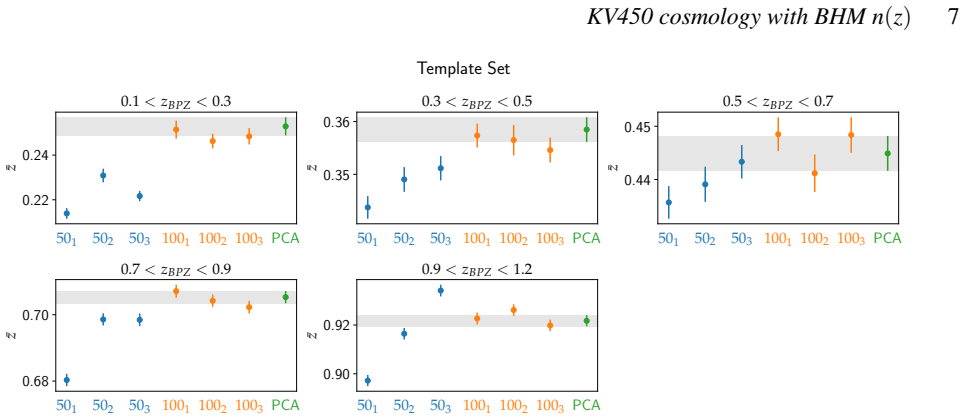
That subsets of 100000 galaxies drawn from the catalog accurately represent the redshift distribution of the full sample without introducing selection bias.
What would settle it
Repeating the full cosmological inference on the complete galaxy catalog instead of subsets and checking whether S8 and the tension metric remain unchanged.
Figures





read the original abstract
Tomographic redshift distributions from photometric data are crucial ingredients in cosmic shear analysis, since they are required for the theoretical calculation of the signal based on the redshift distribution of the galaxies where the shear field is sampled. In this paper, we develop as a proof of concept Leistedt et al.'s template-based Bayesian Hierarchical Model framework into an application to weak lensing data by sampling the redshift distributions of the galaxies in the KiDS+VIKING-450 survey. We also use a principal component analysis to provide a set of representative templates drawn from a large superset. For computational tractability, subsets of $10^5$ galaxies are chosen to determine the redshift distributions, and we test the sensitivity of the cosmological inference to the subset chosen, finding it to be subdominant compared to the statistical error. We marginalise over the inferred redshift distributions and find that the Bayesian method increases the clustering parameter compared with previous studies, alleviating the $S_8$ tension with Planck, where $S_{8}\equiv\sigma_{8}\sqrt{\Omega_{\tm{m}}/0.3}=0.756\pm 0.039$, assuming flat $\Lambda$CDM. The tension with Planck for this survey is reduced from $2.3\sigma$ to $1.9\sigma$. We also infer a value for the matter density, $\Omega_{\tm{m}}=0.31\pm 0.10$.
Editorial analysis
A structured set of objections, weighed in public.
Referee Report
Summary. The paper develops a Bayesian hierarchical model with PCA-derived templates to infer tomographic redshift distributions n(z) for the KiDS+VIKING-450 weak-lensing survey. For computational reasons, n(z) posteriors are obtained from random subsets of 10^5 galaxies; these posteriors are then marginalized over in the cosmological likelihood, yielding S8 = 0.756 ± 0.039 and Ωm = 0.31 ± 0.10 (flat ΛCDM). The resulting S8 value is higher than in previous analyses of the same data, reducing the tension with Planck from 2.3σ to 1.9σ.
Significance. If the subset-based n(z) marginalization is shown to be unbiased, the work supplies a concrete, data-driven route to propagating photo-z uncertainties into cosmic-shear cosmology. The reported upward shift in S8 and the corresponding reduction in tension would be a noteworthy result for the S8 problem, and the hierarchical framework could be adapted to larger surveys.
major comments (3)
- [results / subset-sensitivity test] The claim that subset choice induces only subdominant variation (abstract and results section) is load-bearing for the central S8 result, yet no quantitative test is shown: neither the dispersion in n(z) across multiple independent 10^5-galaxy draws nor a direct comparison to the full-catalog limit is presented. Without this, it is impossible to verify that the reported 0.039 uncertainty on S8 fully captures the sampling uncertainty.
- [cosmological inference section] No explicit expression for the marginalised likelihood is given. It is therefore unclear how the n(z) posterior samples are combined with the cosmic-shear data vector (e.g., whether the marginalisation is performed by Monte-Carlo integration over the PCA coefficients or by an analytic approximation).
- [redshift-distribution validation] The paper provides no comparison of the Bayesian n(z) posteriors against an independent spectroscopic calibration sample or against the official KiDS photo-z catalogue. Such a cross-check is necessary to demonstrate that the hierarchical model does not introduce systematic shifts in the high-z tail that could mimic the reported S8 increase.
minor comments (2)
- [abstract] In the abstract, the LaTeX macro “tm” for “matter” should be replaced by the standard “mathrm” to avoid rendering issues.
- [methods] The number of PCA components retained and the precise subset-selection criteria (random, color-balanced, etc.) should be stated explicitly in the methods section rather than left as free parameters without tabulated values.
Simulated Author's Rebuttal
We thank the referee for their constructive and detailed report. We address each major comment below and have revised the manuscript to strengthen the presentation of our results where possible.
read point-by-point responses
-
Referee: [results / subset-sensitivity test] The claim that subset choice induces only subdominant variation (abstract and results section) is load-bearing for the central S8 result, yet no quantitative test is shown: neither the dispersion in n(z) across multiple independent 10^5-galaxy draws nor a direct comparison to the full-catalog limit is presented. Without this, it is impossible to verify that the reported 0.039 uncertainty on S8 fully captures the sampling uncertainty.
Authors: We agree that a quantitative demonstration is necessary to support the claim. Although internal checks were performed during the analysis, they were not presented with sufficient detail. In the revised manuscript we have added a new figure and accompanying text in the results section that shows the n(z) posteriors from five independent 10^5-galaxy subsets together with the resulting S8 values; the dispersion in S8 across these realisations is 0.008, confirming it is subdominant to the reported 0.039 statistical uncertainty. We have also clarified that the full-catalog limit was not computationally feasible but that the subset-to-subset scatter provides a conservative estimate of the sampling uncertainty. revision: yes
-
Referee: [cosmological inference section] No explicit expression for the marginalised likelihood is given. It is therefore unclear how the n(z) posterior samples are combined with the cosmic-shear data vector (e.g., whether the marginalisation is performed by Monte-Carlo integration over the PCA coefficients or by an analytic approximation).
Authors: We thank the referee for highlighting this omission. In the revised manuscript we have inserted an explicit expression for the marginalised likelihood (new Equation 12 in Section 4) that shows the cosmic-shear likelihood averaged over posterior samples of the PCA coefficients. The marginalisation is performed by Monte-Carlo integration: we draw 1000 samples from the joint posterior on the PCA amplitudes obtained from the hierarchical model and evaluate the shear likelihood for each draw before averaging. revision: yes
-
Referee: [redshift-distribution validation] The paper provides no comparison of the Bayesian n(z) posteriors against an independent spectroscopic calibration sample or against the official KiDS photo-z catalogue. Such a cross-check is necessary to demonstrate that the hierarchical model does not introduce systematic shifts in the high-z tail that could mimic the reported S8 increase.
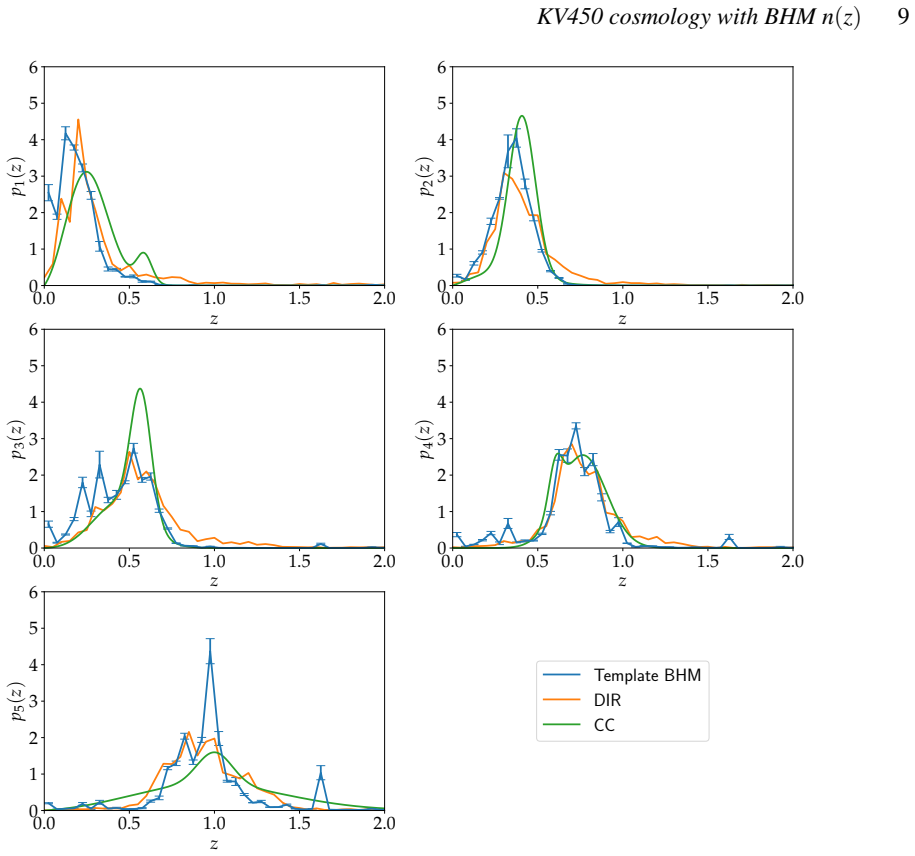
Authors: We acknowledge the importance of external validation. As the present work is framed as a proof-of-concept demonstration of the hierarchical framework, we did not perform such comparisons in the original submission. In the revised manuscript we have added a direct comparison of our Bayesian n(z) posteriors to the official KiDS photo-z catalogue (new Figure 8 and text in Section 3.3), showing consistency within uncertainties and no significant shift in the high-redshift tail. A comparison against an independent spectroscopic calibration sample is not feasible with the data products used in this study; we have added a brief discussion of this limitation and note that such a test will be pursued in future work with overlapping spectroscopic surveys. revision: partial
Circularity Check
Derivation chain is self-contained; no circular reductions identified
full rationale
The paper extends Leistedt et al.'s Bayesian hierarchical model to infer n(z) posteriors from 10^5-galaxy subsets of the KiDS+VIKING-450 photometric catalog, then marginalizes over those posteriors inside the cosmological likelihood to obtain S8 = 0.756 ± 0.039. This is a standard data-driven posterior, not a quantity defined in terms of itself or obtained by fitting a parameter and then relabeling the fit as a prediction. No load-bearing step reduces by the paper's own equations to a self-citation, an ansatz smuggled via citation, or a uniqueness theorem imported from the same authors. The subset-sensitivity test is presented as an empirical check whose variation is stated to be subdominant; it does not create a definitional loop. The result remains externally falsifiable against Planck and independent surveys.
Axiom & Free-Parameter Ledger
free parameters (2)
- number of PCA components
- subset size (10^5 galaxies)
axioms (2)
- domain assumption flat ΛCDM cosmology
- domain assumption photometric redshifts can be modeled as draws from a template library with hierarchical priors
Lean theorems connected to this paper
-
IndisputableMonolith/Foundation/RealityFromDistinction.leanreality_from_one_distinction unclear?
unclearRelation between the paper passage and the cited Recognition theorem.
We marginalise over the inferred redshift distributions and find that the Bayesian method increases the clustering parameter... S8 ≡ σ8 √(Ωm / 0.3) = 0.756 ± 0.039
-
IndisputableMonolith/Cost/FunctionalEquation.leanwashburn_uniqueness_aczel unclear?
unclearRelation between the paper passage and the cited Recognition theorem.
For computational tractability, subsets of 10^5 galaxies are chosen to determine the redshift distributions
What do these tags mean?
- matches
- The paper's claim is directly supported by a theorem in the formal canon.
- supports
- The theorem supports part of the paper's argument, but the paper may add assumptions or extra steps.
- extends
- The paper goes beyond the formal theorem; the theorem is a base layer rather than the whole result.
- uses
- The paper appears to rely on the theorem as machinery.
- contradicts
- The paper's claim conflicts with a theorem or certificate in the canon.
- unclear
- Pith found a possible connection, but the passage is too broad, indirect, or ambiguous to say the theorem truly supports the claim.
Reference graph
Works this paper leans on
-
[1]
KiDS-Legacy: Cosmological constraints from cosmic shear with the complete Kilo-Degree Survey. arXiv e-prints , keywords =. doi:10.48550/arXiv.2503.19441 , archivePrefix =. 2503.19441 , primaryClass =
-
[2]
pop-cosmos: Star formation over 12 Gyr from generative modelling of a deep infrared-selected galaxy catalogue. arXiv e-prints , keywords =. doi:10.48550/arXiv.2509.20430 , archivePrefix =. 2509.20430 , primaryClass =
work page internal anchor Pith review Pith/arXiv arXiv doi:10.48550/arxiv.2509.20430
-
[3]
Euclid and KiDS-1000: Quantifying the impact of source-lens clustering on cosmic shear analyses. , keywords =. doi:10.1051/0004-6361/202451494 , archivePrefix =. 2407.09810 , primaryClass =
-
[4]
pop-cosmos: Insights from generative modeling of a deep, infrared-selected galaxy population. arXiv e-prints , keywords =. doi:10.48550/arXiv.2506.12122 , archivePrefix =. 2506.12122 , primaryClass =
-
[5]
pop-cosmos: Scaleable Inference of Galaxy Properties and Redshifts with a Data-driven Population Model. , keywords =. doi:10.3847/1538-4357/ad7736 , archivePrefix =. 2406.19437 , primaryClass =
-
[6]
pop-cosmos: A Comprehensive Picture of the Galaxy Population from COSMOS Data. , keywords =. doi:10.3847/1538-4365/ad5c69 , archivePrefix =. 2402.00935 , primaryClass =
-
[7]
Weak lensing tomographic redshift distribution inference for the Hyper Suprime-Cam Subaru Strategic Program three-year shape catalogue. , keywords =. doi:10.1093/mnras/stad1962 , archivePrefix =. 2211.16516 , primaryClass =
-
[8]
pop-cosmos: A comprehensive picture of the galaxy population from COSMOS data. arXiv e-prints , keywords =. doi:10.48550/arXiv.2402.00935 , archivePrefix =. 2402.00935 , primaryClass =
-
[9]
Improved Weak Lensing Photometric Redshift Calibration via StratLearn and Hierarchical Modeling. arXiv e-prints , keywords =. doi:10.48550/arXiv.2401.04687 , archivePrefix =. 2401.04687 , primaryClass =
-
[10]
Dark Energy Survey Year 3 results: Cosmological constraints from galaxy clustering and weak lensing. , keywords =. doi:10.1103/PhysRevD.105.023520 , archivePrefix =. 2105.13549 , primaryClass =
-
[11]
Kullback, S. and Leibler, R. A. On Information and Sufficiency. The Annals of Mathematical Statistics. 1951. doi:10.1214/aoms/1177729694
-
[12]
Dark Energy Survey Year 3 results: redshift calibration of the weak lensing source galaxies. , keywords =. doi:10.1093/mnras/stab1515 , archivePrefix =. 2012.08566 , primaryClass =
-
[13]
Constraints on intrinsic alignment contamination of weak lensing surveys using the MegaZ-LRG sample
Constraints on intrinsic alignment contamination of weak lensing surveys using the MegaZ-LRG sample. , keywords =. doi:10.1051/0004-6361/201015621 , archivePrefix =. 1008.3491 , primaryClass =
work page internal anchor Pith review Pith/arXiv arXiv doi:10.1051/0004-6361/201015621
-
[14]
Dark energy constraints from cosmic shear power spectra: impact of intrinsic alignments on photometric redshift requirements. New Journal of Physics , keywords =. doi:10.1088/1367-2630/9/12/444 , archivePrefix =. 0705.0166 , primaryClass =
work page internal anchor Pith review Pith/arXiv arXiv doi:10.1088/1367-2630/9/12/444
-
[15]
Modelling of the weak lensing angular power spectrum
Euclid preparation: XXVIII. Modelling of the weak lensing angular power spectrum. arXiv e-prints , keywords =. doi:10.48550/arXiv.2302.04507 , archivePrefix =. 2302.04507 , primaryClass =
-
[16]
KiDS-1000 Cosmology: Constraints beyond flat CDM. , keywords =. doi:10.1051/0004-6361/202039805 , archivePrefix =. 2010.16416 , primaryClass =
-
[17]
Hierarchical Bayesian Inference of Photometric Redshifts with Stellar Population Synthesis Models. , keywords =. doi:10.3847/1538-4365/ac9d99 , archivePrefix =. 2207.07673 , primaryClass =
-
[18]
An accurate halo model for fitting non-linear cosmological power spectra and baryonic feedback models. , keywords =. doi:10.1093/mnras/stv2036 , archivePrefix =. 1505.07833 , primaryClass =
work page internal anchor Pith review Pith/arXiv arXiv doi:10.1093/mnras/stv2036
-
[19]
KiDS-1000 catalogue: Redshift distributions and their calibration. , keywords =. doi:10.1051/0004-6361/202039018 , archivePrefix =. 2007.15635 , primaryClass =
-
[20]
KiDS-1000 methodology: Modelling and inference for joint weak gravitational lensing and spectroscopic galaxy clustering analysis. , keywords =. doi:10.1051/0004-6361/202038831 , archivePrefix =. 2007.01844 , primaryClass =
-
[21]
KiDS-1000 Cosmology: Multi-probe weak gravitational lensing and spectroscopic galaxy clustering constraints. , keywords =. doi:10.1051/0004-6361/202039063 , archivePrefix =. 2007.15632 , primaryClass =
-
[22]
KiDS-1000 cosmology: Cosmic shear constraints and comparison between two point statistics. , keywords =. doi:10.1051/0004-6361/202039070 , archivePrefix =. 2007.15633 , primaryClass =
-
[23]
KiDS-1000 catalogue: Weak gravitational lensing shear measurements. , keywords =. doi:10.1051/0004-6361/202038850 , archivePrefix =. 2007.01845 , primaryClass =
-
[24]
Accurate emulator for the redshift-space power spectrum of dark matter halos and its application to galaxy power spectrum. , keywords =. doi:10.1103/PhysRevD.102.063504 , archivePrefix =. 2005.06122 , primaryClass =
-
[25]
Planck 2018 results. VI. Cosmological parameters. , keywords =. doi:10.1051/0004-6361/201833910 , archivePrefix =. 1807.06209 , primaryClass =
work page internal anchor Pith review Pith/arXiv arXiv doi:10.1051/0004-6361/201833910 2018
-
[26]
Analytical marginalization over photometric redshift uncertainties in cosmic shear analyses. , keywords =. doi:10.1093/mnras/stad1192 , archivePrefix =. 2301.11978 , primaryClass =
-
[27]
Self-calibration and robust propagation of photometric redshift distribution uncertainties in weak gravitational lensing. , keywords =. doi:10.1051/0004-6361/202040130 , archivePrefix =. 2012.07707 , primaryClass =
-
[28]
KiDS+VIKING-450 and DES-Y1 combined: Cosmology with cosmic shear. , keywords =. doi:10.1051/0004-6361/201936154 , archivePrefix =. 1906.09262 , primaryClass =
-
[29]
Beyond Limber: efficient computation of angular power spectra for galaxy clustering and weak lensing. , keywords =. doi:10.1088/1475-7516/2020/05/010 , archivePrefix =. 1911.11947 , primaryClass =
-
[30]
Post-Limber weak lensing bispectrum, reduced shear correction, and magnification bias correction. , keywords =. doi:10.1103/PhysRevD.101.103531 , archivePrefix =. 2004.01666 , primaryClass =
-
[31]
Euclid-era cosmology for everyone: neural net assisted MCMC sampling for the joint 3 2 likelihood. , keywords =. doi:10.1093/mnras/stz3059 , archivePrefix =. 1907.05881 , primaryClass =
-
[32]
KiDS+VIKING-450: Cosmic shear tomography with optical and infrared data. , keywords =. doi:10.1051/0004-6361/201834878 , archivePrefix =. 1812.06076 , primaryClass =
-
[33]
Primordial power spectrum and cosmology from black-box galaxy surveys. , keywords =. doi:10.1093/mnras/stz2718 , archivePrefix =. 1902.10149 , primaryClass =
-
[34]
KiDS + GAMA: constraints on horndeski gravity from combined large-scale structure probes. , keywords =. doi:10.1093/mnras/stz2581 , archivePrefix =. 1901.03686 , primaryClass =
-
[35]
KiDS+VIKING-450: A new combined optical and near-infrared dataset for cosmology and astrophysics. , keywords =. doi:10.1051/0004-6361/201834879 , archivePrefix =. 1812.06077 , primaryClass =
-
[36]
Importance Nested Sampling and the MultiNest Algorithm. The Open Journal of Astrophysics , keywords =. doi:10.21105/astro.1306.2144 , archivePrefix =. 1306.2144 , primaryClass =
-
[37]
Galaxy structure with strong gravitational lensing: decomposing the internal mass distribution of massive elliptical galaxies. , keywords =. doi:10.1093/mnras/stz2220 , archivePrefix =. 1901.07801 , primaryClass =
-
[38]
Hierarchical Modeling and Statistical Calibration for Photometric Redshifts. , keywords =. doi:10.3847/1538-4357/ab2d29 , archivePrefix =. 1807.01391 , primaryClass =
-
[39]
Euclid preparation. IV. Impact of undetected galaxies on weak-lensing shear measurements. , keywords =. doi:10.1051/0004-6361/201935187 , archivePrefix =. 1902.00044 , primaryClass =
work page internal anchor Pith review Pith/arXiv arXiv doi:10.1051/0004-6361/201935187 1902
-
[40]
Influence of the local Universe on weak gravitational lensing surveys. , keywords =. doi:10.1093/mnras/stz944 , archivePrefix =. 1812.06922 , primaryClass =
-
[41]
Detecting Baryon Acoustic Oscillations in Dark Matter from Kinematic Weak Lensing Surveys
Detecting baryon acoustic oscillations in dark matter from kinematic weak lensing surveys. , keywords =. doi:10.1093/mnras/stz1257 , archivePrefix =. 1901.06326 , primaryClass =
work page internal anchor Pith review Pith/arXiv arXiv doi:10.1093/mnras/stz1257 1901
-
[42]
Steve: A hierarchical Bayesian model for Supernova Cosmology
Steve: A Hierarchical Bayesian Model for Supernova Cosmology. , keywords =. doi:10.3847/1538-4357/ab13a3 , archivePrefix =. 1811.02381 , primaryClass =
work page internal anchor Pith review Pith/arXiv arXiv doi:10.3847/1538-4357/ab13a3
-
[43]
Physical Bayesian modelling of the non-linear matter distribution: New insights into the nearby universe. , keywords =. doi:10.1051/0004-6361/201833710 , archivePrefix =. 1806.11117 , primaryClass =
work page internal anchor Pith review Pith/arXiv arXiv doi:10.1051/0004-6361/201833710
-
[44]
Cosmology from cosmic shear power spectra with Subaru Hyper Suprime-Cam first-year data
Cosmology from cosmic shear power spectra with Subaru Hyper Suprime-Cam first-year data. , keywords =. doi:10.1093/pasj/psz010 , archivePrefix =. 1809.09148 , primaryClass =
work page internal anchor Pith review Pith/arXiv arXiv doi:10.1093/pasj/psz010
-
[45]
Towards emulating cosmic shear data: revisiting the calibration of the shear measurements for the Kilo-Degree Survey. , keywords =. doi:10.1051/0004-6361/201834819 , archivePrefix =. 1812.03983 , primaryClass =
work page internal anchor Pith review Pith/arXiv arXiv doi:10.1051/0004-6361/201834819
-
[46]
Physics of the Dark Universe , keywords =
MontePython 3: Boosted MCMC sampler and other features. Physics of the Dark Universe , keywords =. doi:10.1016/j.dark.2018.100260 , archivePrefix =. 1804.07261 , primaryClass =
-
[47]
Near-Infrared Survey and Photometric Redshifts in the Extended GOODS-North field
Near-infrared Survey and Photometric Redshifts in the Extended GOODS-North Field. , keywords =. doi:10.3847/1538-4357/aaf9a7 , archivePrefix =. 1901.00013 , primaryClass =
work page internal anchor Pith review Pith/arXiv arXiv doi:10.3847/1538-4357/aaf9a7 1901
-
[48]
An emulator for the Lyman- forest. , keywords =. doi:10.1088/1475-7516/2019/02/050 , archivePrefix =. 1812.04654 , primaryClass =
-
[49]
Multifrequency filter search for high redshift sources and lensing systems in Herschel-ATLAS
Multifrequency filter search for high redshift sources and lensing systems in Herschel-ATLAS. , keywords =. doi:10.1051/0004-6361/201834549 , archivePrefix =. 1812.06657 , primaryClass =
work page internal anchor Pith review Pith/arXiv arXiv doi:10.1051/0004-6361/201834549
-
[50]
Bayesian emulator optimisation for cosmology: application to the Lyman-alpha forest
Bayesian emulator optimisation for cosmology: application to the Lyman-alpha forest. , keywords =. doi:10.1088/1475-7516/2019/02/031 , archivePrefix =. 1812.04631 , primaryClass =
work page internal anchor Pith review Pith/arXiv arXiv doi:10.1088/1475-7516/2019/02/031 2019
-
[51]
Redshift inference from the combination of galaxy colours and clustering in a hierarchical Bayesian model. , keywords =. doi:10.1093/mnras/sty3222 , archivePrefix =. 1807.11873 , primaryClass =
work page internal anchor Pith review Pith/arXiv arXiv doi:10.1093/mnras/sty3222
-
[52]
Deep Learning on Small Datasets without Pre-Training using Cosine Loss. arXiv e-prints , keywords =
-
[53]
Cosmological inference from Bayesian forward modelling of deep galaxy redshift surveys
Cosmological inference from Bayesian forward modelling of deep galaxy redshift surveys. , keywords =. doi:10.1051/0004-6361/201834117 , archivePrefix =. 1808.07496 , primaryClass =
work page internal anchor Pith review Pith/arXiv arXiv doi:10.1051/0004-6361/201834117
-
[54]
Weak lensing distortions beyond shear
Weak lensing distortions beyond shear. , keywords =. doi:10.1103/PhysRevD.99.023526 , archivePrefix =. 1809.03924 , primaryClass =
work page internal anchor Pith review Pith/arXiv arXiv doi:10.1103/physrevd.99.023526
-
[55]
Cosmic convergence and shear with extended sources
Cosmic convergence and shear with extended sources. , keywords =. doi:10.1103/PhysRevD.99.023525 , archivePrefix =. 1809.03919 , primaryClass =
work page internal anchor Pith review Pith/arXiv arXiv doi:10.1103/physrevd.99.023525
-
[56]
Bayesian approach to SETI. Proceedings of the National Academy of Science , keywords =. doi:10.1073/pnas.1808578115 , archivePrefix =. 1810.01207 , primaryClass =
work page internal anchor Pith review Pith/arXiv arXiv doi:10.1073/pnas.1808578115
-
[57]
Bayesian optimisation for likelihood-free cosmological inference
Bayesian optimization for likelihood-free cosmological inference. , keywords =. doi:10.1103/PhysRevD.98.063511 , archivePrefix =. 1805.07152 , primaryClass =
work page internal anchor Pith review Pith/arXiv arXiv doi:10.1103/physrevd.98.063511
-
[58]
Weak lensing for precision cosmology
Weak Lensing for Precision Cosmology. , keywords =. doi:10.1146/annurev-astro-081817-051928 , archivePrefix =. 1710.03235 , primaryClass =
work page internal anchor Pith review Pith/arXiv arXiv doi:10.1146/annurev-astro-081817-051928
-
[59]
Photometric redshifts for the Kilo-Degree Survey. Machine-learning analysis with artificial neural networks. , keywords =. doi:10.1051/0004-6361/201731942 , archivePrefix =. 1709.04205 , primaryClass =
work page internal anchor Pith review Pith/arXiv arXiv doi:10.1051/0004-6361/201731942
-
[60]
Forward Modeling of Galaxy Populations for Cosmological Redshift Distribution Inference. , keywords =. doi:10.3847/1538-4365/ac9583 , archivePrefix =. 2207.05819 , primaryClass =
-
[61]
Dark Energy Survey Year 1 Results: Cosmological Constraints from Cosmic Shear
Dark Energy Survey Year 1 results: Cosmological constraints from cosmic shear. , keywords =. doi:10.1103/PhysRevD.98.043528 , archivePrefix =. 1708.01538 , primaryClass =
work page internal anchor Pith review Pith/arXiv arXiv doi:10.1103/physrevd.98.043528
-
[62]
Massive optimal data compression and density estimation for scalable, likelihood-free inference in cosmology. , keywords =. doi:10.1093/mnras/sty819 , archivePrefix =. 1801.01497 , primaryClass =
work page internal anchor Pith review Pith/arXiv arXiv doi:10.1093/mnras/sty819
-
[63]
Automatic physical inference with information maximising neural networks
Automatic physical inference with information maximizing neural networks. , keywords =. doi:10.1103/PhysRevD.97.083004 , archivePrefix =. 1802.03537 , primaryClass =
work page internal anchor Pith review Pith/arXiv arXiv doi:10.1103/physrevd.97.083004
-
[64]
Emulation of reionization simulations for Bayesian inference of astrophysics parameters using neural networks. , keywords =. doi:10.1093/mnras/stx3292 , archivePrefix =. 1708.00011 , primaryClass =
work page internal anchor Pith review Pith/arXiv arXiv doi:10.1093/mnras/stx3292
-
[65]
Precision calculations of the cosmic shear power spectrum projection
Precision calculations of the cosmic shear power spectrum projection. , keywords =. doi:10.1093/mnras/stx2082 , archivePrefix =. 1702.05301 , primaryClass =
work page internal anchor Pith review Pith/arXiv arXiv doi:10.1093/mnras/stx2082
-
[66]
Massive data compression for parameter-dependent covariance matrices
Massive data compression for parameter-dependent covariance matrices. , keywords =. doi:10.1093/mnras/stx2326 , archivePrefix =. 1707.06529 , primaryClass =
work page internal anchor Pith review Pith/arXiv arXiv doi:10.1093/mnras/stx2326
-
[67]
KiDS-450: The tomographic weak lensing power spectrum and constraints on cosmological parameters
KiDS-450: the tomographic weak lensing power spectrum and constraints on cosmological parameters. , keywords =. doi:10.1093/mnras/stx1820 , archivePrefix =. 1706.02892 , primaryClass =
work page internal anchor Pith review Pith/arXiv arXiv doi:10.1093/mnras/stx1820
-
[68]
Emulating Simulations of Cosmic Dawn for 21 cm Power Spectrum Constraints on Cosmology, Reionization, and X-Ray Heating. , keywords =. doi:10.3847/1538-4357/aa8bb4 , archivePrefix =. 1705.04688 , primaryClass =
work page internal anchor Pith review Pith/arXiv arXiv doi:10.3847/1538-4357/aa8bb4
-
[69]
Bayesian power-spectrum inference with foreground and target contamination treatment
Bayesian power spectrum inference with foreground and target contamination treatment. , keywords =. doi:10.1051/0004-6361/201730909 , archivePrefix =. 1706.08971 , primaryClass =
work page internal anchor Pith review Pith/arXiv arXiv doi:10.1051/0004-6361/201730909
-
[70]
The third data release of the Kilo-Degree Survey and associated data products
The third data release of the Kilo-Degree Survey and associated data products. , keywords =. doi:10.1051/0004-6361/201730747 , archivePrefix =. 1703.02991 , primaryClass =
work page internal anchor Pith review Pith/arXiv arXiv doi:10.1051/0004-6361/201730747
-
[71]
The limits of cosmic shear. , keywords =. doi:10.1093/mnras/stx1039 , archivePrefix =. 1611.04954 , primaryClass =
work page internal anchor Pith review Pith/arXiv arXiv doi:10.1093/mnras/stx1039
-
[72]
Science-Driven Optimization of the LSST Observing Strategy. arXiv e-prints , keywords =
-
[73]
How to Obtain the Redshift Distribution from Probabilistic Redshift Estimates. , keywords =. doi:10.3847/1538-4357/ac062f , adsurl =
-
[74]
The effect of Limber and flat-sky approximations on galaxy weak lensing
The effect of Limber and flat-sky approximations on galaxy weak lensing. , keywords =. doi:10.1088/1475-7516/2017/05/014 , archivePrefix =. 1704.01054 , primaryClass =
work page internal anchor Pith review Pith/arXiv arXiv doi:10.1088/1475-7516/2017/05/014 2017
-
[75]
Cosmological parameters, shear maps and power spectra from CFHTLenS using Bayesian hierarchical inference. , keywords =. doi:10.1093/mnras/stw3161 , archivePrefix =. 1607.00008 , primaryClass =
work page internal anchor Pith review Pith/arXiv arXiv doi:10.1093/mnras/stw3161
-
[76]
Unequal-Time Correlators for Cosmology
Unequal-time correlators for cosmology. , keywords =. doi:10.1103/PhysRevD.95.063522 , archivePrefix =. 1612.00770 , primaryClass =
work page internal anchor Pith review Pith/arXiv arXiv doi:10.1103/physrevd.95.063522
-
[77]
What Uncertainties Do We Need in Bayesian Deep Learning for Computer Vision?. arXiv e-prints , keywords =
-
[78]
CFHTLenS revisited: assessing concordance with Planck including astrophysical systematics
CFHTLenS revisited: assessing concordance with Planck including astrophysical systematics. , keywords =. doi:10.1093/mnras/stw2665 , archivePrefix =. 1601.05786 , primaryClass =
work page internal anchor Pith review Pith/arXiv arXiv doi:10.1093/mnras/stw2665
-
[79]
KiDS-450: Cosmological parameter constraints from tomographic weak gravitational lensing
KiDS-450: cosmological parameter constraints from tomographic weak gravitational lensing. , keywords =. doi:10.1093/mnras/stw2805 , archivePrefix =. 1606.05338 , primaryClass =
work page internal anchor Pith review Pith/arXiv arXiv doi:10.1093/mnras/stw2805
-
[80]
Weak gravitational lensing. Scholarpedia , keywords =. doi:10.4249/scholarpedia.32440 , archivePrefix =. 1612.06535 , primaryClass =
work page internal anchor Pith review Pith/arXiv arXiv doi:10.4249/scholarpedia.32440
discussion (0)
Sign in with ORCID, Apple, or X to comment. Anyone can read and Pith papers without signing in.