Recognition: 2 theorem links
· Lean TheoremAdaptive homotopy continuation for robust dispersion curve computation in viscoelastic waveguides: guaranteed branch identity continuity
Pith reviewed 2026-05-15 02:59 UTC · model grok-4.3
The pith
Method ensures one-to-one branch match in viscoelastic dispersion curves
A machine-rendered reading of the paper's core claim, the machinery that carries it, and where it could break.
Core claim
The central claim is that the material homotopy continuation framework, grounded in analytic perturbation theory, guarantees branch identity continuity between solutions at the elastic limit (s=0) and the viscoelastic target (s=1) provided the real-parameter path does not cross exceptional points. Under Type I exceptional point topology, physical mode labels from the elastic stage remain valid, producing characteristic real-part veering accompanied by imaginary-part crossing.
What carries the argument
Material homotopy continuation along a real attenuation parameter s in [0,1], combined with adaptive wavenumber refinement in the Hermitian regime and predictor-corrector propagation to the viscoelastic state.
If this is right
- Reliable mode tracking occurs first in the lossless elastic regime using adaptive refinement.
- Key solutions are propagated sparsely to the full viscoelastic problem via continuation steps.
- Mode labels established at s=0 carry over directly to s=1 without manual intervention under the given conditions.
- Diagnostic checks such as sharp imaginary crossings or velocity discrepancies can flag potential label issues in challenging cases.
Where Pith is reading between the lines
- The method could extend to other non-Hermitian eigenvalue problems in wave propagation, such as in acoustics or quantum mechanics.
- Integration with optimization routines for designing damped waveguide structures becomes feasible due to the automation.
- Further validation on waveguides with higher loss factors or more complex geometries would test the robustness beyond the presented examples.
Load-bearing premise
The path through real parameter values avoids crossing exceptional points that would disrupt the one-to-one branch correspondence.
What would settle it
A numerical example where two branches exchange identities without an exceptional point being encountered, or where the predicted veering and crossing pattern fails to match computed solutions.
Figures




read the original abstract
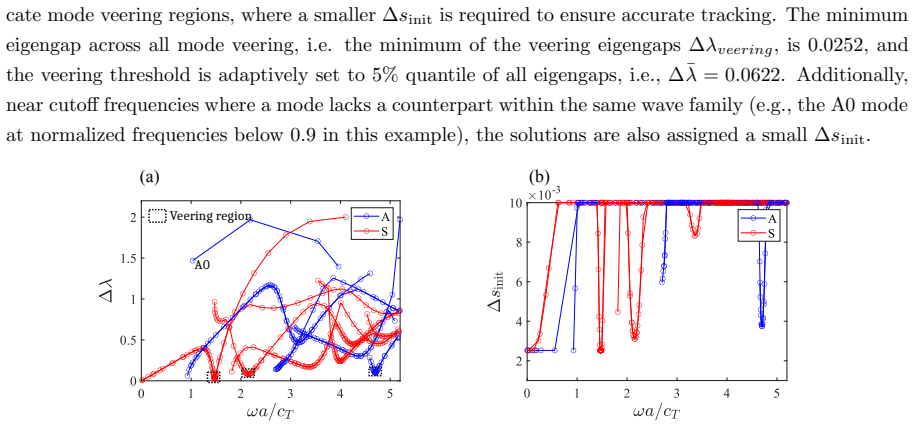
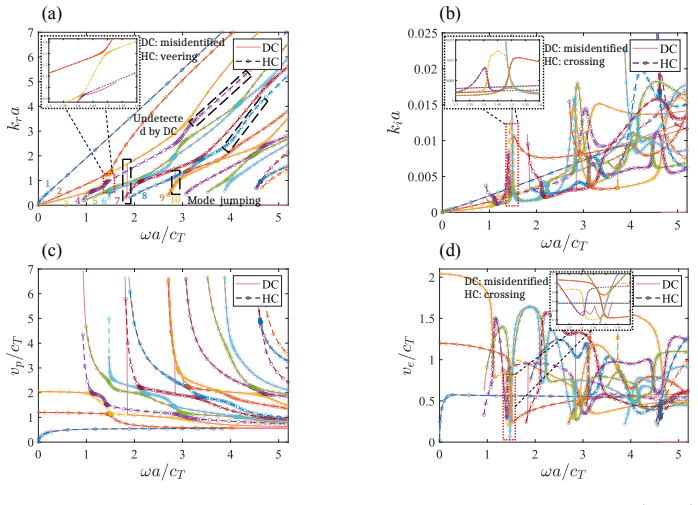
This paper presents the first systematic application of a material homotopy continuation framework for efficient, automated computation of dispersion curves in viscoelastic waveguides of arbitrary cross-section. A material homotopy continuously maps the original lossy problem to an auxiliary lossless one via an attenuation parameter s in [0,1], addressing the core challenges of the non-Hermitian eigenvalue problem. Grounded in analytic perturbation theory, the method guarantees branch identity continuity--a one-to-one correspondence between solutions at s=0 and s=1--provided the real-parameter path does not cross any exceptional points. Under a Type I exceptional point topology, physical mode labels established at the elastic stage remain valid at the viscoelastic stage without post-processing, yielding the characteristic real-part veering with imaginary-part crossing. The decoupling strategy performs reliable mode tracking in the Hermitian regime via adaptive wavenumber refinement, then propagates a sparse set of key solutions to the target viscoelastic state through predictor-corrector homotopy continuation. Numerical examples across symmetric and unsymmetric laminates validate the framework's robustness and efficiency, with the majority of cases verified at a loss factor of approximately 0.003 and a single symmetric laminate providing additional support at 0.02. For a challenging unsymmetric laminate at a loss factor of 0.05, the method still produces numerically accurate solutions; two complementary diagnostic signatures--an extremely sharp imaginary-part crossing and a discernible discrepancy between spectral group velocity and energy flux velocity--warn of potential label mismatch and guide further analysis.
Editorial analysis
A structured set of objections, weighed in public.
Referee Report
Summary. The paper introduces an adaptive homotopy continuation framework for computing dispersion curves in viscoelastic waveguides of arbitrary cross-section. It uses a material homotopy with attenuation parameter s ∈ [0,1] to continuously map from a lossless elastic problem to the lossy viscoelastic one. Grounded in analytic perturbation theory, it claims to guarantee one-to-one branch identity continuity between solutions at s=0 and s=1, provided the real-parameter path avoids exceptional points, allowing physical mode labels to remain valid without post-processing. The approach decouples reliable mode tracking in the Hermitian regime via adaptive wavenumber refinement from the predictor-corrector continuation to the target state. Numerical examples on symmetric and unsymmetric laminates at loss factors up to 0.05 demonstrate robustness.
Significance. If the conditional guarantee holds, the method offers a significant advance in automated, reliable computation of dispersion curves for damped waveguides, addressing the challenges of non-Hermitian eigenvalue problems and mode veering without manual intervention. The decoupling strategy and use of diagnostics for challenging cases enhance its applicability to engineering problems involving viscoelastic materials.
major comments (1)
- [Abstract and §3] Abstract and §3 (homotopy mapping and perturbation theory): The central claim of 'guaranteed branch identity continuity... without post-processing' is conditional on the real-parameter path s ∈ [0,1] never encountering an exceptional point. No general a priori theorem, criterion, or algorithm is supplied to certify that the chosen real path lies away from all EPs for arbitrary waveguides and loss factors; the adaptive refinement is restricted to the Hermitian (s=0) stage, and post-hoc diagnostics (sharp imaginary-part crossing and group-velocity vs. energy-flux discrepancy) are provided only for the single unsymmetric laminate at loss factor 0.05.
minor comments (1)
- [Abstract] Abstract: The statement that 'the majority of cases verified at a loss factor of approximately 0.003' and 'a single symmetric laminate providing additional support at 0.02' should be expanded with exact loss-factor values, number of cases, and cross-section details in the numerical-results section for full reproducibility.
Simulated Author's Rebuttal
We thank the referee for the careful review and for identifying the conditional character of the central guarantee. We respond point-by-point below and indicate where the manuscript will be revised for greater clarity.
read point-by-point responses
-
Referee: [Abstract and §3] Abstract and §3 (homotopy mapping and perturbation theory): The central claim of 'guaranteed branch identity continuity... without post-processing' is conditional on the real-parameter path s ∈ [0,1] never encountering an exceptional point. No general a priori theorem, criterion, or algorithm is supplied to certify that the chosen real path lies away from all EPs for arbitrary waveguides and loss factors; the adaptive refinement is restricted to the Hermitian (s=0) stage, and post-hoc diagnostics (sharp imaginary-part crossing and group-velocity vs. energy-flux discrepancy) are provided only for the single unsymmetric laminate at loss factor 0.05.
Authors: We agree that the one-to-one branch-identity guarantee is strictly conditional on the real path s ∈ [0,1] avoiding exceptional points (EPs). The manuscript already states this proviso explicitly and grounds the conditional result in analytic perturbation theory for Type-I EP topology. No general a priori certification algorithm is supplied because constructing one would require a global, non-convex search over the entire (k,s) space for every waveguide geometry and loss factor—an open and computationally prohibitive problem that lies outside the scope of the present work. Instead, the framework supplies reliable post-hoc diagnostics (sharp imaginary-part crossing together with group-velocity/energy-flux discrepancy) that, in all reported examples, correctly flag the absence of label mismatch. We will revise the abstract and §3 to (i) restate the conditional nature more prominently, (ii) clarify that the diagnostics are intended for practical verification rather than a priori certification, and (iii) note that the adaptive refinement at s=0 remains the only stage where guaranteed Hermitian tracking is performed. These changes constitute a partial revision. revision: partial
- No general a priori theorem, criterion, or algorithm is available to certify that an arbitrary real-parameter path avoids all exceptional points for arbitrary waveguides and loss factors.
Circularity Check
No significant circularity; derivation is self-contained
full rationale
The paper's central claim of guaranteed branch identity continuity rests on analytic perturbation theory applied to the real-parameter material homotopy s ∈ [0,1]. The continuity statement is explicitly conditional on the path avoiding exceptional points, and the method proceeds via independent algorithmic steps: adaptive wavenumber refinement in the Hermitian (s=0) stage followed by predictor-corrector propagation of sparse solutions. No load-bearing step reduces by construction to a fitted input, self-definition, or self-citation chain; the homotopy mapping and perturbation analysis supply the one-to-one correspondence without tautological renaming or imported uniqueness theorems. The derivation therefore remains non-circular under the stated assumptions.
Axiom & Free-Parameter Ledger
axioms (1)
- domain assumption Analytic perturbation theory guarantees branch identity continuity when the real-parameter path does not cross exceptional points
Lean theorems connected to this paper
-
IndisputableMonolith/Foundation/RealityFromDistinction.leanreality_from_one_distinction unclear?
unclearRelation between the paper passage and the cited Recognition theorem.
Grounded in analytic perturbation theory, the method guarantees branch identity continuity—a one-to-one correspondence between solutions at s=0 and s=1—provided the real-parameter path does not cross any exceptional points.
-
IndisputableMonolith/Cost/FunctionalEquation.leanwashburn_uniqueness_aczel unclear?
unclearRelation between the paper passage and the cited Recognition theorem.
The decoupling strategy performs reliable mode tracking in the Hermitian regime via adaptive wavenumber refinement, then propagates a sparse set of key solutions to the target viscoelastic state through predictor-corrector homotopy continuation.
What do these tags mean?
- matches
- The paper's claim is directly supported by a theorem in the formal canon.
- supports
- The theorem supports part of the paper's argument, but the paper may add assumptions or extra steps.
- extends
- The paper goes beyond the formal theorem; the theorem is a base layer rather than the whole result.
- uses
- The paper appears to rely on the theorem as machinery.
- contradicts
- The paper's claim conflicts with a theorem or certificate in the canon.
- unclear
- Pith found a possible connection, but the passage is too broad, indirect, or ambiguous to say the theorem truly supports the claim.
Reference graph
Works this paper leans on
-
[1]
Rose.Ultrasonic Guided Waves in Solid Media
Joseph L. Rose.Ultrasonic Guided Waves in Solid Media. Cambridge University Press, Cambridge, 2014
work page 2014
-
[2]
Victor Giurgiutiu.Structural Health Monitoring with Piezoelectric Wafer Active Sensors. Elsevier, June 2014
work page 2014
-
[3]
Bertram A. Auld. Acoustic fields and waves in solids. Krieger, Malabar, Fla, 2. ed edition, 1990
work page 1990
-
[4]
V. V. Meleshko, A. A. Bondarenko, S. A. Dovgiy, A. N. Trofimchuk, and G. J. F. van Heijst. Elastic waveguides: History and the state of the art. I.Journal of Mathematical Sciences, 162(1):99–120, October 2009
work page 2009
-
[5]
Ahid D. Nashif, David I. G. Jones, and John P. Henderson.Vibration damping. Wiley, New York, 1985
work page 1985
-
[6]
Transfer matrix of multilayered absorbing and anisotropic media
Bernard Hosten and Michel Castaings. Transfer matrix of multilayered absorbing and anisotropic media. Measurements and simulations of ultrasonic wave propagation through composite materials.The Journal of the Acoustical Society of America, 94(3):1488–1495, September 1993
work page 1993
-
[7]
M.J.S. Lowe. Matrix techniques for modeling ultrasonic waves in multilayered media.IEEE Transactions on Ultrasonics, Ferroelectrics, and Frequency Control, 42(4):525–542, July 1995
work page 1995
-
[8]
Ameneh Maghsoodi, Abdolreza Ohadi, and Mojtaba Sadighi. Calculation of Wave Dispersion Curves in Multilayered Composite-Metal Plates.Shock and Vibration, 2014(1):410514, 2014
work page 2014
-
[9]
L. Wang and S. I. Rokhlin. Stable reformulation of transfer matrix method for wave propagation in layered anisotropic media.Ultrasonics, 39(6):413–424, October 2001
work page 2001
-
[10]
S. I. Rokhlin and L. Wang. Stable recursive algorithm for elastic wave propagation in layered anisotropic me- dia: Stiffness matrix method.The Journal of the Acoustical Society of America, 112(3):822–834, September 2002
work page 2002
-
[11]
Disperse: A General Purpose Program for Creating Dispersion Curves
Brian Pavlakovic, Mike Lowe, David Alleyne, and Peter Cawley. Disperse: A General Purpose Program for Creating Dispersion Curves. In Donald O. Thompson and Dale E. Chimenti, editors,Review of Progress in Quantitative Nondestructive Evaluation: Volume 16A, pages 185–192. Springer US, Boston, MA, 1997. 40
work page 1997
-
[12]
The Dispersion Calculator: A Free Software for Calculating Dispersion Curves of Guided Waves
Armin Huber. The Dispersion Calculator: A Free Software for Calculating Dispersion Curves of Guided Waves. In20th World Conference on Non-Destructive Testing (WCNDT 2024), volume 29, pages 1–17, Incheon, S¨ udkorea, May 2024. NDT.net. Number: 6
work page 2024
-
[13]
Armin Huber. Stiffness matrix method for modeling of guided waves in multilayered anisotropic plates: the dispersion calculator. ¨Uberherrn, Deutschland, July 2024
work page 2024
- [14]
-
[15]
Michel Castaings and Michael Lowe. Finite element model for waves guided along solid systems of arbitrary section coupled to infinite solid media.The Journal of the Acoustical Society of America, 123(2):696–708, February 2008
work page 2008
-
[16]
Joseph L. Rose. The Semi-Analytical Finite Element Method. InUltrasonic Guided Waves in Solid Media, pages 135–154. Cambridge University Press, August 2014
work page 2014
-
[17]
Ivan Bartoli, Alessandro Marzani, Francesco Lanza Di Scalea, and Erasmo Viola. Modeling wave propagation in damped waveguides of arbitrary cross-section.Journal of Sound and Vibration, 295(3-5):685–707, August 2006
work page 2006
-
[18]
Alessandro Marzani, Erasmo Viola, Ivan Bartoli, Francesco Lanza Di Scalea, and Piervincenzo Rizzo. A semi-analytical finite element formulation for modeling stress wave propagation in axisymmetric damped waveguides.Journal of Sound and Vibration, 318(3):488–505, December 2008
work page 2008
-
[19]
Jing Mu and Joseph L. Rose. Guided wave normal modes in hollow cylinders with viscoelastic coatings. AIP Conference Proceedings, 975(1):86–91, February 2008
work page 2008
-
[20]
M. Mazzotti, I. Bartoli, A. Marzani, and E. Viola. A coupled SAFE-2.5D BEM approach for the dispersion analysis of damped leaky guided waves in embedded waveguides of arbitrary cross-section.Ultrasonics, 53(7):1227–1241, September 2013
work page 2013
-
[21]
Daniel H. Cortes, Subhendu K. Datta, and Osama M. Mukdadi. Dispersion of elastic guided waves in piezoelectric infinite plates with inversion layers.International Journal of Solids and Structures, 45(18):5088– 5102, September 2008
work page 2008
-
[22]
M. Mazzotti, A. Marzani, I. Bartoli, and E. Viola. Guided waves dispersion analysis for prestressed viscoelas- tic waveguides by means of the SAFE method.International Journal of Solids and Structures, 49(18):2359– 2372, September 2012
work page 2012
-
[23]
M. Mazzotti, I. Bartoli, M. Miniaci, and A. Marzani. Wave dispersion in thin-walled orthotropic waveguides using the first order shear deformation theory.Thin-Walled Structures, 103:128–140, June 2016
work page 2016
-
[24]
Paolo Bocchini, Alessandro Marzani, and Erasmo Viola. Graphical User Interface for Guided Acoustic Waves.Journal of Computing in Civil Engineering, 25(3):202–210, May 2011
work page 2011
-
[25]
Menglong Liu, Wenyan Zhang, Xiao Chen, Lun Li, Kai Wang, Hong Wang, Fangsen Cui, and Zhongqing Su. Modelling guided waves in acoustoelastic and complex waveguides: From SAFE theory to an open-source tool.Ultrasonics, 136:107144, January 2024
work page 2024
-
[26]
A. T. I. Adamou and R. V. Craster. Spectral methods for modelling guided waves in elastic media.The Journal of the Acoustical Society of America, 116(3):1524–1535, September 2004
work page 2004
-
[27]
F. Hernando Quintanilla, Z. Fan, M. J. S. Lowe, and R. V. Craster. Guided waves’ dispersion curves in anisotropic viscoelastic single- and multi-layered media.Proceedings of the Royal Society A: Mathematical, Physical and Engineering Sciences, 471(2183):20150268, November 2015
work page 2015
-
[28]
Souhail Dahmen, Morched Ben Amor, and Mohamed H´ edi Ben Ghozlen. Investigation of the coupled Lamb waves propagation in viscoelastic and anisotropic multilayer composites by Legendre polynomial method. Composite Structures, 153:557–568, October 2016
work page 2016
-
[29]
Adil Han Orta, Mathias Kersemans, and Koen Van Den Abeele. A comparative study for calculating dispersion curves in viscoelastic multi-layered plates.Composite Structures, 294:115779, August 2022
work page 2022
-
[30]
Jabid E. Quiroga, Octavio A. Gonz´ alez-Estrada, and Miguel D´ ıaz-Rodr´ ıguez. Evaluation of Numerical Methods for Dispersion Curve Estimation in Viscoelastic Plates.Eng, 6(9):240, September 2025. 41
work page 2025
-
[31]
Darun Barazanchy and Victor Giurgiutiu. A comparative convergence and accuracy study of composite guided-ultrasonic wave solution methods: Comparing the unified analytic method, SAFE method and DIS- PERSE.Proceedings of the Institution of Mechanical Engineers, Part C: Journal of Mechanical Engineering Science, 231(16):2961–2973, August 2017
work page 2017
-
[32]
R. B. Lehoucq and D. C. Sorensen. Deflation Techniques for an Implicitly Restarted Arnoldi Iteration. SIAM Journal on Matrix Analysis and Applications, 17(4):789–821, October 1996
work page 1996
-
[33]
The Quadratic Eigenvalue Problem.SIAM Review, 43(2):235–286, January 2001
Fran¸ coise Tisseur and Karl Meerbergen. The Quadratic Eigenvalue Problem.SIAM Review, 43(2):235–286, January 2001
work page 2001
-
[34]
Tetsuya Sakurai and Hiroshi Sugiura. A projection method for generalized eigenvalue problems using nu- merical integration.Journal of Computational and Applied Mathematics, 159(1):119–128, October 2003
work page 2003
-
[35]
Alexander P. Seyranian and Alexei A. Mailybaev.Multiparameter stability theory with mechanical applica- tions. Number v. 13 in Series on stability, vibration and control of systems. Series A. World Scientific Pub. Co, Singapore River Edge, N.J, 2003
work page 2003
-
[36]
The modal assurance criterion–twenty years of use and abuse.Sound and vibration, 37:14–23, 2003
Randall J Allemang. The modal assurance criterion–twenty years of use and abuse.Sound and vibration, 37:14–23, 2003
work page 2003
-
[37]
Komlan Akoussan, Hakim Boudaoud, El Mostafa Daya, Yao Koutsawa, and Erasmo Carrera. Numerical method for nonlinear complex eigenvalues problems depending on two parameters: Application to three- layered viscoelastic composite structures.Mechanics of Advanced Materials and Structures, 25(15-16):1361– 1373, December 2018
work page 2018
-
[38]
Xiao Liu, Xiang Liu, Tao Lu, and Dalun Tang. High-efficient complex eigen-solution algorithms for tran- scendental dynamic stiffness formulations of plate built-up structures with frequency-dependent viscoelastic models.Computers & Structures, 301:107456, September 2024
work page 2024
-
[39]
Hakim Boudaoud, Salim Belouettar, El Mostafa Daya, and Michel Potier-Ferry. A numerical method for nonlinear complex modes with application to active–passive damped sandwich structures.Engineering Structures, 31(2):284–291, February 2009
work page 2009
-
[40]
Mathias Ziapkoff, Laetitia Duigou, Guillaume Robin, Jean-Marc Cadou, and El Mostafa Daya. A high order Newton method to solve vibration problem of composite structures considering fractional derivative Zener model.Mechanics of Advanced Materials and Structures, 31(12):2534–2544, June 2024
work page 2024
-
[41]
Allgower.Numerical Continuation Methods: An Introduction
Eugene L. Allgower.Numerical Continuation Methods: An Introduction. Number v.13 in Springer Series in Computational Mathematics Ser. Springer Berlin / Heidelberg, Berlin, Heidelberg, 1990
work page 1990
-
[42]
Taizo Maruyama and Kazuyuki Nakahata. Continuation Approach Combined with Semi-Analytical Finite- Element Method for Solving Guided-Wave Dispersion Equation.Journal of Nondestructive Evaluation, 44, May 2025
work page 2025
-
[43]
Springer Berlin Heidelberg, Berlin, Heidelberg, 1995
Tosio Kato.Perturbation Theory for Linear Operators, volume 132 ofClassics in Mathematics. Springer Berlin Heidelberg, Berlin, Heidelberg, 1995
work page 1995
-
[44]
F. Keck, H. J. Korsch, and S. Mossmann. Unfolding a diabolic point: a generalized crossing scenario.Journal of Physics A: Mathematical and General, 36(8):2125, February 2003
work page 2003
-
[45]
W.D. Heiss. Phases of wave functions and level repulsion.The European Physical Journal D - Atomic, Molecular, Optical and Plasma Physics, 7(1):1–4, August 1999
work page 1999
-
[46]
W. D. Heiss. Exceptional points of non-Hermitian operators.Journal of Physics A: Mathematical and General, 37(6):2455, January 2004
work page 2004
-
[47]
Martin Ghienne and Benoit Nennig. Beyond the limitations of perturbation methods for real random eigenvalue problems using Exceptional Points and analytic continuation.Journal of Sound and Vibration, 480:115398, August 2020
work page 2020
- [48]
-
[49]
Reflections on the Hysteretic Damping Model.Shock and Vibration, 16(5):674758, 2009
Nuno Maia. Reflections on the Hysteretic Damping Model.Shock and Vibration, 16(5):674758, 2009
work page 2009
-
[50]
No crossing rule.Physik, 30:467–470, 1929
John Von Neumann and Eugene Wigner. No crossing rule.Physik, 30:467–470, 1929. 42
work page 1929
-
[51]
Gregory J. Hatton. The noncrossing rule and spurious avoided crossings.Physical Review A, 14(3):901–910, September 1976
work page 1976
-
[52]
C. Alden Mead. The ”noncrossing” rule for electronic potential energy surfaces: The role of time-reversal invariance.The Journal of Chemical Physics, 70(5):2276–2283, March 1979
work page 1979
-
[53]
Springer, Berlin Heidelberg, 1973
Lothar Cremer and Manfred Heckl.Structure-Borne Sound: Structural Vibrations and Sound Radiation at Audio Frequencies. Springer, Berlin Heidelberg, 1973
work page 1973
-
[54]
Neal Granick and Jesse E. Stern. Material Damping of Aliminum by a Resonant-Dwell Technique. August 1965
work page 1965
-
[55]
Kanji Ono. Dynamic Viscosity and Transverse Ultrasonic Attenuation of Engineering Materials.Applied Sciences, 10(15):5265, January 2020
work page 2020
-
[56]
Luyang Gong, Fengjia Zhang, Xiongqi Peng, Fabrizio Scarpa, Zhigao Huang, Guangming Tao, Hong-Yuan Liu, Helezi Zhou, and Huamin Zhou. Improving the damping properties of carbon fiber reinforced polymer composites by interfacial sliding of oriented multilayer graphene oxide.Composites Science and Technology, 224:109309, June 2022
work page 2022
-
[57]
Benoit Nennig and Emmanuel Perrey-Debain. A high order continuation method to locate exceptional points and to compute Puiseux series with applications to acoustic waveguides.Journal of Computational Physics, 412:109425, July 2020
work page 2020
-
[58]
M. Mazzotti, I. Bartoli, A. Marzani, and E. Viola. A 2.5D boundary element formulation for modeling damped waves in arbitrary cross-section waveguides and cavities.Journal of Computational Physics, 248:363– 382, September 2013. 43
work page 2013
discussion (0)
Sign in with ORCID, Apple, or X to comment. Anyone can read and Pith papers without signing in.