Recognition: 2 theorem links
· Lean TheoremOscillatory photoresistance on the high field side of the cyclotron resonance
Pith reviewed 2026-05-15 03:10 UTC · model grok-4.3
The pith
In the short-range disorder and high-power limit, displacement photoresistance produces power-independent radiowave-induced resistance oscillations whose period is set by the radiation electric field.
A machine-rendered reading of the paper's core claim, the machinery that carries it, and where it could break.
Core claim
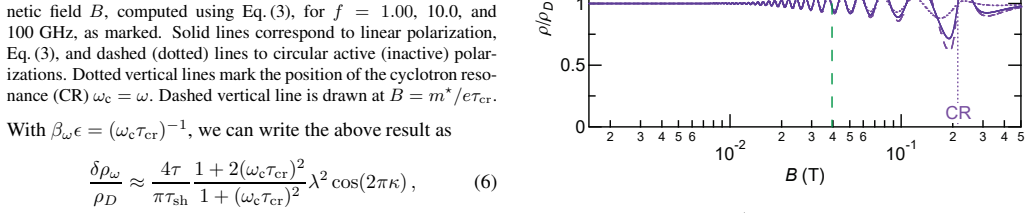
In the limit of short-range disorder and high radiation power, the displacement contribution to photoresistance in overlapping Landau levels at radiation frequencies much smaller than the cyclotron frequency leads to radiowave-induced resistance oscillations (RIROs) whose amplitude is independent of power, whose period is controlled by the radiation electric field, and which can be either 1/B or 1/B²-periodic depending on B, with the crossover linked to the width of the cyclotron resonance absorption curve.
What carries the argument
The displacement contribution arising from radiation-induced shifts of electron guiding centers in the presence of short-range scatterers.
If this is right
- RIRO amplitude remains constant as radiation power increases.
- Oscillation period is set by the radiation electric field strength rather than frequency.
- Periodicity in inverse magnetic field switches from linear to quadratic at a crossover determined by the cyclotron resonance absorption width.
- The oscillations appear only when Landau levels overlap and disorder is short-range.
- RIROs should be directly observable in standard transport experiments on two-dimensional electron systems.
Where Pith is reading between the lines
- The electric-field dependence of the period could allow indirect extraction of the local radiation field inside the sample from resistance data.
- Similar displacement-driven oscillations might appear in other low-frequency regimes if short-range disorder and high power are realized.
- The predicted switch between 1/B and 1/B² periodicity offers a testable signature that distinguishes RIROs from frequency-controlled oscillations.
Load-bearing premise
The calculation assumes short-range disorder, high radiation power, overlapping Landau levels, and radiation frequencies much smaller than the cyclotron frequency.
What would settle it
Measurement of resistance oscillations at radiation frequencies well below the cyclotron resonance whose amplitude stays constant when radiation power is increased and whose period scales with the radiation electric field amplitude.
Figures


read the original abstract
We consider the displacement contribution to photoresistance in overlapping Landau levels at radiation frequencies much smaller than the cyclotron frequency. We show that in the limit of short-range disorder and high radiation power, this contribution leads to a new class of magneto-resistance oscillations. These oscillations, which we call radiowave-induced resistance oscillations (RIROs), are distinct from the well known microwave-induced resistance oscillations in the following aspects: (i) their amplitude is independent of power, (ii) their period is controlled by the radiation electric field, rather than by the radiation frequency, and (iii) they can be either $1/B$ or $1/B^2$-periodic, depending on $B$, with the crossover point linked to the width of the cyclotron resonance absorption curve. We also show that RIROs should be readily observed in experiments.
Editorial analysis
A structured set of objections, weighed in public.
Referee Report
Summary. The manuscript analyzes the displacement contribution to photoresistance in overlapping Landau levels for radiation frequencies much smaller than the cyclotron frequency. In the limits of short-range disorder and high radiation power, it predicts a new class of magneto-resistance oscillations called RIROs, with amplitude independent of power, period controlled by the radiation electric field, and periodicity that is either 1/B or 1/B² depending on B, with crossover linked to the cyclotron resonance width. The oscillations are claimed to be readily observable experimentally.
Significance. If the central prediction holds, the paper identifies a distinct mechanism for resistance oscillations in the high magnetic field regime, separate from microwave-induced resistance oscillations, with power-independent amplitude and field-controlled period. This offers a parameter-free theoretical prediction in the stated limits, enhancing the toolkit for understanding non-equilibrium transport phenomena in 2D electron gases and providing testable experimental signatures.
minor comments (2)
- [Abstract] The abstract summarizes the results but lacks any reference to the underlying equations or derivation steps, which would help readers assess the claims more readily.
- Inclusion of numerical simulations or plots showing the predicted oscillations as a function of B for typical experimental parameters would strengthen the assertion of experimental accessibility.
Simulated Author's Rebuttal
We thank the referee for the positive summary of our manuscript and the recommendation for minor revision. We appreciate the recognition that our work identifies a distinct mechanism for resistance oscillations in the high-field regime with testable, parameter-free predictions in the stated limits.
Circularity Check
Derivation follows standard displacement mechanism without reduction to fitted inputs or self-referential definitions
full rationale
The paper presents RIROs as a direct consequence of the displacement contribution to photoresistance in the stated regime of short-range disorder, high radiation power, overlapping Landau levels, and ω ≪ ω_c. No equation reduces a prediction to a fitted parameter by construction, no ansatz is smuggled via self-citation, and no uniqueness theorem is invoked to force the result. Self-citations to prior work on related oscillations (e.g., MIROs) are present but not load-bearing for the new class of oscillations, whose amplitude independence, E-field period control, and 1/B vs 1/B² crossover are derived from the displacement term under the explicit limits. The central claim therefore remains independent of the paper's own inputs.
Axiom & Free-Parameter Ledger
axioms (3)
- domain assumption Overlapping Landau levels when radiation frequency is much smaller than cyclotron frequency
- domain assumption Short-range disorder
- domain assumption High radiation power
invented entities (1)
-
RIROs (radiowave-induced resistance oscillations)
no independent evidence
Lean theorems connected to this paper
-
IndisputableMonolith/Cost/FunctionalEquation.leanwashburn_uniqueness_aczel unclear?
unclearRelation between the paper passage and the cited Recognition theorem.
δρω/ρD = τ/τsh λ² [f(ξ) + ϵ ∂ϵ f(ξ)] with f(ξ)=J0²(ξ)−J1²(ξ) and ξ(ϵ)=2√P(ϵ) sin(πϵ)
-
IndisputableMonolith/Foundation/DimensionForcing.leanreality_from_one_distinction unclear?
unclearRelation between the paper passage and the cited Recognition theorem.
oscillations periodic in 1/B or 1/B² with crossover at ωc τcr =1
What do these tags mean?
- matches
- The paper's claim is directly supported by a theorem in the formal canon.
- supports
- The theorem supports part of the paper's argument, but the paper may add assumptions or extra steps.
- extends
- The paper goes beyond the formal theorem; the theorem is a base layer rather than the whole result.
- uses
- The paper appears to rely on the theorem as machinery.
- contradicts
- The paper's claim conflicts with a theorem or certificate in the canon.
- unclear
- Pith found a possible connection, but the passage is too broad, indirect, or ambiguous to say the theorem truly supports the claim.
Reference graph
Works this paper leans on
-
[1]
M. A. Zudov, R. R. Du, J. A. Simmons, and J. L. Reno, Shubnikov–de Haas-like oscillations in millimeterwave ph oto- conductivity in a high-mobility two-dimensional electron gas, Phys. Rev. B 64, 201311(R) (2001)
work page 2001
-
[2]
P . D. Ye, L. W. Engel, D. C. Tsui, J. A. Simmons, J. R. Wendt, G. A. V awter, and J. L. Reno,Giant microwave photoresistance of two-dimensional electron gas , Appl. Phys. Lett. 79, 2193 (2001)
work page 2001
-
[3]
M. A. Zudov, I. V . Ponomarev, A. L. Efros, R. R. Du, J. A. Simmons, and J. L. Reno, New Class of Magnetoresistance Os- cillations: Interaction of a Two-Dimensional Electron Gas with Leaky Interface Phonons, Phys. Rev. Lett. 86, 3614 (2001)
work page 2001
-
[4]
A. T. Hatke, M. A. Zudov, L. N. Pfeiffer, and K. W. West, Phase of phonon-induced resistance oscillations in a high-mobil ity two-dimensional electron gas , Phys. Rev. B 84, 121301(R) (2011)
work page 2011
-
[5]
C. L. Yang, J. Zhang, R. R. Du, J. A. Simmons, and J. L. Reno, Zener Tunneling Between Landau Orbits in a High-Mobility Two-Dimensional Electron Gas , Phys. Rev. Lett. 89, 076801 (2002)
work page 2002
-
[6]
W. Zhang, H.-S. Chiang, M. A. Zudov, L. N. Pfeiffer, and K. W. West, Magnetotransport in a two-dimensional electron system in dc electric fields , Phys. Rev. B 75, 041304(R) (2007)
work page 2007
-
[7]
J. Q. Zhang, S. Vitkalov, A. A. Bykov, A. K. Kalagin, and A. K. Bakarov, Effect of a dc electric field on the longitudinal resis- tance of two-dimensional electrons in a magnetic field , Phys. Rev. B 75, 081305(R) (2007)
work page 2007
-
[8]
R. G. Mani, J. H. Smet, K. von Klitzing, V . Narayanamurti, W. B. Johnson, and V . Umansky, Zero-resistance states in- duced by electromagnetic-wave excitation in GaAs/AlGaAs het- erostructures, Nature 420, 646 (2002)
work page 2002
-
[9]
M. A. Zudov, R. R. Du, L. N. Pfeiffer, and K. W. West,Evidence for a New Dissipationless Effect in 2D Electronic Transport , Phys. Rev. Lett. 90, 046807 (2003)
work page 2003
-
[10]
C. L. Yang, M. A. Zudov, T. A. Knuuttila, R. R. Du, L. N. Pfe if- fer, and K. W. West, Observation of Microwave-Induced Zero- Conductance State in Corbino Rings of a Two-Dimensional Electron System, Phys. Rev. Lett. 91, 096803 (2003)
work page 2003
-
[11]
A. A. Bykov, J.-Q. Zhang, S. Vitkalov, A. K. Kalagin, and A. K. Bakarov, Zero-Differential Resistance State of Two- Dimensional Electron Systems in Strong Magnetic Fields, Phys. Rev. Lett. 99, 116801 (2007)
work page 2007
- [12]
-
[13]
A. T. Hatke, H.-S. Chiang, M. A. Zudov, L. N. Pfeiffer, an d K. W. West, Zero differential resistance in two-dimensional electron systems at large filling factors , Phys. Rev. B 82, 041304(R) (2010)
work page 2010
-
[14]
A. C. Durst, S. Sachdev, N. Read, and S. M. Girvin, Radiation- Induced Magnetoresistance Oscillations in a 2D Electron Ga s, Phys. Rev. Lett. 91, 086803 (2003)
work page 2003
-
[15]
X. L. Lei and S. Y . Liu, Radiation-Induced Magnetoresistance Oscillation in a Two-Dimensional Electron Gas in Faraday Ge- ometry, Phys. Rev. Lett. 91, 226805 (2003)
work page 2003
-
[16]
I. A. Dmitriev, A. D. Mirlin, and D. G. Polyakov, Cyclotron- Resonance Harmonics in the ac Response of a 2D Electron Gas with Smooth Disorder, Phys. Rev. Lett. 91, 226802 (2003)
work page 2003
-
[17]
J. Shi and X. C. Xie, Radiation-Induced “Zero-Resistance State” and the Photon-Assisted Transport , Phys. Rev. Lett. 91, 086801 (2003)
work page 2003
-
[18]
M. G. V avilov and I. L. Aleiner, Magnetotransport in a two- dimensional electron gas at large filling factors , Phys. Rev. B 69, 035303 (2004)
work page 2004
-
[19]
I. A. Dmitriev, M. G. V avilov, I. L. Aleiner, A. D. Mirlin , and D. G. Polyakov, Theory of microwave-induced oscillations in the magnetoconductivity of a two-dimensional electron g as, Phys. Rev. B 71, 115316 (2005)
work page 2005
-
[20]
I. A. Dmitriev, A. D. Mirlin, and D. G. Polyakov, Microwave photoconductivity of a two-dimensional electron gas: Mech a- nisms and their interplay at high radiation power , Phys. Rev. B 75, 245320 (2007)
work page 2007
-
[21]
I. A. Dmitriev, S. I. Dorozhkin, and A. D. Mirlin, Theory of microwave-induced photocurrent and photovoltage magneto - oscillations in a spatially nonuniform two-dimensional el ectron gas, Phys. Rev. B 80, 125418 (2009)
work page 2009
-
[22]
I. A. Dmitriev, M. Khodas, A. D. Mirlin, D. G. Polyakov, a nd M. G. V avilov,Mechanisms of the microwave photoconductivity 5 in two-dimensional electron systems with mixed disorder, Phys. Rev. B 80, 165327 (2009)
work page 2009
-
[23]
P . S. Alekseev and A. P . Alekseeva, Highly correlated two- dimensional viscous electron fluid in moderate magnetic fiel ds, Phys. Rev. B 111, 235202 (2025)
work page 2025
-
[24]
S. I. Dorozhkin, Giant Magnetoresistance Oscillations Caused by Cyclotron Resonance Harmonics, JETP Lett. 77, 577 (2003)
work page 2003
-
[25]
A. T. Hatke, M. Khodas, M. A. Zudov, L. N. Pfeiffer, and K. W. West, Multiphoton microwave photoresistance in a high- mobility 2D electron gas, Phys. Rev. B 84, 241302(R) (2011)
work page 2011
-
[26]
See Supplemental Material at [URL will be inserted by pu b- lisher] for a brief discussion of other contributions
-
[27]
Q. Shi, M. A. Zudov, I. A. Dmitriev, K. W. Baldwin, L. N. Pfeif- fer, and K. W. West, Fine structure of high-power microwave- induced resistance oscillations , Phys. Rev. B 95, 041403(R) (2017)
work page 2017
-
[28]
It appears that Eq. (3) of Ref. 25 erroneosly contains a f actor of 2, which has been corrected in Eq. (2) of Ref. 27
-
[29]
M. Khodas and M. G. V avilov, Effect of microwave radiation on the nonlinear resistivity of a two-dimensional electron gas at large filling factors , Phys. Rev. B 78, 245319 (2008)
work page 2008
-
[30]
K. W. Chiu, T. K. Lee, and J. J. Quinn, Infrared magneto- transmittance of a two-dimensional electron gas , Surf. Sci. 58, 182 (1976)
work page 1976
- [31]
-
[32]
I. A. Dmitriev, A. D. Mirlin, D. G. Polyakov, and M. A. Zud ov, Nonequilibrium phenomena in high Landau levels , Rev. Mod. Phys. 84, 1709 (2012)
work page 2012
- [33]
-
[34]
A. T. Hatke, M. A. Zudov, J. D. Watson, M. J. Manfra, L. N. Pfeiffer, and K. W. West, Evidence for effective mass reduction in GaAs/AlGaAs quantum wells , Phys. Rev. B 87, 161307(R) (2013)
work page 2013
-
[35]
Here we restore the non-oscillatory term, − λ 2(τ /τ sh) [25], which ensures that the photoresistivity vanishes at high B for the exact expression
-
[36]
A. T. Hatke, M. A. Zudov, L. N. Pfeiffer, and K. W. West, Microwave photoresistance in a two-dimensional electron g as with separated Landau levels , Phys. Rev. B 84, 241304(R) (2011)
work page 2011
-
[37]
A. T. Hatke, M. A. Zudov, L. N. Pfeiffer, and K. W. West, Non- linear response in overlapping and separated Landau levels of GaAs quantum wells , Phys. Rev. B 86, 081307(R) (2012)
work page 2012
- [38]
-
[39]
A. T. Hatke, M. A. Zudov, L. N. Pfeiffer, and K. W. West, Temperature Dependence of Microwave Photoresistance in 2D Electron Systems, Phys. Rev. Lett. 102, 066804 (2009)
work page 2009
-
[40]
Q. Shi, P . D. Martin, A. T. Hatke, M. A. Zudov, J. D. Watson , G. C. Gardner, M. J. Manfra, L. N. Pfeiffer, and K. W. West, Shubnikov - de Haas oscillations in a two-dimensional elect ron gas under subterahertz radiation , Phys. Rev. B 92, 081405(R) (2015)
work page 2015
-
[41]
A. A. Bykov, D. V . Dmitriev, I. V . Marchishin, S. Byrnes, and S. A. Vitkalov, Zener tunneling between Landau orbits in two-dimensional electron Corbino rings, Appl. Phys. Lett. 100, 251602 (2012)
work page 2012
-
[42]
M. G. V avilov, I. L. Aleiner, and L. I. Glazman, Nonlinear re- sistivity of a two-dimensional electron gas in a magnetic fie ld, Phys. Rev. B 76, 115331 (2007)
work page 2007
-
[43]
D. Konstantinov and K. Kono, Novel Radiation-Induced Magnetoresistance Oscillations in a Nondegenerate Two- Dimensional Electron System on Liquid Helium , Phys. Rev. Lett. 103, 266808 (2009)
work page 2009
-
[44]
M. A. Zudov, O. A. Mironov, Q. A. Ebner, P . D. Martin, Q. Sh i, and D. R. Leadley, Observation of microwave-induced resis- tance oscillations in a high-mobility two-dimensional hol e gas in a strained Ge/SiGe quantum well , Phys. Rev. B 89, 125401 (2014)
work page 2014
-
[45]
D. F. K¨ archer, A. V . Shchepetilnikov, Y . A. Nefyodov, J. Fal- son, I. A. Dmitriev, Y . Kozuka, D. Maryenko, A. Tsukazaki, S. I. Dorozhkin, I. V . Kukushkin, et al., Observation of mi- crowave induced resistance and photovoltage oscillations in MgZnO/ZnO heterostructures, Phys. Rev. B 93, 041410 (2016)
work page 2016
-
[46]
M. Otteneder, I. A. Dmitriev, S. Candussio, M. L. Savche nko, D. A. Kozlov, V . V . Bel’kov, Z. D. Kvon, N. N. Mikhailov, S. A. Dvoretsky, and S. D. Ganichev, Sign-alternating photoconduc- tivity and magnetoresistance oscillations induced by tera hertz radiation in HgTe quantum wells , Phys. Rev. B 98, 245304 (2018)
work page 2018
-
[47]
E. M¨ onch, D. A. Bandurin, I. A. Dmitriev, I. Y . Phinney,I. Yah- niuk, T. Taniguchi, K. Watanabe, P . Jarillo-Herrero, and S. D. Ganichev, Observation of Terahertz-Induced Magnetooscilla- tions in Graphene, Nano Letters 20, 5943 (2020)
work page 2020
-
[48]
M. L. Savchenko, M. Otteneder, I. A. Dmitriev, N. N. Mikhailov, Z. D. Kvon, and S. D. Ganichev, Terahertz pho- toresistivity of a high-mobility 3D topological insulator based on a strained HgTe film , Applied Physics Letters 117, 201103 (2020)
work page 2020
discussion (0)
Sign in with ORCID, Apple, or X to comment. Anyone can read and Pith papers without signing in.