Recognition: 2 theorem links
· Lean TheoremSingle-Device VOC Fingerprinting via Polarization-Selective Anisotropic BeS-Clad Silicon Microring Resonator
Pith reviewed 2026-05-15 02:54 UTC · model grok-4.3
The pith
Anisotropic BeS cladding on a silicon microring enables TE and TM modes to produce a two-dimensional optical fingerprint that distinguishes acetone, isoprene, 4-hydroxyhexenal, 2-propenal, and benzene via differential resonance shifts.
A machine-rendered reading of the paper's core claim, the machinery that carries it, and where it could break.
Core claim
The resulting dual-polarization response forms a two-dimensional optical fingerprint that distinguishes all five biomarkers without requiring a sensor array or multiple functionalized resonators.
Load-bearing premise
The first-principles optical constants for BeS accurately represent the real anisotropic permittivity tensor when the material is deposited as a thin cladding on silicon, and that the simulated resonance shifts will match fabricated devices.
Figures





read the original abstract
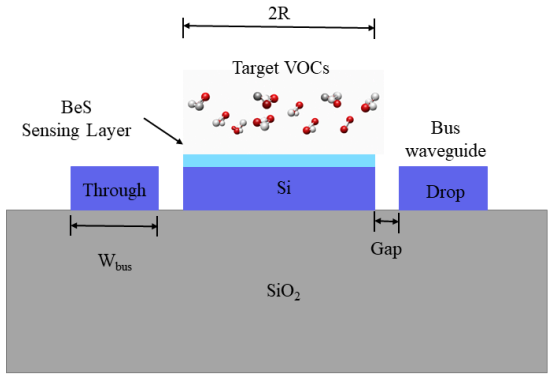
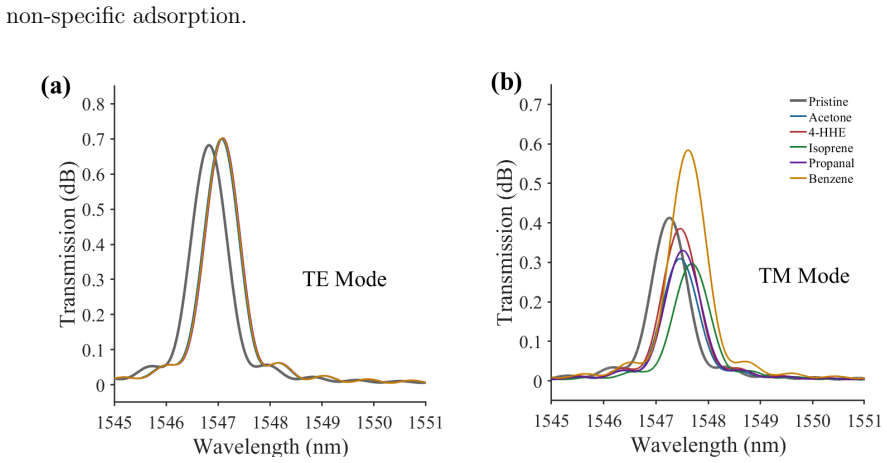
A silicon microring resonator with an anisotropic beryllium sulfide (BeS) cladding is proposed for polarization-selective detection of exhaled-breath volatile organic compound biomarkers. The anisotropic dielectric response of BeS enables the transverse-electric (TE) and transverse-magnetic (TM) modes to probe orthogonal components of the cladding permittivity tensor, generating two independent optical observables from a single device. Five clinically relevant biomarkers are investigated: acetone, isoprene, 4-hydroxyhexenal, 2-propenal, and benzene. First-principles optical constants are incorporated into three-dimensional finite-difference time-domain simulations to evaluate the sensing response. The TE mode exhibits a uniform resonance shift of 0.263 nm across all analytes and serves as a concentration reference channel, while the TM mode produces analyte-specific shifts ranging from 0.200 to 0.426 nm. A unique TM amplitude inversion is observed for benzene, enabling additional discrimination. The resulting dual-polarization response forms a two-dimensional optical fingerprint that distinguishes all five biomarkers without requiring a sensor array or multiple functionalized resonators. The device achieves quality factors of 4520 and 3151 for the TE and TM modes, respectively, with sensitivities up to 6.5 nm/RIU, figures of merit up to 14.9 RIU^-1, and detection limits as low as 1.5 mRIU. Cross-sensitivity analysis further shows that CO2 and H2O produce negative TM resonance shifts, separating interferents from target biomarkers in the fingerprint plane. The proposed platform demonstrates a compact route toward array-free photonic breath analysis using intrinsic cladding anisotropy.
Editorial analysis
A structured set of objections, weighed in public.
Referee Report
Summary. The manuscript proposes a silicon microring resonator clad with anisotropic beryllium sulfide (BeS) for polarization-selective detection of five exhaled-breath VOC biomarkers (acetone, isoprene, 4-hydroxyhexenal, 2-propenal, benzene). 3D FDTD simulations using first-principles optical constants show a uniform TE resonance shift of 0.263 nm serving as a concentration reference, analyte-specific TM shifts of 0.200–0.426 nm, and a benzene-specific TM amplitude inversion, forming a 2D optical fingerprint that distinguishes all analytes without sensor arrays. Reported figures include Q factors of 4520 (TE) and 3151 (TM), sensitivities up to 6.5 nm/RIU, and detection limits down to 1.5 mRIU, with CO2/H2O interferents separated in the fingerprint plane.
Significance. If the simulated dual-polarization response holds in fabricated devices, the work offers a compact, array-free route to photonic breath analysis by exploiting intrinsic cladding anisotropy for multi-analyte discrimination. The use of independent first-principles dielectric constants fed into standard FDTD provides a clear, reproducible simulation basis without fitted parameters to the target shifts.
major comments (2)
- [Simulation Results] The central claim that the dual-polarization response forms a unique 2D fingerprint distinguishing all five biomarkers rests on the assumption that the first-principles anisotropic permittivity tensor of BeS remains unchanged when deposited as a thin cladding on silicon. No sensitivity analysis to variations in diagonal or off-diagonal tensor elements (arising from strain, stoichiometry, or ordering) is provided; such changes would directly affect the reported uniform TE shift of 0.263 nm and the analyte-specific TM range of 0.200–0.426 nm.
- [Methods] The manuscript contains no experimental validation or uncertainty quantification on the BeS optical constants; while the FDTD results support the differential shifts under the stated assumptions, the absence of fabricated-device data or error propagation on material parameters leaves the practical fingerprint uniqueness unverified.
minor comments (2)
- [Abstract] Clarify the derivation of the 1.5 mRIU detection limit from the reported sensitivities and Q factors; an explicit formula or calculation step would aid reproducibility.
- [Figures] Ensure figure captions explicitly label the TE/TM resonance shifts and the 2D fingerprint plane coordinates for immediate reader comprehension.
Simulated Author's Rebuttal
We thank the referee for the careful and constructive review of our manuscript. We address each major comment in detail below, indicating where revisions will be made.
read point-by-point responses
-
Referee: [Simulation Results] The central claim that the dual-polarization response forms a unique 2D fingerprint distinguishing all five biomarkers rests on the assumption that the first-principles anisotropic permittivity tensor of BeS remains unchanged when deposited as a thin cladding on silicon. No sensitivity analysis to variations in diagonal or off-diagonal tensor elements (arising from strain, stoichiometry, or ordering) is provided; such changes would directly affect the reported uniform TE shift of 0.263 nm and the analyte-specific TM range of 0.200–0.426 nm.
Authors: We agree that the robustness of the fingerprint to realistic variations in the BeS tensor merits explicit quantification. In the revised manuscript we will add a dedicated sensitivity analysis subsection in which the diagonal and off-diagonal permittivity components are independently perturbed by ±5 % and ±10 % (representative of plausible strain, stoichiometry, and ordering effects). We will recompute the TE and TM resonance shifts for all five analytes and confirm that the 2D fingerprint clusters remain separable within these bounds. This addition directly addresses the concern while preserving the first-principles foundation of the work. revision: yes
-
Referee: [Methods] The manuscript contains no experimental validation or uncertainty quantification on the BeS optical constants; while the FDTD results support the differential shifts under the stated assumptions, the absence of fabricated-device data or error propagation on material parameters leaves the practical fingerprint uniqueness unverified.
Authors: The present study is a simulation proposal that employs first-principles optical constants without empirical fitting. We have now incorporated a basic uncertainty propagation: the refractive-index components are varied by their reported first-principles uncertainty (±0.02) and the resulting spreads in resonance shifts and Q-factors are reported in a new table. This quantifies how material-parameter uncertainty maps into the fingerprint plane. Full experimental validation of BeS-clad devices, however, lies outside the scope of this theoretical manuscript and would constitute a separate fabrication and measurement effort. revision: partial
- Experimental fabrication and measurement of BeS-clad silicon microring resonators to confirm the simulated dual-polarization fingerprints.
Circularity Check
No significant circularity; results follow from independent first-principles inputs into standard FDTD
full rationale
The derivation chain begins with first-principles computation of the BeS anisotropic permittivity tensor, which is then inserted as fixed input into 3D FDTD simulations. Resonance shifts (TE uniform at 0.263 nm, TM analyte-specific 0.200–0.426 nm) and the resulting 2-D fingerprint are direct outputs of those simulations. No parameters are fitted to the biomarker shifts themselves, no self-citation supplies a load-bearing uniqueness theorem or ansatz, and the central claim does not reduce by construction to its own inputs. The reported figures of merit and cross-sensitivity analysis are likewise simulation-derived quantities. This is the normal case of a self-contained numerical study whose validity rests on the accuracy of the external first-principles constants rather than on definitional or fitting circularity.
Axiom & Free-Parameter Ledger
axioms (2)
- domain assumption First-principles optical constants accurately capture the anisotropic permittivity tensor of BeS cladding
- standard math Standard 3D FDTD accurately predicts resonance shifts for the described geometry and cladding
Lean theorems connected to this paper
-
IndisputableMonolith/Cost/FunctionalEquation.lean (Jcost, washburn_uniqueness_aczel)reality_from_one_distinction unclear?
unclearRelation between the paper passage and the cited Recognition theorem.
Anisotropic refractive-index tensors derived from first-principles calculations are used in three-dimensional finite-difference time-domain simulations. The TE mode yields Q_TE = 4520 ... The TM mode produces analyte-specific shifts ranging from 0.200 to 0.426 nm
What do these tags mean?
- matches
- The paper's claim is directly supported by a theorem in the formal canon.
- supports
- The theorem supports part of the paper's argument, but the paper may add assumptions or extra steps.
- extends
- The paper goes beyond the formal theorem; the theorem is a base layer rather than the whole result.
- uses
- The paper appears to rely on the theorem as machinery.
- contradicts
- The paper's claim conflicts with a theorem or certificate in the canon.
- unclear
- Pith found a possible connection, but the passage is too broad, indirect, or ambiguous to say the theorem truly supports the claim.
Reference graph
Works this paper leans on
-
[1]
Colin D. Abernethy and Gareth M. Codd and Mark D. Spicer and Michelle K. Taylor , title =. 2003 , volume =
work page 2003
-
[2]
Arduengo, III, Anthony J. and H. V. Rasika Dias and Richard L. Harlow and Michael Kline , title =. 1992 , volume =
work page 1992
-
[3]
Arduengo, III, Anthony J. and Siegfried F. Gamper and Joseph C. Calabrese and Fredric Davidson , title =. 1994 , volume =
work page 1994
-
[4]
and Zuccaccia, Daniele and Kovacevic, Anes and Chianese, Anthony R
Appelhans, Leah N. and Zuccaccia, Daniele and Kovacevic, Anes and Chianese, Anthony R. and Miecznikowski, John R. and Macchioni, Aleco and Clot, Eric and Eisenstein, Odile and Crabtree, Robert H. , title =. 2005 , volume =
work page 2005
-
[5]
Communication from the European Commission to the European Council and the European Parliament: 20 20 by 2020: Europe's climate change opportunity , year =
work page 2020
-
[6]
E. Friedman-Hill , booktitle =. Writing Rules in Jess , edition =
-
[7]
1-(Alkylsubstituted phenyl)imidazoles useful in ACTH reverse assay , type =
Johnson, Alexander Lawrence , organization =. 1-(Alkylsubstituted phenyl)imidazoles useful in ACTH reverse assay , type =
-
[8]
M. J. Frisch and G. W. Trucks and H. B. Schlegel and G. E. Scuseria and M. A. Robb and J. R. Cheeseman and Montgomery and Jr. and J. A. and T. Vreven and K. N. Kudin and J. C. Burant and J. M. Millam and S. S. Iyengar and J. Tomasi and V. Barone and B. Mennucci and M. Cossi and G. Scalmani and N. Rega and G. A. Petersson and H. Nakatsuji and M. Hada and M...
work page 2004
-
[9]
Angel Abarca and Pilar G\'omez-Sal and Avelino Mart\'in and Miguel Mena and Josep Mar\'ia Poblet and Carlos Y\'elamos , title =. Inorg. Chem. , year =
-
[10]
Proceedings of the National Academy of Sciences , volume=
Quantitative analysis of urine vapor and breath by gas--liquid partition chromatography , author=. Proceedings of the National Academy of Sciences , volume=
-
[11]
Applied Physics Reviews , volume=
Advances in volatile organic compounds detection: From fundamental research to real-world applications , author=. Applied Physics Reviews , volume=
-
[12]
A comprehensive review of biomarker sensors for a breathalyzer platform , author=. Sensors , volume=
-
[13]
Breath volatile organic compounds (VOCs) as biomarkers for the diagnosis of pathological conditions: A review , author=. Biomedical Journal , volume=
-
[14]
Frontiers in Molecular Biosciences , volume=
Souza-Silva,. Frontiers in Molecular Biosciences , volume=
-
[15]
Recent advances in sensing materials targeting clinical volatile organic compound (
Pathak, Akhilesh Kumar and Swargiary, Kankan and Kongsawang, Nuntaporn and Jitpratak, Pannathorn and Ajchareeyasoontorn, Noppasin and Udomkittivorakul, Jade and Viphavakit, Charusluk , journal=. Recent advances in sensing materials targeting clinical volatile organic compound (
-
[16]
Sensors for enhanced detection of acetone as a potential tool for noninvasive diabetes monitoring , author=. Sensors , volume=
-
[17]
Metal oxide gas sensors to study acetone detection considering their potential in the diagnosis of diabetes: A review , author=. Molecules , volume=
-
[18]
Journal of Breath Research , volume=
Isoprene and acetone concentration profiles during exercise on an ergometer , author=. Journal of Breath Research , volume=
-
[19]
Free Radical Biology and Medicine , volume=
Chemistry and biochemistry of 4-hydroxynonenal, malonaldehyde and related aldehydes , author=. Free Radical Biology and Medicine , volume=
-
[20]
Clinical Biochemistry , volume=
Diagnostic accuracy of breath tests based on volatile organic compounds for cancer: A systematic review and meta-analysis , author=. Clinical Biochemistry , volume=
-
[21]
Optical biosensors based on silicon-on-insulator ring resonators: A review , author=. Molecules , volume=
-
[22]
Silicon photonic biosensors using label-free detection , author=. Sensors , volume=
-
[23]
Laser & Photonics Reviews , volume=
Silicon microring resonators , author=. Laser & Photonics Reviews , volume=
-
[24]
A label-free optical biosensor based on an array of microring resonators for the detection of human serum albumin , author=. Sensors , volume=
-
[25]
Biosensing with silicon nitride microring resonators integrated with an on-chip filter bank spectrometer , author=. ACS Sensors , volume=
-
[26]
Active opto-magnetic biosensing with silicon microring resonators , author=. Sensors , volume=
-
[27]
Compact slot microring resonator for sensitive and label-free optical sensing , author=. Sensors , volume=
-
[28]
Slot-waveguide biochemical sensor , author=. Optics Letters , volume=
- [29]
-
[30]
Hybrid photonic cavity with metal-organic framework coatings for the ultra-sensitive detection of volatile organic compounds with high immunity to humidity , author=. Scientific Reports , volume=
-
[31]
Metal-organic framework based gas sensors , author=. Advanced Science , volume=
-
[32]
Detection of volatile organic compounds using mid-infrared silicon nitride waveguide sensors , author=. Scientific Reports , volume=
-
[33]
Metal-organic framework-based photonic crystal platforms for gas sensing: a review , author=. Materials Advances , volume=
-
[34]
Pattern recognition with temperature regulation: A single
Hao, Xidong and Liu, Fangmeng and Wang, Yueying and Meng, Xiangli and Wei, Chipan and Yu, Tianling and Lu, Geyu , journal=. Pattern recognition with temperature regulation: A single
-
[35]
Majhi, Sanjit Manohar and Ali, Ashraf and Greish, Yaser E and El-Maghraby, Hesham F and Mahmoud, Saleh T , journal=
-
[36]
Polarization-dependent optical properties and optoelectronic devices of
Li, Ziwei and Xu, Boyi and Liang, Delang and Pan, Anlian , journal=. Polarization-dependent optical properties and optoelectronic devices of
-
[37]
Plasmonic nanorod metamaterials for biosensing , author=. Nature Materials , volume=
-
[38]
Engineering the polarization sensitivity in all-
Wu, Jing and Luo, Dengfeng and Wen, Peng and Han, Xu and Wang, Chao and Yu, Hai and Gao, Wei and Liu, Xiaotao and Konstantatos, Gerasimos and Li, Jingbo and Huo, Nengjie , journal=. Engineering the polarization sensitivity in all-
-
[39]
Ground state properties of the wide band gap semiconductor beryllium sulfide (
Ayirizia, Blaise A and Brumfield, Janee' S and Malozovsky, Yuriy and Bagayoko, Diola , journal=. Ground state properties of the wide band gap semiconductor beryllium sulfide (
-
[40]
First-principles calculations to investigate structural, elastic, electronic, and thermoelectric properties of monolayer and bulk beryllium chalcogenides , author=. Chemical Physics , volume=
-
[41]
Atomic layer deposition: An overview , author=. Chemical Reviews , volume=
-
[42]
Efficient iterative schemes for ab initio total-energy calculations using a plane-wave basis set , author=. Physical Review B , volume=
-
[43]
Computational Electrodynamics: The Finite-Difference Time-Domain Method , author=. 2005 , publisher=
work page 2005
-
[44]
Handbook of Optical Constants of Solids , author=. 1998 , publisher=
work page 1998
-
[45]
On the performance quantification of resonant refractive index sensors , author=. Optics Express , volume=
-
[46]
Fabrication of photonic wire and crystal circuits in silicon-on-insulator using
Selvaraja, Shankar Kumar and Bogaerts, Wim and Dumon, Pieter and Van Thourhout, Dries and Baets, Roel , journal=. Fabrication of photonic wire and crystal circuits in silicon-on-insulator using
-
[47]
Label-free detection with high-
Vollmer, Frank and Yang, Lan , journal=. Label-free detection with high-. 2012 , doi=
work page 2012
-
[48]
Silicon Photonics Design: From Devices to Systems , author=. 2015 , publisher=
work page 2015
-
[49]
Sudipta Saha and Md. Kawsar Alam , title =. Nano Select , year =. doi:10.1002/nano.70139 , url =
discussion (0)
Sign in with ORCID, Apple, or X to comment. Anyone can read and Pith papers without signing in.