Recognition: no theorem link
Creating treatment and component hierarchies in component network meta-analysis
Pith reviewed 2026-05-15 03:03 UTC · model grok-4.3
The pith
A workflow identifies uniquely estimable relative effects to build valid treatment hierarchies in component network meta-analysis.
A machine-rendered reading of the paper's core claim, the machinery that carries it, and where it could break.
Core claim
Component network meta-analysis can produce misleading hierarchies if rankings incorporate relative effects that cannot be uniquely estimated from the available studies. The paper supplies an explicit workflow that first determines which relative effects are uniquely estimable directly from the network structure and then restricts hierarchy construction to those effects alone, thereby yielding rankings that remain valid in both frequentist and Bayesian CNMA.
What carries the argument
Step-by-step workflow that identifies the set of uniquely estimable relative effects from the network structure before constructing treatment or component hierarchies.
If this is right
- Hierarchies can be reported for both full treatments and individual components without introducing non-estimable comparisons.
- The same workflow supports multiple distinct hierarchy questions within one network.
- Disconnected networks remain usable for hierarchy questions once only the estimable effects are retained.
- Frequentist and Bayesian implementations follow identical identification logic.
Where Pith is reading between the lines
- Software packages for network meta-analysis could embed the identification step as a default check before any ranking output.
- The approach may generalize to other network models that combine additive components, such as certain dose-response or multi-factor designs.
- Future work could test whether the workflow still recovers correct orderings when the network contains many missing comparisons.
Load-bearing premise
The network structure alone always reveals a usable set of uniquely estimable relative effects that is sufficient to produce non-misleading hierarchies without extra assumptions about connectivity or data.
What would settle it
A simulated or real CNMA network in which the workflow either fails to identify all required estimable effects or produces a hierarchy that demonstrably contradicts the true ordering obtained from complete data.
Figures


read the original abstract
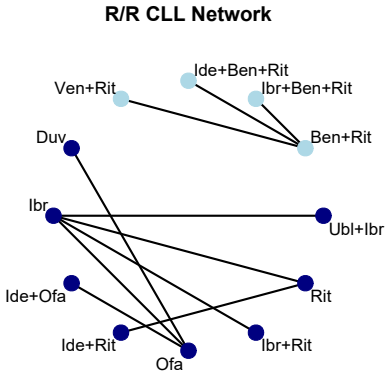
Component network meta-analysis (CNMA) is a statistical methodology that enables estimation of relative effects for multi-component treatments, such as combinations of antidepressants, and individual components, such as single antidepressants, by synthesizing data from multiple studies. A commonly desired output of a systematic review and meta-analysis is a hierarchy of the treatments in terms of a certain performance metric. Methods have been established for standard network meta-analysis (NMA), but have not yet been extended to CNMA. In particular, CNMA presents unique challenges because the set of relative effects that can be uniquely estimated is more complex to determine compared to standard NMA, and a hierarchy involving relative effects that are not uniquely estimable is misleading. We present a step-by-step workflow for answering treatment hierarchy questions in both frequentist and Bayesian CNMA, including explicitly identifying the uniquely estimable relative effects. We illustrate the workflow by posing multiple treatment hierarchy questions in two distinct networks, one concerning primary care of depression and one disconnected network investigating treatment for chronic lymphocytic leukemia.
Editorial analysis
A structured set of objections, weighed in public.
Referee Report
Summary. The manuscript proposes a step-by-step workflow for constructing treatment and component hierarchies in component network meta-analysis (CNMA) under both frequentist and Bayesian frameworks. The workflow centers on explicitly identifying the set of uniquely estimable relative effects from the network structure to avoid producing misleading rankings, and it is illustrated on a connected depression-treatment network and a disconnected chronic lymphocytic leukemia network.
Significance. If the workflow is shown to correctly isolate estimable effects without additional assumptions on parameterization or data rank, it would usefully extend existing NMA hierarchy techniques to the more complex setting of CNMA, where multi-component treatments are common. The provision of a reproducible, structure-based procedure could improve the reliability of rankings in systematic reviews of combination therapies.
major comments (2)
- [Abstract] Abstract: the central claim that network structure alone suffices to identify the uniquely estimable relative effects (and thereby guarantees non-misleading hierarchies) is not supported by any equations, rank conditions, or explicit handling of interaction terms; CNMA design matrices are typically rank-deficient beyond simple connectivity, and the disconnected CLL example is precisely the case where this distinction matters.
- [Workflow description] The workflow description (referenced in the abstract as the main contribution) does not address how the identification step changes when interaction parameters are added or when study-level data produce collinear columns, leaving open the possibility that theoretically unique effects become non-estimable once the full CNMA model is fitted.
minor comments (2)
- [Abstract] Abstract: the two illustrative networks are named but no numerical results, hierarchy outputs, or comparison with standard NMA hierarchies are shown, making it difficult to judge practical performance.
- [Results] Consider adding a short table or figure that contrasts the estimable set obtained from the proposed workflow with the full set of relative effects in at least one example network.
Simulated Author's Rebuttal
We thank the referee for their detailed review and constructive comments on our manuscript. We have carefully considered the points raised regarding the abstract and the workflow description. Our responses are provided below, and we indicate where revisions will be made to strengthen the paper.
read point-by-point responses
-
Referee: [Abstract] Abstract: the central claim that network structure alone suffices to identify the uniquely estimable relative effects (and thereby guarantees non-misleading hierarchies) is not supported by any equations, rank conditions, or explicit handling of interaction terms; CNMA design matrices are typically rank-deficient beyond simple connectivity, and the disconnected CLL example is precisely the case where this distinction matters.
Authors: We agree that the abstract would benefit from additional clarification on this point. The manuscript does describe the identification of estimable effects based on the network structure in Section 2, but we acknowledge the lack of explicit equations in the abstract. In the revised version, we will modify the abstract to briefly reference the rank conditions derived from the design matrix and note that the workflow applies to the standard additive CNMA model. For the disconnected CLL example, the workflow correctly identifies that certain cross-component effects are not estimable due to the network structure, which is a key feature rather than a limitation. We will add a short mathematical appendix detailing the rank conditions for both frequentist and Bayesian settings to support the claim. revision: yes
-
Referee: [Workflow description] The workflow description (referenced in the abstract as the main contribution) does not address how the identification step changes when interaction parameters are added or when study-level data produce collinear columns, leaving open the possibility that theoretically unique effects become non-estimable once the full CNMA model is fitted.
Authors: The workflow is primarily for the additive model without interactions, as interactions would require additional assumptions and data. However, we recognize the need to address this. In the revision, we will expand the workflow description to explain that when interaction terms are included, the identification step involves augmenting the design matrix with interaction columns and re-evaluating linear independence. Regarding collinear columns from study-level data, this is handled by the identification procedure, which checks for unique estimability; if collinearity occurs, those effects would be flagged as non-estimable. We will include a brief discussion and an illustrative example in the revised manuscript. revision: yes
Circularity Check
No circularity: workflow extends standard NMA estimability checks without self-reduction
full rationale
The paper presents a procedural workflow for constructing treatment and component hierarchies in CNMA by first determining the set of uniquely estimable relative effects from the network structure and design matrix. This step references established frequentist and Bayesian NMA techniques for rank and connectivity analysis rather than deriving new outputs from fitted parameters or prior self-citations. No equation or claim reduces a 'prediction' to an input by construction, nor does any load-bearing premise collapse to a self-citation chain or ansatz smuggled via prior work. The central output (hierarchy construction restricted to estimable effects) remains independently verifiable from the study-level data matrix and does not tautologically restate its own inputs.
Axiom & Free-Parameter Ledger
axioms (1)
- domain assumption Standard network meta-analysis assumptions extend directly to component network meta-analysis
Reference graph
Works this paper leans on
-
[1]
Ades, A. E. and Davies, Annabel L. and Phillippo, David M. and Pedder, Hugo and Thom, Howard and Downing, Beatrice and Caldwell, Deborah M. and Welton, Nicky J. , year = 2025, journal =. Treatment Recommendations Based on Network Meta-Analysis:
work page 2025
-
[2]
Ades, A. E. and Welton, Nicky J. and Dias, Sofia and Phillippo, David M. and Caldwell, Deborah M. , year = 2024, journal =. Twenty Years of Network Meta-Analysis:
work page 2024
-
[3]
Electronic Journal of Statistics , volume =
Simultaneous Confidence Intervals for Ranks Using the Partitioning Principle , author =. Electronic Journal of Statistics , volume =
-
[4]
Al Mohamad, Diaa and Goeman, Jelle J. and. Simultaneous. Biometrics , volume =
-
[5]
Allen, Claire and Walker, Andrew M. and Premji, Zahra A. and. Preventing Persistent Postsurgical Pain:. European Journal of Pain , volume =
- [6]
-
[7]
BMC Medical Research Methodology , volume =
B. BMC Medical Research Methodology , volume =
-
[8]
B. A. Bayesian Analysis , volume =
-
[9]
Belland, Brian R. and Walker, Andrew E. and Kim, Nam Ju , year = 2017, journal =. A
work page 2017
- [10]
-
[11]
Borenstein, Michael and Hedges, Larry V. and Higgins, Julian P. T. and Rothstein, Hannah R. , year = 2011, publisher =. Introduction to
work page 2011
-
[12]
Boussageon, R. How Do They Add up?. British Journal of Clinical Pharmacology , volume =
-
[13]
Bugeja, Ann and Hundemer, Gregory L. and McIsaac, Daniel I. , year = 2024, journal =. Authors Reply:
work page 2024
-
[14]
Bulluck, Heerajnarain and Kwok, Chun Shing and Ryding, Alisdair D. and Loke, Yoon K. , year = 2015, journal =. Safety of Short-Term Dual Antiplatelet Therapy after Drug-Eluting Stents:
work page 2015
-
[15]
Approaches for Synthesising Complex Mental Health Interventions in Meta-Analysis , author =. BMJ Ment Health , volume =
-
[16]
Journal of Clinical Epidemiology , volume =
Minimal Important Difference Estimates for Patient-Reported Outcomes:. Journal of Clinical Epidemiology , volume =
- [17]
-
[18]
Agreement between Ranking Metrics in Network Meta-Analysis: An Empirical Study , shorttitle =
Chiocchia, Virginia and Nikolakopoulou, Adriani and Papakonstantinou, Theodoros and Egger, Matthias and Salanti, Georgia , year = 2020, journal =. Agreement between Ranking Metrics in Network Meta-Analysis: An Empirical Study , shorttitle =
work page 2020
-
[19]
Mathematical Biosciences , volume =
Determining the Parametric Structure of Models , author =. Mathematical Biosciences , volume =
-
[20]
and Nikolakopoulou, Adriani , year = 2025, journal =
Curteis, Tristan and Wigle, Augustine and Michaels, Christopher J. and Nikolakopoulou, Adriani , year = 2025, journal =. Ranking of Treatments in Network Meta-Analysis: Incorporating Minimally Important Differences , shorttitle =
work page 2025
-
[21]
and Neupane, Binod and Beyene, Joseph and Thabane, Lehana and Straus, Sharon E
Daly, Caitlin H. and Neupane, Binod and Beyene, Joseph and Thabane, Lehana and Straus, Sharon E. and Hamid, Jemila S. , year = 2019, journal =. Empirical Evaluation of
work page 2019
-
[22]
Research Synthesis Methods , volume =
A Non-Parametric Approach for Jointly Combining Evidence on Progression Free and Overall Survival Time in Network Meta-Analysis , author =. Research Synthesis Methods , volume =
-
[23]
and Mbuagbaw, Lawrence and Thabane, Lehana and Straus, Sharon E
Daly, Caitlin H. and Mbuagbaw, Lawrence and Thabane, Lehana and Straus, Sharon E. and Hamid, Jemila S. , year = 2020, journal =. Spie Charts for Quantifying Treatment Effectiveness and Safety in Multiple Outcome Network Meta-Analysis: A Proof-of-Concept Study , shorttitle =
work page 2020
-
[24]
Davies, Annabel L. and Higgins, Julian P. T. , year = 2024, journal =. A
work page 2024
-
[25]
Research Synthesis Methods , volume =
Degree Irregularity and Rank Probability Bias in Network Meta-Analysis , author =. Research Synthesis Methods , volume =
-
[26]
and Galla, Tobias , year = 2022, journal =
Davies, Annabel L. and Galla, Tobias , year = 2022, journal =. Network Meta-Analysis: A Statistical Physics Perspective , shorttitle =
work page 2022
-
[27]
Minimal Important Change and Difference in Health Outcome:
Dekker, Joost and. Minimal Important Change and Difference in Health Outcome:. Osteoarthritis and Cartilage , volume =
-
[28]
Devine, Emily Beth and. Effectiveness of. Pharmacotherapy: The Journal of Human Pharmacology and Drug Therapy , volume =
-
[29]
Dias, Sofia and Ades, A. E. and Welton, Nicky J. and Jansen, Jeroen P. and Sutton, Alexander J. , year = 2018, publisher =. Network
work page 2018
-
[30]
Dias, Sofia and Welton, Nicky J. and Sutton, Alex J. and Ades, A. E. , year = 2014, abstract =
work page 2014
-
[31]
Assessing Key Assumptions of Network Meta-Analysis: A Review of Methods , shorttitle =
Donegan, Sarah and Williamson, Paula and D'Alessandro, Umberto and Tudur Smith, Catrin , year = 2013, journal =. Assessing Key Assumptions of Network Meta-Analysis: A Review of Methods , shorttitle =
work page 2013
-
[32]
and Chu, Haitao and Chen, Yong , year = 2023, journal =
Duan, Rui and Tong, Jiayi and Lin, Lifeng and Levine, Lisa and Sammel, Mary and Stoddard, Joel and Li, Tianjing and Schmid, Christopher H. and Chu, Haitao and Chen, Yong , year = 2023, journal =
work page 2023
-
[33]
and Petropoulou, Maria and Efthimiou, Orestis and Chen, Kee-Hsin , year = 2025, journal =
Efendi, Defi and Cheng, Adam and Wanda, Dessie and Furukawa, Toshi A. and Petropoulou, Maria and Efthimiou, Orestis and Chen, Kee-Hsin , year = 2025, journal =. Deconstructing Resuscitation Training for Healthcare Providers: A Protocol for a Component Network Meta-Analysis , shorttitle =
work page 2025
-
[34]
Statistics in Medicine , volume =
Bayesian Models for Aggregate and Individual Patient Data Component Network Meta-Analysis , author =. Statistics in Medicine , volume =
-
[35]
Network Meta-Analysis of Rare Events Using the
Efthimiou, Orestis and R. Network Meta-Analysis of Rare Events Using the. Statistics in Medicine , volume =
-
[36]
Evidence Based Mental Health , volume =
Practical Guide to the Meta-Analysis of Rare Events , author =. Evidence Based Mental Health , volume =
-
[37]
Elliott, William J. and Meyer, Peter M. , year = 2007, journal =. Incident Diabetes in Clinical Trials of Antihypertensive Drugs: A Network Meta-Analysis , shorttitle =
work page 2007
-
[38]
Journal of Clinical Epidemiology , volume =
Component Network Meta-Analysis Identifies the Most Effective Components of Psychological Preparation for Adults Undergoing Surgery under General Anesthesia , author =. Journal of Clinical Epidemiology , volume =
-
[39]
Freeman, Suzanne C. and Saeedi, Elnaz and. Data Visualisation Approaches for Component Network Meta-Analysis: Visualising the Data Structure , shorttitle =. BMC Medical Research Methodology , volume =
-
[40]
Furukawa, Yuki and Sakata, Masatsugu and Yamamoto, Ryuichiro and Nakajima, Shun and Kikuchi, Shino and Inoue, Mari and Ito, Masami and Noma, Hiroku and Takashina, Hikari Nishimura and Funada, Satoshi and Ostinelli, Edoardo G. and Furukawa, Toshi A. and Efthimiou, Orestis and Perlis, Michael , year = 2024, journal =. Components and
work page 2024
-
[41]
Garrett, Elizabeth S. and Zeger, Scott L. , year = 2000, journal =. Latent
work page 2000
-
[42]
Dabigatran, Rivaroxaban, or Apixaban versus Enoxaparin for Thromboprophylaxis after Total Hip or Knee Replacement: Systematic Review, Meta-Analysis, and Indirect Treatment Comparisons , shorttitle =. BMJ , volume =
-
[43]
Pest Management Science , volume =
A Network Meta-Analysis Provides New Insight into Fungicide Scheduling for the Control of. Pest Management Science , volume =
-
[44]
Guyatt, Gordon H. and Oxman, Andrew D. and Vist, Gunn E. and Kunz, Regina and. BMJ , volume =
-
[45]
Guyatt, Gordon and Oxman, Andrew D. and Akl, Elie A. and Kunz, Regina and Vist, Gunn and Brozek, Jan and Norris, Susan and. Journal of Clinical Epidemiology , volume =
-
[46]
Statistical Methods in Medical Research , volume =
A Dose-Effect Network Meta-Analysis Model with Application in Antidepressants Using Restricted Cubic Splines , author =. Statistical Methods in Medical Research , volume =
-
[47]
European Journal of Agronomy , volume =
A Comprehensive Network Meta-Analysis to Assess the Benefit of Starter Fertilization on Yield, Nutrient Uptake and Nutrient Use Efficiency , author =. European Journal of Agronomy , volume =
- [48]
-
[49]
Statistics in Medicine , volume =
Quantifying Heterogeneity in a Meta-Analysis , author =. Statistics in Medicine , volume =
-
[50]
Synthesising Quantitative Evidence in Systematic Reviews of Complex Health Interventions , author =. BMJ Global Health , volume =
-
[51]
Hothorn, Torsten and Bretz, Frank and Westfall, Peter , year = 2008, journal =. Simultaneous
work page 2008
-
[52]
and Chaimani, Anna and Schmid, Christopher H
Hutton, Brian and Salanti, Georgia and Caldwell, Deborah M. and Chaimani, Anna and Schmid, Christopher H. and Cameron, Chris and Ioannidis, John P.A. and Straus, Sharon and Thorlund, Kristian and Jansen, Jeroen P. and Mulrow, Cynthia and. The. Annals of Internal Medicine , volume =
-
[53]
Hutton, Brian and. The. Medicina Cl\'inica (English Edition) , volume =
-
[54]
Statistics in Medicine , volume =
A Design-by-Treatment Interaction Model for Network Meta-Analysis with Random Inconsistency Effects , author =. Statistics in Medicine , volume =
-
[55]
The Role of Identification in
-
[56]
Klein, Martin and Wright, Tommy and Wieczorek, Jerzy , year = 2020, journal =. A
work page 2020
- [57]
-
[58]
Research Synthesis Methods , volume =
A Comparison of Heterogeneity Variance Estimators in Simulated Random-Effects Meta-Analyses , author =. Research Synthesis Methods , volume =
-
[59]
Journal of the Royal Society of Medicine , volume =
The Development of Network Meta-Analysis , author =. Journal of the Royal Society of Medicine , volume =
-
[60]
Leucht, Stefan and Cipriani, Andrea and Spineli, Loukia and Mavridis, Dimitris and. Comparative Efficacy and Tolerability of 15 Antipsychotic Drugs in Schizophrenia: A Multiple-Treatments Meta-Analysis , shorttitle =. The Lancet , volume =
-
[61]
Research Synthesis Methods , volume =
Graphical Evaluation of Evidence Structure within a Component Network Meta-Analysis , author =. Research Synthesis Methods , volume =
-
[62]
and Chu, Haitao , year = 2019, journal =
Lian, Qinshu and Hodges, James S. and Chu, Haitao , year = 2019, journal =. A. 45218567 , eprinttype =
work page 2019
-
[63]
Journal of Clinical Epidemiology , volume =
Questionable Assumptions Hampered Interpretation of a Network Meta-Analysis of Primary Care Depression Treatments , author =. Journal of Clinical Epidemiology , volume =
-
[64]
Lu, Guobing and Ades, A. E , year = 2006, journal =. Assessing
work page 2006
-
[65]
Lu, Guobing and Welton, Nicky J. and Higgins, Julian P. T. and White, Ian R. and Ades, A E. , year = 2011, journal =. Linear Inference for Mixed Treatment Comparison Meta-Analysis:
work page 2011
-
[66]
Modeling Between-Trial Variance Structure in Mixed Treatment Comparisons , author =. Biostatistics , volume =
-
[67]
Statistics in Medicine , volume =
Network Meta-Analysis for Indirect Treatment Comparisons , author =. Statistics in Medicine , volume =
-
[68]
Madan, Jason and Chen, Yen-Fu and Aveyard, Paul and Wang, Dechao and Yahaya, Ismail and Munafo, Marcus and Bauld, Linda and Welton, Nicky , year = 2014, journal =. Synthesis of
work page 2014
-
[69]
Journal of Clinical Epidemiology , volume =
Considering Multiple Outcomes with Different Weights Informed the Hierarchy of Interventions in Network Meta-Analysis , author =. Journal of Clinical Epidemiology , volume =
-
[70]
Biometrical Journal , volume =
Extensions of the Probabilistic Ranking Metrics of Competing Treatments in Network Meta-Analysis to Reflect Clinically Important Relative Differences on Many Outcomes , author =. Biometrical Journal , volume =
-
[71]
Mawdsley, D and Bennetts, M and Dias, S and Boucher, M and Welton, Nj , year = 2016, journal =. Model-
work page 2016
-
[72]
Journal of Clinical Epidemiology , volume =
Calculating Additive Treatment Effects from Multiple Randomized Trials Provides Useful Estimates of Combination Therapies , author =. Journal of Clinical Epidemiology , volume =
-
[73]
Mills, Edward J and Druyts, Eric and Ghement, Isabella and Puhan, Milo A , year = 2011, journal =. Pharmacotherapies for Chronic Obstructive Pulmonary Disease: A Multiple Treatment Comparison Meta-Analysis , shorttitle =
work page 2011
-
[74]
Statistics in Medicine , volume =
Using Simulation Studies to Evaluate Statistical Methods , author =. Statistics in Medicine , volume =
-
[75]
Cochrane Database of Systematic Reviews , number =
Blood Pressure-lowering Efficacy of Monotherapy with Thiazide Diuretics for Primary Hypertension , author =. Cochrane Database of Systematic Reviews , number =
-
[76]
Nikolakopoulou, Adriani and Chaimani, Anna and Veroniki, Areti Angeliki and Vasiliadis, Haris S. and Schmid, Christopher H. and Salanti, Georgia , year = 2014, journal =. Characteristics of
work page 2014
-
[77]
Nikolakopoulou, Adriani and Higgins, Julian P. T. and Papakonstantinou, Theodoros and Chaimani, Anna and Giovane, Cinzia Del and Egger, Matthias and Salanti, Georgia , year = 2020, journal =
work page 2020
-
[78]
BMJ Evidence-Based Medicine , volume =
When Does the Placebo Effect Have an Impact on Network Meta-Analysis Results? , author =. BMJ Evidence-Based Medicine , volume =
-
[79]
Bayesian Network Meta-Analysis of Individual and Aggregate Data , urldate =
-
[80]
Get Access from Anywhere
discussion (0)
Sign in with ORCID, Apple, or X to comment. Anyone can read and Pith papers without signing in.