Recognition: 2 theorem links
· Lean TheoremComplete Local Reasoning About Parameterized Programs Over Topologies
Pith reviewed 2026-05-15 02:54 UTC · model grok-4.3
The pith
Safety verification of parameterized concurrent programs reduces to complete local proofs under suitable topology assumptions.
A machine-rendered reading of the paper's core claim, the machinery that carries it, and where it could break.
Core claim
Under reasonable assumptions on the underlying topology, the safety verification problem for parameterized concurrent programs can be reduced to a compositional scheme consisting of a finite set of local proofs that together establish a universally quantified inductive invariant for the entire family. The reduction is complete: success of the local proofs guarantees global safety. An algorithm implementing this scheme is presented and shown effective on benchmarks over several topologies.
What carries the argument
The compositional reduction that decomposes global safety verification of parameterized programs into a finite set of local proofs based on topology structure, yielding a universally quantified inductive invariant.
If this is right
- The algorithm automatically constructs the universally quantified inductive invariant needed for the proof.
- Verification succeeds for the reported benchmarks across multiple distinct topologies.
- The method applies to infinite-state programs because the local proofs avoid explicit global state enumeration.
- Once the topology assumptions hold, parameterized safety reduces to checking finitely many local conditions.
Where Pith is reading between the lines
- The same local-reasoning technique could be tested on liveness properties beyond safety if the topology decomposition extends naturally.
- Programs whose topologies evolve over time might admit similar reductions if the changes preserve the key structural properties.
- Integration with existing invariant-generation tools could automate the local-proof step for larger case studies.
Load-bearing premise
The communication topology must satisfy structural properties that allow global invariants to be decomposed completely into local proofs.
What would settle it
A specific topology and program pair where the local proofs all succeed yet a concrete global execution trace violates the safety property would show the reduction is incomplete.
Figures


read the original abstract
This paper investigates the algorithmic safety verification problem of infinite-state parameterized concurrent programs over a rich set of communication topologies. The goal is to automatically produce a proof of correctness in the form of a universally quantified inductive invariant, where the quantification is over the nodes in the topology. We illustrate that under reasonable assumptions on the underlying topology, the problem can be reduced to and solved as a compositional scheme, that is, the verification of the parameterized family is reduced to a set of local proofs, in a complete manner. We propose a verification algorithm, which is implemented as a tool, and demonstrate through a set of benchmarks over several different topologies that our approach is effective in proving parameterized programs safe.
Editorial analysis
A structured set of objections, weighed in public.
Referee Report
Summary. The paper claims that safety verification for infinite-state parameterized concurrent programs over communication topologies can be reduced, under reasonable assumptions on the topology, to a complete compositional scheme consisting of a finite set of local proofs; it presents a verification algorithm, implements it as a tool, and reports that the approach succeeds on a set of benchmarks across several topologies.
Significance. If the completeness direction holds under a precisely characterized class of topologies, the result would be significant for parameterized verification: it would provide an automatic route to universally quantified inductive invariants via local reasoning, addressing a core difficulty in verifying infinite families of systems such as distributed protocols.
major comments (2)
- [Abstract and opening sections] The central completeness claim (global safety implies existence of local proofs) rests on 'reasonable assumptions on the underlying topology' that are never enumerated as a concrete class of graphs or graph properties (e.g., bounded degree, absence of long cycles, regularity). Without such a characterization it is impossible to determine whether the reduction excludes precisely those topologies that would require additional global invariants.
- [Verification algorithm description] No derivation, proof sketch, or reduction steps are supplied showing how the local proofs are generated or why they are sufficient for global safety; the abstract and reported benchmark success therefore leave the soundness of the local-to-global direction unexamined.
minor comments (1)
- [Abstract] The abstract would be clearer if it listed the concrete topologies used in the benchmarks and stated the exact number of local proofs required in each case.
Simulated Author's Rebuttal
We thank the referee for the constructive comments, which help clarify the presentation of our completeness result. We address each major point below and will revise the manuscript accordingly to make the assumptions explicit and include an accessible proof sketch.
read point-by-point responses
-
Referee: [Abstract and opening sections] The central completeness claim (global safety implies existence of local proofs) rests on 'reasonable assumptions on the underlying topology' that are never enumerated as a concrete class of graphs or graph properties (e.g., bounded degree, absence of long cycles, regularity). Without such a characterization it is impossible to determine whether the reduction excludes precisely those topologies that would require additional global invariants.
Authors: We agree that an explicit characterization is needed. The assumptions in the paper are that the topologies are bounded-degree graphs admitting only finitely many distinct local neighborhood isomorphism types (covering rings, grids, tori, and hypercubes, among others). Under these conditions, global safety reduces to local proofs because any global execution projects to local ones and the finite neighborhood types allow a finite set of local invariants to compose. We will revise the abstract and Section 2 to state this class precisely as 'bounded-degree graphs with finitely many neighborhood types up to isomorphism' and discuss why it excludes topologies requiring non-local invariants. revision: yes
-
Referee: [Verification algorithm description] No derivation, proof sketch, or reduction steps are supplied showing how the local proofs are generated or why they are sufficient for global safety; the abstract and reported benchmark success therefore leave the soundness of the local-to-global direction unexamined.
Authors: The full manuscript derives the algorithm in Section 3 via a fixed-point computation over local state templates and proves soundness/completeness in Section 5 by showing that local invariants imply global safety via topology-induced composition and that any global invariant projects to local ones. We acknowledge that an early high-level sketch is absent. We will add a concise outline in the introduction: (1) generate candidate local invariants by solving constraints from transitions and neighborhood templates; (2) local-to-global sufficiency follows from the finite neighborhood assumption ensuring every global step is covered by some local proof; (3) completeness by existential abstraction over non-local nodes. revision: yes
Circularity Check
No significant circularity; completeness grounded in external topology assumptions
full rationale
The paper claims that under reasonable assumptions on the underlying topology, parameterized verification reduces completely to a finite set of local proofs. No equations, fitted parameters, or self-citations are exhibited in the abstract or described text that would make the claimed reduction equivalent to its inputs by construction. The derivation chain treats topology properties as independent external inputs rather than self-defining or self-citing constructs. This is the normal non-circular case; the completeness result stands or falls on the (unspecified here) topology class but does not reduce tautologically to prior author work or data fits.
Axiom & Free-Parameter Ledger
axioms (1)
- domain assumption reasonable assumptions on the underlying topology enable complete reduction to local proofs
Lean theorems connected to this paper
-
IndisputableMonolith/Foundation/RealityFromDistinction.leanreality_from_one_distinction unclear?
unclearRelation between the paper passage and the cited Recognition theorem.
under reasonable assumptions on the underlying topology, the problem can be reduced to and solved as a compositional scheme... verification of the parameterized family is reduced to a set of local proofs, in a complete manner
-
IndisputableMonolith/Cost/FunctionalEquation.leanwashburn_uniqueness_aczel unclear?
unclearRelation between the paper passage and the cited Recognition theorem.
normalized Ashcroft assertion... quantifier-free k-types... representative terms
What do these tags mean?
- matches
- The paper's claim is directly supported by a theorem in the formal canon.
- supports
- The theorem supports part of the paper's argument, but the paper may add assumptions or extra steps.
- extends
- The paper goes beyond the formal theorem; the theorem is a base layer rather than the whole result.
- uses
- The paper appears to rely on the theorem as machinery.
- contradicts
- The paper's claim conflicts with a theorem or certificate in the canon.
- unclear
- Pith found a possible connection, but the passage is too broad, indirect, or ambiguous to say the theorem truly supports the claim.
Reference graph
Works this paper leans on
-
[1]
International Journal on Software Tools for Technology Transfer18(5), 469–473 (Oct 2016)
Abdulla, P.A., Delzanno, G.: Parameterized verification. International Journal on Software Tools for Technology Transfer18(5), 469–473 (Oct 2016). https://doi.or g/10.1007/s10009-016-0424-3
-
[2]
In: Giacobazzi, R., Berdine, J., Mastroeni, I
Abdulla, P.A., Haziza, F., Holík, L.: All for the Price of Few. In: Giacobazzi, R., Berdine, J., Mastroeni, I. (eds.) Verification, Model Checking, and Abstract Interpretation. pp. 476–495. Springer, Berlin, Heidelberg (2013). https://doi.org/ 10.1007/978-3-642-35873-9_28
-
[3]
Distributed Computing31(3), 187–222 (Jun 2018)
Aminof,B.,Kotek,T.,Rubin,S.,Spegni,F.,Veith,H.:Parameterizedmodelcheck- ing of rendezvous systems. Distributed Computing31(3), 187–222 (Jun 2018). https://doi.org/10.1007/s00446-017-0302-6
-
[4]
Information Processing Letters22(6), 307–309 (May 1986)
Apt, K.R., Kozen, D.C.: Limits for automatic verification of finite-state concurrent systems. Information Processing Letters22(6), 307–309 (May 1986). https://doi. org/10.1016/0020-0190(86)90071-2
-
[5]
(eds.) Computer Aided Verification
Arons, T., Pnueli, A., Ruah, S., Xu, Y., Zuck, L.: Parameterized Verification with Automatically Computed Inductive Assertions? In: Berry, G., Comon, H., Finkel, A. (eds.) Computer Aided Verification. pp. 221–234. Springer, Berlin, Heidelberg (2001). https://doi.org/10.1007/3-540-44585-4_19
-
[6]
Ashmore, R., Gurfinkel, A., Trefler, R.: Local Reasoning for Parameterized First Order Protocols. In: Badger, J.M., Rozier, K.Y. (eds.) NASA Formal Methods. pp. 36–53. Springer International Publishing, Cham (2019). https://doi.org/10.1007/ 978-3-030-20652-9_3
work page 2019
-
[7]
Blicha, M., Britikov, K., Sharygina, N.: The Golem Horn Solver. In: Enea, C., Lal, A. (eds.) Computer Aided Verification. pp. 209–223. Springer Nature Switzerland, Cham (2023). https://doi.org/10.1007/978-3-031-37703-7_10 22 Ruotong Cheng and Azadeh Farzan
-
[8]
Communica- tions of the ACM22(5), 281–283 (May 1979)
Chang, E., View Profile, Roberts, R., View Profile: An improved algorithm for decentralized extrema-finding in circular configurations of processes. Communica- tions of the ACM22(5), 281–283 (May 1979). https://doi.org/10.1145/359104.3 59108
-
[9]
https://doi.org/10.48550/arXiv.2601.18745
Cheng, R., Farzan, A.: Symmetric Proofs of Parameterized Programs (Jan 2026). https://doi.org/10.48550/arXiv.2601.18745
-
[10]
In: Ramakrishnan, C.R., Rehof, J
de Moura, L., Bjørner, N.: Z3: An Efficient SMT Solver. In: Ramakrishnan, C.R., Rehof, J. (eds.) Tools and Algorithms for the Construction and Analysis of Sys- tems. pp. 337–340. Springer, Berlin, Heidelberg (2008). https://doi.org/10.1007/ 978-3-540-78800-3_24
work page 2008
-
[11]
In: Proceedings of the 22nd ACM SIGPLAN-SIGACT Symposium on Principles of Programming Languages
Emerson, E.A., Namjoshi, K.S.: Reasoning about rings. In: Proceedings of the 22nd ACM SIGPLAN-SIGACT Symposium on Principles of Programming Languages. pp. 85–94. POPL ’95, Association for Computing Machinery, New York, NY, USA (Jan 1995). https://doi.org/10.1145/199448.199468
-
[12]
Emmi, M., Majumdar, R., Manevich, R.: Parameterized verification of transac- tional memories. In: Proceedings of the 31st ACM SIGPLAN Conference on Pro- gramming Language Design and Implementation. pp. 134–145. PLDI ’10, As- sociation for Computing Machinery, New York, NY, USA (Jun 2010). https: //doi.org/10.1145/1806596.1806613
-
[13]
Farzan, A., Kincaid, Z., Podelski, A.: Proof Spaces for Unbounded Parallelism. In: Proceedings of the 42nd Annual ACM SIGPLAN-SIGACT Symposium on Prin- ciples of Programming Languages. pp. 407–420. ACM, Mumbai India (Jan 2015). https://doi.org/10.1145/2676726.2677012
-
[14]
Proceedings of the ACM on Programming Languages8(POPL), 2485–2513 (Jan 2024)
Farzan, A., Klumpp, D., Podelski, A.: Commutativity Simplifies Proofs of Parame- terized Programs. Proceedings of the ACM on Programming Languages8(POPL), 2485–2513 (Jan 2024). https://doi.org/10.1145/3632925
-
[15]
Feldman, Y.M.Y., Padon, O., Immerman, N., Sagiv, M., Shoham, S.: Bounded Quantifier Instantiation for Checking Inductive Invariants. In: Legay, A., Margaria, T. (eds.) Tools and Algorithms for the Construction and Analysis of Systems. pp. 76–95. Springer, Berlin, Heidelberg (2017). https://doi.org/10.1007/978-3-662-5 4577-5_5
-
[16]
Grebenshchikov, S., Lopes, N.P., Popeea, C., Rybalchenko, A.: Synthesizing soft- ware verifiers from proof rules. In: Proceedings of the 33rd ACM SIGPLAN Confer- ence on Programming Language Design and Implementation. pp. 405–416. PLDI ’12, Association for Computing Machinery, New York, NY, USA (Jun 2012). https://doi.org/10.1145/2254064.2254112
-
[17]
Gurfinkel, A., Shoham, S., Meshman, Y.: SMT-based verification of parameter- ized systems. In: Proceedings of the 2016 24th ACM SIGSOFT International Symposium on Foundations of Software Engineering. pp. 338–348. FSE 2016, Association for Computing Machinery, New York, NY, USA (Nov 2016). https: //doi.org/10.1145/2950290.2950330
-
[18]
Haziza, F.: Few is Just Enough! : Small Model Theorem for Parameterized Verifi- cation and Shape Analysis (2015)
work page 2015
-
[19]
Cambridge University Press, Cambridge ; New York (1997)
Hodges, W.: A Shorter Model Theory. Cambridge University Press, Cambridge ; New York (1997)
work page 1997
-
[20]
In: Proceedings of the 44th ACM SIGPLAN Symposium on Principles of Programming Languages
Hoenicke, J., Majumdar, R., Podelski, A.: Thread modularity at many levels: A pearl in compositional verification. In: Proceedings of the 44th ACM SIGPLAN Symposium on Principles of Programming Languages. pp. 473–485. ACM, Paris France (Jan 2017). https://doi.org/10.1145/3009837.3009893 Complete Local Reasoning About Parameterized Programs Over Topologies 23
-
[21]
In: 2018 Formal Methods in Computer Aided Design (FMCAD)
Hojjat, H., Rümmer, P.: The ELDARICA Horn Solver. In: 2018 Formal Methods in Computer Aided Design (FMCAD). pp. 1–7 (Oct 2018). https://doi.org/10.239 19/FMCAD.2018.8603013
-
[22]
Hojjat, H., Rümmer, P., Subotic, P., Yi, W.: Horn Clauses for Communicating Timed Systems. EPTCS169, 39–52 (2014)
work page 2014
-
[23]
Koenig, J.R., View Profile, Padon, O., View Profile, Immerman, N., View Profile, Aiken, A., View Profile: First-order quantified separators. In: Proceedings of the 41st ACM SIGPLAN Conference on Programming Language Design and Imple- mentation, pp. 703–717. ACM Conferences (Jun 2020). https://doi.org/10.1145/ 3385412.3386018
-
[24]
Formal Methods in System Design48(3), 175–205 (Jun 2016)
Komuravelli, A., Gurfinkel, A., Chaki, S.: SMT-based model checking for recursive programs. Formal Methods in System Design48(3), 175–205 (Jun 2016). https: //doi.org/10.1007/s10703-016-0249-4
-
[25]
Texts in Theoretical Computer Science
Kroening, D., Strichman, O.: Decision Procedures. Texts in Theoretical Computer Science. An EATCS Series, Springer Berlin Heidelberg, Berlin, Heidelberg (2016). https://doi.org/10.1007/978-3-662-50497-0
-
[26]
Springer Berlin Heidelberg, Berlin, Heidelberg (2004)
Libkin, L.: Elements of Finite Model Theory. Springer Berlin Heidelberg, Berlin, Heidelberg (2004). https://doi.org/10.1007/978-3-662-07003-1
-
[27]
Monniaux, D., Gonnord, L.: Cell Morphing: From Array Programs to Array-Free Horn Clauses. In: Rival, X. (ed.) Static Analysis. pp. 361–382. Springer, Berlin, Heidelberg (2016). https://doi.org/10.1007/978-3-662-53413-7_18
-
[28]
Namjoshi, K.S.: Symmetry and Completeness in the Analysis of Parameterized Systems. In: Cook, B., Podelski, A. (eds.) Verification, Model Checking, and Ab- stract Interpretation. pp. 299–313. Springer, Berlin, Heidelberg (2007). https: //doi.org/10.1007/978-3-540-69738-1_22
-
[29]
In: Kuncak, V., Rybalchenko, A
Namjoshi, K.S., Trefler, R.J.: Local Symmetry and Compositional Verification. In: Kuncak, V., Rybalchenko, A. (eds.) Verification, Model Checking, and Abstract In- terpretation, vol. 7148, pp. 348–362. Springer Berlin Heidelberg, Berlin, Heidelberg (2012). https://doi.org/10.1007/978-3-642-27940-9_23
-
[30]
Namjoshi, K.S., Trefler, R.J.: Parameterized Compositional Model Checking. In: Chechik, M., Raskin, J.F. (eds.) Tools and Algorithms for the Construction and Analysis of Systems. pp. 589–606. Springer, Berlin, Heidelberg (2016). https://do i.org/10.1007/978-3-662-49674-9_39
-
[31]
Namjoshi, K.S., Trefler, R.J.: Symmetry Reduction for the Local Mu-Calculus. In: Beyer, D., Huisman, M. (eds.) Tools and Algorithms for the Construction and Analysis of Systems. pp. 379–395. Springer International Publishing, Cham (2018). https://doi.org/10.1007/978-3-319-89963-3_22
-
[32]
ACM SIGPLAN Notices51(6), 614–630 (Jun 2016)
Padon, O., View Profile, McMillan, K.L., View Profile, Panda, A., View Pro- file, Sagiv, M., View Profile, Shoham, S., View Profile: Ivy: Safety verification by interactive generalization. ACM SIGPLAN Notices51(6), 614–630 (Jun 2016). https://doi.org/10.1145/2980983.2908118
-
[33]
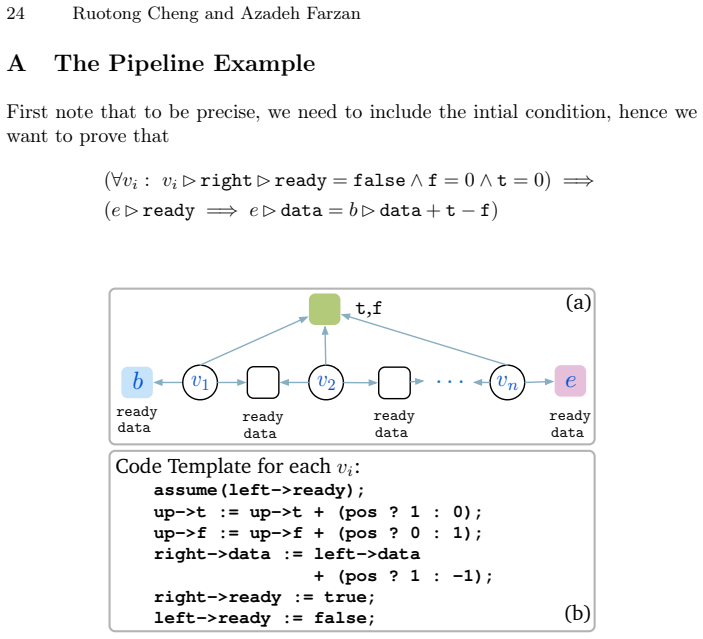
Pnueli, A., Ruah, S., Zuck, L.: Automatic Deductive Verification with Invisible Invariants. In: Margaria, T., Yi, W. (eds.) Tools and Algorithms for the Con- struction and Analysis of Systems. pp. 82–97. Springer, Berlin, Heidelberg (2001). https://doi.org/10.1007/3-540-45319-9_7 24 Ruotong Cheng and Azadeh Farzan A The Pipeline Example First note that to...
-
[34]
, νk]and tuplev∈T ′k, ifµ|= φ(v), thenβ ∗µ|=φ(β −1(v))
For anyQF-Ashcroftformulaφ[ν 1, . . . , νk]and tuplev∈T ′k, ifµ|= φ(v), thenβ ∗µ|=φ(β −1(v))
-
[35]
For any Ashcroft assertionΦ, ifµ|=Φ, thenβ ∗µ|=Φ. Proof.Letφ[ν 1, . . . , νk]be aQF-Ashcroftformula and tuplev∈T ′k. State- ment 1 can be shown by induction on the structure ofφ. For instance, as a base case, ifφis a formula of the formϕ[µ(ν1), . . . ,µ(νk)], whereϕis aV Data-formula, then µ|=φ(v)⇐ ⇒D|=ϕ(µ(v 1), . . . , µ(vk)) ⇐ ⇒D|=ϕ((β ∗µ)(β−1(v1)), . ....
-
[36]
There are finitely many quantifier-freek-typesT1, . . . , Tm inT, and everyT r is definable by a quantifier-free formulaαr, i.e., for anyV-structureTand v∈T k, we haveT|=α r(v)⇐ ⇒qftype(T,v) =T r. Moreover, the formula defining the quantifier-freek-type of a given node tuple inTis computable
-
[37]
Any quantifier-free formula withkfree variables is equivalent overTto a disjunction of a subset of theαr’s. Proof.1. LetT∈ Tandv∈T k. For eachu∈N(v), lett u[ν]be aV-term of minimal height such thatt u(v) =u. Letαbe the conjunction of the following formulas: –tvi =ν i for eachi∈ {1, . . . , k}; –tu1 ̸=t u2 for all distinctu1, u2 ∈N(v); –for all relation sy...
-
[38]
Letϕbe a quantifier-free formula withkvariables
Combining 1 and Proposition 1, we have that any≃-equivalence class of node tuples of lengthkinTis definable by someα r. Letϕbe a quantifier-free formula withkvariables. The class of node tu- ples inTdefined byϕis closed under≃-equivalence. Thus, it is a union of≃-equivalence classes. Take the disjunction of theα r’s that define each equivalence class.⊓ ⊔ ...
discussion (0)
Sign in with ORCID, Apple, or X to comment. Anyone can read and Pith papers without signing in.