Recognition: 2 theorem links
· Lean TheoremWarp-as-History: Generalizable Camera-Controlled Video Generation from One Training Video
Pith reviewed 2026-05-15 03:12 UTC · model grok-4.3
The pith
A simple interface turns camera warps into pseudo-history inputs, enabling frozen video models to follow trajectories without training or optimization.
A machine-rendered reading of the paper's core claim, the machinery that carries it, and where it could break.
Core claim
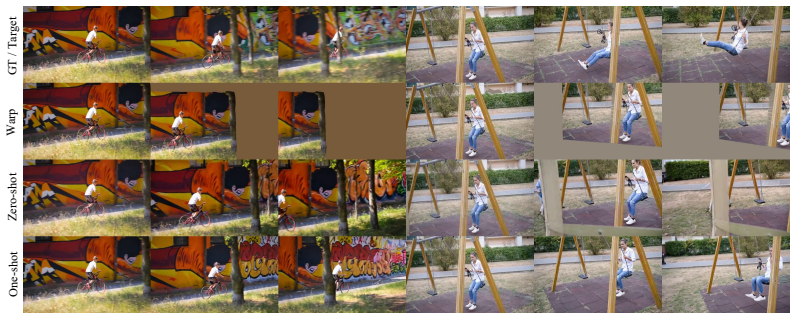
We propose Warp-as-History, a simple interface that turns camera-induced warps into camera-warped pseudo-history with target-frame positional alignment and visible-token selection. Given a target camera trajectory, we construct camera-warped pseudo-history from past observations and feed it through the model's visual-history pathway. Crucially, we align its positional encoding with the target frames being denoised and remove warped-history tokens without valid source observations. Without any training, architectural modification, or test-time optimization, this interface reveals a non-trivial zero-shot capability of a frozen video generation model to follow camera trajectories. Moreover, a 1
What carries the argument
Warp-as-History interface that converts camera-induced warps into camera-warped pseudo-history with target-frame positional alignment and visible-token selection, then routes the result through the model's existing visual-history pathway.
If this is right
- Frozen pre-trained video generation models gain the ability to follow prescribed camera trajectories in a zero-shot setting.
- Lightweight offline LoRA fine-tuning on one camera-annotated video improves camera adherence, visual quality, and motion dynamics.
- The improved capability generalizes to unseen videos without any target-video adaptation or test-time optimization.
- Camera control no longer requires post-training on large-scale camera-annotated datasets or architectural modifications.
Where Pith is reading between the lines
- Pre-trained models appear to encode implicit 3D viewpoint understanding within their history pathways that can be activated by warped inputs.
- Similar warp-based history construction might allow control over other video attributes such as object motion or lighting by repurposing the same pathway.
- This approach could lower barriers for developing controllable video generators by reducing dependence on massive annotated training collections.
- Limits may appear with complex multi-turn camera paths or long sequences where accumulated warp errors become visible.
Load-bearing premise
The pre-trained model's visual-history pathway can interpret camera-warped pseudo-history inputs without the warps introducing artifacts that break motion coherence or visual quality.
What would settle it
If videos generated with the warped pseudo-history inputs consistently fail to match the prescribed camera trajectory or exhibit motion artifacts and quality loss, the zero-shot capability claim would be falsified.
Figures



read the original abstract
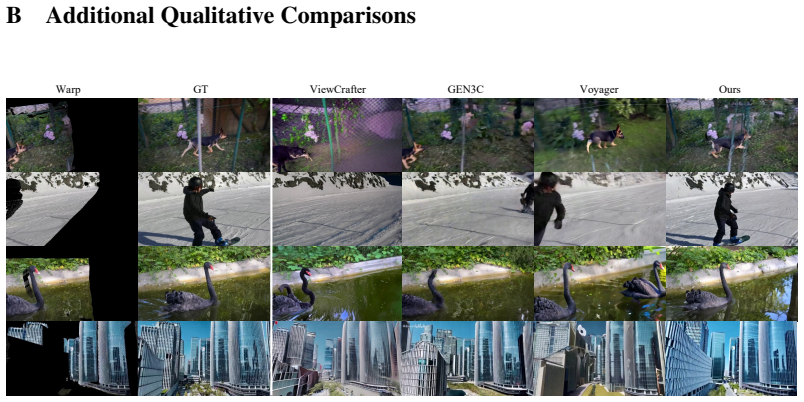
Camera-controlled video generation has made substantial progress, enabling generated videos to follow prescribed viewpoint trajectories. However, existing methods usually learn camera-specific conditioning through camera encoders, control branches, or attention and positional-encoding modifications, which often require post-training on large-scale camera-annotated videos. Training-free alternatives avoid such post-training, but often shift the cost to test-time optimization or extra denoising-time guidance. We propose Warp-as-History, a simple interface that turns camera-induced warps into camera-warped pseudo-history with target-frame positional alignment and visible-token selection. Given a target camera trajectory, we construct camera-warped pseudo-history from past observations and feed it through the model's visual-history pathway. Crucially, we align its positional encoding with the target frames being denoised and remove warped-history tokens without valid source observations. Without any training, architectural modification, or test-time optimization, this interface reveals a non-trivial zero-shot capability of a frozen video generation model to follow camera trajectories. Moreover, lightweight offline LoRA finetuning on only one camera-annotated video further improves this capability and generalizes to unseen videos, improving camera adherence, visual quality, and motion dynamics without test-time optimization or target-video adaptation. Extensive experiments on diverse datasets confirm the effectiveness of our method.
Editorial analysis
A structured set of objections, weighed in public.
Referee Report
Summary. The manuscript proposes Warp-as-History, a simple interface for camera-controlled video generation. Given a target camera trajectory, it constructs camera-warped pseudo-history from past frames with positional alignment to target frames and masking of invalid tokens, then feeds this through the visual-history pathway of a frozen pre-trained video generation model. The central claims are that this yields non-trivial zero-shot camera trajectory following without any training, architectural changes, or test-time optimization, and that lightweight offline LoRA finetuning on a single camera-annotated video further improves camera adherence, visual quality, and motion dynamics while generalizing to unseen videos.
Significance. If the zero-shot and single-video generalization claims hold under rigorous validation, the work would be significant for showing that pre-trained video models already encode usable camera-control pathways that can be activated via input warping alone. This would reduce reliance on large-scale camera-annotated datasets or per-video optimization, offering a practical route to controllable generation.
major comments (2)
- [§3] §3 (method description): The construction of camera-warped pseudo-history necessarily introduces disocclusions, stretching, and lighting mismatches. The paper provides no quantitative ablation measuring how these artifacts affect motion coherence or whether the frozen model resolves them as camera-induced change versus noise; this directly bears on the zero-shot claim.
- [§4] §4 (experiments): The reported improvements from single-video LoRA and zero-shot results lack error bars, multiple random seeds, or statistical tests across the diverse datasets. Without these, it is unclear whether the generalization to unseen videos is robust or could be explained by dataset-specific memorization of artifact patterns.
minor comments (2)
- [Abstract] The abstract states 'extensive experiments confirm effectiveness' but the main text should explicitly list the camera-adherence metrics (e.g., rotation/translation error) and visual-quality metrics used in all tables.
- [§3.1] Notation for 'visible-token selection' and 'target-frame positional alignment' is introduced without a small diagram or pseudocode; adding one would clarify the interface for readers.
Simulated Author's Rebuttal
We thank the referee for the constructive comments, which help clarify the validation needed for our zero-shot and single-video generalization claims. We address each major point below and will incorporate revisions to strengthen the empirical support.
read point-by-point responses
-
Referee: [§3] §3 (method description): The construction of camera-warped pseudo-history necessarily introduces disocclusions, stretching, and lighting mismatches. The paper provides no quantitative ablation measuring how these artifacts affect motion coherence or whether the frozen model resolves them as camera-induced change versus noise; this directly bears on the zero-shot claim.
Authors: We agree that the warping step can introduce disocclusions, stretching, and lighting mismatches. Our method mitigates these via explicit masking of invalid tokens (removing those without valid source observations) and positional alignment of the warped history to the target frames. The zero-shot results across datasets indicate the frozen model interprets the input as coherent camera motion rather than noise, as reflected in improved camera adherence and motion metrics. To directly quantify the artifacts' impact, we will add an ablation study in the revision that compares motion coherence (e.g., via optical-flow consistency and perceptual metrics) under controlled warping degradation versus the full masked approach. revision: yes
-
Referee: [§4] §4 (experiments): The reported improvements from single-video LoRA and zero-shot results lack error bars, multiple random seeds, or statistical tests across the diverse datasets. Without these, it is unclear whether the generalization to unseen videos is robust or could be explained by dataset-specific memorization of artifact patterns.
Authors: We concur that reporting variability and statistical tests would better substantiate robustness. The current results show consistent gains on multiple diverse datasets, but we did not include error bars or multi-seed runs in the initial submission. In the revision we will rerun the zero-shot and LoRA experiments with at least three random seeds, add error bars to all tables, and include statistical significance tests (e.g., paired t-tests) to confirm that improvements are not attributable to dataset-specific artifact memorization. revision: yes
Circularity Check
No significant circularity in the Warp-as-History interface
full rationale
The paper presents Warp-as-History as a simple interface that constructs camera-warped pseudo-history from past observations, aligns positional encodings with target frames, masks invalid tokens, and feeds the result through an existing frozen video model's visual-history pathway. This is described as revealing an emergent zero-shot capability without training or architectural changes. The optional single-video LoRA finetuning is presented as lightweight empirical adaptation that generalizes, not as a fitted parameter renamed as prediction. No equations, self-definitional reductions, fitted-input predictions, or load-bearing self-citations appear in the method description; the central claims rest on the pre-trained model's existing pathways and external empirical validation rather than any closed-form equivalence to inputs by construction.
Axiom & Free-Parameter Ledger
axioms (1)
- domain assumption A pre-trained video generation model possesses a visual-history pathway whose internal representations can be steered by camera-warped pseudo-history inputs.
Lean theorems connected to this paper
-
IndisputableMonolith/Foundation/Cost/FunctionalEquation.leanwashburn_uniqueness_aczel unclear?
unclearRelation between the paper passage and the cited Recognition theorem.
We propose Warp-as-History, a simple interface that turns camera-induced warps into camera-warped pseudo-history with target-frame positional alignment and visible-token selection... feed it through the model’s visual-history pathway.
What do these tags mean?
- matches
- The paper's claim is directly supported by a theorem in the formal canon.
- supports
- The theorem supports part of the paper's argument, but the paper may add assumptions or extra steps.
- extends
- The paper goes beyond the formal theorem; the theorem is a base layer rather than the whole result.
- uses
- The paper appears to rely on the theorem as machinery.
- contradicts
- The paper's claim conflicts with a theorem or certificate in the canon.
- unclear
- Pith found a possible connection, but the passage is too broad, indirect, or ambiguous to say the theorem truly supports the claim.
Reference graph
Works this paper leans on
-
[1]
Yixiang Dai, Fan Jiang, Chiyu Wang, Mu Xu, and Yonggang Qi. FantasyWorld: Geometry-consistent world modeling via unified video and 3d prediction.arXiv preprint arXiv:2509.21657,
-
[2]
CameraCtrl: Enabling Camera Control for Text-to-Video Generation
Hao He, Yinghao Xu, Yuwei Guo, Gordon Wetzstein, Bo Dai, Hongsheng Li, and Ceyuan Yang. Cam- eraCtrl: Enabling camera control for text-to-video generation.arXiv preprint arXiv:2404.02101,
work page internal anchor Pith review Pith/arXiv arXiv
-
[3]
Training-free camera control for video generation.arXiv preprint arXiv:2406.10126,
Chen Hou and Zhibo Chen. Training-free camera control for video generation.arXiv preprint arXiv:2406.10126,
-
[4]
Self Forcing: Bridging the Train-Test Gap in Autoregressive Video Diffusion
Tianyu Huang, Wangguandong Zheng, Tengfei Wang, Yuhao Liu, Zhenwei Wang, Junta Wu, Jie Jiang, Hui Li, Rynson Lau, Wangmeng Zuo, et al. V oyager: Long-range and world-consistent video diffusion for explorable 3d scene generation.ACM Transactions on Graphics (TOG), 44(6): 1–15, 2025a. Xun Huang, Zhengqi Li, Guande He, Mingyuan Zhou, and Eli Shechtman. Self ...
work page internal anchor Pith review Pith/arXiv arXiv
-
[5]
Cameras as relative positional encoding.arXiv preprint arXiv:2507.10496,
Ruilong Li, Brent Yi, Junchen Liu, Hang Gao, Yi Ma, and Angjoo Kanazawa. Cameras as relative positional encoding.arXiv preprint arXiv:2507.10496,
-
[6]
Novel view extrapolation with video diffusion priors.arXiv preprint arXiv:2411.14208,
Kunhao Liu, Ling Shao, and Shijian Lu. Novel view extrapolation with video diffusion priors.arXiv preprint arXiv:2411.14208,
-
[7]
Chenxi Song, Yanming Yang, Tong Zhao, Ruibo Li, and Chi Zhang. WorldForge: Unlocking emergent 3d/4d generation in video diffusion model via training-free guidance.arXiv preprint arXiv:2509.15130, 2025a. Kiwhan Song, Boyuan Chen, Max Simchowitz, Yilun Du, Russ Tedrake, and Vincent Sitzmann. History-guided video diffusion.arXiv preprint arXiv:2502.06764, 20...
-
[8]
Wenqiang Sun, Haiyu Zhang, Haoyuan Wang, Junta Wu, Zehan Wang, Zhenwei Wang, Yunhong Wang, Jun Zhang, Tengfei Wang, and Chunchao Guo. Worldplay: Towards long-term geometric consistency for real-time interactive world modeling.arXiv preprint arXiv:2512.14614,
-
[9]
$\pi^3$: Permutation-Equivariant Visual Geometry Learning
Yifan Wang, Jianjun Zhou, Haoyi Zhu, Wenzheng Chang, Yang Zhou, Zizun Li, Junyi Chen, Jiangmiao Pang, Chunhua Shen, and Tong He. π3: Permutation-equivariant visual geometry learning.arXiv preprint arXiv:2507.13347,
work page internal anchor Pith review Pith/arXiv arXiv
-
[10]
Video world models with long-term spatial memory.arXiv preprint arXiv:2506.05284,
Tong Wu, Shuai Yang, Ryan Po, Yinghao Xu, Ziwei Liu, Dahua Lin, and Gordon Wetzstein. Video world models with long-term spatial memory.arXiv preprint arXiv:2506.05284,
-
[11]
CogVideoX: Text-to-Video Diffusion Models with An Expert Transformer
Zhuoyi Yang, Jiayan Teng, Wendi Zheng, Ming Ding, Shiyu Huang, Jiazheng Xu, Yuanming Yang, Wenyi Hong, Xiaohan Zhang, Guanyu Feng, et al. CogVideoX: Text-to-video diffusion models with an expert transformer.arXiv preprint arXiv:2408.06072,
work page internal anchor Pith review Pith/arXiv arXiv
-
[12]
Meng You, Zhiyu Zhu, Hui Liu, and Junhui Hou. NVS-Solver: Video diffusion model as zero-shot novel view synthesizer.arXiv preprint arXiv:2405.15364,
-
[13]
Context as memory: Scene-consistent interactive long video generation with memory retrieval
Jiwen Yu, Jianhong Bai, Yiran Qin, Quande Liu, Xintao Wang, Pengfei Wan, Di Zhang, and Xihui Liu. Context as memory: Scene-consistent interactive long video generation with memory retrieval. InProceedings of the SIGGRAPH Asia 2025 Conference Papers, pages 1–11,
work page 2025
-
[14]
ViewCrafter: Taming Video Diffusion Models for High-fidelity Novel View Synthesis
Wangbo Yu, Jinbo Xing, Li Yuan, Wenbo Hu, Xiaoyu Li, Zhipeng Huang, Xiangjun Gao, Tien- Tsin Wong, Ying Shan, and Yonghong Tian. Viewcrafter: Taming video diffusion models for high-fidelity novel view synthesis.arXiv preprint arXiv:2409.02048,
work page internal anchor Pith review Pith/arXiv arXiv
-
[15]
Helios: Real real-time long video generation model.arXiv preprint arXiv:2603.04379,
Shenghai Yuan, Yuanyang Yin, Zongjian Li, Xinwei Huang, Xiao Yang, and Li Yuan. Helios: Real real-time long video generation model.arXiv preprint arXiv:2603.04379,
-
[16]
Unified camera positional encoding for controlled video generation.arXiv preprint arXiv:2512.07237,
Cheng Zhang, Boying Li, Meng Wei, Yan-Pei Cao, Camilo Cruz Gambardella, Dinh Phung, and Jianfei Cai. Unified camera positional encoding for controlled video generation.arXiv preprint arXiv:2512.07237,
-
[17]
Stereo Magnification: Learning View Synthesis using Multiplane Images
Tinghui Zhou, Richard Tucker, John Flynn, Graham Fyffe, and Noah Snavely. Stereo magnification: Learning view synthesis using multiplane images.arXiv preprint arXiv:1805.09817,
work page internal anchor Pith review Pith/arXiv arXiv
-
[18]
Here we provide the exact evaluation settings, full interface-ablation tables, and auxiliary external-baseline metrics omitted from the compact main tables. Training and sequence selection.Training videos are sampled from sequences disjoint from all evaluation videos. When evaluation is reported on a subset for compute reasons, the subset is randomly sele...
work page 2025
-
[19]
Regime Setting PSNR↑SSIM↑LPIPS↓Vis. LPIPS↓R-Err↓T-Err↓FID↓FVD↓DOVER↑Flicker↑Motion↑Subject↑Backgr.↑Dynamic↑Imaging↑ Text-only Base 14.38 0.3627 0.4199 0.2626 7.96 0.1968 71.55 80.87 0.463 0.989 0.994 0.979 0.971 0.091 65.21 Zero-shot NoAlign 12.03 0.2752 0.5439 0.3430 7.33 0.1343 94.86 83.98 0.384 0.948 0.973 0.912 0.929 0.740 58.75 NoVisDrop 12.31 0.3162...
work page 1968
discussion (0)
Sign in with ORCID, Apple, or X to comment. Anyone can read and Pith papers without signing in.