Recognition: 1 theorem link
· Lean TheoremStrong Gravitational Lensing with the James Webb Space Telescope
Pith reviewed 2026-05-15 02:59 UTC · model grok-4.3
The pith
Strong gravitational lensing with JWST now permits detailed study of distant sources at levels previously unreachable.
A machine-rendered reading of the paper's core claim, the machinery that carries it, and where it could break.
Core claim
Strong gravitational lensing, where foreground mass curves spacetime and deflects light into magnified multiple images of background sources, combined with JWST's capabilities, now enables observation, detection, and study of distant sources like never before, extending prior uses of lensing to probe dark matter distributions and high-redshift galaxies.
What carries the argument
Strong gravitational lensing, the deflection of light by massive foreground galaxies or clusters that creates substantially magnified and multiply imaged background sources.
If this is right
- Higher-resolution images of magnified distant galaxies become routinely available for detailed morphological and spectroscopic analysis.
- Improved constraints on the dark matter content of lensing clusters and galaxies follow from better modeling of multiple images.
- Detection of fainter and more distant objects than possible with prior facilities extends the reach of studies of the early universe.
- Multiple images of the same variable or transient source allow cross-verification of distances and time-delay measurements.
Where Pith is reading between the lines
- Statistical samples from many lensed fields could tighten limits on the abundance of low-mass dark matter halos.
- Lensed transients detected with JWST might provide independent routes to measure the Hubble constant via time delays.
- The same data could test whether current lens models systematically underpredict magnifications at the highest redshifts.
Load-bearing premise
That JWST will deliver the expected magnification, resolution, and sensitivity gains for lensing studies without major unforeseen observational or modeling limitations.
What would settle it
JWST lensing fields that fail to yield the predicted increase in detected high-redshift sources or show large systematic mismatches between observed image positions and lens models.
Figures



read the original abstract
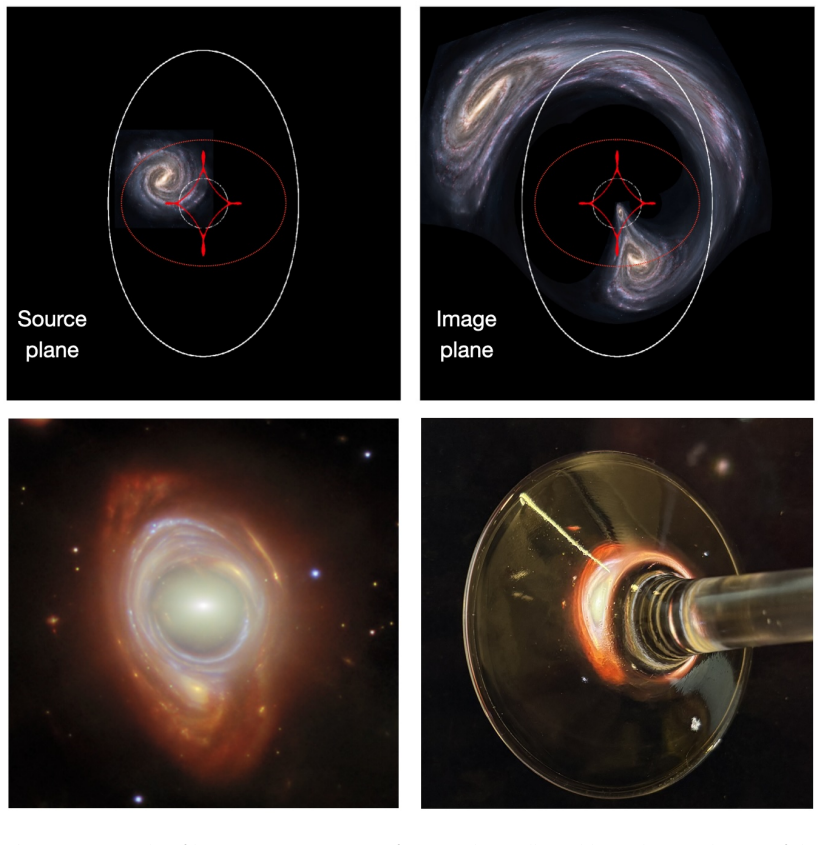
The theory of General Relativity predicts that, since massive bodies curve spacetime, light from a distant source would be deflected by a foreground massive object -- a phenomenon known as \emph{Gravitational Lensing}. Historically, the strength of deflection of light from background stars by the sun, during the 1919 solar eclipse, supplied one of the first proofs for the theory of General Relativity. However, it is only in the last few decades, with the advent of the Hubble Space Telescope and other large, ground-based facilities, that lensing has become a principal tool in modern astronomy. Lensing allows us to study both the matter content of the lensing bodies such as galaxies or clusters of galaxies, mainly dominated by the otherwise-invisible \emph{dark matter}, and the distant background sources that are being lensed by them. Strong gravitational lensing, where sources are substantially magnified and multiply imaged, is particularly useful to that end. The substantial magnification allows for a high-resolution view of the sources and to detect fainter and farther objects than would otherwise be possible; and image multiplicity helps in verifying the distance to them, and for studying variable or transient sources. Paired with the unprecedented capabilities of the James Webb Space Telescope (JWST), lensing now allows us to observe, detect, and study distant sources like never before. I summarise recent advances in strong-lensing applications and near-future prospects with JWST.
Editorial analysis
A structured set of objections, weighed in public.
Referee Report
Summary. The manuscript is a review summarizing the principles of strong gravitational lensing from general relativity, its historical validation, applications to studying dark matter in galaxies and clusters, and the magnification and multiplicity benefits for observing distant background sources. It concludes by highlighting near-future prospects when these established lensing techniques are paired with the James Webb Space Telescope's capabilities in resolution, sensitivity, and wavelength coverage.
Significance. If the descriptive overview holds, the paper provides a concise, accessible summary of established lensing applications that could serve as an entry point for researchers planning JWST observations. It correctly grounds claims in prior literature on Hubble-era lensing results without introducing new derivations, parameters, or predictions that would require internal validation.
minor comments (2)
- [Abstract] Abstract: The first-person phrasing ('I summarise') is acceptable in a review but could be revised to passive construction ('Recent advances... are summarised') to align with the formal tone of most astronomy journals.
- The manuscript would benefit from an explicit list of key recent JWST lensing papers cited, to make the 'recent advances' section more traceable for readers.
Simulated Author's Rebuttal
We thank the referee for their positive assessment of the manuscript and for recommending acceptance. We are pleased that the review is viewed as a concise and accessible entry point for researchers planning JWST observations, correctly grounded in prior literature.
Circularity Check
No significant circularity detected
full rationale
This is a qualitative review paper with no derivations, equations, fitted parameters, quantitative predictions, or load-bearing self-citations that reduce to internal inputs. The central claim is descriptive: JWST paired with strong lensing enables new observations of distant sources. It rests on established telescope specifications and prior literature rather than any self-referential construction. No steps qualify under the enumerated circularity patterns.
Axiom & Free-Parameter Ledger
axioms (1)
- standard math General Relativity predicts that massive bodies deflect light from distant sources
Lean theorems connected to this paper
-
IndisputableMonolith/Foundation/RealityFromDistinction.leanreality_from_one_distinction unclear?
unclearRelation between the paper passage and the cited Recognition theorem.
The theory of General Relativity predicts that... strong gravitational lensing... Paired with the unprecedented capabilities of the James Webb Space Telescope (JWST)
What do these tags mean?
- matches
- The paper's claim is directly supported by a theorem in the formal canon.
- supports
- The theorem supports part of the paper's argument, but the paper may add assumptions or extra steps.
- extends
- The paper goes beyond the formal theorem; the theorem is a base layer rather than the whole result.
- uses
- The paper appears to rely on the theorem as machinery.
- contradicts
- The paper's claim conflicts with a theorem or certificate in the canon.
- unclear
- Pith found a possible connection, but the passage is too broad, indirect, or ambiguous to say the theorem truly supports the claim.
Reference graph
Works this paper leans on
-
[1]
Gravitational lensing: a unique probe of dark matter and dark energy
Ellis RS. Gravitational lensing: a unique probe of dark matter and dark energy. Philo- sophical Transactions of the Royal Society A: Mathematical, Physical and Engineering Sciences. 2010;368(1914):967–987
work page 2010
-
[2]
Introduction to gravitational lensing: With python examples
Meneghetti M. Introduction to gravitational lensing: With python examples. Springer In- ternational Publishing; 2021. Lecture Notes in Physics; Available from:https://books. google.co.il/books?id=2HlMEAAAQBAJ
work page 2021
-
[3]
Die Feldgleichungen der Gravitation
Einstein A. Die Feldgleichungen der Gravitation. Sitzungsberichte der K¨ oniglich Preussischen Akademie der Wissenschaften. 1915 Jan;:844–847. 26
work page 1915
-
[4]
Die Grundlage der allgemeinen Relativit¨ atstheorie
Einstein A. Die Grundlage der allgemeinen Relativit¨ atstheorie. Annalen der Physik. 1916 Jan;354(7):769–822
work page 1916
-
[5]
Dyson FW, Eddington AS, Davidson C. A Determination of the Deflection of Light by the Sun’s Gravitational Field, from Observations Made at the Total Eclipse of May 29,
-
[6]
Philosophical Transactions of the Royal Society of London Series A. 1920 Jan; 220:291–333
work page 1920
-
[7]
0957+561 A, B: twin quasistellar objects or grav- itational lens? Nature
Walsh D, Carswell RF, Weymann RJ. 0957+561 A, B: twin quasistellar objects or grav- itational lens? Nature. 1979 May;279:381–384
work page 1979
-
[8]
2237+0305 : a new and unusual gravitational lens
Huchra J, Gorenstein M, Kent S, et al. 2237+0305 : a new and unusual gravitational lens. Astron. J.. 1985 May;90:691–696
work page 1985
-
[9]
Giant Luminous Arcs in Galaxy Clusters
Lynds R, Petrosian V. Giant Luminous Arcs in Galaxy Clusters. In: Bulletin of the American Astronomical Society; Vol. 18; Sep.; 1986. p. 1014
work page 1986
-
[10]
A blue ring-like structure, in the center of the A 370 cluster of galaxies
Soucail G, Fort B, Mellier Y, et al. A blue ring-like structure, in the center of the A 370 cluster of galaxies. Astron. Astrophys.. 1987 Jan;172:L14–L16
work page 1987
-
[11]
Luminous Arcs in Clusters of Galaxies
Lynds R, Petrosian V. Luminous Arcs in Clusters of Galaxies. Astrophys. J.. 1989 Jan; 336:1
work page 1989
-
[12]
The giant arc in A 370 : spectroscopic evidence for gravitational lensing from a source at Z=0.724
Soucail G, Mellier Y, Fort B, et al. The giant arc in A 370 : spectroscopic evidence for gravitational lensing from a source at Z=0.724. Astron. Astrophys.. 1988 Feb;191:L19– L21
work page 1988
-
[13]
Giant luminous arcs discovered in two clusters of galaxies
Paczynski B. Giant luminous arcs discovered in two clusters of galaxies. Nature. 1987 Feb;325(6105):572–573
work page 1987
-
[14]
Tyson JA, Valdes F, Wenk RA. Detection of Systematic Gravitational Lens Galaxy Image Alignments: Mapping Dark Matter in Galaxy Clusters. Astrophys. J. Lett.. 1990 Jan;349:L1
work page 1990
-
[15]
Mapping the Dark Matter with Weak Gravitational Lensing
Kaiser N, Squires G. Mapping the Dark Matter with Weak Gravitational Lensing. As- trophys. J.. 1993 Feb;404:441
work page 1993
-
[16]
A Method for Weak Lensing Observations
Kaiser N, Squires G, Broadhurst T. A Method for Weak Lensing Observations. Astro- phys. J.. 1995 Aug;449:460
work page 1995
-
[17]
The Distribution of Dark Matter in Distant Cluster Lenses - Modelling A:370
Kneib JP, Mellier Y, Fort B, et al. The Distribution of Dark Matter in Distant Cluster Lenses - Modelling A:370. Astron. Astrophys.. 1993 Jun;273:367
work page 1993
-
[18]
Hubble Space Telescope Observations of the Lensing Cluster Abell 2218
Kneib JP, Ellis RS, Smail I, et al. Hubble Space Telescope Observations of the Lensing Cluster Abell 2218. Astrophys. J.. 1996 Nov;471:643
work page 1996
-
[19]
A Probable z˜7 Galaxy Strongly Lensed by the Rich Cluster A2218: Exploring the Dark Ages
Kneib JP, Ellis RS, Santos MR, et al. A Probable z˜7 Galaxy Strongly Lensed by the Rich Cluster A2218: Exploring the Dark Ages. Astrophys. J.. 2004 Jun;607:697–703
work page 2004
-
[20]
A Hubble Space Telescope lensing survey of X-ray luminous galaxy clusters - IV
Smith GP, Kneib JP, Smail I, et al. A Hubble Space Telescope lensing survey of X-ray luminous galaxy clusters - IV. Mass, structure and thermodynamics of cluster cores at z= 0.2. Mon. Not. R. Astron. Soc.. 2005 May;359(2):417–446
work page 2005
-
[21]
Strong-Lensing Analysis of A1689 from Deep Advanced Camera Images
Broadhurst T, Ben´ ıtez N, Coe D, et al. Strong-Lensing Analysis of A1689 from Deep Advanced Camera Images. Astrophys. J.. 2005 Mar;621:53–88
work page 2005
-
[22]
The Surprisingly Steep Mass Profile of A1689, from a Lensing Analysis of Subaru Images
Broadhurst T, Takada M, Umetsu K, et al. The Surprisingly Steep Mass Profile of A1689, from a Lensing Analysis of Subaru Images. Astrophys. J. Lett.. 2005 Feb;619:L143–L146
work page 2005
-
[23]
Parametric strong gravitational lensing analysis of Abell
Halkola A, Seitz S, Pannella M. Parametric strong gravitational lensing analysis of Abell
-
[24]
Mon. Not. R. Astron. Soc.. 2006 Nov;372:1425–1462
work page 2006
-
[25]
Multiscale cluster lens mass mapping - I
Jullo E, Kneib JP. Multiscale cluster lens mass mapping - I. Strong lensing modelling. Mon. Not. R. Astron. Soc.. 2009 May;395:1319–1332
work page 2009
-
[26]
A genetic algorithm for the non-parametric inversion of strong lensing systems
Liesenborgs J, De Rijcke S, Dejonghe H. A genetic algorithm for the non-parametric inversion of strong lensing systems. Mon. Not. R. Astron. Soc.. 2006 Apr;367:1209–1216
work page 2006
-
[27]
Zitrin A, Broadhurst T, Umetsu K, et al. New multiply-lensed galaxies identified in ACS/NIC3 observations of Cl0024+1654 using an improved mass model. Mon. Not. R. Astron. Soc.. 2009 Jul;396:1985–2002
work page 2009
-
[28]
MACS: A Quest for the Most Massive Galaxy Clusters in the Universe
Ebeling H, Edge AC, Henry JP. MACS: A Quest for the Most Massive Galaxy Clusters in the Universe. Astrophys. J.. 2001 Jun;553:668–676
work page 2001
-
[29]
LoCuSS: first results from strong-lensing analysis of 20 massive galaxy clusters at z = 0.2
Richard J, Smith GP, Kneib JP, et al. LoCuSS: first results from strong-lensing analysis of 20 massive galaxy clusters at z = 0.2. Mon. Not. R. Astron. Soc.. 2010 May;404:325– 27 349
work page 2010
-
[30]
The Cluster Lensing and Supernova Survey with Hubble: An Overview
Postman M, Coe D, Ben´ ıtez N, et al. The Cluster Lensing and Supernova Survey with Hubble: An Overview. Astrophys. J. Suppl. Ser.. 2012 Apr;199:25
work page 2012
-
[31]
RELICS: Reionization Lensing Cluster Survey
Coe D, Salmon B, Bradaˇ c M, et al. RELICS: Reionization Lensing Cluster Survey. Astrophys. J.. 2019 Oct;884(1):85
work page 2019
-
[32]
A magnified young galaxy from about 500 million years after the Big Bang
Zheng W, Postman M, Zitrin A, et al. A magnified young galaxy from about 500 million years after the Big Bang. Nature. 2012 Sep;489:406–408
work page 2012
-
[33]
CLASH: Three Strongly Lensed Images of a Candi- date z≈11 Galaxy
Coe D, Zitrin A, Carrasco M, et al. CLASH: Three Strongly Lensed Images of a Candi- date z≈11 Galaxy. Astrophys. J.. 2013 Jan;762(1):32
work page 2013
-
[34]
The Frontier Fields: Survey Design and Initial Results
Lotz JM, Koekemoer A, Coe D, et al. The Frontier Fields: Survey Design and Initial Results. Astrophys. J.. 2017 Mar;837:97
work page 2017
-
[35]
Oguri M, Schrabback T, Jullo E, et al. The Hidden Fortress: Structure and substructure of the complex strong lensing cluster SDSS J1029+2623. arXiv. 2012 Sep;1209.0458
work page internal anchor Pith review Pith/arXiv arXiv 2012
-
[36]
CLASH: The Concentration-Mass Relation of Galaxy Clusters
Merten J, Meneghetti M, Postman M, et al. CLASH: The Concentration-Mass Relation of Galaxy Clusters. arXiv. 2014 Apr;1404.1376, ApJ in press
work page internal anchor Pith review Pith/arXiv arXiv 2014
-
[37]
CLASH: Weak-lensing Shear-and- magnification Analysis of 20 Galaxy Clusters
Umetsu K, Medezinski E, Nonino M, et al. CLASH: Weak-lensing Shear-and- magnification Analysis of 20 Galaxy Clusters. Astrophys. J.. 2014 Nov;795:163
work page 2014
-
[38]
Umetsu K. Cluster-Galaxy Weak Lensing. arXiv e-prints. 2020 Jul;:arXiv:2007.00506
-
[39]
Stern C, Dietrich JP, Bocquet S, et al. Weak-lensing analysis of SPT-selected galaxy clusters using Dark Energy Survey Science Verification data. Mon. Not. R. Astron. Soc.. 2019 May;485(1):69–87
work page 2019
- [40]
-
[41]
Hoekstra H, Herbonnet R, Muzzin A, et al. The Canadian Cluster Comparison Project: detailed study of systematics and updated weak lensing masses. Mon. Not. R. Astron. Soc.. 2015 May;449(1):685–714
work page 2015
-
[42]
Weak lensing analysis of SZ-selected clusters of galaxies from the SPT and Planck surveys
Gruen D, Seitz S, Brimioulle F, et al. Weak lensing analysis of SZ-selected clusters of galaxies from the SPT and Planck surveys. Mon. Not. R. Astron. Soc.. 2014 Aug; 442(2):1507–1544
work page 2014
-
[43]
The Optical Gravitational Lensing Experi- ment
Udalski A, Szymanski M, Kaluzny J, et al. The Optical Gravitational Lensing Experi- ment. Acta Astron.. 1992 Oct;42:253–284
work page 1992
-
[44]
Sumi T, Abe F, Bond IA, et al. Microlensing Optical Depth toward the Galactic Bulge from Microlensing Observations in Astrophysics Group Observations during 2000 with Difference Image Analysis. Astrophys. J.. 2003 Jul;591(1):204–227
work page 2000
-
[45]
Limits on the Macho content of the Galactic Halo from the EROS-2 Survey of the Magellanic Clouds
Tisserand P, Le Guillou L, Afonso C, et al. Limits on the Macho content of the Galactic Halo from the EROS-2 Survey of the Magellanic Clouds. Astron. Astrophys.. 2007 Jul; 469(2):387–404
work page 2007
-
[46]
Treu T. Strong Lensing by Galaxies. Annu. Rev. Astron. Astrophys.. 2010 Sep;48:87–125
work page 2010
-
[47]
Observational aspects of gravitational lensing
Surdej J. Observational aspects of gravitational lensing. In: Mellier Y, Fort B, Soucail G, editors. Gravitational lensing. Vol. 360; 1990. p. 57–72
work page 1990
-
[48]
The optical gravitational lens experiment
Surdej J, Refsdal S, Pospieszalska-Surdej A. The optical gravitational lens experiment. In: Surdej J, Fraipont-Caro D, Gosset E, et al., editors. Liege International Astrophysical Colloquia; (Liege International Astrophysical Colloquia; Vol. 31); Jan.; 1993. p. 199
work page 1993
-
[49]
A new formulation of gravitational lens theory, time-delay, and Fermat’s principle
Schneider P. A new formulation of gravitational lens theory, time-delay, and Fermat’s principle. Astron. Astrophys.. 1985 Feb;143:413–420
work page 1985
-
[50]
Fermat’s principle, caustics, and the classification of gravita- tional lens images
Blandford R, Narayan R. Fermat’s principle, caustics, and the classification of gravita- tional lens images. Astrophys. J.. 1986 Nov;310:568–582
work page 1986
-
[51]
Lectures on Gravitational Lensing
Narayan R, Bartelmann M. Lectures on Gravitational Lensing. ArXiv Astrophysics e- prints. 1996 Jun;astro-ph/9606001
work page internal anchor Pith review Pith/arXiv arXiv 1996
-
[52]
Berry M. Waves and thom’s theorem. Advances in Physics. 1976;25(1):1–26. Available from:https://doi.org/10.1080/00018737600101342
- [53]
-
[54]
Kneib JP, Natarajan P. Cluster lenses. Astron. Astrophys. Rev.. 2011 Nov;19:47. 28
work page 2011
-
[55]
Gravitational Lensing: Strong, Weak and Micro; 2006
Meylan G, Jetzer P, North P, et al., editors. Gravitational Lensing: Strong, Weak and Micro; 2006
work page 2006
-
[56]
Mapping the dark matter with weak gravitational lensing
Kaiser N, Squires G. Mapping the dark matter with weak gravitational lensing. Astro- phys. J.. 1993 Feb;404:441–450
work page 1993
-
[57]
Empirical Models for Dark Matter Halos
Merritt D, Graham AW, Moore B, et al. Empirical Models for Dark Matter Halos. I. Nonparametric Construction of Density Profiles and Comparison with Parametric Models. Astron. J.. 2006 Dec;132(6):2685–2700
work page 2006
-
[58]
Niemiec A, Jauzac M, Eckert D, et al. Beyond the ultradeep frontier fields and legacy ob- servations (BUFFALO): a high-resolution strong+weak-lensing view of Abell 370. Mon. Not. R. Astron. Soc.. 2023 Sep;524(2):2883–2910
work page 2023
-
[59]
Fischer P, McKay TA, Sheldon E, et al. Weak Lensing with Sloan Digital Sky Survey Commissioning Data: The Galaxy-Mass Correlation Function to 1 H−1 Mpc. Astron. J.. 2000 Sep;120(3):1198–1208
work page 2000
- [60]
-
[61]
LSST: From Science Drivers to Reference Design and Anticipated Data Products
Ivezi´ cˇZ, Kahn SM, Tyson JA, et al. LSST: From Science Drivers to Reference Design and Anticipated Data Products. Astrophys. J.. 2019 Mar;873(2):111
work page 2019
-
[62]
Gravitational Microlensing by Double Stars and Planetary Systems
Mao S, Paczynski B. Gravitational Microlensing by Double Stars and Planetary Systems. Astrophys. J. Lett.. 1991 Jun;374:L37
work page 1991
-
[63]
Discovering Planetary Systems through Gravitational Microlenses
Gould A, Loeb A. Discovering Planetary Systems through Gravitational Microlenses. Astrophys. J.. 1992 Sep;396:104
work page 1992
-
[64]
JWST’s GLIMPSE: an overview of the deep- est probe of early galaxy formation and cosmic reionization
Atek H, Chisholm J, Kokorev V, et al. JWST’s GLIMPSE: an overview of the deep- est probe of early galaxy formation and cosmic reionization. arXiv e-prints. 2025 Nov; :arXiv:2511.07542
-
[65]
The Largest Gravitational Lens: MACS J0717.5+3745 (z = 0.546)
Zitrin A, Broadhurst T, Rephaeli Y, et al. The Largest Gravitational Lens: MACS J0717.5+3745 (z = 0.546). Astrophys. J. Lett.. 2009 Dec;707:L102–L106
work page 2009
-
[66]
Non-parametric inversion of strong lensing systems
Diego JM, Protopapas P, Sandvik HB, et al. Non-parametric inversion of strong lensing systems. Mon. Not. R. Astron. Soc.. 2005 Jun;360:477–491
work page 2005
-
[67]
Pixelated Lenses and H 0 from Time-Delay Quasars
Williams LLR, Saha P. Pixelated Lenses and H 0 from Time-Delay Quasars. Astron. J.. 2000 Feb;119(2):439–450
work page 2000
-
[68]
A Bayesian approach to strong lensing modelling of galaxy clusters
Jullo E, Kneib JP, Limousin M, et al. A Bayesian approach to strong lensing modelling of galaxy clusters. New Journal of Physics. 2007 Dec;9:447
work page 2007
-
[69]
Oguri M, Takada M, Okabe N, et al. Direct measurement of dark matter halo ellipticity from two-dimensional lensing shear maps of 25 massive clusters. Mon. Not. R. Astron. Soc.. 2010 Jul;405:2215–2230
work page 2010
-
[70]
Suyu SH, Acebron A, Grillo C, et al. Cosmology with supernova Encore in the strong lensing cluster MACS J0138-2155: Lens model comparison and H0 measurement. arXiv e-prints. 2025 Sep;:arXiv:2509.12319
work page internal anchor Pith review Pith/arXiv arXiv 2025
-
[71]
Galaxy cluster strong lensing: image deflections from density fluctuations along the line of sight
Host O. Galaxy cluster strong lensing: image deflections from density fluctuations along the line of sight. Mon. Not. R. Astron. Soc.. 2012 Feb;420:L18–L22
work page 2012
-
[72]
Enhanced cluster lensing models with measured galaxy kinematics
Bergamini P, Rosati P, Mercurio A, et al. Enhanced cluster lensing models with measured galaxy kinematics. Astron. Astrophys.. 2019 Nov;631:A130
work page 2019
-
[73]
Treu T, Brammer G, Diego JM, et al. ”Refsdal” Meets Popper: Comparing Predictions of the Re-appearance of the Multiply Imaged Supernova Behind MACSJ1149.5+2223. Astrophys. J.. 2016 Jan;817:60
work page 2016
-
[74]
The Frontier Fields lens modelling comparison project
Meneghetti M, Natarajan P, Coe D, et al. The Frontier Fields lens modelling comparison project. Mon. Not. R. Astron. Soc.. 2017 Dec;472(3):3177–3216
work page 2017
-
[75]
A Pair of Lensed Galaxies at z=4.92 in the Field of CL 1358+62
Franx M, Illingworth GD, Kelson DD, et al. A Pair of Lensed Galaxies at z=4.92 in the Field of CL 1358+62. Astrophys. J. Lett.. 1997 Sep;486:L75
work page 1997
-
[76]
Discovery of a possibly old galaxy at $z=6.027$, multiply imaged by the massive cluster Abell 383
Richard J, Kneib J, Ebeling H, et al. Discovery of an old galaxy at z=6.027, multiply imaged by the massive cluster Abell 383. arXiv. 2011 Feb;1102.5092
work page internal anchor Pith review Pith/arXiv arXiv 2011
-
[77]
CLASH: z∼6 young galaxy candidate quintuply lensed by the frontier field cluster RXC J2248.7-4431
Monna A, Seitz S, Greisel N, et al. CLASH: z∼6 young galaxy candidate quintuply lensed by the frontier field cluster RXC J2248.7-4431. Mon. Not. R. Astron. Soc.. 2014 Feb;438:1417–1434. 29
work page 2014
-
[78]
Zitrin A, Zheng W, Broadhurst T, et al. A Geometrically Supported z ˜ 10 Candidate Multiply Imaged by the Hubble Frontier Fields Cluster A2744. Astrophys. J. Lett.. 2014 Sep;793:L12
work page 2014
-
[79]
Discovery of a Very Bright Strongly Lensed Galaxy Candidate at z ˜ 7.6
Bradley LD, Bouwens RJ, Ford HC, et al. Discovery of a Very Bright Strongly Lensed Galaxy Candidate at z ˜ 7.6. Astrophys. J.. 2008 May;678:647–654
work page 2008
-
[80]
Ellis RS, McLure RJ, Dunlop JS, et al. The Abundance of Star-forming Galaxies in the Redshift Range 8.5-12: New Results from the 2012 Hubble Ultra Deep Field Campaign. Astrophys. J. Lett.. 2013 Jan;763:L7
work page 2012
discussion (0)
Sign in with ORCID, Apple, or X to comment. Anyone can read and Pith papers without signing in.