Near-IR Weak-lensing (NIRWL) Measurements in the CANDELS Fields. II. Mass Mapping and Overdensity Characterization
Pith reviewed 2026-05-19 16:02 UTC · model grok-4.3
The pith
Near-infrared weak lensing in CANDELS fields detects 12 shear-selected overdensities with median mass 5.5 times 10 to the 13 solar masses.
A machine-rendered reading of the paper's core claim, the machinery that carries it, and where it could break.
Core claim
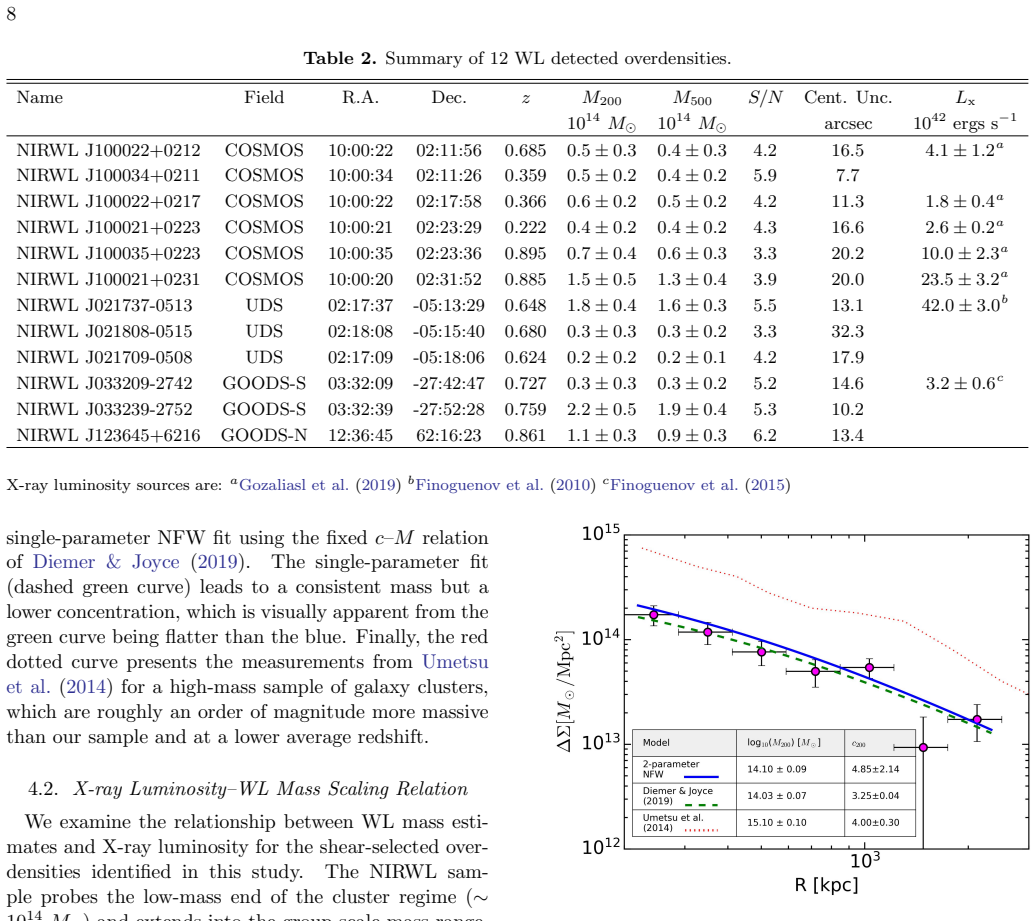
The central claim is that the near-infrared weak-lensing analysis identifies twelve shear-selected overdensities spanning M_200 from (0.2--2.2) times 10^14 solar masses with a median of 5.5 times 10^13 solar masses at mean redshift 0.68. Seven detections coincide with diffuse X-ray emission whose centroids match the weak-lensing peaks, and the stacked tangential shear is well fit by an NFW profile with concentration 4.9 plus or minus 2.1 and mass 1.3 plus or minus 0.3 times 10^14 solar masses. This establishes the capability of NIR weak lensing to measure low-mass systems.
What carries the argument
Shear-selected overdensities identified via near-infrared weak lensing, which maps foreground mass from the coherent distortion of background galaxy shapes measured in HST NIR imaging.
If this is right
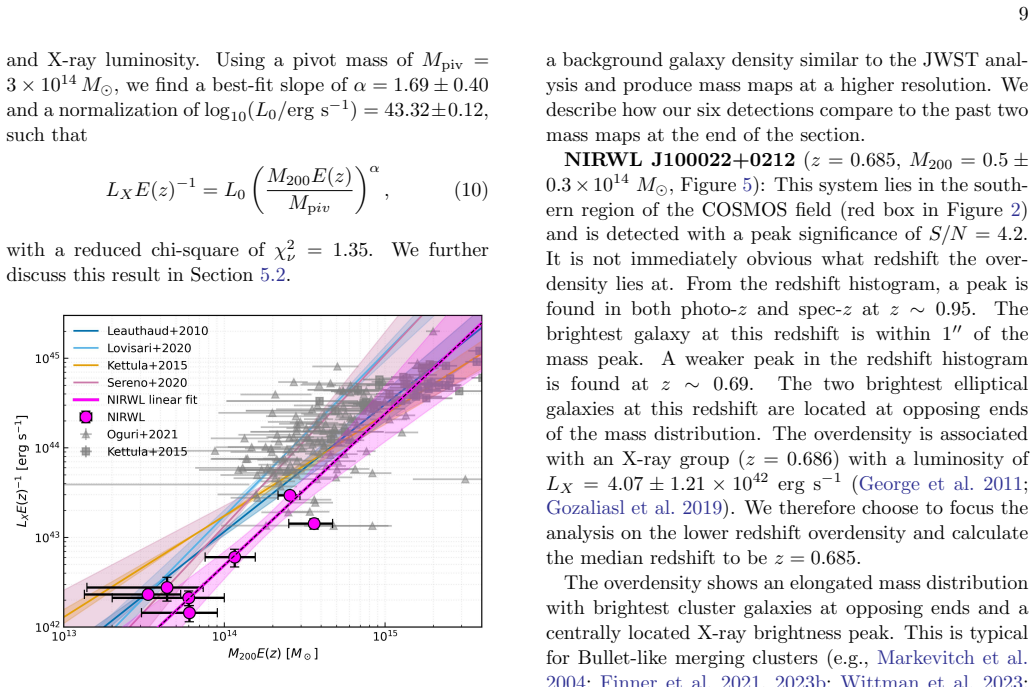
- The twelve detections broadly follow published X-ray luminosity to weak-lensing mass scaling relations.
- Seven of the overdensities exhibit diffuse X-ray emission whose centroids align with the weak-lensing peaks.
- The average radial mass density profile recovered by stacking all detections is well described by an NFW model.
- The results position NIR weak lensing as a viable technique for precursor studies with future wide-area near-infrared surveys.
Where Pith is reading between the lines
- Extending the same source density to wider fields could reveal whether the low-mass end of the halo mass function at z approximately 0.7 matches predictions from structure formation simulations.
- Cross-matching these shear-selected systems with spectroscopic surveys might test whether the selected overdensities contain the expected galaxy populations for their weak-lensing masses.
- The stacking approach could be repeated on subsets split by redshift or environment to check for evolution in the average concentration parameter.
Load-bearing premise
The measured shear signals are assumed to trace the mass of the overdensities with negligible contamination from intrinsic alignments, photometric redshift errors, or line-of-sight projections, and that spatial coincidence with X-ray centroids confirms the structures are collapsed.
What would settle it
Independent mass measurements from X-ray temperature or galaxy velocity dispersions that systematically disagree with the weak-lensing masses for the same twelve overdensities would falsify the claim that the shear signals accurately reflect the true halo masses.
Figures



read the original abstract
The Hubble Space Telescope Cosmic Assembly Near-infrared Deep Extragalactic Legacy Survey (CANDELS) fields offer an exceptional combination of depth, spatial resolution, and area for identifying a shear-selected sample of dark matter overdensities. We present the first near-infrared (NIR) weak-lensing (WL) analysis of the 0.23 square degrees covered by the HST CANDELS fields: COSMOS, UDS, EGS, GOODS-N, and GOODS-S. Leveraging the high sensitivity of HST NIR imaging to distant galaxies, we achieve a WL source galaxy density of $\sim170$ galaxies arcmin$^{-2}$. Our analysis identifies 12 shear-selected overdensities spanning masses from $M_{200}=(0.2$--$2.2)\times10^{14}\ M_\odot$, with a median mass of $M_{200}=5.5\times10^{13}\ M_\odot$, demonstrating the strong capability of NIR WL for measuring low-mass systems. The systems lie in the redshift range $0.22<z<0.9$, with a mean redshift of $z=0.68$. We utilize multiwavelength data to confirm the nature of the overdensities. Seven of the overdensities have diffuse X-ray emission reported in the literature, with X-ray centroids that are spatially consistent with our WL peaks, confirming their nature as collapsed structures. We find that our WL detections broadly follow the expected X-ray luminosity--WL mass scaling relations. By stacking the tangential shear of all detections, we determine the average radial mass density profile and find that it is well fit by an NFW model with fitted concentration and mass of $4.9\pm2.1$ and $M_{200}=1.3\pm0.3\times10^{14}\ M_\odot$, respectively. These results serve as a precursor to NIR WL science with the Roman High Latitude Wide Area Survey.
Editorial analysis
A structured set of objections, weighed in public.
Referee Report
Summary. The manuscript presents the first near-infrared weak-lensing analysis of the 0.23 square degrees covered by the HST CANDELS fields (COSMOS, UDS, EGS, GOODS-N, GOODS-S). It reports a source galaxy density of ~170 arcmin^{-2}, identifies 12 shear-selected overdensities with M_{200} spanning (0.2--2.2)×10^{14} M_⊙ (median 5.5×10^{13} M_⊙) at 0.22<z<0.9 (mean z=0.68), notes spatial coincidence with diffuse X-ray emission for seven systems, and presents an NFW fit to the stacked tangential shear profile with concentration 4.9±2.1 and M_{200}=1.3±0.3×10^{14} M_⊙. The results are framed as a precursor to NIR WL science with the Roman High Latitude Wide Area Survey.
Significance. If the sample purity is established, the work would be significant for showing that NIR weak lensing can detect and characterize low-mass collapsed structures (down to ~2×10^{13} M_⊙) with high source density, directly relevant to the Roman HLWAS. The concrete X-ray matches for seven systems and the stacked NFW profile provide tangible support for the method's viability.
major comments (2)
- [§4] §4 (Overdensity identification): The claim that the 12 shear peaks trace genuine collapsed structures down to M_{200}=2×10^{13} M_⊙ rests on the assumption that the tangential shear is lensing-dominated. The text reports X-ray spatial coincidence for only seven systems and states consistency with X-ray luminosity--WL mass relations, but does not present null tests (random shape rotations or randomized galaxy positions) or a projection probability estimate from the source redshift distribution. This is load-bearing for the median mass and the demonstration of NIR WL capability for low-mass systems.
- [§5.2] §5.2 (Systematics and error budget): No marginalization or quantitative assessment is provided for intrinsic galaxy alignments, photometric redshift errors, or line-of-sight projections. These contaminants are particularly relevant for the low-mass end of the sample and directly affect the reliability of the reported masses and the stacked profile parameters.
minor comments (2)
- [§2] The abstract and text use M_{200} without always specifying the exact overdensity definition or the assumed cosmology; a brief statement in §2 would improve clarity.
- [Figure 8] Figure showing the stacked shear profile and NFW fit would benefit from explicit residuals or χ² value to allow readers to assess the goodness of fit beyond the quoted parameter uncertainties.
Simulated Author's Rebuttal
We thank the referee for their careful and constructive review of our manuscript. We have addressed each of the major comments below by incorporating additional tests and quantitative assessments into the revised version of the paper.
read point-by-point responses
-
Referee: [§4] §4 (Overdensity identification): The claim that the 12 shear peaks trace genuine collapsed structures down to M_{200}=2×10^{13} M_⊙ rests on the assumption that the tangential shear is lensing-dominated. The text reports X-ray spatial coincidence for only seven systems and states consistency with X-ray luminosity--WL mass relations, but does not present null tests (random shape rotations or randomized galaxy positions) or a projection probability estimate from the source redshift distribution. This is load-bearing for the median mass and the demonstration of NIR WL capability for low-mass systems.
Authors: We agree that explicit null tests and a projection probability estimate would strengthen the interpretation of the full sample. In the revised manuscript we have added two null tests: (i) rotating all galaxy shapes by 45 degrees, which produces no peaks above the detection threshold, and (ii) randomizing galaxy positions while preserving the source density, which likewise yields no significant detections. We have also computed the line-of-sight projection probability using the measured source redshift distribution and the expected number density of halos at the relevant redshifts, finding a chance-coincidence probability below 8 % for the reported mass range. These results are now presented in §4 and support the original claim that the shear peaks trace collapsed structures. revision: yes
-
Referee: [§5.2] §5.2 (Systematics and error budget): No marginalization or quantitative assessment is provided for intrinsic galaxy alignments, photometric redshift errors, or line-of-sight projections. These contaminants are particularly relevant for the low-mass end of the sample and directly affect the reliability of the reported masses and the stacked profile parameters.
Authors: We acknowledge that a more quantitative treatment of these systematics improves the robustness of the results. In the revised §5.2 we now include: (i) an estimate of intrinsic alignment contamination using the linear alignment model, which contributes <5 % to the tangential shear for our source sample; (ii) a bootstrap resampling of photometric redshifts within their reported uncertainties, showing that individual mass estimates shift by at most 12 %; and (iii) an assessment of line-of-sight projections via mock catalogs that is folded into the total error budget. These contributions have been added to the uncertainties on both the individual M_{200} values and the stacked NFW parameters. revision: yes
Circularity Check
No significant circularity; results from direct shear measurements and external comparisons
full rationale
The paper's central results—identifying 12 shear-selected overdensities and reporting their M200 masses—are obtained by measuring tangential shear from HST NIR galaxy shapes at ~170 arcmin^{-2} density, locating peaks, and fitting standard NFW profiles to the observed shear signals. The stacked profile fit (c=4.9±2.1, M200=1.3±0.3×10^{14} M⊙) and individual mass estimates follow from these data-driven steps without any equation reducing the output masses or profiles to quantities defined by the same fitted parameters. X-ray centroid coincidences and luminosity-mass relations are external validations, not internal definitions. No self-citation chains, ansatz smuggling, or uniqueness theorems from prior author work appear as load-bearing elements in the derivation chain.
Axiom & Free-Parameter Ledger
free parameters (2)
- NFW concentration parameter =
4.9
- Stacked M_200 =
1.3e14 solar masses
axioms (2)
- domain assumption Shear measurements from NIR-selected galaxies accurately reflect the projected mass distribution of foreground structures with minimal contamination from intrinsic alignments or redshift errors.
- domain assumption Spatial agreement between WL peaks and reported X-ray centroids indicates the same physical collapsed structures rather than chance alignments.
Lean theorems connected to this paper
-
IndisputableMonolith/Cost/FunctionalEquation.leanwashburn_uniqueness_aczel unclear?
unclearRelation between the paper passage and the cited Recognition theorem.
We utilize a similar technique called FIATMAP ... We fit two relations to the density profile. We first fit a two-parameter NFW model ... fix the concentration to the Diemer & Joyce (2019) concentration-mass (c-M) relation.
-
IndisputableMonolith/Foundation/RealityFromDistinction.leanreality_from_one_distinction unclear?
unclearRelation between the paper passage and the cited Recognition theorem.
We fix the cosmology of our analysis to a flat LCDM with h=0.7, Om=0.3, and OL=0.7.
What do these tags mean?
- matches
- The paper's claim is directly supported by a theorem in the formal canon.
- supports
- The theorem supports part of the paper's argument, but the paper may add assumptions or extra steps.
- extends
- The paper goes beyond the formal theorem; the theorem is a base layer rather than the whole result.
- uses
- The paper appears to rely on the theorem as machinery.
- contradicts
- The paper's claim conflicts with a theorem or certificate in the canon.
- unclear
- Pith found a possible connection, but the passage is too broad, indirect, or ambiguous to say the theorem truly supports the claim.
Reference graph
Works this paper leans on
-
[1]
Nonthermal radiation from clusters of galaxies: the role of merger shocks in particle acceleration
Nonthermal Radiation from Clusters of Galaxies: The Role of Merger Shocks in Particle Acceleration. , keywords =. doi:10.1086/345429 , archivePrefix =. astro-ph/0207523 , primaryClass =
work page internal anchor Pith review Pith/arXiv arXiv doi:10.1086/345429
-
[2]
The first catalog of galaxy clusters and groups in the Western Galactic Hemisphere
The SRG/eROSITA All-Sky Survey. The first catalog of galaxy clusters and groups in the Western Galactic Hemisphere. , keywords =. doi:10.1051/0004-6361/202348264 , archivePrefix =. 2402.08452 , primaryClass =
-
[3]
The Red-Sequence Cluster Survey
The Red-Sequence Cluster Survey. The New Era of Wide Field Astronomy , year = 2001, editor =. doi:10.48550/arXiv.astro-ph/0011073 , archivePrefix =. astro-ph/0011073 , primaryClass =
work page internal anchor Pith review Pith/arXiv arXiv doi:10.48550/arxiv.astro-ph/0011073 2001
-
[4]
, year = 1958, month = may, volume =
The Distribution of Rich Clusters of Galaxies. , year = 1958, month = may, volume =. doi:10.1086/190036 , adsurl =
-
[5]
Infrared Diagnostics of Galaxy Evolution , year = 2008, editor =
Clusters of Galaxies at 1 < z< 2 : The Spitzer Adaptation of the Red-Sequence Cluster Survey. Infrared Diagnostics of Galaxy Evolution , year = 2008, editor =
work page 2008
-
[6]
, year = 1974, month = feb, volume =
Formation of Galaxies and Clusters of Galaxies by Self-Similar Gravitational Condensation. , year = 1974, month = feb, volume =. doi:10.1086/152650 , adsurl =
-
[7]
Formation of galaxies and large-scale structure with cold dark matter. , keywords =. doi:10.1038/311517a0 , adsurl =
-
[8]
The evolution of large-scale structure in a universe dominated by cold dark matter. , keywords =. doi:10.1086/163168 , adsurl =
-
[9]
The color - absolute magnitude relation for E and S0 galaxies. I. Calibration and tests for universality using Virgo and eight other nearby clusters. , keywords =. doi:10.1086/155464 , adsurl =
-
[10]
Precision photometry of early-type galaxies in the Coma and Virgo clusters : a test of the universality of the colour-magnitude relation - II. Analysis. , year = 1992, month = feb, volume =. doi:10.1093/mnras/254.4.601 , adsurl =
-
[11]
The Properties of Poor Groups of Galaxies. I. Spectroscopic Survey and Results. , keywords =. doi:10.1086/305355 , archivePrefix =. astro-ph/9708132 , primaryClass =
work page internal anchor Pith review Pith/arXiv arXiv doi:10.1086/305355
-
[12]
The redMaPPer Galaxy Cluster Catalog From DES Science Verification Data
The RedMaPPer Galaxy Cluster Catalog From DES Science Verification Data. , keywords =. doi:10.3847/0067-0049/224/1/1 , archivePrefix =. 1601.00621 , primaryClass =
work page internal anchor Pith review Pith/arXiv arXiv doi:10.3847/0067-0049/224/1/1
-
[13]
CARMA observations of massive Planck -discovered cluster candidates at z 0.5 associated with WISE overdensities: breaking the size-flux degeneracy. , keywords =. doi:10.1093/mnras/stw2392 , archivePrefix =. 1505.01132 , primaryClass =
work page internal anchor Pith review Pith/arXiv arXiv doi:10.1093/mnras/stw2392
-
[14]
The XXL Survey. I. Scientific motivations - XMM-Newton observing plan - Follow-up observations and simulation programme. , keywords =. doi:10.1051/0004-6361/201526766 , archivePrefix =. 1512.04317 , primaryClass =
work page internal anchor Pith review Pith/arXiv arXiv doi:10.1051/0004-6361/201526766
-
[15]
Scaling relations between X-ray properties and weak lensing mass
XXL Survey groups and clusters in the Hyper Suprime-Cam Survey. Scaling relations between X-ray properties and weak lensing mass. , keywords =. doi:10.1093/mnras/stz3425 , archivePrefix =. 1912.02827 , primaryClass =
-
[16]
X-Ray Scaling Relations for a Representative Sample of Planck-selected Clusters Observed with XMM-Newton. , keywords =. doi:10.3847/1538-4357/ab7997 , archivePrefix =. 2002.11740 , primaryClass =
-
[17]
A Weak Lensing Study of X-ray Groups in the Cosmos Survey: Form and Evolution of the Mass-Luminosity Relation. , keywords =. doi:10.1088/0004-637X/709/1/97 , archivePrefix =. 0910.5219 , primaryClass =
work page internal anchor Pith review Pith/arXiv arXiv doi:10.1088/0004-637x/709/1/97
-
[18]
CFHTLenS: Weak lensing calibrated scaling relations for low mass clusters of galaxies
CFHTLenS: weak lensing calibrated scaling relations for low-mass clusters of galaxies. , keywords =. doi:10.1093/mnras/stv923 , archivePrefix =. 1410.8769 , primaryClass =
work page internal anchor Pith review Pith/arXiv arXiv doi:10.1093/mnras/stv923
-
[19]
Subaru Prime Focus Camera -- Suprime-Cam --
Subaru Prime Focus Camera -- Suprime-Cam. , keywords =. doi:10.1093/pasj/54.6.833 , archivePrefix =. astro-ph/0211006 , primaryClass =
work page internal anchor Pith review Pith/arXiv arXiv doi:10.1093/pasj/54.6.833
-
[20]
Hyper Suprime-Cam: System design and verification of image quality. , keywords =. doi:10.1093/pasj/psx063 , adsurl =
-
[21]
A large sample of shear-selected clusters from the Hyper Suprime-Cam Subaru Strategic Program S16A Wide field mass maps. , keywords =. doi:10.1093/pasj/psx120 , archivePrefix =. 1802.10290 , primaryClass =
work page internal anchor Pith review Pith/arXiv arXiv doi:10.1093/pasj/psx120
-
[22]
Hyper Suprime-Cam: Camera dewar design. , keywords =. doi:10.1093/pasj/psx069 , adsurl =
-
[23]
Hyper Suprime-Cam: Filters. , keywords =. doi:10.1093/pasj/psy056 , adsurl =
-
[24]
Low frequency follow up of radio halos and relics in the GMRT Radio Halo Cluster Survey
Low frequency follow up of radio haloes and relics in the GMRT Radio Halo Cluster Survey. , keywords =. doi:10.1051/0004-6361/201219872 , archivePrefix =. 1210.7617 , primaryClass =
work page internal anchor Pith review Pith/arXiv arXiv doi:10.1051/0004-6361/201219872
-
[25]
Radio spectral study of the cluster of galaxies Abell 2255
Radio spectral study of the cluster of galaxies Abell 2255. , keywords =. doi:10.1051/0004-6361/200912465 , archivePrefix =. 0909.5198 , primaryClass =
work page internal anchor Pith review Pith/arXiv arXiv doi:10.1051/0004-6361/200912465
-
[26]
An Ultra-Steep Spectrum Radio Relic in the Galaxy Cluster Abell 2443
An Ultra-steep-spectrum Radio Relic in the Galaxy Cluster A2443. , keywords =. doi:10.1088/0004-6256/141/5/149 , archivePrefix =. 1102.4606 , primaryClass =
work page internal anchor Pith review Pith/arXiv arXiv doi:10.1088/0004-6256/141/5/149
-
[27]
Weak-lensing detection of intracluster filaments in the Coma cluster. Nature Astronomy , keywords =. doi:10.1038/s41550-023-02164-w , archivePrefix =. 2310.03073 , primaryClass =
-
[28]
The largest gravitationally bound structures: the Corona Borealis supercluster - mass and bound extent. , keywords =. doi:10.1093/mnras/stu693 , archivePrefix =. 1404.1308 , primaryClass =
work page internal anchor Pith review Pith/arXiv arXiv doi:10.1093/mnras/stu693
-
[29]
The Dynamics of the Corona Borealis Supercluster. , keywords =. doi:10.1086/114635 , adsurl =
-
[30]
The Planck clusters in the LOFAR sky. I. LoTSS-DR2: New detections and sample overview. , keywords =. doi:10.1051/0004-6361/202143020 , archivePrefix =. 2202.11720 , primaryClass =
-
[31]
The giant radio halo in Abell 2163
The giant radio halo in Abell 2163. , keywords =. doi:10.1051/0004-6361:20010581 , archivePrefix =. astro-ph/0104451 , primaryClass =
work page internal anchor Pith review Pith/arXiv arXiv doi:10.1051/0004-6361:20010581
-
[32]
The on-site quality-assurance system for Hyper Suprime-Cam: OSQAH. , keywords =. doi:10.1093/pasj/psx079 , adsurl =
-
[33]
Weighing ``El Gordo'' with a Precision Scale: Hubble Space Telescope Weak-lensing Analysis of the Merging Galaxy Cluster ACT-CL J0102-4915 at z = 0.87. , keywords =. doi:10.1088/0004-637X/785/1/20 , archivePrefix =. 1309.5097 , primaryClass =
work page internal anchor Pith review Pith/arXiv arXiv doi:10.1088/0004-637x/785/1/20
-
[34]
Constraining the Mass of the Emerging Galaxy Cluster SpARCS1049+56 at z = 1.71 with Infrared Weak Lensing. , keywords =. doi:10.3847/1538-4357/ab7bdb , archivePrefix =. 2002.01956 , primaryClass =
-
[35]
A Systematic X-Ray Search for Clusters of Galaxies behind the Milky Way. , keywords =. doi:10.1086/343790 , adsurl =
-
[36]
A High-Caliber View of the Bullet Cluster through JWST Strong and Weak Lensing Analyses. , keywords =. doi:10.3847/2041-8213/add2f0 , archivePrefix =. 2503.21870 , primaryClass =
-
[37]
Hubble Space Telescope and Hyper-Suprime-Cam Weak-lensing Study of the Equal-mass Dissociative Merger CIZA J0107.7+5408. , keywords =. doi:10.3847/1538-4357/ac9fd3 , archivePrefix =. 2210.12165 , primaryClass =
-
[38]
Dark matter maps reveal cosmic scaffolding
Dark matter maps reveal cosmic scaffolding. , keywords =. doi:10.1038/nature05497 , archivePrefix =. astro-ph/0701594 , primaryClass =
work page internal anchor Pith review Pith/arXiv arXiv doi:10.1038/nature05497
-
[39]
An ultra-high-resolution map of (dark) matter. Nature Astronomy , keywords =. doi:10.1038/s41550-025-02763-9 , archivePrefix =. 2601.17239 , primaryClass =
-
[40]
Miscentring in galaxy clusters: dark matter to brightest cluster galaxy offsets in 10 000 Sloan Digital Sky Survey clusters. , keywords =. doi:10.1111/j.1365-2966.2012.21886.x , archivePrefix =. 1208.1766 , primaryClass =
-
[41]
A gas-giant planet transiting a rapidly rotating A5 star
Direct measurement of dark matter halo ellipticity from two-dimensional lensing shear maps of 25 massive clusters. , keywords =. doi:10.1111/j.1365-2966.2010.16622.x , archivePrefix =. 1004.4214 , primaryClass =
-
[42]
Toward Precision LSST Weak-Lensing Measurement. I. Impacts of Atmospheric Turbulence and Optical Aberration. , keywords =. doi:10.1086/660137 , archivePrefix =. 1011.1913 , primaryClass =
work page internal anchor Pith review Pith/arXiv arXiv doi:10.1086/660137 1913
-
[43]
Measuring Reddening with SDSS Stellar Spectra and Recalibrating SFD
Measuring Reddening with Sloan Digital Sky Survey Stellar Spectra and Recalibrating SFD. , keywords =. doi:10.1088/0004-637X/737/2/103 , archivePrefix =. 1012.4804 , primaryClass =
work page internal anchor Pith review Pith/arXiv arXiv doi:10.1088/0004-637x/737/2/103
-
[44]
Charles R. Harris and K. Jarrod Millman and St. Array programming with. 2020 , month = sep, journal =. doi:10.1038/s41586-020-2649-2 , publisher =
-
[45]
Pedregosa, F. and Varoquaux, G. and Gramfort, A. and Michel, V. and Thirion, B. and Grisel, O. and Blondel, M. and Prettenhofer, P. and Weiss, R. and Dubourg, V. and Vanderplas, J. and Passos, A. and Cournapeau, D. and Brucher, M. and Perrot, M. and Duchesnay, E. , journal=. Scikit-learn: Machine Learning in
-
[46]
MC2: Mapping the Dark Matter Distribution of the ``Toothbrush'' Cluster RX J0603.3+4214 with Hubble Space Telescope and Subaru Weak Lensing. , keywords =. doi:10.3847/0004-637X/817/2/179 , archivePrefix =. 1510.03486 , primaryClass =
work page internal anchor Pith review Pith/arXiv arXiv doi:10.3847/0004-637x/817/2/179
-
[47]
Multiwavelength Analysis of A1240, the Double Radio-relic Merging Galaxy Cluster Embedded in an 80 Mpc-long Cosmic Filament. , keywords =. doi:10.3847/1538-4357/ac36c8 , archivePrefix =. 2109.06879 , primaryClass =
-
[48]
LoCuSS: Subaru Weak Lensing Study of 30 Galaxy Clusters
LoCuSS: Subaru Weak Lensing Study of 30 Galaxy Clusters. , keywords =. doi:10.1093/pasj/62.3.811 , archivePrefix =. 0903.1103 , primaryClass =
work page internal anchor Pith review Pith/arXiv arXiv doi:10.1093/pasj/62.3.811
-
[49]
Exemplary Merging Clusters: Weak-lensing and X-Ray Analysis of the Double Radio Relic, Merging Galaxy Clusters MACS J1752.0+4440 and ZWCL 1856.8+6616. , keywords =. doi:10.3847/1538-4357/ac0d00 , archivePrefix =. 2010.02226 , primaryClass =
-
[50]
A powerful double radio relic system discovered in PSZ1 G108.18-11.53: evidence for a shock with non-uniform Mach number?. , keywords =. doi:10.1093/mnras/stv1873 , archivePrefix =. 1508.02901 , primaryClass =
work page internal anchor Pith review Pith/arXiv arXiv doi:10.1093/mnras/stv1873
-
[51]
Particle re-acceleration and Faraday-complex structures in the RXC J1314.4-2515 galaxy cluster. , keywords =. doi:10.1093/mnras/stz2408 , archivePrefix =. 1908.11868 , primaryClass =
-
[52]
MC ^ 2 : Multiwavelength and Dynamical Analysis of the Merging Galaxy Cluster ZwCl 0008.8+5215: An Older and Less Massive Bullet Cluster. , keywords =. doi:10.3847/1538-4357/aa667f , archivePrefix =. 1703.04803 , primaryClass =
work page internal anchor Pith review Pith/arXiv arXiv doi:10.3847/1538-4357/aa667f
-
[53]
Radio halos in nearby (z < 0.4) clusters of galaxies
Radio halos in nearby (z < 0.4) clusters of galaxies. , keywords =. doi:10.1051/0004-6361/200912667 , archivePrefix =. 0909.0911 , primaryClass =
work page internal anchor Pith review Pith/arXiv arXiv doi:10.1051/0004-6361/200912667
-
[54]
No Shock Across Part of a Radio Relic in the Merging Galaxy Cluster ZwCl 2341.1+0000?
No shock across part of a radio relic in the merging galaxy cluster ZwCl 2341.1+0000?. , keywords =. doi:10.1093/mnras/stu1299 , archivePrefix =. 1406.7290 , primaryClass =
work page internal anchor Pith review Pith/arXiv arXiv doi:10.1093/mnras/stu1299
-
[55]
MC^2: A deeper look at ZwCl 2341.1+0000 with Bayesian galaxy clustering and weak lensing analyses
MC ^ 2 : A Deeper Look at ZwCl 2341.1+0000 with Bayesian Galaxy Clustering and Weak Lensing Analyses. , keywords =. doi:10.3847/1538-4357/aa6d66 , archivePrefix =. 1707.00009 , primaryClass =
work page internal anchor Pith review Pith/arXiv arXiv doi:10.3847/1538-4357/aa6d66
-
[56]
Nature, of blue galaxies in the cluster CL 1447+2619. , keywords =. doi:10.1038/310031a0 , adsurl =
-
[57]
The Formation of Dark Halos in a Universe Dominated by Cold Dark Matter. , keywords =. doi:10.1086/166213 , adsurl =
-
[58]
In the wake of dark giants: new signatures of dark matter self-interactions in equal-mass mergers of galaxy clusters. , keywords =. doi:10.1093/mnras/stx896 , archivePrefix =. 1608.08630 , primaryClass =
work page internal anchor Pith review Pith/arXiv arXiv doi:10.1093/mnras/stx896
-
[59]
Weak-lensing Analysis of X-Ray-selected XXL Galaxy Groups and Clusters with Subaru HSC Data. , keywords =. doi:10.3847/1538-4357/ab6bca , archivePrefix =. 1909.10524 , primaryClass =
-
[60]
A gas-giant planet transiting a rapidly rotating A5 star
X-ray groups and clusters of galaxies in the Subaru-XMM Deep Field. , keywords =. doi:10.1111/j.1365-2966.2010.16256.x , archivePrefix =. 0912.0039 , primaryClass =
-
[61]
The XMM-Newton Wide-Field Survey in the COSMOS Field: Statistical Properties of Clusters of Galaxies. , keywords =. doi:10.1086/516577 , archivePrefix =. astro-ph/0612360 , primaryClass =
work page internal anchor Pith review Pith/arXiv arXiv doi:10.1086/516577
-
[62]
X-Ray Groups of Galaxies in the Aegis Deep and Wide Fields
X-Ray Groups of Galaxies in the AEGIS Deep and Wide Fields. , keywords =. doi:10.1088/0004-637X/765/2/117 , archivePrefix =. 1302.5114 , primaryClass =
work page internal anchor Pith review Pith/arXiv arXiv doi:10.1088/0004-637x/765/2/117
-
[63]
The evolution of the AGN content in groups up to z~1
The evolution of the AGN content in groups up to z -0.5ex 1. , keywords =. doi:10.1051/0004-6361/201219759 , archivePrefix =. 1302.2861 , primaryClass =
work page internal anchor Pith review Pith/arXiv arXiv doi:10.1051/0004-6361/201219759
-
[64]
Ultra-deep catalog of X-ray groups in the Extended Chandra Deep Field South
Ultra-deep catalog of X-ray groups in the Extended Chandra Deep Field South. , keywords =. doi:10.1051/0004-6361/201323053 , archivePrefix =. 1501.03506 , primaryClass =
work page internal anchor Pith review Pith/arXiv arXiv doi:10.1051/0004-6361/201323053
-
[65]
Measures of Location and Scale for Velocities in Clusters of Galaxies---A Robust Approach. , keywords =. doi:10.1086/115487 , adsurl =
-
[66]
The Average Mass-to-Light Profile of Galaxy Clusters
The Average Mass and Light Profiles of Galaxy Clusters. , keywords =. doi:10.1086/303805 , archivePrefix =. astro-ph/9512087 , primaryClass =
work page internal anchor Pith review Pith/arXiv arXiv doi:10.1086/303805
-
[67]
Galaxy groups in the Two-degree Field Galaxy Redshift Survey: the luminous content of the groups. , keywords =. doi:10.1111/j.1365-2966.2004.08354.x , archivePrefix =. astro-ph/0402566 , primaryClass =
-
[68]
A derivation of masses and total luminosities of galaxy groups and clusters in the maxBCG catalogue
A derivation of masses and total luminosities of galaxy groups and clusters in the maxBCG catalogue. , keywords =. doi:10.1093/mnras/stv371 , archivePrefix =. 1503.00975 , primaryClass =
work page internal anchor Pith review Pith/arXiv arXiv doi:10.1093/mnras/stv371
-
[69]
The structure and evolution of weakly self-interacting cold dark matter halos
The Structure and Evolution of Weakly Self-interacting Cold Dark Matter Halos. , keywords =. doi:10.1086/312674 , archivePrefix =. astro-ph/0002409 , primaryClass =
work page internal anchor Pith review Pith/arXiv arXiv doi:10.1086/312674
-
[70]
Discovery of a Radio Relic in the Massive Merging Cluster SPT-CL J2023-5535 from the ASKAP-EMU Pilot Survey. , keywords =. doi:10.3847/1538-4357/aba742 , archivePrefix =. 2007.08244 , primaryClass =
-
[71]
RVSAO 2.0: Digital Redshifts and Radial Velocities
RVSAO 2.0: Digital Redshifts and Radial Velocities. , keywords =. doi:10.1086/316207 , archivePrefix =. astro-ph/9803252 , primaryClass =
work page internal anchor Pith review Pith/arXiv arXiv doi:10.1086/316207
-
[72]
Constraints on the Self-Interaction Cross Section of Dark Matter from Numerical Simulations of the Merging Galaxy Cluster 1E 0657-56. , keywords =. doi:10.1086/587859 , archivePrefix =. 0704.0261 , primaryClass =
work page internal anchor Pith review Pith/arXiv arXiv doi:10.1086/587859
-
[73]
A direct empirical proof of the existence of dark matter
A Direct Empirical Proof of the Existence of Dark Matter. , keywords =. doi:10.1086/508162 , archivePrefix =. astro-ph/0608407 , primaryClass =
work page internal anchor Pith review Pith/arXiv arXiv doi:10.1086/508162
-
[74]
Software and Cyberinfrastructure for Astronomy II , year = 2012, editor =
More flexibility in representing geometric distortion in astronomical images. Software and Cyberinfrastructure for Astronomy II , year = 2012, editor =. doi:10.1117/12.925460 , adsurl =
-
[75]
MC ^ 2 : Subaru and Hubble Space Telescope Weak-lensing Analysis of the Double Radio Relic Galaxy Cluster PLCK G287.0+32.9. , keywords =. 2017. doi:10.3847/1538-4357/aa998c , archivePrefix =. 1710.02527 , primaryClass =
work page internal anchor Pith review Pith/arXiv arXiv doi:10.3847/1538-4357/aa998c 2017
-
[76]
Cosmological MHD Simulations of Galaxy Cluster Radio Relics: Insights and Warnings for Observations
Cosmological Magnetohydrodynamic Simulations of Galaxy Cluster Radio Relics: Insights and Warnings for Observations. , keywords =. doi:10.1088/0004-637X/765/1/21 , archivePrefix =. 1211.3122 , primaryClass =
work page internal anchor Pith review Pith/arXiv arXiv doi:10.1088/0004-637x/765/1/21
-
[77]
Planck 2015 results. XXVII. The second Planck catalogue of Sunyaev-Zeldovich sources. , keywords =. doi:10.1051/0004-6361/201525823 , archivePrefix =. 1502.01598 , primaryClass =
work page internal anchor Pith review Pith/arXiv arXiv doi:10.1051/0004-6361/201525823 2015
-
[78]
MACS: A quest for the most massive galaxy clusters in the universe
MACS: A Quest for the Most Massive Galaxy Clusters in the Universe. , keywords =. doi:10.1086/320958 , archivePrefix =. astro-ph/0009101 , primaryClass =
work page internal anchor Pith review Pith/arXiv arXiv doi:10.1086/320958
-
[79]
The evolution of galaxies in clusters. I. ISIT photometry of Cl 0024+1654 and 3C 295. , keywords =. doi:10.1086/155751 , adsurl =
-
[80]
Merging Cluster Collaboration: Optical and Spectroscopic Survey of a Radio-selected Sample of 29 Merging Galaxy Clusters. , keywords =. doi:10.3847/1538-4365/aaf88b , adsurl =
discussion (0)
Sign in with ORCID, Apple, or X to comment. Anyone can read and Pith papers without signing in.