Fire and ice: Partially fault-tolerant quantum computing with selective state filtering
Pith reviewed 2026-05-19 15:45 UTC · model grok-4.3
pith:XTAJIPPF Add to your LaTeX paper
What is a Pith Number?\usepackage{pith}
\pithnumber{XTAJIPPF}
Prints a linked pith:XTAJIPPF badge after your title and writes the identifier into PDF metadata. Compiles on arXiv with no extra files. Learn more
The pith
Concatenating the five-qubit Laflamme code onto the four-qubit Iceberg code produces reliable error-corrected quantum computation at realistic noise rates despite incomplete fault tolerance.
A machine-rendered reading of the paper's core claim, the machinery that carries it, and where it could break.
Core claim
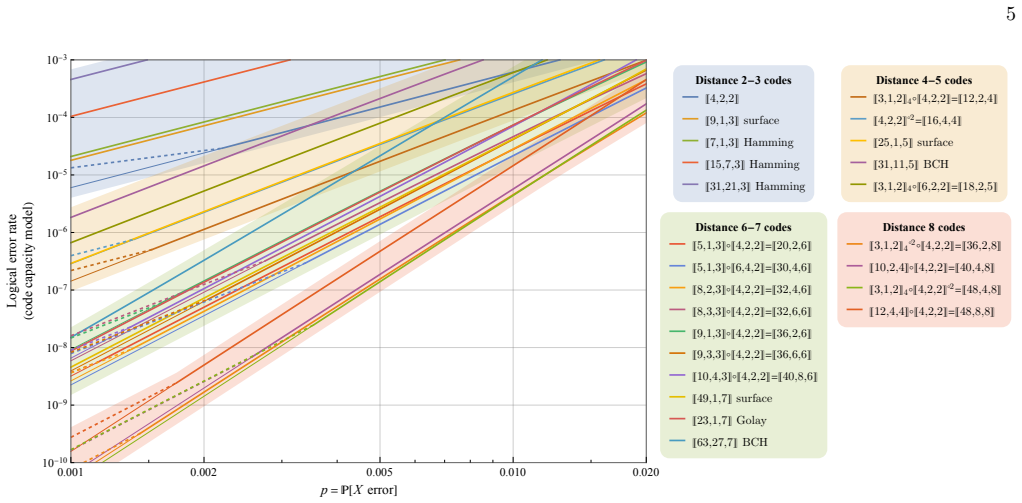
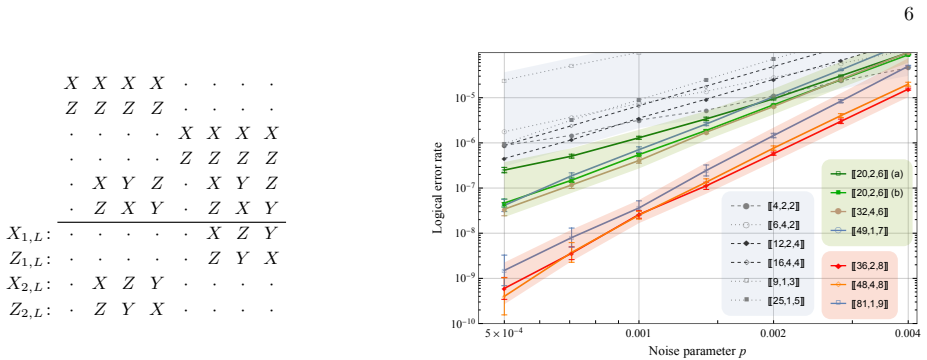
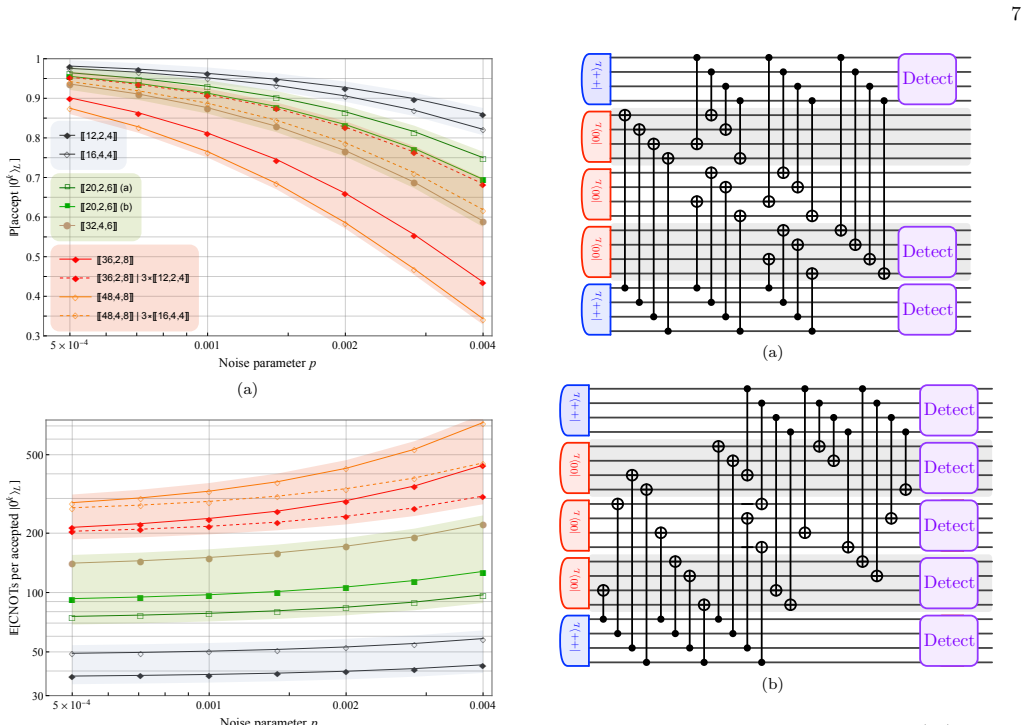
We develop an error-corrected quantum computation scheme based on concatenating the five-qubit Laflamme code onto the four-qubit Iceberg code. The approach skates a thin line: it is explicitly not fault tolerant, risking higher logical error rates, and it relies on selective filtering to prepare encoded states for error correction, risking significant overhead. Yet, at realistic simulated noise rates, the scheme is reliable and resource efficient. It forges a practical path toward scalable quantum computation.
What carries the argument
Concatenation of the five-qubit Laflamme code onto the four-qubit Iceberg code, with selective state filtering used to prepare encoded states for the outer code.
If this is right
- Logical error rates stay low enough for useful computation even without full fault tolerance.
- Resource overhead remains modest compared with standard fault-tolerant schemes at current hardware noise levels.
- The method can be used as a bridge to larger-scale demonstrations before perfect error correction is available.
- Selective filtering provides a workable way to initialize encoded states without requiring perfect operations.
Where Pith is reading between the lines
- Similar partial-fault-tolerance ideas might apply to other code pairs where one code handles initialization and the other handles computation.
- Hardware teams could test this scheme first on small numbers of qubits to measure actual overhead before scaling.
- The approach suggests that near-term devices may not need complete fault tolerance to run interesting algorithms if initialization is handled cleverly.
Load-bearing premise
The selective filtering step successfully prepares encoded states for error correction without introducing prohibitive overhead or error rates at the targeted noise levels.
What would settle it
An experiment or detailed simulation at realistic noise rates that shows the selective filtering step either adds enough errors to make logical failure rates exceed the threshold for useful computation or consumes far more physical resources than projected would disprove the central claim.
Figures






read the original abstract
We develop an error-corrected quantum computation scheme based on concatenating the five-qubit Laflamme code onto the four-qubit Iceberg code. The approach skates a thin line: it is explicitly not fault tolerant, risking higher logical error rates, and it relies on selective filtering to prepare encoded states for error correction, risking significant overhead. Yet, at realistic simulated noise rates, the scheme is reliable and resource efficient. It forges a practical path toward scalable quantum computation.
Editorial analysis
A structured set of objections, weighed in public.
Referee Report
Summary. The manuscript proposes a partially fault-tolerant quantum computing scheme that concatenates the five-qubit Laflamme code onto the four-qubit Iceberg code and relies on selective state filtering to prepare encoded states for error correction. Despite explicitly not being fault tolerant, the authors claim that at realistic simulated noise rates the scheme remains reliable and resource efficient, forging a practical path toward scalable quantum computation.
Significance. If the simulation results can be shown to hold under explicit noise models and error-injection protocols, the work would demonstrate a useful intermediate regime between fully fault-tolerant and uncorrected computation, potentially lowering overhead for near-term devices. The hybrid concatenation plus selective filtering strategy is a concrete trade-off worth documenting even if the quantitative claims require strengthening.
major comments (2)
- [Simulations section] Simulations section: the central claim that the scheme is reliable at realistic noise rates rests on simulations whose noise models, physical error rates, and verification methods are not specified, preventing assessment of whether logical error rates remain acceptable after filtering.
- [Selective filtering analysis] Selective filtering analysis: no analytic bound is derived for the filtering success probability as a function of physical error rate, and no Monte Carlo results are presented that inject realistic filtering errors (measurement-induced dephasing or heralded failures) into the concatenated Iceberg-Laflamme circuit; this assumption is load-bearing for the resource-efficiency and reliability assertions.
minor comments (1)
- [Abstract] The abstract would benefit from a single sentence stating the range of physical error rates at which the reported performance is observed.
Simulated Author's Rebuttal
We thank the referee for their careful reading of our manuscript and for providing constructive feedback. We address each of the major comments in detail below. We have revised the manuscript to incorporate additional details and results where feasible.
read point-by-point responses
-
Referee: Simulations section: the central claim that the scheme is reliable at realistic noise rates rests on simulations whose noise models, physical error rates, and verification methods are not specified, preventing assessment of whether logical error rates remain acceptable after filtering.
Authors: We agree that the simulation details were insufficiently specified in the original manuscript. To address this, we have revised the Simulations section to clearly describe the noise model employed, which is a depolarizing noise model applied independently to each physical qubit with error rates in the range of 10^{-4} to 10^{-2}. We specify the physical error rates used in the simulations and detail the verification methods, including how logical error rates are computed post-filtering and error correction using Monte Carlo sampling with 10^6 trials. These revisions should allow the referee and readers to assess the logical error rates appropriately. revision: yes
-
Referee: Selective filtering analysis: no analytic bound is derived for the filtering success probability as a function of physical error rate, and no Monte Carlo results are presented that inject realistic filtering errors (measurement-induced dephasing or heralded failures) into the concatenated Iceberg-Laflamme circuit; this assumption is load-bearing for the resource-efficiency and reliability assertions.
Authors: We concur that providing an analytic bound would be beneficial; however, the complexity of error propagation through the concatenated codes makes a simple closed-form expression difficult to derive without additional approximations that may not accurately reflect the scheme. We have instead added new Monte Carlo simulation results in the revised manuscript that explicitly inject realistic filtering errors, including measurement-induced dephasing and heralded failures, into the full concatenated circuit. These results show that the filtering success probability remains sufficiently high (above 75% at physical error rates of 0.5%) to maintain the claimed resource efficiency and reliability. We believe this numerical evidence adequately supports the assertions, though we note the absence of an analytic bound as a limitation. revision: partial
Circularity Check
No significant circularity; claims rest on external simulations
full rationale
The paper's central claims concern reliability and resource efficiency of a concatenated Iceberg-Laflamme scheme at realistic simulated noise rates, with explicit acknowledgment that the approach is not fault-tolerant and relies on selective filtering. These performance assertions are tied to external noise models and simulation outcomes rather than any self-referential definition, fitted parameter renamed as prediction, or load-bearing self-citation chain. No equations or steps in the provided abstract reduce a derived quantity to its own inputs by construction; the selective filtering step is presented as an assumption carrying risk, not as a tautological input. The derivation chain therefore remains self-contained against external benchmarks.
Axiom & Free-Parameter Ledger
Lean theorems connected to this paper
-
IndisputableMonolith/Foundation/RealityFromDistinction.leanreality_from_one_distinction unclear?
unclearRelation between the paper passage and the cited Recognition theorem.
We develop an error-corrected quantum computation scheme based on concatenating the five-qubit Laflamme code onto the four-qubit Iceberg code... at realistic simulated noise rates, the scheme is reliable and resource efficient.
-
IndisputableMonolith/Cost/FunctionalEquation.leanwashburn_uniqueness_aczel unclear?
unclearRelation between the paper passage and the cited Recognition theorem.
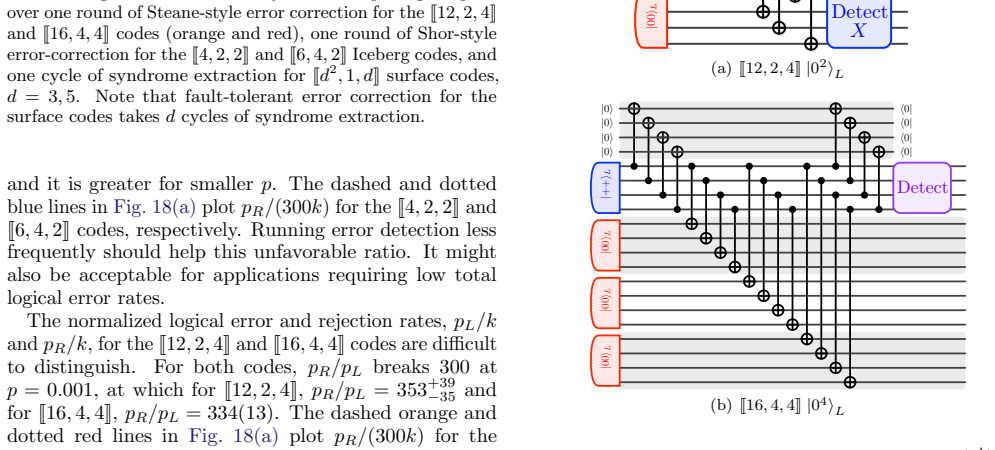
Steane-style error correction... encoded |0^k> and |+^k> states... rejection rates
What do these tags mean?
- matches
- The paper's claim is directly supported by a theorem in the formal canon.
- supports
- The theorem supports part of the paper's argument, but the paper may add assumptions or extra steps.
- extends
- The paper goes beyond the formal theorem; the theorem is a base layer rather than the whole result.
- uses
- The paper appears to rely on the theorem as machinery.
- contradicts
- The paper's claim conflicts with a theorem or certificate in the canon.
- unclear
- Pith found a possible connection, but the passage is too broad, indirect, or ambiguous to say the theorem truly supports the claim.
Reference graph
Works this paper leans on
-
[1]
V. V. Albert and P. Faist. The error correction zoo. 2025, ://errorcorrectionzoo.org/
work page 2025
-
[2]
N. Berthusen and E. Durso-Sabina . Simple logical quantum computation with concatenated symplectic double codes. (2025), arXiv:2510.18753 http://arxiv.org/abs/2510.18753
- [3]
-
[4]
S. Bravyi and A. Y. Kitaev. Universal quantum computation with ideal C lifford gates and noisy ancillas. http://dx.doi.org/10.1103/PhysRevA.71.022316 Phys. Rev. A 71:022316 (2005) , arXiv:quant-ph/0403025 http://arxiv.org/abs/quant-ph/0403025
-
[5]
S. Bravyi, B. Leemhuis, and B. M. Terhal. Majorana fermion codes. http://dx.doi.org/10.1088/1367-2630/12/8/083039 New J. Phys. 12:083039 (2010) , arXiv:1004.3791 http://arxiv.org/abs/1004.3791
work page internal anchor Pith review Pith/arXiv arXiv doi:10.1088/1367-2630/12/8/083039 2010
-
[6]
Optimal Resources for Topological 2D Stabilizer Codes: Comparative Study
H. Bomb \' n and M. A. Martin-Delgado. Optimal resources for topological two-dimensional stabilizer codes: C omparative study. http://dx.doi.org/10.1103/PhysRevA.76.012305 Phys. Rev. A 76:012305 (2007) , arXiv:quant-ph/0703272 http://arxiv.org/abs/quant-ph/0703272
work page internal anchor Pith review Pith/arXiv arXiv doi:10.1103/physreva.76.012305 2007
- [7]
-
[8]
Quantum error correction with only two extra qubits
R. Chao and B. W. Reichardt. Quantum error correction with only two extra qubits. http://dx.doi.org/10.1103/PhysRevLett.121.050502 Phys. Rev. Lett. 121:050502 (2018) , arXiv:1705.02329 http://arxiv.org/abs/1705.02329
work page internal anchor Pith review Pith/arXiv arXiv doi:10.1103/physrevlett.121.050502 2018
-
[9]
A. Cross and D. Vendeth. Small binary stabilizer subsystem codes. 2025, arXiv:2501.17447 http://arxiv.org/abs/2501.17447
-
[10]
B. Eastin. Fault-tolerant thresholds for encoded ancillae with homogeneous errors. http://dx.doi.org/10.1103/PhysRevA.75.022301 Phys. Rev. A 75:022301 (2007) , arXiv:quant-ph/0605192 http://arxiv.org/abs/quant-ph/0605192
work page internal anchor Pith review Pith/arXiv arXiv doi:10.1103/physreva.75.022301 2007
-
[11]
M. Grassl and T. Beth. Quantum BCH codes. 1999, arXiv:quant-ph/9910060 http://arxiv.org/abs/quant-ph/9910060
work page internal anchor Pith review Pith/arXiv arXiv 1999
-
[12]
Quantum error correction below the surface code threshold
Google Quantum AI and Collaborators . Quantum error correction below the surface code threshold. http://dx.doi.org/10.1038/s41586-024-08449-y Nature 638:920--926 (2025) , arXiv:2408.13687 http://arxiv.org/abs/2408.13687
-
[13]
Suppressing quantum errors by scaling a surface code logical qubit
Google Quantum AI . Suppressing quantum errors by scaling a surface code logical qubit. http://dx.doi.org/10.1038/s41586-022-05434-1 Nature 614:676--681 (2023) , arXiv:2207.06431 http://arxiv.org/abs/2207.06431
-
[14]
Stabilizer Codes and Quantum Error Correction
D. Gottesman. Stabilizer codes and quantum error correction. PhD thesis, California Institute of Technology, 1997, arXiv:quant-ph/9705052 http://arxiv.org/abs/quant-ph/9705052
work page internal anchor Pith review Pith/arXiv arXiv 1997
-
[15]
H. Goto. Many-hypercube codes: H igh-rate quantum error-correcting codes for high-performance fault-tolerant quantum computing. http://dx.doi.org/10.1126/sciadv.adp6388 Science Advances 10:eadp6388 (2024) , arXiv:2403.16054 http://arxiv.org/abs/2403.16054
-
[16]
M. Grassl. Bounds on the minimum distance of linear codes and quantum codes, online available at http://www.codetables.de
-
[17]
R. S. Gupta, N. Sundaresan, T. Alexander, et al. Encoding a magic state with beyond break-even fidelity. http://dx.doi.org/10.1038/s41586-023-06846-3 Nature 625:259--263 (2024) , arXiv:2305.13581 http://arxiv.org/abs/2305.13581
-
[18]
Magic state cultivation: growing T states as cheap as CNOT gates
C. Gidney, N. Shutty, and C. Jones. Magic state cultivation: growing T states as cheap as CNOT gates. 2024, arXiv:2409.17595 http://arxiv.org/abs/2409.17595
work page internal anchor Pith review Pith/arXiv arXiv 2024
-
[19]
Z. He, D. Amaro, R. Shaydulin, and M. Pistoia. Performance of quantum approximate optimization with quantum error detection. http://dx.doi.org/10.1038/s42005-025-02136-8 Commun. Phys. 8:217 (2025) , arXiv:2409.12104 http://arxiv.org/abs/2409.12104
-
[20]
M. B. Hastings and J. Haah. Dynamically generated logical qubits. http://dx.doi.org/10.22331/q-2021-10-19-564 Quantum 5:564 (2021) , arXiv:2107.02194 http://arxiv.org/abs/2107.02194
-
[21]
O. Higgott. PyMatching : A P ython package for decoding quantum codes with minimum-weight perfect matching. http://dx.doi.org/10.1145/3505637 ACM Trans. Quantum Comput. 3(3): 1--16 (2022) , arXiv:2105.13082 http://arxiv.org/abs/2105.13082
- [22]
-
[23]
E. Knill. Quantum computing with realistically noisy devices. http://dx.doi.org/10.1038/nature03350 Nature 434:39 (2005)
-
[24]
A. A. Kovalev and L. P. Pryadko. Quantum K ronecker sum-product low-density parity-check codes with finite rate. http://dx.doi.org/10.1103/PhysRevA.88.012311 Phys. Rev. A 88:012311 (2013)
-
[25]
R. Nakai and H. Goto. Subsystem many-hypercube codes: H igh-rate concatenated codes with low-weight syndrome measurements. http://dx.doi.org/10.1103/xbzn-vn37 Phys. Rev. Applied 25:014032 (2026) , arXiv:2510.04526 http://arxiv.org/abs/2510.04526
-
[26]
Fault-tolerant ancilla preparation and noise threshold lower bounds for the 23-qubit Golay code
A. Paetznick and B. Reichardt. Fault-tolerant ancilla preparation and noise threshold lower bounds for the 23-qubit G olay code. http://dx.doi.org/10.26421/QIC12.11-12-10 Quantum Inf. Comput. 12:1034--1080 (2012) , arXiv:1106.2190 http://arxiv.org/abs/1106.2190
work page internal anchor Pith review Pith/arXiv arXiv doi:10.26421/qic12.11-12-10 2012
-
[27]
Demonstration of logical qubits and repeated error correction with better-than-physical error rates
A. Paetznick , M. Silva , C. Ryan-Anderson , et al. Demonstration of logical qubits and repeated error correction with better-than-physical error rates. 2024, arXiv:2404.02280 http://arxiv.org/abs/2404.02280
work page internal anchor Pith review Pith/arXiv arXiv 2024
-
[28]
C. N. Self, M. Benedetti, and D. Amaro. Protecting expressive circuits with a quantum error detection code. http://dx.doi.org/10.1038/s41567-023-02282-2 Nat. Phys. 20:219--224 (2024) , arXiv:2211.06703 http://arxiv.org/abs/2211.06703
-
[29]
M. Serra-Peralta , M. H. Shaw, and B. M. Terhal. Decoding across transversal C lifford gates in the surface code. http://dx.doi.org/10.1103/sk5y-25b1 PRX Quantum 7:010335 (2026) , arXiv:2505.13599 http://arxiv.org/abs/2505.13599
-
[30]
A. M. Steane. Active stabilization, quantum computation, and quantum state synthesis. http://dx.doi.org/10.1103/PhysRevLett.78.2252 Phys. Rev. Lett. 78(11):2252 (1997) , arXiv:quant-ph/9611027 http://arxiv.org/abs/quant-ph/9611027
work page internal anchor Pith review Pith/arXiv arXiv doi:10.1103/physrevlett.78.2252 1997
-
[31]
A. M. Steane. Fast fault-tolerant filtering of quantum codewords. 2002, arXiv:quant-ph/0202036 http://arxiv.org/abs/quant-ph/0202036
work page internal anchor Pith review Pith/arXiv arXiv 2002
-
[32]
Spatially Correlated Qubit Errors and Burst-Correcting Quantum Codes
F. Vatan, V. P. Roychowdhury, and M. P. Anantram. Spatially correlated qubit errors and burst-correcting quantum codes. 1997, arXiv:quant-ph/9704019 http://arxiv.org/abs/quant-ph/9704019
work page internal anchor Pith review Pith/arXiv arXiv 1997
-
[33]
T. J. Yoder, E. Schoute, P. Rall, et al. Tour de gross: A modular quantum computer based on bivariate bicycle codes. 2025, arXiv:2506.03094 http://arxiv.org/abs/2506.03094
work page internal anchor Pith review Pith/arXiv arXiv 2025
-
[34]
C. Zalka. Threshold estimate for fault tolerant quantum computation. 1997, arXiv:quant-ph/9612028 http://arxiv.org/abs/quant-ph/9612028
work page internal anchor Pith review Pith/arXiv arXiv 1997
-
[35]
H. Zhou, C. Zhao, M. Cain, et al. Low-overhead transversal fault tolerance for universal quantum computation. http://dx.doi.org/10.1038/s41586-025-09543-5 Nature 646:303--308 (2025) , arXiv:2406.17653 http://arxiv.org/abs/2406.17653
discussion (0)
Sign in with ORCID, Apple, or X to comment. Anyone can read and Pith papers without signing in.