Topical Shifts in the Dark Web: A Longitudinal Analysis of Content from the Cybercrime Ecosystem
Pith reviewed 2026-05-19 14:36 UTC · model grok-4.3
pith:N6EZ6AJS Add to your LaTeX paper
What is a Pith Number?\usepackage{pith}
\pithnumber{N6EZ6AJS}
Prints a linked pith:N6EZ6AJS badge after your title and writes the identifier into PDF metadata. Compiles on arXiv with no extra files. Learn more
The pith
Dark web cybercrime discussions concentrate 75% of their volume in a small set of persistent core topics that last a median of 75 months.
A machine-rendered reading of the paper's core claim, the machinery that carries it, and where it could break.
Core claim
Analysis of 25,065 dark web websites through 11,403,638 HTML snapshots collected over six years identifies 55 thematic clusters in which approximately 75 percent of total discussion volume resides in a small number of persistent core topics, short-lived themes account for only about 3 percent of activity, and the median topic lifespan reaches 75 months, demonstrating gradual thematic evolution rather than sudden replacement.
What carries the argument
A longitudinal topic-modeling framework that combines domain-specific embeddings, density-based clustering, and temporal aggregation to measure topic prevalence and lifecycle at the website level.
If this is right
- Law-enforcement and threat-intelligence efforts can achieve higher returns by concentrating on the small set of persistent core topics instead of monitoring every emerging theme.
- Static single-point snapshots of dark web content miss the long-term stability that characterizes most discussion volume.
- Cybercrime forums and marketplaces adapt to external pressures such as enforcement actions through slow, incremental shifts rather than wholesale replacement of topics.
- The 3 percent share held by short-lived themes indicates that transient events or hype cycles contribute little to the overall activity on these platforms.
Where Pith is reading between the lines
- The same gradual-evolution pattern may appear in other pressured online environments such as clear-web fraud forums or encrypted messaging groups.
- Resource allocation for continuous monitoring could be reduced by maintaining lightweight trackers only on the identified core topics.
- If topic lifespans remain stable across future years, the 75-month median supplies a natural time window for longitudinal studies of how specific enforcement events influence discussion volume.
Load-bearing premise
The topic-modeling approach correctly groups real discussion themes and tracks their true lifespans without major distortion from the way the snapshots were collected or from choices made during clustering.
What would settle it
A new collection of dark web snapshots processed with the same framework that shows either markedly lower concentration in core topics or a median lifespan well below 75 months would falsify the central claim.
Figures


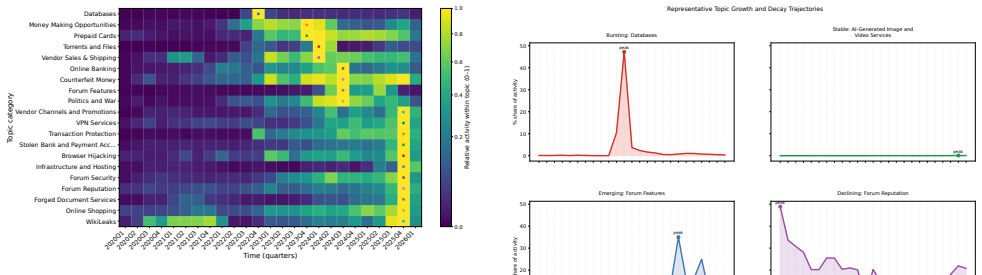
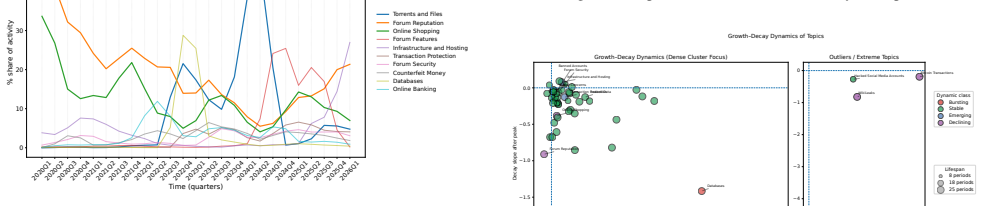
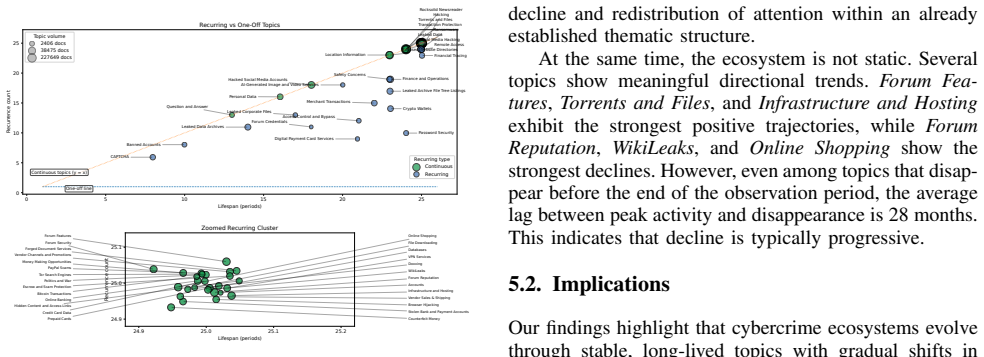

read the original abstract
The dark web hosts a dynamic ecosystem of cybercrime forums and marketplaces that adapt to law enforcement pressure, technological change, and economic incentives. Prior research has extracted cyber threat intelligence from these platforms using static snapshots, with limited attention to how discussions evolve over time. In this study, we conduct a longitudinal analysis of 25,065 websites in the dark web using 11,403,638 HTML snapshots (approximately 1245.38 GB) collected over six years. We develop a longitudinal topic-modeling framework combining domain-specific embeddings, density-based clustering and temporal aggregation to measure topic prevalence and lifecycle at the website level. Our analysis identifies 55 thematic clusters. We find that approximately 75% of total discussion volume is concentrated in a small set of persistent core topics, while short-lived themes account for approximately 3% of activity. The median topic lifespan is 75 months, indicating gradual thematic evolution rather than abrupt replacement.
Editorial analysis
A structured set of objections, weighed in public.
Referee Report
Summary. The manuscript analyzes 25,065 dark web websites via 11,403,638 HTML snapshots collected over six years. It introduces a longitudinal topic-modeling pipeline that combines domain-specific embeddings, density-based clustering, and temporal aggregation to extract 55 thematic clusters. The central empirical claims are that ~75% of total discussion volume concentrates in a small set of persistent core topics, short-lived themes account for ~3% of activity, and the median topic lifespan is 75 months, supporting a conclusion of gradual thematic evolution rather than abrupt replacement.
Significance. If the pipeline accurately measures prevalence and lifespan without material distortion, the work supplies large-scale longitudinal evidence on the stability of cybercrime discussions, filling a gap left by prior static-snapshot studies. The dataset scale and website-level tracking constitute clear strengths; the findings would inform threat-intelligence monitoring and law-enforcement resource allocation if shown to be robust.
major comments (2)
- [Methods] Methods section (framework description): the density-based clustering and temporal aggregation steps are presented without any reported sensitivity tests on hyperparameters (minimum cluster size, distance threshold, aggregation window). These free parameters directly determine the partition into 55 clusters and the subsequent calculations of the 75% core-topic volume share, 3% short-lived share, and 75-month median lifespan; absence of such checks leaves open the possibility that the gradual-evolution conclusion is an artifact of the chosen settings or non-uniform snapshot collection.
- [Results] Results (volume and lifespan claims): the reported 75% and 3% volume figures and 75-month median are given without error bars, bootstrap intervals, or comparisons against alternative clustering algorithms or ground-truth subsets. Because the central claims rest on the correctness of these quantities, the lack of quantitative validation or robustness metrics weakens confidence that the measurements reflect properties of the data rather than pipeline choices.
minor comments (2)
- [Data collection] Clarify whether the 1,245.38 GB figure refers to compressed or uncompressed HTML and whether duplicate or low-quality snapshots were filtered before embedding.
- [Abstract] The abstract states the dataset size and high-level method but omits any mention of validation metrics; adding a short sentence on inter-annotator agreement or held-out topic coherence would improve readability.
Simulated Author's Rebuttal
We are grateful to the referee for the careful reading and valuable suggestions that will help improve the robustness of our analysis. We respond to each major comment in turn, indicating where we will revise the manuscript to address the concerns raised.
read point-by-point responses
-
Referee: [Methods] Methods section (framework description): the density-based clustering and temporal aggregation steps are presented without any reported sensitivity tests on hyperparameters (minimum cluster size, distance threshold, aggregation window). These free parameters directly determine the partition into 55 clusters and the subsequent calculations of the 75% core-topic volume share, 3% short-lived share, and 75-month median lifespan; absence of such checks leaves open the possibility that the gradual-evolution conclusion is an artifact of the chosen settings or non-uniform snapshot collection.
Authors: We concur that reporting sensitivity tests is important for validating the pipeline choices. The hyperparameters were tuned to produce coherent and stable clusters based on initial explorations of the data, but this process was not documented in the submitted manuscript. For the revision, we will include a new subsection in the Methods detailing sensitivity analyses. We will test ranges for minimum cluster size, distance threshold, and aggregation window, and show that the primary conclusions—75% of volume in persistent core topics, 3% in short-lived themes, and a median lifespan of 75 months—hold across these variations. We will also address potential effects of non-uniform snapshot collection by analyzing subsets with more uniform temporal coverage. revision: yes
-
Referee: [Results] Results (volume and lifespan claims): the reported 75% and 3% volume figures and 75-month median are given without error bars, bootstrap intervals, or comparisons against alternative clustering algorithms or ground-truth subsets. Because the central claims rest on the correctness of these quantities, the lack of quantitative validation or robustness metrics weakens confidence that the measurements reflect properties of the data rather than pipeline choices.
Authors: The referee correctly notes the absence of uncertainty estimates and comparative validations for the key quantitative results. These figures are obtained by aggregating the cluster memberships over all 11,403,638 snapshots. In the revised paper, we will add bootstrap-derived confidence intervals for the volume shares by resampling at the website level. We will also include a comparison of topic lifespans derived from our density-based method versus an alternative embedding-based clustering technique applied to a random subset of 5,000 websites. Regarding ground-truth subsets, this is not available for the full dataset; however, we will report additional metrics such as average cluster purity based on manual inspection of a sample of clusters to support the findings. revision: partial
- Complete ground-truth validation for all 55 clusters across the entire dataset is not possible given the scale and sensitive nature of the dark web data.
Circularity Check
Empirical measurement pipeline with no definitional or self-referential reduction
full rationale
The paper collects 11M+ HTML snapshots and applies a pipeline of domain-specific embeddings, density-based clustering, and temporal aggregation to extract 55 clusters, then computes prevalence shares and lifespans directly from those clusters. The 75% core-topic volume and 75-month median lifespan are arithmetic summaries of the resulting cluster assignments and time spans; they are not obtained by fitting a parameter to a subset and relabeling it as a prediction, nor by any self-citation that supplies the uniqueness or functional form of the result. No equation or claim in the abstract or described framework reduces to its own inputs by construction. Hyperparameter dependence is a robustness issue, not a circularity issue under the stated criteria.
Axiom & Free-Parameter Ledger
free parameters (2)
- clustering hyperparameters
- temporal aggregation window
Lean theorems connected to this paper
-
IndisputableMonolith/Foundation/RealityFromDistinction.leanreality_from_one_distinction unclear?
unclearRelation between the paper passage and the cited Recognition theorem.
We develop a longitudinal topic-modeling framework combining domain-specific embeddings, density-based clustering and temporal aggregation to measure topic prevalence and lifecycle at the website level. Our analysis identifies 55 thematic clusters.
-
IndisputableMonolith/Cost/FunctionalEquation.leanwashburn_uniqueness_aczel unclear?
unclearRelation between the paper passage and the cited Recognition theorem.
Topic prevalence is measured as the aggregated topic probability mass across snapshots within each time interval... Topic lifecycle is measured using temporal change indicators, including topic lifespan, growth and decay rate.
What do these tags mean?
- matches
- The paper's claim is directly supported by a theorem in the formal canon.
- supports
- The theorem supports part of the paper's argument, but the paper may add assumptions or extra steps.
- extends
- The paper goes beyond the formal theorem; the theorem is a base layer rather than the whole result.
- uses
- The paper appears to rely on the theorem as machinery.
- contradicts
- The paper's claim conflicts with a theorem or certificate in the canon.
- unclear
- Pith found a possible connection, but the passage is too broad, indirect, or ambiguous to say the theorem truly supports the claim.
Reference graph
Works this paper leans on
-
[1]
Relevance of the deep web to academic research,
E. Essien, “Relevance of the deep web to academic research,” International Journal of Natural and Applied Sciences, vol. 12, pp. 107–113, 2020
work page 2020
-
[2]
“Tor metrics,” 2025. [Online]. Available: https:// metrics.torproject.org/
work page 2025
-
[3]
A review of dark web: Trends and future directions,
S. Sobhan, T. Williams, M. J. H. Faruk, J. Rodriguez, M. Tasnim, E. Mathew, J. Wright, and H. Shahriar, “A review of dark web: Trends and future directions,” in2022 IEEE 46th Annual COMP- SAC, 2022, pp. 1780–1785
work page 2022
-
[4]
The Dark Side of the Web: Towards Understanding Various Data Sources in Cyber Threat Intelligence ,
S. L. Schroer, N. Canevascini, I. Pekaric, P. Widmer, and P. Laskov, “ The Dark Side of the Web: Towards Understanding Various Data Sources in Cyber Threat Intelligence ,” in2025 IEEE European Symposium on Security and Privacy Workshops (EuroS&PW). Los Alamitos, CA, USA: IEEE Computer Society, Jul. 2025, pp. 79–89
work page 2025
-
[5]
J. Robertson, A. Diab, E. Marin, E. Nunes, V . Paliath, J. Shakar- ian, and P. Shakarian,Darkweb cyber threat intelligence mining. Cambridge University Press, 2017
work page 2017
-
[6]
Darknet and deepnet mining for proactive cybersecurity threat intelligence,
E. Nunes, A. Diab, A. Gunn, E. Marin, V . Mishra, V . Paliath, J. Robertson, J. Shakarian, A. Thart, and P. Shakarian, “Darknet and deepnet mining for proactive cybersecurity threat intelligence,” in2016 IEEE ISI, 2016, pp. 7–12
work page 2016
-
[7]
M. S. A. Basha, K. V . Kumar, and R. N D, “Classifying dark web–related social media discourse using machine learning, deep learning, and transformer models,” in2025 6th ICICNIS, 2025
work page 2025
-
[8]
Behind the curtain: The illicit trade of firearms, explosives and ammunition on the dark web,
G. P. Paoli, J. Aldridge, R. Nathan, and R. Warnes, “Behind the curtain: The illicit trade of firearms, explosives and ammunition on the dark web,” 2017
work page 2017
-
[9]
Data capture and analysis of darknet markets,
M. Ball and R. Broadhurst, “Data capture and analysis of darknet markets,”Available at SSRN 3344936, 2021
work page 2021
-
[10]
Assessing crime disclosure patterns in a large-scale cybercrime forum,
R. Hoheisel, T. Meurs, J. Wientjes, M. Junger, A. Abhishta, and M. Paquet-Clouston, “Assessing crime disclosure patterns in a large-scale cybercrime forum,”arXiv preprint arXiv:2603.01624, 2026
-
[11]
D. D ´ecary-H´etu and L. Giommoni, “Do police crackdowns dis- rupt drug cryptomarkets? a longitudinal analysis of the effects of operation onymous,”Crime, Law and Social Change, 2017
work page 2017
-
[12]
M. Felderer and I. Pekaric, “Research challenges in empowering agile teams with security knowledge based on public and private information sources.” 2017
work page 2017
-
[13]
Bridging safety and security in complex systems: A model-based approach with saft-gt toolchain,
I. Pekaric, R. Groner, A. Raschke, T. Witte, J. G. Adigun, M. Felderer, and M. Tichy, “Bridging safety and security in complex systems: A model-based approach with saft-gt toolchain,” Journal of Systems and Software, 2026
work page 2026
-
[14]
Enhancing relationships between crim- inology and cybersecurity,
B. Dupont and C. Whelan, “Enhancing relationships between crim- inology and cybersecurity,”Journal of Criminology, 2021
work page 2021
-
[15]
Uncovering the trust signals supporting telegram’s cybercrime economy,
R. Ricaldi, T. Marjanov, L. Allodi, and A. Hutchings, “Uncovering the trust signals supporting telegram’s cybercrime economy,” in 2025 eCrime, 2025, pp. 1–17
work page 2025
-
[16]
Analysis of security mechanisms of dark web markets,
Y . Wang, B. Arief, and J. Hernandez-Castro, “Analysis of security mechanisms of dark web markets,” inProceedings of the 2024 EICC. NY , USA: Association for Computing Machinery, 2024
work page 2024
-
[17]
E. R. Leukfeldt, E. R. Kleemans, and W. P. Stol, “Cybercriminal networks, social ties and online forums: Social ties versus digital ties within phishing and malware networks,”The British Journal of Criminology, vol. 57, no. 3, pp. 704–722, 2017
work page 2017
-
[18]
A comprehensive study on emerging trends of dark web marketplaces and forums,
F. Hasanti, M. Z. Osman, M. H. Rahman, M. Z. A. Darus, and N. B. Mohd, “A comprehensive study on emerging trends of dark web marketplaces and forums,” in2024 IEEE ICOCO, 2024
work page 2024
-
[19]
Where is dmitry going? framing ’migratory’ decisions in the criminal underground,
L. Allodi, R. Ricaldi, J. Wientjes, and A. Radu, “Where is dmitry going? framing ’migratory’ decisions in the criminal underground,”
-
[20]
Available: https://arxiv.org/abs/2411.16291 9
[Online]. Available: https://arxiv.org/abs/2411.16291 9
-
[21]
J. Sultana and A. K. Jilani,Exploring and Analysing Surface, Deep, Dark Web and Attacks. Cham: Springer, 2021, pp. 97–108
work page 2021
-
[22]
S. Kaur and S. Randhawa, “Dark Web: A Web of Crimes,”Wireless Personal Communications, vol. 112, no. 4, Jun. 2020
work page 2020
-
[23]
D. Kavallieros, D. Myttas, E. Kermitsis, E. Lissaris, G. Giataganas, and E. Darra,Understanding the Dark Web. Cham: Springer International Publishing, 2021, pp. 3–26
work page 2021
-
[24]
M. Campobasso, R. R ˘adulescu, S. Brons, and L. Allodi, “You can tell a cybercriminal by the company they keep: A framework to infer the relevance of underground communities to the threat landscape,”arXiv preprint arXiv:2306.05898, 2023
-
[25]
A social network analysis and comparison of six dark web forums,
I. Pete, J. Hughes, Y . T. Chua, and M. Bada, “A social network analysis and comparison of six dark web forums,” in2020 IEEE EuroS&PW, 2020, pp. 484–493
work page 2020
-
[26]
S. Davis and B. Arrigo, “The dark web and anonymizing technolo- gies: legal pitfalls, ethical prospects, and policy directions from radical criminology,”Crime, Law and Social Change, vol. 76, no. 4, pp. 367–386, Nov 2021
work page 2021
-
[27]
A qualitative mapping of darkweb marketplaces,
D. Georgoulias, J. M. Pedersen, M. Falch, and E. Vasilomanolakis, “A qualitative mapping of darkweb marketplaces,” in2021 APWG eCrime, 2021, pp. 1–15
work page 2021
-
[28]
E. Kermitsis, D. Kavallieros, D. Myttas, E. Lissaris, and G. Gi- ataganas,Dark Web Markets. Cham: Springer International Publishing, 2021, pp. 85–118
work page 2021
-
[29]
Extraction of actionable threat intelligence from dark web data,
V . Varghese, S. Mahalakshmi, and S. Kb, “Extraction of actionable threat intelligence from dark web data,” inICCC. IEEE, 2023
work page 2023
-
[30]
The language of legal and illegal activity on the darknet,
L. Choshen, D. Eldad, D. Hershcovich, E. Sulem, and O. Abend, “The language of legal and illegal activity on the darknet,” 01 2019
work page 2019
-
[31]
Structure and Content of the Visible Darknet
G. Avarikioti, R. Brunner, A. Kiayias, R. Wattenhofer, and D. Zin- dros, “Structure and content of the visible darknet,”arXiv preprint arXiv:1811.01348, 2018
work page internal anchor Pith review Pith/arXiv arXiv 2018
-
[32]
Shedding new light on the language of the dark web,
Y . Jin, E. Jang, Y . Lee, S. Shin, and J.-W. Chung, “Shedding new light on the language of the dark web,” inProceedings of the 2022 conference of the north American chapter of the association for computational linguistics: human language technologies, 2022
work page 2022
-
[33]
Darknet as a source of cyber intelligence: Survey, taxonomy, and characterization,
C. Fachkha and M. Debbabi, “Darknet as a source of cyber intelligence: Survey, taxonomy, and characterization,”IEEE Com- munications Surveys & Tutorials, vol. 18, no. 2, 2016
work page 2016
-
[34]
R. Ricaldi, Y . Yalamov, M. Campobasso, L. Allodi, H. Kool, A. Moneva, and E. R. Leukfeldt, “An experimental design to investigate attacker actions on an access-as-a-service ‘criminal’ platform,” in2025 IEEE European Symposium on Security and Privacy Workshops (EuroS&PW), 2025, pp. 109–114
work page 2025
-
[35]
Into the deep web: Understanding e-commercefraud from autonomous chat with cy- bercriminals,
P. W. Wang, X. L. Liao, Y . Qin, and X. Wang, “Into the deep web: Understanding e-commercefraud from autonomous chat with cy- bercriminals,” inProceedings of the ISOC Network and Distributed System Security Symposium (NDSS), 2020, 2020
work page 2020
-
[36]
Klaus Krippendorff,Content Analysis : An Introduction to Its Methodology, fourth edition ed. Los Angeles: SAGE, Jan. 2019
work page 2019
-
[37]
L. De-Marcos, J.-A. Medina-Merodio, and Z. Stapic, “Methodolo- gies for data collection and analysis of dark web forum content: A systematic literature review,”Electronics, vol. 14, no. 21, p. 4191, 2025
work page 2025
-
[38]
Information extraction from darknet market advertisements and forums,
C. Heistracher, S. Schlarb, and F. Ghaffar, “Information extraction from darknet market advertisements and forums,” inProceedings of the 14th international Conference on emerging security infor- mation, systems and Technologies (SECURWARE 2020), 2020
work page 2020
-
[39]
Ex- ploring the dark web for cyber threat intelligence using machine leaning,
M. Kadoguchi, S. Hayashi, M. Hashimoto, and A. Otsuka, “Ex- ploring the dark web for cyber threat intelligence using machine leaning,” in2019 IEEE International Conference on Intelligence and Security Informatics (ISI). IEEE, 2019, pp. 200–202
work page 2019
-
[40]
A litera- ture review on mining cyberthreat intelligence from unstructured texts,
M. R. Rahman, R. Mahdavi-Hezaveh, and L. Williams, “A litera- ture review on mining cyberthreat intelligence from unstructured texts,” in2020 ICDMW. IEEE, 2020, pp. 516–525
work page 2020
-
[41]
E. Karaosman, A. Rizvani, and I. Pekaric, “Security Barriers to Trustworthy AI-Driven Cyber Threat Intelligence in Finance: Evidence from Practitioners,” inThe Sixteenth ACM Conference on Data and Application Security and Privacy (CODASPY), 2026
work page 2026
-
[42]
New cyber threat discovery from darknet marketplaces,
F. Dong, S. Yuan, H. Ou, and L. Liu, “New cyber threat discovery from darknet marketplaces,” in2018 IEEE Conference on Big Data and Analytics (ICBDA). IEEE, 2018, pp. 62–67
work page 2018
-
[43]
Darkembed: Exploit prediction with neural language models,
N. Tavabi, P. Goyal, M. Almukaynizi, P. Shakarian, and K. Lerman, “Darkembed: Exploit prediction with neural language models,” in Proceedings of the AAAI Conference, vol. 32, no. 1, 2018
work page 2018
-
[44]
K. S. Sangher, A. Singh, and H. M. Pandey, “Lstm and bert based transformers models for cyber threat intelligence for intent identification of social media platforms exploitation from darknet forums,”International Journal of Information Technology, 2024
work page 2024
-
[45]
K. S. Sangher, A. Singh, H. M. Pandey, and V . Kumar, “To- wards safe cyber practices: Developing a proactive cyber-threat intelligence system for dark web forum content by identifying cybercrimes,”Information, vol. 14, no. 6, p. 349, 2023
work page 2023
-
[46]
Sentiment analysis of hacker forums with deep learning to predict potential cyberattacks,
B. Mardassa, A. Beza, A. Al Madhan, and M. Aldwairi, “Sentiment analysis of hacker forums with deep learning to predict potential cyberattacks,” in2024 15th Annual Undergraduate Research Con- ference on Applied Computing (URC). IEEE, 2024, pp. 1–6
work page 2024
- [47]
-
[48]
BERTopic: Neural topic modeling with a class-based TF-IDF procedure
M. Grootendorst, “Bertopic: Neural topic modeling with a class-based tf-idf procedure,” 2022. [Online]. Available: https: //arxiv.org/abs/2203.05794
work page internal anchor Pith review Pith/arXiv arXiv 2022
-
[49]
C. Heistracher, F. Mignet, and S. Schlarb, “Machine learning tech- niques for the classification of product descriptions from darknet marketplaces.” inICAI, 2020, pp. 128–137
work page 2020
-
[50]
Dark web text classification by learning through svm optimization,
C. A. Murty and P. H. Rughani, “Dark web text classification by learning through svm optimization,”Journal of Advances in Information Technology, vol. 13, no. 6, pp. 624–631, 2022
work page 2022
-
[51]
Automated categorization of onion sites for analyzing the darkweb ecosystem,
S. Ghosh, A. Das, P. Porras, V . Yegneswaran, and A. Gehani, “Automated categorization of onion sites for analyzing the darkweb ecosystem,” inProceedings of the 23rd ACM SIGKDD, 2017
work page 2017
-
[52]
A big data architecture for early identification and categorization of dark web sites,
J. Pastor Galindo, H.- ˆA. Sandlin, F. G. M ´armol, G. Bovet, and G. M. P ´erez, “A big data architecture for early identification and categorization of dark web sites,”Future Generation Computer Systems, vol. 157, pp. 67–81, 2024
work page 2024
-
[53]
A comparative analysis of models for dark web data classification,
A. Dalvi, A. Shah, P. Desai, R. Chavan, and S. Bhirud, “A comparative analysis of models for dark web data classification,” inInternational Joint Conference on Advances in Computational Intelligence. Springer, 2022, pp. 245–257
work page 2022
-
[54]
Dark side of the web: Dark web classification based on textcnn and topic modeling weight,
G.-Y . Shin, Y . Jang, D.-W. Kim, S. Park, A.-R. Park, Y . Kim, and M.-M. Han, “Dark side of the web: Dark web classification based on textcnn and topic modeling weight,”IEEE Access, 2023
work page 2023
-
[55]
C. Chen, C. Peersman, M. Edwards, Z. Ursani, and A. Rashid, “Amoc: A multifaceted machine learning-based toolkit for analysing cybercriminal communities on the darknet,” in2021 IEEE International Conference on Big Data. IEEE, 2021
work page 2021
-
[56]
Sentiment & pattern analysis for identifying nature of the content hosted in the dark web,
C. Murty and P. H. Rughani, “Sentiment & pattern analysis for identifying nature of the content hosted in the dark web,”Indian J. Comput Sci Eng, vol. 12, no. 6, 2021
work page 2021
-
[57]
Discovering topics from dark websites,
L. Yang, F. Liu, J. M. Kizza, and R. K. Ege, “Discovering topics from dark websites,” inProceedings of the IEEE Symposium on Computational Intelligence in Cyber Security, 2009
work page 2009
-
[58]
Topic-based social network analysis for virtual communities of interests in the dark web,
G. L’Huillier, H. Alvarez, S. A. R´ıos, and F. Aguilera, “Topic-based social network analysis for virtual communities of interests in the dark web,” inACM SIGKDD Explorations Newsletter, 2011
work page 2011
-
[59]
R. Basheer and B. Alkhatib, “Darkonto: An ontology construc- tion approach for dark web community discussions through topic modeling and ontology learning,”Human Behavior and Emerging Technologies, 2024
work page 2024
-
[60]
Analyzing a dark web forum page in the context of terrorism: a topic modeling approach,
E. S ¨onmez and K. Sec ¸kin Codal, “Analyzing a dark web forum page in the context of terrorism: a topic modeling approach,” Security Journal, vol. 37, no. 4, pp. 1360–1381, 2024
work page 2024
-
[61]
Evolution of dark web threat analysis and detection: A systematic approach,
S. Nazah, S. Huda, J. Abawajy, and M. M. Hassan, “Evolution of dark web threat analysis and detection: A systematic approach,” IEEE Access, vol. 8, pp. 171 796–171 819, 2020
work page 2020
-
[62]
Darkbert: A language model for the dark side of the internet,
Y . Jin, E. Jang, J. Cui, J.-W. Chung, Y . Lee, and S. Shin, “Darkbert: A language model for the dark side of the internet,” inProceedings of the 61st annual meeting of the association for computational linguistics (volume 1: long papers), 2023, pp. 7515–7533
work page 2023
-
[63]
Llms in cybersecurity: Friend or foe in the human decision loop?
I. Pekaric, P. Zech, and T. Mattson, “Llms in cybersecurity: Friend or foe in the human decision loop?”arXiv preprint arXiv:2509.06595, 2025
-
[64]
Ethics guidelines for internet- mediated research
C. Hewson and T. Buchanan, “Ethics guidelines for internet- mediated research.” The British Psychological Society, 2013
work page 2013
-
[65]
B. Pickering, S. Roth, and C. Webber, “Ethical approaches to studying cybercrime: considerations, practice and experience in the united kingdom,” inResearching Cybercrimes: Methodologies, Ethics, and Critical Approaches. Springer, 2021, pp. 347–369
work page 2021
-
[66]
Department-Specific Security Awareness Campaigns: A Cross-Organizational Study of HR and Accounting,
M. Pfister, G. Apruzzese, and I. Pekaric, “Department-Specific Security Awareness Campaigns: A Cross-Organizational Study of HR and Accounting,” in2025 APWG Symposium on Electronic Crime Research (eCrime), 2025
work page 2025
-
[67]
J. Ave, I. Pekaric, M. Frohner, and G. Apruzzese, ““bot lane noob”: Towards Practical Deployment of NLP-based Toxicity Detectors in Video Games,” inEuropean Symposium on Research in Computer Security (ESORICS), 2026. 10 Appendix A. A.1. Reproducibility Overview This section summarizes the configuration required to reproduce the content analysis pipeline. ...
work page 2026
discussion (0)
Sign in with ORCID, Apple, or X to comment. Anyone can read and Pith papers without signing in.