Stochastic Compositional Optimization via Hybrid Momentum Frank--Wolfe
Pith reviewed 2026-05-19 15:13 UTC · model grok-4.3
pith:VOH7P5BM Add to your LaTeX paper
What is a Pith Number?\usepackage{pith}
\pithnumber{VOH7P5BM}
Prints a linked pith:VOH7P5BM badge after your title and writes the identifier into PDF metadata. Compiles on arXiv with no extra files. Learn more
The pith
A hybrid momentum Frank-Wolfe algorithm achieves the optimal O(K^{-1/4}) convergence rate for stochastic compositional problems with merely Lipschitz outer functions.
A machine-rendered reading of the paper's core claim, the machinery that carries it, and where it could break.
Core claim
The Hybrid Momentum Stochastic Frank--Wolfe algorithm minimizes objectives of the form min F(f(x), x) where F is L_F-Lipschitz by maintaining a momentum-based Jacobian tracker together with a Taylor-corrected function tracker; the trackers supply a stochastic linearization to a generalized linear minimization oracle, producing an O(K^{-1/4}) convergence rate in the generalized Frank-Wolfe gap under expected smoothness or bounded r-th moments for r in (1,2], while recovering deterministic rates as noise vanishes.
What carries the argument
The hybrid momentum tracker that combines a momentum-based Jacobian estimator with a Taylor-corrected function-value estimator to deliver a complete stochastic linearization to the generalized linear minimization oracle.
If this is right
- The algorithm applies to non-differentiable outer functions including robust max-of-losses, Conditional Value-at-Risk, and norm regularizers.
- It matches the optimal complexity for projection-free single-sample stochastic methods under expected smoothness.
- Convergence holds for heavy-tailed noise oracles with bounded r-th moments where 1 < r ≤ 2.
- The rates recover the deterministic analysis when stochastic noise is absent.
Where Pith is reading between the lines
- This tracking technique could be adapted to other projection-free stochastic algorithms.
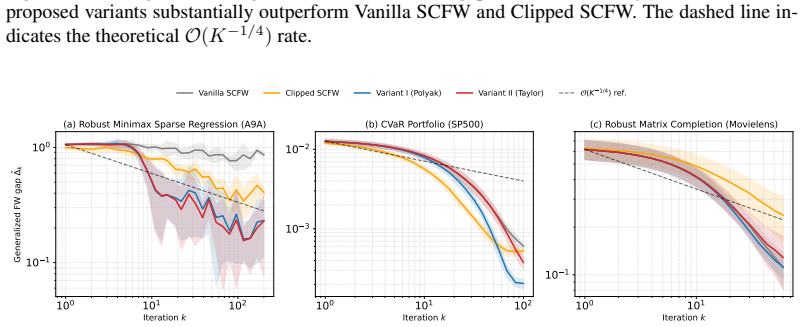
- Empirical tests on risk-sensitive machine learning problems would show whether the theoretical rate translates to practice.
- Extensions to multi-layer compositional structures or different oracles may be possible.
- Relaxing the moment conditions further could widen the range of applicable noise models.
Load-bearing premise
The outer function is assumed to be L_F-Lipschitz continuous, which is used to bound the generalized Frank-Wolfe gap without needing differentiability of F.
What would settle it
Running the algorithm on a simple test problem with a known optimal convergence rate and observing whether it attains O(K to the power of -1/4) or slower under the Lipschitz condition on the outer function.
Figures

read the original abstract
Stochastic compositional optimization minimizes objectives of the form $\min_{\bm{x} \in \mathcal{X}} F(\bm{f}(\bm{x}), \bm{x})$, where $\bm{f}$ is accessible only through noisy stochastic queries. Existing methods for this problem assume that the outer function $F$ is continuously differentiable, which excludes many practically important applications such as robust max-of-losses, Conditional Value-at-Risk, and norm regularizers. We propose the Hybrid Momentum Stochastic Frank--Wolfe algorithm, which drops the smoothness assumption on $F$. By combining a momentum-based Jacobian tracker with a Taylor-corrected function tracker, the algorithm feeds an entire stochastic linearization -- rather than a single gradient -- into a generalized linear minimization oracle. We establish an $\mathcal{O}(K^{-1/4})$ convergence rate in the generalized Frank--Wolfe gap for non-convex objectives with $L_F$-Lipschitz outer functions, matching the optimal complexity for projection-free single-sample stochastic methods under expected smoothness. The analysis extends to heavy-tailed noise oracles with bounded $r$-th moments for $r \in (1, 2]$ and recovers the deterministic rates of Vladarean et al (2023) as the noise vanishes.
Editorial analysis
A structured set of objections, weighed in public.
Referee Report
Summary. The manuscript proposes the Hybrid Momentum Stochastic Frank-Wolfe algorithm for stochastic compositional optimization of the form min F(f(x), x) where the outer function F is assumed only L_F-Lipschitz (not necessarily differentiable). The method maintains a momentum-based Jacobian tracker and a Taylor-corrected function-value tracker to produce a stochastic linearization that is passed to a generalized linear minimization oracle. The central result is an O(K^{-1/4}) convergence rate on the generalized Frank-Wolfe gap for non-convex objectives under expected smoothness (or bounded r-th moments for r in (1,2]), matching the optimal complexity for projection-free single-sample stochastic methods; the analysis recovers the deterministic rates of Vladarean et al. (2023) in the noiseless limit.
Significance. If the stated rate and assumptions hold, the work is significant because it removes the continuous differentiability requirement on F, thereby covering practically relevant non-smooth outer functions such as robust max-of-losses, Conditional Value-at-Risk, and certain norm regularizers. The projection-free single-sample setting together with the extension to heavy-tailed oracles under expected smoothness constitutes a concrete advance over existing stochastic compositional methods.
minor comments (3)
- [Theorem 3.1] The definition of the generalized Frank-Wolfe gap and the precise statement of the linear minimization oracle should be recalled in the main theorem statement (rather than only in the preliminaries) to make the rate claim self-contained.
- [Introduction] The abstract and introduction state that the rate matches the optimal complexity for projection-free single-sample methods; a short paragraph contrasting the obtained bound with the best known rates under stronger smoothness assumptions on F would help readers assess the trade-off.
- [Section 2] Notation for the momentum parameter and the Taylor correction term is introduced without an explicit table of symbols; adding such a table would improve readability of the error recursions.
Simulated Author's Rebuttal
We thank the referee for the positive assessment of our manuscript and the recommendation for minor revision. The report accurately summarizes the Hybrid Momentum Stochastic Frank-Wolfe algorithm, its O(K^{-1/4}) rate on the generalized Frank-Wolfe gap under L_F-Lipschitz outer functions, and the practical relevance for non-smooth cases such as CVaR and robust max-of-losses. We appreciate the recognition that the work matches optimal complexity for projection-free single-sample stochastic methods and recovers deterministic rates in the noiseless limit.
Circularity Check
Derivation self-contained; no circular reductions identified
full rationale
The paper derives its O(K^{-1/4}) rate on the generalized Frank-Wolfe gap directly from the L_F-Lipschitz property of the outer function together with expected-smoothness or bounded-r-moment assumptions on the stochastic oracles. The argument maintains a momentum-based Jacobian tracker and a Taylor-corrected function-value tracker, then substitutes the resulting stochastic linearization into a generalized linear minimization oracle; the error recursions close under these assumptions without any fitted parameter being relabeled as a prediction or any self-citation serving as the sole justification for a uniqueness claim. Recovery of the deterministic rates of Vladarean et al. (2023) is presented only as a limiting special case when noise vanishes, not as a load-bearing premise. No self-definitional, ansatz-smuggling, or renaming patterns appear in the central convergence statement.
Axiom & Free-Parameter Ledger
axioms (2)
- domain assumption Outer function F is L_F-Lipschitz continuous
- domain assumption Stochastic oracles satisfy expected smoothness or bounded r-th moments for r in (1,2]
Lean theorems connected to this paper
-
IndisputableMonolith/Cost/FunctionalEquation.leanwashburn_uniqueness_aczel unclear?
unclearRelation between the paper passage and the cited Recognition theorem.
We propose the Hybrid Momentum Stochastic Frank–Wolfe algorithm... feeds an entire stochastic linearization... into a generalized linear minimization oracle. We establish an O(K^{-1/4}) convergence rate in the generalized Frank–Wolfe gap for non-convex objectives with L_F-Lipschitz outer functions
-
IndisputableMonolith/Foundation/ArithmeticFromLogic.leanLogicNat recovery unclear?
unclearRelation between the paper passage and the cited Recognition theorem.
the generalized Frank–Wolfe gap is ˆ∆(y) := φ(y) − min_x F(f(y) + ∇f(y)(x−y), x)
What do these tags mean?
- matches
- The paper's claim is directly supported by a theorem in the formal canon.
- supports
- The theorem supports part of the paper's argument, but the paper may add assumptions or extra steps.
- extends
- The paper goes beyond the formal theorem; the theorem is a base layer rather than the whole result.
- uses
- The paper appears to rely on the theorem as machinery.
- contradicts
- The paper's claim conflicts with a theorem or certificate in the canon.
- unclear
- Pith found a possible connection, but the passage is too broad, indirect, or ambiguous to say the theorem truly supports the claim.
Reference graph
Works this paper leans on
-
[1]
Conference on Learning Theory , pages=
Linearization Algorithms for Fully Composite Optimization , author=. Conference on Learning Theory , pages=. 2023 , organization=
work page 2023
-
[2]
Compustat North America --- Daily Updates , howpublished =. 2024 , url =
work page 2024
-
[3]
IEEE Transactions on Signal Processing , volume=
Solving stochastic compositional optimization is nearly as easy as solving stochastic optimization , author=. IEEE Transactions on Signal Processing , volume=. 2021 , publisher=
work page 2021
-
[4]
Mathematical Programming , volume=
Stochastic compositional gradient descent: algorithms for minimizing compositions of expected-value functions , author=. Mathematical Programming , volume=. 2017 , publisher=
work page 2017
-
[5]
Journal of Machine Learning Research , volume=
Stochastic conditional gradient methods: From convex minimization to submodular maximization , author=. Journal of Machine Learning Research , volume=
-
[6]
International conference on machine learning , pages=
Revisiting Frank-Wolfe: Projection-free sparse convex optimization , author=. International conference on machine learning , pages=. 2013 , organization=
work page 2013
-
[7]
International Conference on Machine Learning , pages=
Conditional gradient methods via stochastic path-integrated differential estimator , author=. International Conference on Machine Learning , pages=. 2019 , organization=
work page 2019
- [8]
-
[9]
RanSOM: Second-Order Momentum with Randomized Scaling for Constrained and Unconstrained Optimization , author=. 2026 , eprint=
work page 2026
-
[10]
Naval research logistics quarterly , volume=
An algorithm for quadratic programming , author=. Naval research logistics quarterly , volume=. 1956 , publisher=
work page 1956
-
[11]
arXiv preprint arXiv:2202.04296 , year=
A Projection-free Algorithm for Constrained Stochastic Multi-level Composition Optimization , author=. arXiv preprint arXiv:2202.04296 , year=
-
[12]
Advances in Neural Information Processing Systems , volume=
A stochastic composite gradient method with incremental variance reduction , author=. Advances in Neural Information Processing Systems , volume=
-
[13]
Optimization of conditional value-at-risk , author=. Journal of risk , volume=
-
[14]
Advances in neural information processing systems , volume=
Stochastic gradient methods for distributionally robust optimization with f-divergences , author=. Advances in neural information processing systems , volume=
-
[15]
International Conference on Machine Learning , pages=
Active learning for minimax objectives , author=. International Conference on Machine Learning , pages=. 2020 , organization=
work page 2020
-
[16]
International Conference on Machine Learning , pages=
Minimizing the maximal loss: How and why , author=. International Conference on Machine Learning , pages=. 2016 , organization=
work page 2016
-
[17]
Advances in neural information processing systems , volume=
Multi-task learning as multi-objective optimization , author=. Advances in neural information processing systems , volume=
-
[18]
International Conference on Machine Learning , pages=
A conditional gradient framework for composite convex minimization with applications to semidefinite programming , author=. International Conference on Machine Learning , pages=. 2018 , organization=
work page 2018
-
[19]
International Conference on Machine Learning , pages=
A reductions approach to fair classification , author=. International Conference on Machine Learning , pages=. 2018 , organization=
work page 2018
-
[20]
Advances in Neural Information Processing Systems , volume=
Empirical risk minimization under fairness constraints , author=. Advances in Neural Information Processing Systems , volume=
-
[21]
Algorithmic Learning Theory , pages=
Two-player games for efficient non-convex constrained optimization , author=. Algorithmic Learning Theory , pages=. 2019 , organization=
work page 2019
-
[22]
Advances in neural information processing systems , volume=
Learning with average top-k loss , author=. Advances in neural information processing systems , volume=
-
[23]
Mathematical Programming , volume=
Lower bounds for non-convex stochastic optimization , author=. Mathematical Programming , volume=. 2023 , publisher=
work page 2023
-
[24]
SIAM Journal on Optimization , volume=
Stochastic conditional gradient++: (non) convex minimization and continuous submodular maximization , author=. SIAM Journal on Optimization , volume=. 2020 , publisher=
work page 2020
-
[25]
SIAM Journal on Optimization , volume=
Stochastic multilevel composition optimization algorithms with level-independent convergence rates , author=. SIAM Journal on Optimization , volume=. 2022 , publisher=
work page 2022
-
[26]
SIAM Journal on Optimization , volume=
High-order optimization methods for fully composite problems , author=. SIAM Journal on Optimization , volume=. 2022 , publisher=
work page 2022
-
[27]
SIAM Journal on Optimization , volume=
A single timescale stochastic approximation method for nested stochastic optimization , author=. SIAM Journal on Optimization , volume=. 2020 , publisher=
work page 2020
-
[28]
arXiv preprint arXiv:2110.11721 , year=
Projection-free algorithm for stochastic bi-level optimization , author=. arXiv preprint arXiv:2110.11721 , year=
-
[29]
Quantitative Finance , volume=
Empirical properties of asset returns: stylized facts and statistical issues , author=. Quantitative Finance , volume=. 2001 , publisher=
work page 2001
-
[30]
ACM Transactions on Interactive Intelligent Systems (TiiS) , volume=
The MovieLens datasets: History and context , author=. ACM Transactions on Interactive Intelligent Systems (TiiS) , volume=. 2015 , publisher=
work page 2015
-
[31]
ACM Transactions on Intelligent Systems and Technology (TIST) , volume=
LIBSVM: A library for support vector machines , author=. ACM Transactions on Intelligent Systems and Technology (TIST) , volume=. 2011 , publisher=
work page 2011
-
[32]
Advances in Neural Information Processing Systems , volume=
Momentum-based variance reduction in non-convex SGD , author=. Advances in Neural Information Processing Systems , volume=
discussion (0)
Sign in with ORCID, Apple, or X to comment. Anyone can read and Pith papers without signing in.