Clumps in spiral galaxies at z lesssim 3: Disentangling two spatial modes of star formation
Pith reviewed 2026-05-19 15:06 UTC · model grok-4.3
pith:HUSCQSV5 Add to your LaTeX paper
What is a Pith Number?\usepackage{pith}
\pithnumber{HUSCQSV5}
Prints a linked pith:HUSCQSV5 badge after your title and writes the identifier into PDF metadata. Compiles on arXiv with no extra files. Learn more
The pith
Spiral arms stimulate clump formation in galaxies out to redshift 3.3 without changing the clumps' star formation properties.
A machine-rendered reading of the paper's core claim, the machinery that carries it, and where it could break.
Core claim
Using residual images from photometric models that include spiral arms yields clumps whose luminosities, masses and sizes are smaller than commonly accepted. Clumps concentrate toward spiral arms, their parameters correlate with arm properties, and arm clumps are smaller but brighter than inter-arm clumps while sharing similar colors. The results indicate that spiral arms stimulate clump formation although the star formation properties of the clumps themselves remain unchanged compared to the inter-arm region.
What carries the argument
Residual images obtained after subtracting photometric models that separately fit spiral arms, which permit clean identification and measurement of clumps apart from arm light.
If this is right
- Clumps inside spiral arms are smaller yet brighter than those in inter-arm regions.
- Clump and spiral parameters show measurable correlations.
- Colors and other star-formation indicators remain similar for clumps in and out of arms.
- Clumps in modeled spiral galaxies have lower luminosities, masses and sizes than values reported for clumpy galaxies without arm modeling.
Where Pith is reading between the lines
- Applying the same arm-subtraction method to galaxies at still higher redshifts could test whether the stimulation effect strengthens or weakens with look-back time.
- Many galaxies previously classified as clumpy may contain undetected spiral structure revealed only after arm modeling.
- The unchanged colors suggest the arm trigger acts through increased gas density or dynamical compression rather than by changing the initial mass function inside the clumps.
Load-bearing premise
The photometric models that include spiral arms produce residuals in which clumps can be cleanly identified and measured without significant artifacts or over-subtraction from the arm modeling process.
What would settle it
A re-analysis of the same images using alternative spiral-arm models that yields substantially different clump counts, sizes or spatial distributions would falsify the claim that arms stimulate clump formation.
Figures




read the original abstract
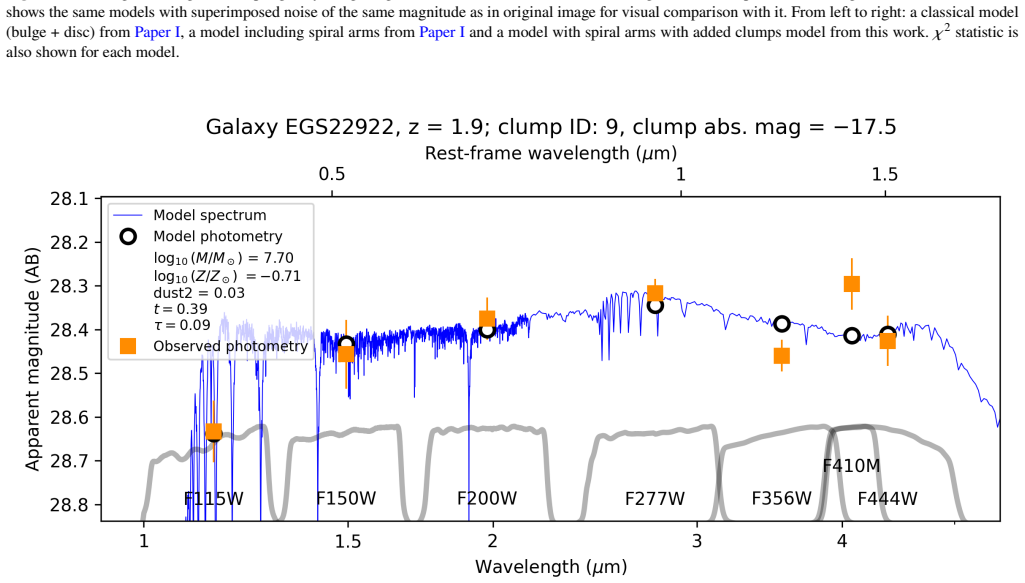
At high redshifts, star formation in galaxies is more often concentrated in clumps than in spiral arms. Although clumps are actively studied, it is rarely done considering spiral arms as objects for study as well, and the connection between clumps and spirals remains understudied. We used a sample of 159 spiral galaxies at $0.1 \leq z \leq 3.3$ observed by HST and JWST. Using the residual images from photometric models with spiral arms constructed before, which was not done previously, we have done identification of clumps and measured their properties with photometric decomposition, finding 3003 clumps in overall, and performing SED fitting for a fraction of them. We examined the overall properties of clumps, focusing on the properties of spiral structure. We found that clumps luminosities, masses and sizes are smaller than commonly accepted in literature, either for the reason spiral arms were modelled separately, or because clumps in spiral galaxies are different compared to clumpy ones. We demonstrate the connection between clumps and spirals, in particular clumps are spatially concentrated towards spirals and various parameters of clumps and spirals correlate. Also, clumps in spiral arms tend to be smaller but brighter compared to clumps in inter-arm area, but their colours are similar. There are also some differences between clumps and spirals such as colour, emphasizing the importance of their separate analysis. Our results probably indicate that spiral arms stimulate the formation of clumps, although star formation properties of clumps in spiral arms is not changed compared to inter-arm region.
Editorial analysis
A structured set of objections, weighed in public.
Referee Report
Summary. The manuscript analyzes clumps in a sample of 159 spiral galaxies at 0.1 ≤ z ≤ 3.3 observed with HST and JWST. By constructing photometric models that explicitly include spiral arms and working with the resulting residual images (an approach not previously applied), the authors identify and photometrically decompose 3003 clumps, perform SED fitting on a subset, and compare clump properties inside versus outside spiral arms. They report that clumps are smaller, less luminous, and less massive than values commonly cited in the literature; that clumps are spatially concentrated toward spiral arms; that arm clumps are smaller but brighter than inter-arm clumps while sharing similar colors; and that various clump and spiral parameters correlate. The authors conclude that spiral arms stimulate clump formation without altering the underlying star-formation properties relative to inter-arm regions.
Significance. If the central results hold after addressing methodological concerns, the work would be significant for disentangling two spatial modes of star formation and for demonstrating a direct connection between spiral structure and clump formation across a wide redshift range. The large sample, the explicit arm modeling step, and the reported differences in clump size/brightness between arm and inter-arm environments could help reconcile discrepancies in the clump literature and motivate new theoretical work on how density waves influence clump formation.
major comments (2)
- [Methods / residual-image analysis] The central claim that spiral arms stimulate clump formation rests on the spatial concentration and property differences measured in residuals after spiral-arm photometric modeling. No quantitative validation (e.g., injection-recovery tests or direct comparison of clump catalogs derived with versus without arm modeling) is described to demonstrate that residuals are free of systematic subtraction artifacts at the clump scale; such artifacts could artificially enhance the apparent arm-clump correlation.
- [Results / clump properties and correlations] The abstract reports a sample of 159 galaxies and 3003 clumps plus SED fitting on a fraction, but provides no error bars on derived quantities, no explicit criteria for data exclusion or model assumptions, and no quantitative measures (e.g., correlation coefficients or significance levels) of the claimed clump-spiral parameter correlations. These omissions leave the strength of the reported trends difficult to assess.
minor comments (3)
- [Title and abstract] The title states z ≲ 3 while the abstract gives 0.1 ≤ z ≤ 3.3; ensure consistency or clarify the exact upper limit.
- [Abstract / methods] Specify the exact number (or fraction) of clumps for which SED fitting was performed and the fitting code, templates, and priors used.
- [Results] Clarify whether the reported size, luminosity, and mass differences between arm and inter-arm clumps are statistically significant after accounting for selection effects and measurement uncertainties.
Simulated Author's Rebuttal
We thank the referee for their careful reading and constructive feedback on our manuscript. We address each major comment below and describe the revisions we will implement to strengthen the paper.
read point-by-point responses
-
Referee: [Methods / residual-image analysis] The central claim that spiral arms stimulate clump formation rests on the spatial concentration and property differences measured in residuals after spiral-arm photometric modeling. No quantitative validation (e.g., injection-recovery tests or direct comparison of clump catalogs derived with versus without arm modeling) is described to demonstrate that residuals are free of systematic subtraction artifacts at the clump scale; such artifacts could artificially enhance the apparent arm-clump correlation.
Authors: We agree that explicit quantitative validation would increase confidence in the residual-based clump catalog. The spiral-arm modeling follows standard photometric decomposition techniques previously validated on lower-redshift samples, and residuals were inspected to remove obvious artifacts before clump detection. However, the original submission did not include injection-recovery tests or side-by-side catalog comparisons. In the revised manuscript we will add injection-recovery experiments: simulated clumps of varying size, brightness, and position will be inserted into the original images, the full arm-modeling and residual pipeline will be re-run, and recovery fractions plus any systematic biases in arm versus inter-arm regions will be reported. This directly quantifies potential subtraction artifacts at the clump scale. revision: yes
-
Referee: [Results / clump properties and correlations] The abstract reports a sample of 159 galaxies and 3003 clumps plus SED fitting on a fraction, but provides no error bars on derived quantities, no explicit criteria for data exclusion or model assumptions, and no quantitative measures (e.g., correlation coefficients or significance levels) of the claimed clump-spiral parameter correlations. These omissions leave the strength of the reported trends difficult to assess.
Authors: We accept that the presentation of statistical details can be improved for clarity. While the methods section describes the fitting procedures and sample selection, error bars, exclusion criteria, and quantitative correlation statistics were not uniformly reported. In the revision we will (i) attach uncertainties to all reported clump sizes, luminosities, and masses, (ii) explicitly list the data-exclusion criteria (e.g., signal-to-noise thresholds, convergence criteria for fits) and model assumptions (e.g., functional forms for arms and clumps), and (iii) provide Spearman or Pearson correlation coefficients together with their p-values for every claimed clump-spiral parameter correlation. revision: yes
Circularity Check
No significant circularity; results derive from direct observational measurements
full rationale
The paper's derivation chain consists of applying photometric decomposition to residual images after spiral-arm modeling, identifying 3003 clumps, and reporting spatial correlations and property differences between arm and inter-arm regions. No equations, fitted parameters, or predictions are presented that reduce by construction to the input data or to self-citations. The use of prior arm models is described as a novel application rather than a load-bearing uniqueness theorem imported from the authors' own work. The central claims remain independent of any definitional loop or renamed empirical pattern.
Axiom & Free-Parameter Ledger
Lean theorems connected to this paper
-
IndisputableMonolith/Cost/FunctionalEquation.leanwashburn_uniqueness_aczel unclear?
unclearRelation between the paper passage and the cited Recognition theorem.
Using the residual images from photometric models with spiral arms... we have done identification of clumps and measured their properties with photometric decomposition, finding 3003 clumps... clumps are spatially concentrated towards spirals and various parameters of clumps and spirals correlate.
-
IndisputableMonolith/Foundation/DimensionForcing.leanalexander_duality_circle_linking unclear?
unclearRelation between the paper passage and the cited Recognition theorem.
clumps in spiral arms tend to be smaller but brighter compared to clumps in inter-arm area, but their colours are similar.
What do these tags mean?
- matches
- The paper's claim is directly supported by a theorem in the formal canon.
- supports
- The theorem supports part of the paper's argument, but the paper may add assumptions or extra steps.
- extends
- The paper goes beyond the formal theorem; the theorem is a base layer rather than the whole result.
- uses
- The paper appears to rely on the theorem as machinery.
- contradicts
- The paper's claim conflicts with a theorem or certificate in the canon.
- unclear
- Pith found a possible connection, but the passage is too broad, indirect, or ambiguous to say the theorem truly supports the claim.
Reference graph
Works this paper leans on
-
[1]
Adams, Dominic and Mehta, Vihang and Dickinson, Hugh and Scarlata, Claudia and Fortson, Lucy and Kruk, Sandor and Simmons, Brooke and Lintott, Chris , year =. Galaxy. The Astrophysical Journal , volume =. doi:10.3847/1538-4357/ac6512 , keywords =
-
[2]
Bagley, Micaela B. and Finkelstein, Steven L. and Koekemoer, Anton M. and Ferguson, Henry C. and Arrabal Haro, Pablo and Dickinson, Mark and Kartaltepe, Jeyhan S. and Papovich, Casey and. 2023 , month = mar, journal =. doi:10.3847/2041-8213/acbb08 , keywords =
-
[3]
Bassett, Robert and Glazebrook, Karl and Fisher, David B. and Wisnioski, Emily and Damjanov, Ivana and Abraham, Roberto and Obreschkow, Danail and Green, Andrew W. and. Integrated and Resolved Dust Attenuation in Clumpy Star-Forming Galaxies at 0.07. 2017 , month = may, journal =. doi:10.1093/mnras/stw2983 , keywords =
-
[4]
Battisti, A. J. and. Avoiding (Photo-z). 2025 , month = jul, journal =. doi:10.3847/2515-5172/adea37 , keywords =
-
[5]
Bekki, K. , year =. Quantifying the Fine Structures of Disk Galaxies with Deep Learning:. Astronomy and Astrophysics , volume =. doi:10.1051/0004-6361/202039797 , keywords =
-
[6]
Berger, Vance W. and Zhou, YanYan , year =. Kolmogorov--. Wiley. doi:10.1002/9781118445112.stat06558 , copyright =
- [7]
-
[8]
Larry Bradley and Brigitta Sipőcz and Thomas Robitaille and Erik Tollerud and Zé Vinícius and Christoph Deil and Kyle Barbary and Tom J Wilson and Ivo Busko and Axel Donath and Hans Moritz Günther and Mihai Cara and P. L. Lim and Sebastian Meßlinger and Zach Burnett and Simon Conseil and Michael Droettboom and Azalee Bostroem and E. M. Bray and Lars Ander...
-
[9]
Brooks, Alyson and Christensen, Charlotte , year =. Bulge. Galactic. doi:10.1007/978-3-319-19378-6_12 , keywords =
-
[10]
Radii of Young Star Clusters in Nearby Galaxies , author =. 2021 , month = dec, journal =. doi:10.1093/mnras/stab2907 , keywords =
-
[11]
Buck, Tobias and Macci. 2017 , month = jul, journal =. doi:10.1093/mnras/stx685 , keywords =
-
[12]
Recovering the Origins of the Lenticular Galaxy
Buzzo, Maria Luisa and Cortesi, Arianna and. Recovering the Origins of the Lenticular Galaxy. 2021 , month = jun, journal =. doi:10.1093/mnras/stab941 , keywords =
-
[13]
A solar-metallicity and dusty DLA at z _ abs = 2.58
Cacciato, Marcello and Dekel, Avishai and Genel, Shy , year =. Evolution of Violent Gravitational Disc Instability in Galaxies: Late Stabilization by Transition from Gas to Stellar Dominance , shorttitle =. Monthly Notices of the Royal Astronomical Society , volume =. doi:10.1111/j.1365-2966.2011.20359.x , keywords =
-
[14]
Merger Induced Clump Formation in Distant Infrared Luminous Starburst Galaxies , author =. 2019 , month = dec, journal =. doi:10.1051/0004-6361/201935778 , keywords =
-
[15]
Calvi, V. and Stiavelli, M. and Bradley, L. and Pizzella, A. and Kim, S. , year =. The. The Astrophysical Journal , volume =. doi:10.1088/0004-637X/796/2/102 , keywords =
-
[16]
Carilli, C. L. and Walter, F. , year =. Cool. Annual Review of Astronomy and Astrophysics , volume =. doi:10.1146/annurev-astro-082812-140953 , keywords =
-
[17]
Carniani, S. and Maiolino, R. and Pallottini, A. and Vallini, L. and Pentericci, L. and Ferrara, A. and Castellano, M. and Vanzella, E. and Grazian, A. and Gallerani, S. and Santini, P. and Wagg, J. and Fontana, A. , year =. Extended Ionised and Clumpy Gas in a Normal Galaxy at z = 7.1 Revealed by. Astronomy and Astrophysics , volume =. doi:10.1051/0004-6...
-
[18]
The Nature of Giant Clumps in Distant Galaxies Probed by the Anatomy of the Cosmic Snake , author =. 2018 , month = nov, journal =. doi:10.1038/s41550-017-0295-x , keywords =
-
[19]
Chugunov, Ilia V. and Marchuk, Alexander A. and Mosenkov, Aleksandr V. and Savchenko, Sergey S. and Shishkina, Ekaterina V. and Chazov, Maxim I. and Nazarova, Aleksandra E. and Skryabina, Maria N. and Smirnova, Polina I. and Smirnov, Anton A. , year =. Galaxies Decomposition with Spiral Arms -. Monthly Notices of the Royal Astronomical Society , volume =....
-
[20]
Chugunov, Ilia V. and Marchuk, Alexander A. and Mosenkov, Aleksandr V. , year =. Less Wound and More Asymmetric:. Publications of the Astronomical Society of Australia , volume =. doi:10.1017/pasa.2025.6 , keywords =
-
[21]
Chugunov, Ilia V. and Marchuk, Alexander A. and Savchenko, Sergey S. , year =. Examination of the. Galaxies , volume =. doi:10.3390/galaxies13020044 , copyright =
-
[22]
Cibinel, A. and Daddi, E. and Bournaud, F. and Sargent, M. T. and. 2017 , month = aug, journal =. doi:10.1093/mnras/stx1112 , keywords =
-
[23]
Star Formation at the Smallest Scales: A
Claeyssens, Ad. Star Formation at the Smallest Scales: A. 2023 , month = apr, journal =. doi:10.1093/mnras/stac3791 , keywords =
-
[24]
Tracing Star Formation across Cosmic Time at Tens of Parsec-Scales in the Lensing Cluster Field
Claeyssens, Ad. Tracing Star Formation across Cosmic Time at Tens of Parsec-Scales in the Lensing Cluster Field. 2025 , month = mar, journal =. doi:10.1093/mnras/staf058 , keywords =
-
[25]
Clark, C. J. R. and Verstocken, S. and Bianchi, S. and Fritz, J. and Viaene, S. and Smith, M. W. L. and Baes, M. and Casasola, V. and Cassara, L. P. and Davies, J. I. and De Looze, I. and De Vis, P. and Evans, R. and Galametz, M. and Jones, A. P. and Lianou, S. and Madden, S. and Mosenkov, A. V. and Xilouris, M. , year = 2018, month = jan, journal =. doi:...
- [26]
-
[27]
Conroy, Charlie , year =. Modeling the. Annual Review of Astronomy and Astrophysics , volume =. doi:10.1146/annurev-astro-082812-141017 , keywords =
work page internal anchor Pith review doi:10.1146/annurev-astro-082812-141017
-
[28]
The Fundamental Properties of Galaxies and a New Galaxy Classification System , author =. 2006 , month = dec, journal =. doi:10.1111/j.1365-2966.2006.11114.x , keywords =
-
[29]
Conselice, Christopher J. , year =. The. Annual Review of Astronomy and Astrophysics , volume =. doi:10.1146/annurev-astro-081913-040037 , keywords =
-
[30]
Conselice, Christopher J. and Mundy, Carl J. and Ferreira, Leonardo and Duncan, Kenneth , year =. A. The Astrophysical Journal , volume =. doi:10.3847/1538-4357/ac9b1a , keywords =
-
[31]
Davis, Darren R. and Hayes, Wayne B. , year =. The Astrophysical Journal , volume =. doi:10.1088/0004-637X/790/2/87 , keywords =
-
[32]
Dekel, Avishai and Sari, Re'em and Ceverino, Daniel , year =. Formation of. The Astrophysical Journal , volume =. doi:10.1088/0004-637X/703/1/785 , keywords =
-
[33]
and Ginzburg, Omri and Mandelker, Nir and Ceverino, Daniel and Primack, Joel , year =
Dekel, Avishai and Tziperman, Offek and Sarkar, Kartick C. and Ginzburg, Omri and Mandelker, Nir and Ceverino, Daniel and Primack, Joel , year =. Conditions for Clump Survival in. Monthly Notices of the Royal Astronomical Society , volume =. doi:10.1093/mnras/stad855 , keywords =
-
[34]
The Fraction of Clumpy Galaxies in JADES over $2<z<9$
The. 2025 , month = aug, publisher =. doi:10.48550/arXiv.2508.14972 , keywords =
work page internal anchor Pith review Pith/arXiv arXiv doi:10.48550/arxiv.2508.14972 2025
-
[35]
On the. 2017 , month = feb, journal =. doi:10.3847/2041-8213/aa5d52 , keywords =
-
[36]
Molecular Gas Cloud Properties at z. 2023 , month = mar, journal =. doi:10.1093/mnras/stad113 , keywords =
-
[37]
Dobbs, Clare and Baba, Junichi , year =. Dawes. Publications of the Astronomical Society of Australia , volume =. doi:10.1017/pasa.2014.31 , keywords =
-
[38]
Dressler, A. , year =. Galaxy Morphology in Rich Clusters: Implications for the Formation and Evolution of Galaxies. , shorttitle =. The Astrophysical Journal , volume =. doi:10.1086/157753 , keywords =
-
[39]
Du, Wei and McGaugh, Stacy S. , year =. Self-Consistent. The Astronomical Journal , volume =. doi:10.3847/1538-3881/aba754 , keywords =
-
[40]
Overview of the JWST Advanced Deep Extragalactic Survey (JADES)
Eisenstein, Daniel J. and Willott, Chris and Alberts, Stacey and Arribas, Santiago and Bonaventura, Nina and Bunker, Andrew J. and Cameron, Alex J. and Carniani, Stefano and Charlot, Stephane and. Overview of the. 2023 , month = jun, journal =. doi:10.48550/arXiv.2306.02465 , keywords =
work page internal anchor Pith review Pith/arXiv arXiv doi:10.48550/arxiv.2306.02465 2023
-
[41]
Elmegreen, Debra Meloy and Elmegreen, Bruce G. and Rubin, Douglas S. and Schaffer, Meredith A. , year =. Galaxy. The Astrophysical Journal , volume =. doi:10.1086/432502 , keywords =
-
[42]
and Ravindranath, Swara and Coe, Daniel A
Elmegreen, Debra Meloy and Elmegreen, Bruce G. and Ravindranath, Swara and Coe, Daniel A. , year =. Resolved. The Astrophysical Journal , volume =. doi:10.1086/511667 , keywords =
-
[43]
Elmegreen, Bruce G. and Bournaud, Fr. Bulge. 2008 , month = nov, journal =. doi:10.1086/592190 , keywords =
-
[44]
and Elmegreen, Debra Meloy and Fernandez, Maria Ximena and Lemonias, Jenna Jo , year =
Elmegreen, Bruce G. and Elmegreen, Debra Meloy and Fernandez, Maria Ximena and Lemonias, Jenna Jo , year =. Bulge and. The Astrophysical Journal , volume =. doi:10.1088/0004-637X/692/1/12 , keywords =
-
[45]
Epinat, Beno. Tracing the. 2011 , month = dec, volume =. doi:10.1017/S1743921311022617 , keywords =
-
[46]
The Astrophysical Journal , volume =
Erwin, Peter , year =. The Astrophysical Journal , volume =. doi:10.1088/0004-637X/799/2/226 , keywords =
-
[47]
Espejo Salcedo, J. M. and Pastras, S. and V. Galaxy Morphologies at Cosmic Noon with. 2025 , month = aug, journal =. doi:10.1051/0004-6361/202554725 , keywords =
-
[48]
Metal-Poor. 2025 , month = oct, journal =. doi:10.3847/1538-4357/adfb64 , keywords =
-
[49]
Balance among Gravitational Instability, Star Formation and Accretion Determines the Structure and Evolution of Disc Galaxies , author =. 2014 , month = feb, journal =. doi:10.1093/mnras/stt2294 , keywords =
-
[50]
Classifying and Modelling Spiral Structures in Hydrodynamic Simulations of Astrophysical Discs , author =. 2018 , month = may, journal =. doi:10.1093/mnras/sty331 , keywords =
-
[51]
Foyle, K. and Rix, H.-W. and Walter, F. and Leroy, A. K. , year =. Arm and. The Astrophysical Journal , volume =. doi:10.1088/0004-637X/725/1/534 , keywords =
-
[52]
Primordial Rotating Disk Composed of at Least 15 Dense Star-Forming Clumps at Cosmic Dawn , author =. Nature Astronomy , volume =. doi:10.1038/s41550-025-02592-w , keywords =
-
[53]
Fukugita, M. and Ichikawa, T. and Gunn, J. E. and Doi, M. and Shimasaku, K. and Schneider, D. P. , year =. The. The Astronomical Journal , volume =. doi:10.1086/117915 , keywords =
-
[54]
A Grand-Design Spiral Galaxy 1.5 Billion Years after the
Jain, Rashi and Wadadekar, Yogesh , year =. A Grand-Design Spiral Galaxy 1.5 Billion Years after the. Astronomy and Astrophysics , volume =. doi:10.1051/0004-6361/202451689 , keywords =
-
[55]
Genzel, R. and Tacconi, L. J. and Eisenhauer, F. and F. The Rapid Formation of a Large Rotating Disk Galaxy Three Billion Years after the. 2006 , month = aug, journal =. doi:10.1038/nature05052 , keywords =
-
[56]
Genzel, R. and Newman, S. and Jones, T. and F. The. 2011 , month = jun, journal =. doi:10.1088/0004-637X/733/2/101 , keywords =
-
[57]
Goldreich, P. and. I. 1965 , month = jan, journal =. doi:10.1093/mnras/130.2.97 , annotation =
-
[58]
Goldreich, P. and. 1965 , month = jan, journal =. doi:10.1093/mnras/130.2.125 , annotation =
-
[59]
Gong, Jun-Yu and Mao, Ye-Wei and Gao, Hua and Yu, Si-Yue , year =. Multiwavelength. The Astrophysical Journal Supplement Series , volume =. doi:10.3847/1538-4365/acd554 , keywords =
-
[60]
and Cassata, Paolo and Koekemoer, Anton M
Guo, Yicheng and Giavalisco, Mauro and Ferguson, Henry C. and Cassata, Paolo and Koekemoer, Anton M. , year =. Multi-Wavelength. The Astrophysical Journal , volume =. doi:10.1088/0004-637X/757/2/120 , keywords =
-
[61]
Guo, Yicheng and Ferguson, Henry C. and Bell, Eric F. and Koo, David C. and Conselice, Christopher J. and Giavalisco, Mauro and Kassin, Susan and Lu, Yu and Lucas, Ray and Mandelker, Nir and McIntosh, Daniel H. and Primack, Joel R. and Ravindranath, Swara and Barro, Guillermo and Ceverino, Daniel and Dekel, Avishai and Faber, Sandra M. and Fang, Jerome J....
-
[62]
Guo, Yicheng and Rafelski, Marc and Bell, Eric F. and Conselice, Christopher J. and Dekel, Avishai and Faber, S. M. and Giavalisco, Mauro and Koekemoer, Anton M. and Koo, David C. and Lu, Yu and Mandelker, Nir and Primack, Joel R. and Ceverino, Daniel and. Clumpy. 2018 , month = feb, journal =. doi:10.3847/1538-4357/aaa018 , keywords =
-
[63]
Hart, Ross E. and Bamford, Steven P. and Hayes, Wayne B. and Cardamone, Carolin N. and Keel, William C. and Kruk, Sandor J. and Lintott, Chris J. and Masters, Karen L. and Simmons, Brooke D. and Smethurst, Rebecca J. , year =. Galaxy. Monthly Notices of the Royal Astronomical Society , volume =. doi:10.1093/mnras/stx2137 , keywords =
-
[64]
ACS Data Handbook v. 13.0. ACS Data Handbook v. 13.0 , year = 2024, volume =
work page 2024
-
[65]
H. 2013 , month = mar, journal =. doi:10.1093/mnras/sts633 , keywords =
-
[66]
Hodge, J. A. and Swinbank, A. M. and Simpson, J. M. and Smail, I. and Walter, F. and Alexander, D. M. and Bertoldi, F. and Biggs, A. D. and Brandt, W. N. and Chapman, S. C. and Chen, C. C. and Coppin, K. E. K. and Cox, P. and Dannerbauer, H. and Edge, A. C. and Greve, T. R. and Ivison, R. J. and Karim, A. and Knudsen, K. K. and Menten, K. M. and Rix, H.-W...
-
[67]
Hodge, J. A. and. High-Redshift Star Formation in the. 2020 , month = dec, journal =. doi:10.1098/rsos.200556 , keywords =
-
[68]
Hopkins, Philip F. and Bundy, Kevin and Croton, Darren and Hernquist, Lars and Keres, Dusan and Khochfar, Sadegh and Stewart, Kyle and Wetzel, Andrew and Younger, Joshua D. , year =. Mergers and. The Astrophysical Journal , volume =. doi:10.1088/0004-637X/715/1/202 , keywords =
-
[69]
, archivePrefix = "arXiv", eprint =
Stellar Feedback and Bulge Formation in Clumpy Discs , author =. 2012 , month = dec, journal =. doi:10.1111/j.1365-2966.2012.21981.x , keywords =
-
[70]
Revisiting the Original Morphology-Density Relation , author =. 2015 , month = aug, journal =. doi:10.1093/mnras/stv1113 , keywords =
-
[71]
Stellar Masses of Giant Clumps in. 2020 , month = nov, journal =. doi:10.1093/mnras/staa2777 , keywords =
-
[72]
Ikeda, Ryota and Iono, Daisuke and Tadaki, Ken-ichi and Franco, Maximilien and Yun, Min S. and Zavala, Jorge A. and Tamura, Yoichi and Tsukui, Takafumi and Williams, Christina C. and Hatsukade, Bunyo and Lee, Minju M. and Michiyama, Tomonari and Mitsuhashi, Ikki and Nakanishi, Kouichiro and Casey, Caitlin M. and Ikarashi, Soh and Lee, Kianhong and Matsuda...
-
[73]
Non-Linear Violent Disc Instability with High
Inoue, Shigeki and Dekel, Avishai and Mandelker, Nir and Ceverino, Daniel and Bournaud, Fr. Non-Linear Violent Disc Instability with High. Monthly Notices of the Royal Astronomical Society , volume =. doi:10.1093/mnras/stv2793 , keywords =
-
[74]
Inoue, Shigeki and Yoshida, Naoki , year =. Spiral-Arm Instability: Giant Clump Formation via Fragmentation of a Galactic Spiral Arm , shorttitle =. Monthly Notices of the Royal Astronomical Society , volume =. doi:10.1093/mnras/stx2978 , keywords =
-
[75]
Two-Fluid Gravitational Instabilities in a Galactic Disk , author =. 1984 , month = jan, journal =. doi:10.1086/161597 , keywords =
-
[76]
and Leja, Joel and Conroy, Charlie and Speagle, Joshua S
Johnson, Benjamin D. and Leja, Joel and Conroy, Charlie and Speagle, Joshua S. , year =. Stellar. The Astrophysical Journal Supplement Series , volume =. doi:10.3847/1538-4365/abef67 , keywords =
work page internal anchor Pith review doi:10.3847/1538-4365/abef67
-
[77]
Julian, William H. and Toomre, Alar , year =. Non-. The Astrophysical Journal , volume =. doi:10.1086/148957 , annotation =
-
[78]
Kajisawa, M. and Yamada, T. , year =. Evolution of the. The Astrophysical Journal , volume =. doi:10.1086/425957 , keywords =
-
[79]
Kalita, Boris S. and Silverman, John D. and Daddi, Emanuele and Bottrell, Connor and Ho, Luis C. and Ding, Xuheng and Yang, Lilan , year =. A. The Astrophysical Journal , volume =. doi:10.3847/1538-4357/acfee4 , keywords =
-
[80]
Clumps as Multiscale Structures in Cosmic Noon Galaxies , author =. 2025 , month = jan, journal =. doi:10.1093/mnras/stae2781 , keywords =
discussion (0)
Sign in with ORCID, Apple, or X to comment. Anyone can read and Pith papers without signing in.