Discretizing Group-Convolutional Neural Networks for 3D Geometry in Feature Space
Pith reviewed 2026-05-19 15:52 UTC · model grok-4.3
pith:KXHWQWJR Add to your LaTeX paper
What is a Pith Number?\usepackage{pith}
\pithnumber{KXHWQWJR}
Prints a linked pith:KXHWQWJR badge after your title and writes the identifier into PDF metadata. Compiles on arXiv with no extra files. Learn more
The pith
Sampling transformations in feature space preserves accuracy in group-convolutional networks for 3D geometry while reducing costs.
A machine-rendered reading of the paper's core claim, the machinery that carries it, and where it could break.
Core claim
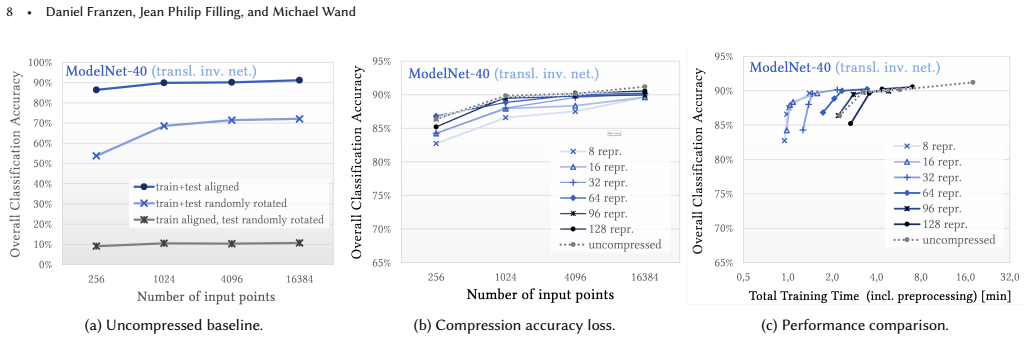
Replacing geometrically dense samples with representative samples selected by feature similarity decouples geometric resolution from memory and processing costs during training and inference. This provides a novel way to trade off computational effort and accuracy, with the main empirical result that coarse feature-space sampling already preserves classification accuracy remarkably well and permits precomputation based on geometric similarity.
What carries the argument
Feature-space sampling that replaces dense sampling of the transformation group with representative samples chosen according to feature similarity.
If this is right
- Training of equivariant 3D classifiers becomes substantially faster through precomputation of geometrically similar poses.
- Memory and processing costs are decoupled from the number of degrees of freedom in the transformation group.
- Equivariance can be maintained at lower computational expense by trading geometric density for feature-based selection.
- Practical deployment of GCNNs on 3D data becomes more feasible as exponential cost growth with group size is avoided.
Where Pith is reading between the lines
- The same feature-space approach could extend to other transformation groups or higher-dimensional data where dense sampling is prohibitive.
- Precomputed similarity tables might allow dynamic adjustment of sampling density during inference based on available compute.
- Limits of the method could be tested by measuring equivariance error directly rather than downstream classification accuracy alone.
Load-bearing premise
Representative samples selected purely by feature similarity are sufficient to maintain the equivariance properties and accuracy that dense geometric sampling would have provided.
What would settle it
A significant drop in classification accuracy on standard 3D benchmarks when replacing dense geometric sampling with the proposed coarse feature-space sampling would falsify the central claim.
Figures



read the original abstract
Group-convolutional neural networks (GCNNs) are among the most important methods for introducing symmetry as an inductive bias in deep learning: In each linear layer, GCNNs sample a transformation group $G$ densely and correlate data and filters in different poses (with suitable anti-aliasing for steerable GCNNs) to maintain equivariance with respect to $G$. Unfortunately, applying filters to many data items resulting from this sampling is expensive (even for translations alone, i.e., in ordinary CNNs), and costs grow exponentially with increasing degrees of freedom (such as translations and rotations in 3D), which often hinders practical applications. In this paper, we propose sampling in feature space, i.e., replacing geometrically dense samples with representative samples selected by feature similarity. This decouples geometric resolution from memory and processing costs during training and inference, providing a novel way to trade off computational effort and accuracy. Our main empirical finding is that a coarse feature-space sampling already preserves classification accuracy remarkably well, which permits precomputation based on geometric similarity, accelerating the training of equivariant 3D classifiers substantially.
Editorial analysis
A structured set of objections, weighed in public.
Referee Report
Summary. The paper proposes replacing dense geometric sampling in group-convolutional neural networks (GCNNs) for 3D geometry with representative samples selected by feature similarity in feature space. This decouples geometric resolution from computational costs during training and inference. The central empirical claim is that coarse feature-space sampling already preserves classification accuracy remarkably well, enabling precomputation based on geometric similarity and substantial acceleration of equivariant 3D classifiers.
Significance. If the empirical result holds and the discretization maintains sufficient equivariance, the approach would offer a practical efficiency gain for symmetry-aware networks in 3D, where dense sampling costs grow rapidly with degrees of freedom. It introduces a tunable trade-off between accuracy and compute that could broaden adoption of GCNNs in resource-constrained settings.
major comments (2)
- Abstract: the central claim that coarse feature-space sampling preserves classification accuracy 'remarkably well' is stated without any reference to datasets, baselines, error bars, or the precise definition of feature similarity. This absence prevents verification of the claim's support and generalizability from the provided text.
- The method replaces geometrically dense sampling (with anti-aliasing) by feature-similarity selection, which decouples the discretization from the group structure G. For the accuracy-preservation claim to be load-bearing rather than task-specific, the manuscript must demonstrate that the selected points still induce a representation equivariant (or sufficiently close) under the original group actions; otherwise the observed accuracy may not generalize beyond the particular datasets.
minor comments (1)
- The abstract would be strengthened by a single sentence indicating the 3D classification tasks or data modalities on which the empirical result was observed.
Simulated Author's Rebuttal
We thank the referee for the thoughtful review and constructive suggestions. We address each of the major comments below and outline the revisions we will make to the manuscript.
read point-by-point responses
-
Referee: Abstract: the central claim that coarse feature-space sampling preserves classification accuracy 'remarkably well' is stated without any reference to datasets, baselines, error bars, or the precise definition of feature similarity. This absence prevents verification of the claim's support and generalizability from the provided text.
Authors: We agree that the abstract would benefit from greater specificity to allow readers to better assess the claim. In the revised version, we will update the abstract to reference the datasets used (such as ModelNet for 3D point cloud classification), the baselines compared against (dense geometric sampling), and note that feature similarity is defined using distances in the embedding space of a backbone network. We will also mention that results include standard deviations from repeated experiments where applicable. revision: yes
-
Referee: The method replaces geometrically dense sampling (with anti-aliasing) by feature-similarity selection, which decouples the discretization from the group structure G. For the accuracy-preservation claim to be load-bearing rather than task-specific, the manuscript must demonstrate that the selected points still induce a representation equivariant (or sufficiently close) under the original group actions; otherwise the observed accuracy may not generalize beyond the particular datasets.
Authors: This comment raises a crucial point about the preservation of equivariance. Our approach selects samples based on feature similarity to approximate the dense sampling while reducing computational cost. Although the manuscript focuses on empirical performance, we acknowledge the need for more explicit analysis. We will add a new section or subsection that quantifies the equivariance error by measuring the difference in network outputs under group transformations before and after sampling. This will help demonstrate that the approximation remains sufficiently equivariant for the tasks considered. We believe this addition will address concerns about generalizability. revision: yes
Circularity Check
No circularity: empirical discretization trade-off is self-contained
full rationale
The paper's central contribution is an empirical proposal to replace dense geometric sampling in GCNNs with representative samples chosen by feature similarity, with the key observation that coarse feature-space sampling preserves classification accuracy on the tested tasks. No equations, derivations, or predictions are presented that reduce by construction to fitted inputs, self-definitions, or self-citation chains; the method is explicitly framed as a practical accuracy-compute trade-off rather than a closed-form identity or uniqueness result. The full manuscript contains no load-bearing steps where an output is forced to match its inputs via the paper's own definitions or prior author work, making the derivation self-contained against external benchmarks.
Axiom & Free-Parameter Ledger
Lean theorems connected to this paper
-
IndisputableMonolith/Foundation/AbsoluteFloorClosure.leanreality_from_one_distinction unclear?
unclearRelation between the paper passage and the cited Recognition theorem.
replacing geometrically dense samples with representative samples selected by feature similarity... decouples geometric resolution from memory and processing costs
What do these tags mean?
- matches
- The paper's claim is directly supported by a theorem in the formal canon.
- supports
- The theorem supports part of the paper's argument, but the paper may add assumptions or extra steps.
- extends
- The paper goes beyond the formal theorem; the theorem is a base layer rather than the whole result.
- uses
- The paper appears to rely on the theorem as machinery.
- contradicts
- The paper's claim conflicts with a theorem or certificate in the canon.
- unclear
- Pith found a possible connection, but the passage is too broad, indirect, or ambiguous to say the theorem truly supports the claim.
Reference graph
Works this paper leans on
-
[1]
Matan Atzmon, Haggai Maron, and Yaron Lipman. 2018. Point Convolutional Neural Networks by Extension Operators. Issue 4
work page 2018
-
[2]
Erik J. Bekkers. 2020. B-Spline CNNs on Lie Groups. InInternational Conference on Learning Representations (ICLR). https://openreview.net/forum?id=H1gBhkBFDH
work page 2020
-
[3]
Bekkers, Sharvaree Vadgama, Rob D
Erik J. Bekkers, Sharvaree Vadgama, Rob D. Hesselink, Putri A. van der Linden, and David W. Romero. 2024. Fast, Expressive SE(𝑛) Equivariant Networks through Weight-Sharing in Position-Orientation Space. InInternational Conference on Learning Representations (ICLR). https://openreview.net/forum?id=dPHLbUqGbr
work page 2024
-
[4]
Daniel Bolya, Cheng-Yang Fu, Xiaoliang Dai, Peizhao Zhang, Christoph Fe- ichtenhofer, and Judy Hoffman. 2023. Token Merging: Your ViT But Faster. InThe Eleventh International Conference on Learning Representations. https: //openreview.net/forum?id=JroZRaRw7Eu
work page 2023
- [5]
-
[6]
Johann Brehmer, Pim De Haan, Sönke Behrends, and Taco Cohen. 2023. Geo- metric Algebra Transformer. InThirty-seventh Conference on Neural Information Processing Systems. https://openreview.net/forum?id=M7r2CO4tJC
work page 2023
-
[7]
Geometric Deep Learning: Grids, Groups, Graphs, Geodesics, and Gauges
Michael M. Bronstein, Joan Bruna, Taco Cohen, and Petar Veličković. 2021. Geo- metric Deep Learning: Grids, Groups, Graphs, Geodesics, and Gauges.arXiv preprint arXiv:2104.13478(2021)
work page internal anchor Pith review Pith/arXiv arXiv 2021
- [8]
-
[9]
Gabriele Cesa, Leon Lang, and Maurice Weiler. 2022. A Program to Build E(N)- Equivariant Steerable CNNs. InInternational Conference on Learning Representa- tions. https://openreview.net/forum?id=WE4qe9xlnQw
work page 2022
-
[10]
Haiwei Chen, Shichen Liu, Weikai Chen, Hao Li, and Randall Hill. 2021. Equi- variant Point Network for 3D Point Cloud Analysis. (2021), 14514–14523
work page 2021
-
[11]
Ta-Ying Cheng, Qingyong Hu, Qian Xie, Niki Trigoni, and Andrew Markham
-
[12]
InEuropean Conference on Computer Vision (ECCV)
Meta-Sampler: Almost Universal yet Task-Oriented Sampling for Point Clouds. InEuropean Conference on Computer Vision (ECCV)
-
[13]
Taco S. Cohen and Max Welling. 2016. Group Equivariant Convolutional Net- works. InProceedings of the International Conference on Machine Learning (ICML)
work page 2016
-
[14]
Taco S. Cohen and Max Welling. 2017. Steerable CNNs. InInternational Conference on Learning Representations (ICLR)
work page 2017
-
[15]
Chang, Manolis Savva, Maciej Halber, Thomas Funkhouser, and Matthias Nießner
Angela Dai, Angel X. Chang, Manolis Savva, Maciej Halber, Thomas Funkhouser, and Matthias Nießner. 2017. ScanNet: Richly-Annotated 3D Reconstructions of Indoor Scenes. InProceedings of the IEEE Conference on Computer Vision and Pattern Recognition (CVPR). 5828–5839
work page 2017
-
[16]
Pim de Haan, Maurice Weiler, Taco Cohen, and Max Welling. 2021. Gauge Equivariant Mesh CNNs: Anisotropic Convolutions on Geometric Graphs. In International Conference on Learning Representations (ICLR). https://openreview. net/forum?id=Jnspzp-oIZE
work page 2021
-
[17]
DeepSeek-AI. 2025. DeepSeek-V3.2-Exp: Boosting Long-Context Efficiency with DeepSeek Sparse Attention. https://github.com/deepseek-ai/DeepSeek-V3.2- Exp/blob/main/DeepSeek_V3_2.pdf
work page 2025
-
[18]
J. Fei and Z. Deng. 2024. Rotation invariance and equivariance in 3D deep learning: a survey.Artif Intell Rev57, 168 (2024). doi:10.1007/s10462-024-10741-2
-
[19]
Matthias Fey, Jan Eric Lenssen, Frank Weichert, and Heinrich Müller. 2018. SplineCNN: Fast Geometric Deep Learning with Continuous B-Spline Kernels. In IEEE Conference on Computer Vision and Pattern Recognition (CVPR)
work page 2018
-
[20]
Jan-Michael Frahm, Pierre Fite-Georgel, David Gallup, Tim Johnson, Rahul Ragu- ram, Changchang Wu, Yi-Hung Jen, Enrique Dunn, Brian Clipp, Svetlana Lazeb- nik, and Marc Pollefeys. 2010. Building Rome on a Cloudless Day. InComputer Vision – ECCV 2010, Kostas Daniilidis, Petros Maragos, and Nikos Paragios (Eds.). Springer Berlin Heidelberg, Berlin, Heidelbe...
work page 2010
-
[21]
Fabian B. Fuchs, Daniel E. Worrall, Volker Fischer, and Max Welling. 2020. SE(3)- transformers: 3D roto-translation equivariant attention networks. InProceedings of the 34th International Conference on Neural Information Processing Systems (Vancouver, BC, Canada)(NIPS ’20). Curran Associates Inc., Red Hook, NY, USA, Article 166, 12 pages
work page 2020
-
[22]
Natasha Gelfand and Leonidas J. Guibas. 2004. Shape segmentation using local slippage analysis. InProceedings of the 2004 Eurographics/ACM SIGGRAPH Sympo- sium on Geometry Processing(Nice, France)(SGP ’04). Association for Computing Machinery, New York, NY, USA, 214–223. doi:10.1145/1057432.1057461
-
[23]
Ian Goodfellow, Yoshua Bengio, and Aaron Courville. 2016.Deep Learning. MIT Press. http://www.deeplearningbook.org
work page 2016
-
[24]
Meng-Hao Guo, Jun-Xiong Cai, Zheng-Ning Liu, Tai-Jiang Mu, Ralph R. Martin, and Shi-Min Hu. 2021. PCT: Point cloud transformer.Computational Visual Media 7, 2 (Apr 2021), 187–199. doi:10.1007/s41095-021-0229-5
-
[25]
Rana Hanocka, Amir Hertz, N. Fish, R. Giryes, S. Fleishman, and D. Cohen-Or
-
[26]
MeshCNN: a network with an edge.ACM Transactions on Graphics (TOG) 38 (2019), 1 – 12
work page 2019
-
[27]
Sergey Ioffe and Christian Szegedy. 2015. Batch Normalization: Accelerating Deep Network Training by Reducing Internal Covariate Shift. InProceedings of the 32nd International Conference on Machine Learning, ICML 2015, Lille, France, 6-11 July 2015 (JMLR Workshop and Conference Proceedings, Vol. 37), Francis R. Bach and David M. Blei (Eds.). JMLR.org, 448–456
work page 2015
-
[28]
Wessels, Friso de Kruiff, Thijs P
Mohammad Mohaiminul Islam, Rishabh Anand, David R. Wessels, Friso de Kruiff, Thijs P. Kuipers, Rex Ying, Clara I. Sánchez, Sharvaree Vadgama, Georg Bökman, and Erik J. Bekkers. 2025. Platonic Transformers: A Solid Choice For Equivariance. arXiv preprint arXiv:2510.03511(2025). arXiv:2510.03511 [cs.CV]
-
[30]
J. Kerber, M. Bokeloh, M. Wand, and H.-P. Seidel. 2013. Scalable Sym- metry Detection for Urban Scenes.Computer Graphics Forum32, 1 (2013), 3–15. arXiv:https://onlinelibrary.wiley.com/doi/pdf/10.1111/j.1467- 8659.2012.03226.x doi:10.1111/j.1467-8659.2012.03226.x
-
[31]
David M. Knigge, David W. Romero, and Erik J. Bekkers. 2022. Exploiting Redun- dancy: Separable Group Convolutional Networks on Lie Groups. InProceedings of the 39th International Conference on Machine Learning (ICML) (Proceedings of Machine Learning Research, Vol. 162). PMLR, 11359–11386
work page 2022
-
[32]
Risi Kondor, Zhen Lin, and Shubhendu Trivedi. 2018. Clebsch–Gordan nets: a fully fourier space spherical convolutional neural network. InProceedings of the 32nd International Conference on Neural Information Processing Systems(Montréal, Canada)(NIPS’18). Curran Associates Inc., Red Hook, NY, USA, 10138–10147
work page 2018
-
[33]
Alex Krizhevsky, Ilya Sutskever, and Geoffrey E Hinton. 2012. ImageNet Clas- sification with Deep Convolutional Neural Networks. InAdvances in Neural Information Processing Systems, F. Pereira, C.J. Burges, L. Bottou, and K.Q. Wein- berger (Eds.), Vol. 25. Curran Associates, Inc. https://proceedings.neurips.cc/ paper_files/paper/2012/file/c399862d3b9d6b76...
work page 2012
-
[34]
Thijs P. Kuipers and Erik J. Bekkers. 2023. Regular SE(3) Group Convolutions for Volumetric Medical Image Analysis. InMedical Image Computing and Computer Assisted Intervention (MICCAI) (Lecture Notes in Computer Science, Vol. 14222). Springer, 252–261
work page 2023
-
[35]
Taeyoung Lee. 2022. Real Harmonic Analysis on the Special Orthogonal Group. Int. J. Anal. Appl.20, 21 (2022)
work page 2022
-
[36]
Yangyan Li, Rui Bu, M. Sun, W. Wu, X. Di, and B. Chen. 2018. PointCNN: Convo- lution On X-Transformed Points.arXiv: Computer Vision and Pattern Recognition (2018)
work page 2018
-
[37]
Zhuangzi Li, Shan Liu, Wei Gao, Guanbin Li, and Ge Li. 2025. S4R: Rethink- ing Point Cloud Sampling via Guiding Upsampling-Aware Perception.IEEE Transactions on Multimedia27 (2025), 6677–6689. doi:10.1109/TMM.2025.3586148
-
[38]
Jiehong Lin, Hongyang Li, Ke Chen, Jiangbo Lu, and Kui Jia. 2021. Sparse Steerable Convolutions: An Efficient Learning of SE(3)-Equivariant Features for Estimation and Tracking of Object Poses in 3D Space. InAdvances in Neural Information Processing Systems, A. Beygelzimer, Y. Dauphin, P. Liang, and J. Wortman Vaughan (Eds.). https://openreview.net/forum?...
work page 2021
-
[39]
Niloy J. Mitra, Leonidas J. Guibas, and Mark Pauly. 2006. Partial and approximate symmetry detection for 3D geometry.ACM Trans. Graph.25, 3 (July 2006), 560–568. doi:10.1145/1141911.1141924
-
[40]
Mitra, Mark Pauly, Michael Wand, and Duygu Ceylan
Niloy J. Mitra, Mark Pauly, Michael Wand, and Duygu Ceylan. 2013. Symmetry in 3D Geometry: Extraction and Applications.Computer Graphics Forum32, 6 (2013), 1–23. arXiv:https://onlinelibrary.wiley.com/doi/pdf/10.1111/cgf.12010 doi:10.1111/cgf.12010
-
[41]
Ehsan Nezhadarya, Ehsan Taghavi, Ryan Razani, Bingbing Liu, and Jun Luo
-
[42]
In Proceedings of the IEEE/CVF Conference on Computer Vision and Pattern Recognition (CVPR)
Adaptive Hierarchical Down-Sampling for Point Cloud Classification. In Proceedings of the IEEE/CVF Conference on Computer Vision and Pattern Recognition (CVPR)
-
[43]
Yatian Pang, Wenxiao Wang, Francis EH Tay, Wei Liu, Yonghong Tian, and Li Yuan. 2022. Masked autoencoders for point cloud self-supervised learning. In Computer Vision–ECCV 2022: 17th European Conference, Tel A viv, Israel, October Discretizing Group-Convolutional Neural Networks for 3D Geometry in Feature Space•11 23–27, 2022, Proceedings, Part II. Spring...
work page 2022
-
[44]
C. Qi, Hao Su, Kaichun Mo, and L. Guibas. 2017. PointNet: Deep Learning on Point Sets for 3D Classification and Segmentation.2017 IEEE Conference on Computer Vision and Pattern Recognition (CVPR)(2017), 77–85
work page 2017
-
[45]
C. Qi, L. Yi, Hao Su, and L. Guibas. 2017. PointNet++: Deep Hierarchical Feature Learning on Point Sets in a Metric Space. InNIPS
work page 2017
-
[46]
Qi, Hao Su, Matthias Nießner, Angela Dai, Mengyuan Yan, and Leonidas J
Charles R. Qi, Hao Su, Matthias Nießner, Angela Dai, Mengyuan Yan, and Leonidas J. Guibas. 2016. Volumetric and Multi-view CNNs for Object Clas- sification on 3D Data. In2016 IEEE Conference on Computer Vision and Pattern Recognition (CVPR). 5648–5656. doi:10.1109/CVPR.2016.609
-
[47]
Yongming Rao, Wenliang Zhao, Benlin Liu, Jiwen Lu, Jie Zhou, and Cho-Jui Hsieh
-
[48]
InAdvances in Neural Information Processing Systems, A
DynamicViT: Efficient Vision Transformers with Dynamic Token Sparsi- fication. InAdvances in Neural Information Processing Systems, A. Beygelzimer, Y. Dauphin, P. Liang, and J. Wortman Vaughan (Eds.). https://openreview.net/ forum?id=kR95DuwwXHZ
-
[49]
David Ruhe, Johannes Brandstetter, and Patrick Forré. 2023. Clifford Group Equivariant Neural Networks. InThirty-seventh Conference on Neural Information Processing Systems. https://openreview.net/forum?id=n84bzMrGUD
work page 2023
-
[50]
Víctor Garcia Satorras, Emiel Hoogeboom, and Max Welling. 2021. E(n) Equivari- ant Graph Neural Networks. InProceedings of the 38th International Conference on Machine Learning (Proceedings of Machine Learning Research, Vol. 139), Marina Meila and Tong Zhang (Eds.). PMLR, 9323–9332. https://proceedings.mlr.press/ v139/satorras21a.html
work page 2021
-
[51]
Kristof Schütt, Pieter-Jan Kindermans, Huziel Enoc Sauceda Felix, Stefan Chmiela, A. Tkatchenko, and K. Müller. 2017. SchNet: A continuous-filter convolutional neural network for modeling quantum interactions. InNIPS
work page 2017
-
[52]
Shuran Song and Jianxiong Xiao. 2014. Sliding Shapes for 3D Object Detection in Depth Images. InComputer Vision – ECCV 2014, David Fleet, Tomas Pajdla, Bernt Schiele, and Tinne Tuytelaars (Eds.). Springer International Publishing, Cham, 634–651
work page 2014
- [53]
- [54]
-
[55]
Tensor field networks: Rotation- and translation-equivariant neural networks for 3D point clouds
Nathaniel Thomas, Tess Smidt, Steven M. Kearnes, Lusann Yang, Li Li, Kai Kohlhoff, and Patrick Riley. 2018. Tensor Field Networks: Rotation- and Translation-Equivariant Neural Networks for 3D Point Clouds.CoRR abs/1802.08219 (2018). arXiv:1802.08219 http://arxiv.org/abs/1802.08219
work page internal anchor Pith review Pith/arXiv arXiv 2018
-
[56]
Mikaela Angelina Uy, Quang-Hieu Pham, Binh-Son Hua, Duc Thanh Nguyen, and Sai-Kit Yeung. 2019. Revisiting Point Cloud Classification: A New Benchmark Dataset and Classification Model on Real-World Data. InInternational Conference on Computer Vision (ICCV)
work page 2019
-
[57]
Sharvaree Vadgama, Mohammad Mohaiminul Islam, Domas Buracas, Christian Shewmake, Artem Moskalev, and Erik J. Bekkers. 2025. Probing Equivariance and Symmetry Breaking in Convolutional Networks. InAdvances in Neural Infor- mation Processing Systems (NeurIPS). arXiv:2501.01999 [cs.CV]
-
[58]
Ashish Vaswani, Noam Shazeer, Niki Parmar, Jakob Uszkoreit, Llion Jones, Aidan N Gomez, Ł ukasz Kaiser, and Illia Polosukhin. 2017. Attention is All you Need. InAdvances in Neural Information Processing Systems, I. Guyon, U. Von Luxburg, S. Bengio, H. Wallach, R. Fergus, S. Vishwanathan, and R. Garnett (Eds.), Vol. 30. Curran Associates, Inc. https://proc...
work page 2017
-
[59]
2010.The nonequispaced fast SO(3) Fourier transform, generali- sations and applications
Antje Vollrath. 2010.The nonequispaced fast SO(3) Fourier transform, generali- sations and applications. Ph. D. Dissertation. Universität zu Lübeck, Institut für Mathematik
work page 2010
-
[60]
Jiahua Wang, Yao Zhao, Ting Liu, and Shikui Wei. 2021. GDS: Global Description Guided Down-Sampling for 3D Point Cloud Classification. InProceedings of the 2020 4th International Conference on Vision, Image and Signal Processing(Bangkok, Thailand)(ICVISP 2020). Association for Computing Machinery, New York, NY, USA, Article 19, 6 pages. doi:10.1145/344882...
-
[61]
Yue Wang, Yongbin Sun, Ziwei Liu, Sanjay E. Sarma, Michael M. Bronstein, and Justin M. Solomon. 2019. Dynamic Graph CNN for Learning on Point Clouds. ACM Transactions on Graphics (TOG)(2019)
work page 2019
-
[62]
Maurice Weiler, Wouter Boomsma, Mario Geiger, Max Welling, and Taco S. Co- hen. 2018. 3D Steerable CNNs, Learning Rotationally Equivariant Features in Volumetric Data. InAdvances in Neural Information Processing Systems (NeurIPS)
work page 2018
- [63]
-
[64]
Ruben Wiersma, Elmar Eisemann, and Klaus Hildebrandt. 2020. CNNs on Surfaces using Rotation-Equivariant Features.Transactions on Graphics39, 4 (July 2020). doi:10.1145/3386569.3392437
-
[65]
Marysia Winkels and Taco S. Cohen. 2018. 3D G-CNNs for Pulmonary Nodule Detection.arXiv preprint arXiv:1804.04656(2018). arXiv:1804.04656 [cs.CV]
work page internal anchor Pith review Pith/arXiv arXiv 2018
-
[66]
Daniel Worrall and Gabriel Brostow. 2018. CubeNet: Equivariance to 3D Rotation and Translation. InProceedings of the European Conference on Computer Vision (ECCV). 567–584
work page 2018
-
[67]
Zhirong Wu, Shuran Song, Aditya Khosla, Fisher Yu, Linguang Zhang, Xiaoou Tang, and Jianxiong Xiao. 2015. 3d shapenets: A deep representation for volumet- ric shapes. InProceedings of the IEEE conference on computer vision and pattern recognition. 1912–1920
work page 2015
-
[68]
Hengshuang Zhao, Li Jiang, Jiaya Jia, Philip Torr, and Vladlen Koltun. 2021. Point Transformer. In2021 IEEE/CVF International Conference on Computer Vision (ICCV). 16239–16248. doi:10.1109/ICCV48922.2021.01595
-
[69]
Minghan Zhu, Maani Ghaffari, William A Clark, and Huei Peng. 2023. E2PN: Effi- cient SE (3)-equivariant point network. InProceedings of the IEEE/CVF Conference on Computer Vision and Pattern Recognition. 1223–1232
work page 2023
discussion (0)
Sign in with ORCID, Apple, or X to comment. Anyone can read and Pith papers without signing in.