Chiral-Mode Control around a Hermitian Diabolic Point in Discrete Non-Hermitian Coupled Resonators
Pith reviewed 2026-05-19 19:49 UTC · model grok-4.3
pith:2KFDJB2F Add to your LaTeX paper
What is a Pith Number?\usepackage{pith}
\pithnumber{2KFDJB2F}
Prints a linked pith:2KFDJB2F badge after your title and writes the identifier into PDF metadata. Compiles on arXiv with no extra files. Learn more
The pith
Infinitesimal complex perturbations near a Hermitian diabolic point induce chiral-mode selection via an asymptotic exceptional point.
A machine-rendered reading of the paper's core claim, the machinery that carries it, and where it could break.
Core claim
Near a Hermitian diabolic point in a discrete system of coupled single-mode resonators, an infinitesimal complex onsite perturbation induces chiral-mode selection governed by an asymptotic exceptional point. An AEP denotes a Hermitian DP equipped with a non-Hermitian perturbation that induces an asymptotically defective effective Hamiltonian. The eigenvectors coalesce in the asymptotic limit toward the DP, although the Hamiltonian at the point itself remains diagonalizable. The associated eigenvalue response exhibits the anomalous fractional-power scaling Δλ ∝ ε^{3/2}. In a broader two-parameter perturbation space, ordinary EPs lie on exceptional-line branches that meet at the AEP. A finiteb
What carries the argument
The asymptotic exceptional point (AEP), a Hermitian diabolic point equipped with a non-Hermitian perturbation that makes the effective Hamiltonian asymptotically defective so eigenvectors coalesce only in the limit while the point itself stays diagonalizable.
If this is right
- Direct switching from an achiral state to a chiral state is realized via the AEP.
- Reversal between opposite chiral states occurs when a bias sweep crosses an EP pair near the AEP.
- The AEP and EP-pair operating points exhibit different performance characteristics inside a finite-resolution averaging model.
- Under sufficiently high control resolution the AEP operating point becomes more favorable than the EP-pair operating point.
- The mechanism supplies a concrete route toward compact and low-energy chiral photonic devices.
Where Pith is reading between the lines
- The same asymptotic coalescence might appear in larger resonator lattices or in continuous waveguides with similar degeneracies.
- Dynamic electrical or optical tuning of the onsite perturbation could turn the AEP into a real-time chiral switch in integrated circuits.
- The three-halves scaling could serve as a diagnostic signature when searching for analogous points in acoustic or mechanical resonator arrays.
- Combining the AEP with topological protection might produce chiral modes that remain robust against fabrication disorder.
Load-bearing premise
The minimal three-resonator discrete model accurately captures the essential non-Hermitian dynamics and chiral response of the broader class of coupled-resonator systems under infinitesimal complex onsite perturbations.
What would settle it
Measure the eigenvalue splitting versus perturbation amplitude in a fabricated three-resonator photonic device tuned near the diabolic point; confirmation requires the splitting to scale exactly as the three-halves power of the amplitude rather than linearly or as the square root.
Figures





read the original abstract
Motivated by the prospect of chiral-mode control in compact photonic systems, we analyze discrete coupled single-mode resonators. Using the minimal three-resonator model, we show that an infinitesimal complex onsite perturbation near a Hermitian diabolic point (DP) induces chiral-mode selection, governed by what we term an asymptotic exceptional point (AEP). Here, an AEP denotes a Hermitian DP equipped with a non-Hermitian perturbation that induces an asymptotically defective effective Hamiltonian. The eigenvectors coalesce in the asymptotic limit toward the DP, although the Hamiltonian at the point itself remains diagonalizable. Operationally, this AEP response realizes chirality switching from an achiral state to a chiral state. The associated eigenvalue response exhibits the anomalous fractional-power scaling ${\Delta}{\lambda} \propto {\varepsilon}^{3/2}$, distinct from the square-root response of an ordinary exceptional point (EP). We further show that, in a broader two-parameter perturbation space, ordinary EPs lie on exceptional-line branches that meet at the AEP. A finitebias control sweep crosses these branches at an EP pair, enabling chirality reversal between opposite chiral states. The central message is therefore that the AEP organizes two related routes for chirality switching: direct switching from an achiral state to a chiral state via the AEP, and switching between opposite chiral states via an EP pair in the vicinity of the AEP. Within a finite-resolution averaging model, these two operating points exhibit different practical performance characteristics, and under sufficiently high control resolution, the AEP operating point can become more favorable than the EP-pair operating point, suggesting a route toward compact and low-energy chiral photonic devices.
Editorial analysis
A structured set of objections, weighed in public.
Referee Report
Summary. The manuscript analyzes a minimal three-resonator model of discrete coupled single-mode resonators. It shows that an infinitesimal complex onsite perturbation near a Hermitian diabolic point induces chiral-mode selection governed by an asymptotic exceptional point (AEP), with the eigenvalue response exhibiting anomalous fractional-power scaling Δλ ∝ ε^{3/2}. In a two-parameter perturbation space, ordinary exceptional points lie on exceptional-line branches meeting at the AEP, enabling chirality reversal between opposite chiral states via an EP pair. The work compares practical performance characteristics under finite-resolution averaging and suggests implications for compact, low-energy chiral photonic devices.
Significance. If the central results hold, the paper provides an analytical demonstration of a distinct non-Hermitian response mechanism around a Hermitian diabolic point, introducing the AEP concept and highlighting fractional scaling that differs from standard square-root exceptional-point behavior. The direct perturbation analysis of the three-resonator Hamiltonian yields clear predictions for eigenvector coalescence in the asymptotic limit and organizes two routes for chirality switching. This could be relevant for photonic device design, though the strength lies primarily in the minimal-model derivation rather than in extensive numerical validation or experimental mapping.
major comments (1)
- [minimal three-resonator model and AEP analysis] The derivation of the AEP, eigenvector coalescence, and Δλ ∝ ε^{3/2} scaling is performed on the characteristic equation of the specific 3×3 non-Hermitian matrix in the minimal-model section. The manuscript does not verify whether this leading-order fractional scaling and the organization of exceptional-line branches persist when the discrete lattice is enlarged (e.g., four resonators) or when next-nearest-neighbor couplings are added; such a check is load-bearing for the claim that the AEP governs chiral-mode selection in the broader class of coupled-resonator systems.
minor comments (2)
- [Abstract] The abstract introduces the AEP but does not explicitly state that the Hamiltonian remains diagonalizable exactly at the diabolic point; adding one clarifying sentence would improve readability.
- [perturbation space discussion] Notation for the complex onsite perturbation ε and the two-parameter space could be made more uniform between the text and any accompanying figures to avoid minor ambiguity in branch labeling.
Simulated Author's Rebuttal
We thank the referee for the thoughtful review and for identifying this important point regarding the scope of our analysis. We respond to the major comment below.
read point-by-point responses
-
Referee: The derivation of the AEP, eigenvector coalescence, and Δλ ∝ ε^{3/2} scaling is performed on the characteristic equation of the specific 3×3 non-Hermitian matrix in the minimal-model section. The manuscript does not verify whether this leading-order fractional scaling and the organization of exceptional-line branches persist when the discrete lattice is enlarged (e.g., four resonators) or when next-nearest-neighbor couplings are added; such a check is load-bearing for the claim that the AEP governs chiral-mode selection in the broader class of coupled-resonator systems.
Authors: We agree that the manuscript performs the derivation exclusively on the 3×3 characteristic equation of the minimal model and does not include explicit checks for larger lattices or additional couplings. The minimal three-resonator system was deliberately chosen to enable a fully analytical treatment that reveals the asymptotic coalescence and the 3/2 scaling without approximation. While the abstract and introduction frame the results in the context of discrete coupled resonators more generally, we do not provide a rigorous demonstration that the AEP mechanism persists unchanged outside the minimal model. In the revised manuscript we will add a dedicated paragraph in the discussion section that explicitly states the scope of the analytical results, clarifies that extensions to N>3 resonators or next-nearest-neighbor terms would require numerical verification, and notes that such extensions lie beyond the present work. This revision will ensure the claims accurately reflect what has been shown. revision: yes
Circularity Check
No significant circularity; derivation is self-contained perturbation analysis
full rationale
The paper derives the AEP concept and the Δλ ∝ ε^{3/2} scaling directly from the characteristic equation of its minimal 3×3 non-Hermitian Hamiltonian under infinitesimal complex onsite perturbation near the Hermitian DP. No step defines a quantity in terms of itself, renames a fitted parameter as a prediction, or relies on a load-bearing self-citation chain. The central claims follow from explicit matrix diagonalization and asymptotic analysis within the stated discrete model, making the derivation self-contained rather than tautological.
Axiom & Free-Parameter Ledger
axioms (1)
- domain assumption The dynamics of the coupled single-mode resonators can be captured by a finite-dimensional non-Hermitian Hamiltonian matrix.
invented entities (1)
-
Asymptotic Exceptional Point (AEP)
no independent evidence
Lean theorems connected to this paper
-
IndisputableMonolith/Foundation/AlexanderDuality.leanalexander_duality_circle_linking (D=3 forcing) echoes?
echoesECHOES: this paper passage has the same mathematical shape or conceptual pattern as the Recognition theorem, but is not a direct formal dependency.
Using the minimal three-resonator model... anomalous fractional-power scaling Δλ∝ε^{3/2}... effective two-mode form HAEP∼[[λDP,c1ε^p],[c2ε^q,λDP]] with p≠q
-
IndisputableMonolith/Cost/FunctionalEquation.leanwashburn_uniqueness_aczel (J-cost uniqueness) echoes?
echoesECHOES: this paper passage has the same mathematical shape or conceptual pattern as the Recognition theorem, but is not a direct formal dependency.
the eigenvalue splitting is Δλ∼√ε·ε²=ε^{3/2}... coexistence of a first-order direct coupling and a second-order indirect coupling
What do these tags mean?
- matches
- The paper's claim is directly supported by a theorem in the formal canon.
- supports
- The theorem supports part of the paper's argument, but the paper may add assumptions or extra steps.
- extends
- The paper goes beyond the formal theorem; the theorem is a base layer rather than the whole result.
- uses
- The paper appears to rely on the theorem as machinery.
- contradicts
- The paper's claim conflicts with a theorem or certificate in the canon.
- unclear
- Pith found a possible connection, but the passage is too broad, indirect, or ambiguous to say the theorem truly supports the claim.
Reference graph
Works this paper leans on
-
[1]
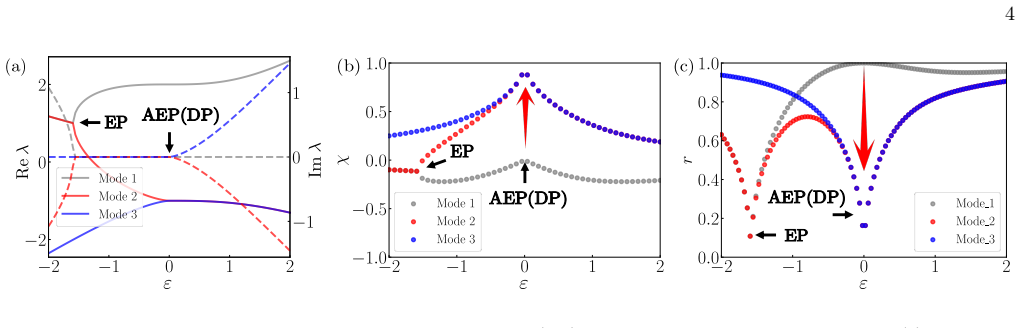
(b) Chiralityχ j as a function ofε. Although the eigenvalues vary continuously, the eigenstates exhibit singular chiral-mode selection in the limitε→0. (c) Phase rigidities as functions ofε, showing that the singularity becomes increasingly pronounced asε→0. where†denotes the Hermitian conjugate. Then the basis vectors and the Hamiltonian in the eigenbasi...
-
[2]
The most striking feature appears in the eigenstates near the DP
This EP corresponds primarily to the coalescence of modes originating from|L 0⟩; consequently, the resulting eigenmode does not exhibit OAM chirality. The most striking feature appears in the eigenstates near the DP. Fig. 2(b) shows that, although the unper- turbed system atε= 0 does not select either chirality, an arbitrarily small nonzero perturbation i...
-
[3]
(B8) Thus, in the angular-momentum (k-) space,V ± act as unidirectional shift operators
AEP-based chirality generation in N-site systems The perturbationsV ± generalize to theN-site system as V+ = N−1X j=0 e−i2πj/N |j⟩ ⟨j|= N−1X j=0 |kj−1⟩ ⟨kj|, V− = N−1X j=0 ei2πj/N |j⟩ ⟨j|= N−1X j=0 |kj⟩ ⟨kj−1|. (B8) Thus, in the angular-momentum (k-) space,V ± act as unidirectional shift operators. The full Hamiltonian in- cluding both perturbations is H=...
-
[4]
III, combining two perturbations enables chirality reversal
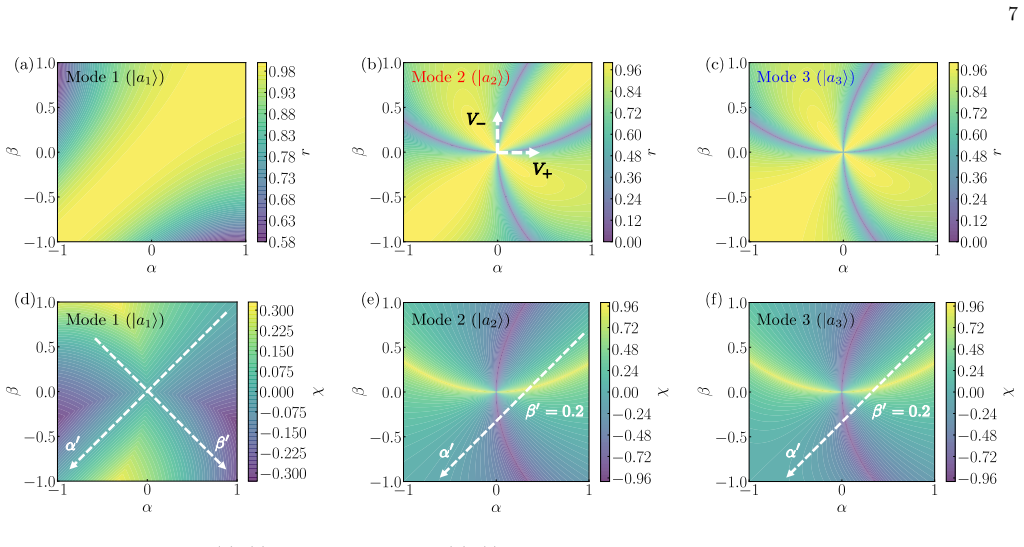
EP-based chirality reversal in N-site systems As discussed for the three-resonator system in Sec. III, combining two perturbations enables chirality reversal. TheN-site analogue of Eq. (25) is obtained by parame- terizing the perturbations in Eq. (B9) as ε+ ε− ! = cosθsinθ −sinθcosθ ! α β ! .(B17) 15 Degenerate Modes Achiral Standing-wave Modes FIG. 8. Co...
-
[5]
Explicit definitions ofFoM AEP andFoM EP To compare the direct AEP and EP-pair operating points as chirality switching, we introduced in the main text the engineering figure of merit FoM = C(ρ) (1 + ∆(ρ))(1 + Γ(ρ)) (E1) Here,C(ρ) denotes the normalized chirality-change ratio defined in Eq. (34), ∆(ρ) is the required sweep amplitude along the real-part con...
-
[6]
Complementary achiral-to-chiral FoM for the EP branch For the main-text comparison, the EP-based operat- ing point is treated in its natural role as a full chirality- reversal process between two opposite-chirality states. As a direct comparison with the achiral-to-chiral operation via the AEP, we also consider a complementary single- branch perturbation-...
-
[7]
One-dimensional averaging along the loss direction We next examine the robustness of the above defini- tions with respect to the averaging scheme by considering 20 one-dimensional broadening only along the imaginary- direction control axis. As the simplest model for the case in which gain/loss uncertainty is the dominant source of control error, we consid...
-
[8]
X. Zhu, H. Ramezani, C. Shi, J. Zhu, and X. Zhang, Physical Review X4, 031042 (2014)
work page 2014
-
[9]
C. Shi, M. Dubois, Y. Chen, L. Cheng, H. Ramezani, Y. Wang, and X. Zhang, Nature Communications7, 11110 (2016)
work page 2016
-
[10]
S ¸. K.¨Ozdemir, S. Rotter, F. Nori, and L. Yang, Nature Materials18, 783 (2019)
work page 2019
-
[11]
R. El-Ganainy, K. G. Makris, M. Khajavikhan, Z. H. Musslimani, S. Rotter, and D. N. Christodoulides, Na- ture Physics14, 11 (2018)
work page 2018
- [12]
-
[13]
W. D. Heiss, Journal of Physics A: Mathematical and Theoretical45, 444016 (2012)
work page 2012
-
[14]
Berry, Czechoslovak Journal of Physics54, 1039 (2004)
M. Berry, Czechoslovak Journal of Physics54, 1039 (2004)
work page 2004
-
[15]
J. Doppler, A. A. Mailybaev, J. B¨ ohm, U. Kuhl, A. Girschik, F. Libisch, T. J. Milburn, P. Rabl, N. Moi- seyev, and S. Rotter, Nature537, 76 (2016)
work page 2016
-
[16]
W. Heiss and H. Harney, The European Physical Journal D - Atomic, Molecular, Optical and Plasma Physics17, 149 (2001)
work page 2001
- [17]
-
[18]
A. M. Yao and M. J. Padgett, Advances in Optics and Photonics3, 161 (2011)
work page 2011
-
[19]
K. J. Vahala, Nature424, 839 (2003)
work page 2003
-
[20]
J. Wang, J.-Y. Yang, I. M. Fazal, N. Ahmed, Y. Yan, H. Huang, Y. Ren, Y. Yue, S. Dolinar, M. Tur, and A. E. Willner, Nature Photonics6, 488 (2012)
work page 2012
-
[21]
A. E. Willner, K. Pang, H. Song, K. Zou, and H. Zhou, Applied Physics Reviews8, 041312 (2021)
work page 2021
- [22]
-
[23]
W. E. Hayenga, M. Parto, J. Ren, F. O. Wu, M. P. Hokmabadi, C. Wolff, R. El-Ganainy, N. A. Mortensen, D. N. Christodoulides, and M. Khajavikhan, ACS Pho- tonics6, 1895 (2019)
work page 2019
- [24]
- [25]
-
[26]
Y. Xu, L. Li, H. Jeong, S. Kim, I. Kim, J. Rho, and Y. Liu, Science Advances9, eadf3510 (2023)
work page 2023
-
[27]
Kato,Perturbation Theory for Linear Operators, repr
T. Kato,Perturbation Theory for Linear Operators, repr. of the 1980 ed ed., Classics in Mathematics (Springer, Berlin Heidelberg, 1995)
work page 1980
-
[28]
Z. Lin, H. Ramezani, T. Eichelkraut, T. Kottos, H. Cao, and D. N. Christodoulides, Physical Review Letters106, 213901 (2011)
work page 2011
- [29]
-
[30]
P. Miao, Z. Zhang, J. Sun, W. Walasik, S. Longhi, N. M. Litchinitser, and L. Feng, Science353, 464 (2016)
work page 2016
-
[31]
Wiersig, Physical Review A84, 063828 (2011)
J. Wiersig, Physical Review A84, 063828 (2011)
work page 2011
- [32]
-
[33]
A. Ø. Svela, J. M. Silver, L. Del Bino, S. Zhang, M. T. M. Woodley, M. R. Vanner, and P. Del’Haye, Light: Science & Applications9, 204 (2020)
work page 2020
-
[34]
H. Lee, A. Kecebas, F. Wang, L. Chang, S. K. ¨Ozdemir, and T. Gu, eLight3, 20 (2023)
work page 2023
-
[35]
A. Mock, D. Sounas, and A. Al` u, ACS Photonics6, 2056 (2019)
work page 2056
-
[36]
C. F. Fong, Y. Ota, Y. Arakawa, S. Iwamoto, and Y. K. Kato, Physical Review Research3, 043096 (2021)
work page 2021
-
[37]
M. Takiguchi, R. Kuruma, Y. Moritake, P. Heidt, M. Ono, E. Kuramochi, H. Sumikura, and M. No- tomi, inCLEO 2026(Optica Publishing Group, 2026) , STH2D.7
work page 2026
-
[38]
W. R. Sweeney, C. W. Hsu, S. Rotter, and A. D. Stone, Physical Review Letters122, 093901 (2019)
work page 2019
- [39]
-
[40]
J. Zhu, C. Wang, C. Tao, Z. Fu, H. Liu, F. Bo, L. Yang, G. Zhang, and J. Xu, Physical Review A108, L041501 (2023)
work page 2023
-
[41]
H. A. Haus and W. Huang, Proceedings of the IEEE79, 1505 (1991)
work page 1991
- [42]
-
[43]
M. V. Berry, Journal of Modern Optics50, 63 (2003)
work page 2003
-
[44]
E. N. Bulgakov, I. Rotter, and A. F. Sadreev, Physical Review E74, 056204 (2006)
work page 2006
-
[45]
Wiersig, Physical Review Research5, 033042 (2023)
J. Wiersig, Physical Review Research5, 033042 (2023)
work page 2023
-
[46]
Schomerus, Physical Review Research6, 013044 (2024)
H. Schomerus, Physical Review Research6, 013044 (2024)
work page 2024
-
[47]
Feshbach, Annual Review of Nuclear and Particle Sci- ence8, 49 (1958)
H. Feshbach, Annual Review of Nuclear and Particle Sci- ence8, 49 (1958)
work page 1958
-
[48]
J. Moro, J. V. Burke, and M. L. Overton, SIAM Journal on Matrix Analysis and Applications18, 793 (1997)
work page 1997
- [49]
- [50]
- [51]
-
[52]
M. Brunstein, R. Braive, R. Hostein, A. Beveratos, I. Robert-Philip, I. Sagnes, T. J. Karle, A. M. Yacomotti, J. A. Levenson, V. Moreau, G. Tessier, and Y. D. Wilde, Optics Express17, 17118 (2009)
work page 2009
- [53]
- [54]
-
[55]
S. Iadanza, Physical Review B102, 10.1103/Phys- RevB.102.245404 (2020)
-
[56]
C. J. Chen, J. Zheng, T. Gu, J. F. McMillan, M. Yu, G.- Q. Lo, D.-L. Kwong, and C. W. Wong, Optics Express 19, 12480 (2011)
work page 2011
-
[57]
F. Intonti, N. Caselli, S. Vignolini, F. Riboli, S. Kumar, A. Rastelli, O. G. Schmidt, M. Francardi, A. Gerardino, L. Balet, L. H. Li, A. Fiore, and M. Gurioli, Applied Physics Letters100, 033116 (2012)
work page 2012
- [58]
discussion (0)
Sign in with ORCID, Apple, or X to comment. Anyone can read and Pith papers without signing in.