Coarse-grained local available potential energy
Pith reviewed 2026-05-19 19:38 UTC · model grok-4.3
The pith
Spatial filtering applied to local available potential energy produces separate evolution equations for large and small scales plus a cross-scale flux term.
A machine-rendered reading of the paper's core claim, the machinery that carries it, and where it could break.
Core claim
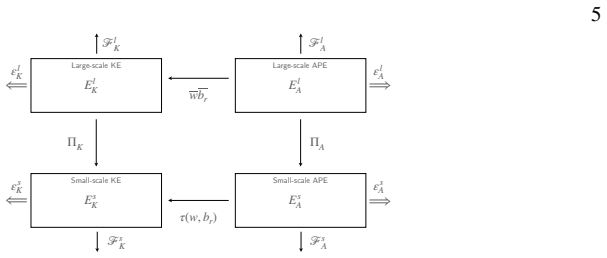
Applying a spatial filter to the local definition of available potential energy yields evolution equations for the filtered large-scale APE and the sub-filter small-scale APE, together with an explicit cross-scale APE flux term that accounts for transfers between the two ranges.
What carries the argument
The spatial filtering (coarse-graining) operator applied to the local APE, which isolates the filtered APE, the sub-filter APE, and the cross-scale flux term within the derived evolution equations.
If this is right
- The new equations can be paired with existing coarse-grained kinetic energy frameworks to study a full energy cycle that includes both spatial-scale conversions and reservoir conversions.
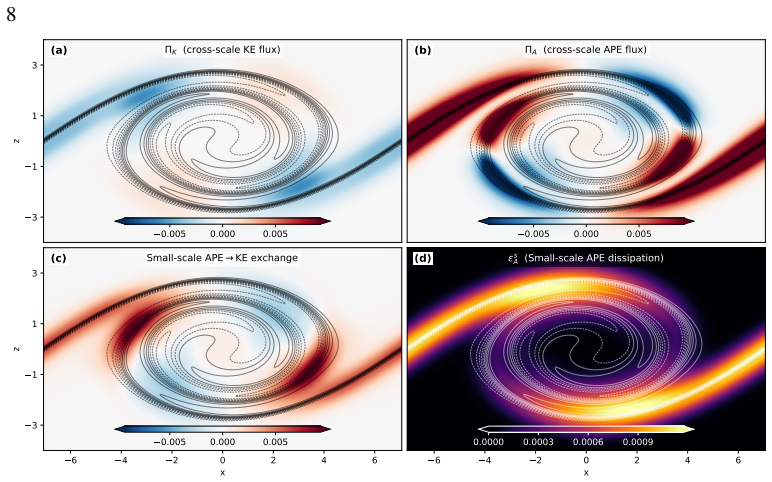
- The method applies directly to numerical simulations of stratified flows such as Kelvin-Helmholtz instability.
- It supplies a tool for analyzing energetics and dynamics in flows ranging from three-dimensional turbulence to planetary-scale circulations.
Where Pith is reading between the lines
- The scale-separated budgets could support development of sub-grid closures that respect both energy reservoirs and scale transfers in large-scale models.
- Extending the same filtering procedure to three-dimensional turbulence cases would test whether the cross-scale flux behaves similarly in fully turbulent stratified flows.
- Applying the framework to other canonical instabilities would show how APE cascades differ across flow types.
Load-bearing premise
The local definition of available potential energy keeps its original physical meaning and usefulness once a spatial filter has been applied.
What would settle it
In the two-dimensional Kelvin-Helmholtz simulation, if the sum of the large-scale and small-scale APE evolution equations does not recover the unfiltered APE equation, the derivation would be falsified.
Figures


read the original abstract
The available potential energy (APE) of a fluid can be defined locally in space, providing useful insights into both the energetics and dynamics of stratified flows ranging from three-dimensional turbulence to planetary scale circulations. Here we develop a framework for considering the multi-scale evolution of the local APE using a spatial filtering, or coarse-graining, approach. Evolution equations for the APE at scales larger, and smaller, than the filtering scale are derived -- including the cross-scale APE flux term. These results can be paired with existing frameworks for coarse-grained kinetic energy, offering the potential for examining a complete energy cycle that accounts for conversions between both spatial scales and energy reservoirs. An illustrative example of the application of this approach to a simulation of two-dimensional Kelvin-Helmholtz instability is provided.
Editorial analysis
A structured set of objections, weighed in public.
Referee Report
Summary. The paper develops a spatial filtering framework for the local available potential energy (APE) in stratified fluids. It derives evolution equations for the APE components at scales larger and smaller than the filter scale, including an explicit cross-scale APE flux term. These are intended to complement existing coarse-grained kinetic energy equations to enable analysis of complete multi-scale energy cycles involving conversions between KE and APE reservoirs. An application to a 2D Kelvin-Helmholtz instability simulation is presented as illustration.
Significance. If the filtered local APE quantities retain their physical interpretation as energy available for conversion to kinetic energy, the framework would allow systematic examination of inter-scale energy transfers and the full KE-APE cycle in stratified turbulence and geophysical flows. The work builds directly on prior local APE definitions and filtering methods for kinetic energy, providing a natural extension that could support falsifiable predictions about energy cascades once verified against known limits or exact solutions.
major comments (2)
- [Derivation of filtered APE equations] The central derivation (abstract and the evolution-equation section) obtains the filtered APE equations by direct application of the filter operator to the local APE expression. This does not address the non-commutativity between spatial filtering and the global reference-state construction (adiabatic rearrangement to minimum potential energy). Because the reference state is determined by a global sorting operation on the buoyancy field, the filtered APE is not in general equal to the APE of the filtered field; the resulting cross-scale flux term may therefore lack the claimed physical meaning as genuine inter-scale transfer of available energy.
- [Illustrative example and verification] No explicit verification of the derived equations against known limiting cases (e.g., unfiltered local APE recovery as filter scale → 0, or global APE conservation in the absence of forcing/dissipation) is provided. The 2D Kelvin-Helmholtz example applies the method but supplies no quantitative check that the filtered quantities satisfy the same conversion-to-KE interpretation as the unfiltered local APE.
minor comments (2)
- [Notation and definitions] Notation for the filter kernel and the decomposition into large- and small-scale APE should be introduced with a single consistent symbol set early in the manuscript to avoid later ambiguity when the cross-scale flux is defined.
- [Introduction] The abstract states that the results 'can be paired with existing frameworks' but does not cite the specific coarse-grained KE papers that would be used; adding these references would clarify the intended synthesis.
Simulated Author's Rebuttal
We thank the referee for the constructive comments, which help clarify the scope and interpretation of our coarse-graining framework for local available potential energy. We respond to each major comment below and indicate the planned revisions.
read point-by-point responses
-
Referee: [Derivation of filtered APE equations] The central derivation (abstract and the evolution-equation section) obtains the filtered APE equations by direct application of the filter operator to the local APE expression. This does not address the non-commutativity between spatial filtering and the global reference-state construction (adiabatic rearrangement to minimum potential energy). Because the reference state is determined by a global sorting operation on the buoyancy field, the filtered APE is not in general equal to the APE of the filtered field; the resulting cross-scale flux term may therefore lack the claimed physical meaning as genuine inter-scale transfer of available energy.
Authors: We acknowledge that the global reference state (obtained by adiabatic rearrangement) does not commute with spatial filtering, so the filtered local APE differs from the APE computed on the filtered buoyancy field. Our derivation applies the filter to the local APE expression as defined in the manuscript, producing a consistent budget that includes an explicit cross-scale flux. This flux represents the scale-to-scale transfer of the filtered APE quantity and, when paired with existing filtered KE equations, still permits examination of the full multi-scale KE-APE cycle. We will revise the manuscript to add an explicit discussion of the non-commutativity, to state clearly that the cross-scale term is the flux of the filtered local APE (rather than of the APE of the filtered field), and to note regimes where the two interpretations approximately coincide. revision: partial
-
Referee: [Illustrative example and verification] No explicit verification of the derived equations against known limiting cases (e.g., unfiltered local APE recovery as filter scale → 0, or global APE conservation in the absence of forcing/dissipation) is provided. The 2D Kelvin-Helmholtz example applies the method but supplies no quantitative check that the filtered quantities satisfy the same conversion-to-KE interpretation as the unfiltered local APE.
Authors: We agree that direct verification against limiting cases would strengthen the presentation. In the revised manuscript we will add a dedicated verification subsection (or appendix) showing (i) recovery of the unfiltered local APE evolution equation in the limit of vanishing filter width and (ii) domain-integrated conservation of total (large-scale plus small-scale) APE when forcing and dissipation are absent. For the Kelvin-Helmholtz illustration we will include quantitative diagnostics, such as the integrated APE-to-KE conversion rates at each scale and a closure check on the summed budgets, to confirm consistency with the unfiltered interpretation. revision: yes
Circularity Check
Derivation of filtered local APE evolution equations is self-contained with no circular reductions
full rationale
The paper derives evolution equations for coarse-grained local available potential energy by direct spatial filtering of the standard local APE definition, producing terms for large-scale, small-scale, and cross-scale fluxes. This is a straightforward mathematical manipulation of the governing equations and does not involve fitting parameters, re-expressing results in terms of themselves, or relying on load-bearing self-citations for the central claims. The derivation stands independently on the local APE framework and filtering operations without reducing to its inputs by construction, making the result self-contained.
Axiom & Free-Parameter Ledger
axioms (2)
- domain assumption The Boussinesq or similar approximation for stratified incompressible flow remains valid under spatial filtering.
- standard math Spatial filtering commutes with the relevant differential operators in the governing equations.
Lean theorems connected to this paper
-
IndisputableMonolith/Cost/FunctionalEquation.leanwashburn_uniqueness_aczel unclear?
unclearRelation between the paper passage and the cited Recognition theorem.
Evolution equations for the APE at scales larger, and smaller, than the filtering scale are derived — including the cross-scale APE flux term.
-
IndisputableMonolith/Foundation/BranchSelection.leanbranch_selection unclear?
unclearRelation between the paper passage and the cited Recognition theorem.
The positive definite nature of the APE density follows from the convexity of (1.1)
What do these tags mean?
- matches
- The paper's claim is directly supported by a theorem in the formal canon.
- supports
- The theorem supports part of the paper's argument, but the paper may add assumptions or extra steps.
- extends
- The paper goes beyond the formal theorem; the theorem is a base layer rather than the whole result.
- uses
- The paper appears to rely on the theorem as machinery.
- contradicts
- The paper's claim conflicts with a theorem or certificate in the canon.
- unclear
- Pith found a possible connection, but the passage is too broad, indirect, or ambiguous to say the theorem truly supports the claim.
Reference graph
Works this paper leans on
-
[1]
Physical Review Letters 106 (17), 174502
Aluie, Hussein 2011 Compressible Turbulence : The Cascade and its Locality . Physical Review Letters 106 (17), 174502
work page 2011
-
[2]
New Journal of Physics 19 (2), 025008
Aluie, Hussein 2017 Coarse-grained incompressible magnetohydrodynamics: analyzing the turbulent cascades . New Journal of Physics 19 (2), 025008
work page 2017
-
[3]
2018 Mapping the Energy Cascade in the North Atlantic Ocean : The Coarse - Graining Approach
Aluie, Hussein , Hecht, Matthew & Vallis, Geoffrey K. 2018 Mapping the Energy Cascade in the North Atlantic Ocean : The Coarse - Graining Approach . Journal of Physical Oceanography 48 (2), 225--244
work page 2018
-
[4]
Barkan, Roy , Winters, Kraig B. & McWilliams, James C. 2017 Stimulated Imbalance and the Enhancement of Eddy Kinetic Energy Dissipation by Internal Waves . Journal of Physical Oceanography 47 (1), 181--198
work page 2017
-
[5]
2021 Layering, Instabilities , and Mixing in Turbulent Stratified Flows
Caulfield, C.P. 2021 Layering, Instabilities , and Mixing in Turbulent Stratified Flows . Annual Review of Fluid Mechanics 53 (1), 113--145
work page 2021
-
[6]
Caulfield, C. P. & Peltier, W. R. 2000 The anatomy of the mixing transition in homogeneous and stratified free shear layers . Journal of Fluid Mechanics 413 , 1--47
work page 2000
-
[7]
2005 Locality of turbulent cascades
Eyink, Gregory L. 2005 Locality of turbulent cascades . Physica D: Nonlinear Phenomena 207 (1-2), 91--116
work page 2005
-
[8]
& Aluie, Hussein 2009 Localness of energy cascade in hydrodynamic turbulence
Eyink, Gregory L. & Aluie, Hussein 2009 Localness of energy cascade in hydrodynamic turbulence. I . Smooth coarse graining . Physics of Fluids 21 (11), 115107
work page 2009
-
[9]
1992 Turbulence: the filtering approach
Germano, M. 1992 Turbulence: the filtering approach . Journal of Fluid Mechanics 238 , 325--336
work page 1992
-
[10]
1981 On potential energy density in an incompressible, stratified fluid
Holliday, Dennis & McIntyre, Michael E. 1981 On potential energy density in an incompressible, stratified fluid . Journal of Fluid Mechanics 107 , 221--225
work page 1981
-
[11]
Kaminski, A. K. & Smyth, W. D. 2019 Stratified shear instability in a field of pre-existing turbulence . Journal of Fluid Mechanics 862 , 639--658
work page 2019
-
[12]
Klaassen, G. P. & Peltier, W. R. 1985 Evolution of Finite Amplitude Kelvin – Helmholtz Billows in Two Spatial Dimensions . Journal of the Atmospheric Sciences 42 (12), 1321--1339
work page 1985
-
[13]
, Aluie, Hussein , Marshall, David P
Kouhen, Salah , Storer, Benjamin A. , Aluie, Hussein , Marshall, David P. & Christensen, Hannah M. 2024 Convective and Orographic Origins of the Mesoscale Kinetic Energy Spectrum . Geophysical Research Letters 51 (21), e2024GL110804
work page 2024
-
[14]
1955 Available Potential Energy and the Maintenance of the General Circulation
Lorenz, Edward N. 1955 Available Potential Energy and the Maintenance of the General Circulation . Tellus 7 (2), 157--167
work page 1955
-
[15]
Margules, M 1903 Uber die Energie der Sturme . Jahrb. Zentralanst. Meteorol. Wien 40 , 1--26
work page 1903
-
[16]
2020 A general criterion for the release of background potential energy through double diffusion
Middleton, Leo & Taylor, John R. 2020 A general criterion for the release of background potential energy through double diffusion . Journal of Fluid Mechanics 893 , R3
work page 2020
-
[17]
Molemaker, M. Jeroen & McWilliams, James C. 2010 Local balance and cross-scale flux of available potential energy . Journal of Fluid Mechanics 645 , 295--314
work page 2010
-
[18]
Journal of Fluid Mechanics 624 , 45--55
Roullet, Guillaume & Klein, Patrice 2009 Available potential energy diagnosis in a direct numerical simulation of rotating stratified turbulence . Journal of Fluid Mechanics 624 , 45--55
work page 2009
-
[19]
Physical Review Fluids 3 (12), 124610
Sadek, Mahmoud & Aluie, Hussein 2018 Extracting the spectrum of a flow by spatial filtering . Physical Review Fluids 3 (12), 124610
work page 2018
-
[20]
Schubert, René , Gula, Jonathan , Greatbatch, Richard J. , Baschek, Burkard & Biastoch, Arne 2020 The Submesoscale Kinetic Energy Cascade : Mesoscale Absorption of Submesoscale Mixed Layer Eddies and Frontal Downscale Fluxes . Journal of Physical Oceanography 50 (9), 2573--2589
work page 2020
-
[21]
Journal of Fluid Mechanics 740 , 114--135
Scotti, Alberto & White, Brian 2014 Diagnosing mixing in stratified turbulent flows with a locally defined available potential energy . Journal of Fluid Mechanics 740 , 114--135
work page 2014
-
[22]
2023 A Forward Energy Flux at Submesoscales Driven by Frontogenesis
Srinivasan, Kaushik , Barkan, Roy & McWilliams, James C. 2023 A Forward Energy Flux at Submesoscales Driven by Frontogenesis . Journal of Physical Oceanography 53 (1), 287--305
work page 2023
-
[23]
Journal of Fluid Mechanics 296 , 73--126
Staquet, Chantal 1995 Two-dimensional secondary instabilities in a strongly stratified shear layer . Journal of Fluid Mechanics 296 , 73--126
work page 1995
-
[24]
Stewart, K.D. , Saenz, J.A. , Hogg, A.McC. , Hughes, G.O. & Griffiths, R.W. 2014 Effect of topographic barriers on the rates of available potential energy conversion of the oceans . Ocean Modelling 76 , 31--42
work page 2014
-
[25]
, Buzzicotti, Michele , Khatri, Hemant , Griffies, Stephen M
Storer, Benjamin A. , Buzzicotti, Michele , Khatri, Hemant , Griffies, Stephen M. & Aluie, Hussein 2022 Global energy spectrum of the general oceanic circulation . Nature Communications 13 (1), 5314
work page 2022
-
[26]
Annual Review of Fluid Mechanics 45 (1), 35--58
Tailleux, Rémi 2013 Available Potential Energy and Exergy in Stratified Fluids . Annual Review of Fluid Mechanics 45 (1), 35--58
work page 2013
-
[27]
Tailleux, Rémi & Roullet, Guillaume 2025 Energetically consistent localised APE budgets for local and regional studies of stratified flow energetics . Ocean Modelling 197 , 102579
work page 2025
-
[28]
2001 Mixing and available potential energy in stratified flows
Tseng, Yu-heng & Ferziger, Joel H. 2001 Mixing and available potential energy in stratified flows . Physics of Fluids 13 (5), 1281--1293
work page 2001
-
[29]
, Silvestri, Simone , Constantinou, Navid C
Wagner, Gregory L. , Silvestri, Simone , Constantinou, Navid C. , Ramadhan, Ali , Campin, Jean-Michel , Hill, Chris , Chor, Tomas , Strong-Wright, Jago , Lee, Xin Kai , Poulin, Francis , Souza, Andre , Burns, Keaton J. , Bishnu, Siddhartha , Marshall, John & Ferrari, Raffaele 2025 High-level, high-resolution ocean modeling at all scales with Oceananigans ...
work page 2025
-
[30]
Winant, C. D. & Browand, F. K. 1974 Vortex pairing : the mechanism of turbulent mixing-layer growth at moderate Reynolds number . Journal of Fluid Mechanics 63 (2), 237--255
work page 1974
-
[31]
& Barkan, Roy 2013 Available potential energy density for Boussinesq fluid flow
Winters, Kraig B. & Barkan, Roy 2013 Available potential energy density for Boussinesq fluid flow . Journal of Fluid Mechanics 714 , 476--488
work page 2013
-
[32]
Winters, Kraig B. & D'Asaro, Eric A. 1996 Diascalar flux and the rate of fluid mixing . Journal of Fluid Mechanics 317 , 179--193
work page 1996
-
[33]
Winters, Kraig B. , Lombard, Peter N. , Riley, James J. & D'Asaro, Eric A. 1995 Available potential energy and mixing in density-stratified fluids . Journal of Fluid Mechanics 289 , 115--128
work page 1995
-
[34]
Zemskova, Varvara E. , White, Brian L. & Scotti, Alberto 2015 Available Potential Energy and the General Circulation : Partitioning Wind , Buoyancy Forcing , and Diapycnal Mixing . Journal of Physical Oceanography 45 (6), 1510--1531
work page 2015
- [35]
-
[36]
T. Barker and D. G. Schaeffer and P. Boh\'orquez and J. M. N. T. Gray , title =. J. Fluid. Mech. , year =
- [37]
-
[38]
A. V. Briukhanov and S. S. Grigorian and S. M. Miagkov and M. Y. Plam and I. E. Shurova and M. E. Eglit and Y. L. Yakimov , title =. Physics of Snow and Ice, Proceedings of the International Conference on Low Temperature Science , volume =
- [39]
- [40]
-
[41]
S.C.R. Dennis , title =. Ninth Intl Conf. on Numerical Methods in Fluid Dynamics , publisher =. 1985 , editor =
work page 1985
-
[42]
Formation of levees, troughs and elevated channels by avalanches on erodible slopes , author =. J. Fluid Mech. , volume =
- [43]
-
[44]
and Saut, Jean Claude , title =
Joseph, Daniel D. and Saut, Jean Claude , title =. Theoretical and Computational Fluid Dynamics , publisher=
-
[45]
M.G. Worster , title =. Interactive dynamics of convection and solidification , publisher =. 1992 , editor =
work page 1992
- [46]
- [47]
-
[48]
C.M. Linton and D.V. Evans , title =. Phil.\ Trans.\ R. Soc.\ Lond. , year =
- [49]
- [50]
- [51]
-
[52]
On the oscillations Near and at resonance in open pipes , year =
L. On the oscillations Near and at resonance in open pipes , year =. J. Engng Maths , volume =
- [53]
-
[54]
Camera Calibration Toolbox for Matlab , howpublished =
Bouguet, J.-Y , year=. Camera Calibration Toolbox for Matlab , howpublished =
discussion (0)
Sign in with ORCID, Apple, or X to comment. Anyone can read and Pith papers without signing in.