Massively Degenerate Coherent Perfect Absorption in Gradient-Index Fibers
Pith reviewed 2026-05-19 19:08 UTC · model grok-4.3
The pith
A gradient-index fiber uses its self-imaging property to absorb arbitrary multimode light fields with reflectivities below one percent.
A machine-rendered reading of the paper's core claim, the machinery that carries it, and where it could break.
Core claim
Using the self-imaging property of the GRIN fiber, the bulky free-space architecture of previous coherent perfect absorbers is replaced by a monolithic waveguiding platform that supports near-degenerate rephasing of many spatial modes. Standard GRIN profiles optimized for minimal intermodal dispersion enable highly efficient absorption of complex multimode fields, with field-of-view reflectivities well below 1% for realistic parameters.
What carries the argument
The self-imaging property of the gradient-index fiber, which produces periodic refocusing that allows many spatial modes to rephase near-degenerately for arbitrary multimode inputs.
If this is right
- The approach replaces free-space CPA setups with a compact fiber platform.
- Standard low-dispersion GRIN profiles already suffice for high-efficiency multimode absorption.
- This enables scalable multimode absorption in fiber-based and integrated photonic systems.
- Potential uses include light harvesting, optical control, and imaging through multimode channels.
Where Pith is reading between the lines
- The same self-imaging mechanism might be combined with active modulation inside the fiber to create switchable or tunable multimode absorbers.
- Similar GRIN-based rephasing could be explored for multimode coherent perfect transmission or amplification in the same geometry.
- Testing the effect with partially coherent or partially polarized inputs would clarify how robust the absorption remains outside ideal conditions.
Load-bearing premise
The self-imaging property of the GRIN fiber permits near-degenerate rephasing of many spatial modes simultaneously for arbitrary multimode input states.
What would settle it
Experimentally launch a complex multimode field into a standard GRIN fiber segment and measure the reflected power; a field-of-view reflectivity above a few percent for realistic parameters would contradict the central claim.
Figures



read the original abstract
Coherent perfect absorbers (CPAs) have recently attracted considerable attention due to their ability to enhance light--matter interaction. By exploiting interference, CPAs enable even weakly absorbing materials to achieve complete absorption under appropriate excitation conditions. Generalizing this concept to the simultaneous absorption of arbitrary multimode input states remains challenging, however, since conventional implementations typically operate only for a single or a very small number of input channels. Here, we propose a compact realization of a multimode coherent perfect absorber based on a gradient-index (GRIN) fiber. Using the self-imaging property of the fiber, the bulky free-space architecture of previous approaches is replaced by a monolithic waveguiding platform that supports near-degenerate rephasing of many spatial modes. We show that standard GRIN profiles optimized for minimal intermodal dispersion enable highly efficient absorption of complex multimode fields, with field-of-view reflectivities well below \(1\%\) for realistic parameters. This approach provides a practical and scalable route toward efficient multimode absorption in fiber-based and integrated photonic systems, with potential applications in light harvesting, optical control, and imaging.
Editorial analysis
A structured set of objections, weighed in public.
Referee Report
Summary. The manuscript proposes a compact multimode coherent perfect absorber realized in a gradient-index (GRIN) fiber. It exploits the self-imaging property of GRIN fibers to achieve near-degenerate rephasing of many spatial modes simultaneously, replacing bulky free-space CPA architectures with a monolithic waveguiding platform. The central claim is that standard GRIN profiles optimized for minimal intermodal dispersion enable highly efficient absorption of complex multimode fields, with field-of-view reflectivities well below 1% for realistic parameters.
Significance. If the central result holds, the work provides a practical and scalable route to multimode coherent perfect absorption in fiber-based and integrated photonic systems. It leverages established GRIN fiber technology and the self-imaging property to support applications in light harvesting, optical control, and imaging, where efficient absorption of arbitrary multimode states is required without single-mode precision.
major comments (2)
- Abstract: The assertion that standard GRIN profiles enable 'highly efficient absorption of complex multimode fields, with field-of-view reflectivities well below 1% for realistic parameters' is load-bearing for the central claim but rests on an unstated bound on mode count and the assumption that residual phase spread from higher-order modal dispersion remains smaller than the absorber linewidth; no explicit scaling of reflectivity with mode number or input complexity is supplied.
- Abstract, paragraph on generalization to multimode inputs: The claim that the self-imaging property 'permits near-degenerate rephasing of many spatial modes simultaneously for arbitrary multimode input states' requires support from analysis that includes quadratic and higher-order group-velocity variations with mode order as well as finite aperture effects; these become non-negligible for inputs occupying more than a few lowest-order modes or carrying random relative phases.
minor comments (2)
- Abstract: Consider specifying the absorber material, the precise GRIN profile parameters (e.g., parabolic index coefficient), and the wavelength range used to reach the quoted reflectivity values.
- Abstract: The term 'massively degenerate' is used in the title but not quantified in the abstract; a brief statement of the number of supported modes or degeneracy factor would improve clarity.
Simulated Author's Rebuttal
We thank the referee for the careful and constructive review of our manuscript. The comments raise important points about the strength of the claims in the abstract and the supporting analysis for multimode inputs. We address each major comment below and indicate where revisions will be made to improve clarity and rigor without altering the central results.
read point-by-point responses
-
Referee: [—] Abstract: The assertion that standard GRIN profiles enable 'highly efficient absorption of complex multimode fields, with field-of-view reflectivities well below 1% for realistic parameters' is load-bearing for the central claim but rests on an unstated bound on mode count and the assumption that residual phase spread from higher-order modal dispersion remains smaller than the absorber linewidth; no explicit scaling of reflectivity with mode number or input complexity is supplied.
Authors: We agree that the abstract statement would benefit from greater explicitness. The manuscript body contains numerical results for multimode inputs (up to ~20 modes) under standard GRIN parameters, where the self-imaging length is chosen to keep residual phase spread within the absorber linewidth, yielding reflectivities below 1%. However, we did not include an explicit scaling plot or bound in the main text. We will revise the abstract to reference the mode-count range explored and add a short paragraph plus supplementary figure showing reflectivity versus mode number and input complexity (e.g., random-phase versus aligned-phase cases) to make the supporting assumptions transparent. revision: partial
-
Referee: [—] Abstract, paragraph on generalization to multimode inputs: The claim that the self-imaging property 'permits near-degenerate rephasing of many spatial modes simultaneously for arbitrary multimode input states' requires support from analysis that includes quadratic and higher-order group-velocity variations with mode order as well as finite aperture effects; these become non-negligible for inputs occupying more than a few lowest-order modes or carrying random relative phases.
Authors: The GRIN profile used is the standard parabolic index that is known to suppress quadratic and higher-order modal dispersion to first order; our propagation model already incorporates the leading dispersion terms and finite-aperture clipping at the fiber entrance and exit. For arbitrary relative phases the self-imaging plane still produces a common phase front for the supported modes, enabling the CPA condition. That said, the referee correctly notes that these effects grow with mode order. We will add a dedicated subsection (or supplementary note) that quantifies the residual quadratic phase spread and aperture-induced mode truncation for inputs spanning the lowest 30 modes with random phases, confirming that the reflectivity remains below 1% for the parameter regime stated in the abstract. revision: partial
Circularity Check
No significant circularity; central result follows from standard GRIN self-imaging property
full rationale
The paper invokes the established self-imaging property of parabolic GRIN fibers (a textbook result independent of this work) to argue that phases rephase near-degenerately across modes. No equation in the provided text defines a quantity in terms of itself, renames a fit as a prediction, or reduces the reflectivity claim to a self-citation chain. The absorption performance is presented as a direct consequence of that external property plus realistic parameters, making the derivation self-contained against external benchmarks.
Axiom & Free-Parameter Ledger
free parameters (1)
- GRIN profile parameters
axioms (1)
- domain assumption Self-imaging property of gradient-index fibers allows rephasing of multiple spatial modes
Reference graph
Works this paper leans on
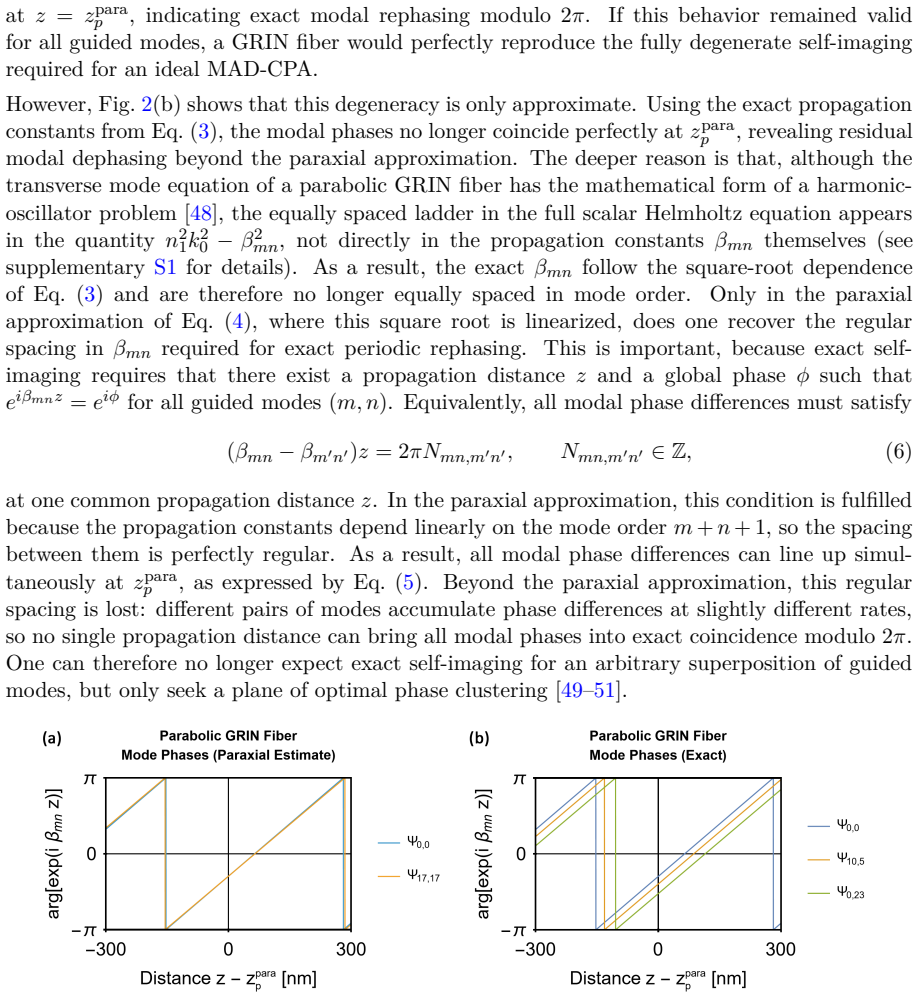
-
[1]
Resonant cavity-enhanced (RCE) photodetectors,
K. Kishino et al., “Resonant cavity-enhanced (RCE) photodetectors,” IEEE Journal of Quantum Electronics27, 2025–2034 (1991)
work page 2025
-
[2]
A theoretical study of resonant cavity- enhanced photodectectors with ge and si active regions,
M. S. Ünlü, K. Kishino, H. J. Liaw, and H. Morkoç, “A theoretical study of resonant cavity- enhanced photodectectors with ge and si active regions,” Journal of Applied Physics71, 4049–4058 (1992)
work page 1992
-
[3]
R.B.Adler,L.J.Chu,andR.M.Fano,Electromagnetic energy transmission and radiation,
-
[4]
Press, Cambridge, Mass.[u.a.], 1969), 621 pp
print., The MIT Press classics (M.I.T. Press, Cambridge, Mass.[u.a.], 1969), 621 pp
work page 1969
-
[5]
H. A. Haus,Waves and fields in optoelectronics, Prentice-Hall series in solid state physical electronics (Prentice-Hall, Englewood Cliffs, NJ, 1984), 402 pp
work page 1984
-
[6]
Optical microsphere resonators: optimal coupling to high-q whispering-gallery modes,
M. L. Gorodetsky and V. S. Ilchenko, “Optical microsphere resonators: optimal coupling to high-q whispering-gallery modes,” Journal of the Optical Society of America B16, 147 (1999)
work page 1999
-
[7]
M. Cai, O. Painter, and K. J. Vahala, “Observation of critical coupling in a fiber taper to a silica-microsphere whispering-gallery mode system,” Physical Review Letters85, 74–77 (2000)
work page 2000
-
[8]
Critical coupling and its control in optical waveguide-ring resonator systems,
A. Yariv, “Critical coupling and its control in optical waveguide-ring resonator systems,” IEEE Photonics Technology Letters14, 483–485 (2002)
work page 2002
-
[9]
Multiband diffraction and refraction control in binary arrays of periodically curved waveguides,
S. Longhi, “Multiband diffraction and refraction control in binary arrays of periodically curved waveguides,” Opt. Lett.31, 1857–1859 (2006)
work page 2006
-
[11]
All-optically untangling light prop- agation through multimode fibers,
H. Kupianskyi, S. A. R. Horsley, and D. B. Phillips, “All-optically untangling light prop- agation through multimode fibers,” Optica11, 101 (2024)
work page 2024
-
[12]
Control of the temporal and polarization response of a multimode fiber,
M. Mounaix and J. Carpenter, “Control of the temporal and polarization response of a multimode fiber,” Nature Communications10,10.1038/s41467-019-13059-8(2019)
-
[13]
Unscrambling entanglement through a complex medium,
N. H. Valencia, S. Goel, W. McCutcheon, H. Defienne, and M. Malik, “Unscrambling entanglement through a complex medium,” Nature Physics16, 1112–1116 (2020)
work page 2020
-
[14]
Coherent perfectt absorbers: time-reversed lasers,
Y. D. Chong, L. Ge, H. Cao, and A. D. Stone, “Coherent perfectt absorbers: time-reversed lasers,” Physical Review Letters105, 053901 (2010)
work page 2010
-
[15]
Hidden Black: Coherent Enhancement of Absorption in Strongly Scattering Media,
Y. D. Chong and A. D. Stone, “Hidden Black: Coherent Enhancement of Absorption in Strongly Scattering Media,” Physical Review Letters107, 163901 (2011)
work page 2011
-
[16]
Coherent perfect absorbers: linear control of light with light,
D. G. Baranov, A. Krasnok, T. Shegai, A. Alù, and Y. Chong, “Coherent perfect absorbers: linear control of light with light,” Nature Reviews Materials2, 17064 (2017)
work page 2017
-
[17]
Perfectly absorbing exceptional points and chiral absorbers,
W. R. Sweeney, C. W. Hsu, S. Rotter, and A. D. Stone, “Perfectly absorbing exceptional points and chiral absorbers,” Phys. Rev. Lett.122, 093901 (2019)
work page 2019
-
[18]
Coherent perfect absorption at an exceptional point,
C. Wang, W. R. Sweeney, A. D. Stone, and L. Yang, “Coherent perfect absorption at an exceptional point,” Science373, 1261–1265 (2021)
work page 2021
-
[19]
Chiral and degenerate perfect absorption on exceptional surfaces,
S. Soleymani et al., “Chiral and degenerate perfect absorption on exceptional surfaces,” Nature Communications13, 599 (2022)
work page 2022
-
[20]
Coherent control of chaotic optical microcavity with reflectionless scat- tering modes,
X. Jiang et al., “Coherent control of chaotic optical microcavity with reflectionless scat- tering modes,” Nature Physics20, 109–115 (2023)
work page 2023
-
[21]
Theory of reflectionless scattering modes,
W. R. Sweeney, C. W. Hsu, and A. D. Stone, “Theory of reflectionless scattering modes,” Physical Review A102, 063511 (2020). 13
work page 2020
-
[22]
Trapped modes and reflectionless modes as eigenfunctions of the same spectral problem,
A.-S. B.-B. Dhia, L. Chesnel, and V. Pagneux, “Trapped modes and reflectionless modes as eigenfunctions of the same spectral problem,” Proceedings of the Royal Society A: Mathematical, Physical and Engineering Sciences474, 20180050 (2018)
work page 2018
-
[23]
Anti-reflectionstructure for perfect transmission through complex media,
M.Horodynski,M.Kühmayer,C.Ferise,S.Rotter,andM.Davy,“Anti-reflectionstructure for perfect transmission through complex media,” Nature607, 281–286 (2022)
work page 2022
-
[24]
Random anti-lasing through coherent perfect absorption in a disordered medium,
K. Pichler et al., “Random anti-lasing through coherent perfect absorption in a disordered medium,” Nature567, 351–355 (2019)
work page 2019
-
[25]
Perfect absorption in complex scattering systems with or without hidden symmetries,
L. Chen, T. Kottos, and S. M. Anlage, “Perfect absorption in complex scattering systems with or without hidden symmetries,” en, Nature Communications11,10.1038/s41467- 020-19645-5(2020)
-
[26]
An equivalent realization of coherent perfect absorption under single beam illumination,
S. Li et al., “An equivalent realization of coherent perfect absorption under single beam illumination,” Scientific Reports4, 7369 (2014)
work page 2014
-
[27]
Broadband single-channel coherent perfect absorption with a perfect magnetic mirror,
Y. Jin and K. Yu, “Broadband single-channel coherent perfect absorption with a perfect magnetic mirror,” Optics Express28, 35108 (2020)
work page 2020
-
[28]
Low-power all-optical switch based on time-reversed microring laser,
A. Mock, “Low-power all-optical switch based on time-reversed microring laser,” IEEE Photonics Journal4, 2229–2235 (2012)
work page 2012
-
[29]
Nonlinear optical switch based on coherent perfect absorption,
M.-D. Guo, H.-F. Li, F.-L. Wang, C.-X. Zhou, and Y.-J. Wu, “Nonlinear optical switch based on coherent perfect absorption,” Optics Letters48, 4037 (2023)
work page 2023
-
[30]
Casimir forces in inhomo- geneous media: renormalization and the principle of virtual work,
Y. Li, K. A. Milton, X. Guo, G. Kennedy, and S. A. Fulling, “Casimir forces in inhomo- geneous media: renormalization and the principle of virtual work,” Physical Review D99, 125004 (2019)
work page 2019
-
[31]
Y. Zhang, F.-P. Wu, and H.-F. Zhang, “Theoretical model of a ri thz sensor realized by coherent perfect absorption with optical phase modulation,” IEEE Sensors Journal22, 14842–14850 (2022)
work page 2022
-
[32]
R. Ebrahimi Meymand, A. Soleymani, and N. Granpayeh, “All-optical and, or, and xor logicgatesbasedoncoherentperfectabsorptioningraphene-basedmetasurfaceatterahertz region,” Optics Communications458, 124772 (2020)
work page 2020
-
[33]
X. Fang, K. F. MacDonald, and N. I. Zheludev, “Controlling light with light using coherent metadevices: all-optical transistor, summator and invertor,” Light: Science & Applications 4, e292–e292 (2015)
work page 2015
-
[34]
Time-Reversed Lasing and Interferometric Control of Absorption,
W. Wan et al., “Time-Reversed Lasing and Interferometric Control of Absorption,” en, Science331, 889–892 (2011)
work page 2011
-
[35]
Perfect coupling of light to surface plasmons by coherent absorption,
H. Noh, Y. Chong, A. D. Stone, and H. Cao, “Perfect coupling of light to surface plasmons by coherent absorption,” Physical review letters108, 186805 (2012)
work page 2012
-
[36]
Coherent virtual absorption based on complex zero excitation for ideal light capturing,
D. G. Baranov, A. Krasnok, and A. Alù, “Coherent virtual absorption based on complex zero excitation for ideal light capturing,” en, Optica4, 1457 (2017)
work page 2017
-
[37]
Coherent perfect absorption of arbitrary wavefronts at an exceptional point,
H. Hörner et al., “Coherent perfect absorption of arbitrary wavefronts at an exceptional point,” Phys. Rev. Lett.133, 173801 (2024)
work page 2024
-
[38]
Non-linear coherent perfect absorption in the proximity of excep- tional points,
S. Suwunnarat et al., “Non-linear coherent perfect absorption in the proximity of excep- tional points,” Communications Physics5,10.1038/s42005-021-00782-2(2022)
-
[39]
C.-Z. Wang, J. Guillamon, W. Tuxbury, U. Kuhl, and T. Kottos, “Nonlinearity-induced scattering zero degeneracies for spectral management of coherent perfect absorption in complex systems,” Physical Review Applied22, 064093 (2024)
work page 2024
-
[40]
D. Globosits et al.,Exceptional points, lasing, and coherent perfect absorption in floquet scattering systems, 2025. 14
work page 2025
-
[41]
Massively degenerate coherent perfect absorber for arbitrary wave- fronts,
Y. Slobodkin et al., “Massively degenerate coherent perfect absorber for arbitrary wave- fronts,” Science377, 995–998 (2022)
work page 2022
-
[42]
S. Longhi, “PT-symmetric laser absorber,” Physical Review A82, 031801 (2010)
work page 2010
-
[43]
J. Arnaud, “Degenerate optical cavities,” Applied optics8, 189–196 (1969)
work page 1969
-
[44]
Observing geometric frustration with thousands of coupled lasers,
M. Nixon, E. Ronen, A. A. Friesem, and N. Davidson, “Observing geometric frustration with thousands of coupled lasers,” Physical review letters110, 184102 (2013)
work page 2013
-
[45]
Rapid laser solver for the phase retrieval problem,
C. Tradonsky et al., “Rapid laser solver for the phase retrieval problem,” Science Advances 5, eaax4530 (2019)
work page 2019
-
[46]
Multimode theory of graded-core fibers,
D. Gloge and E. A. J. Marcatili, “Multimode theory of graded-core fibers,” Bell System Technical Journal52, 1563–1578 (1973)
work page 1973
-
[47]
Pulse broadening in graded-index optical fibers,
R. Olshansky and D. B. Keck, “Pulse broadening in graded-index optical fibers,” Applied Optics15, 483 (1976)
work page 1976
-
[48]
A. K. Ghatak and K. Thyagarajan,Introduction to fiber optics, Repr., transf. to digital print. (Cambridge Univ. Press, Cambridge, 2004), 565 pp
work page 2004
-
[49]
Calculation of dispersion in graded-index multimode fibers by a propagating-beam method,
M. D. Feit and J. A. Fleck, “Calculation of dispersion in graded-index multimode fibers by a propagating-beam method,” Applied Optics18, 2843 (1979)
work page 1979
-
[50]
General self-imaging properties in n× n multimode interference couplers including phase relations,
M. Bachmann, P. A. Besse, and H. Melchior, “General self-imaging properties in n× n multimode interference couplers including phase relations,” Applied Optics33, 3905 (1994)
work page 1994
-
[51]
Optical multi-mode interference devices based on self- imaging:principlesandapplications,
L. Soldano and E. Pennings, “Optical multi-mode interference devices based on self- imaging:principlesandapplications,”JournalofLightwaveTechnology13,615–627(1995)
work page 1995
-
[52]
Non-hermitian multimode interference,
S. Longhi and L. Feng, “Non-hermitian multimode interference,” Optics Letters45, 1962 (2020)
work page 1962
-
[53]
J. P. Dakin and R. G. W. Brown,Handbook of optoelectronics (two-volume set)(Taylor & Francis Group, 2006), p. 1680. 15 Supplementary Material for Massively Degenerate Coherent Perfect Absorption in Gradient-Index Fibers Helmut Hörner, Şahin K. Özdemir, and Stefan Rotter S1 Why a Parabolic GRIN Profile Does Not Produce Exact Rephasing Beyond the Paraxial A...
work page 2006
-
[54]
A parabolic GRIN profile leads to a harmonic-oscillator problem both in the paraxial approximation and in the exact scalar Helmholtz equation
-
[55]
In the paraxial approximation, the harmonic-oscillator eigenvalues enter directly into the propagation constantsβn, leading to an equally spacedβn-ladder and exact periodic rephasing
-
[56]
In the exact scalar Helmholtz equation, the harmonic-oscillator eigenvalues enter into n2 0k2 0−β2 n, so the equally spaced ladder is a ladder inβ2 n, not inβn
-
[57]
The paraxial result is recovered by linearizing the square root in the exact expression
-
[58]
Consequently, exact global modal rephasing is a feature of the paraxial approximation, while the full Helmholtz problem generally supports only approximate rephasing. This explains why the self-imaging of a parabolic GRIN fiber is exact in the paraxial model but only approximate in the full modal description used for the present MAD-CPA analysis. S2 Why O...
-
[59]
the intrinsic anharmonic correction of the spectrum, represented by the−∆2x2/2term in (S2.23), and
-
[60]
the tunable correction induced by choosingq̸= 2, represented by the−∆εxlnxterm. In the group-delay problem these same two effects appear in theδ- andδ2-terms of (S2.7); in the rephasing problem they appear as the first two deviations from a perfectly linear propagation- constant ladder. Since both optimizations are controlled by the same perturbative bala...
discussion (0)
Sign in with ORCID, Apple, or X to comment. Anyone can read and Pith papers without signing in.