Demonstration of a Multiplexing Trapped Ion Quantum Processing Unit
Pith reviewed 2026-05-20 19:20 UTC · model grok-4.3
The pith
Trapped ion quantum processor uses multiplexing to cut control lines while keeping heating low.
A machine-rendered reading of the paper's core claim, the machinery that carries it, and where it could break.
Core claim
The central claim is that a multiplexing scheme based on sample-and-hold allows a trapped-ion quantum processing unit to perform operations with motional heating rates below one phonon per second and expected gate errors from charge decay below 10^{-4} when sampling intervals are under 50 ms.
What carries the argument
The sample-and-hold technique that initially charges trap electrodes to the required voltages from a reduced set of input signals and then disconnects them for the duration of qubit operations.
Load-bearing premise
The electrode voltages remain stable enough during the hold phase that any drift or noise adds no more than 10^{-4} to the gate error.
What would settle it
A measurement showing motional heating rates above one phonon per second or gate errors exceeding the 10^{-4} threshold when the switches remain open for intervals near 50 ms would indicate the multiplexing scheme is not compatible with high-fidelity operations.
Figures






read the original abstract
A fault-tolerant quantum computer is expected to require thousands of qubits. Trapped ion architectures provide a modular approach where the quantum register is divided into multiple subregisters connected by physically moving the corresponding ions. Transporting ions at scale comes with several challenges such as the need to connect thousands of control lines to an ion trap chip. Multiplexing the required control voltages from few input signals to multiple electrodes offers a solution to this wiring challenge. Here we demonstrate a quantum processing unit that combines a surface ion trap with a time multiplexer via a sample-and-hold technique that initially charges electrodes to fixed voltages and disconnects them during qubit operations. We characterize the unit's performance by measuring motional heating rates below one phonon per second in both open and closed switch configurations. We further characterize the sample and hold process and find that sampling intervals below 50 ms are sufficient to keep expected gate errors from decaying charges during the hold phase below $10^{-4}$. Our results indicate that the multiplexing scheme is compatible with high-fidelity operations.
Editorial analysis
A structured set of objections, weighed in public.
Referee Report
Summary. The manuscript demonstrates a multiplexing trapped ion quantum processing unit that integrates a surface ion trap with a time-multiplexer using a sample-and-hold technique. Electrodes are charged to fixed voltages and then disconnected during qubit operations to address wiring scalability. The authors report direct measurements of motional heating rates below one phonon per second in both open and closed switch configurations, and characterize sampling intervals below 50 ms as sufficient to keep modeled gate errors from decaying charges below 10^{-4}, concluding that the scheme is compatible with high-fidelity operations.
Significance. If the error estimates hold, this addresses a critical wiring bottleneck for scaling trapped-ion systems to thousands of qubits in modular architectures. The direct heating-rate measurements in both switch states provide concrete experimental support for compatibility, independent of fitted models, and the work offers a practical path toward reduced control-line counts without immediate fidelity loss.
major comments (1)
- [Abstract and sample-and-hold characterization] Abstract and sample-and-hold characterization section: The central claim that multiplexing contributes less than 10^{-4} gate error rests on an estimate of voltage drift from charge decay during the hold phase. However, this estimate is derived from a model without reported direct in-situ measurements of electrode potential, noise spectra, or drift while the ion is trapped and laser-addressed. Direct verification would be needed to rule out contributions from switch leakage, EMI, or unmodeled effects that could exceed the modeled budget.
minor comments (2)
- [Abstract] The abstract states heating rates below one phonon per second but does not include statistical uncertainties, number of measurements, or full error budgets for these values.
- [Sample-and-hold characterization] Clarify the precise functional form and assumptions used to convert sampling interval to expected gate error from decaying charges (e.g., any dependence on electrode capacitance or leakage current).
Simulated Author's Rebuttal
We thank the referee for their constructive review and for recognizing the potential significance of our multiplexing approach for scaling trapped-ion systems. We address the major comment point by point below.
read point-by-point responses
-
Referee: Abstract and sample-and-hold characterization section: The central claim that multiplexing contributes less than 10^{-4} gate error rests on an estimate of voltage drift from charge decay during the hold phase. However, this estimate is derived from a model without reported direct in-situ measurements of electrode potential, noise spectra, or drift while the ion is trapped and laser-addressed. Direct verification would be needed to rule out contributions from switch leakage, EMI, or unmodeled effects that could exceed the modeled budget.
Authors: We appreciate the referee drawing attention to the distinction between modeled voltage drift and direct experimental verification. The gate-error estimate is obtained from the product of the measured sampling interval, the electrode capacitance, and the leakage current of the sample-and-hold circuitry (determined from component specifications and bench measurements). While we do not report direct in-situ electrode-potential measurements during ion trapping and laser addressing, such measurements are technically challenging without introducing additional conductors or sensors that could themselves perturb the electric-field environment. Instead, we rely on the direct motional-heating-rate measurements performed with the ion present and the lasers active. These rates remain below 1 phonon/s in both the open-switch and closed-switch configurations, providing an experimental upper bound on any excess electric-field noise or slow drifts attributable to the multiplexer. Because motional heating is the dominant error channel linked to electrode-voltage fluctuations in our system, the absence of measurable excess heating supports the claim that unmodeled contributions from leakage, EMI, or other effects remain within the budgeted error. In the revised manuscript we will add a paragraph in the sample-and-hold characterization section that explicitly connects the heating-rate data to the modeled drift budget and states the assumptions underlying the leakage-current estimate. revision: partial
Circularity Check
No significant circularity: experimental characterization stands independently
full rationale
The paper reports direct experimental measurements of motional heating rates below one phonon per second in open and closed switch configurations, along with empirical characterization of sampling intervals below 50 ms to bound expected gate errors from charge decay below 10^{-4}. These results derive from in-situ ion trap observations rather than any mathematical derivation, fitted parameter renamed as prediction, or self-citation chain that reduces the central claim to its own inputs. No equations or uniqueness theorems are invoked that loop back by construction; the compatibility conclusion follows from the reported data without self-referential reduction.
Axiom & Free-Parameter Ledger
axioms (1)
- domain assumption Sample-and-hold voltage stability during disconnection is adequate to keep gate errors below 10^{-4}
Reference graph
Works this paper leans on
-
[1]
Fabrication The ion traps were fabricated at Infineon Technolo- gies’ industrial facilities in Villach, Austria. Chip traps fabricated on silicon substrates exhibit a factor of 3.3 to 5.6 higher RF power dissipation, compared to fused silica [63]. Hence, fused silica was chosen as substrate material, which is present in the form of disks, measuring200 mm ...
-
[2]
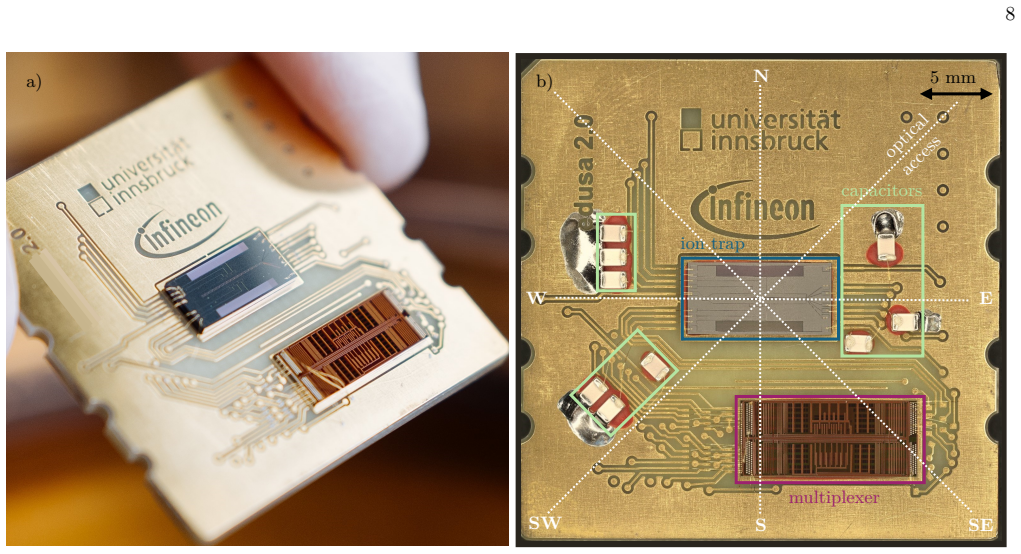
separated the wafer into the individual chip traps. C. Quantum processing unit and experimental setup The core of this work is the QPU consisting of the trap chip and the multiplexer, both assembled onto a printed circuit board (PCB), shown in Figure 4. The two chips were glued onto the square PCB with a base length of34 mmusing an one-component epoxy adh...
-
[3]
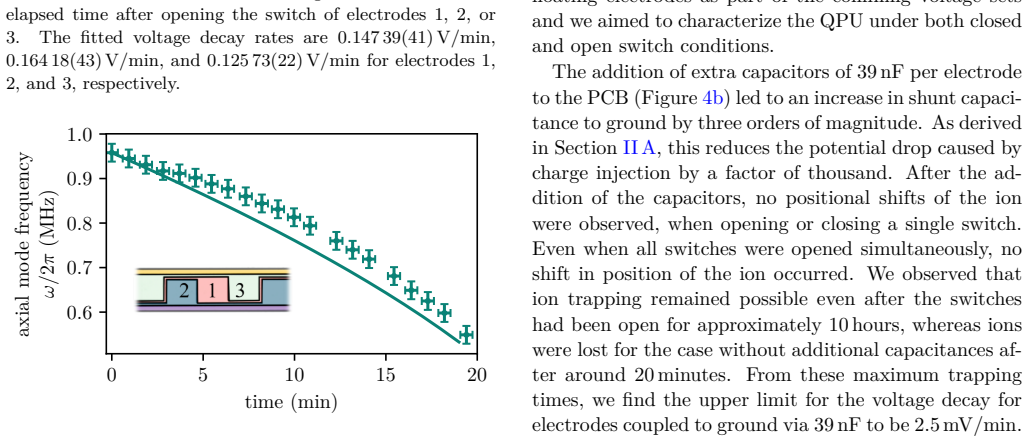
0 5 10 15 20 time (min) 0.6 0.7 0.8 0.9 1.0 axial mode frequency ω/2π (MHz) FIG
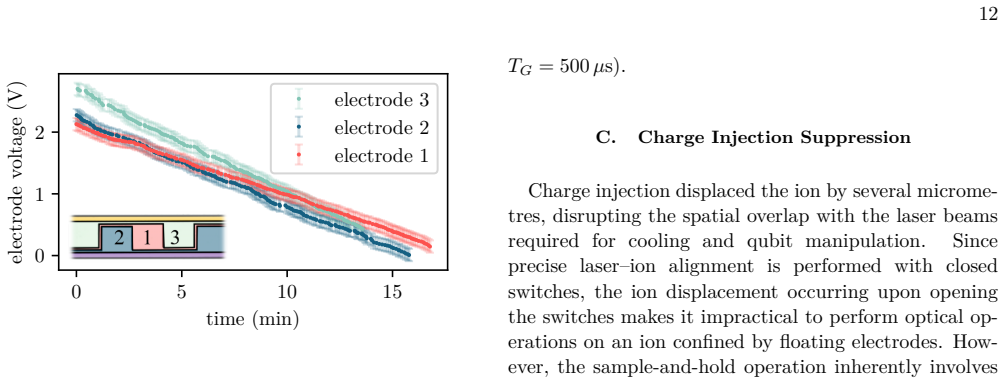
The fitted voltage decay rates are0.147 39(41) V/min, 0.164 18(43) V/min, and0.125 73(22) V/minfor electrodes 1, 2, and 3, respectively. 0 5 10 15 20 time (min) 0.6 0.7 0.8 0.9 1.0 axial mode frequency ω/2π (MHz) FIG. 9: Axial mode frequency as a function of elapsed time afteropeningtheswitchesofelectrodes2and3. Experimental data is shown as dotted points...
-
[4]
We added capacitances into the multiplexer for the dynamic electrodes with15 pF
and ion rotations [32]. We added capacitances into the multiplexer for the dynamic electrodes with15 pF. Local electric fields, which might vary from one unit cell to another are neutralized by compensation elec- trodes. The 98 compensation electrodes (yellow) are located on the outside of the dynamic electrodes. The voltage for all compensation electrode...
-
[5]
14: a) Colored microscope picture of the second traps electrode design
This input-output characteristic was independent of 16 a) RF RF 80µm 110µm unit cell 190µm 100µm 190µm 90µm multiplexer shim DAC trap 1 2 3 4 5 6 7 8 9 digital control dynamic DACs b) cryostat 49 50 51 52 53 54 55 56 57 58 59 60 Cshim,1 Cshim,2 10 11 12 50 pF 15 pF 15 pF FIG. 14: a) Colored microscope picture of the second traps electrode design. Shown is...
-
[6]
M. C. Smith, A. D. Leu, K. Miyanishi, M. F. Gely, and D. M. Lucas. Single-qubit gates with errors at the10−7 level.Phys. Rev. Lett., 134:230601, Jun 2025
work page 2025
-
[7]
Pengfei Wang, Chun-Yang Luan, Mu Qiao, Mark Um, Junhua Zhang, Ye Wang, Xiao Yuan, Mile Gu, Jingn- ing Zhang, and Kihwan Kim. Single ion qubit with estimated coherence time exceeding one hour.Nature Communications, 12(1), January 2021
work page 2021
-
[8]
C.M. Löschnauer, J. Mosca Toba, A.C. Hughes, S.A. King, M.A. Weber, R. Srinivas, R. Matt, R. Nour- shargh, D.T.C. Allcock, C.J. Ballance, C. Matthiesen, M. Malinowski, and T.P. Harty. Scalable, high-fidelity all-electronic control of trapped-ion qubits.PRX Quan- tum, 6:040313, Oct 2025
work page 2025
- [9]
-
[10]
S. A. Moses, C. H. Baldwin, M. S. Allman, R. An- cona, L. Ascarrunz, C. Barnes, J. Bartolotta, B. Bjork, P. Blanchard, M. Bohn, J. G. Bohnet, N. C. Brown, N. Q. Burdick, W. C. Burton, S. L. Campbell, J. P. Campora, C. Carron, J. Chambers, J. W. Chan, Y. H. Chen, A. Chernoguzov, E. Chertkov, J. Colina, J. P. Curtis, R. Daniel, M. DeCross, D. Deen, C. Delan...
work page 2023
-
[11]
Jwo-Sy Chen, Erik Nielsen, Matthew Ebert, Volkan Inlek, Kenneth Wright, Vandiver Chaplin, Andrii O. Maksymov, Eduardo J. P’aez, Amrit Poudel, Peter Maunz, and John King Gamble. Benchmarking a trapped-ion quantum computer with 30 qubits.Quan- tum, 8:1516, 2023
work page 2023
-
[12]
Marciniak, Lukas Postler, Georg Jacob, Oliver Krieglsteiner, Verena Podlesnic, Michael Meth, V
Ivan Pogorelov, Thomas Feldker, Christian D. Marciniak, Lukas Postler, Georg Jacob, Oliver Krieglsteiner, Verena Podlesnic, Michael Meth, V. Neg- nevitsky, Martin Stadler, Bernd Hofer, Christophe Wachter, Kirill Lakhmanskiy, Rainer Blatt, Philipp Schindler, and Thomas Monz. Compact ion-trap quan- tum computing demonstrator.PRX Quantum, 2021
work page 2021
-
[13]
Faisal Alam, Jan Lukas Bosse, Ieva Čepait˙ e, Adrian Chapman, Laura Clinton, Marcos Crichigno, Eliza- beth Crosson, Toby Cubitt, Charles Derby, Oliver Dowinton, Norhan Eassa, Paul K. Faehrmann, Steve Flammia, Brian Flynn, Filippo Maria Gambetta, Raúl García-Patrón, Max Hunter-Gordon, Glenn Jones, Ab- hishek Khedkar, Joel Klassen, Michael Kreshchuk, Ed- wa...
-
[14]
Anthony Ransford, M. S. Allman, Jake Arkinstall, J. P. Campora III, Samuel F. Cooper, Robert D. De- laney, Joan M. Dreiling, Brian Estey, Caroline Fig- gatt, Alex Hall, Ali A. Husain, Akhil Isanaka, Colin J. Kennedy, Nikhil Kotibhaskar, Ivaylo S. Madjarov, Karl Mayer, Alistair R. Milne, Annie J. Park, Adam P. Reed, Riley Ancona, Molly P. Andersen, Pablo A...
work page internal anchor Pith review Pith/arXiv arXiv 2025
-
[15]
Quantum computing in the nisq era and beyond.Quantum, 2:79, 2018
John Preskill. Quantum computing in the nisq era and beyond.Quantum, 2:79, 2018
work page 2018
-
[16]
Kottmann, Tim Menke, Wai-Keong Mok, Sukin Sim, Leong-Chuan Kwek, and Alán Aspuru-Guzik
Kishor Bharti, Alba Cervera-Lierta, Thi Ha Kyaw, Tobias Haug, Sumner Alperin-Lea, Abhinav Anand, Matthias Degroote, Hermanni Heimonen, Jakob S. Kottmann, Tim Menke, Wai-Keong Mok, Sukin Sim, Leong-Chuan Kwek, and Alán Aspuru-Guzik. Noisy intermediate-scale quantum algorithms.Rev. Mod. Phys., 94:015004, Feb 2022
work page 2022
-
[17]
How to factor 2048 bit rsa integers in 8 hours using 20 million noisy qubits
Craig Gidney and Martin Ekerå. How to factor 2048 bit rsa integers in 8 hours using 20 million noisy qubits. Quantum, 5:433, April 2021
work page 2048
-
[18]
Fault-Tolerant Quantum Computing with Trapped Ions: The Walking Cat Architecture
Felix Tripier, Woo Chang Chung, Jacob Young, Safwan Alam, Bryce Bjork, Aharon Brodutch, Finn Lasse Buessen, Nolan J. Coble, Thomas Dellaert, Dmitri Maslov, Martin Roetteler, Edwin Tham, Mark Web- ster, Min Ye, John Gamble, Andrii Maksymov, J. P. Marceaux, and Nicolas Delfosse. Fault-Tolerant Quan- tum Computing with Trapped Ions: The Walking Cat Architect...
work page internal anchor Pith review Pith/arXiv arXiv 2026
-
[19]
Madelyn Cain, Qian Xu, Robbie King, Lewis R. B. Pi- card, HarryLevine, ManuelEndres, JohnPreskill, Hsin- Yuan Huang, and Dolev Bluvstein. Shor’s algorithm is possible with as few as 10,000 reconfigurable atomic qubits, 2026. arXiv:2603.28627
work page internal anchor Pith review Pith/arXiv arXiv 2026
-
[20]
David Kielpinski, Christopher R. Monroe, and David J. Wineland. Architecture for a large-scale ion-trap quan- 19 tum computer.Nature, 417:709–711, 2002
work page 2002
-
[21]
S. Seidelin, J. Chiaverini, R. Reichle, J. Bollinger, D. Leibfried, J. Britton, J. Wesenberg, R. Blakestad, R. Epstein, D. Hume, W. Itano, J. Jost, C. Langer, R. Ozeri, N. Shiga, and D. Wineland. Microfabricated surface-electrode ion trap for scalable quantum informa- tion processing.Physical Review Letters, 96(25), June 2006
work page 2006
-
[22]
Zak David Romaszko, Seokjun Hong, Martin Siegele, Reuben Kahan Puddy, Foni Raphael Lebrun-Gallagher, Sebastian Weidt, and Winfried Karl Hensinger. En- gineering of microfabricated ion traps and integration of advanced on-chip features.Nature Reviews Physics, 2:285–299, 2019
work page 2019
-
[23]
Holz, Thomas Monz, Rainer Blatt, Philipp Schindler, Clemens Roessler, and Jonathan P
Silke Auchter, Christopher James Axline, Chiara De- caroli, Marco Valentini, Lina Purwin, Robin Oswald, Roland Matt, Elmar Aschauer, Yves Colombe, Philip C. Holz, Thomas Monz, Rainer Blatt, Philipp Schindler, Clemens Roessler, and Jonathan P. Home. Industrially microfabricated ion trap with 1 ev trap depth.Quantum Science & Technology, 7, 2022
work page 2022
-
[24]
Bassem Badawi, Philip C. Holz, Michael Raffetseder, Nicolas Jungwirth, Juris Ulmanis, Hans-Joachim Quen- zer, Dirk Kähler, Thomas Monz, and Philipp Schindler. Chiplet technology for large-scale trapped-ion quantum processors, 2025. arXiv:2512.02645
-
[25]
rf-induced heating dynamics of noncrys- tallized trapped ions.Physical Review A, 2021
Martin van Mourik, Pavel Hrmo, Lukas Gerster, Ben- jamin Wilhelm, Rainer Blatt, Philipp Schindler, and Thomas Monz. rf-induced heating dynamics of noncrys- tallized trapped ions.Physical Review A, 2021
work page 2021
-
[26]
Harald Rohde, Stephan Gulde, Christian F. Roos, P. A. Barton, Dietrich Leibfried, Jürgen Eschner, Ferdinand Schmidt-Kaler, and Rainer Blatt. Sympathetic ground- state cooling and coherent manipulation with two-ion crystals.Journal of Optics B-quantum and Semiclassi- cal Optics, 3, 2000
work page 2000
- [27]
-
[28]
D. Kielpinski, C. Monroe, and D. J. Wineland. Ar- chitecture for a large-scale ion-trap quantum computer. Nature, 417(6890):709–711, jun 2002
work page 2002
-
[29]
Juan Pino, J. M. Dreiling, Caroline Figgatt, John P. Gaebler, Steven A. Moses, Michael S. Allman, Charles H. Baldwin, Michael Foss-Feig, David Hayes, Karl Mayer, Ciarán Ryan-Anderson, and Brian Neyen- huis. Demonstration of the trapped-ion quantum ccd computer architecture.Nature, 592:209 – 213, 2020
work page 2020
-
[30]
Mehta, Daniel Kienzler, and Jonathan Home
Carmelo Mordini, Alfredo Ricci Vasquez, Yuto Moto- hashi, Mose Müller, Maciej Malinowski, Chi Zhang, Karan K. Mehta, Daniel Kienzler, and Jonathan Home. Multizone trapped-ion qubit control in an integrated photonics qccd device.Physical Review X, 2024
work page 2024
-
[31]
Ciarán Ryan-Anderson, Justin Gary Bohnet, K W Lee, Daniel N. Gresh, Aaron M. Hankin, John P. Gaebler, David Francois, Alexander Chernoguzov, Dario Luc- chetti, Natalie C. Brown, T. M. Gatterman, Si Khadir Halit, Kevin A. Gilmore, J. Gerber, Brian Neyenhuis, David Hayes, and Russell P. Stutz. Realization of real- time fault-tolerant quantum error correctio...
work page 2021
-
[32]
S. A. Moses, Juan Pino, J. M. Dreiling, Caroline Fig- gatt, John P. Gaebler, Michael S. Allman, C. H. Bald- win, Michael Foss-Feig, David Hayes, K. Mayer, Ciarán Ryan-Anderson, and Brian Neyenhuis. Demonstration oftheqccdtrapped-ionquantumcomputerarchitecture. arXiv: Quantum Physics, 2020
work page 2020
-
[33]
Demonstration of logical qubits and repeated error correction with better-than-physical error rates
A. Paetznick, M. P. da Silva, C. Ryan-Anderson, J. M. Bello-Rivas, J. P. Campora III, A. Chernoguzov, J. M. Dreiling, C. Foltz, F. Frachon, J. P. Gaebler, T. M. Gatterman, L. Grans-Samuelsson, D. Gresh, D. Hayes, N. Hewitt, C. Holliman, C. V. Horst, J. Johansen, D. Lucchetti, Y. Matsuoka, M. Mills, S. A. Moses, B. Neyenhuis, A. Paz, J. Pino, P. Siegfried,...
work page internal anchor Pith review Pith/arXiv arXiv 2024
-
[34]
M. Valentini, M. W. van Mourik, F. Butt, J. Wahl, M. Dietl, M. Pfeifer, F. Anmasser, Y. Colombe, C. Rössler, P. C. Holz, R. Blatt, A. Bermudez, M. Müller, T. Monz, and P. Schindler. Demonstra- tion of two-dimensional connectivity for a scalable error-corrected ion-trap quantum processor architec- ture.Phys. Rev. X, 15:041023, Nov 2025
work page 2025
- [35]
-
[36]
Vidyut Kaushal, B. Lekitsch, Adam Stahl, James A. Hilder, D. Pijn, Christian T. Schmiegelow, Alejan- dro Bermudez, Markus Müller, Ferdinand Schmidt- Kaler, and U.G. Poschinger. Shuttling-based trapped- ion quantum information processing.AVS Quantum Science, 2019
work page 2019
-
[37]
Martin W. van Mourik, Esteban A. Martinez, Lukas Gerster, Pavel Hrmo, Thomas Monz, Philipp Schindler, and Rainer Blatt. Coherent rotations of qubits within a surface ion-trap quantum computer.Phys. Rev. A, 102:022611, Aug 2020
work page 2020
-
[38]
Barreiro, Michael Chwalla, Daniel Nigg, William A
Thomas Monz, Philipp Schindler, Julio T. Barreiro, Michael Chwalla, Daniel Nigg, William A. Coish, Max- imilian Harlander, Wolfgang Hänsel, Markus Hennrich, and Rainer Blatt. 14-qubit entanglement: Creation and coherence.Physical Review Letters, 106(13), March 2011
work page 2011
-
[39]
D. J. Wineland. Ion traps for quantum information pro- cessing.Journal of the Optical Society of America B, 20(6):1358–1366, 2003
work page 2003
-
[40]
Versolato, Alexander Wind- berger, Franziska Ruth Brunner, Timothy G
Michael Schwarz, Oscar O. Versolato, Alexander Wind- berger, Franziska Ruth Brunner, Timothy G. Ballance, Sita Eberle, Joachim Ullrich, Piet O. Schmidt, An- ders Kragh Hansen, Alexander D Gingell, Michael 20 Drewsen, and José R. Crespo López-Urrutia. Cryogenic linear paul trap for cold highly charged ion experiments. The Review of scientific instruments, ...
work page 2012
-
[41]
C. D. Bruzewicz, Jeremy M. Sage, and John Chiaverini. Measurement of ion motional heating rates over a range of trap frequencies and temperatures.Physical Review A, 91:041402, 2014
work page 2014
-
[42]
Jaroslaw Labaziewicz, Yufei Ge, David R. Leibrandt, Shannon X. Wang, Ruth Shewmon, and Isaac L. Chuang. Temperature dependence of electric field noise above gold surfaces.Physical review letters, 101 18:180602, 2008
work page 2008
-
[43]
Ming-Fa Chen, Fang-Cheng Chen, Wen-Chih Chiou, and Doug C.H. Yu. System on integrated chips (soic(tm) for 3d heterogeneous integration. In2019 IEEE 69th Electronic Components and Technology Con- ference (ECTC), pages 594–599, 2019
work page 2019
-
[44]
Pascal Vivet, Eric Guthmuller, Yvain Thonnart, Gaël Pillonnet, César Fuguet, Ivan Miro-Panades, Guillaume Moritz, Jean Durupt, Christian Bernard, Didier Var- reau, Julian J. H. Pontes, Sébastien Thuries, David Co- riat, Michel Harrand, Denis Dutoit, Didier Lattard, Lu- cile Arnaud, Jean Charbonnier, Perceval Coudrain, Ar- naud Garnier, Frédéric Berger, Al...
work page 2021
-
[45]
Integrated optical multi-ion quantum logic.Nature, 586:533–537, 2020
KaranKMehta, ChiZhang, MaciejMalinowski, Thanh- Long Nguyen, Martin Stadler, and Jonathan P Home. Integrated optical multi-ion quantum logic.Nature, 586:533–537, 2020
work page 2020
-
[46]
Integrated multi- wavelengthcontrolofanionqubit.Nature, 586:538–542, 2020
Robert J Niffenegger, Jules Stuart, Cheryl Sorace- Agaskar, Dave Kharas, Suraj Bramhavar, Colin D Bruzewicz, William Loh, Ryan T Maxson, Robert McConnell, David Reens, et al. Integrated multi- wavelengthcontrolofanionqubit.Nature, 586:538–542, 2020
work page 2020
-
[47]
Versatile laser-free trapped-ion entangling gates.New Journal of Physics, 21:033033, 2019
RT Sutherland, R Srinivas, SC Burd, D Leibfried, AC Wilson, DJ Wineland, and DJ Wineland. Versatile laser-free trapped-ion entangling gates.New Journal of Physics, 21:033033, 2019
work page 2019
-
[48]
Philip C. Holz, Silke Auchter, Gerald Stocker, Marco Valentini, Kirill Lakhmanskiy, Clemens Rössler, Paul Stampfer, Sokratis Sgouridis, Elmar Aschauer, Yves Colombe, and Rainer Blatt. 2d linear trap array for quantum information processing.Advanced Quantum Technologies, 3, 2020
work page 2020
-
[49]
J Alonso, F M Leupold, B C Keitch, and J P Home. Quantum control of the motional states of trapped ions throughfastswitchingoftrappingpotentials.New Jour- nal of Physics, 15(2):023001, feb 2013
work page 2013
- [50]
- [51]
-
[52]
Alexander Meyer, Peter Toth, Axel Engelhardt, Jens Repp, Matthias Brandl, and Vadim Issakov. A 12 bit r- 2r digital-to-analog converter for shuttling operation in a trapped-ion quantum computer.2023 IEEE BiCMOS and Compound Semiconductor Integrated Circuits and Technology Symposium (BCICTS), pages 28–31, 2023
work page 2023
-
[53]
Michael Sieberer. A cryogenic digital-to-analog con- verter for trapped-ion quantum computing.2024 IEEE European Solid-State Electronics Research Conference (ESSERC), pages 480–483, 2024
work page 2024
-
[54]
Sungbin Park, Seokchan Song, Keumhyun Kim, Hye Ryun Lee, Moonjoo Lee, and Jae-Yoon Sim. A cryo-cmos 64-channel bias generator ic for surface ion trap.2024 IEEE European Solid-State Electronics Re- search Conference (ESSERC), pages 488–491, 2024
work page 2024
-
[55]
Cryogenic evaluation of a digital-to- analog converter for a trapped-ion quantum computer
Alexander Meyer, Paul Julius Ritter, Marius Neumann, Peter Toth, Sebastian Halama, Jens Repp, Matthias Brandl, Benedikt Hampel, Meinhard Schilling, and Vadim Issakov. Cryogenic evaluation of a digital-to- analog converter for a trapped-ion quantum computer. IEEE Transactions on Instrumentation and Measure- ment, 74:1–10, 2025
work page 2025
-
[56]
M. Malinowski, D.T.C. Allcock, and C.J. Ballance. How to wire a 1000-qubit trapped ion quantum computer. PRX Quantum, 4(4), October 2023
work page 2023
-
[57]
Robert D. Delaney, Lucas R. Sletten, Matthew J. Cich, Brian Estey, Maya I. Fabrikant, David Hayes, Ian M. Hoffman, James Hostetter, Christopher Langer, Steven A. Moses, Abigail R. Perry, Timothy A. Peter- son, Andrew Schaffer, Curtis Volin, Grahame Vittorini, and William Cody Burton. Scalable multispecies ion transport in a grid-based surface-electrode tr...
work page 2024
-
[58]
Woojun Lee, Daun Chung, Honggi Jeon, Beomgeun Cho, Kwangyeul Choi, Seungwoo Yoo, Changhyun Jung, Junho Jeong, Changsoon Kim, Dong-Il Dan Cho, and Taehyun Kim. Photoinduced charge-carrier dynam- ics in a semiconductor-based ion trap investigated via motion-sensitive qubit transitions.Physical Review A, 2023
work page 2023
-
[59]
Nicholas D. Guise, Spencer D. Fallek, Harley Hayden, C-S Pai, Curtis Volin, K. R. Brown, J. True Merrill, Alexa W. Harter, Jason M. Amini, Lisa M. Lust, Kelly Muldoon, Doug Carlson, and Jerry Budach. In-vacuum active electronics for microfabricated ion traps.Review of Scientific Instruments, 85(6):063101, jun 2014
work page 2014
-
[60]
Robert F. Spivey, I. Volkan Inlek, Zhubing Jia, Stephen Crain, Ke jia Sun, Junki Kim, Geert Vrijsen, Chao Fang, Colin Fitzgerald, Steffen Kross, Tom Noel, and Jungsang Kim. High-stability cryogenic system for quantum computing with compact packaged ion traps. IEEE Transactions on Quantum Engineering, 3:1–11, 2021. 21
work page 2021
-
[61]
Peter Micke, J Stark, S A King, T Leopold, Thomas Pfeifer, Lisa Schmöger, Michael Schwarz, Lukas J. Spieß, Piet O. Schmidt, and José R. Crespo López- Urrutia. Closed-cycle, low-vibration 4 k cryostat for ion traps and other applications.The Review of scientific instruments, 90 6:065104, 2019
work page 2019
- [62]
-
[63]
Mohammad Abu Zahra, Jens Repp, Michael Hartmann, Matthias Brandl, and Ralf Brederlow. Evaluation of ldmosdevice’sbehavioratcryogenictemperatures.2024 International Semiconductor Conference (CAS), pages 181–184, 2024
work page 2024
-
[64]
Thomas H. Cormen, Charles E. Leiserson, Ronald L. Rivest, and Clifford Stein.Introduction to Algorithms. MIT Press, Cambridge, MA, 3 edition, 2009
work page 2009
-
[65]
Joseba Alonso, Florian M. Leupold, Z.U. Solèr, Matteo Fadel, Matteo Marinelli, Ben C. Keitch, Vlad Negnevit- sky, and Jonathan Home. Generation of large coherent states by bang–bang control of a trapped-ion oscillator. Nature Communications, 7:11243, 2016
work page 2016
-
[66]
Mohammad Abu Zahra, Fabian Anmasser, Ralf Bred- erlow, Jens Repp, and Matthias Brandl. Crymson: A cryogenic high voltage analog multiplexer asic for scal- ing trapped ion quantum computers.Manuscript under review, 2026
work page 2026
-
[67]
George Wegmann, E.A. Vittoz, and Fouad Rahali. Charge injection in analog mos switches.Solid-State Circuits, IEEE Journal of, 22:1091 – 1097, 01 1988
work page 1988
-
[68]
Matthias Dietl, Marco Valentini, Fabian Anmasser, Alexander Zesar, Silke Auchter, Martin van Mourik, Thomas Monz, Rainer Blatt, Clemens Rössler, and Philipp Schindler. Test and characterization of mul- tilayer ion traps on fused silica.Advanced Quantum Technologies, 8(11):e00412, 2025
work page 2025
- [69]
-
[70]
Neil W. Ashcroft and N. David Mermin.Solid State Physics. Saunders College Publishing, New York, 1976
work page 1976
-
[71]
Brian N. Chapman and John L. Vossen, editors.Glow Discharge Processes: Sputtering and Plasma Etching. Academic Press, New York, 1980
work page 1980
-
[72]
Vincent M. Donnelly and Avinoam Kornblit. Plasma etching: Yesterday, today, and tomorrow.Journal of Vacuum Science and Technology, 31:050825, 2013
work page 2013
-
[73]
Yong Zhang, Ting Ting Zuo, Zhi Tang, Michael C. Gao, Karin A. Dahmen, Peter K. Liaw, and Zhao Ping Lu. Microstructures and properties of high-entropy alloys. Progress in Materials Science, 61:1–93, 2014
work page 2014
-
[74]
W. Grobman, M. Thompson, R. Wang, C. Yuan, R. Tian, and E. Demircan. Reticle enhancement tech- nology: implications and challenges for physical design. InProceedings of the 38th Design Automation Confer- ence (IEEE Cat. No.01CH37232), pages 73–78, 2001
work page 2001
-
[75]
van den Brink, Hans Jasper, Steve D
Martin A. van den Brink, Hans Jasper, Steve D. Slon- aker, Peter Wijnhoven, and Frans Klaassen. Step-and- scan and step-and-repeat: a technology comparison. In Gene E. Fuller, editor,Optical Microlithography IX, vol- ume 2726, pages 734 – 753. International Society for Optics and Photonics, SPIE, 1996
work page 1996
-
[76]
Automated system for optical inspection of defects in resist-coated non-patterned wafer.Jordan Journal of Physics, 2020
work page 2020
-
[77]
Wei-ShengLei, AjayKumar, andRaoYalamanchili. Die singulation technologies for advanced packaging: A crit- ical review.Journal of Vacuum Science & Technology. B. Nanotechnology and Microelectronics: Materials, Processing, Measurement, and Phenomena, 30:040801, 2012
work page 2012
- [78]
-
[79]
A Room-Temperature Extreme High Vacuum System for Trapped-Ion Quantum Information Processing, 2025
Lewis Hahn, Nikhil Kotibhaskar, Fabien Lefebvre, Sak- shee Patil, Sainath Motlakunta, Mahmood Sabooni, and Rajibul Islam. A Room-Temperature Extreme High Vacuum System for Trapped-Ion Quantum Information Processing, 2025. arXiv:2512.11794
-
[80]
D. Carter. ’fuzz button’ interconnects at microwave and mm-wave frequencies. InIEE Seminar on Packaging and Interconnects at Microwave and mm-Wave Frequen- cies (Ref. No. 2000/083), pages 3/1–3/6, 2000
work page 2000
discussion (0)
Sign in with ORCID, Apple, or X to comment. Anyone can read and Pith papers without signing in.