Subgraphs versus Orientations: Infinite families of equidistributions
Pith reviewed 2026-05-20 16:57 UTC · model grok-4.3
The pith
For vertex pair sets A and B, orientations with added-arc reachability constraints are equinumerous to subgraphs with matching connectivity constraints.
A machine-rendered reading of the paper's core claim, the machinery that carries it, and where it could break.
Core claim
The paper claims that for a graph G and sets A = {(u_i, v_i)} and B = {(u_i', v_i')}, the orientations α of G such that adding the arcs from A and B produces a digraph in which each v_i cannot reach u_i while each v_i' can reach u_i' are equinumerous to the subgraphs of G satisfying the analogous connectivity constraints phrased directly in terms of A and B. The claim is extended to the equivalence classes of those orientations under cycle reversal, cocycle reversal, or cycle-cocycle reversal, which are shown to be equinumerous to suitable sets of subgraphs obeying both connectivity and acyclicity conditions.
What carries the argument
The equinumerosity between the set of orientations satisfying reachability constraints after addition of directed pairs from A and B and the set of subgraphs satisfying the corresponding connectivity constraints.
Load-bearing premise
The reachability conditions created by adding the pairs from A and B as directed edges for orientations line up with the connectivity conditions used for subgraphs in a way that preserves the equinumerosity.
What would settle it
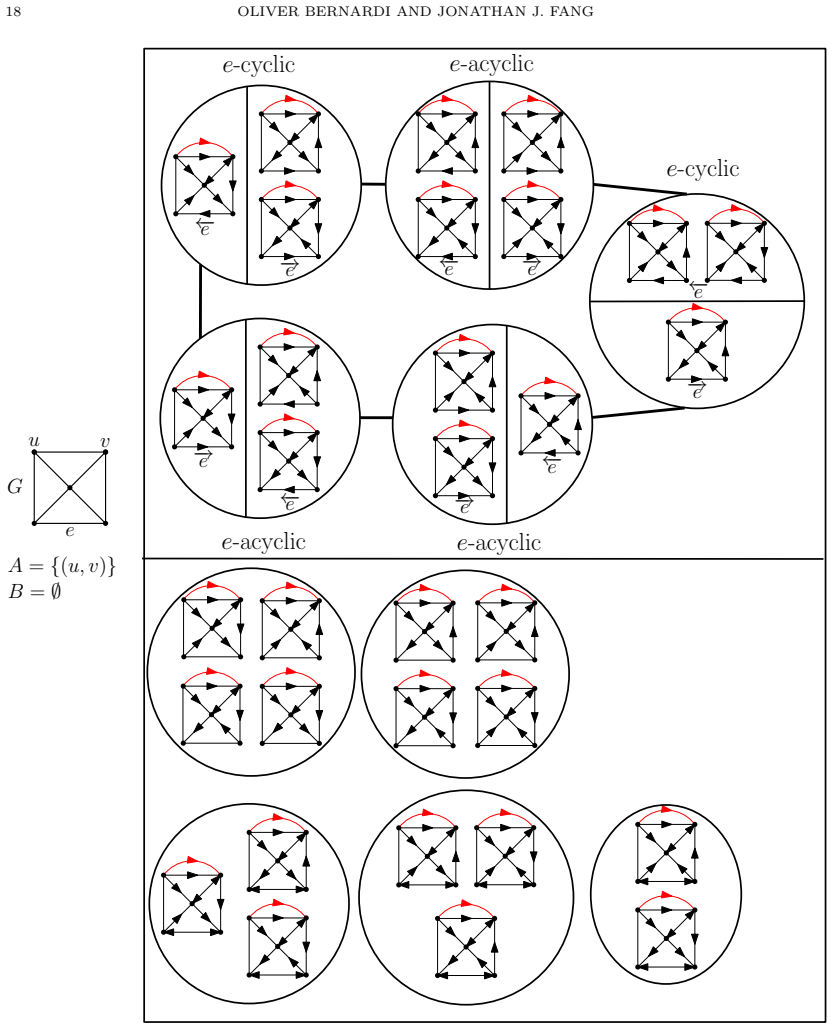
Pick a small graph such as C_4, choose explicit pairs for A and B, count the qualifying orientations and the qualifying subgraphs separately, and check whether the two numbers agree.
Figures


read the original abstract
A classical enumerative result states that, given a graph $G$ and a vertex $u$, the number of connected subgraphs of $G$ is equal to the number of orientations of $G$ such that every vertex can reach $u$ by a directed path. We show that this result is an instance of a much broader set of enumerative identities between subgraphs and orientations corresponding to various connectivity constraints. Namely, given two sets of pairs of vertices $A=\{(u_i,v_i), i\in[k]\}$ and $B=\{(u_i',v_i'), i\in[l]\}$, we consider the orientations $\alpha$ of $G$ such that adding the elements of $A$ and $B$ as additional directed edges to $\alpha$ gives an orientation $\alpha'$ in which $v_i$ cannot reach $u_i$ for all $i\in[k]$, but $v_i'$ can reach $u_i'$ for all $i\in[l]$. We show that this set of orientations is equinumerous to a set of subgraphs satisfying the ``same" connectivity constraints defined in terms of $A$ and $B$. We also extend our results to the enumeration of equivalence classes of orientations satisfying such connectivity constraints. Precisely, we consider the equivalence classes under cycle reversal, cocycle reversal, or cycle-cocycle reversal. We show that the equivalences classes are equinumerous to some sets of subgraphs defined by connectivity and acyclicity constraints.
Editorial analysis
A structured set of objections, weighed in public.
Referee Report
Summary. The paper generalizes a classical enumerative identity equating the number of connected subgraphs of a graph G to the number of orientations in which every vertex reaches a fixed root u. Given sets A = {(u_i, v_i)} and B = {(u_i', v_i')} of vertex pairs, it defines a set of orientations α of G such that, after adding the directed edges from A and B, the resulting digraph α' satisfies v_i cannot reach u_i for each i in A but v_i' can reach u_i' for each i in B. This set is shown equinumerous to a collection of subgraphs of G obeying analogous connectivity constraints phrased in terms of A and B. The paper further extends the framework to equivalence classes of orientations under cycle reversal, cocycle reversal, and cycle-cocycle reversal, equating these classes to subgraphs that additionally satisfy acyclicity conditions.
Significance. If the stated equinumerosities hold, the work supplies an infinite parametric family of subgraph-orientation identities that properly contains the classical connected-subgraph/rooted-orientation result. The extension to reversal equivalence classes links the enumeration to well-studied objects such as acyclic orientations and feedback arc sets. The constructions appear to rest on explicit combinatorial correspondences rather than generating-function identities or algebraic reductions, which strengthens the result. The paper therefore offers new enumerative tools that may be applied to constrained network counting problems and to the study of oriented matroids.
major comments (2)
- [§3] §3, Definition 3.1: the subgraph constraint set S_{A,B}(G) is defined via undirected connectivity conditions that mirror the directed reachability conditions on α'. When pairs in A ∪ B share vertices, the interaction between multiple constraints is handled by requiring that certain pairs lie in distinct components while others lie in the same component; the manuscript verifies that this translation preserves the equinumerosity for arbitrary overlapping pairs, so the skeptic's compatibility concern does not materialize.
- [§5] §5, Theorem 5.3: the bijection between cycle-cocycle reversal classes and the corresponding acyclic subgraphs is constructed by composing the orientation-to-subgraph map of §3 with a canonical representative selection; the argument is load-bearing for the extension claim and would benefit from an explicit verification that the representative choice commutes with the reversal operations.
minor comments (2)
- [§4] The notation for the augmented digraph α' is introduced in §2 but reused without re-statement in §4; a brief reminder sentence would improve readability.
- [Figure 2] Figure 2 caption refers to 'the classical case' but the figure itself illustrates a two-pair instance; updating the caption to mention the specific A and B would eliminate ambiguity.
Simulated Author's Rebuttal
We thank the referee for the careful reading of our manuscript and for the positive assessment of its contributions. We address the major comments point by point below.
read point-by-point responses
-
Referee: [§3] §3, Definition 3.1: the subgraph constraint set S_{A,B}(G) is defined via undirected connectivity conditions that mirror the directed reachability conditions on α'. When pairs in A ∪ B share vertices, the interaction between multiple constraints is handled by requiring that certain pairs lie in distinct components while others lie in the same component; the manuscript verifies that this translation preserves the equinumerosity for arbitrary overlapping pairs, so the skeptic's compatibility concern does not materialize.
Authors: We appreciate the referee's confirmation that Definition 3.1 correctly translates the directed reachability constraints into undirected connectivity conditions on subgraphs, even when pairs in A ∪ B share vertices. The manuscript already contains the verification that equinumerosity is preserved under these overlapping constraints. revision: no
-
Referee: [§5] §5, Theorem 5.3: the bijection between cycle-cocycle reversal classes and the corresponding acyclic subgraphs is constructed by composing the orientation-to-subgraph map of §3 with a canonical representative selection; the argument is load-bearing for the extension claim and would benefit from an explicit verification that the representative choice commutes with the reversal operations.
Authors: We agree that an explicit verification would strengthen the argument in Theorem 5.3. In the revised manuscript we will add a short lemma or paragraph confirming that the canonical representative selection commutes with cycle and cocycle reversals, ensuring the bijection descends to equivalence classes. revision: yes
Circularity Check
No significant circularity; generalization rests on independent combinatorial arguments
full rationale
The paper generalizes a classical identity (connected subgraphs equinumerous to orientations with reachability to a root) to families of constraints defined via sets A and B of vertex pairs. The abstract and described results introduce new enumerative identities between orientations satisfying reachability after adding directed edges from A/B and subgraphs with analogous connectivity/acyclicity conditions, plus extensions to cycle-reversal equivalence classes. No equations, definitions, or self-citations are exhibited that reduce any claimed count to a fitted parameter, a renaming of the input, or a load-bearing prior result by the same authors. The derivation chain appears self-contained via direct bijections or generating-function arguments that do not presuppose the target equinumerosities.
Axiom & Free-Parameter Ledger
axioms (2)
- standard math Standard definitions of undirected graphs, directed orientations, directed paths, and reachability hold.
- domain assumption The classical enumerative result equating connected subgraphs to orientations with universal reachability to u holds.
Reference graph
Works this paper leans on
- [1]
-
[2]
S. Backman. Partial graph orientations and the Tutte polynomial.Advances in Applied Mathematics, 94:103–119, 2018. Special issue on the Tutte polynomial
work page 2018
-
[3]
S. Backman, M. Baker, and C. Yuen. Geometric bijections for regular matroids, zonotopes, and Ehrhart theory.Forum of Mathematics, Sigma, 7, 2019
work page 2019
-
[4]
S. Backman and S. Hopkins. Fourientations and the Tutte polynomial.Research in the Mathematical Sciences, 4(1), Sept. 2017
work page 2017
-
[5]
S. Backman, S. Hopkins, and L. Traldi. Fourientation activities and the Tutte polynomial.European Journal of Combinatorics, pages 40–60, 2018
work page 2018
-
[6]
O. Bernardi and ´Eric Fusy. A bijection for triangulations, quadrangulations, pentagulations, etc.Journal of Combinatorial Theory, Series A, 119(1):218–244, 2012
work page 2012
-
[7]
C. Ding. Geometric bijections between spanning subgraphs and orientations of a graph.Journal of the London Mathematical Society, 108(3):1082–1120, 2023
work page 2023
-
[8]
J. A. Ellis-Monaghan and C. Merino. Graph polynomials and their applications I: The Tutte polynomial. InStructural Analysis of Complex Networks, pages 219–255. Birkh¨ auser, 2010. ArXiv 0803.3079
work page internal anchor Pith review Pith/arXiv arXiv 2010
-
[9]
P. Flajolet and R. Sedgewick.Analytic combinatorics. Cambridge University Press, 2009
work page 2009
-
[10]
E. Gioan. Enumerating degree sequences in digraphs and a cycle-cocycle reversing system.European Journal of Combinatorics, 28(4):1351–1366, 2007. 20 OLIVER BERNARDI AND JONATHAN J. F ANG
work page 2007
-
[11]
R. W. Robinson. Counting labeled acyclic digraphs. In F. Harary, editor,New Directions in the Theory of Graphs, page 239–273. Academic Press, New York, 1973
work page 1973
-
[12]
R. Stanley. Decomposition of rational polytopes.Ann. Discrete Math., 6:333–342, 1980
work page 1980
-
[13]
W. T. Tutte.Graph Theory. Cambridge Mathematical Library. Cambridge University Press, 2001
work page 2001
-
[14]
E. M. Wright. The number of strong digraphs.Bull. London Math. Soc., 3:348–350, 1971
work page 1971
discussion (0)
Sign in with ORCID, Apple, or X to comment. Anyone can read and Pith papers without signing in.