A Revised Mass and Period for the Habitable Zone super-Earth GJ 3378b: A Planet Straddling the Cosmic Shoreline
Pith reviewed 2026-05-19 21:42 UTC · model grok-4.3
pith:ODLDJBNJ Add to your LaTeX paper
What is a Pith Number?\usepackage{pith}
\pithnumber{ODLDJBNJ}
Prints a linked pith:ODLDJBNJ badge after your title and writes the identifier into PDF metadata. Compiles on arXiv with no extra files. Learn more
The pith
Joint radial velocity analysis revises the super-Earth GJ 3378b to an orbital period of 21.45 days and a minimum mass of 2.3 Earth masses while keeping it inside the habitable zone.
A machine-rendered reading of the paper's core claim, the machinery that carries it, and where it could break.
Core claim
The joint RV model reduces the orbital period to P = 21.45 ± 0.01 d and the minimum mass to m sin i = 2.3 ± 0.4 M⊕. The shortened orbital distance remains within the conservative circumstellar liquid-water habitable zone, while the reduced mass increases the likelihood that the planet has a terrestrial composition. The revised planet properties place it near the cosmic shoreline, where planets in the HZs of M dwarfs may lose their atmospheres due to radiative stripping.
What carries the argument
The joint orbital fit applied to the combined radial-velocity time series from the HPF, NEID, CARMENES, and SPIRou instruments.
If this is right
- The lower mass makes a rocky, terrestrial composition more probable than a gaseous envelope.
- The planet remains inside the conservative habitable zone for liquid water.
- Its position near the cosmic shoreline implies that atmospheric loss through stellar radiation may have occurred or may still be occurring.
- Similar joint analyses of multi-instrument radial velocity data could revise other M-dwarf planet candidates announced from single telescopes.
Where Pith is reading between the lines
- Atmospheric escape models for M-dwarf planets could be tested by searching for remaining hydrogen or helium envelopes around this world.
- Future transit observations might reveal whether the planet has retained any atmosphere despite its proximity to the shoreline.
- Reanalysis of other single-instrument detections around fully convective M dwarfs may shift additional planets relative to the cosmic shoreline.
Load-bearing premise
The combined radial velocity measurements contain no significant stellar activity signals or instrumental systematics that could mimic or shift the 21.45-day Keplerian signature.
What would settle it
An independent radial velocity data set that recovers a strong periodic signal at the original 24.73-day period, or that shows stellar activity indicators correlating with that period instead of 21.45 days, would falsify the revised solution.
Figures




read the original abstract
The nearby ($d = 7.7$ pc) M4V star GJ~3378 is a target of our radial velocity (RV) exoplanet survey of fully convective stars in the Solar neighborhood with the near-infrared spectrograph HPF on the Hobby-Eberly Telescope (HET) at McDonald Observatory. Recently, Moutou et al.~(2024) announced the discovery of an $m\sin i = 5.26^{+0.94}_{-0.97} M_\oplus$ planet, GJ 3378b, with an orbital period of $24.73 \pm 0.06$ days, based on SPIRou RV data. Here, we present our HPF RVs for GJ 3378, as well as additional Doppler spectroscopy from the extreme precision NEID Spectrometer on the WIYN telescope at Kitt Peak National Observatory. We have analyzed the HPF+NEID RVs jointly with the published RVs from the CARMENES and SPIRou spectrometers. We present an orbital model for GJ 3378b that differs significantly from the Moutou et al.~solution. The joint RV model reduces the orbital period to $P = 21.45 \pm 0.01$d and the minimum mass to $m \sin i = 2.3 \pm 0.4 M_\oplus$. The shortened orbital distance remains within the conservative circumstellar liquid-water habitable zone (HZ), while the reduced mass increases the likelihood that the planet has a terrestrial composition. The revised planet properties place it near the ``cosmic shoreline," where planets in the HZs of M dwarfs may lose their atmospheres due to radiative stripping.
Editorial analysis
A structured set of objections, weighed in public.
Referee Report
Summary. The manuscript reports new HPF and NEID radial-velocity observations of the M4V star GJ 3378, combines them with published CARMENES and SPIRou data, and performs a joint Keplerian fit that revises the orbital period of GJ 3378b from 24.73 d to 21.45 ± 0.01 d and the minimum mass from ~5.3 M⊕ to 2.3 ± 0.4 M⊕. The authors conclude that the planet remains inside the conservative habitable zone but now has a lower mass favoring a terrestrial composition and lies near the cosmic shoreline for atmospheric loss.
Significance. If the revised parameters hold, the result updates the properties of a nearby HZ planet and strengthens the case for terrestrial composition, with direct relevance to atmospheric-retention models around M dwarfs. The multi-instrument dataset is a methodological strength that allows cross-validation, but the scientific impact depends on demonstrating that the 21.45 d signal is not an artifact of unmodeled stellar activity or instrument systematics.
major comments (1)
- [§3 (RV analysis and orbital modeling)] §3 (RV analysis and orbital modeling): The joint least-squares Keplerian fit to the combined HPF+NEID+CARMENES+SPIRou time series yields the revised P = 21.45 ± 0.01 d and m sin i = 2.3 ± 0.4 M⊕ without an explicit description of activity mitigation (e.g., inclusion of activity indicators, Gaussian-process kernels, or covariance tests between the 21–25 d window and stellar rotation). For an M4V star this period range overlaps possible spot-induced or rotation-harmonic signals, so the assumption that all power at 21.45 d is planetary is load-bearing for the central claim of revised parameters.
minor comments (2)
- [Abstract] Abstract: A one-sentence summary of activity or covariance checks performed would help readers immediately assess the robustness of the revised solution.
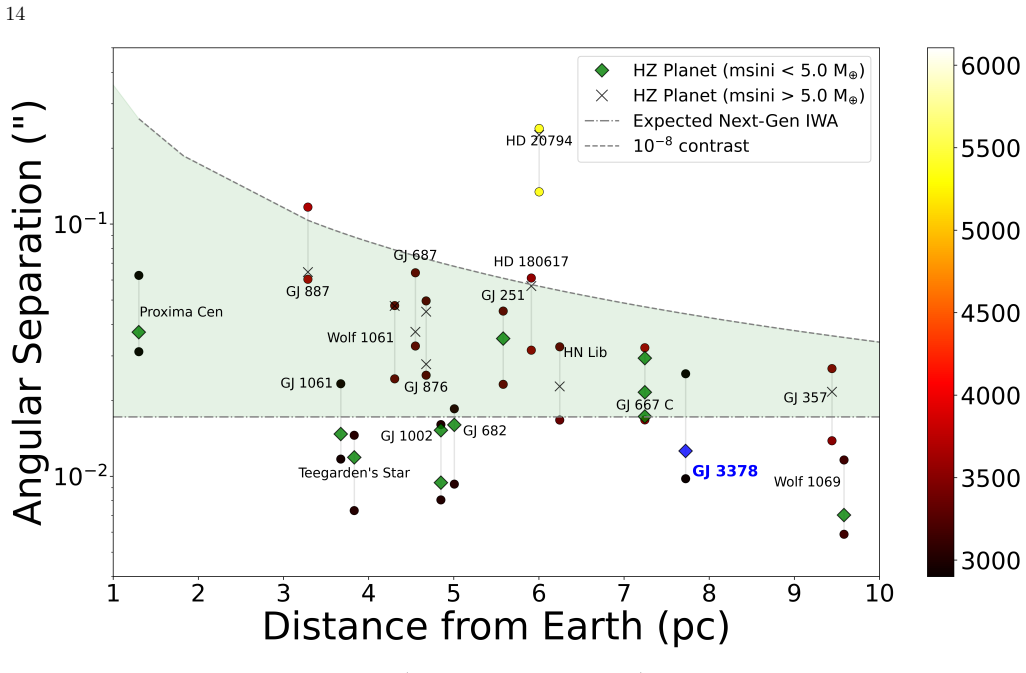
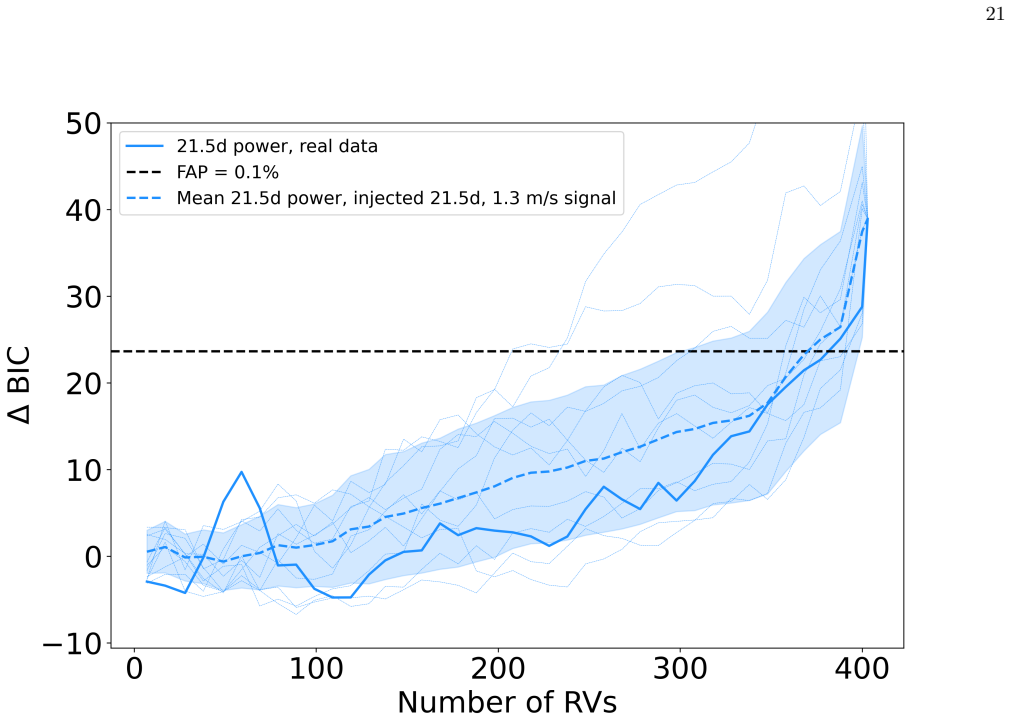
- [Figure 2] Figure 2 or equivalent periodogram panel: Clarify whether the displayed power spectrum includes or excludes activity-indicator correlations.
Simulated Author's Rebuttal
We thank the referee for their careful reading and constructive feedback on our manuscript. The major comment identifies a legitimate need for greater transparency in our treatment of stellar activity, which we address below through targeted revisions.
read point-by-point responses
-
Referee: [§3 (RV analysis and orbital modeling)] §3 (RV analysis and orbital modeling): The joint least-squares Keplerian fit to the combined HPF+NEID+CARMENES+SPIRou time series yields the revised P = 21.45 ± 0.01 d and m sin i = 2.3 ± 0.4 M⊕ without an explicit description of activity mitigation (e.g., inclusion of activity indicators, Gaussian-process kernels, or covariance tests between the 21–25 d window and stellar rotation). For an M4V star this period range overlaps possible spot-induced or rotation-harmonic signals, so the assumption that all power at 21.45 d is planetary is load-bearing for the central claim of revised parameters.
Authors: We agree that the original manuscript would benefit from an explicit description of activity checks, particularly for an M4V star where the revised period lies near plausible rotation harmonics. In the revised manuscript we have expanded §3 with a new subsection on activity mitigation. We report periodogram analyses of activity indicators (Hα, Na I D, Ca II IRT) extracted from all four instruments, none of which show significant power between 21–25 d. We also present covariance tests between the RV time series and the activity indicators, as well as an alternative model that includes a quasi-periodic Gaussian-process kernel; the planetary parameters remain consistent within 1σ. These additions directly address the referee’s concern and strengthen the case that the 21.45 d signal is not activity-induced. revision: yes
Circularity Check
No significant circularity: revised parameters from direct multi-instrument RV Keplerian fit
full rationale
The paper's central result (P = 21.45 ± 0.01 d, m sin i = 2.3 ± 0.4 M⊕) is obtained by joint least-squares fitting of observed HPF+NEID+CARMENES+SPIRou radial velocities to a standard Keplerian orbital model. This is a conventional data-driven estimation step with no reduction to any quantity defined by the authors' own prior equations, no fitted input relabeled as prediction, and no load-bearing self-citation chain. The derivation remains self-contained against external RV datasets and does not invoke uniqueness theorems or ansatzes from the same author group to force the outcome.
Axiom & Free-Parameter Ledger
free parameters (2)
- orbital period =
21.45 d
- minimum mass =
2.3 M⊕
axioms (1)
- domain assumption Radial-velocity variations are dominated by a single planetary Keplerian signal
Lean theorems connected to this paper
-
IndisputableMonolith/Foundation/RealityFromDistinction.leanreality_from_one_distinction unclear?
unclearRelation between the paper passage and the cited Recognition theorem.
The joint RV model reduces the orbital period to P = 21.45 ± 0.01 d and the minimum mass to m sin i = 2.3 ± 0.4 M⊕
What do these tags mean?
- matches
- The paper's claim is directly supported by a theorem in the formal canon.
- supports
- The theorem supports part of the paper's argument, but the paper may add assumptions or extra steps.
- extends
- The paper goes beyond the formal theorem; the theorem is a base layer rather than the whole result.
- uses
- The paper appears to rely on the theorem as machinery.
- contradicts
- The paper's claim conflicts with a theorem or certificate in the canon.
- unclear
- Pith found a possible connection, but the passage is too broad, indirect, or ambiguous to say the theorem truly supports the claim.
Reference graph
Works this paper leans on
-
[1]
Hogg, D. W., & O’Neil, M. 2015, IEEE Transactions on Pattern Analysis and Machine Intelligence, 38, 252, doi: 10.1109/TPAMI.2015.2448083 Artigau, ´E., Cadieux, C., Cook, N. J., et al. 2024, AJ, 168, 252, doi: 10.3847/1538-3881/ad7b30 Astropy Collaboration, Price-Whelan, A. M., Sip˝ ocz, B. M., et al. 2018, AJ, 156, 123, doi: 10.3847/1538-3881/aabc4f
-
[2]
Demleitner, M., & Andrae, R. 2021, AJ, 161, 147, doi: 10.3847/1538-3881/abd806
work page internal anchor Pith review doi:10.3847/1538-3881/abd806 2021
- [3]
-
[4]
Barnes, J. R., Collier Cameron, A., Donati, J.-F., et al. 2005, MNRAS, 357, L1, doi: 10.1111/j.1745-3933.2005.08587.x
-
[5]
Basant, R., Luque, R., Bean, J. L., et al. 2025, ApJL, 982, L1, doi: 10.3847/2041-8213/adb8d5
-
[6]
2025, AJ, 170, 279, doi: 10.3847/1538-3881/ae0e20
Beard, C., Robertson, P., Lubin, J., et al. 2025, AJ, 170, 279, doi: 10.3847/1538-3881/ae0e20
-
[7]
2022, in American Astronomical Society Meeting Abstracts, Vol
Bender, C., Ninan, J., Terrien, R., et al. 2022, in American Astronomical Society Meeting Abstracts, Vol. 240, American Astronomical Society Meeting #240, 401.01
work page 2022
-
[8]
Butler, R. P., Vogt, S. S., Laughlin, G., et al. 2017, AJ, 153, 208, doi: 10.3847/1538-3881/aa66ca
-
[9]
doi:10.3847/1538-4357/834/1/17 , year = 2016, month =
Chen, J., & Kipping, D. 2017, ApJ, 834, 17, doi: 10.3847/1538-4357/834/1/17 16
-
[10]
Choi, J., Dotter, A., Conroy, C., et al. 2016, ApJ, 823, 102, doi: 10.3847/0004-637X/823/2/102
work page internal anchor Pith review doi:10.3847/0004-637x/823/2/102 2016
-
[11]
Davenport, J. R. A., Hebb, L., & Hawley, S. L. 2015, ApJ, 806, 212, doi: 10.1088/0004-637X/806/2/212
-
[12]
F., Kouach, D., Moutou, C., et al
Donati, J. F., Kouach, D., Moutou, C., et al. 2020, MNRAS, 498, 5684, doi: 10.1093/mnras/staa2569
-
[13]
Donati, J. F., Lehmann, L. T., Cristofari, P. I., et al. 2023, MNRAS, 525, 2015, doi: 10.1093/mnras/stad2301
-
[14]
2017, ApJL, 837, L26, doi: 10.3847/2041-8213/aa6438
Dong, C., Lingam, M., Ma, Y., & Cohen, O. 2017, ApJL, 837, L26, doi: 10.3847/2041-8213/aa6438
-
[15]
Dotter, A. 2016, ApJS, 222, 8, doi: 10.3847/0067-0049/222/1/8
work page internal anchor Pith review doi:10.3847/0067-0049/222/1/8 2016
-
[16]
Dumusque, X., Boisse, I., & Santos, N. C. 2014, ApJ, 796, 132, doi: 10.1088/0004-637X/796/2/132
-
[17]
EXOFASTv2: A public, generalized, publication-quality exoplanet modeling code
Eastman, J. D., Rodriguez, J. E., Agol, E., et al. 2019, arXiv e-prints, arXiv:1907.09480. https://arxiv.org/abs/1907.09480
work page internal anchor Pith review Pith/arXiv arXiv 2019
-
[18]
El-Badry, K., Rix, H.-W., & Heintz, T. M. 2021, MNRAS, 506, 2269, doi: 10.1093/mnras/stab323
-
[19]
P., Su´ arez Mascare˜ no, A., Figueira, P., et al
Faria, J. P., Su´ arez Mascare˜ no, A., Figueira, P., et al. 2022, A&A, 658, A115, doi: 10.1051/0004-6361/202142337
-
[20]
Ford, E. B. 2006, ApJ, 642, 505, doi: 10.1086/500802
-
[21]
Bayesian Model Selection and Extrasolar Planet Detection
Ford, E. B., & Gregory, P. C. 2007, in Astronomical Society of the Pacific Conference Series, Vol. 371, Statistical Challenges in Modern Astronomy IV, ed. G. J. Babu & E. D. Feigelson, 189, doi: 10.48550/arXiv.astro-ph/0608328
work page internal anchor Pith review Pith/arXiv arXiv doi:10.48550/arxiv.astro-ph/0608328 2007
-
[22]
Fulton, B. J., Petigura, E. A., Blunt, S., & Sinukoff, E. 2018, PASP, 130, 044504, doi: 10.1088/1538-3873/aaaaa8 Gaia Collaboration, Vallenari, A., Brown, A.G.A., Prusti, T., & et al. 2022, A&A, doi: 10.1051/0004-6361/202243940 Gaia Collaboration, Brown, A. G. A., Vallenari, A., et al. 2016, A&A, 595, A2, doi: 10.1051/0004-6361/201629512 Gaia Collaboratio...
-
[23]
S., Seager, S., Mennesson, B., et al
Gaudi, B. S., Seager, S., Mennesson, B., et al. 2020, arXiv e-prints, arXiv:2001.06683, doi: 10.48550/arXiv.2001.06683
-
[24]
Gibson, S. R., Howard, A. W., Marcy, G. W., et al. 2016, in Society of Photo-Optical Instrumentation Engineers (SPIE) Conference Series, Vol. 9908, Ground-based and Airborne Instrumentation for Astronomy VI, ed. C. J
work page 2016
-
[25]
Evans, L. Simard, & H. Takami, 990870, doi: 10.1117/12.2233334 Gonz´ alez Hern´ andez, J. I., Su´ arez Mascare˜ no, A., Silva, A. M., et al. 2024, A&A, 690, A79, doi: 10.1051/0004-6361/202451311
-
[26]
Gupta, A. F., Wright, J. T., Robertson, P., et al. 2021, AJ, 161, 130, doi: 10.3847/1538-3881/abd79e
-
[27]
F., Fitzmaurice, E., Mahadevan, S., et al
Gupta, A. F., Fitzmaurice, E., Mahadevan, S., et al. 2025, arXiv e-prints, arXiv:2506.23704, doi: 10.48550/arXiv.2506.23704
-
[28]
2015, ApJ, 806, 61, doi: 10.1088/0004-637X/806/1/61
Halverson, S., Roy, A., Mahadevan, S., et al. 2015, ApJ, 806, 61, doi: 10.1088/0004-637X/806/1/61
-
[29]
Harris, C. R., Millman, K. J., van der Walt, S. J., et al. 2020, Nature, 585, 357, doi: 10.1038/s41586-020-2649-2
-
[30]
D., Collier Cameron, A., Queloz, D., et al
Haywood, R. D., Collier Cameron, A., Queloz, D., et al. 2014, MNRAS, 443, 2517, doi: 10.1093/mnras/stu1320
-
[31]
Henry, T. J., Jao, W.-C., Winters, J. G., et al. 2018, AJ, 155, 265, doi: 10.3847/1538-3881/aac262
-
[32]
Hill, G. J., Lee, H., MacQueen, P. J., et al. 2021, AJ, 162, 298, doi: 10.3847/1538-3881/ac2c02
-
[33]
2019, A&A, 623, A39, doi: 10.1051/0004-6361/201834672
Hippke, M., & Heller, R. 2019, A&A, 623, A39, doi: 10.1051/0004-6361/201834672
-
[34]
Hunter, J. D. 2007, Computing in Science & Engineering, 9, 90, doi: 10.1109/MCSE.2007.55
-
[35]
Jenkins, J. M., Twicken, J. D., McCauliff, S., et al. 2016, in Society of Photo-Optical Instrumentation Engineers (SPIE) Conference Series, Vol. 9913, Software and Cyberinfrastructure for Astronomy IV, ed. G. Chiozzi & J. C. Guzman, 99133E, doi: 10.1117/12.2233418
-
[36]
2012, in Society of Photo-Optical Instrumentation Engineers (SPIE) Conference Series, Vol
Johns, M., McCarthy, P., Raybould, K., et al. 2012, in Society of Photo-Optical Instrumentation Engineers (SPIE) Conference Series, Vol. 8444, Ground-based and Airborne Telescopes IV, ed. L. M. Stepp, R. Gilmozzi, & H. J. Hall, 84441H, doi: 10.1117/12.926716
-
[37]
2016, in Society of Photo-Optical Instrumentation Engineers (SPIE) Conference Series, Vol
Jurgenson, C., Fischer, D., McCracken, T., et al. 2016, in Society of Photo-Optical Instrumentation Engineers (SPIE) Conference Series, Vol. 9908, Ground-based and Airborne Instrumentation for Astronomy VI, ed. C. J
work page 2016
-
[38]
Evans, L. Simard, & H. Takami, 99086T, doi: 10.1117/12.2233002
-
[39]
Kane, S. R., & Burt, J. A. 2024, AJ, 168, 279, doi: 10.3847/1538-3881/ad8a68
-
[40]
Harada, C. K. 2024, AJ, 168, 195, doi: 10.3847/1538-3881/ad6a50
-
[41]
2018, Research Notes of the American Astronomical Society, 2, 4, doi: 10.3847/2515-5172/aaa4b7
Kanodia, S., & Wright, J. 2018, Research Notes of the American Astronomical Society, 2, 4, doi: 10.3847/2515-5172/aaa4b7
-
[42]
Kanodia, S., Halverson, S., Ninan, J. P., et al. 2021, ApJ, 912, 15, doi: 10.3847/1538-4357/abec83
-
[43]
Kanodia, S., Lin, A. S. J., Lubar, E., et al. 2023, AJ, 166, 105, doi: 10.3847/1538-3881/acea60
-
[44]
Kaplan, K. F., Bender, C. F., Terrien, R. C., et al. 2019, in Astronomical Society of the Pacific Conference Series, Vol. 523, Astronomical Data Analysis Software and Systems XXVII, ed. P. J. Teuben, M. W. Pound, B. A. Thomas, & E. M. Warner, 567 17
work page 2019
-
[45]
Kass, R. E., & Raftery, A. E. 1995, Journal of the American Statistical Association, 90, 773, doi: 10.1080/01621459.1995.10476572
-
[46]
Kasting, J. F., Whitmire, D. P., & Reynolds, R. T. 1993, Icarus, 101, 108, doi: 10.1006/icar.1993.1010
-
[47]
2025, A&A, 697, A225, doi: 10.1051/0004-6361/202347056
Kemmer, J., Lafarga, M., Fuhrmeister, B., et al. 2025, A&A, 697, A225, doi: 10.1051/0004-6361/202347056
-
[48]
Kopparapu, R. K., Ramirez, R., Kasting, J. F., et al. 2013, ApJ, 765, 131, doi: 10.1088/0004-637X/765/2/131
-
[49]
batman: BAsic Transit Model cAlculatioN in Python
Kreidberg, L. 2015, PASP, 127, 1161, doi: 10.1086/683602 Lightkurve Collaboration, Cardoso, J. V. d. M., Hedges, C., et al. 2018, Lightkurve: Kepler and TESS time series analysis in Python,, Astrophysics Source Code Library http://ascl.net/1812.013
-
[50]
2021, AJ, 162, 61, doi: 10.3847/1538-3881/ac0057
Lubin, J., Robertson, P., Stefansson, G., et al. 2021, AJ, 162, 61, doi: 10.3847/1538-3881/ac0057
-
[51]
Mahadevan, S., Ramsey, L. W., Terrien, R., et al. 2014, in Society of Photo-Optical Instrumentation Engineers (SPIE) Conference Series, Vol. 9147, Ground-based and Airborne Instrumentation for Astronomy V, ed. S. K
work page 2014
-
[52]
Ramsay, I. S. McLean, & H. Takami, 91471G, doi: 10.1117/12.2056417
-
[53]
2024, in Society of Photo-Optical Instrumentation Engineers (SPIE) Conference Series, Vol
Malo, L., Baron, F., Poulin-Girard, A.-S., et al. 2024, in Society of Photo-Optical Instrumentation Engineers (SPIE) Conference Series, Vol. 13096, Ground-based and Airborne Instrumentation for Astronomy X, ed. J. J
work page 2024
-
[54]
Bryant, K. Motohara, & J. R. D. Vernet, 1309646, doi: 10.1117/12.3020168
-
[55]
Mann, A. W., Feiden, G. A., Gaidos, E., Boyajian, T., & von Braun, K. 2015, ApJ, 804, 64, doi: 10.1088/0004-637X/804/1/64
-
[56]
2024, A&A, 687, A205, doi: 10.1051/0004-6361/202449865
Mas-Buitrago, P., Gonz´ alez-Marcos, A., Solano, E., et al. 2024, A&A, 687, A205, doi: 10.1051/0004-6361/202449865
-
[57]
Metcalf, A. J., Anderson, T., Bender, C. F., et al. 2019, Optica, 6, 233, doi: 10.1364/OPTICA.6.000233
-
[58]
Monet, D. G., Levine, S. E., Canzian, B., et al. 2003, AJ, 125, 984, doi: 10.1086/345888
-
[59]
and Abolmasov, Pavel , month = may, year =
Morin, J., Donati, J.-F., Forveille, T., et al. 2008, MNRAS, 384, 77, doi: 10.1111/j.1365-2966.2007.12709.x
-
[60]
2017, A&A, 601, A110, doi: 10.1051/0004-6361/201630201
Mortier, A., & Collier Cameron, A. 2017, A&A, 601, A110, doi: 10.1051/0004-6361/201630201
-
[61]
Moutou, C., Ould-Elhkim, M., Donati, J. F., et al. 2024, A&A, 688, A196, doi: 10.1051/0004-6361/202450466 National Academies of Sciences, & Medicine, E. 2023,
-
[62]
Origins, Worlds, and Life: A Decadal Strategy for Planetary Science and Astrobiology 2023-2032, doi: 10.17226/26522
-
[63]
Ninan, J. P., Bender, C. F., Mahadevan, S., et al. 2018, in Society of Photo-Optical Instrumentation Engineers (SPIE) Conference Series, Vol. 10709, High Energy, Optical, and Infrared Detectors for Astronomy VIII, ed. A. D. Holland & J. Beletic, 107092U, doi: 10.1117/12.2312787
-
[64]
P., Mahadevan, S., Stefansson, G., et al
Ninan, J. P., Mahadevan, S., Stefansson, G., et al. 2019, Journal of Astronomical Telescopes, Instruments, and Systems, 5, 041511, doi: 10.1117/1.JATIS.5.4.041511
-
[65]
Ould-Elhkim, M., Moutou, C., Donati, J. F., et al. 2023, A&A, 675, A187, doi: 10.1051/0004-6361/202346472 pandas development team, T. 2020, pandas-dev/pandas: Pandas, latest Zenodo, doi: 10.5281/zenodo.3509134
-
[66]
2024, A&A, 688, A59, doi: 10.1051/0004-6361/202449911
Parc, L., Bouchy, F., Venturini, J., Dorn, C., & Helled, R. 2024, A&A, 688, A59, doi: 10.1051/0004-6361/202449911
-
[67]
K., Charbonneau, D., & Vanderburg, A
Pass, E. K., Charbonneau, D., & Vanderburg, A. 2025, ApJL, 986, L3, doi: 10.3847/2041-8213/adda39
-
[68]
Pepe, F., Cristiani, S., Rebolo, R., et al. 2021, A&A, 645, A96, doi: 10.1051/0004-6361/202038306
-
[69]
S., Lubin, J., Beard, C., et al
Polanski, A. S., Lubin, J., Beard, C., et al. 2024, ApJS, 272, 32, doi: 10.3847/1538-4365/ad4484
-
[70]
2015, International Journal of Astrobiology, 14, 279, doi: 10.1017/S1473550414000135
Held, J. 2015, International Journal of Astrobiology, 14, 279, doi: 10.1017/S1473550414000135
-
[71]
P., Ottiger, M., Fontanet, E., et al
Quanz, S. P., Ottiger, M., Fontanet, E., et al. 2022, A&A, 664, A21, doi: 10.1051/0004-6361/202140366
-
[72]
Ground-based and Airborne Instrumentation for Astronomy V , year = 2014, editor =
Quirrenbach, A., Amado, P. J., Caballero, J. A., et al. 2014, in Society of Photo-Optical Instrumentation Engineers (SPIE) Conference Series, Vol. 9147, Ground-based and Airborne Instrumentation for Astronomy V, ed. S. K. Ramsay, I. S. McLean, & H. Takami, 91471F, doi: 10.1117/12.2056453
-
[73]
Ramsey, L. W., Adams, M. T., Barnes, T. G., et al. 1998, in Society of Photo-Optical Instrumentation Engineers (SPIE) Conference Series, Vol. 3352, Advanced Technology Optical/IR Telescopes VI, ed. L. M. Stepp, 34–42, doi: 10.1117/12.319287
-
[74]
2020, ApJS, 247, 11, doi: 10.3847/1538-4365/ab609f
Reiners, A., & Zechmeister, M. 2020, ApJS, 247, 11, doi: 10.3847/1538-4365/ab609f
-
[75]
2013, A&A, 560, A4, doi: 10.1051/0004-6361/201321970
Reinhold, T., Reiners, A., & Basri, G. 2013, A&A, 560, A4, doi: 10.1051/0004-6361/201321970
-
[76]
2016, A&A, 596, A111, doi: 10.1051/0004-6361/201629576
Ribas, I., Bolmont, E., Selsis, F., et al. 2016, A&A, 596, A111, doi: 10.1051/0004-6361/201629576
-
[77]
2023, A&A, 670, A139, doi: 10.1051/0004-6361/202244879
Ribas, I., Reiners, A., Zechmeister, M., et al. 2023, A&A, 670, A139, doi: 10.1051/0004-6361/202244879
-
[78]
Ricker, G. R., Winn, J. N., Vanderspek, R., et al. 2015, Journal of Astronomical Telescopes, Instruments, and Systems, 1, 014003, doi: 10.1117/1.JATIS.1.1.014003
work page internal anchor Pith review doi:10.1117/1.jatis.1.1.014003 2015
-
[79]
2014, Science, 345, 440, doi: 10.1126/science.1253253 18
Robertson, P., Mahadevan, S., Endl, M., & Roy, A. 2014, Science, 345, 440, doi: 10.1126/science.1253253 18
-
[80]
Robertson, P., Anderson, T., Stefansson, G., et al. 2019, Journal of Astronomical Telescopes, Instruments, and Systems, 5, 015003, doi: 10.1117/1.JATIS.5.1.015003
discussion (0)
Sign in with ORCID, Apple, or X to comment. Anyone can read and Pith papers without signing in.