Demonstration of transport in an ion trap design for two-dimensional lattices
Pith reviewed 2026-05-20 18:36 UTC · model grok-4.3
The pith
Ion trap chip uses only DC voltages to tune radial distances in 2D lattices
A machine-rendered reading of the paper's core claim, the machinery that carries it, and where it could break.
Core claim
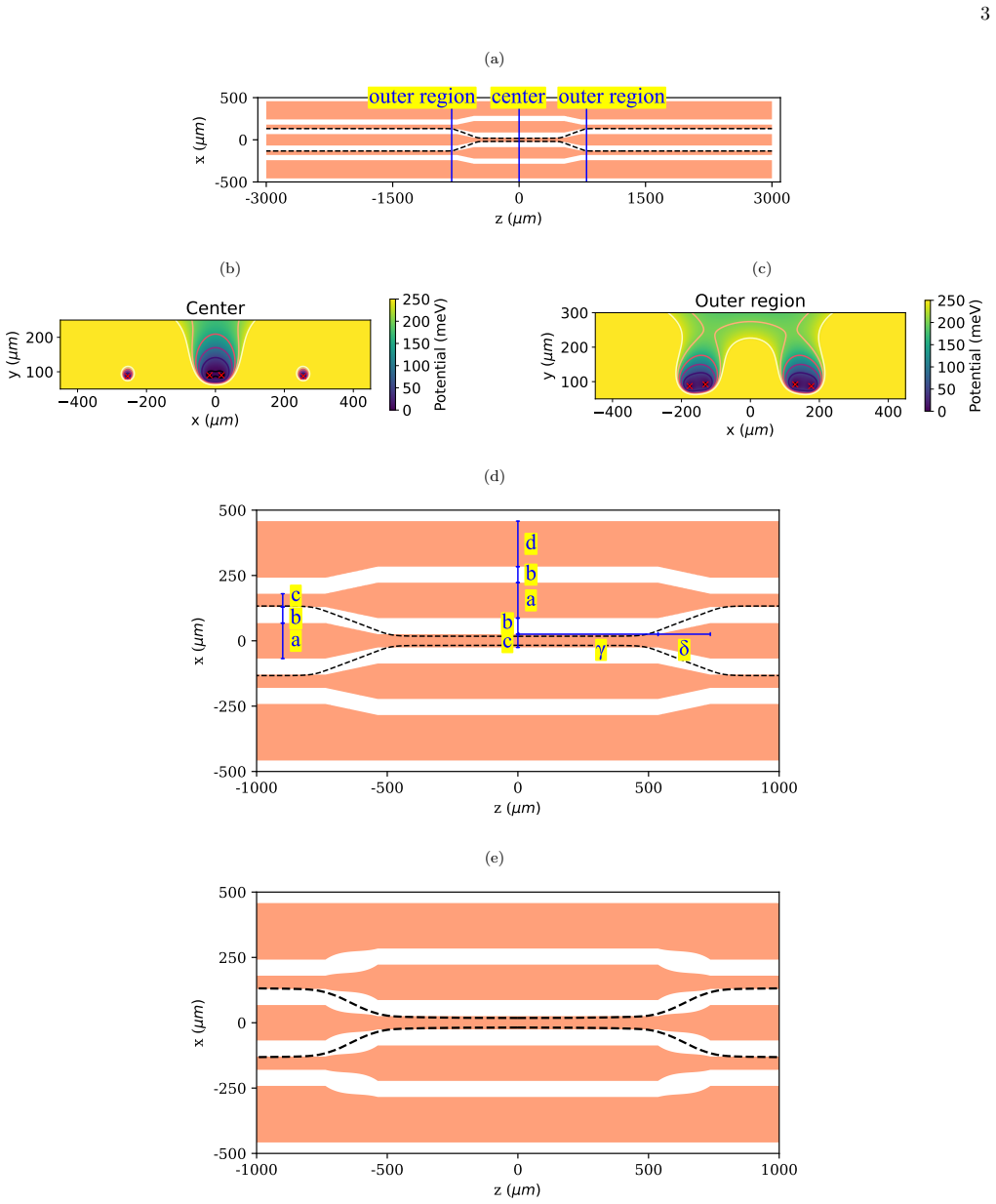
The central claim is that a new ion-trap chip geometry permits radial repositioning of ions between interaction sites by DC-voltage control alone, executed through engineered transition zones that separate transport paths from quantum-operation regions, as verified by moving a single ion across one such zone on a microfabricated prototype while characterizing the central trapping region.
What carries the argument
The transition zones, regions of the electrode layout shaped to support smooth radial ion movement under DC voltages while isolating them from the RF pseudo-potential used in the interaction zones.
If this is right
- Radial ion separation in the lattice becomes adjustable without changing RF voltages.
- Ions can be moved between distinct interaction zones while remaining confined.
- Stray fields and heating rates remain characterizable in the central trap region.
- Multi-metal-layer fabrication offers a direct route to larger lattices.
- Coulomb coupling in both radial and axial directions can be maintained across the 2D array.
Where Pith is reading between the lines
- The approach could reduce the number of independent RF channels required for large-scale ion-lattice processors.
- Extending the single-ion transport data to chains of several ions would test whether collective motion introduces new heating mechanisms.
- Similar electrode layouts might be adapted to other 2D ion-array geometries that currently rely on RF tuning.
Load-bearing premise
The transition zones can be shaped and voltage-tuned so that radial transport introduces neither heating rates nor stray fields large enough to block quantum operations, a premise tested so far only for a single ion at the center of the prototype.
What would settle it
Observation of heating rates or stray-field magnitudes during radial transport that exceed thresholds compatible with high-fidelity two-qubit gates on multiple ions would falsify practical utility of the design.
Figures





read the original abstract
Microfabricated ion trap chips are at the core of some of the most advanced quantum computers. How a large number of ions is arranged and controlled on an ion trap chip depends on the chosen trap architecture. One such architecture is the quantum spring array (QSA). In the QSA architecture, ion chains are arranged in a two-dimensional lattice and interact with ion chains in neighboring sites in the radial and axial directions of the respective chain. This interaction, or coupling, is mediated by the Coulomb force while keeping ions in separate trapping sites, and scales inversely with the third power of the separation. The capability to control the distance between ions in the lattice is thus essential. In previous works, the radial separation between ions was tuned by controlling the rf pseudo-potential, which revealed to be experimentally challenging to realize while maintaining low heating rates. In this work, we present an ion trap chip design that allows tuning of the radial distance between ions using only dc voltages. The radial transport is executed between different interaction zones, designated for quantum operations, through specifically designed transition zones. A prototype of this type of ion trap chip was microfabricated on fused silica substrate. Its functionality is characterized by demonstrating dc-controlled radial transport of a single ion through a transition zone and measuring stray fields and ion heating rates in the center of the trap. Moreover, the fabrication of a multi-metal layer version of such a trap is presented as a scaling path for the presented chip design.
Editorial analysis
A structured set of objections, weighed in public.
Referee Report
Summary. The manuscript presents a microfabricated ion trap chip for the quantum spring array (QSA) architecture that enables tuning of radial ion separation in a 2D lattice using only DC voltages, via specifically designed transition zones between interaction sites. A prototype fabricated on fused silica is characterized by demonstrating DC-controlled radial transport of a single ion through a transition zone; stray-field and heating-rate measurements are reported in the trap center. A multi-metal-layer fabrication variant is also described as a scaling route.
Significance. If the design functions as intended, the DC-only radial control could offer a more experimentally tractable alternative to prior RF-pseudo-potential methods for adjusting ion-ion couplings in 2D lattices, potentially aiding scalability of ion-trap quantum processors. The single-ion transport result and multi-layer fabrication path are constructive steps, but the restricted characterization limits the immediate implications for maintaining quantum-operation conditions during transport.
major comments (1)
- [Abstract and experimental characterization] Abstract and experimental results section: stray-field and heating-rate data are reported only for the center of the trap. The central claim—that the transition zones support DC-controlled radial transport suitable for quantum operations—requires verification that time-varying DC voltages do not introduce prohibitive heating or position-dependent stray fields while the ion traverses the transition zone; no such data are provided.
minor comments (1)
- [Abstract] The abstract refers to 'basic characterization measurements' without reporting any numerical values, uncertainties, or comparison baselines, which would improve clarity of the presented results.
Simulated Author's Rebuttal
We thank the referee for their constructive feedback and recommendation for major revision. We address the single major comment below, clarifying the scope of our current results while acknowledging limitations in the experimental characterization.
read point-by-point responses
-
Referee: [Abstract and experimental characterization] Abstract and experimental results section: stray-field and heating-rate data are reported only for the center of the trap. The central claim—that the transition zones support DC-controlled radial transport suitable for quantum operations—requires verification that time-varying DC voltages do not introduce prohibitive heating or position-dependent stray fields while the ion traverses the transition zone; no such data are provided.
Authors: We agree that stray-field and heating-rate measurements are reported only for the trap center. The manuscript demonstrates successful DC-controlled radial transport of a single ion through a transition zone, indicating that the ion remains confined during the move. However, we did not perform position-resolved measurements of heating rates or stray fields during transport or within the transition zone itself under time-varying DC voltages. These data would strengthen claims regarding suitability for quantum operations. In the revised manuscript, we have updated the abstract and experimental section to explicitly state the limited scope of the current characterization and to identify such measurements as important future work. revision: partial
- Measurements of heating rates and position-dependent stray fields while the ion traverses the transition zone under time-varying DC voltages are not available in the current dataset.
Circularity Check
No circularity: experimental demonstration with no derivation chain
full rationale
The manuscript is a hardware demonstration of a microfabricated ion trap chip. It reports fabrication details, DC-controlled radial transport of a single ion through a transition zone, and stray-field/heating measurements performed in the trap center. No equations, theoretical derivations, fitted parameters, or modeling steps are present that could reduce to self-citation, self-definition, or renamed inputs. All claims rest on direct experimental observation and device characterization rather than any self-referential chain, satisfying the criteria for a self-contained result.
Axiom & Free-Parameter Ledger
Lean theorems connected to this paper
-
IndisputableMonolith/Foundation/AlexanderDuality.leanalexander_duality_circle_linking (D=3 forcing) unclear?
unclearRelation between the paper passage and the cited Recognition theorem.
We present an ion trap chip design that allows tuning of the radial distance between ions using only dc voltages. The radial transport is executed between different interaction zones... through specifically designed transition zones.
-
IndisputableMonolith/Cost/FunctionalEquation.leanwashburn_uniqueness_aczel (J-cost uniqueness) unclear?
unclearRelation between the paper passage and the cited Recognition theorem.
The shape of the transition zones was described by a cubic B-spline... cost function C(B) = w1 ∫ ω²(ξ(z)) dz + w2 ∫ |∂φPP/∂t̂| dz
What do these tags mean?
- matches
- The paper's claim is directly supported by a theorem in the formal canon.
- supports
- The theorem supports part of the paper's argument, but the paper may add assumptions or extra steps.
- extends
- The paper goes beyond the formal theorem; the theorem is a base layer rather than the whole result.
- uses
- The paper appears to rely on the theorem as machinery.
- contradicts
- The paper's claim conflicts with a theorem or certificate in the canon.
- unclear
- Pith found a possible connection, but the passage is too broad, indirect, or ambiguous to say the theorem truly supports the claim.
Reference graph
Works this paper leans on
-
[1]
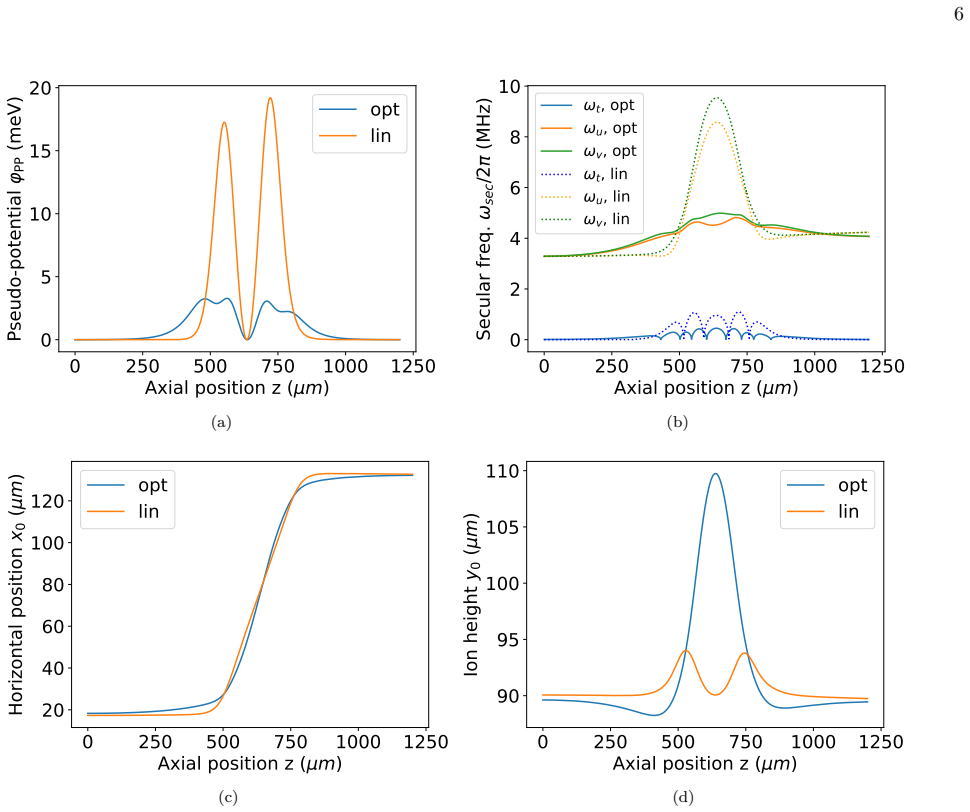
for given rf electrode sizes as cost-function: C(a, b, c, d) = 2 xc 0(a, b, c, d)−x goal 0 2 + yc 0(a, b, c, d)−y goal 0 2 ,(2) with the optimization objectivesx goal 0 = 18µm and ygoal 0 = 90µm. The optimization objectivesx goal 0 ,y goal 0 are similar in size to the minimum positions of the ra- dial double-well in the trap for radial coupling in [1]. Th...
-
[2]
M. Valentini, M. W. van Mourik, F. Butt, J. Wahl, M. Di- etl, M. Pfeifer, F. Anmasser, Y. Colombe, C. R¨ ossler, P. C. Holz, R. Blatt, A. Bermudez, M. M¨ uller, T. Monz, and P. Schindler,Demonstration of Two-Dimensional Connectivity for a Scalable Error-Corrected Ion-Trap Quantum Processor Architecture, Phys. Rev. X15, 041023 (2025)
work page 2025
-
[3]
P. C. Holz, S. Auchter, G. Stocker, M. Valentini, K. Lakhmanskiy, C. R¨ ossler, P. Stampfer, S. Sgouridis, E. Aschauer, Y. Colombe, and R. Blatt,2d linear trap ar- ray for quantum information processing, Adv. Quantum Technol.3, 2000031 (2020)
work page 2020
-
[4]
S. A. Moseset al.,A Race-Track Trapped-Ion Quantum Processor, Phys. Rev. X13, 041052 (2023)
work page 2023
-
[5]
C. L¨ oschnauer, J. Mosca Toba, A. Hughes, S. King, M. Weber, R. Srinivas, R. Matt, R. Nourshargh, D. All- cock, C. Ballance, C. Matthiesen, M. Malinowski, and T. Harty,Scalable, High-Fidelity All-Electronic Control of Trapped-Ion Qubits, PRX Quantum6, 040313 (2025)
work page 2025
-
[6]
M. C. Smith, A. D. Leu, K. Miyanishi, M. F. Gely, and D. M. Lucas,Single-Qubit Gates with Errors at the10 −7 Level, Phys. Rev. Lett.134, 230601 (2025)
work page 2025
-
[7]
C. D. Bruzewicz, J. Chiaverini, R. McConnell, and J. M. Sage,Trapped-ion quantum computing: Progress and challenges, Applied Physics Reviews6, 021314 (2019)
work page 2019
- [8]
-
[9]
Helios: A 98-qubit trapped-ion quantum computer
A. Ransfordet al.,Helios: A 98-qubit trapped-ion quan- tum computer, arXiv:2511.05465 (2025)
work page internal anchor Pith review Pith/arXiv arXiv 2025
-
[10]
J. I. Cirac and P. Zoller,Quantum Computations with Cold Trapped Ions, Phys. Rev. Lett.74, 4091 (1995)
work page 1995
-
[11]
F. Schmidt-Kaler, H. H¨ affner, M. Riebe, S. Gulde, G. Lancaster, T. Deuschle, C. Becher, C. Roos, J. Es- chner, and R. Blatt,Realization of the Cirac–Zoller controlled-NOT quantum gate, Nature422, 408 (2003)
work page 2003
-
[12]
A. Sørensen and K. Mølmer,Entanglement and quantum computation with ions in thermal motion, Phys. Rev. A 62, 022311 (2000)
work page 2000
- [13]
-
[14]
D. Kielpinski, C. Monroe, and D. J. Wineland,Architec- ture for a large-scale ion-trap quantum computer, Nature 417, 709 (2002)
work page 2002
- [15]
-
[16]
S. Jain, J. Alonso, M. Grau, and J. P. Home,Scalable Arrays of Micro-Penning Traps for Quantum Computing and Simulation, Phys. Rev. X10, 031027 (2020)
work page 2020
-
[17]
J. M. Pino, J. M. Dreiling, C. Figgatt, J. P. Gaebler, S. A. Moses, M. S. Allman, C. H. Baldwin, M. Foss-Feig, D. Hayes, K. Mayer, C. Ryan-Anderson, and B. Neyen- huis,Demonstration of the trapped-ion quantum CCD computer architecture, Nature592, 209 (2021)
work page 2021
-
[18]
M. Mielenz, H. Kalis, M. Wittemer, F. Hakelberg, U. Warring, R. Schmied, M. Blain, P. Maunz, D. L. Moehring, D. Leibfried, and T. Schaetz,Arrays of in- dividually controlled ions suitable for two-dimensional quantum simulations, Nat Commun7, ncomms11839 (2016)
work page 2016
-
[19]
U. Saha, J. D. Siverns, J. Hannegan, M. Prabhu, Q. Quraishi, D. Englund, and E. Waks,Routing Single Photons from a Trapped Ion Using a Photonic Integrated Circuit, Phys. Rev. Appl.19, 034001 (2023)
work page 2023
-
[20]
D. Riedel, T. Graziosi, Z. Wang, C. De-Eknamkul, A. Ab- ulnaga, J. Dietz, A. Mucchietto, M. Haas, M. Sutula, P. Barral, M. Pompili, M. Raha, C. Robens, J. Ha, D. Sukachev, D. Levonian, M. Bhaskar, M. Markham, and B. Machielse,Scalable Photonic Quantum Intercon- nect Platform, Phys. Rev. X16, 011063 (2026)
work page 2026
- [21]
-
[22]
W. C. Burton, B. Estey, I. M. Hoffman, A. R. Perry, C. Volin, and G. Price,Transport of Multispecies Ion Crystals through a Junction in a Radio-Frequency Paul Trap, Phys. Rev. Lett.130, 173202 (2023)
work page 2023
-
[23]
H. Kaufmann, T. Ruster, C. T. Schmiegelow, F. Schmidt- Kaler, and U. G. Poschinger,Dynamics and control of fast ion crystal splitting in segmented Paul traps, New J. Phys.16, 073012 (2014)
work page 2014
-
[24]
M. Palmero, S. Mart´ ınez-Garaot, U. G. Poschinger, A. Ruschhaupt, and J. G. Muga,Fast separation of two trapped ions, New J. Phys.17, 093031 (2015)
work page 2015
-
[25]
R. D. Delaney, L. R. Sletten, M. J. Cich, B. Estey, M. I. Fabrikant, D. Hayes, I. M. Hoffman, J. Hostet- ter, C. Langer, S. A. Moses, A. R. Perry, T. A. Peter- son, A. Schaffer, C. Volin, G. Vittorini, and W. C. Bur- ton,Scalable Multispecies Ion Transport in a Grid-Based Surface-Electrode Trap, Phys. Rev. X14, 041028 (2024)
work page 2024
-
[26]
M. Malinowski, D. Allcock, and C. Ballance,How to Wire a1000-Qubit Trapped-Ion Quantum Computer, PRX Quantum4, 040313 (2023)
work page 2023
-
[27]
K. R. Brown, C. Ospelkaus, Y. Colombe, A. C. Wilson, D. Leibfried, and D. J. Wineland,Coupled quantized me- chanical oscillators, Nature471, 196 (2011)
work page 2011
-
[28]
M. Harlander, R. Lechner, M. Brownnutt, R. Blatt, and W. H¨ ansel,Trapped-ion antennae for the transmission of quantum information, Nature471, 200 (2011)
work page 2011
-
[29]
M. G. House,Analytic model for electrostatic fields in 13 surface-electrode ion traps, Phys. Rev. A78, 033402 (2008)
work page 2008
- [30]
-
[31]
M. W. van Mourik,Control of multi-species trapped ions in a scalable quantum computer, Doctoral dissertation, University of Innsbruck (2023)
work page 2023
-
[32]
V. Kaushal, B. Lekitsch, A. Stahl, J. Hilder, D. Pijn, C. Schmiegelow, A. Bermudez, M. M¨ uller, F. Schmidt- Kaler, and U. Poschinger,Shuttling-based trapped-ion quantum information processing, AVS Quantum Science 2, 014101 (2020)
work page 2020
-
[33]
A. Walther, F. Ziesel, T. Ruster, S. T. Dawkins, K. Ott, M. Hettrich, K. Singer, F. Schmidt-Kaler, and U. Poschinger,Controlling Fast Transport of Cold Trapped Ions, Phys. Rev. Lett.109, 080501 (2012)
work page 2012
- [34]
-
[35]
P. Holz,Towards ion-lattice quantum processors with surface trap arrays, Doctoral dissertation, University of Innsbruck (2020)
work page 2020
-
[36]
S. A. Schulz, U. Poschinger, F. Ziesel, and F. Schmidt- Kaler,Sideband cooling and coherent dynamics in a microchip multi-segmented ion trap, New J. Phys.10, 045007 (2008)
work page 2008
-
[37]
M. H. Oliveira and J. A. Miranda,Biot-Savart-like law in electrostatics, Eur. J. Phys.22, 31 (2000)
work page 2000
-
[38]
J. H. Wesenberg,Electrostatics of surface-electrode ion traps, Phys. Rev. A78, 063410 (2008)
work page 2008
-
[39]
Jordens,Electrode package for Python,https://pypi
R. Jordens,Electrode package for Python,https://pypi. org/project/electrode/, [Online; accessed 3-April- 2025]
work page 2025
-
[40]
R. Schmied,SurfacePatternsoftware package, https://atom.physik.unibas.ch/en/people/ group-members/roman-schmied/surfacepattern/, [Online; accessed 13-May-2026]
work page 2026
-
[41]
I. A. Boldin, A. Kraft, and C. Wunderlich,Measuring Anomalous Heating in a Planar Ion Trap with Variable Ion-Surface Separation, Phys. Rev. Lett.120, 023201 (2018)
work page 2018
-
[42]
R. B. Blakestad, C. Ospelkaus, A. P. VanDevender, J. H. Wesenberg, M. J. Biercuk, D. Leibfried, and D. J. Wineland,Near-ground-state transport of trapped- ion qubits through a multidimensional array, Phys. Rev. A84, 032314 (2011)
work page 2011
-
[43]
K. Taniguchi, K. Sun, S. Xu, A. Parakh, X. Xia, M. Schecter, C. Volin, E. Hudson, and H. Haeffner,Feasi- bility Study of 3D-Printed Micro Junction Array for Ion Trap Quantum Processor, arXiv:2509.17275 (2025)
-
[44]
J. H. Wesenberg,Ideal intersections for radio-frequency trap networks, Phys. Rev. A79, 013416 (2009)
work page 2009
-
[45]
R. B. Blakestad, C. Ospelkaus, A. P. VanDevender, J. M. Amini, J. Britton, D. Leibfried, and D. J. Wineland, High-Fidelity Transport of Trapped-Ion Qubits through an X-Junction Trap Array, Phys. Rev. Lett.102, 153002 (2009)
work page 2009
-
[46]
A. Mokhberi, R. Schmied, and S. Willitsch,Optimised surface-electrode ion-trap junctions for experiments with cold molecular ions, New J. Phys.19, 043023 (2017)
work page 2017
-
[47]
J. A. Sedlacek, J. Stuart, W. Loh, R. McConnell, C. D. Bruzewicz, J. M. Sage, and J. Chiaverini,Method for de- termination of technical noise contributions to ion mo- tional heating, Journal of Applied Physics124, 214904 (2018)
work page 2018
-
[48]
F. Anmasser, M. Abu-Zahra, K. Sch¨ uppert, M. Po- totschnig, J. Wahl, M. Dietl, M. Pfeifer, Y. Colombe, J. Repp, M. Brandl, P. Schindler, and C. R¨ ossler,Demon- stration of a Multiplexing Trapped Ion Quantum Process- ing Unit, in preparation (2026)
work page 2026
-
[49]
S. Auchter, C. Axline, C. Decaroli, M. Valentini, L. Pur- win, R. Oswald, R. Matt, E. Aschauer, Y. Colombe, P. Holz, T. Monz, R. Blatt, P. Schindler, C. R¨ ossler, and J. P. Home,Industrially microfabricated ion trap with 1 eV trap depth, Quantum Sci. Technol.7, 035015 (2022)
work page 2022
- [50]
- [51]
-
[52]
C. F. Roos,Controlling the quantum state of trapped ions, Doctoral dissertation, University of Innsbruck (2000)
work page 2000
-
[53]
J. Greeneich, S. Wittekoek, M. van den Brink, B. Katz, and J. Coolsen, Resolution And Overlay Of Submicron I- Line Wafer Steppers, inOptical/Laser Microlithography, Vol. 0922, edited by B. J. Lin, International Society for Optics and Photonics (SPIE, 1988) pp. 277 – 290
work page 1988
-
[54]
D. Leibfried, R. Blatt, C. Monroe, and D. Wineland, Quantum dynamics of single trapped ions, Rev. Mod. Phys.75, 281 (2003). [54]Sinara. An open-source hardware ecosystem for quantum physics.,https://sinara-hw.github.io/, [Online; ac- cessed 18-September-2025]
work page 2003
-
[55]
Ross,A first course in probability, 10th ed
S. Ross,A first course in probability, 10th ed. (Pearson Education Ltd., 2020)
work page 2020
-
[56]
D. J. Berkeland, J. D. Miller, J. C. Bergquist, W. M. Itano, and D. J. Wineland,Minimization of ion micro- motion in a Paul trap, Journal of Applied Physics83, 5025 (1998)
work page 1998
- [57]
-
[58]
T. Pruttivarasin, M. Ramm, and H. H¨ affner,Direct spec- troscopy of the 2S1/2 − 2P1/2 and 2D3/2 − 2P1/2 transi- tions and observation of micromotion modulated spectra in trapped 40Ca+, J. Phys. B47, 135002 (2014)
work page 2014
-
[59]
D. Kiesenhofer,Control of two-dimensional ion crystals in a radio-frequency trap for quantum simulation, Doc- toral dissertation, University of Innsbruck (2024)
work page 2024
-
[60]
B. ´A. J´ osteinsson,Characterization of Micromotion in a Linear Paul Trap & Optimization of a Two-Phase RF Drive, Master’s thesis, ETH Z¨ urich (2023)
work page 2023
-
[61]
C. R. Clark, C. D. Herold, J. T. Merrill, H. N. Tinkey, W. Rellergert, R. Clark, R. Brown, W. D. Robertson, C. Volin, K. Maller, C. Shappert, B. J. McMahon, B. C. Sawyer, and K. R. Brown,Characterization of fast ion transport via position-dependent optical deshelving, Phys. Rev. A107, 043119 (2023). 14
work page 2023
-
[62]
M. F. Brandl,A Quantum von Neumann Architecture for Large-Scale Quantum Computing, arXiv:1702.02583 (2017)
work page internal anchor Pith review Pith/arXiv arXiv 2017
-
[63]
B. Badawi, P. C. Holz, M. Raffetseder, N. Jungwirth, J. Ulmanis, H.-J. Quenzer, D. K¨ ahler, T. Monz, and P. Schindler,Chiplet technology for large-scale trapped- ion quantum processors, arXiv:2512.02645 (2025)
-
[64]
E. Jansson, V. Scheuer, E. Jordan, K. Kostourou, and T. E. Mehlst¨ aubler, Indium tin oxide combined with anti-reflective coatings with high transmittance for wave- lengths<400 nm, Appl. Opt.64, 1715 (2025)
work page 2025
discussion (0)
Sign in with ORCID, Apple, or X to comment. Anyone can read and Pith papers without signing in.