Towards Measuring the CP-Violating Phase with Atmospheric Neutrinos
Pith reviewed 2026-05-19 21:39 UTC · model grok-4.3
pith:5NUXLXMH Add to your LaTeX paper
What is a Pith Number?\usepackage{pith}
\pithnumber{5NUXLXMH}
Prints a linked pith:5NUXLXMH badge after your title and writes the identifier into PDF metadata. Compiles on arXiv with no extra files. Learn more
The pith
An up-down flux ratio of sub-GeV atmospheric neutrinos can measure the CP-violating phase with sensitivity that exceeds T2HK near 90° and 270°.
A machine-rendered reading of the paper's core claim, the machinery that carries it, and where it could break.
Core claim
The authors introduce an up-down flux ratio for sub-GeV atmospheric neutrinos that incorporates realistic detection effects and thereby reduces systematic uncertainties. For Hyper-Kamiokande this ratio delivers greater sensitivity to δ_CP than T2HK near 90° and 270°. The approach supplies a complementary measurement once theoretical uncertainties are brought under control.
What carries the argument
The up-down flux ratio for sub-GeV atmospheric neutrinos, built to include detector response and thereby suppress systematic uncertainties while retaining sensitivity to δ_CP.
If this is right
- The method supplies an independent measurement of δ_CP that does not rely on accelerator beams.
- It can be applied as soon as Hyper-Kamiokande accumulates sufficient sub-GeV statistics.
- Success would reduce the dependence of CP-violation searches on single, high-cost long-baseline experiments.
- The same ratio technique could be adapted to other large water-Cherenkov or liquid-scintillator detectors.
Where Pith is reading between the lines
- If the uncertainty reduction succeeds, future neutrino programs might allocate more resources to atmospheric monitoring rather than solely to beam intensity.
- The approach could be cross-checked by comparing the extracted δ_CP with results from T2HK once both datasets exist.
- Confirmation of large CP violation in this channel would strengthen the case that leptonic CP violation contributes to the observed matter-antimatter asymmetry.
Load-bearing premise
Theoretical uncertainties in atmospheric neutrino flux and interaction rates can be reduced enough to keep the total error below the level needed to beat T2HK sensitivity.
What would settle it
A calculation that demonstrates the residual theoretical uncertainty on the up-down ratio remains larger than the statistical advantage Hyper-K gains over T2HK near δ_CP = 90° and 270°.
Figures


read the original abstract
We propose a new approach to measuring the CP-violating phase in neutrino mixing using atmospheric neutrinos, differing significantly from prior work. We develop an up-down flux ratio for sub-GeV atmospheric neutrinos that incorporates realistic detection effects and reduces systematic uncertainties. For the example of Hyper-Kamiokande -- the first experiment with sufficient atmospheric-neutrino statistics in this energy range -- our approach can surpass the sensitivity of the Tokai to Hyper-Kamiokande (T2HK) long-baseline experiment near $\mathit{\delta_\mathrm{CP} = 90^\circ}$ and $\mathit{270^\circ}$. Realizing this potential will require additional, but realistic, work to reduce theoretical uncertainties. Success will provide an important, complementary probe to multi-\$1B accelerator-based experiments.
Editorial analysis
A structured set of objections, weighed in public.
Referee Report
Summary. The manuscript proposes a new up-down flux ratio observable for sub-GeV atmospheric neutrinos that incorporates realistic detection effects and aims to reduce systematic uncertainties. For Hyper-Kamiokande, the approach is claimed to surpass the sensitivity of the T2HK long-baseline experiment near δ_CP = 90° and 270°, provided that theoretical uncertainties in atmospheric fluxes, cross sections, and matter effects can be reduced through additional work.
Significance. If the simulations and uncertainty reductions can be demonstrated, the result would provide a valuable complementary probe of CP violation using atmospheric neutrinos, leveraging the large statistics available at next-generation detectors like Hyper-Kamiokande without requiring new accelerator infrastructure. This could strengthen constraints on δ_CP in regions where beam experiments have limited reach.
major comments (2)
- [Abstract] Abstract: The headline sensitivity claim (surpassing T2HK near δ_CP = 90° and 270°) is presented without any explicit calculations, error budgets, simulation details, or validation against existing atmospheric neutrino data. This is load-bearing for the central claim because the projected gain rests entirely on unshown Monte Carlo results and the performance of the proposed ratio.
- [Abstract] Abstract (final paragraph): The assertion that 'additional, but realistic, work' will suffice to reduce theoretical uncertainties on sub-GeV fluxes and cross sections is stated without numerical targets (e.g., required suppression factor relative to current models) or a concrete roadmap (new data-driven constraints or improved hadronic modeling). This premise is load-bearing because the up-down ratio is designed to cancel common systematics, yet residual uncertainties must be lowered below T2HK levels for the statistical advantage to translate into a sensitivity gain.
minor comments (1)
- [Abstract] The LaTeX notation for δ_CP in the abstract is inconsistent with standard inline math formatting used elsewhere in the manuscript.
Simulated Author's Rebuttal
We thank the referee for the careful and constructive review. We address the two major comments point by point below, clarifying the supporting material already present in the manuscript while committing to targeted revisions that strengthen the presentation without altering the core results.
read point-by-point responses
-
Referee: [Abstract] Abstract: The headline sensitivity claim (surpassing T2HK near δ_CP = 90° and 270°) is presented without any explicit calculations, error budgets, simulation details, or validation against existing atmospheric neutrino data. This is load-bearing for the central claim because the projected gain rests entirely on unshown Monte Carlo results and the performance of the proposed ratio.
Authors: The abstract is intentionally concise, but the full manuscript contains the requested details: Sections 3–5 present the Monte Carlo framework, the construction of the up-down ratio including detection efficiencies and energy-angle smearing, the full error budget (flux, cross-section, and matter-effect components), and direct comparisons to T2HK sensitivities at δ_CP = 90° and 270°. Validation against existing Super-Kamiokande sub-GeV data is shown in Figure 4 and the accompanying text, where the ratio reproduces the observed zenith-angle distributions within quoted uncertainties. We will revise the abstract to include a single sentence directing readers to these sections and figures so that the claim is explicitly tied to the supporting material. revision: partial
-
Referee: [Abstract] Abstract (final paragraph): The assertion that 'additional, but realistic, work' will suffice to reduce theoretical uncertainties on sub-GeV fluxes and cross sections is stated without numerical targets (e.g., required suppression factor relative to current models) or a concrete roadmap (new data-driven constraints or improved hadronic modeling). This premise is load-bearing because the up-down ratio is designed to cancel common systematics, yet residual uncertainties must be lowered below T2HK levels for the statistical advantage to translate into a sensitivity gain.
Authors: We agree that greater quantitative specificity is warranted. In the revised manuscript we will add a dedicated paragraph (new Section 6.2) that states explicit targets: reduction of the sub-GeV atmospheric flux uncertainty from the current ~20 % to ~12 % (a factor of ~1.7) via updated hadronic models constrained by recent NA61/SHINE and LHCf data, and a further factor-of-1.5 improvement in neutrino-nucleus cross-section uncertainties through a joint fit with MINERvA and future Hyper-K atmospheric samples. The roadmap includes (i) incorporation of new forward-hadron production measurements, (ii) dedicated sub-GeV cross-section campaigns at accelerator facilities, and (iii) in-situ constraints from the first years of Hyper-K data itself. These steps are projected to bring residual uncertainties below the T2HK systematic floor, preserving the statistical advantage of the atmospheric sample. revision: yes
Circularity Check
No significant circularity in the derivation chain
full rationale
The paper proposes a new up-down flux ratio observable for sub-GeV atmospheric neutrinos that incorporates realistic detection effects to reduce systematics, then states that this can surpass T2HK sensitivity near δ_CP = 90° and 270° for Hyper-Kamiokande, conditional on additional work to lower theoretical uncertainties. No equations, fitted parameters, or self-citations are shown to reduce the claimed sensitivity gain to inputs by construction; the central result is an original methodological proposal rather than a tautological prediction or renamed known result. The derivation chain remains self-contained against external benchmarks.
Axiom & Free-Parameter Ledger
axioms (2)
- domain assumption Standard three-flavor neutrino mixing framework with CP-violating phase delta_CP
- ad hoc to paper Atmospheric neutrino flux models can be refined to reduce theoretical uncertainties sufficiently
Lean theorems connected to this paper
-
IndisputableMonolith/Foundation/RealityFromDistinction.leanreality_from_one_distinction unclear?
unclearRelation between the paper passage and the cited Recognition theorem.
We develop an up-down flux ratio for sub-GeV atmospheric neutrinos that incorporates realistic detection effects and reduces systematic uncertainties... R(δ_CP) ∝ (1 − 0.05 cos δ_CP)
What do these tags mean?
- matches
- The paper's claim is directly supported by a theorem in the formal canon.
- supports
- The theorem supports part of the paper's argument, but the paper may add assumptions or extra steps.
- extends
- The paper goes beyond the formal theorem; the theorem is a base layer rather than the whole result.
- uses
- The paper appears to rely on the theorem as machinery.
- contradicts
- The paper's claim conflicts with a theorem or certificate in the canon.
- unclear
- Pith found a possible connection, but the passage is too broad, indirect, or ambiguous to say the theorem truly supports the claim.
Reference graph
Works this paper leans on
-
[1]
These points were largely known
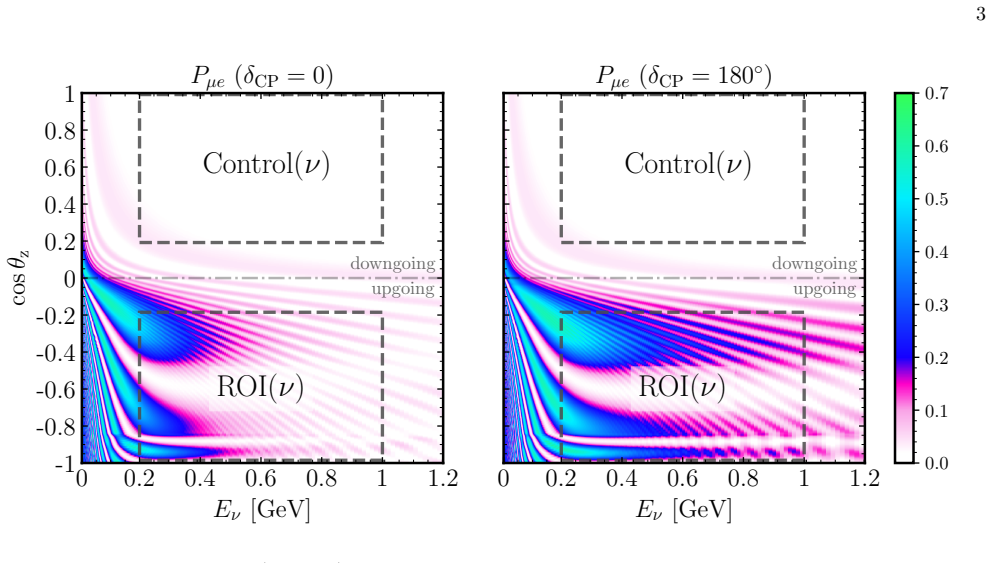
When the value ofδ CP is changed, the two panels show strong differences for upgoing neutrinos. These points were largely known. Prior work leveraged these and other points to probeδ CP using atmospheric neutrinos, but none had adequate sensitivity even when assuming optimistic detection scenarios [23–35]. Conceptual Version of Our Approach.—Before presen...
-
[2]
and +(0.2, 1), respectively. The angular ranges are chosen to reduce the smearing between up and downgo- ing samples while maintaining good statistics. For both ROI(ℓ) and Control(ℓ), we require detected energies of 0.2–1.0 GeV. The energy range is chosen so that (i) the δCP-dependent differences in the average rates have a 0.96 0.98 1.00 1.02 R(δCP) 0 90...
-
[3]
The last appears because the cor- responding slow oscillations do not fully average out in the ROI. The remaining parameters (not shown),θ 12 and ∆m2 32, have an even smaller impact due to the averaging of oscillation phases over energy and zenith angle. Figure 6 shows an ensemble of density profiles we use to assess the impact of their uncertainties onR(...
-
[4]
Steigman, Observational tests of antimatter cosmolo- gies, Ann
G. Steigman, Observational tests of antimatter cosmolo- gies, Ann. Rev. Astron. Astrophys.14, 339 (1976)
work page 1976
-
[5]
The origin of the matter-antimatter asymmetry
M. Dine and A. Kusenko, The Origin of the matter - antimatter asymmetry, Rev. Mod. Phys.76, 1 (2003), arXiv:hep-ph/0303065
work page internal anchor Pith review Pith/arXiv arXiv 2003
-
[6]
A. D. Sakharov, Violation of CP Invariance, C asymme- try, and baryon asymmetry of the universe, Pisma Zh. Eksp. Teor. Fiz.5, 32 (1967)
work page 1967
-
[7]
M. B. Gavela, P. Hernandez, J. Orloff, and O. Pene, Stan- dard model CP violation and baryon asymmetry, Mod. Phys. Lett. A9, 795 (1994), arXiv:hep-ph/9312215
work page internal anchor Pith review Pith/arXiv arXiv 1994
-
[8]
Electroweak Baryogenesis and Standard Model CP Violation
P. Huet and E. Sather, Electroweak baryogenesis and standard model CP violation, Phys. Rev. D51, 379 (1995), arXiv:hep-ph/9404302
work page internal anchor Pith review Pith/arXiv arXiv 1995
-
[9]
M. Fukugita and T. Yanagida, Baryogenesis Without Grand Unification, Phys. Lett. B174, 45 (1986)
work page 1986
-
[10]
Leptogenesis as the origin of matter
W. Buchmuller, R. D. Peccei, and T. Yanagida, Leptoge- nesis as the origin of matter, Ann. Rev. Nucl. Part. Sci. 55, 311 (2005), arXiv:hep-ph/0502169
work page internal anchor Pith review Pith/arXiv arXiv 2005
-
[11]
S. Davidson, E. Nardi, and Y. Nir, Leptogenesis, Phys. Rept.466, 105 (2008), arXiv:0802.2962 [hep-ph]
work page internal anchor Pith review Pith/arXiv arXiv 2008
-
[12]
Pontecorvo, Neutrino Experiments and the Problem of Conservation of Leptonic Charge, Sov
B. Pontecorvo, Neutrino Experiments and the Problem of Conservation of Leptonic Charge, Sov. Phys. JETP 26, 984 (1968)
work page 1968
-
[13]
Pontecorvo, Mesonium and antimesonium, Sov
B. Pontecorvo, Mesonium and antimesonium, Sov. Phys. JETP6, 429 (1957)
work page 1957
-
[14]
Pontecorvo, Inverse beta processes and nonconserva- tion of lepton charge, Sov
B. Pontecorvo, Inverse beta processes and nonconserva- tion of lepton charge, Sov. Phys. JETP7, 172 (1958)
work page 1958
-
[15]
Z. Maki, M. Nakagawa, and S. Sakata, Remarks on the unified model of elementary particles, Prog. Theor. Phys. 28, 870 (1962)
work page 1962
-
[16]
Navaset al.(Particle Data Group), Review of particle physics, Phys
S. Navaset al.(Particle Data Group), Review of particle physics, Phys. Rev. D110, 030001 (2024)
work page 2024
-
[17]
C. Jarlskog, A Basis Independent Formulation of the Connection Between Quark Mass Matrices, CP Violation and Experiment, Z. Phys. C29, 491 (1985)
work page 1985
- [18]
- [19]
-
[20]
K. Abeet al.(T2K), Measurements of neutrino oscilla- tion parameters from the T2K experiment using 3.6×10²¹ protons on target, Eur. Phys. J. C83, 782 (2023), arXiv:2303.03222 [hep-ex]
-
[21]
S. Abubakaret al.(T2K, NOvA), Joint neutrino oscil- lation analysis from the T2K and NOvA experiments, Nature646, 818 (2025), arXiv:2510.19888 [hep-ex]
-
[22]
Hyper-Kamiokande Design Report
K. Abeet al.(Hyper-Kamiokande), Hyper-Kamiokande Design Report (2018), arXiv:1805.04163 [physics.ins- det]
work page internal anchor Pith review Pith/arXiv arXiv 2018
-
[23]
K. Abeet al.(Hyper-Kamiokande), Sensitivity of the Hyper-Kamiokande experiment to neutrino oscillation parameters using accelerator neutrinos, Eur. Phys. J. C 86, 170 (2026), arXiv:2505.15019 [hep-ex]
-
[24]
B. Abiet al.(DUNE), Deep Underground Neu- trino Experiment (DUNE), Far Detector Technical De- sign Report, Volume II: DUNE Physics, (2020), arXiv:2002.03005 [hep-ex]
-
[25]
Abiet al.(DUNE), Long-baseline neutrino oscillation physics potential of the DUNE experiment, Eur
B. Abiet al.(DUNE), Long-baseline neutrino oscillation physics potential of the DUNE experiment, Eur. Phys. J. C80, 978 (2020), arXiv:2006.16043 [hep-ex]
- [26]
-
[27]
O. L. G. Peres and A. Y. Smirnov, Oscillations of very low energy atmospheric neutrinos, Phys. Rev. D79, 113002 (2009), arXiv:0903.5323 [hep-ph]
work page internal anchor Pith review Pith/arXiv arXiv 2009
-
[28]
E. K. Akhmedov, S. Razzaque, and A. Y. Smirnov, Mass hierarchy, 2-3 mixing and CP-phase with Huge Atmo- spheric Neutrino Detectors, JHEP02, 082, [Erratum: JHEP 07, 026 (2013)], arXiv:1205.7071 [hep-ph]
work page internal anchor Pith review Pith/arXiv arXiv 2013
-
[29]
Super-PINGU for measurement of the leptonic CP-phase with atmospheric neutrinos
S. Razzaque and A. Y. Smirnov, Super-PINGU for mea- surement of the leptonic CP-phase with atmospheric neu- trinos, JHEP05, 139, arXiv:1406.1407 [hep-ph]
work page internal anchor Pith review Pith/arXiv arXiv
- [30]
-
[31]
H. Minakata, I. Martinez-Soler, and K. Okumura, Using Low Energy Atmospheric Neutrinos for Precision Mea- surement of the Mixing Parameters, PoSNuF act2019, 035 (2019), arXiv:1911.10057 [hep-ph]
- [32]
-
[33]
D. Indumathi, S. M. Lakshmi, and M. V. N. Murthy, Probing Leptonicδ CP Using Low Energy Atmospheric Neutrinos, Springer Proc. Phys.261, 487 (2021)
work page 2021
- [34]
-
[35]
T. Westeret al.(Super-Kamiokande), Atmospheric neu- trino oscillation analysis with neutron tagging and an ex- panded fiducial volume in Super-Kamiokande I–V, Phys. Rev. D109, 072014 (2024), arXiv:2311.05105 [hep-ex]
-
[36]
A. Chatterjee and A. De Roeck, Neutrino oscillations with atmospheric neutrinos at large liquid argon TPCs, Phys. Lett. B855, 138838 (2024), arXiv:2402.16441 [hep- ph]
-
[37]
The sensitivity of liquid scintillator detectors to CP-violation with atmospheric neutrinos
T. Birkenfeld and A. Stahl, The sensitivity of liquid scin- tillator detectors to CP-violation with atmospheric neu- trinos (2025), arXiv:2507.07598 [hep-ex]
work page internal anchor Pith review Pith/arXiv arXiv 2025
-
[38]
J. Aguilaret al.(ESSnuSB), Complementarity between atmospheric and super-beam neutrinos at ESSnuSB (2026), arXiv:2603.02836 [hep-ex]
-
[39]
CP Violation and Neutrino Oscillations
H. Nunokawa, S. J. Parke, and J. W. F. Valle, CP Vio- lation and Neutrino Oscillations, Prog. Part. Nucl. Phys. 60, 338 (2008), arXiv:0710.0554 [hep-ph]
work page internal anchor Pith review Pith/arXiv arXiv 2008
- [40]
-
[41]
S. M. Bilenky and B. Pontecorvo, Lepton Mixing and Neutrino Oscillations, Phys. Rept.41, 225 (1978). 9
work page 1978
-
[42]
C. Giunti and K. C. Wook,Fundamentals of Neutrino Physics and Astrophysics(Oxford Univ., Oxford, 2007)
work page 2007
-
[43]
NuFit-6.0: Updated global analysis of three-flavor neutrino oscillations
I. Esteban, M. C. Gonzalez-Garcia, M. Maltoni, I. Martinez-Soler, J. P. Pinheiro, and T. Schwetz, NuFit- 6.0: updated global analysis of three-flavor neutrino os- cillations, JHEP12, 216, arXiv:2410.05380 [hep-ph]
work page internal anchor Pith review Pith/arXiv arXiv
-
[44]
F. Anet al.(JUNO), Neutrino Physics with JUNO, J. Phys. G43, 030401 (2016), arXiv:1507.05613 [physics.ins-det]
work page internal anchor Pith review Pith/arXiv arXiv 2016
-
[45]
A. Abuslemeet al.(JUNO), Sub-percent precision mea- surement of neutrino oscillation parameters with JUNO, Chin. Phys. C46, 123001 (2022), arXiv:2204.13249 [hep- ex]
-
[46]
R. Banerjee, J. Rout, S. Patra, and P. Mehta, CP violat- ing signal at DUNE in presence of nonstandard interac- tions and the role of second oscillation maxima (2026), arXiv:2601.07435 [hep-ph]
-
[47]
Precise quasielastic neutrino/nucleon cross section
A. Strumia and F. Vissani, Precise quasielastic neu- trino/nucleon cross-section, Phys. Lett. B564, 42 (2003), arXiv:astro-ph/0302055
work page internal anchor Pith review Pith/arXiv arXiv 2003
-
[48]
The GENIE Neutrino Monte Carlo Generator
C. Andreopouloset al., The GENIE Neutrino Monte Carlo Generator, Nucl. Instrum. Meth. A614, 87 (2010), arXiv:0905.2517 [hep-ph]
work page internal anchor Pith review Pith/arXiv arXiv 2010
-
[49]
B. Zhou and J. F. Beacom, First detailed calculation of atmospheric neutrino foregrounds to the diffuse super- nova neutrino background in Super-Kamiokande, Phys. Rev. D109, 103003 (2024), arXiv:2311.05675 [hep-ph]
-
[50]
M. Honda, Atmospheric Neutrino Flux Calculation with NRLMSISE-00 Atmosphere Model and New Cosmic Ray Observations, JPS Conf. Proc.12, 010008 (2016)
work page 2016
-
[51]
Flavoring Astrophysical Neutrinos: Flavor Ratios Depend on Energy
T. Kashti and E. Waxman, Flavoring astrophysical neu- trinos: Flavor ratios depend on energy, Phys. Rev. Lett. 95, 181101 (2005), arXiv:astro-ph/0507599
work page internal anchor Pith review Pith/arXiv arXiv 2005
-
[52]
Kajita, Nobel Lecture: Discovery of atmospheric neu- trino oscillations, Rev
T. Kajita, Nobel Lecture: Discovery of atmospheric neu- trino oscillations, Rev. Mod. Phys.88, 030501 (2016)
work page 2016
-
[53]
D. Indumathi, M. V. N. Murthy, and L. S. Mohan, Hi- erarchy independent sensitivity to leptonicδ CP with at- mospheric neutrinos, Phys. Rev. D100, 115027 (2019), arXiv:1701.08997 [hep-ph]
-
[54]
A. Ioannisian, S. Pokorski, J. Rosiek, and M. Ryczkowski, Analytical description of CP violation in oscillations of atmospheric neutrinos traversing the Earth, JHEP10, 120, arXiv:2005.07719 [hep-ph]
-
[55]
P. B. Denton, H. Minakata, and S. J. Parke, Compact Perturbative Expressions For Neutrino Oscillations in Matter, JHEP06, 051, arXiv:1604.08167 [hep-ph]
work page internal anchor Pith review Pith/arXiv arXiv
-
[56]
Compact Perturbative Expressions for Neutrino Oscillations in Matter: II
P. B. Denton and S. J. Parke, Addendum to “Com- pact perturbative expressions for neutrino oscillations in matter” (2018), [Addendum: JHEP 06, 109 (2018)], arXiv:1801.06514 [hep-ph]
work page internal anchor Pith review Pith/arXiv arXiv 2018
-
[57]
Z.-z. Xing, S. Zhou, and Y.-L. Zhou, Renormalization- Group Equations of Neutrino Masses and Flavor Mixing Parameters in Matter, JHEP05, 015, arXiv:1802.00990 [hep-ph]
work page internal anchor Pith review Pith/arXiv arXiv
-
[58]
Three Neutrino Oscillations in Matter
A. Ioannisian and S. Pokorski, Three Neutrino Os- cillations in Matter, Phys. Lett. B782, 641 (2018), arXiv:1801.10488 [hep-ph]
work page internal anchor Pith review Pith/arXiv arXiv 2018
-
[59]
J. A. Formaggio and G. P. Zeller, From eV to EeV: Neu- trino Cross Sections Across Energy Scales, Rev. Mod. Phys.84, 1307 (2012), arXiv:1305.7513 [hep-ex]
work page internal anchor Pith review Pith/arXiv arXiv 2012
-
[60]
O. L. G. Peres and A. Y. Smirnov, Testing the solar neu- trino conversion with atmospheric neutrinos, Phys. Lett. B456, 204 (1999), arXiv:hep-ph/9902312
work page internal anchor Pith review Pith/arXiv arXiv 1999
-
[61]
Analytic Approximations for Three Neutrino Oscillation Parameters and Probabilities in Matter
M. Freund, Analytic approximations for three neutrino oscillation parameters and probabilities in matter, Phys. Rev. D64, 053003 (2001), arXiv:hep-ph/0103300
work page internal anchor Pith review Pith/arXiv arXiv 2001
-
[62]
I. Martinez-Soler and H. Minakata, Perturbing Neutrino Oscillations Around the Solar Resonance, PTEP2019, 073B07 (2019), arXiv:1904.07853 [hep-ph]
-
[63]
J. F. Beacom and S. Palomares-Ruiz, Neutral Current Atmospheric Neutrino Flux Measurement Using Neu- trino Proton Elastic Scattering in Super-Kamiokande, Phys. Rev. D67, 093001 (2003), arXiv:hep-ph/0301060
work page internal anchor Pith review Pith/arXiv arXiv 2003
- [64]
- [65]
- [66]
- [67]
- [68]
-
[69]
A Measurement of Atmospheric Neutrino Oscillation Parameters by Super-Kamiokande I
Y. Ashieet al.(Super-Kamiokande), A Measurement of atmospheric neutrino oscillation parameters by SUPER- KAMIOKANDE I, Phys. Rev. D71, 112005 (2005), arXiv:hep-ex/0501064
work page internal anchor Pith review Pith/arXiv arXiv 2005
-
[70]
R. Wendellet al.(Super-Kamiokande), Atmospheric neutrino oscillation analysis with sub-leading effects in Super-Kamiokande I, II, and III, Phys. Rev. D81, 092004 (2010), arXiv:1002.3471 [hep-ex]
work page internal anchor Pith review Pith/arXiv arXiv 2010
-
[71]
Atmospheric neutrino oscillation analysis with external constraints in Super-Kamiokande I-IV
K. Abeet al.(Super-Kamiokande), Atmospheric neu- trino oscillation analysis with external constraints in Super-Kamiokande I-IV, Phys. Rev. D97, 072001 (2018), arXiv:1710.09126 [hep-ex]
work page internal anchor Pith review Pith/arXiv arXiv 2018
- [72]
-
[73]
u-tokyo.ac.jp/mhonda/public/nflx2014/index.html, accessed: 2025-Jun-20
HKKM kamioka datasets,http://www-rccn.icrr. u-tokyo.ac.jp/mhonda/public/nflx2014/index.html, accessed: 2025-Jun-20
work page 2025
-
[74]
Calculation of oscillation probabilities of atmospheric neutrinos using nuCraft
M. Wallraff and C. Wiebusch, Calculation of oscilla- tion probabilities of atmospheric neutrinos using nu- Craft, Comput. Phys. Commun.197, 185 (2015), arXiv:1409.1387 [astro-ph.IM]
work page internal anchor Pith review Pith/arXiv arXiv 2015
-
[75]
nucraft,https://nucraft.hepforge.org/, accessed: 2025-Jun-20
work page 2025
-
[76]
The GENIE Neutrino Monte Carlo Generator: Physics and User Manual
C. Andreopoulos, C. Barry, S. Dytman, H. Gallagher, T. Golan, R. Hatcher, G. Perdue, and J. Yarba, The GENIE Neutrino Monte Carlo Generator: Physics and User Manual (2015), arXiv:1510.05494 [hep-ph]
work page internal anchor Pith review Pith/arXiv arXiv 2015
-
[77]
Tena-Vidalet al.(GENIE), Neutrino-nucleon cross- section model tuning in GENIE v3, Phys
J. Tena-Vidalet al.(GENIE), Neutrino-nucleon cross- section model tuning in GENIE v3, Phys. Rev. D104, 072009 (2021), arXiv:2104.09179 [hep-ph]
-
[78]
Agostinelliet al.(GEANT4), GEANT4–a simulation toolkit, Nucl
S. Agostinelliet al.(GEANT4), GEANT4–a simulation toolkit, Nucl. Instrum. Meth. A506, 250 (2003)
work page 2003
-
[79]
NuSTEC White Paper: Status and Challenges of Neutrino-Nucleus Scattering
L. Alvarez-Rusoet al., NuSTEC White Paper: Sta- tus and challenges of neutrino–nucleus scattering, Prog. Part. Nucl. Phys.100, 1 (2018), arXiv:1706.03621 [hep- 10 ph]
work page internal anchor Pith review Pith/arXiv arXiv 2018
-
[80]
Suzuki, The Super-Kamiokande experiment, Eur
Y. Suzuki, The Super-Kamiokande experiment, Eur. Phys. J. C79, 298 (2019)
work page 2019
discussion (0)
Sign in with ORCID, Apple, or X to comment. Anyone can read and Pith papers without signing in.