QuadLink: Autoregressive Quad-Dominant Mesh Generation via Point-Relation Learning
Pith reviewed 2026-05-19 19:44 UTC · model grok-4.3
The pith
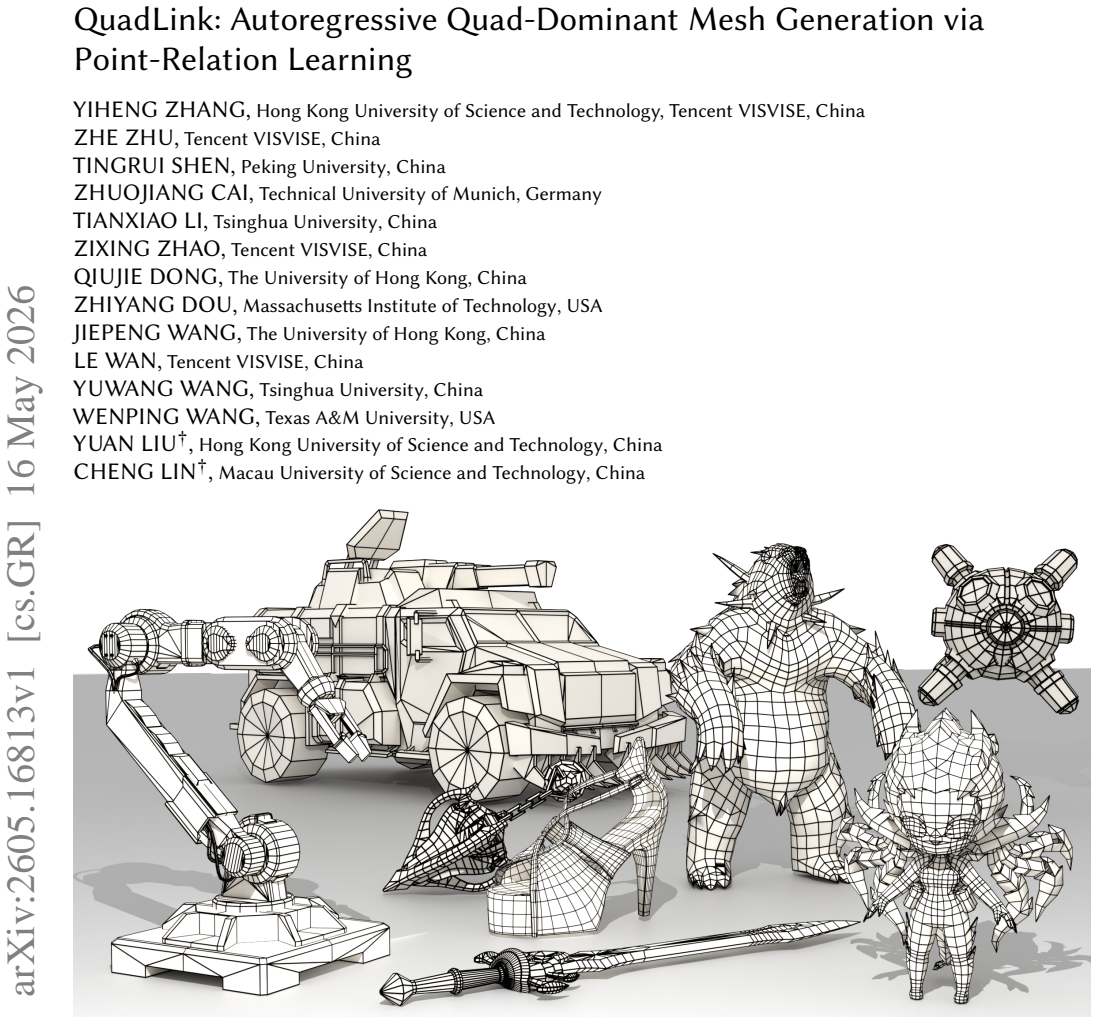
QuadLink generates production-ready quad-dominant meshes from point clouds by learning to link points into structured faces.
A machine-rendered reading of the paper's core claim, the machinery that carries it, and where it could break.
Core claim
QuadLink formulates polygonal mesh generation as a hybrid centroid-conditioned vertex linking model: it first predicts a unified set of anchors (vertices and face centroids), then learns centroid-conditioned links that associate vertices with face centroids, and finally assembles polygonal faces with a quad-first strategy guided by robust geometric verification strategies. This link-based formulation enables efficient generation of sparse and anisotropic quad-dominant meshes with coherent edge flow and meanwhile supporting hybrid polygonal topology.
What carries the argument
The hybrid centroid-conditioned vertex linking model for associating vertices with face centroids to assemble polygonal faces.
If this is right
- It produces meshes with improved geometric fidelity and topological quality from point clouds.
- The method supports sparse and anisotropic quad-dominant meshes with coherent edge flow.
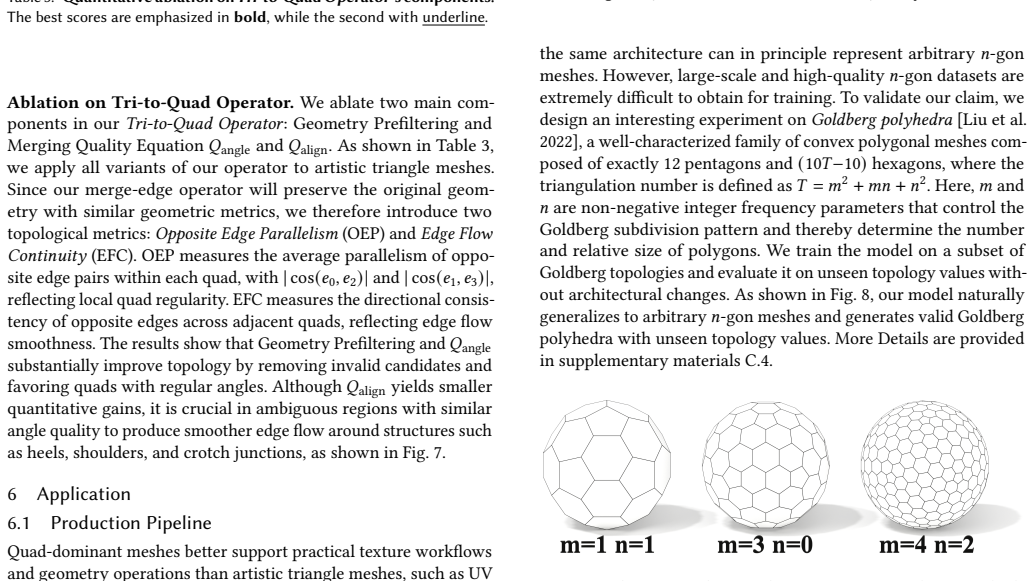
- Hybrid polygonal topology is natively supported without any changes to the architecture.
- The Tri-to-Quad Operator provides a way to generate suitable training data from existing triangle meshes.
Where Pith is reading between the lines
- This could reduce manual effort in retopologizing 3D models for animation and simulation.
- The autoregressive aspect might enable generating meshes incrementally for large scenes.
- Similar point-relation learning could be adapted for other input types like depth maps or images.
- It may lead to more automated pipelines in industries requiring high-quality quad meshes.
Load-bearing premise
The Tri-to-Quad Operator converts artistic triangle meshes into quad-dominant training data in a way that does not introduce biases or artifacts that would degrade the learned linking model's performance on real point cloud inputs.
What would settle it
A direct comparison on diverse point cloud test sets where QuadLink shows no gains in standard geometric and topological metrics over existing methods would falsify the improved performance claim.
Figures






read the original abstract
The generation of production-ready quad-dominant meshes is a cornerstone of modern 3D content creation. Generating anisotropic quad-dominant meshes from point clouds is challenging, as existing methods are typically limited to producing either pure triangular meshes or pure quadrilateral meshes with isotropic densities. In this paper, we present QuadLink, a unified framework consisting of three stages for quad-dominant mesh generation by linking points into structured faces. QuadLink formulates polygonal mesh generation as a hybrid centroid-conditioned vertex linking model: it first predicts a unified set of anchors (vertices and face centroids), then learns centroid-conditioned links that associate vertices with face centroids, and finally assembles polygonal faces with a quad-first strategy guided by robust geometric verification strategies. This link-based formulation enables efficient generation of sparse and anisotropic quad-dominant meshes with coherent edge flow and meanwhile supporting hybrid polygonal topology. To construct training data for this model, we further introduce a Tri-to-Quad Operator that converts artistic triangle meshes into quad-dominant training data via global merge selection. Extensive experiments show that QuadLink produces production-ready quad-dominant meshes from point clouds and achieves improved geometric fidelity and topological quality compared to prior baselines. Our method natively supports hybrid polygonal topology, generalizing to arbitrary n-gon meshes without architectural changes.
Editorial analysis
A structured set of objections, weighed in public.
Referee Report
Summary. The manuscript presents QuadLink, a three-stage framework for autoregressive quad-dominant mesh generation from point clouds. It predicts a unified set of anchors consisting of vertices and face centroids, learns centroid-conditioned links to associate vertices with those centroids, and assembles polygonal faces via a quad-first strategy with geometric verification. Training data is prepared by a Tri-to-Quad Operator that converts artistic triangle meshes into quad-dominant examples through global merge selection. The central claim is that this link-based formulation produces production-ready sparse and anisotropic quad-dominant meshes with coherent edge flow, supports hybrid polygonal (n-gon) topology without architectural changes, and achieves improved geometric fidelity and topological quality over prior baselines.
Significance. If the performance claims and generalization hold, the work would be a meaningful advance in computer graphics for 3D content creation, where anisotropic quad-dominant meshes are preferred for production pipelines. The hybrid topology support and point-relation learning approach offer a unified alternative to methods limited to pure triangles or isotropic quads. The Tri-to-Quad Operator provides a practical data-generation step, though its fidelity to real point-cloud distributions is central to the results.
major comments (2)
- [§3.2 (Tri-to-Quad Operator)] §3.2 (Tri-to-Quad Operator): The global merge selection heuristic is presented without quantitative validation that the resulting quad-dominant meshes preserve original edge-flow, anisotropy, and local curvature statistics. This is load-bearing for the generalization claim, because any systematic bias in the training distribution relative to raw point-cloud inputs could cause the learned linking model to produce incoherent faces on real data, undermining both the fidelity and hybrid-topology assertions.
- [Experiments section] Experiments section / Table 1 (or equivalent results table): The abstract asserts 'improved geometric fidelity and topological quality' with 'extensive experiments,' yet the manuscript must supply concrete metrics (e.g., Hausdorff distance, quad quality scores, edge-flow coherence), dataset details, error bars, and ablations against baselines. Without these, the central performance claim lacks visible empirical grounding.
minor comments (2)
- [§3.3 (Assembly)] Clarify the exact geometric verification criteria used in the final assembly stage and how they interact with the quad-first ordering; a short pseudocode or decision tree would improve reproducibility.
- [Figures] Ensure all figures showing generated meshes include side-by-side comparisons with ground-truth or baseline outputs at consistent viewpoints and include scale bars or point-cloud density information.
Simulated Author's Rebuttal
We thank the referee for the thoughtful and constructive comments. We address each major comment below and outline the revisions we will make to strengthen the manuscript.
read point-by-point responses
-
Referee: [§3.2 (Tri-to-Quad Operator)] §3.2 (Tri-to-Quad Operator): The global merge selection heuristic is presented without quantitative validation that the resulting quad-dominant meshes preserve original edge-flow, anisotropy, and local curvature statistics. This is load-bearing for the generalization claim, because any systematic bias in the training distribution relative to raw point-cloud inputs could cause the learned linking model to produce incoherent faces on real data, undermining both the fidelity and hybrid-topology assertions.
Authors: We agree that additional quantitative validation of the Tri-to-Quad Operator would strengthen the generalization argument. In the revised manuscript we will add a dedicated analysis (new table or appendix) reporting edge-flow preservation (e.g., average deviation in edge directions and lengths), anisotropy statistics (aspect-ratio and density distributions), and local curvature fidelity (mean and Gaussian curvature errors) between the source triangle meshes and the converted quad-dominant meshes. These metrics will be computed on the same artistic meshes used for training. revision: yes
-
Referee: [Experiments section] Experiments section / Table 1 (or equivalent results table): The abstract asserts 'improved geometric fidelity and topological quality' with 'extensive experiments,' yet the manuscript must supply concrete metrics (e.g., Hausdorff distance, quad quality scores, edge-flow coherence), dataset details, error bars, and ablations against baselines. Without these, the central performance claim lacks visible empirical grounding.
Authors: We acknowledge that the current results presentation would benefit from greater explicitness. The manuscript already contains comparative results and visualizations, but we will expand the Experiments section and Table 1 to report concrete quantitative metrics including Hausdorff distance, quad quality scores (aspect ratio, skewness, minimum angle), edge-flow coherence (e.g., average deviation from principal curvature directions), full dataset specifications, error bars or standard deviations across runs, and additional ablation studies against the listed baselines. These additions will make the performance claims directly verifiable. revision: yes
Circularity Check
No significant circularity detected in derivation chain
full rationale
The paper presents a data-driven ML pipeline: a centroid-conditioned linking model trained on meshes produced by the introduced Tri-to-Quad Operator, followed by geometric assembly. No equations, uniqueness theorems, or self-citations are shown that reduce any claimed prediction or result to a quantity defined by the inputs or by the model's own fitted outputs. The central claims rest on empirical comparison to baselines rather than any self-referential derivation, satisfying the criteria for an independent, non-circular formulation.
Axiom & Free-Parameter Ledger
invented entities (1)
-
Tri-to-Quad Operator
no independent evidence
Lean theorems connected to this paper
-
IndisputableMonolith/Foundation/AlexanderDuality.leanalexander_duality_circle_linking unclear?
unclearRelation between the paper passage and the cited Recognition theorem.
QuadLink formulates polygonal mesh generation as a hybrid centroid-conditioned vertex linking model... learns centroid-conditioned links that associate vertices with face centroids... quad-first strategy guided by robust geometric verification
-
IndisputableMonolith/Foundation/BranchSelection.leanbranch_selection unclear?
unclearRelation between the paper passage and the cited Recognition theorem.
Tri-to-Quad Operator that converts artistic triangle meshes into quad-dominant training data via global merge selection... maximum-weight matching problem
-
IndisputableMonolith/Cost/FunctionalEquation.leanwashburn_uniqueness_aczel unclear?
unclearRelation between the paper passage and the cited Recognition theorem.
contrastive-learning objective based on triplet margin loss
What do these tags mean?
- matches
- The paper's claim is directly supported by a theorem in the formal canon.
- supports
- The theorem supports part of the paper's argument, but the paper may add assumptions or extra steps.
- extends
- The paper goes beyond the formal theorem; the theorem is a base layer rather than the whole result.
- uses
- The paper appears to rely on the theorem as machinery.
- contradicts
- The paper's claim conflicts with a theorem or certificate in the canon.
- unclear
- Pith found a possible connection, but the passage is too broad, indirect, or ambiguous to say the theorem truly supports the claim.
discussion (0)
Sign in with ORCID, Apple, or X to comment. Anyone can read and Pith papers without signing in.