Shot noise generated by subpopulations of neural networks
Pith reviewed 2026-05-19 18:49 UTC · model grok-4.3
The pith
Subpopulation shot noise in neural networks arises from a mixture of two distinct spectral components rather than simple scaling.
A machine-rendered reading of the paper's core claim, the machinery that carries it, and where it could break.
Core claim
The power spectral density of shot noise generated by a subpopulation is derived analytically as a size-dependent mixture of two distinct spectral components, obtained by generalizing the nesting method and applying a reduction technique for non-Lorentzian distributions of local neuron parameters, and it matches direct numerical simulations closely.
What carries the argument
Generalized nesting method for deriving the power spectral density of subpopulation shot noise, together with the reduction technique for non-Lorentzian parameter distributions.
If this is right
- The correct size-dependent frequency spectrum of subpopulation shot noise can now be incorporated into stochastic mean-field models.
- These models apply to hierarchical neural networks with dense local connectivity and sparse inter-population connectivity.
- The spectrum is essential because it is not a simple scaled version of the full population's noise.
- Foundation is provided for a new class of stochastic mean-field models.
Where Pith is reading between the lines
- This approach may improve predictions of how noise influences signal propagation in brain circuits with sparse long-range connections.
- Extensions could include deriving similar expressions for other finite-size effects in multi-population networks.
- Experimental validation might involve measuring noise spectra in identified subpopulations using targeted recording methods.
Load-bearing premise
The generalization of the nesting method and the previously developed reduction technique for non-Lorentzian distributions of local neuron parameters are valid and sufficient to capture the subpopulation dynamics and noise spectrum.
What would settle it
A numerical simulation of a finite neural network with sparse inter-population projections that produces a subpopulation output spectrum differing from the derived analytical mixture of two components.
Figures


read the original abstract
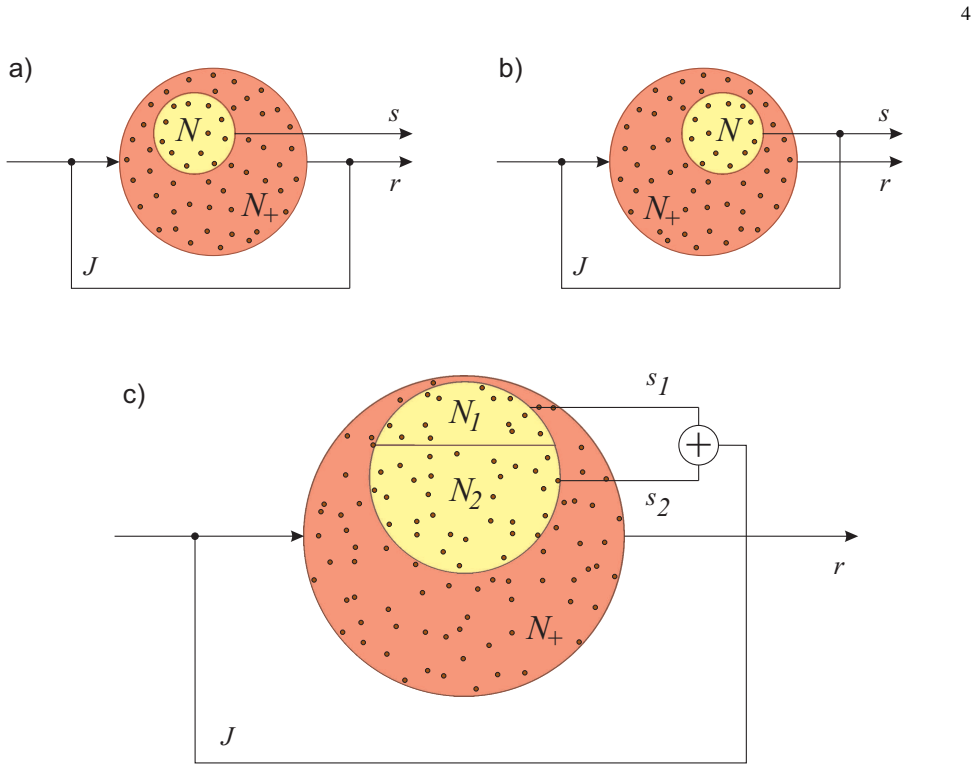
While recent advances in next-generation neural mass models provide exact descriptions of densely coupled neural populations in the thermodynamic limit, populations in vivo remain strictly finite in size. Finite-size effects introduce stochastic fluctuations whose impact on network dynamics depends on their spectral content. Furthermore, coupling between different populations is typically sparse, meaning that only a small, random subset of neurons from one population projects connections to another. This subset (a subpopulation) produces an output signal that is inherently noisy. Given that the subpopulation constitutes only a fraction of the full population, its shot noise differs from that of the whole population in both intensity and spectral shape. In the present work, we analyze these differences and demonstrate that they depend non-trivially on subpopulation size. Using a generalization of our nesting method, we derive an analytical expression for the power spectral density of subpopulation shot noise, which shows excellent agreement with direct numerical simulations. Unlike many previous studies that rely on mathematically convenient but unrealistic Lorentzian distributions (with diverging moments), our approach accounts for more realistic, non-Lorentzian distributions of local neuron parameters using a previously developed reduction technique. These results provide a foundation for a new class of stochastic mean-field models for hierarchical neural networks. Such models can now incorporate the correct, size-dependent frequency spectrum of subpopulation shot noise. Crucially, this spectrum is not a simple scaled version of the full population's noise. Instead, it arises from a non-trivial mixture of two distinct spectral components. This is essential for networks with dense local connectivity and sparse inter-population connectivity.
Editorial analysis
A structured set of objections, weighed in public.
Referee Report
Summary. The manuscript derives an analytical expression for the power spectral density of shot noise generated by finite subpopulations in neural networks. Using a generalization of the authors' nesting method combined with a prior reduction technique for non-Lorentzian distributions of local neuron parameters, it shows that the subpopulation PSD is a non-trivial mixture of two distinct spectral components rather than a simple scaled version of the full-population noise. Excellent agreement with direct numerical simulations is reported, providing a foundation for stochastic mean-field models of hierarchical networks with dense local and sparse inter-population connectivity.
Significance. If the central derivation is valid, the result is significant because it supplies the correct size-dependent frequency spectrum for subpopulation shot noise in realistic (non-Lorentzian) parameter regimes. This enables more accurate stochastic modeling of finite-size fluctuations in sparsely coupled hierarchical networks, moving beyond scaled full-population approximations. Credit is due for the explicit non-trivial mixture claim, the use of the reduction technique to handle non-Lorentzian distributions, and the reported numerical agreement.
major comments (1)
- [Derivation section (generalization of nesting method and reduction technique)] Derivation of subpopulation PSD via generalized nesting method: the claim that the PSD is a non-trivial mixture of two spectral components (rather than a scaled full-population spectrum) requires that the reduction technique commutes with random subpopulation sampling. For non-Lorentzian parameter distributions, sampling a finite random fraction may alter moments or introduce correlations that change the weights of the two components; the manuscript must explicitly verify that the nesting construction still closes exactly under this sampled measure, as this is load-bearing for the central distinction from a simple scaling.
minor comments (2)
- [Abstract and Introduction] The abstract and introduction refer to 'our nesting method' and 'previously developed reduction technique' without explicit citations to the prior papers; adding these references would clarify the novelty and allow readers to trace the generalization.
- [Results and comparison with simulations] Simulation details (subpopulation size fractions tested, number of realizations, error bars or goodness-of-fit metrics) should be expanded in the results section to strengthen the reported excellent agreement.
Simulated Author's Rebuttal
We thank the referee for the positive and constructive report. The significance assessment is appreciated, and we address the single major comment point-by-point below. We will revise the manuscript to strengthen the presentation of the derivation as requested.
read point-by-point responses
-
Referee: [Derivation section (generalization of nesting method and reduction technique)] Derivation of subpopulation PSD via generalized nesting method: the claim that the PSD is a non-trivial mixture of two spectral components (rather than a scaled full-population spectrum) requires that the reduction technique commutes with random subpopulation sampling. For non-Lorentzian parameter distributions, sampling a finite random fraction may alter moments or introduce correlations that change the weights of the two components; the manuscript must explicitly verify that the nesting construction still closes exactly under this sampled measure, as this is load-bearing for the central distinction from a simple scaling.
Authors: We thank the referee for identifying this important technical point. The reduction technique for non-Lorentzian distributions relies on a moment-matching procedure applied to the underlying parameter distribution. Because the subpopulation is formed by uniform random sampling from the identical distribution, the moments that enter the reduction remain statistically unchanged (any finite-sample fluctuations in moments are already accounted for by the generalized nesting construction itself). Consequently, the weights of the two spectral components are unaffected by the sampling step, and the nesting equations close exactly under the sampled measure. The reported agreement between the analytical PSD and direct simulations for multiple subpopulation sizes provides supporting evidence. To make the commutation explicit, we will add a short paragraph in the derivation section with the corresponding mathematical argument. revision: yes
Circularity Check
Central PSD derivation for subpopulation shot noise reduces to generalization of authors' prior nesting method and reduction technique
specific steps
-
self citation load bearing
[Abstract]
"Using a generalization of our nesting method, we derive an analytical expression for the power spectral density of subpopulation shot noise... our approach accounts for more realistic, non-Lorentzian distributions of local neuron parameters using a previously developed reduction technique."
The load-bearing analytical PSD expression is obtained by generalizing the authors' own prior nesting method and invoking their previously developed reduction technique. The claimed non-trivial mixture of two spectral components therefore reduces to quantities and closure properties defined in those earlier self-citations rather than emerging from an independent derivation that accounts for finite random subpopulation sampling.
full rationale
The paper's strongest claim—that subpopulation shot noise PSD is a non-trivial mixture of two distinct spectral components rather than a scaled full-population spectrum—rests on applying a 'generalization of our nesting method' combined with a 'previously developed reduction technique' for non-Lorentzian parameter distributions. These are explicitly self-referential. While the abstract reports excellent numerical agreement, the derivation chain does not demonstrate that the reduction step commutes with random subpopulation sampling or that the two-component decomposition remains orthogonal under the sampled measure; instead the new expression inherits its structure from the prior frameworks. This meets the criteria for self-citation load-bearing on the central analytical result. The paper remains self-contained for its simulation validation but the claimed analytical novelty is not independently derived here.
Axiom & Free-Parameter Ledger
free parameters (1)
- subpopulation size fraction
axioms (2)
- domain assumption Generalization of the nesting method accurately describes subpopulation output statistics.
- domain assumption Reduction technique correctly maps non-Lorentzian local parameter distributions to effective population dynamics.
Reference graph
Works this paper leans on
-
[1]
Modular and hierarchically modular organization of brain networks,
D. Meunier, R. Lambiotte, and E. T. Bullmore, “Modular and hierarchically modular organization of brain networks,” Frontiers in neuroscience 4 (2010)
work page 2010
-
[2]
Rich-club organization of the human connectome,
M. P. van den Heuvel and O. Sporns, “Rich-club organization of the human connectome,” The Journal of Neuroscience 31, 15775–15786 (2011)
work page 2011
-
[3]
S.-Y. Kim and W. Lim, “Effect of interpopulation spike-timing-dependent plasticity on synchronized rhythms in neuronal networks with inhibitory and excitatory populations,” Cognitive Neurodynamics 14, 535–567 (2020)
work page 2020
-
[4]
Excitatory and inhibitory interactions in localized populations of model neurons,
H. R. Wilson and J. D. Cowan, “Excitatory and inhibitory interactions in localized populations of model neurons,” Biophysical Journal 12, 1–24 (1972), wilson-Cowan original paper
work page 1972
-
[5]
B. H. Jansen and V. G. Rit, “Electroencephalogram and visual evoked potential generation in a mathematical model of coupled cortical columns,” Biological cybernetics 73, 357–366 (1995)
work page 1995
-
[6]
The dynamic brain: From spiking neurons to neural masses and cortical fields,
G. Deco, V. K. Jirsa, P. A. Robinson, M. Breakspear, and K. Friston, “The dynamic brain: From spiking neurons to neural masses and cortical fields,” PLoS Comput Biol 4, e1000092 (2008)
work page 2008
-
[7]
T. Schwalger, M. Deger, and W. Gerstner, “Towards a theory of cortical columns: From spiking neurons to interacting neural populations of finite size,” PLoS Computational Biology 13, 1–63 (2017)
work page 2017
-
[8]
Macroscopic description for networks of spiking neurons,
E. Montbri\' o , D. Paz\' o , and A. Roxin, “Macroscopic description for networks of spiking neurons,” Physical Review X 5, 021028 (2015)
work page 2015
-
[9]
M. di Volo and A. Torcini, “Transition from asynchronous to oscillatory dynamics in balanced spiking networks with instantaneous synapses,” Physical Review Letters 121, 128301 (2018)
work page 2018
-
[10]
Reduction methodology for fluctuation driven population dynamics,
D. S. Goldobin, M. di Volo, and A. Torcini, “Reduction methodology for fluctuation driven population dynamics,” Physical Review Letters 127, 038301 (2021)
work page 2021
-
[11]
R. Gast, T. R. Kn\" o sche, and H. Schmidt, “Mean-field approximations of networks of spiking neurons with short-term synaptic plasticity,” Physical Review E 104, 44310 (2021)
work page 2021
-
[12]
Exact mean-field models for spiking neural networks with adaptation,
L. Chen and S. A. Campbell, “Exact mean-field models for spiking neural networks with adaptation,” Journal of Computational Neuroscience 50, 445–469 (2022)
work page 2022
-
[13]
S. Eydam, I. Franovi\' c , and L. Kang, “Control of seizure-like dynamics in neuronal populations with excitability adaptation related to ketogenic diet,” Chaos: An Interdisciplinary Journal of Nonlinear Science 34 (2024)
work page 2024
-
[14]
Low-dimensional model for adaptive networks of spiking neurons,
B. Pietras, P. Clusella, and E. Montbri\' o , “Low-dimensional model for adaptive networks of spiking neurons,” Physical Review E 111, 14422 (2025)
work page 2025
-
[15]
Mean-field approximation for networks with synchrony-driven adaptive coupling,
N. Fennelly, A. Neff, R. Lambiotte, A. Keane, and \' A ine Byrne, “Mean-field approximation for networks with synchrony-driven adaptive coupling,” Chaos: An Interdisciplinary Journal of Nonlinear Science 35 (2025)
work page 2025
-
[16]
Asynchronous and coherent dynamics in balanced excitatory-inhibitory spiking networks,
H. Bi, M. di Volo, and A. Torcini, “Asynchronous and coherent dynamics in balanced excitatory-inhibitory spiking networks,” Frontiers in Systems Neuroscience 15, 135 (2021)
work page 2021
-
[17]
Synaptic shot noise triggers fast and slow global oscillations in balanced neural networks,
D. S. Goldobin, M. V. Ageeva, M. di Volo, F. Tixidre, and A. Torcini, “Synaptic shot noise triggers fast and slow global oscillations in balanced neural networks,” Physical Review E 112, 034301 (2025)
work page 2025
-
[18]
Fast global oscillations in networks of integrate-and-fire neurons with low firing rates,
N. Brunel and V. Hakim, “Fast global oscillations in networks of integrate-and-fire neurons with low firing rates,” Neural computation 11, 1621–1671 (1999)
work page 1999
-
[19]
A stochastic-field description of finite-size spiking neural networks,
G. Dumont, A. Payeur, and A. Longtin, “A stochastic-field description of finite-size spiking neural networks,” PLOS Computational Biology 13, e1005691 (2017)
work page 2017
-
[20]
Shot noise in next-generation neural mass models for finite-size networks,
V. V. Klinshov and S. Y. Kirillov, “Shot noise in next-generation neural mass models for finite-size networks,” Physical Review E 106, L062302 (2022)
work page 2022
-
[21]
How random connectivity shapes the fluctuating dynamics of finite-size neural populations,
N. E. Greven, J. Ranft, and T. Schwalger, “How random connectivity shapes the fluctuating dynamics of finite-size neural populations,” PRX Life 4, 013007 (2026)
work page 2026
-
[22]
Nonlinear bias of collective oscillation frequency induced by asymmetric cauchy noise,
M. V. Ageeva and D. S. Goldobin, “Nonlinear bias of collective oscillation frequency induced by asymmetric cauchy noise,” Chaos 35, 023126 (2025). 23M. K. Nandi, M. Valla, and M. di Volo, “Bursting gamma oscillations in neural mass models,” Frontiers in Computational Neuroscience 18, 1422159 (2024)
work page 2025
-
[23]
Bursting gamma oscillations in neural mass models,
M. K. Nandi, M. Valla, and M. di Volo, “Bursting gamma oscillations in neural mass models,” Frontiers in Computational Neuroscience 18, 1422159 (2024)
work page 2024
-
[24]
Reduction of the collective dynamics of neural populations with realistic forms of heterogeneity,
V. Klinshov, S. Kirillov, and V. Nekorkin, “Reduction of the collective dynamics of neural populations with realistic forms of heterogeneity,” Physical Review E 103, L040302 (2021)
work page 2021
-
[25]
Dynamics of a network of quadratic integrate-and-fire neurons with bimodal heterogeneity,
V. Pyragas and K. Pyragas, “Dynamics of a network of quadratic integrate-and-fire neurons with bimodal heterogeneity,” Physics Letters A 416, 127677 (2021)
work page 2021
-
[26]
Mean-field equations for neural populations with q -gaussian heterogeneities,
V. Pyragas and K. Pyragas, “Mean-field equations for neural populations with q -gaussian heterogeneities,” Physical Review E 105 (2022), 10.1103/PhysRevE.105.044402
-
[27]
V. Pyragas and K. Pyragas, “Effect of cauchy noise on a network of quadratic integrate-and-fire neurons with non-cauchy heterogeneities,” Physics Letters A 480, 128972 (2023)
work page 2023
-
[28]
Mean-field models of neural populations with gaussian noise and non-cauchy heterogeneities,
V. Pyragas and K. Pyragas, “Mean-field models of neural populations with gaussian noise and non-cauchy heterogeneities,” Physical Review E 110, 64211 (2024)
work page 2024
-
[29]
Neural heterogeneity controls computations in spiking neural networks,
R. Gast, S. A. Solla, and A. Kennedy, “Neural heterogeneity controls computations in spiking neural networks,” Proceedings of the National Academy of Sciences 121, e2311885121 (2024)
work page 2024
-
[30]
S. Y. Kirillov and V. V. Klinshov, “Collective fluctuations in the finite-size kuramoto model below the critical coupling: Shot-noise approach,” Chaos: An Interdisciplinary Journal of Nonlinear Science 35 (2025)
work page 2025
discussion (0)
Sign in with ORCID, Apple, or X to comment. Anyone can read and Pith papers without signing in.