Project RAINBOW: An all-integrated all-optical ultrafast dual-comb chip
Pith reviewed 2026-05-22 09:41 UTC · model grok-4.3
The pith
A single integrated chip generates two broadband optical frequency combs from one control parameter.
A machine-rendered reading of the paper's core claim, the machinery that carries it, and where it could break.
Core claim
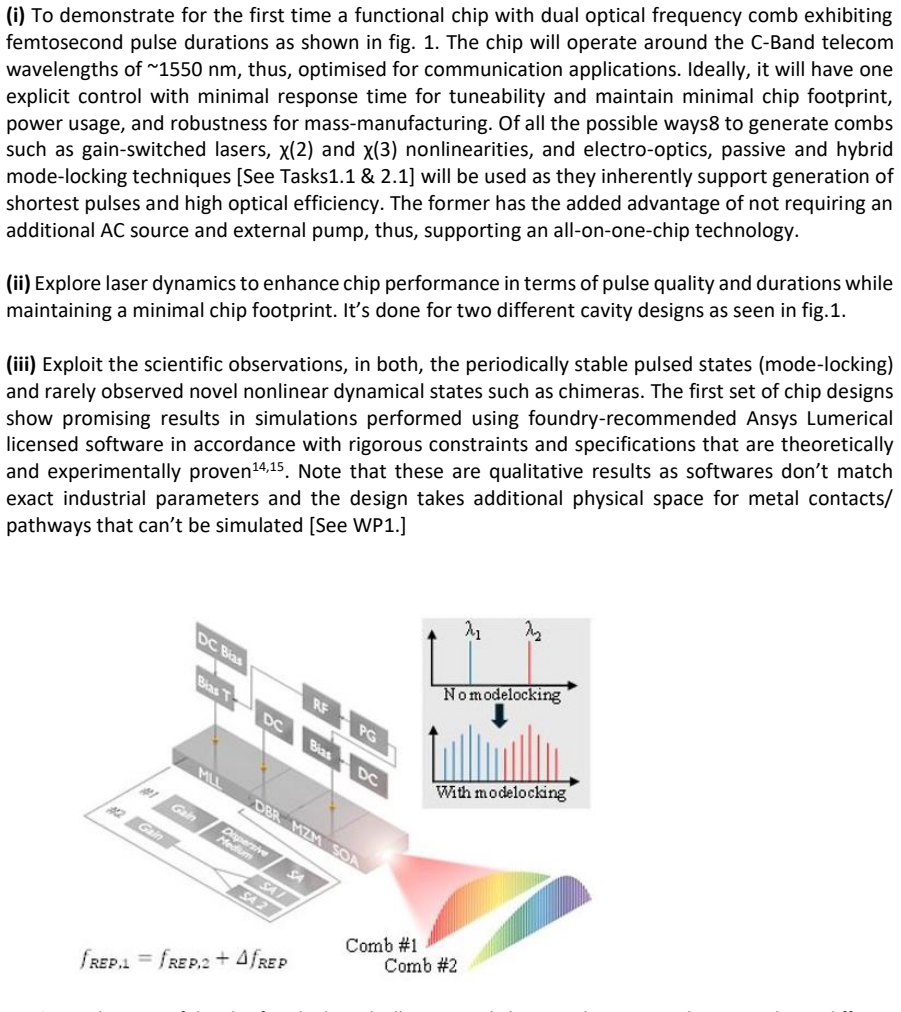
By developing a novel turn-key device on a fingertip-sized chip using generic foundry processes, the work seeks to demonstrate modelocked pulses at two separate central frequencies from one laser. The chip emits two broadband combs controlled by one parameter, with synergetic properties coupled via one gain medium, forming a new ultra-broadband comb that delivers unprecedented phase correlation between the two sub-combs.
What carries the argument
Dual central-frequency mode-locking in a single integrated gain medium, enabling one-parameter control of two coupled broadband combs with synergetic properties.
If this is right
- The device will be significantly smaller, lighter, cheaper, and more power-efficient than free-space systems.
- It will reduce the gap between lab demonstrations and market applications for optical frequency combs.
- It pioneers the demonstration of modelocked pulses at two separate frequencies on an integrated chip.
- High phase correlation will support more precise measurements in applications like atomic clocks and secure communication.
Where Pith is reading between the lines
- Such a chip could enable portable versions of dual-comb spectroscopy for field use.
- Understanding gained from the light-material interactions could inform designs for even wider bandwidth combs.
- Combining this with other on-chip components might create complete metrology systems without external optics.
Load-bearing premise
Sustained modelocked pulses can be generated at two separate central frequencies from the same laser on an integrated chip despite limited knowledge of light-material interactions at this scale.
What would settle it
Observation of sustained dual-frequency modelocked operation on the chip with a single control parameter and measurable high phase correlation between the resulting combs.
Figures
read the original abstract
A train of periodic optical pulses gives an optical frequency "comb" that acts as a precise ruler for light measurement due to its equally spaced frequencies. Today, such pulses last millionths of a billionth of a second (Femtoseconds/fs) and associated comb spans billions of frequencies (Terahertz), similar to a discretized rainbow ranging from ultraviolet to infrared light. This is the core technology in many optic-based applications like atomic clocks and secure communication. Despite its obvious value, these remain mostly confined to research labs for being complex, expensive, and power-hungry. One promising solution is to use laser mode-locking: a technique that forces a laser to emit short coherent pulses. While chip-size systems have already been demonstrated, this approach still lacks flexibility and performance in repetition rate and bandwidth simultaneously. This research proposal leverages the industrialization of integrated photonic chips to develop a first-ever all-integrated two-coloured pulsed source with durations of a few hundred fs. It will engineer a novel turn-key device that will 1) pioneer the demonstration of modelocked pulses at two separate central frequencies originating from the same laser, 2) fit on a fingertip, and 3) be compatible with generic foundry processes, and thus, mass-manufacturable. Sustained generation of such pulses is intricate with little knowledge about light-material interaction at this scale. The chip will emit two broadband combs using one control parameter. These combs will have synergetic comb properties and coupled through one gain medium. Thus, we will create a new ultra-broadband comb resulting in unprecedented phase correlation between the two sub-combs. Simultaneously, the device will be significantly smaller, lighter, cheaper, and more power-efficient than its free-space rivals, reducing the gap between lab and market.
Editorial analysis
A structured set of objections, weighed in public.
Referee Report
Summary. The manuscript is a research proposal for Project RAINBOW, an all-integrated photonic chip that generates modelocked pulses at two separate central frequencies from a single laser cavity. It claims the device will emit two broadband combs controlled by one parameter, coupled through a shared gain medium to produce an ultra-broadband comb with synergetic properties and unprecedented phase correlation between the sub-combs, while being fingertip-sized and compatible with generic foundry processes for mass manufacturing.
Significance. If successfully demonstrated, the proposed dual-comb chip could advance integrated photonics by delivering a compact, power-efficient, and mass-manufacturable source that narrows the gap between laboratory dual-comb systems and practical applications in metrology and communications. The concept of achieving high phase correlation and synergetic comb properties via a single control parameter and shared gain medium is novel in principle and addresses real barriers of complexity and cost in existing free-space setups. Credit is given for stressing foundry compatibility as a route to scalability.
major comments (1)
- [Abstract] Abstract: The central claim that sustained modelocked pulses at two separate central frequencies can be generated from the same laser on an integrated chip, coupled through one gain medium, and controlled by a single parameter to yield synergetic comb properties and unprecedented phase correlation is presented without any cavity design, dispersion map, gain spectrum engineering, or preliminary simulations. This is a load-bearing assumption for the entire proposal, yet the text itself notes that sustained generation is intricate with little knowledge of light-material interactions at this scale.
minor comments (1)
- The proposal would be strengthened by adding quantitative targets for pulse duration, comb bandwidth, and repetition rate, along with references to prior demonstrations of integrated mode-locked lasers and dual-comb sources.
Simulated Author's Rebuttal
We thank the referee for their careful reading and constructive feedback on our research proposal. We address the major comment below and describe the revisions we intend to implement.
read point-by-point responses
-
Referee: [Abstract] Abstract: The central claim that sustained modelocked pulses at two separate central frequencies can be generated from the same laser on an integrated chip, coupled through one gain medium, and controlled by a single parameter to yield synergetic comb properties and unprecedented phase correlation is presented without any cavity design, dispersion map, gain spectrum engineering, or preliminary simulations. This is a load-bearing assumption for the entire proposal, yet the text itself notes that sustained generation is intricate with little knowledge of light-material interactions at this scale.
Authors: We agree that the abstract, as currently written, presents the core claims at a high level without accompanying design specifics or simulations. Because the manuscript is a forward-looking research proposal rather than a completed experimental study, the emphasis is on the scientific motivation, novelty, and manufacturability pathway. Nevertheless, the full text contains a dedicated section outlining the proposed dual-cavity architecture, target dispersion profile, and gain-medium engineering approach based on standard foundry-compatible platforms. We will revise the abstract to explicitly state the proposal character of the work and add a concise summary of the preliminary rate-equation and dispersion modeling already performed. We will also expand the main text with a schematic cavity design, estimated dispersion map, and initial simulation results showing stable dual-wavelength mode-locking under a single control parameter. The acknowledged intricacy of light-material interactions at chip scale is precisely the knowledge gap the project is designed to close through systematic experimental iteration; the proposal therefore frames the work as an investigation rather than an assertion of guaranteed success. revision: yes
Circularity Check
No circularity: forward-looking proposal with no derivations or fitted inputs
full rationale
This document is a research proposal outlining planned development of an integrated dual-comb source. It contains no equations, no derivations, no fitted parameters, and no self-citations that support a load-bearing claim. The text describes intended device properties and acknowledges experimental challenges without presenting any chain that reduces a result to its own inputs by construction. All central statements are framed as future demonstrations rather than derived conclusions, rendering the document self-contained as a proposal with zero circularity under the defined criteria.
Axiom & Free-Parameter Ledger
Lean theorems connected to this paper
-
IndisputableMonolith/Foundation/RealityFromDistinction.leanreality_from_one_distinction unclear?
unclearRelation between the paper passage and the cited Recognition theorem.
The chip will emit two broadband combs using one control parameter. These combs will have synergetic comb properties and coupled through one gain medium.
What do these tags mean?
- matches
- The paper's claim is directly supported by a theorem in the formal canon.
- supports
- The theorem supports part of the paper's argument, but the paper may add assumptions or extra steps.
- extends
- The paper goes beyond the formal theorem; the theorem is a base layer rather than the whole result.
- uses
- The paper appears to rely on the theorem as machinery.
- contradicts
- The paper's claim conflicts with a theorem or certificate in the canon.
- unclear
- Pith found a possible connection, but the passage is too broad, indirect, or ambiguous to say the theorem truly supports the claim.
Reference graph
Works this paper leans on
-
[1]
Haus, H. A. Mode -locking of lasers. IEEE Journal of Selected Topics in Quantum Electronics 6, 1173–1185 (2000)
work page 2000
-
[2]
Nobel Lecture: Generating high-intensity ultrashort optical pulses
Strickland, D. Nobel Lecture: Generating high-intensity ultrashort optical pulses. Rev Mod Phys 91, 030502 (2019)
work page 2019
-
[3]
Cundiff, S. T. & Ye, J. Colloquium: Femtosecond optical frequency combs. Rev Mod Phys 75, 325 (2003)
work page 2003
-
[4]
Hänsch, T. W. Nobel Lecture: Passion for precision. Rev Mod Phys 78, 1297–1309 (2006)
work page 2006
-
[5]
Fortier, T. & Baumann, E. 20 years of developments in optical frequency comb technology and applications. Communications Physics 2019 2:1 2, 1–16 (2019). Project RAINBOW by Dr.Ir. Tushar Malica 8
work page 2019
-
[6]
Hu, H. & Oxenløwe, L. K. Chip -based optical frequency combs for high -capacity optical communications. Nanophotonics 10, 1367–1385 (2021). Chang, L., Liu, S. & Bowers, J. E. Integrated optical frequency comb technologies. Nature Photonics 2022 16:2 16, 95–108 (2022)
work page 2021
-
[7]
Hermans, A., Van Gasse, K. & Kuyken, B. On-chip optical comb sources. APL Photonics 7, 100901 (2022)
work page 2022
-
[8]
Gaeta, A. L., Lipson, M. & Kippenberg, T. J. Photonic -chip-based frequency combs. Nature Photonics 2019 13:3 13, 158–169 (2019)
work page 2019
-
[9]
Industry Tutorial: Low loss PICs: from fast prototyping to high volumes by Ligentec
Geiselmann, M. Industry Tutorial: Low loss PICs: from fast prototyping to high volumes by Ligentec. Optica (2022)
work page 2022
-
[10]
Guo, Q. et al. Ultrafast mode -locked laser in nanophotonic lithium niobate. Science (1979) 382, 708–713 (2023)
work page 1979
-
[11]
Trocha, P. et al. Ultra -fast optical ranging using quantum -dash mode -locked laser diodes. Scientific Reports 2022 12:1 12, 1–12 (2022)
work page 2022
-
[12]
Global Optical Frequency Combs (OFC) Market Research Report 2022
QYResearch. Global Optical Frequency Combs (OFC) Market Research Report 2022. (2022)
work page 2022
-
[13]
Javaloyes, J. & Balle, S. Mode -locking in semiconductor Fabry -Pérot lasers. IEEE J Quantum Electron 46, 1023–1030 (2010)
work page 2010
-
[14]
Extended cavity passively mode -locked lasers in indium phosphide generic integration technology
Moskalenko, V. Extended cavity passively mode -locked lasers in indium phosphide generic integration technology. (Technical university Eindhoven, 2016)
work page 2016
-
[15]
Abdollahi, S., Ladouce, M., Marin -Palomo, P. & Virte, M. Agile THz -range spectral multiplication of frequency combs using a multi-wavelength laser. Nature Communications 2024 15:1 15, 1–10 (2024)
work page 2024
-
[16]
Abrams, D. M. & Strogatz, S. H. Chimera states for coupled oscillators. Phys Rev Lett 93, 174102 (2004)
work page 2004
-
[17]
Kuramoto, Y. & Battogtokh, D. Coexistence of Coherence and Incoherence in Nonlocally Coupled Phase Oscillators. | Request PDF. Nonlinear Phenomena in complex systems 5, 380–385 (2002)
work page 2002
-
[18]
Viktorov, E. A., Habruseva, T., Hegarty, S. P., Huyet, G. & Kelleher, B. Coherence and incoherence in an optical comb. Phys Rev Lett 112, 224101 (2014)
work page 2014
-
[19]
Hagerstrom, A. M. et al. Experimental observation of chimeras in coupled -map lattices. Nature Physics 2012 8:9 8, 658–661 (2012)
work page 2012
-
[20]
Pawlus, R., Virte, M., Thienpont, H. & Breuer, S. Patent US20220376475A1, WO2021069629A1, EP4042529A1-Wavelength control of multi-wavelength laser. (2022)
work page 2022
-
[21]
Larger, L., Penkovsky, B. & Maistrenko, Y. Laser chimeras as a paradigm for multistable patterns in complex systems. Nature Communications 2015 6:1 6, 1–7 (2015). Project RAINBOW by Dr.Ir. Tushar Malica 9
work page 2015
-
[22]
InP Market & Technology Light Report- Optica Edition
Yole Group. InP Market & Technology Light Report- Optica Edition. (2022)
work page 2022
-
[23]
Yadav, A., Chichkov, N. B., Avrutin, E. A., Gorodetsky, A. & Rafailov, E. U. Edge emitting mode- locked quantum dot lasers. Prog Quantum Electron 87, 100451 (2023)
work page 2023
-
[24]
Strickland, D. & Mourou, G. Compression of amplified chirped optical pulses. Opt Commun 55, 447–449 (1985)
work page 1985
-
[25]
Hou, L., Marsh, J. H. & Haji, M. Mode locking at terahertz frequencies using a distributed Bragg reflector laser with a sampled grating. Optics Letters, Vol. 38, Issue 7, pp. 1113 -1115 38, 1113– 1115 (2013)
work page 2013
-
[26]
Malica, T. et al. Mapping the dynamical regimes of a SESAM mode-locked VECSEL with a long cavity using time series analysis. Optics Express, Vol. 26, Issue 13, pp. 16624 -16638 26, 16624– 16638 (2018)
work page 2018
-
[27]
Radziunas, M. et al. Strong pulse asymmetry in quantum -dot mode-locked semiconductor lasers. Appl Phys Lett 98, (2011)
work page 2011
discussion (0)
Sign in with ORCID, Apple, or X to comment. Anyone can read and Pith papers without signing in.