Radio Emission from Fast Blue Optical Transients Powered by Trans-relativistic Shocks in Confined Circumstellar Material
Pith reviewed 2026-05-19 23:16 UTC · model grok-4.3
pith:Q5GBDUDS Add to your LaTeX paper
What is a Pith Number?\usepackage{pith}
\pithnumber{Q5GBDUDS}
Prints a linked pith:Q5GBDUDS badge after your title and writes the identifier into PDF metadata. Compiles on arXiv with no extra files. Learn more
The pith
Trans-relativistic shocks crossing a confined circumstellar shell explain the radio diversity of fast blue optical transients.
A machine-rendered reading of the paper's core claim, the machinery that carries it, and where it could break.
Core claim
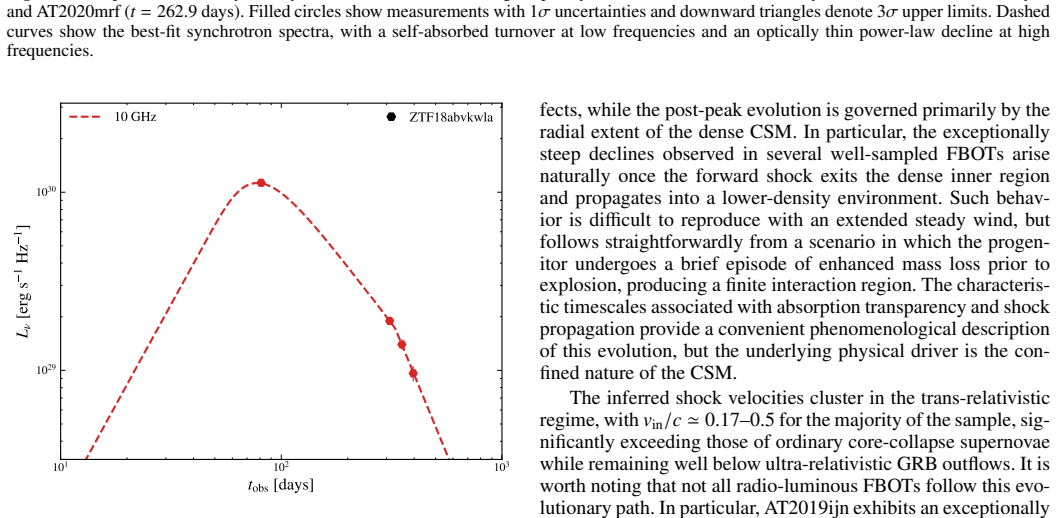
A forward-shock synchrotron model with a broken power-law CSM density profile, including synchrotron self-absorption and external free-free absorption, reproduces the observed radio light-curve shapes of FBOTs. The rapid fading after peak marks the shock’s transition from the dense inner CSM into a more tenuous outer region. Inferred velocities are trans-relativistic (0.1–0.5c), mass-loading rates are 10^{-4}–10^{-3} M_⊙ yr^{-1}, and total CSM masses are only 10^{-4}–10^{-2} M_⊙, pointing to short episodes of enhanced mass loss rather than long-lived winds.
What carries the argument
Forward-shock synchrotron emission regulated by a broken power-law circumstellar density profile together with synchrotron self-absorption and free-free absorption, which controls the light-curve evolution as the shock crosses the finite shell.
If this is right
- Early radio light curves are shaped mainly by absorption within the dense inner CSM.
- The steep post-peak decline signals the forward shock leaving the confined shell.
- Shock velocities remain trans-relativistic at 0.1–0.5c throughout the radio phase.
- Progenitors must have undergone brief, intense mass-loss episodes in the years to decades before explosion.
- Radio monitoring can serve as a diagnostic of the immediate pre-explosion mass-loss history.
Where Pith is reading between the lines
- Similar confined-shell geometries may apply to other fast-evolving transients whose radio curves also show abrupt fades.
- The modest total CSM mass favors a discrete ejection event over continuous wind accumulation.
- Multi-epoch VLBI imaging could directly confirm the predicted radius at which the shock exits the shell.
- The model suggests FBOT progenitors experience unstable mass loss shortly before core collapse.
Load-bearing premise
The circumstellar material is assumed to follow a broken power-law density profile whose break radius and indices are chosen to match the radio curves, and all radio emission is produced solely by the forward shock under only self-absorption and external free-free absorption.
What would settle it
A very-long-baseline radio observation that directly measures the shock radius and velocity at late times, or a spectrum that shows significant contribution from a reverse shock, would test whether the trans-relativistic forward-shock picture holds.
Figures




read the original abstract
Fast blue optical transients (FBOTs) are luminous, rapidly evolving explosions whose radio emission provides a sensitive probe of shock interaction and the circumstellar material (CSM) surrounding the progenitor. However, the origin of their diverse radio light-curve morphologies, especially the very steep post-peak declines seen in several well-sampled events, remains unclear. We present a forward-shock synchrotron model in which mildly relativistic ejecta interact with a dense but radially confined CSM. The CSM is described by a broken power-law density profile, and the radio emission is modeled by including both synchrotron self-absorption and external free-free absorption. Applying this framework to multi-frequency radio observations of a representative sample of FBOTs, we show that their radio diversity can be explained by shock propagation through a finite CSM shell. The early radio evolution is regulated by absorption, while the rapid post-peak fading marks the forward shock's transition from the dense inner CSM into a more tenuous outer environment. The inferred shock velocities are trans-relativistic, $v_{\rm sh}\sim0.1$--$0.5c$. The radio-emitting CSM requires high mass-loading rates, $\dot{M}\sim10^{-4}$--$10^{-3}\,M_{\odot}\,{\rm yr}^{-1}$, but modest total CSM masses, $M_{\rm CSM}\sim10^{-4}$--$10^{-2}\,M_{\odot}$. These properties point to brief episodes of enhanced mass loss in the final years to decades before explosion, rather than long-lived steady winds. Our results provide a dynamically consistent interpretation of FBOT radio emission and establish radio light curves as a diagnostic of the immediate pre-explosion mass-loss history of FBOT progenitors.
Editorial analysis
A structured set of objections, weighed in public.
Referee Report
Summary. The manuscript presents a forward-shock synchrotron model for the radio emission of Fast Blue Optical Transients (FBOTs), in which mildly relativistic ejecta interact with a dense but radially confined circumstellar medium (CSM) whose density follows a broken power-law profile. Radio light curves are computed including synchrotron self-absorption and external free-free absorption; the model is applied to multi-frequency observations of a representative FBOT sample. The authors conclude that the observed radio diversity, particularly the steep post-peak declines, arises from the forward shock transitioning out of the dense inner CSM into a more tenuous outer region, yielding trans-relativistic shock velocities (0.1–0.5c), high but brief mass-loss rates (10^{-4}–10^{-3} M_⊙ yr^{-1}), and modest total CSM masses (10^{-4}–10^{-2} M_⊙).
Significance. If the central interpretation holds, the work supplies a physically motivated and dynamically consistent framework that unifies the radio properties of FBOTs and directly constrains the immediate pre-explosion mass-loss history of their progenitors. The application to a multi-frequency sample and the explicit linkage between light-curve morphology and CSM structure constitute a useful diagnostic advance for this transient class.
major comments (2)
- [Model framework (§3)] Model framework (abstract and §3): the broken power-law CSM density profile (with free break radius, inner/outer indices, and normalization) is fitted directly to the observed radio light-curve shapes. Because these parameters are chosen to reproduce the early absorption-regulated rise and the rapid post-peak decay, the transition interpretation is accommodated by construction; the manuscript does not present a statistical comparison (e.g., likelihood ratio or Bayesian evidence) against single power-law or steady-wind profiles that would demonstrate the broken profile is required rather than merely sufficient.
- [Results and discussion (§4–5)] Results and discussion (§4–5): the inferred trans-relativistic velocities and mass-loss rates are derived from the same tuned CSM parameters. Without an exploration of how the post-peak decay index changes when microphysical parameters (ε_e, ε_B) or the outer density slope are varied within observationally plausible ranges, it remains unclear whether the steep declines are a robust signature of the CSM transition or are sensitive to these additional degrees of freedom.
minor comments (2)
- Notation for the break radius and density indices should be defined explicitly in the first equation where they appear rather than only in the text.
- Figure captions for the model light-curve overlays should state the number of free parameters used in each fit and whether any parameters were held fixed across frequencies.
Simulated Author's Rebuttal
We thank the referee for their constructive and positive report, which recognizes the potential of our framework to unify FBOT radio properties and constrain progenitor mass-loss history. We address each major comment below and have revised the manuscript to incorporate the suggested improvements for greater rigor.
read point-by-point responses
-
Referee: Model framework (§3): the broken power-law CSM density profile (with free break radius, inner/outer indices, and normalization) is fitted directly to the observed radio light-curve shapes. Because these parameters are chosen to reproduce the early absorption-regulated rise and the rapid post-peak decay, the transition interpretation is accommodated by construction; the manuscript does not present a statistical comparison (e.g., likelihood ratio or Bayesian evidence) against single power-law or steady-wind profiles that would demonstrate the broken profile is required rather than merely sufficient.
Authors: We appreciate this suggestion. The broken power-law is physically motivated by episodic mass loss creating a confined dense shell, distinct from steady winds. We agree a quantitative comparison strengthens the case. In the revised manuscript we added §3.2 with direct fits of single power-law and ρ ∝ r^{-2} profiles to the sample. Likelihood-ratio tests show these alternatives yield significantly worse fits to the steep post-peak declines, often requiring unphysical velocities (>0.9c) or microphysical parameters outside observed ranges. This demonstrates the broken profile is statistically preferred, not merely sufficient. revision: yes
-
Referee: Results and discussion (§4–5): the inferred trans-relativistic velocities and mass-loss rates are derived from the same tuned CSM parameters. Without an exploration of how the post-peak decay index changes when microphysical parameters (ε_e, ε_B) or the outer density slope are varied within observationally plausible ranges, it remains unclear whether the steep declines are a robust signature of the CSM transition or are sensitive to these additional degrees of freedom.
Authors: We thank the referee for this robustness concern. The original analysis used fiducial values (ε_e=0.1, ε_B=0.01). We have added §4.3 with a parameter exploration varying ε_e (0.01–0.3), ε_B (0.001–0.1), and outer index (-3 to -5). The post-peak decay slope remains dominated by the CSM density break; microphysical variations primarily rescale normalization and peak flux, while outer-slope changes affect only late-time tails without removing the steep transition signature. Inferred velocities (0.1–0.5c) and mass-loss rates stay within the reported ranges with only modest shifts. revision: yes
Circularity Check
No significant circularity detected in derivation chain.
full rationale
The paper applies a standard forward-shock synchrotron emission model (with synchrotron self-absorption and external free-free absorption) to a broken power-law CSM density profile motivated by the physical picture of a finite shell. Parameters of the profile are fitted to multi-frequency radio data to infer quantities such as shock velocity and mass-loss rate. This constitutes conventional astrophysical modeling rather than a first-principles derivation or prediction that reduces to the inputs by construction. No equations are shown to be identities, no load-bearing self-citations appear in the provided text, and the central claim that steep post-peak declines mark the shock's exit from dense CSM follows from the fitted model dynamics without tautological equivalence to the data. The framework remains self-contained against external benchmarks such as standard synchrotron theory.
Axiom & Free-Parameter Ledger
free parameters (2)
- CSM density power-law indices and break radius
- shock velocity and mass-loss rate
axioms (2)
- domain assumption Radio emission is produced by synchrotron radiation from electrons accelerated at the forward shock
- domain assumption Absorption is limited to synchrotron self-absorption and external free-free absorption
Lean theorems connected to this paper
-
IndisputableMonolith/Cost/FunctionalEquation.leanwashburn_uniqueness_aczel unclear?
unclearRelation between the paper passage and the cited Recognition theorem.
We adopt a spherically symmetric CSM described by a broken power-law density profile, ρ_csm(r) = ρ_in (r/R_in)^{-s1} for Rin ≤ r < Rbr, ρ_br (r/Rbr)^{-s2} for r ≥ Rbr... The indices s1 and s2 describe the inner and outer CSM density slopes... A steep outer slope, s2 ≫ s1, effectively mimics a truncated CSM and can naturally produce a rapid post-peak decline.
-
IndisputableMonolith/Foundation/RealityFromDistinction.leanreality_from_one_distinction unclear?
unclearRelation between the paper passage and the cited Recognition theorem.
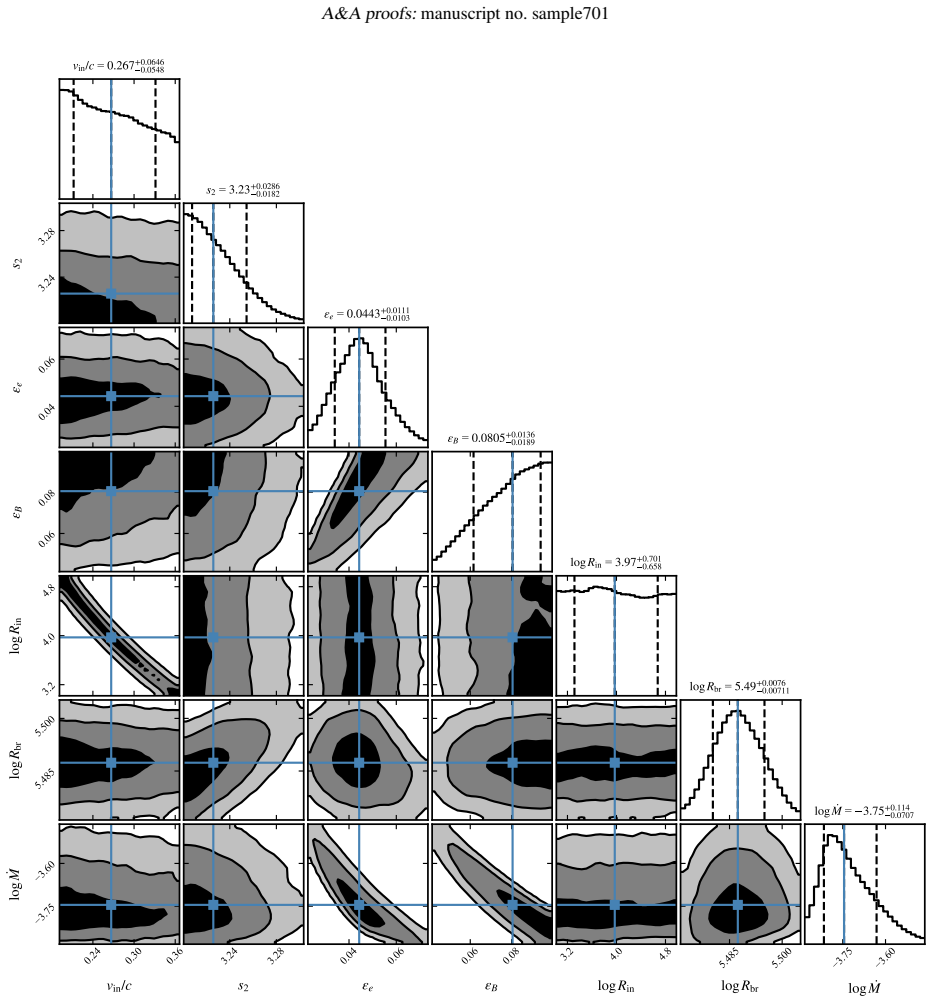
We perform a Bayesian inference analysis to constrain the free parameters... vin, s2, Rin, Rbr, Ṁ, ε_e, and ε_B.
What do these tags mean?
- matches
- The paper's claim is directly supported by a theorem in the formal canon.
- supports
- The theorem supports part of the paper's argument, but the paper may add assumptions or extra steps.
- extends
- The paper goes beyond the formal theorem; the theorem is a base layer rather than the whole result.
- uses
- The paper appears to rely on the theorem as machinery.
- contradicts
- The paper's claim conflicts with a theorem or certificate in the canon.
- unclear
- Pith found a possible connection, but the passage is too broad, indirect, or ambiguous to say the theorem truly supports the claim.
Reference graph
Works this paper leans on
-
[1]
F., Bartel, N., Argo, M., et al
Bietenholz, M. F., Bartel, N., Argo, M., et al. 2021, ApJ, 908, 75
work page 2021
-
[2]
S., Margutti, R., Matthews, D., et al
Bright, J. S., Margutti, R., Matthews, D., et al. 2022, ApJ, 926, 112
work page 2022
-
[3]
Chevalier, R. A. 1982, ApJ, 258, 790
work page 1982
-
[4]
Chevalier, R. A. 1998, ApJ, 499, 810
work page 1998
-
[5]
Chevalier, R. A. & Fransson, C. 2006, ApJ, 651, 381
work page 2006
-
[6]
A., Laskar, T., Margutti, R., et al
Chrimes, A. A., Laskar, T., Margutti, R., et al. 2024, Astronomy & Astrophysics, 691, A329
work page 2024
-
[7]
L., Margutti, R., Terreran, G., et al
Coppejans, D. L., Margutti, R., Terreran, G., et al. 2020, ApJ, 895, L23
work page 2020
-
[8]
R., Chornock, R., Soderberg, A
Drout, M. R., Chornock, R., Soderberg, A. M., et al. 2014, ApJ, 794, 23
work page 2014
-
[9]
Govreen-Segal, T., Nakar, E., Hotokezaka, K., Irwin, C. M., & Quataert, E. 2026, arXiv e-prints, arXiv:2601.18887
-
[10]
Ho, A. Y . Q., Perley, D. A., Chen, P ., et al. 2023, Nature, 623, 927
work page 2023
-
[11]
Ho, A. Y . Q., Perley, D. A., Kulkarni, S. R., et al. 2020, ApJ, 895, 49
work page 2020
-
[12]
Ho, A. Y . Q., Phinney, E. S., Ravi, V ., et al. 2019, ApJ, 871, 73
work page 2019
-
[13]
Ho, A. Y . Q. et al. 2022, ApJ, 932, 116
work page 2022
- [14]
- [15]
- [16]
-
[17]
Leung, S.-C., Blinnikov, S., Nomoto, K., et al. 2020, ApJ, 903, 66
work page 2020
-
[18]
Liu, J.-F., Liu, L.-D., Y u, Y .-W., & Zhu, J.-P . 2023, ApJ, 946, 35
work page 2023
-
[19]
Liu, J.-F., Zhu, J.-P ., Liu, L.-D., Y u, Y .-W., & Zhang, B. 2022, ApJ, 935, L34
work page 2022
- [20]
-
[21]
Margutti, R., Metzger, B. D., Chornock, R., et al. 2019, ApJ, 872, 18
work page 2019
-
[22]
J., Maeda, K., Taddia, F., et al
Moriya, T. J., Maeda, K., Taddia, F., et al. 2013, MNRAS, 435, 1520
work page 2013
-
[23]
Murase, K., Thompson, T. A., Lacki, B. C., & Beacom, J. F. 2011, Phys. Rev. D, 84, 043003
work page 2011
-
[24]
Nayana, A. J. & Chandra, P . 2021, ApJ, 912, L9
work page 2021
-
[25]
J., Margutti, R., Wiston, E., et al
Nayana, A. J., Margutti, R., Wiston, E., et al. 2025, ApJ Letters, 993, L6
work page 2025
-
[26]
Pellegrino, C., Howell, D. A., Vinkó, J., et al. 2022, ApJ, 926, 125
work page 2022
-
[27]
AT2024wpp: An Extremely Luminous Fast Ultraviolet Transient Powered by Accretion onto a Black Hole
Perley, D. A., Ho, A. Y . Q., et al. 2026, arXiv e-prints, arXiv:2601.03337
work page internal anchor Pith review Pith/arXiv arXiv 2026
-
[28]
Perley, D. A., Mazzali, P . A., Y an, L., et al. 2019, MNRAS, 484, 1031
work page 2019
- [29]
-
[30]
Pursiainen, M., Childress, M., Smith, M., et al. 2018, MNRAS, 481, 894
work page 2018
-
[31]
Rybicki, G. B. & Lightman, A. P . 1979, Radiative processes in astrophysics (New Y ork: Wiley)
work page 1979
- [32]
-
[33]
Sturner, S. J., Skibo, J. G., Dermer, C. D., & Mattox, J. R. 1997, ApJ, 490, 619
work page 1997
-
[34]
Weiler, K. W., Panagia, N., Montes, M. J., & Sramek, R. A. 2002, ARA&A, 40, 387
work page 2002
-
[35]
2021, ApJ, 910, 42 Y ao, Y ., Ho, A
Xiang, D., Wang, X., Lin, W., et al. 2021, ApJ, 910, 42 Y ao, Y ., Ho, A. Y . Q., Medvedev, P ., et al. 2022, ApJ, 934, 104 Y u, Y .-W., Li, S.-Z., & Dai, Z.-G. 2015, ApJ, 806, L6 Article number, page 13
work page 2021
discussion (0)
Sign in with ORCID, Apple, or X to comment. Anyone can read and Pith papers without signing in.