Inexact Adjoint Gradients and Directional Tolerances for Full-Potential Airfoil Optimization
Pith reviewed 2026-05-19 22:17 UTC · model grok-4.3
The pith
Inexact adjoint gradients satisfy exact descent inequalities under directional tolerances derived from residual bounds.
A machine-rendered reading of the paper's core claim, the machinery that carries it, and where it could break.
Core claim
For residuals affine in the state variable the gradient error is bounded by a linear combination of state and adjoint residual tolerances; on compact design sets the bound is uniform and yields a directional tolerance that restores the exact descent inequality, so an inexact general directions algorithm converges under standard step-size rules.
What carries the argument
The directional tolerance condition on the inexact reduced gradient, obtained from the uniform error bound on compact sets of decision variables.
If this is right
- The inexact general directions method converges when step sizes are uniformly bounded.
- Convergence is also guaranteed under diminishing step sizes.
- Armijo-type line searches preserve the convergence property.
- The framework applies directly to pressure-matching airfoil optimization governed by a full-potential solver on body-fitted meshes.
Where Pith is reading between the lines
- Larger residual tolerances could be used to reduce the number of inner solver iterations per optimization step.
- The same error-propagation argument may apply to other PDE-constrained problems whose residuals are affine in the state.
- A practical test would compare total wall-clock time to reach a given optimality tolerance with exact versus inexact gradients.
Load-bearing premise
The state and adjoint residuals must be affine in the state variable so that their tolerances combine linearly into a gradient-error bound.
What would settle it
A numerical test on the airfoil problem in which the computed inexact gradient violates the descent inequality even though the state and adjoint residuals stay inside the stated tolerances.
Figures





read the original abstract
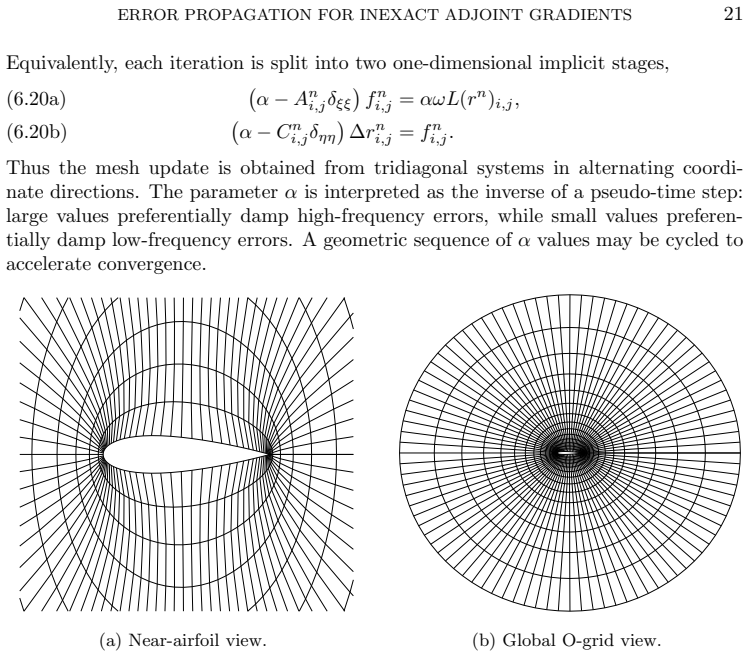
This paper develops a framework connecting discrete adjoint gradient-error analysis with an optimization method that uses directional error tolerances, and applies it to airfoil shape optimization governed by a conservative full-potential flow solver on body-fitted structured meshes. The theoretical part derives the reduced discrete adjoint formula for scalar objectives constrained by a state equation and analyzes how inexact state and adjoint residuals propagate into the reduced gradient. For residuals that are affine in the state variable, the gradient error is bounded by a linear combination of the state and adjoint residual tolerances. On compact sets of decision variables, a uniform version of this bound is obtained, leading to a directional tolerance condition under which the inexact gradient satisfies an exact descent inequality. The resulting inexact general directions method inherits convergence properties under uniformly bounded, diminishing, and Armijo-type step-size rules. The computational part combines a parabolic initial grid generator, an elliptic mesh smoother, and a full-potential discretization with artificial-density stabilization and approximate-factorization iteration. The optimization problem is formulated as a pressure-matching problem in which a class-shape-transformation airfoil parametrization is adjusted so that the computed surface pressure coefficient approaches prescribed reference data, subject to mesh-generation and full-potential residual constraints.
Editorial analysis
A structured set of objections, weighed in public.
Referee Report
Summary. The paper develops a framework connecting discrete adjoint gradient-error analysis with an optimization method that uses directional error tolerances. It derives the reduced discrete adjoint formula for scalar objectives constrained by a state equation and analyzes propagation of inexact state and adjoint residuals into the reduced gradient. For residuals affine in the state variable, the gradient error is bounded by a linear combination of the tolerances; a uniform version on compact sets of decision variables yields a directional tolerance condition ensuring an exact descent inequality. The resulting inexact general directions method inherits convergence under bounded, diminishing, and Armijo step-size rules. The framework is applied to pressure-matching airfoil shape optimization using a conservative full-potential discretization with artificial-density stabilization on body-fitted structured meshes, combined with parabolic grid generation and elliptic smoothing, and a class-shape-transformation parametrization.
Significance. If the error bounds and directional tolerances extend rigorously to the nonlinear discretization, the work supplies a principled approach to controlling inexactness in adjoint-based gradients for PDE-constrained optimization while retaining convergence guarantees. This could lower the cost of high-fidelity aerodynamic design iterations. The explicit linkage between residual tolerances and descent properties, together with the concrete airfoil application, adds practical value; the manuscript also demonstrates a reproducible computational pipeline for mesh generation and full-potential solution.
major comments (1)
- [§2 (theoretical part on gradient-error bound)] §2 (theoretical part on gradient-error bound): The linear bound on gradient error is stated to follow from a first-principles propagation analysis only when the state and adjoint residuals are affine in the state variable. The airfoil application employs a conservative full-potential discretization with artificial-density stabilization and approximate-factorization iteration; the underlying PDE is nonlinear, so the discrete residual is generally not affine. Without an explicit extension of the bound, a linearization argument that preserves affinity, or numerical verification that the effective residual satisfies the condition on the relevant compact sets, the uniform bound, directional tolerance, and exact descent inequality do not necessarily carry over to the optimization problem considered.
minor comments (2)
- [Abstract and §1] The abstract and introduction could more explicitly indicate whether the affinity assumption is verified for the stabilized full-potential residual or whether a local linearization is used to justify the bound in the computational examples.
- [§2 and §4] Notation for the reduced gradient and the directional tolerance condition should be introduced with a single consistent symbol set to avoid ambiguity when moving between the theoretical and computational sections.
Simulated Author's Rebuttal
We thank the referee for the careful reading and constructive comments on the manuscript. We address the major comment below and describe the revisions we intend to incorporate.
read point-by-point responses
-
Referee: §2 (theoretical part on gradient-error bound): The linear bound on gradient error is stated to follow from a first-principles propagation analysis only when the state and adjoint residuals are affine in the state variable. The airfoil application employs a conservative full-potential discretization with artificial-density stabilization and approximate-factorization iteration; the underlying PDE is nonlinear, so the discrete residual is generally not affine. Without an explicit extension of the bound, a linearization argument that preserves affinity, or numerical verification that the effective residual satisfies the condition on the relevant compact sets, the uniform bound, directional tolerance, and exact descent inequality do not necessarily carry over to the optimization problem considered.
Authors: We agree that the gradient-error bound in Section 2 is derived under the explicit assumption of residuals affine in the state variable. The conservative full-potential discretization with artificial-density stabilization produces a nonlinear residual, and the manuscript does not supply an extension of the linear bound, a local linearization argument, or numerical verification that the descent inequality holds for the tolerances employed on the relevant compact sets of design variables. To close this gap we will add a short subsection in the theoretical development that discusses the local validity of the bound for small residual tolerances (where nonlinear contributions are higher-order) and will include numerical checks in the results section confirming that the computed inexact gradients satisfy the exact descent inequality for the tolerances used in the airfoil examples. These additions will appear in the revised Section 2 and the computational results. revision: yes
Circularity Check
No significant circularity in derivation chain
full rationale
The paper presents a first-principles derivation of the reduced discrete adjoint formula followed by explicit error propagation analysis under the stated assumption that residuals are affine in the state variable. This produces a linear combination bound on gradient error, a uniform version on compact sets, and a directional tolerance condition, all obtained directly from the adjoint equations and residual tolerances without any reduction to fitted parameters, self-referential definitions, or load-bearing self-citations. The central claims follow from the given assumptions and algebraic manipulation rather than by construction from the target results themselves, making the derivation self-contained against external benchmarks.
Axiom & Free-Parameter Ledger
axioms (2)
- domain assumption State and adjoint residuals are affine in the state variable
- domain assumption Decision variables lie in a compact set
Lean theorems connected to this paper
-
Cost.FunctionalEquationwashburn_uniqueness_aczel unclear?
unclearRelation between the paper passage and the cited Recognition theorem.
For residuals that are affine in the state variable, the gradient error is bounded by a linear combination of the state and adjoint residual tolerances.
What do these tags mean?
- matches
- The paper's claim is directly supported by a theorem in the formal canon.
- supports
- The theorem supports part of the paper's argument, but the paper may add assumptions or extra steps.
- extends
- The paper goes beyond the formal theorem; the theorem is a base layer rather than the whole result.
- uses
- The paper appears to rely on the theorem as machinery.
- contradicts
- The paper's claim conflicts with a theorem or certificate in the canon.
- unclear
- Pith found a possible connection, but the passage is too broad, indirect, or ambiguous to say the theorem truly supports the claim.
Reference graph
Works this paper leans on
-
[1]
D. P. Bertsekas,Nonlinear Programming, Athena Scientific, 3rd ed., 2016
work page 2016
-
[2]
T. G. Kolda and B. W. Bader, Tensor decompositions and applications,SIAM Review, 51 (2009), pp. 455–500
work page 2009
-
[3]
G. K. W. Kenway, C. A. Mader, P. He, and J. R. R. A. Martins, Effective adjoint approaches for computational fluid dynamics,Progress in Aerospace Sciences, 110 (2019), 100542
work page 2019
-
[4]
P. D. Khanh, B. S. Mordukhovich, and D. B. Tran, Inexact reduced gradient methods with adaptive error control, 2024
work page 2024
-
[5]
T. L. Holst, Implicit algorithm for the conservative transonic full-potential equation using an arbitrary mesh,AIAA Journal, 17 (1979), pp. 1038–1045
work page 1979
-
[6]
T. L. Holst and W. F. Ballhaus, Fast, conservative schemes for the full potential equation applied to transonic flows,AIAA Journal, 17 (1979), pp. 145–152
work page 1979
-
[7]
B. M. Kulfan, Universal parametric geometry representation method,Journal of Aircraft, 45 (2008), pp. 142–158
work page 2008
discussion (0)
Sign in with ORCID, Apple, or X to comment. Anyone can read and Pith papers without signing in.