Reservation Based Smart Parking Management
Pith reviewed 2026-05-19 22:02 UTC · model grok-4.3
The pith
A dynamic buffer of non-reservable slots plus a star-based reputation system reduces no-park failures in reservation-based parking.
A machine-rendered reading of the paper's core claim, the machinery that carries it, and where it could break.
Core claim
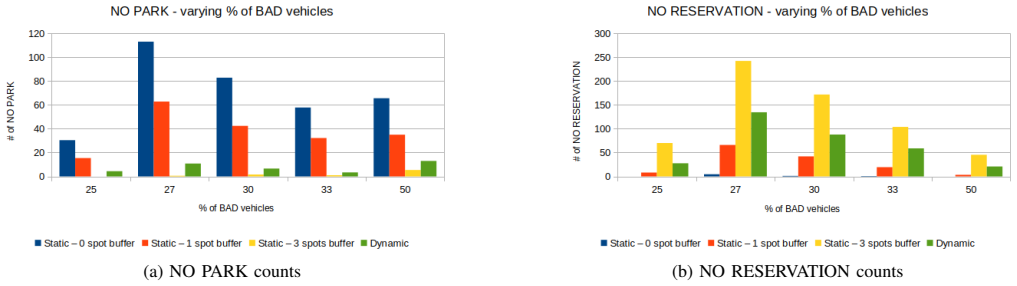
The paper introduces a dual-mechanism architecture for reservation-based smart parking. A Reservation Module employs a dynamic-size buffer of non-reservable slots to grant parking availability. A reputation-based Reward System uses a star-based metric to incentivize punctual departures through financial penalties and access restrictions. SUMO simulations show the dynamic buffer yields a better tradeoff between availability and reservation success while the reputation component progressively adapts to user behavior, mitigating no-park instances and improving utilization.
What carries the argument
Dual-mechanism architecture of a dynamic buffer strategy for non-reservable slots and a star-based reputation reward system that applies penalties and restrictions.
If this is right
- Dynamic buffer sizing improves the tradeoff between parking availability and successful reservations.
- Star-based reputation penalties and restrictions reduce the frequency of no-park situations.
- Progressive adaptation to observed user behavior increases overall parking resource utilization.
- The combined system enhances urban viability by lowering congestion linked to failed reservations.
Where Pith is reading between the lines
- The same buffer-plus-reputation pattern could apply to other time-shared urban resources such as EV charging bays or loading zones.
- Reputation scores might be shared across multiple parking operators to create city-wide incentives.
- Buffer size adaptation rules could be tuned further with real-time occupancy data to handle peak-hour surges.
Load-bearing premise
Real drivers will alter their departure times in response to star-based reputation penalties and restrictions, and the SUMO simulator will accurately reflect the resulting changes in system performance.
What would settle it
A field trial that measures the rate of no-park incidents before and after deploying the dynamic buffer and reputation penalties on the same set of parking spots.
Figures


read the original abstract
In the framework of Smart Cities and Intelligent Transportation Systems (ITS), efficient parking management is essential to reduce urban congestion and emissions. However, current reservation-based systems often encounter a scenario in which users find their reserved slot occupied by a previous occupant who failed to vacate on time ("No PARK" situation). This paper introduces a dual-mechanism architecture designed to enhance system reliability. A Reservation Module uses a dynamic size buffer of non-reservable slots to grant parking availability. A reputation-based Reward System exploits a "star-based" metric to incentivize punctual departures through financial penalties and access restrictions. The simulations conducted with the SUMO urban simulator are promising, showing that the dynamic buffer strategy provides a better tradeoff between parking availability and reservation success. By progressively adapting to users behavior, the proposed system mitigates "NO PARK" instances and improves resource utilization, significantly enhancing urban viability. Index Terms-Smart City, Intelligent transportation systems, Parking, Reservation systems, V2I, Reputation-based mechanisms, Smart Parking
Editorial analysis
A structured set of objections, weighed in public.
Referee Report
Summary. The manuscript proposes a dual-mechanism architecture for reservation-based smart parking in smart cities. A Reservation Module employs a dynamic-size buffer of non-reservable slots to balance availability and success rates. A reputation-based Reward System uses a star-based metric to apply financial penalties and access restrictions that incentivize timely departures, thereby reducing 'NO PARK' situations where reserved slots remain occupied. SUMO simulations are presented as promising, with the dynamic buffer claimed to improve the availability-success tradeoff and the reputation mechanism claimed to mitigate NO PARK instances while enhancing resource utilization.
Significance. If the claimed performance gains were supported by quantitative metrics, baselines, and behavioral validation, the work could offer a practical contribution to intelligent transportation systems by addressing a common failure mode in reservation parking. The combination of dynamic buffering and incentive mechanisms is a plausible direction, but the absence of reported numbers, comparisons, or calibration data means the significance cannot yet be assessed from the presented evidence.
major comments (3)
- [Abstract / Simulation Results] Abstract and Simulation Results section: The claim that 'simulations conducted with the SUMO urban simulator are promising' and that the dynamic buffer 'provides a better tradeoff' is unsupported; no quantitative results, error bars, baseline comparisons (e.g., against static buffers or existing reservation systems), or validation against real parking occupancy data are supplied, leaving the central performance assertions without empirical grounding.
- [Reputation-based Reward System] Reputation System description: The assertion that the star-based reputation metric 'mitigates NO PARK instances and improves resource utilization' rests on an unvalidated behavioral model; the text assumes users will alter departure times in response to penalties and restrictions, yet provides no calibration against observed user data, no sensitivity analysis on compliance rates, and no description of how the SUMO agent model implements this response.
- [Reservation Module] Dynamic buffer strategy: The free parameter governing 'dynamic size buffer adjustment rule' is introduced without a precise algorithmic specification or proof that the adaptation rule is stable or converges under realistic arrival/departure distributions.
minor comments (2)
- [Abstract] The abstract contains a minor grammatical issue ('exploits a star-based metric to incentivize punctual departures through financial penalties and access restrictions') that could be clarified for readability.
- [Simulation Setup] No mention of the specific SUMO version, network topology, or traffic demand parameters used in the simulations; these details would aid reproducibility.
Simulated Author's Rebuttal
We thank the referee for the constructive and detailed feedback on our manuscript. We have reviewed each major comment carefully and provide point-by-point responses below, along with our plans for revision where applicable.
read point-by-point responses
-
Referee: [Abstract / Simulation Results] Abstract and Simulation Results section: The claim that 'simulations conducted with the SUMO urban simulator are promising' and that the dynamic buffer 'provides a better tradeoff' is unsupported; no quantitative results, error bars, baseline comparisons (e.g., against static buffers or existing reservation systems), or validation against real parking occupancy data are supplied, leaving the central performance assertions without empirical grounding.
Authors: We agree that the current presentation of results is primarily qualitative and lacks sufficient quantitative support. In the revised manuscript, we will add specific performance metrics from the SUMO simulations, including average parking availability rates, reservation success rates, and resource utilization percentages, along with error bars on the relevant figures. We will also include direct comparisons against a static buffer baseline and a simple first-come-first-served reservation system. Regarding validation against real parking occupancy data, this is outside the scope of the present simulation-focused study. revision: yes
-
Referee: [Reputation-based Reward System] Reputation System description: The assertion that the star-based reputation metric 'mitigates NO PARK instances and improves resource utilization' rests on an unvalidated behavioral model; the text assumes users will alter departure times in response to penalties and restrictions, yet provides no calibration against observed user data, no sensitivity analysis on compliance rates, and no description of how the SUMO agent model implements this response.
Authors: The reputation mechanism is implemented as a rule-based adjustment in the SUMO agent behavior model, where agents with lower star ratings incur penalties that probabilistically influence their departure scheduling. We will expand the manuscript to include a detailed description of this implementation, pseudocode for the agent decision logic, and a sensitivity analysis varying compliance rates from 50% to 90%. Calibration against specific real-world user datasets is not available for this work, but the model draws on established incentive principles from transportation literature. revision: partial
-
Referee: [Reservation Module] Dynamic buffer strategy: The free parameter governing 'dynamic size buffer adjustment rule' is introduced without a precise algorithmic specification or proof that the adaptation rule is stable or converges under realistic arrival/departure distributions.
Authors: We will include a precise algorithmic specification of the dynamic buffer adjustment rule, including the exact update formula and pseudocode, in the revised Reservation Module section. To address stability, we will present additional simulation results showing buffer size evolution and system performance under varied Poisson arrival rates and exponential departure distributions. A formal mathematical proof of convergence is not provided, as the rule is a heuristic designed for practical adaptation rather than a theoretically guaranteed process. revision: yes
- Validation against real-world parking occupancy data from operational smart city systems, which would require external datasets not accessible within the current simulation study.
Circularity Check
No significant circularity in system proposal or simulation results
full rationale
The paper presents a high-level architecture for a reservation-based smart parking system consisting of a dynamic buffer module and a star-based reputation mechanism, with performance evaluated through SUMO simulations. No mathematical derivations, equations, parameter fittings, or self-citations appear that reduce any claimed prediction or result to the inputs by construction. The reported improvements in availability, reservation success, and NO PARK mitigation are direct outputs of the described simulation rules and assumed user compliance, without tautological self-definition or load-bearing self-referential steps. This constitutes a standard design proposal and empirical evaluation without circular elements in the reasoning chain.
Axiom & Free-Parameter Ledger
free parameters (1)
- dynamic buffer size adjustment rule
axioms (1)
- domain assumption Drivers will alter departure times in response to financial penalties and future access restrictions tied to a star-based reputation score.
invented entities (1)
-
star-based reputation metric
no independent evidence
Lean theorems connected to this paper
-
IndisputableMonolith/Cost/FunctionalEquation.leanwashburn_uniqueness_aczel unclear?
unclearRelation between the paper passage and the cited Recognition theorem.
The dynamic buffer strategy provides a better tradeoff between parking availability and reservation success while the reputation system mitigates NO PARK instances
-
IndisputableMonolith/Foundation/ArithmeticFromLogic.leanabsolute_floor_iff_bare_distinguishability unclear?
unclearRelation between the paper passage and the cited Recognition theorem.
A reputation-based Reward System exploits a star-based metric to incentivize punctual departures through financial penalties and access restrictions
What do these tags mean?
- matches
- The paper's claim is directly supported by a theorem in the formal canon.
- supports
- The theorem supports part of the paper's argument, but the paper may add assumptions or extra steps.
- extends
- The paper goes beyond the formal theorem; the theorem is a base layer rather than the whole result.
- uses
- The paper appears to rely on the theorem as machinery.
- contradicts
- The paper's claim conflicts with a theorem or certificate in the canon.
- unclear
- Pith found a possible connection, but the passage is too broad, indirect, or ambiguous to say the theorem truly supports the claim.
Reference graph
Works this paper leans on
-
[1]
A survey of parking solu- tions for smart cities,
M. Aljohani, S. Olariu, A. Alali, and S. Jain, “A survey of parking solu- tions for smart cities,”IEEE Transactions on Intelligent Transportation Systems, vol. 23, no. 8, pp. 10 012–10 029, 2021
work page 2021
-
[2]
Parking prediction in smart cities: A survey,
X. Xiao, Z. Peng, Y . Lin, Z. Jin, W. Shao, R. Chen, N. Cheng, and G. Mao, “Parking prediction in smart cities: A survey,”IEEE Transactions on Intelligent Transportation Systems, vol. 24, no. 10, pp. 10 302–10 326, 2023
work page 2023
-
[3]
Optimizing urban parking spaces to improve the efficiency of the trans- port system,
I. Makarova, V . Mavrin, L. Gabsalikhova, A. Boyko, and M. Jayabalan, “Optimizing urban parking spaces to improve the efficiency of the trans- port system,” in2025 18th International Conference on Development in eSystem Engineering (DeSE). IEEE, 2025, pp. 158–162
work page 2025
-
[4]
Asap: An agent- assisted smart auction-based parking system in internet of things,
S. R. Rizvi, S. Zehra, R. Mukkamala, and S. Olariu, “Asap: An agent- assisted smart auction-based parking system in internet of things,” in Proceedings of the 9th ACM Symposium on Design and Analysis of Intelligent Vehicular Networks and Applications, 2019, pp. 1–8
work page 2019
-
[5]
Mapark: A multi-agent auction- based parking system in internet of things,
S. R. Rizvi, S. Zehra, and S. Olariu, “Mapark: A multi-agent auction- based parking system in internet of things,”IEEE Intelligent Transporta- tion Systems Magazine, vol. 13, no. 4, pp. 104–115, 2020
work page 2020
-
[6]
Evaluating infrastructure-less cooperative parking guidance via agent-based simu- lation,
D. De Soricellis, A. Ferrando, and F. Muzzini, “Evaluating infrastructure-less cooperative parking guidance via agent-based simu- lation,” inInternational Conference on Practical Applications of Agents and Multi-Agent Systems. Springer, 2025, pp. 53–64
work page 2025
-
[7]
Auction-based parking reser- vation system with electricity trading,
S. Hashimoto, R. Kanamori, and T. Ito, “Auction-based parking reser- vation system with electricity trading,” in2013 IEEE 15th Conference on Business Informatics. IEEE, 2013, pp. 33–40
work page 2013
-
[8]
E. Kokolaki, M. Karaliopoulos, and I. Stavrakakis, “Trading public parking space,” inProceeding of IEEE International Symposium on a World of Wireless, Mobile and Multimedia Networks 2014. IEEE, 2014, pp. 1–6
work page 2014
-
[9]
Improving service quality for parking lot users using intelligent parking reservation poli- cies,
N. Doulamis, E. Protopapadakis, and L. Lambrinos, “Improving service quality for parking lot users using intelligent parking reservation poli- cies,” in2013 27th International Conference on Advanced Information Networking and Applications Workshops. IEEE, 2013, pp. 1392–1397
work page 2013
-
[10]
Smartparking: A secure and intelligent parking system,
G. Yan, W. Yang, D. B. Rawat, and S. Olariu, “Smartparking: A secure and intelligent parking system,”IEEE intelligent transportation systems magazine, vol. 3, no. 1, pp. 18–30, 2011
work page 2011
-
[11]
Parking reservation-application dedi- cated for car users based on telecommunications apis,
P. Trusiewicz and J. Legierski, “Parking reservation-application dedi- cated for car users based on telecommunications apis,” in2013 Feder- ated Conference on Computer Science and Information Systems. IEEE, 2013, pp. 865–869
work page 2013
-
[12]
Application based smart parking reservation system using openalpr,
K. Tejas, U. Yadav, V . V . Krishnan, K. Vishrutha, and S. Mallikarjuna, “Application based smart parking reservation system using openalpr,” Eng. Manage., vol. 55, pp. 4811–4816, 2020
work page 2020
-
[13]
R. R. Safitri, A. Pratiarso, and A. Zainudin, “Mobile-based smart parking reservation system with rate display occupancy using heuristic algorithm and haversine formula,” in2020 International Electronics Symposium (IES). IEEE, 2020, pp. 332–339
work page 2020
-
[14]
Secsps: A secure and privacy-preserving framework for smart parking systems,
A. Alqazzaz, I. Alrashdi, E. Aloufi, M. Zohdy, and H. Ming, “Secsps: A secure and privacy-preserving framework for smart parking systems,” J. Inf. Secur, vol. 9, no. 4, pp. 299–314, 2018
work page 2018
-
[15]
Cross platform smart reservation based parking system,
A. Somani, S. Periwal, K. Patel, and P. Gaikwad, “Cross platform smart reservation based parking system,” in2018 International Conference on Smart City and Emerging Technology (ICSCET). IEEE, 2018, pp. 1–5
work page 2018
-
[16]
Reservation-based multi-objective smart parking approach for smart cities,
N. Mejri, M. Ayari, R. Langar, and L. Saidane, “Reservation-based multi-objective smart parking approach for smart cities,” in2016 IEEE International Smart Cities Conference (ISC2). IEEE, 2016, pp. 1–6
work page 2016
-
[17]
Y . Xiao, Z. Cai, J. Li, M. Liang, and X. Long, “A collaborative reservation mechanism of multiple parking lots based on dynamic vehicle path planning,”Journal of Advanced Transportation, vol. 2021, no. 1, p. 8876069, 2021
work page 2021
-
[18]
iparker—a new smart car-parking system based on dynamic resource allocation and pricing,
A. O. Kotb, Y .-C. Shen, X. Zhu, and Y . Huang, “iparker—a new smart car-parking system based on dynamic resource allocation and pricing,” IEEE transactions on intelligent transportation systems, vol. 17, no. 9, pp. 2637–2647, 2016
work page 2016
-
[19]
Smart parking for all: equipped and non-equipped vehicles in smart cities,
F. Muzzini, M. Montangero, and N. Capodieci, “Smart parking for all: equipped and non-equipped vehicles in smart cities,” inInternational Symposium on Intelligent and Distributed Computing. Springer, 2022, pp. 257–266
work page 2022
-
[20]
Improving urban viabil- ity through smart parking,
F. Muzzini, N. Capodieci, and M. Montangero, “Improving urban viabil- ity through smart parking,”International Journal of Parallel, Emergent and Distributed Systems, vol. 38, no. 6, pp. 522–540, 2023
work page 2023
discussion (0)
Sign in with ORCID, Apple, or X to comment. Anyone can read and Pith papers without signing in.