Enhancing Network Resilience via Graph-Based Anomaly Detection in Sovereign Functions
Pith reviewed 2026-05-19 22:32 UTC · model grok-4.3
The pith
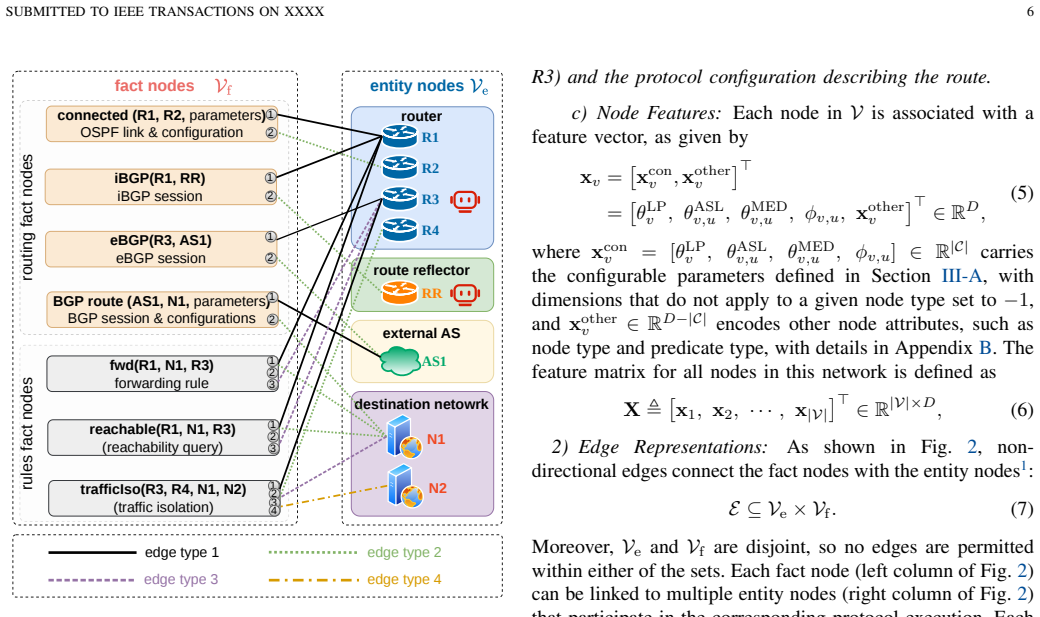
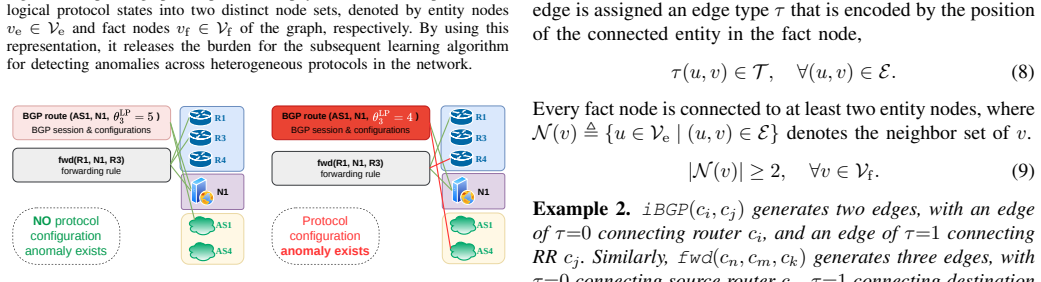
GSID detects protocol configuration anomalies by identifying structural inconsistencies in a bipartite graph linking physical entities to logical states.
A machine-rendered reading of the paper's core claim, the machinery that carries it, and where it could break.
Core claim
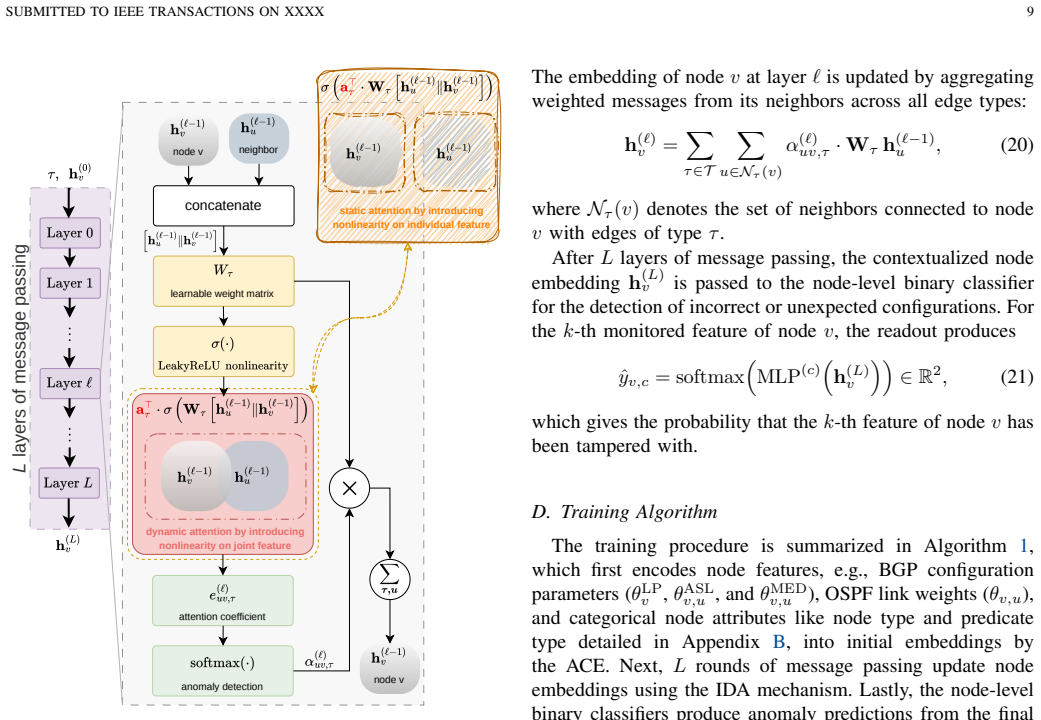
The GSID model solves the protocol configuration anomaly detection problem by treating it as detection of structural inconsistencies in a bipartite graph that captures both physical network entities and logical protocol states, employing an adaptive configuration encoder to handle heterogeneous parameters and an inconsistency dynamic attention mechanism that scores edges by drawing rule compliance from one end and route connectivity from the other.
What carries the argument
Graph Structural Inconsistency Detector (GSID) that converts anomaly detection into structural inconsistency scoring on a bipartite graph, using adaptive encoding for parameter variety and dynamic asymmetric attention to surface edge mismatches.
If this is right
- GSID outperforms state-of-the-art baselines by threefold in F1 score and by 23.2 percent in accuracy on configuration anomaly detection.
- Ablation studies confirm that both the adaptive configuration encoder and the inconsistency dynamic attention mechanism contribute to the performance gains.
- Tests on unseen network scales and real-world topologies demonstrate superior adaptability compared with baselines.
- The approach can enhance network resilience by identifying anomalies that arise from protocol configuration errors.
Where Pith is reading between the lines
- The same bipartite-graph framing could be extended to track configuration drift over time rather than only static snapshots.
- Integration with automated configuration tools might allow networks to flag and correct inconsistencies before they propagate.
- Similar inconsistency scoring could apply to other layered systems where physical resources connect to logical rules, such as software-defined infrastructure.
Load-bearing premise
The bipartite graph constructed from physical network entities and logical protocol states is assumed to capture the relevant structural inconsistencies that correspond to actual configuration anomalies without significant missing relationships or noise.
What would settle it
Running GSID on a live network and finding that most flagged inconsistencies do not correspond to observable failures, routing errors, or configuration problems that actually affect operation would show the method does not detect meaningful anomalies.
Figures





read the original abstract
Sovereign network functions, e.g., routing protocols, are becoming increasingly complex and susceptible to failures arising from protocol configuration anomalies and anomalous configurations. This paper interprets the protocol configuration anomaly detection problem as detection of structural inconsistencies of connected nodes and edges in a bipartite graph that captures both physical network entities and logical protocol states. This graph structural inconsistency detector (GSID) model is proposed to solve the problem efficiently. To handle the heterogeneous nature of protocol configuration parameters, GSID employs an adaptive configuration encoder (ACE) that dynamically selects encoding strategies per parameter to preserve fine-grained numerical discrepancies. To expose the subtle inconsistencies of connected nodes and edges in the bipartite graph, GSID uses an inconsistency dynamic attention (IDA) mechanism that scores edges by drawing asymmetric attentions from both ends, rule compliance from one end and route connectivity from the other. It is demonstrated experimentally that GSID outperforms state-of-the-art baselines by threefold in F1 score and by 23.2% in accuracy. Ablation studies validate the effectiveness of both the ACE and IDA modules. Tests on unseen network scales and real-world network topologies show the superior adaptability of our GSID, compared to the baselines.
Editorial analysis
A structured set of objections, weighed in public.
Referee Report
Summary. The manuscript proposes the Graph Structural Inconsistency Detector (GSID) to detect configuration anomalies in sovereign network functions by modeling them as structural inconsistencies in a bipartite graph that represents both physical network entities and logical protocol states. The approach introduces an Adaptive Configuration Encoder (ACE) to dynamically select encoding strategies for heterogeneous parameters and an Inconsistency Dynamic Attention (IDA) mechanism that scores edges using asymmetric attentions drawn from rule compliance and route connectivity. Experimental results claim that GSID outperforms state-of-the-art baselines by a factor of three in F1 score and by 23.2% in accuracy, with supporting ablation studies on the ACE and IDA modules plus generalization tests on unseen network scales and real-world topologies.
Significance. If the reported performance gains and generalization results hold under rigorous validation, the work could meaningfully advance network resilience techniques by offering a graph-based method tailored to protocol configuration anomalies. The ACE and IDA components provide targeted handling of parameter heterogeneity and subtle edge inconsistencies, which may extend to other graph anomaly tasks in networking. The emphasis on adaptability to different scales adds practical value for deployment in complex sovereign functions.
major comments (2)
- Abstract and §4 (Experimental Evaluation): The abstract states clear performance gains but supplies no information on datasets, baseline implementations, statistical tests, or potential post-hoc choices, leaving the central empirical claim without visible supporting detail. This is load-bearing for the threefold F1 and 23.2% accuracy assertions.
- §3 (Graph Construction and Modeling): The bipartite graph is assumed to capture the relevant structural inconsistencies that correspond to actual configuration anomalies without significant missing relationships or noise, yet no independent validation (e.g., expert-labeled anomalies or protocol log cross-checks) is described to confirm that edge/node inconsistencies align with real anomalies rather than artifacts of graph construction.
minor comments (2)
- Ensure consistent first-use definitions for acronyms GSID, ACE, and IDA in the main body.
- Clarify the exact composition of the real-world network topologies used in the generalization tests.
Simulated Author's Rebuttal
We thank the referee for the constructive comments and the opportunity to clarify our work. We address each major comment below with point-by-point responses, indicating where revisions have been made to strengthen the manuscript.
read point-by-point responses
-
Referee: Abstract and §4 (Experimental Evaluation): The abstract states clear performance gains but supplies no information on datasets, baseline implementations, statistical tests, or potential post-hoc choices, leaving the central empirical claim without visible supporting detail. This is load-bearing for the threefold F1 and 23.2% accuracy assertions.
Authors: We acknowledge that the abstract is concise and omits explicit details on the evaluation setup. Section 4 describes the datasets (synthetic networks generated from protocol models across varying scales plus real-world topologies), baseline reproductions (standard graph anomaly detectors with hyperparameters matched to original publications), and statistical procedures (results averaged over 10 random seeds with t-tests for significance). No post-hoc selection occurred; all configurations are reported. We have revised the abstract to include a one-sentence summary of the datasets and evaluation scope, and added a clarifying paragraph in §4 on baseline implementation and statistical testing. revision: yes
-
Referee: §3 (Graph Construction and Modeling): The bipartite graph is assumed to capture the relevant structural inconsistencies that correspond to actual configuration anomalies without significant missing relationships or noise, yet no independent validation (e.g., expert-labeled anomalies or protocol log cross-checks) is described to confirm that edge/node inconsistencies align with real anomalies rather than artifacts of graph construction.
Authors: The bipartite graph is derived directly from protocol specifications: nodes encode physical entities and logical states, while edges represent rule compliance and route connectivity extracted from standard protocol definitions. Anomalies are injected as explicit violations of these relations, aligning inconsistencies with anomalies by construction. We did not perform separate expert labeling or log cross-checks, which is a limitation of the current study. We have expanded §3 with additional justification of the mapping from graph structure to protocol anomalies and noted the reliance on specification-driven construction. revision: partial
Circularity Check
No circularity: empirical model proposal with independent experimental validation
full rationale
The paper introduces GSID as a graph-based anomaly detector using a bipartite graph of physical/logical entities, an adaptive configuration encoder (ACE), and an inconsistency dynamic attention (IDA) mechanism. All performance claims (3x F1, +23.2% accuracy, ablation results, generalization to unseen scales and real topologies) are presented as outcomes of experimental evaluation on test data, not as derivations or predictions that reduce to the model's own fitted parameters or definitions by construction. No equations, self-citations, or uniqueness theorems are invoked in the provided text to force the results. The graph-construction assumption is a modeling choice subject to external validation, not a self-referential loop.
Axiom & Free-Parameter Ledger
axioms (1)
- domain assumption A bipartite graph of physical entities and logical protocol states can represent configuration anomalies as structural inconsistencies
invented entities (3)
-
GSID model
no independent evidence
-
ACE module
no independent evidence
-
IDA mechanism
no independent evidence
Lean theorems connected to this paper
-
IndisputableMonolith/Cost/FunctionalEquation.leanwashburn_uniqueness_aczel unclear?
unclearRelation between the paper passage and the cited Recognition theorem.
GSID employs an adaptive configuration encoder (ACE) that dynamically selects encoding strategies per parameter... inconsistency dynamic attention (IDA) mechanism that scores edges by drawing asymmetric attentions from both ends
What do these tags mean?
- matches
- The paper's claim is directly supported by a theorem in the formal canon.
- supports
- The theorem supports part of the paper's argument, but the paper may add assumptions or extra steps.
- extends
- The paper goes beyond the formal theorem; the theorem is a base layer rather than the whole result.
- uses
- The paper appears to rely on the theorem as machinery.
- contradicts
- The paper's claim conflicts with a theorem or certificate in the canon.
- unclear
- Pith found a possible connection, but the passage is too broad, indirect, or ambiguous to say the theorem truly supports the claim.
Forward citations
Cited by 1 Pith paper
-
Sample-Efficient Misconfiguration Classification for Network Resilience in Wireless Communications
EtaGATv2, an edge-type-aware graph attention network, classifies protocol misconfigurations in wireless networks at state-of-the-art levels using 50% of the training samples by addressing non-uniform symptom propagati...
Reference graph
Works this paper leans on
-
[1]
Re- silience and failure analysis in next-generation communication networks: A contemporary survey,
S. Bi, X. Yuan, S. Hu, K. Li, W. Ni, E. Hossain, and X. Wang, “Re- silience and failure analysis in next-generation communication networks: A contemporary survey,”IEEE Trans. Network Sci. Eng., vol. 13, pp. 2793–2821, 2026
work page 2026
-
[2]
Enhancing the resilience of communication networks,
OECD, “Enhancing the resilience of communication networks,” Organ- isation for Economic Co-operation and Development, Tech. Rep., 2025
work page 2025
-
[3]
B. Karaman, I. Basturk, S. Taskin, F. Kara, E. Zeydan, and H. Yanikomeroglu, “Enhancing resiliency of integrated space-air ground- sea networks with renewable energies: A use case after the 2023 t ¨urkiye earthquake,”IEEE Commun. Mag., vol. 62, no. 12, pp. 104–111, 2024
work page 2023
-
[4]
G. Kaur and P. Chanak, “An intelligent fault tolerant data routing scheme for wireless sensor network-assisted industrial Internet of Things,”IEEE Trans. Ind. Inf., vol. 19, no. 4, pp. 5543–5553, 2023
work page 2023
-
[5]
R. Owenet al., “Failures and resilience in the IP era: Navigating the fragility of modern telecommunications networks–the sovereign functions,”IEEE Access, vol. 13, pp. 155 759–155 777, 2025
work page 2025
-
[6]
J. P. Sterbenzet al., “Resilience and survivability in communication networks: Strategies, principles, and survey of disciplines,”Computer Networks, vol. 54, no. 8, pp. 1245–1265, 2010
work page 2010
-
[8]
GraphBGP: BGP anomaly detection based on dynamic graph learning,
Z. Wu, Y . Li, X. Wang, Z. Diao, W. Fan, F. Xiao, and G. Xie, “GraphBGP: BGP anomaly detection based on dynamic graph learning,” IEEE Trans. Inf. Forensics Secur., vol. 20, pp. 9864–9877, 2025
work page 2025
-
[9]
Stochastic anal- ysis of double blockchain architecture in IoT communication networks,
X. Hao, P. L. Yeoh, Z. Ji, Y . Yu, B. Vucetic, and Y . Li, “Stochastic anal- ysis of double blockchain architecture in IoT communication networks,” IEEE Internet Things J., vol. 9, no. 12, pp. 9700–9711, 2022
work page 2022
-
[10]
February 22, 2024 AT&T mo- bility network outage: Report and findings,
Federal Communications Commission, “February 22, 2024 AT&T mo- bility network outage: Report and findings,” https://docs.fcc.gov/public/ attachments/DOC-404150A1.pdf, Jul. 2024, accessed: 2025-05-05. SUBMITTED TO IEEE TRANSACTIONS ON XXXX 17
work page 2024
-
[11]
The July 2 communication failure and our re- sponse,
KDDI Corporation, “The July 2 communication failure and our re- sponse,” https://www.kddi.com/english/important-news/20220729 01/, 2022, accessed: 2025-05-05
-
[12]
June 15, 2020 T-Mobile network outage report,
Federal Communications Commission, “June 15, 2020 T-Mobile network outage report,” https://docs.fcc.gov/public/attachments/ DOC-367699A1.pdf, Oct. 2020, accessed: 2025-05-05
work page 2020
-
[13]
Understanding BGP misconfiguration,
R. Mahajan, D. Wetherall, and T. Anderson, “Understanding BGP misconfiguration,” inProceedings of Conf. Appl., Technol., Archit., Protoc. Comput. Commun. (SIGCOMM), New York, USA, 2002
work page 2002
-
[14]
Catastrophic cascade of failures in interdependent networks,
S. V . Buldyrev, R. Parshani, G. Paul, H. E. Stanley, and S. Havlin, “Catastrophic cascade of failures in interdependent networks,”Nature, vol. 464, no. 7291, pp. 1025–1028, 2010
work page 2010
-
[15]
Network-centric auditing and regulation for cryptocur- rency systems: A tutorial,
Q. Dinget al., “Network-centric auditing and regulation for cryptocur- rency systems: A tutorial,”IEEE Trans. Network Sci. Eng., vol. 13, pp. 7498–7511, 2026
work page 2026
-
[16]
From large AI models to agentic AI: A tutorial on future intelligent communications,
F. Jiang, C. Pan, K. Wang, P. Michiardi, O. A. Dobre, and M. Debbah, “From large AI models to agentic AI: A tutorial on future intelligent communications,”IEEE J. Sel. Areas Commun., vol. 44, pp. 3507–3540, 2026
work page 2026
-
[17]
C. Liu, W. Yuan, S. Li, X. Liu, H. Li, D. W. K. Ng, and Y . Li, “Learning- based predictive beamforming for integrated sensing and communication in vehicular networks,”IEEE J. Sel. Areas Commun., vol. 40, no. 8, pp. 2317–2334, Aug. 2022
work page 2022
-
[18]
H. Fang, P. Yu, X. Liu, J. Liu, Z. Qu, Y . Wang, W. Li, S. Guo, and C. Wu, “Graph-aware diffusion policy for fault-tolerant agentic AI service migration in edge computing power networks,”IEEE Trans. Network Sci. Eng., vol. 13, pp. 5992–6009, 2026
work page 2026
-
[19]
Y . Lu, S. Zhang, C. Liu, R. Zhang, B. Ai, D. Niyato, W. Ni, X. Wang, and A. Jamalipour, “Agentic graph neural networks for wireless commu- nications and networking toward edge general intelligence: A survey,” IEEE Commun. Surv. Tutorials, vol. 28, pp. 4519–4554, 2026
work page 2026
-
[20]
B. Zhu, X. Wang, and D. Niyato, “Task-specific trust evaluation for multi-hop collaborator selection via GNN-aided distributed agentic AI,” IEEE J. Sel. Areas Commun., vol. 44, pp. 2411–2426, 2026
work page 2026
-
[21]
BGP anomaly detection techniques: A survey,
B. Al-Musawi, P. Branch, and G. Armitage, “BGP anomaly detection techniques: A survey,”IEEE Commun. Surv. Tutorials, vol. 19, no. 1, pp. 377–396, 2017
work page 2017
-
[22]
ACMA statement on Optus Triple Zero investigation,
Australian Communications and Media Authority, “ACMA statement on Optus Triple Zero investigation,” https://www.acma.gov.au/articles/ 2025-09/acma-statement-optus-triple-zero-investigation, September 2025, accessed: 18 April 2026
work page 2025
-
[23]
Z. Wuet al., “CloudTrie: An uncertainty-quantified anomaly detection framework for prefix hijacking with multisource fusion,”IEEE Trans. Instrum. Meas., vol. 75, pp. 1–14, 2026
work page 2026
-
[24]
Provisioning for interdomain quality of service: the mescal approach,
M. Howarthet al., “Provisioning for interdomain quality of service: the mescal approach,”IEEE Commun. Mag., vol. 43, no. 6, pp. 129–137, 2005
work page 2005
-
[25]
On the importance of resilience engineering for networked systems in a changing world,
D. Hutchison, D. Pezaros, J. Rak, and P. Smith, “On the importance of resilience engineering for networked systems in a changing world,” IEEE Commun. Mag., vol. 61, no. 11, pp. 200–206, 2023
work page 2023
-
[26]
Resilient and robust QoS-preserving post-fault VNF placement,
D. M. Manias, A. Chouman, J. Naoum-Sawaya, and A. Shami, “Resilient and robust QoS-preserving post-fault VNF placement,”IEEE Network- ing Lett., vol. 5, no. 4, pp. 270–274, 2023
work page 2023
-
[27]
Minimum candidate selection al- gorithm for hybrid IP/SDN networks with single link failures,
N. Vuppalapati and T. Venkatesh, “Minimum candidate selection al- gorithm for hybrid IP/SDN networks with single link failures,”IEEE Networking Lett., vol. 4, no. 3, pp. 152–156, 2022
work page 2022
-
[28]
Reliably route IoT packets in software defined mmwave mesh networks,
T.-Q. Bai, C.-Y . Huang, and Y .-K. Lee, “Reliably route IoT packets in software defined mmwave mesh networks,”IEEE Networking Lett., vol. 5, no. 1, pp. 50–54, 2023
work page 2023
-
[29]
S. Imanaka, M. Inoue, and E. Oki, “Failure-resilient server allocation model with single-database connectivity for delay-sensitive Internet-of- Things monitoring,”IEEE Networking Lett., vol. 7, no. 3, pp. 215–219, 2025
work page 2025
-
[30]
An AI-driven intent-based network architecture,
Y . Njah, A. Leivadeas, and M. Falkner, “An AI-driven intent-based network architecture,”IEEE Commun. Mag., vol. 63, no. 4, pp. 146– 153, 2025
work page 2025
-
[31]
NetKG: Synthesizing interpretable network router configurations with knowledge graph,
Z. Guo, F. Li, P. Zhang, X. Wang, and J. Cao, “NetKG: Synthesizing interpretable network router configurations with knowledge graph,” IEEE Trans. Comput., vol. 74, no. 11, pp. 3722–3735, 2025
work page 2025
-
[32]
Experiences with modeling network topologies at multiple levels of abstraction,
J. C. Mogulet al., “Experiences with modeling network topologies at multiple levels of abstraction,” in17th USENIX Symp. Networked Systems Design and Implementation (NSDI), 2020, pp. 403–418
work page 2020
-
[33]
Self-healing in knowledge-driven autonomous networks: Context, challenges, and future directions,
H. Fanget al., “Self-healing in knowledge-driven autonomous networks: Context, challenges, and future directions,”IEEE Network, vol. 38, no. 6, pp. 425–432, 2024
work page 2024
-
[34]
A border gateway protocol 4 (bgp-4),
Y . Rekhter, T. Li, and S. Hares, “A border gateway protocol 4 (bgp-4),” RFC 4271 (Draft Standard), Jan. 2006. [Online]. Available: https://datatracker.ietf.org/doc/html/rfc4271
work page 2006
-
[35]
J. Moy, “Ospf version 2,” RFC 2328 (Internet Standard), Apr. 1998. [Online]. Available: https://datatracker.ietf.org/doc/html/rfc2328
work page 1998
-
[36]
On supporting ip routing in the next generation of mobile systems,
H. Hellaoui, M. Laitila, M. Isom ¨aki, and H. Chao, “On supporting ip routing in the next generation of mobile systems,”IEEE Communica- tions Standards Magazine, vol. 9, no. 1, pp. 44–50, 2025
work page 2025
-
[37]
M. A. Onsu, P. Lohan, B. Kantarci, and E. Janulewicz, “A generative model-guided distributed DRL framework for scalable and efficient SFC orchestration in future network architectures,”IEEE Trans. Network Sci. Eng., vol. 13, pp. 2708–2725, 2026
work page 2026
-
[38]
TOAST: Task-oriented adaptive semantic transmission over dynamic wireless environments,
S. Yun, J. Pei, and P. Wang, “TOAST: Task-oriented adaptive semantic transmission over dynamic wireless environments,”IEEE Trans. Net- work Sci. Eng., vol. 13, pp. 4331–4349, 2026
work page 2026
-
[39]
X. Ruan, J. Feng, C. Xu, and J. Wang, “Observer-based dynamic event-triggered strategies for leader-following consensus of multi-agent systems with disturbances,”IEEE Trans. Network Sci. Eng., vol. 7, no. 4, pp. 3148–3158, 2020
work page 2020
-
[40]
X. Ma, F. Fang, T. Liu, and X. Wang, “Dynamic authentication and granularized authorization with a cross-domain zero trust architecture in large-scale iot networks,”IEEE Trans. Network Sci. Eng., vol. 13, pp. 5888–5904, 2026
work page 2026
-
[41]
Secure deep reinforcement learning for dynamic resource allocation in wireless MEC networks,
X. Hao, P. L. Yeoh, C. She, B. Vucetic, and Y . Li, “Secure deep reinforcement learning for dynamic resource allocation in wireless MEC networks,”IEEE Trans. Commun., vol. 72, no. 3, pp. 1414–1427, 2024
work page 2024
-
[42]
A novel UA V-assisted V ANET routing protocol for post-disaster emergency communications,
Z. Fan, M. Zhang, Y . Cao, Z. Liu, O. Kaiwartya, Y . Javed, and F. Bashir Hussain, “A novel UA V-assisted V ANET routing protocol for post-disaster emergency communications,”IEEE Trans. Network Sci. Eng., vol. 13, pp. 4863–4882, 2026
work page 2026
-
[43]
X. Hao, P. L. Yeoh, C. She, Y . Yu, B. Vucetic, and Y . Li, “A constrained deep reinforcement learning optimization for reliable network slicing in a blockchain-secured low-latency wireless network,” inProceedings of IEEE Int. Conf. Commun. (ICC), 2024, pp. 91–96
work page 2024
-
[44]
APGNN: Alarm propagation graph neural network for fault detection and alarm root cause analysis,
W. Jiang and Y . Bai, “APGNN: Alarm propagation graph neural network for fault detection and alarm root cause analysis,”Comput. Netw., vol. 220, no. C, Jan. 2023
work page 2023
-
[45]
N. Chen, W. Hu, J. Shang, and H. S. Alinezhad, “Sequence alignment and dual-graph fusion-based manifold regularization for root-cause identification of industrial alarm floods,”IEEE Trans. Ind. Inf., vol. 22, no. 4, pp. 3066–3077, 2026
work page 2026
-
[46]
An adaptive graph-based approach for similarity analysis and early classification of alarm floods,
A. Davoodi and A. W. Al-Dabbagh, “An adaptive graph-based approach for similarity analysis and early classification of alarm floods,”IEEE Trans. Autom. Sci. Eng., vol. 23, pp. 3198–3213, 2026
work page 2026
-
[47]
GonoGo–assessing the confidence level of distribute intrusion detection systems alarms based on BGP,
R. S. Silva and L. M. Felipe de Moraes, “GonoGo–assessing the confidence level of distribute intrusion detection systems alarms based on BGP,”IEEE Trans. Netw. Serv. Manage., vol. 22, no. 1, pp. 209–219, 2025
work page 2025
-
[48]
Cisco Meraki,Managing Multiple Networks with Configuration Tem- plates, Cisco Meraki, 2020
work page 2020
-
[49]
Learning to configure computer networks with neural algorithmic reasoning,
L. Beurer-Kellner, M. Vechev, L. Vanbever, and P. Veliˇckovi´c, “Learning to configure computer networks with neural algorithmic reasoning,” in Proceedings of Int. Conf. Neural Inf. Process. Syst. (NeurIPS), 2022
work page 2022
-
[50]
RouteNet: Leveraging graph neural networks for network modeling and optimization in SDN,
K. Rusek, J. Su ´arez-Varela, P. Almasan, P. Barlet-Ros, and A. Cabellos- Aparicio, “RouteNet: Leveraging graph neural networks for network modeling and optimization in SDN,”IEEE J. Sel. Areas Commun., vol. 38, no. 10, pp. 2260–2270, 2020
work page 2020
-
[51]
RouteNet-Fermi: Network modeling with graph neural networks,
Ferriol-Galm ´eset al., “RouteNet-Fermi: Network modeling with graph neural networks,”IEEE/ACM Trans. Networking, vol. 31, no. 6, pp. 3080–3095, 2023
work page 2023
-
[52]
RouteNet-Gauss: Hardware-enhanced net- work modeling with machine learning,
C. G ¨uemes-Palauet al., “RouteNet-Gauss: Hardware-enhanced net- work modeling with machine learning,”IEEE/ACM Trans. Networking, vol. 34, pp. 3840–3853, 2026
work page 2026
-
[53]
Graph neural network-based bandwidth allocation for secure wireless commu- nications,
X. Hao, P. L. Yeoh, Y . Liu, C. She, B. Vucetic, and Y . Li, “Graph neural network-based bandwidth allocation for secure wireless commu- nications,” inProceedings of IEEE Int. Conf. Commun. (ICC), 2023, pp. 332–337
work page 2023
-
[54]
Distributed on-demand routing algorithm with graph representation learning for industrial IoT,
B. Dai, H. Li, and W. Huang, “Distributed on-demand routing algorithm with graph representation learning for industrial IoT,”IEEE Trans. Network Sci. Eng., vol. 12, no. 1, pp. 332–343, 2025
work page 2025
-
[55]
C. Wang, Z. Ren, W. Cheng, and H. Zhang, “CDMR: Effective computing-dependent multi-path routing strategies in satellite and terres- trial integrated networks,”IEEE Trans. Network Sci. Eng., vol. 9, no. 5, pp. 3715–3730, 2022
work page 2022
-
[56]
C. Zhang, S. Zhang, J. J. Q. Yu, and S. Yu, “FASTGNN: A topological information protected federated learning approach for traffic speed forecasting,”IEEE Trans. Ind. Inf., vol. 17, no. 12, pp. 8464–8474, 2021
work page 2021
-
[57]
Y . Guo, J. Lv, H. Luo, H. Zhou, and B. Lin, “Toward traffic engineering in anonymous communication networks: A meta-routing learning ap- SUBMITTED TO IEEE TRANSACTIONS ON XXXX 18 proach,”IEEE Trans. Network Sci. Eng., vol. 13, pp. 2572–2585, 2026
work page 2026
-
[58]
Hybrid-task meta-learning: A GNN approach for scalable and transferable bandwidth allocation,
X. Hao, C. She, P. L. Yeoh, Y . Liu, B. Vucetic, and Y . Li, “Hybrid-task meta-learning: A GNN approach for scalable and transferable bandwidth allocation,”IEEE Trans. Wireless Commun., vol. 23, no. 12, pp. 19 820– 19 835, 2024
work page 2024
-
[59]
Y . Liu, C. She, Y . Zhong, W. Hardjawana, F.-C. Zheng, and B. Vucetic, “Graph neural networks for quality of service improvement in interference-limited ultra-reliable and low-latency communications,” IEEE Trans. Veh. Technol., vol. 73, no. 3, pp. 3718–3732, 2024
work page 2024
-
[60]
Edge-wise gated graph neural network for user association in massive URLLC,
X. Liu, C. She, Y . Li, and B. Vucetic, “Edge-wise gated graph neural network for user association in massive URLLC,” inProceedings of 2021 IEEE Globecom Workshops (GC Wkshps), 2021, pp. 1–6
work page 2021
-
[61]
Change management in physical network lifecycle automation,
M. Al-Fareset al., “Change management in physical network lifecycle automation,” in2023 USENIX Annual Technical Conference (USENIX). Boston, MA: USENIX Association, Jul. 2023, pp. 635–653
work page 2023
-
[62]
N. Yang, S. Chen, H. Zhang, and R. Berry, “Beyond the edge: An advanced exploration of reinforcement learning for mobile edge com- puting, its applications, and future research trajectories,”IEEE Commun. Surv. Tutorials, vol. 27, no. 1, pp. 546–594, 2025
work page 2025
-
[63]
Scalable double blockchain architecture for IoT information and reputation man- agement,
X. Hao, P. L. Yeoh, T. Wu, Y . Yu, Y . Li, and B. Vucetic, “Scalable double blockchain architecture for IoT information and reputation man- agement,” in2021 IEEE 7th World Forum on Internet of Things (WF- IoT), 2021, pp. 171–176
work page 2021
-
[64]
D. G. S. Pivoto, F. A. P. d. Figueiredo, C. Cavdar, G. R. d. L. Tejerina, and L. L. Mendes, “A comprehensive survey of machine learning applied to resource allocation in wireless communications,”IEEE Commun. Surv. Tutorials, vol. 28, pp. 1986–2053, 2026
work page 1986
-
[65]
L. Kouet al., “Dynamic adaptive aggregation and feature pyramid network enhanced graphsage for advanced persistent threat detection in next-generation communication networks,”IEEE Trans. Netw. Serv. Manage., vol. 23, pp. 2712–2727, 2026
work page 2026
-
[66]
Support vector machine approach of malicious user identification in cognitive radio networks,
K. Arshidet al., “Support vector machine approach of malicious user identification in cognitive radio networks,”Wirel. Netw., vol. 30, no. 6, p. 4761–4772, Sep. 2022
work page 2022
-
[67]
Graph optimization via decoupled edge tuning for efficient industrial anomaly detection,
K. Wang, S. Lyu, Y . Liu, and B. Wang, “Graph optimization via decoupled edge tuning for efficient industrial anomaly detection,”IEEE Trans. Network Sci. Eng., vol. 12, no. 5, pp. 4028–4043, 2025
work page 2025
-
[68]
Blockchain anomaly transaction detection method based on graph continual learning,
X. Shen, C. Xu, and L. Zhu, “Blockchain anomaly transaction detection method based on graph continual learning,”IEEE Trans. Network Sci. Eng., vol. 13, pp. 6059–6078, 2026
work page 2026
-
[69]
Multimodal multitask control plane verification framework,
Y . Dai, H. Zhang, J. Wang, and J. Liao, “Multimodal multitask control plane verification framework,”IEEE Trans. Netw. Serv. Manage., vol. 21, no. 6, pp. 6684–6702, 2024
work page 2024
-
[70]
Performance and features: Mitigating the low-rate TCP-targeted DoS attack via SDN,
D. Tang, Y . Yan, S. Zhang, J. Chen, and Z. Qin, “Performance and features: Mitigating the low-rate TCP-targeted DoS attack via SDN,” IEEE J. Sel. Areas Commun., vol. 40, no. 1, pp. 428–444, 2022
work page 2022
-
[71]
DeepBGP: A machine learning approach for BGP configuration synthesis,
M. Bahnasy, F. Li, S. Xiao, and X. Cheng, “DeepBGP: A machine learning approach for BGP configuration synthesis,” inProceedings of the Workshop on Network Meets AI & ML (SIGCOMM Workshop), New York, USA, 2020, pp. 48–55
work page 2020
-
[72]
Neural message passing for quantum chemistry,
J. Gilmer, S. S. Schoenholz, P. F. Riley, O. Vinyals, and G. E. Dahl, “Neural message passing for quantum chemistry,” inProceedings of the 34th Int. Conf. Machine Learning (ICML), 2017, p. 1263–1272
work page 2017
-
[73]
Recognizing BGP communities based on graph neural network,
Y . Tan, W. Huang, Y . You, S. Su, and H. Lu, “Recognizing BGP communities based on graph neural network,”IEEE Network, vol. 38, no. 6, pp. 282–288, 2024
work page 2024
-
[74]
BGNN: Detection of BGP anomalies using graph neural networks,
K. Hoarau, P. U. Tournoux, and T. Razafindralambo, “BGNN: Detection of BGP anomalies using graph neural networks,” inProceedings of 2022 IEEE Symp. Computers Commun. (ISCC), 2022, pp. 1–6
work page 2022
-
[75]
Semi-supervised classification with graph convolutional networks,
T. N. Kipf and M. Welling, “Semi-supervised classification with graph convolutional networks,” inProceedings of Int. Conf. Learn. Represen- tations (ICLR), 2017
work page 2017
-
[76]
P. Veli ˇckovi´c, G. Cucurull, A. Casanova, A. Romero, P. Li `o, and Y . Bengio, “Graph attention networks,” inProceedings of Int. Conf. Learn. Representations (ICLR), 2018
work page 2018
-
[77]
S. Yun, M. Jeong, R. Kim, J. Kang, and H. J. Kim, “Graph transformer networks,”Advances neural information processing syst., vol. 32, 2019
work page 2019
-
[78]
Attack detection and location using state forecasting in multivariate time series of ICS,
G. Cao, Y . Wu, D. Yu, and Z. Wang, “Attack detection and location using state forecasting in multivariate time series of ICS,”IEEE Trans. Network Sci. Eng., vol. 12, no. 4, pp. 2989–3001, 2025
work page 2025
-
[79]
Dual graph learning for multivariate time series anomaly detection in IoUT,
Y . Luo, J. Chen, S. Qin, and D. Wu, “Dual graph learning for multivariate time series anomaly detection in IoUT,”IEEE Trans. Network Sci. Eng., vol. 13, pp. 1632–1646, 2026
work page 2026
-
[80]
Asynchronous decentralized federated anomaly detection for 6G networks,
Y . Liu and K. Yang, “Asynchronous decentralized federated anomaly detection for 6G networks,”IEEE Trans. Cognit. Commun. Networking, vol. 11, no. 5, pp. 3384–3396, 2025
work page 2025
-
[81]
How attentive are graph attention networks?
S. Brody, U. Alon, and E. Yahav, “How attentive are graph attention networks?” inProceedings of Int. Conf. Learn. Representations (ICLR), 2022
work page 2022
discussion (0)
Sign in with ORCID, Apple, or X to comment. Anyone can read and Pith papers without signing in.