Stationary birth-death processes generating inflation-deflation distributions: Avoiding the issue of dominance
Pith reviewed 2026-05-20 01:38 UTC · model grok-4.3
The pith
All standard inflation mixture distributions for count data are reparameterizations of stationary distributions from birth-death processes with modified rates.
A machine-rendered reading of the paper's core claim, the machinery that carries it, and where it could break.
Core claim
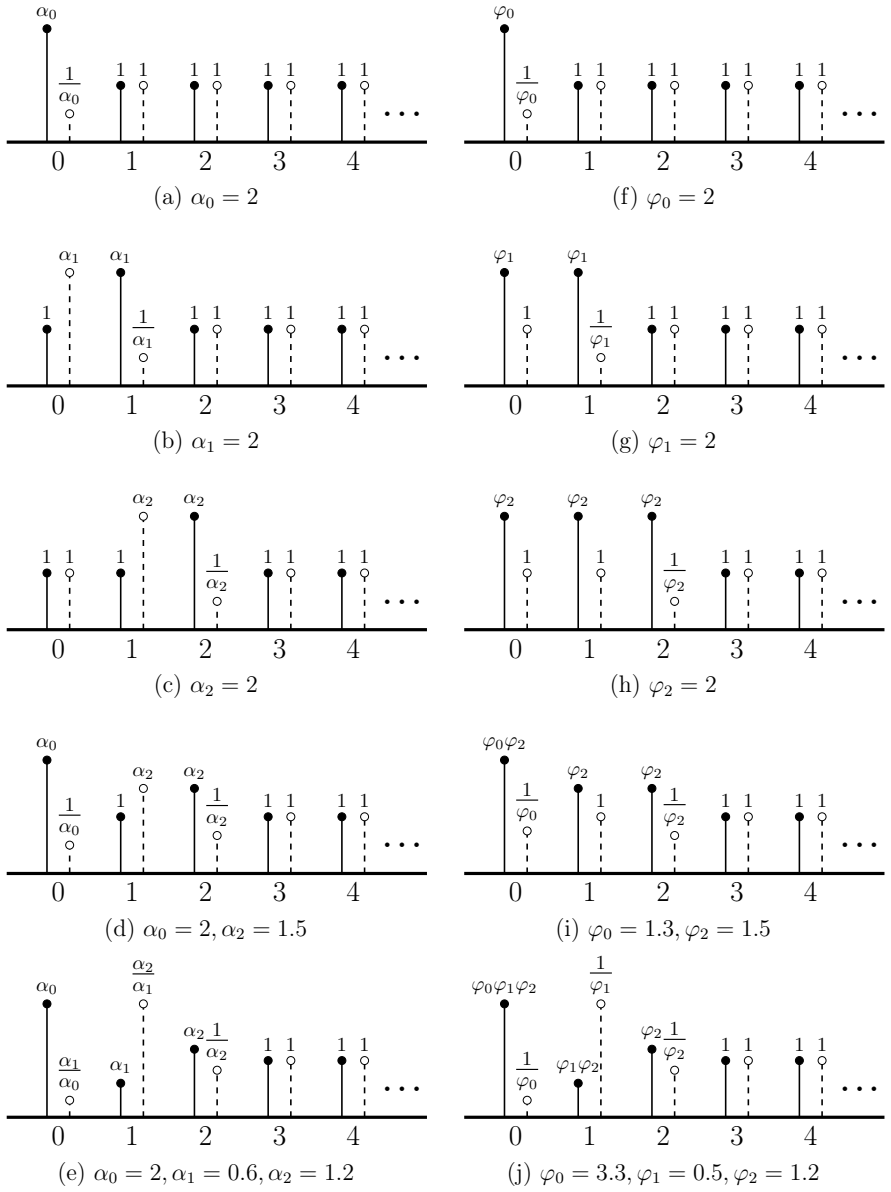
All well-known inflation mixture distributions are, in fact, parameterizations of the stationary distributions of birth-death processes. The mechanism by which excess counts arise through modifications of the birth and death rates in the base distributions produces stationary distributions that form an exponential family. This paper introduces two types of such inflation-deflation stationary distributions.
What carries the argument
Stationary distributions of birth-death processes obtained by modifying the birth and death rates of base count distributions such as Poisson or negative binomial.
If this is right
- These stationary distributions can be applied in regression analyses as alternatives to mixture models.
- The distributions belong to an exponential family, facilitating certain statistical properties.
- Two specific types of inflation-deflation distributions are defined from this approach.
- The approach applies to several base distributions including geometric, Poisson, negative binomial, hyper-Poisson, and Conway-Maxwell-Poisson.
Where Pith is reading between the lines
- Researchers might compare the fit and interpretability of these stationary distributions against traditional mixtures in real datasets to see practical differences.
- This perspective could extend to other stochastic models where rate modifications lead to similar distributional forms.
- Parameter estimation in regressions using these distributions may reveal different sensitivities to covariates compared to mixture-based approaches.
Load-bearing premise
Modifying the birth and death rates of base distributions produces stationary distributions that form an exponential family and generate the observed inflation-deflation patterns.
What would settle it
A regression analysis on count data with covariates where the estimated effects differ substantially between the mixture model and the corresponding birth-death stationary model would demonstrate they are not equivalent.
Figures




read the original abstract
A mixture of two or more count distributions has become deeply embedded in the analysis of excess counts, often relative to the stationary (equilibrium) distributions of birth-death processes such as the geometric, Poisson, Poisson-Lindley (PL), negative binomial (NB), hyper-Poisson (HP), and Conway-Maxwell-Poisson (CMP) distributions. However, the mechanism by which excess counts arise--namely, through modifications of the birth and death rates in the base distributions--has not yet been directly examined in the research literature. All well-known inflation mixture distributions are, in fact, parameterizations of the stationary distributions of birth-death processes. Thus, although the resulting distributions share the same shapes, they arise from distinct mechanisms and are not equivalent in regression analyses. This paper focuses on inflation-deflation stationary distributions arising from modified birth-death processes that form an exponential family and introduces two types of such distributions.
Editorial analysis
A structured set of objections, weighed in public.
Referee Report
Summary. The manuscript presents a framework where inflation and deflation in count distributions are generated via stationary distributions of birth-death processes with adjusted birth and death rates. It posits that standard inflation mixture models are equivalent in form to these stationary distributions but arise from different mechanisms, rendering them non-equivalent for regression modeling. Two new types of inflation-deflation distributions forming an exponential family are introduced to address dominance issues in mixtures.
Significance. If the derivations are correct, this work offers a novel mechanistic interpretation for over- and under-dispersion in counts, potentially leading to more interpretable regression models where rate modifications can be directly parameterized by covariates. The exponential family property is advantageous for inference. Credit is due for attempting to unify mixture and process-based views of these distributions, though the practical implications for regression require further elaboration.
major comments (2)
- Abstract: The central claim that 'All well-known inflation mixture distributions are, in fact, parameterizations of the stationary distributions of birth-death processes' is load-bearing but is stated without reference to a specific derivation or example; the full paper should include an explicit construction showing how modified rates lead to the mixture probability mass function for at least one base distribution such as the Poisson or geometric.
- Main text: The claim that the distributions 'are not equivalent in regression analyses' due to distinct mechanisms lacks supporting evidence such as a comparison of the score functions, information matrices, or fitted models under the two approaches when covariates are included; this needs to be addressed to substantiate the non-equivalence beyond semantic distinction.
minor comments (1)
- Abstract: The phrase 'introduces two types of such distributions' would benefit from naming or briefly describing the two types to provide a clearer overview for readers.
Simulated Author's Rebuttal
We thank the referee for their detailed and constructive comments on our manuscript. These suggestions have prompted us to clarify and strengthen several key aspects of the work. Below, we respond to each major comment in turn.
read point-by-point responses
-
Referee: Abstract: The central claim that 'All well-known inflation mixture distributions are, in fact, parameterizations of the stationary distributions of birth-death processes' is load-bearing but is stated without reference to a specific derivation or example; the full paper should include an explicit construction showing how modified rates lead to the mixture probability mass function for at least one base distribution such as the Poisson or geometric.
Authors: We appreciate the referee's point that the central claim would benefit from a more explicit example. The manuscript derives the general form of the stationary distributions under modified birth and death rates and notes their equivalence to inflation mixtures, but we agree that a concrete construction for, say, the Poisson base distribution would improve clarity. In the revised manuscript, we will insert a new subsection providing the step-by-step derivation: starting from the balance equations for the birth-death process with adjusted rates, solving for the stationary probabilities, and showing that they match the zero-inflated Poisson pmf for appropriate parameter choices. revision: yes
-
Referee: Main text: The claim that the distributions 'are not equivalent in regression analyses' due to distinct mechanisms lacks supporting evidence such as a comparison of the score functions, information matrices, or fitted models under the two approaches when covariates are included; this needs to be addressed to substantiate the non-equivalence beyond semantic distinction.
Authors: We acknowledge that the manuscript currently relies on the mechanistic distinction to argue non-equivalence in regression contexts without providing a direct comparative analysis. To address this, we will add a new paragraph or subsection in the discussion of regression modeling that compares the score functions and information matrices for a covariate-linked model under both the mixture and the process-based approaches. This will demonstrate that the two lead to different estimating equations and asymptotic variances, supporting the claim of non-equivalence beyond the semantic level. revision: yes
Circularity Check
No significant circularity; derivation of inflation-deflation distributions from modified birth-death rates is self-contained.
full rationale
The paper examines the mechanism of excess counts via modifications to birth and death rates in base distributions, showing that resulting stationary distributions form an exponential family and match known inflation mixtures in shape but arise from distinct processes. No equations or claims reduce by construction to fitted inputs, self-definitions, or self-citation chains. The assertion of non-equivalence in regression analyses follows directly from the distinct generative mechanisms without requiring external uniqueness theorems or ansatzes from the authors' prior work. The provided abstract and context indicate an independent construction against standard count distributions, consistent with a normal non-circular finding.
Axiom & Free-Parameter Ledger
axioms (1)
- domain assumption Modifications of birth and death rates in base count distributions produce stationary distributions that form an exponential family.
Lean theorems connected to this paper
-
IndisputableMonolith/Foundation/RealityFromDistinction.leanreality_from_one_distinction unclear?
unclearRelation between the paper passage and the cited Recognition theorem.
All well-known inflation mixture distributions are, in fact, parameterizations of the stationary distributions of birth-death processes... not equivalent in regression analyses.
-
IndisputableMonolith/Cost/FunctionalEquation.leanwashburn_uniqueness_aczel unclear?
unclearRelation between the paper passage and the cited Recognition theorem.
Proposition 5... type 1 and type 2 models also belong to the exponential family.
What do these tags mean?
- matches
- The paper's claim is directly supported by a theorem in the formal canon.
- supports
- The theorem supports part of the paper's argument, but the paper may add assumptions or extra steps.
- extends
- The paper goes beyond the formal theorem; the theorem is a base layer rather than the whole result.
- uses
- The paper appears to rely on the theorem as machinery.
- contradicts
- The paper's claim conflicts with a theorem or certificate in the canon.
- unclear
- Pith found a possible connection, but the passage is too broad, indirect, or ambiguous to say the theorem truly supports the claim.
Reference graph
Works this paper leans on
-
[1]
Arora, M., Rao Chaganty, N., and Sellers, K. F. (2021). A flexible regression model for zero-and k-inflated count data. Journal of Statistical Computation and Simulation 91(9), 1815--1845
work page 2021
-
[2]
Baker, R. (2026). A model for underdispersed count data. Statistical Papers , 67(2):30, 1--14
work page 2026
-
[3]
Bardwell, G. E. and Crow, E. L. (1964). A two-parameter family of hyper-Poisson distributions. Journal of the American Statistical Association 59(305), 133--141
work page 1964
-
[4]
Bickel, P. J. and Doksum, K. A. (2015). Mathematical Statistics: Basic Ideas and Selected Topics Volume I , 2nd Ed. Chapman and Hall/CRC
work page 2015
-
[5]
Böhning, D. and Junnumtuam, S. (2025). Some general points for inflation models. Statistics and Probability Letters 219, 1--6
work page 2025
-
[6]
Böhning, D. (2016). Ratio plot and ratio regression with applications to social and medical sciences. Statistical Science , 205--218
work page 2016
-
[7]
Boswell, M. T. and Patil, G. P. (1970). Chance mechanisms generating the negative binomial distributions. Random counts in models and structures 1, 3--22
work page 1970
-
[8]
Cameron, A.C. and Trivedi, P.K. (2013). Regression Analysis of Count Data . Cambridge University Press
work page 2013
-
[9]
Conway, R. W. and Maxwell, W. L. (1962). A queuing model with state dependent service rates. Journal of Industrial Engineering 12, 132--136
work page 1962
-
[10]
Cox, D. R. and Miller, H.D. (1965). The Theory of Stochastic Processes . Chapman and Hall, London, UK
work page 1965
-
[11]
Cragg, J. G. (1971). Some statistical models for limited dependent variables with application to the demand for durable goods. Econometrica: Journal of the Econometric Society 39(5), 829--844
work page 1971
- [12]
-
[13]
Del Castillo, J. and Pérez-Casany, M. (1998). Weighted Poisson distributions for overdispersion and underdispersion situations. Annals of the Institute of Statistical Mathematics 50(3), 567-585
work page 1998
-
[14]
Faddy, M. J. (1997). Extended Poisson process modelling and analysis of count data. Biometrical Journal 39(4), 431--440
work page 1997
-
[15]
Feng, C. X. (2021). A comparison of zero-inflated and hurdle models for modeling zero-inflated count data. Journal of statistical distributions and applications 8(1), 1--19
work page 2021
-
[16]
Grimmett, G. and Stirzaker, D. (2001). Probability and Random Processes , 3rd Ed. Oxford University Press, USA
work page 2001
-
[17]
C., Hinde, J., and de Andrade Moral, R
Haslett, J., Parnell, A. C., Hinde, J., and de Andrade Moral, R. (2022). Modelling excess zeros in count data: A new perspective on modelling approaches. International statistical review 90(2), 216--236
work page 2022
-
[18]
Hunkrajok, M. and Skulpakdee, W. (2025). A simple algorithm for computing the probabilities of count models based on pure birth processes. Computational Statistics 40(1), 249--272
work page 2025
-
[19]
Janardan, K. G. (2005). A discrete distribution associated with a pure birth process. Statistical Papers 46(4), 587-597
work page 2005
-
[20]
Johnson, N. L. and Kotz, S. (1969). Distributions in Statistics: Discrete Distributions , Wiley, New York
work page 1969
-
[21]
Johnson, N. L., Kemp, A. W., and Kotz, S. (2005). Univariate discrete distributions , John Wiley & Sons
work page 2005
-
[22]
Karlis, D. and Xekalaki, E. (2000). A simulation comparison of several procedures for testing the Poisson assumption. Journal of the Royal Statistical Society Series D: The Statistician 49(3), 355--382
work page 2000
-
[23]
C., Mizere, D., and Balakrishnan, N
Kokonendji, C. C., Mizere, D., and Balakrishnan, N. (2008). Connections of the Poisson weight function to overdispersion and underdispersion. Journal of Statistical Planning and Inference 138(5), 1287--1296
work page 2008
-
[24]
Lambert, D. (1992). Zero-inflated Poisson regression, with an application to defects in manufacturing. Technometrics 34(1), 1--14
work page 1992
-
[25]
Lerdsuwansri, R., Pijitrattana, P., Sangnawakij, P., Lanumteang, K., Maruotti, A., Friedl, H., and Böhning, D. (2025). Identifying one-inflation in regression models for ratio estimators in single-source capture-recapture problems. Journal of Statistical Computation and Simulation 95(15), 3279--3299
work page 2025
-
[26]
Lin, T. H. and Tsai, M. H. (2013). Modeling health survey data with excessive zero and K responses. Statistics in Medicine 32(9), 1572--1583
work page 2013
-
[27]
Melkersson, M. and Rooth, D. O. (2000). Modeling female fertility using inflated count data models. Journal of Population Economics 13(2), 189--203
work page 2000
-
[28]
Mullahy, J. (1986). Specification and testing of some modified count data models. Journal of econometrics 33(3), 341--365
work page 1986
-
[29]
Puig, P., Valero, J., and Fernández‐Fontelo, A. (2024). Some mechanisms leading to underdispersion: Old and new proposals. Scandinavian Journal of Statistics 51(1), 245--267
work page 2024
-
[30]
R: A language and environment for statistical computing
R Core Team (2019). R: A language and environment for statistical computing. R Foundation for Statistical Computing, Vienna, Austria
work page 2019
-
[31]
Ridout, M., Demétrio, C. G., and Hinde, J. (1998). Models for count data with many zeros. In Proceedings of the XIXth international biometric conference , vol. 19, no. 1, pp. 179-192. Cape Town, South Africa: International Biometric Society Invited Papers
work page 1998
-
[32]
Sankaran, M. (1970). 275. note: The discrete poisson-lindley distribution. Biometrics 26(1), 145--149
work page 1970
-
[33]
Singh, S. (1963). A note on inflated Poisson distribution. Journal of the Indian statistical association 1, 140--144
work page 1963
-
[34]
Skulpakdee, W. and Hunkrajok, M. (2022). Unusual-event processes for count data. SORT-Statistics and Operations Research Transactions 46(1), 39--66
work page 2022
- [35]
-
[36]
Westfall, P.H. (2014). Kurtosis as peakedness, 1905–2014. RIP. The American Statistician 68(3), 191--195
work page 2014
-
[37]
Winkelmann, R. (1995). Duration dependence and dispersion in count-data models. Journal of Business & Economic Statistics 13(4), 467--474
work page 1995
-
[38]
Winkelmann, R. (2008). Econometric Analysis of Count Data . Heidelberg: Springer Berlin Heidelberg, Berlin
work page 2008
-
[39]
Wise, J. (1962). The relationship between the mean and variance of a stationary birth-death process, and its economic application. Biometrika 49(1/2), 253--255
work page 1962
-
[40]
Zhang, C., Tian, G. L., and Ng, K. W. (2016). Properties of the zero-and-one inflated Poisson distribution and likelihood-based inference methods. Statistics and its interface 9(1), 11--32
work page 2016
discussion (0)
Sign in with ORCID, Apple, or X to comment. Anyone can read and Pith papers without signing in.