Realizing crosscap transpositions as monodromies of singular fibrations
Pith reviewed 2026-05-20 01:05 UTC · model grok-4.3
The pith
The monodromy around an M-singularity is a crosscap transposition in the mapping class group of a non-orientable surface.
A machine-rendered reading of the paper's core claim, the machinery that carries it, and where it could break.
Core claim
We show that the monodromy around an M-singularity is a crosscap transposition in the mapping class group of a non-orientable surface. We introduce M-fibrations whose singularities are only M-singularities and prove that relations among crosscap transpositions give rise to such fibrations. We construct a closed non-orientable 4-manifold which admits an M-fibration but admits no Lefschetz fibration.
What carries the argument
The M-singularity, whose critical locus is a circle contained in a single fiber, with its monodromy being the crosscap transposition.
If this is right
- Relations among crosscap transpositions can be realized by M-fibrations on non-orientable 4-manifolds.
- Handle decompositions of M-fibrations and their orientation double covers can be explicitly described.
- The two 2-handles in the orientation double cover have attaching circles and framings determined by the M-singularity.
- Examples exist of non-orientable 4-manifolds with M-fibrations but without Lefschetz fibrations.
Where Pith is reading between the lines
- This approach may help distinguish different fibration types on 4-manifolds by their allowed monodromies.
- Further study of the stable perturbation of the M-singularity could reveal more about its global properties.
- Such constructions could lead to new invariants or classifications for non-orientable 4-manifolds.
Load-bearing premise
The local model of an M-singularity has infinite A_e-codimension and admits an explicit stable perturbation compatible with the monodromy computation.
What would settle it
A direct calculation of the monodromy induced by the local model of the M-singularity in the relevant mapping class group, or an independent check that the constructed manifold admits no Lefschetz fibration.
Figures


read the original abstract
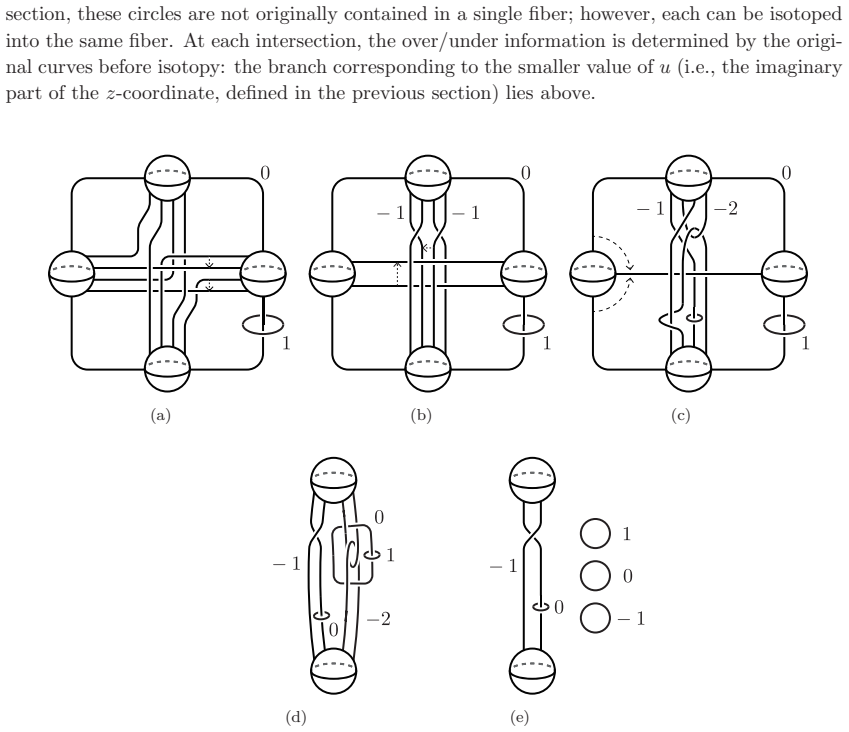
We introduce a new type of singularity for smooth maps from $4$-manifolds to surfaces, called an $M$-singularity, whose critical locus is a circle contained in a single fiber. We show that the monodromy around an $M$-singularity is a crosscap transposition in the mapping class group of a non-orientable surface. We also introduce $M$-fibrations, namely smooth maps whose singularities consist only of $M$-singularities, and prove that relations among crosscap transpositions give rise to such fibrations on non-orientable $4$-manifolds. We then study handle decompositions associated with $M$-fibrations and their orientation double coverings. In particular, we describe the attaching circles and framings of the two $2$-handles arising from the orientation double cover of an $M$-singularity. Using this description, we construct a closed non-orientable $4$-manifold which admits an $M$-fibration but admits no Lefschetz fibration. We further discuss singularity-theoretic properties of the local model of an $M$-singularity, namely its infinite $\mathcal{A}_e$-codimension and an explicit stable perturbation.
Editorial analysis
A structured set of objections, weighed in public.
Referee Report
Summary. The paper introduces M-singularities for smooth maps from 4-manifolds to surfaces, with critical locus a circle contained in a single fiber. It claims that the monodromy around an M-singularity is a crosscap transposition in the mapping class group of a non-orientable surface. M-fibrations are defined as maps whose only singularities are M-singularities, and relations among crosscap transpositions are shown to realize such fibrations on non-orientable 4-manifolds. Handle decompositions of the orientation double covers are studied, with explicit descriptions of attaching circles and framings for the two 2-handles arising from an M-singularity. This is used to construct a closed non-orientable 4-manifold admitting an M-fibration but no Lefschetz fibration. Singularity-theoretic properties of the local model, including infinite A_e-codimension and an explicit stable perturbation, are also discussed.
Significance. If the central identifications hold, the work extends singular fibration theory to non-orientable 4-manifolds by realizing crosscap transpositions via a new singularity type. The explicit handle descriptions in the double cover and the example manifold distinguishing M-fibrations from Lefschetz fibrations provide concrete tools and distinctions useful for 4-manifold topology and mapping class group applications. The singularity analysis adds a local model with infinite codimension that may inform stable map theory.
major comments (1)
- [singularity-theoretic properties paragraph] The paragraph on singularity-theoretic properties of the local model: the claim that the explicit stable perturbation induces precisely the crosscap transposition monodromy (without extra critical points or changes to the non-orientable fiber structure) is load-bearing for the monodromy identification and all subsequent constructions. The local equations and perturbation are stated to be compatible with the global mapping class group computation, but the bridge from local stable map to the precise action on the surface (or its fundamental group) and the two 2-handles in the double cover is not verified in sufficient detail to confirm no extraneous attaching data is introduced.
minor comments (2)
- [introduction] Clarify the precise definition of the mapping class group action used for non-orientable surfaces early in the manuscript, including how crosscap transpositions are generated.
- [local model discussion] Add a diagram or local coordinate chart for the stable perturbation of the M-singularity to aid readability of the local model.
Simulated Author's Rebuttal
We thank the referee for their careful reading of the manuscript and for identifying a point where additional verification would strengthen the exposition. We address the major comment below and will incorporate the requested clarifications in the revised version.
read point-by-point responses
-
Referee: [singularity-theoretic properties paragraph] The paragraph on singularity-theoretic properties of the local model: the claim that the explicit stable perturbation induces precisely the crosscap transposition monodromy (without extra critical points or changes to the non-orientable fiber structure) is load-bearing for the monodromy identification and all subsequent constructions. The local equations and perturbation are stated to be compatible with the global mapping class group computation, but the bridge from local stable map to the precise action on the surface (or its fundamental group) and the two 2-handles in the double cover is not verified in sufficient detail to confirm no extraneous attaching data is introduced.
Authors: We agree that a more explicit bridge between the local stable perturbation and the global monodromy action strengthens the argument. In the revised manuscript we will expand the singularity-theoretic section to include a detailed local computation: starting from the given equations of the M-singularity and its stable perturbation, we will track the birth/death of critical points, confirm that precisely one crosscap transposition is realized on the non-orientable fiber (with no additional critical points or changes to the fiber topology), and compute the induced automorphism on the fundamental group of the fiber. We will then explicitly relate this local monodromy to the attaching circles and framings of the two 2-handles in the orientation double cover by describing the local handle decomposition before and after the perturbation, thereby verifying that no extraneous attaching data appears. These additions will be placed immediately after the current local-model discussion and will be cross-referenced to the global mapping-class-group and handlebody sections. revision: yes
Circularity Check
No circularity: definitions and monodromy computation are independent of fitted inputs or self-referential reductions
full rationale
The paper introduces M-singularities via explicit local models (critical locus a circle in one fiber) and proves the monodromy is a crosscap transposition by direct computation in the non-orientable mapping class group, relying on standard facts about mapping class groups and an explicit stable perturbation rather than any equation that reduces to its own inputs by construction. The M-fibration relations, handle decompositions of the orientation double cover, and the explicit closed 4-manifold example are built from these definitions without self-definition, fitted-parameter renaming, or load-bearing self-citation chains. The derivation remains self-contained against external benchmarks in singularity theory and 4-manifold topology.
Axiom & Free-Parameter Ledger
axioms (1)
- standard math The mapping class group of a non-orientable surface is generated in part by crosscap transpositions.
invented entities (1)
-
M-singularity
no independent evidence
Lean theorems connected to this paper
-
IndisputableMonolith/Foundation/AlexanderDuality.leanalexander_duality_circle_linking unclear?
unclearRelation between the paper passage and the cited Recognition theorem.
We show that the monodromy around an M-singularity is a crosscap transposition in the mapping class group of a non-orientable surface.
-
IndisputableMonolith/Foundation/RealityFromDistinction.leanreality_from_one_distinction unclear?
unclearRelation between the paper passage and the cited Recognition theorem.
relations among crosscap transpositions give rise to such fibrations on non-orientable 4-manifolds
What do these tags mean?
- matches
- The paper's claim is directly supported by a theorem in the formal canon.
- supports
- The theorem supports part of the paper's argument, but the paper may add assumptions or extra steps.
- extends
- The paper goes beyond the formal theorem; the theorem is a base layer rather than the whole result.
- uses
- The paper appears to rely on the theorem as machinery.
- contradicts
- The paper's claim conflicts with a theorem or certificate in the canon.
- unclear
- Pith found a possible connection, but the passage is too broad, indirect, or ambiguous to say the theorem truly supports the claim.
Reference graph
Works this paper leans on
-
[1]
R. ˙I. Baykur and N. Hamada. Lefschetz fibrations with arbitrary signature. J. Eur. Math. Soc. (JEMS) , 26(8):2837–2895, 2024
work page 2024
-
[2]
M. Dehn. Die Gruppe der Abbildungsklassen. Acta Math. , 69(1):135–206, 1938. Das arithmetische Feld auf Fl¨ achen
work page 1938
-
[3]
P. L. Duren. Univalent functions , volume 259 of Grundlehren der mathematischen Wissenschaften [Funda- mental Principles of Mathematical Sciences] . Springer-Verlag, New York, 1983
work page 1983
-
[4]
D. B. A. Epstein. Curves on 2-manifolds and isotopies. Acta Math. , 115:83–107, 1966
work page 1966
-
[5]
R. E. Gompf. Toward a topological characterization of sy mplectic manifolds. J. Symplectic Geom. , 2(2):177– 206, 2004
work page 2004
-
[6]
R. E. Gompf and A. I. Stipsicz. 4 -manifolds and Kirby calculus , volume 20 of Graduate Studies in Mathe- matics. American Mathematical Society, Providence, RI, 1999
work page 1999
-
[7]
A. Gramain. Le type d’homotopie du groupe des diff´ eomorp hismes d’une surface compacte. Ann. Sci. ´Ecole Norm. Sup. (4) , 6:53–66, 1973
work page 1973
-
[8]
K. Hayano. On genus-1 simplified broken Lefschetz fibrati ons. Algebr. Geom. Topol. , 11(3):1267–1322, 2011. 15
work page 2011
-
[9]
A. Kas. On the handlebody decomposition associated to a L efschetz fibration. Pacific J. Math. , 89(1):89–104, 1980
work page 1980
-
[10]
M. Korkmaz. Noncomplex smooth 4-manifolds with Lefsch etz fibrations. Internat. Math. Res. Notices , (3):115–128, 2001
work page 2001
-
[11]
Y. Lekili. W rinkled fibrations on near-symplectic mani folds. Geom. Topol., 13(1):277–318, 2009. Appendix B by R. ˙I. Baykur
work page 2009
-
[12]
M. Le´ sniak and B. Szepietowski. Generating the mappin g class group of a nonorientable surface by crosscap transpositions. Topology Appl., 229:20–26, 2017
work page 2017
-
[13]
W. B. R. Lickorish. Homeomorphisms of non-orientable t wo-manifolds. Proc. Cambridge Philos. Soc. , 59:307– 317, 1963
work page 1963
-
[14]
W. B. R. Lickorish. A finite set of generators for the home otopy group of a 2-manifold. Proc. Cambridge Philos. Soc. , 60:769–778, 1964
work page 1964
- [15]
-
[16]
P. S. Pao. The topological structure of 4-manifolds wit h effective torus actions. I. Trans. Amer. Math. Soc. , 227:279–317, 1977
work page 1977
-
[17]
K. Saji. Criteria for Morin singularities for maps into lower dimensions, and applications. In Real and complex singularities, volume 675 of Contemp. Math. , pages 315–336. Amer. Math. Soc., Providence, RI, 2016
work page 2016
-
[18]
B. Szepietowski. Crosscap slides and the level 2 mappin g class group of a nonorientable surface. Geom. Dedicata, 160:169–183, 2012
work page 2012
-
[19]
C. T. C. W all. Finite determinacy of smooth map-germs. Bull. London Math. Soc. , 13(6):481–539, 1981
work page 1981
-
[20]
T. Yoshikawa. Orientation double covers of non-orient able lefschetz fibrations. arXiv e-prints , 2025. arXiv:2509.06624. Email address : k-hayano@math.keio.ac.jp Department of Mathematics, F aculty of Science and Technolo gy, Keio University, Yagami Campus, 3-14-1, Hiyoshi, Kohoku-ku, Yokohama, 223-8522, Japan 16
discussion (0)
Sign in with ORCID, Apple, or X to comment. Anyone can read and Pith papers without signing in.