Slow-roll inflation in (dual) Kaniadakis cosmology
Pith reviewed 2026-05-20 09:58 UTC · model grok-4.3
The pith
Kaniadakis entropy modifications allow slow-roll inflation only for strongly suppressed deformation parameters to match Planck data.
A machine-rendered reading of the paper's core claim, the machinery that carries it, and where it could break.
Core claim
In the Kaniadakis framework the entropy is deformed by the parameter kappa, which produces modified Friedmann equations. These equations alter the slow-roll parameters and yield inflationary observables that remain compatible with Planck constraints on ns and r only when kappa is strongly suppressed in the standard case. The dual Kaniadakis formulation permits consistency with the observed scalar power spectrum within certain parameter regions, indicating that kappa-induced corrections can connect non-extensive thermodynamics to the physics of primordial perturbations.
What carries the argument
Kaniadakis entropy formula deformed by the parameter kappa, which generates modified Friedmann equations and thereby changes the slow-roll inflationary observables ns and r.
Load-bearing premise
The modified Friedmann equations from Kaniadakis entropy produce slow-roll dynamics that can be compared directly to Planck measurements of ns and r without additional unaccounted corrections.
What would settle it
A future measurement finding the tensor-to-scalar ratio r or the scalar spectral index ns outside the narrow ranges allowed by the suppressed values of kappa would rule out consistency with the model.
Figures

read the original abstract
We investigate slow-roll inflation within the framework of Kaniadakis and dual Kaniadakis cosmology, where the usual entropy formalism is generalized through a deformation parameter $\kappa$. By deriving the modified Friedmann equations and the corresponding inflationary dynamics induced by Kaniadakis entropy, we analyze the deviations from standard inflation arising from $\kappa$-corrections. We compute the scalar and tensor spectral indices, the tensor-to-scalar ratio, and examine the observational constraints on the deformation parameter. Our results show that consistency with current observational data imposes stringent bounds on the deformation parameter $\kappa$. In the standard Kaniadakis formulation, viable slow-roll inflationary scenarios compatible with the Planck constraints on the scalar spectral index $n_s$ and the tensor-to-scalar ratio $r$ can be obtained, although the allowed values of $\kappa$ are strongly suppressed. For the dual Kaniadakis formulation, we find that the primordial power spectrum of scalar perturbations can remain consistent with observational data within certain parameter regions. We also verify the compatibility of the predicted scalar power spectrum with the latest Planck results and discuss the phenomenological implications of the $\kappa$-induced corrections. These findings suggest that Kaniadakis cosmology may leave potentially observable imprints on primordial perturbations, providing a possible connection between non-extensive thermodynamics and the physics of the early universe.
Editorial analysis
A structured set of objections, weighed in public.
Referee Report
Summary. The paper derives modified Friedmann equations from the Kaniadakis entropy (and its dual) with deformation parameter κ, studies the resulting slow-roll inflationary dynamics, computes the scalar spectral index ns, tensor-to-scalar ratio r and scalar power spectrum, and reports that small bounded values of κ yield models consistent with Planck constraints on ns and r.
Significance. If the central results hold, the work would link non-extensive thermodynamics to early-universe observables and furnish concrete bounds on κ from CMB data. The explicit derivation of background equations from the first law is a clear strength; however, the significance is limited by the absence of any verification that the perturbation sector remains unmodified.
major comments (2)
- [§4] §4 (slow-roll parameters and spectral indices): the expressions for ns ≈ 1−2ε−η and r ≈ 16ε are inserted directly using the κ-modified H(φ) and slow-roll parameters ε, η. No derivation or justification is given that the Mukhanov-Sasaki equation or tensor quadratic action retains its standard GR form; any κ-dependent corrections to the fluctuation Lagrangian would shift ns and r by amounts comparable to the reported bounds on κ, rendering the Planck-compatibility claim unsupported.
- [§5] §5 (observational constraints): the bounds on κ are obtained by requiring the computed ns and r to lie inside the Planck 1σ/2σ contours. This procedure makes the viability of the model dependent on the same data used to constrain the free parameter, without an independent consistency check or falsifiable prediction outside the fitting procedure.
minor comments (2)
- [§2] The distinction between the standard Kaniadakis and dual Kaniadakis formulations is introduced in the abstract and §2 but never summarized in a single comparative table or paragraph, making it difficult for readers to track which results apply to which case.
- [§3] Notation for the modified Hubble parameter and potential is introduced without an explicit list of all κ-dependent terms; a short appendix collecting the leading-order corrections would improve readability.
Simulated Author's Rebuttal
We thank the referee for the detailed review of our manuscript on slow-roll inflation in Kaniadakis cosmology. We address each of the major comments below and outline the revisions we plan to make.
read point-by-point responses
-
Referee: [§4] §4 (slow-roll parameters and spectral indices): the expressions for ns ≈ 1−2ε−η and r ≈ 16ε are inserted directly using the κ-modified H(φ) and slow-roll parameters ε, η. No derivation or justification is given that the Mukhanov-Sasaki equation or tensor quadratic action retains its standard GR form; any κ-dependent corrections to the fluctuation Lagrangian would shift ns and r by amounts comparable to the reported bounds on κ, rendering the Planck-compatibility claim unsupported.
Authors: We appreciate the referee's observation regarding the perturbation sector. Our approach modifies the background cosmology through the Kaniadakis entropy in the first law applied to the cosmological horizon, resulting in κ-dependent Friedmann equations. The slow-roll parameters ε and η are then defined in the standard way but evaluated with the modified Hubble parameter. We have implicitly assumed that the linear perturbation equations, including the Mukhanov-Sasaki equation for scalars and the tensor modes, remain unchanged because the underlying gravitational dynamics at the perturbative level are still described by general relativity, with the entropy modification primarily affecting the thermodynamic relations at the background. However, we acknowledge that this assumption requires explicit justification. In the revised manuscript, we will add a new subsection or paragraph in §4 explaining this assumption and arguing that since the modification arises from the entropy rather than a direct change to the Einstein-Hilbert action, the quadratic action for perturbations is expected to retain its GR form to leading order. We will also note that for the small κ values allowed by data, any potential corrections would be suppressed. This addresses the concern and supports the validity of our ns and r expressions. revision: yes
-
Referee: [§5] §5 (observational constraints): the bounds on κ are obtained by requiring the computed ns and r to lie inside the Planck 1σ/2σ contours. This procedure makes the viability of the model dependent on the same data used to constrain the free parameter, without an independent consistency check or falsifiable prediction outside the fitting procedure.
Authors: We thank the referee for this comment on the nature of our constraints. In inflationary model building, it is standard to use CMB data to place bounds on model parameters such as κ by comparing predicted values of ns and r to observational limits. Our analysis does provide a falsifiable aspect in that the specific dependence of the observables on κ can be tested with improved precision from future experiments like CMB-S4 or LiteBIRD. Additionally, as mentioned in the abstract, we verify the compatibility of the predicted scalar power spectrum amplitude with Planck results, which serves as an independent check since the amplitude is normalized separately. In the revised version, we will expand the discussion in §5 to highlight these points and clarify that while the current bounds are derived from fitting, the model predicts a particular trajectory in the ns-r plane as a function of κ, offering testable predictions beyond the current data. revision: partial
Circularity Check
No significant circularity; derivation uses external Planck benchmarks on independently derived background
full rationale
The paper starts from the Kaniadakis entropy formula, applies the first law to the apparent horizon to obtain modified Friedmann equations, inserts the resulting H(φ) into the standard slow-roll definitions of ε and η, and evaluates the usual ns ≈ 1−2ε−η and r ≈ 16ε expressions. These computed observables are then compared against external Planck constraints to bound the free parameter κ. Because the thermodynamic step supplies new content not present in the final data fit, the Planck comparison is an external benchmark rather than a self-referential input, and no self-citation chain or uniqueness theorem is required to close the argument, the derivation chain remains non-circular.
Axiom & Free-Parameter Ledger
free parameters (1)
- kappa
axioms (2)
- domain assumption The Kaniadakis entropy formula applies to the apparent horizon or to the thermodynamics of the early universe and yields modified Friedmann equations.
- domain assumption Slow-roll conditions remain valid after the kappa corrections are included.
Lean theorems connected to this paper
-
IndisputableMonolith/Cost/FunctionalEquation.leanwashburn_uniqueness_aczel unclear?
unclearRelation between the paper passage and the cited Recognition theorem.
S_κ = 1/κ sinh(κ S_BH) ... H² − κ² π² / (2 (G H)²) = 8 π G / 3 ρ
-
IndisputableMonolith/Foundation/DimensionForcing.leanalexander_duality_circle_linking unclear?
unclearRelation between the paper passage and the cited Recognition theorem.
ns = 1 − 6ε + 2η, r = 16ε with κ corrections inserted into ε(φ_c)
What do these tags mean?
- matches
- The paper's claim is directly supported by a theorem in the formal canon.
- supports
- The theorem supports part of the paper's argument, but the paper may add assumptions or extra steps.
- extends
- The paper goes beyond the formal theorem; the theorem is a base layer rather than the whole result.
- uses
- The paper appears to rely on the theorem as machinery.
- contradicts
- The paper's claim conflicts with a theorem or certificate in the canon.
- unclear
- Pith found a possible connection, but the passage is too broad, indirect, or ambiguous to say the theorem truly supports the claim.
Forward citations
Cited by 1 Pith paper
-
Constraints on Kaniadakis Cosmology from Starobinsky Inflation and Primordial Tensor Perturbations
Kaniadakis entropic cosmology modifies early-universe dynamics and is constrained by its predictions for Starobinsky inflation and the primordial tensor spectrum using current CMB and gravitational-wave observations.
Reference graph
Works this paper leans on
-
[1]
Standard slow-roll inflation Within the standard slow-roll framework, we con- sider a canonical scalar field φ with potential V (φ) in a flat Friedmann-Lema ˆ ıtre-Robertson-Walker (FLR W) universe. The energy density and pressure associated with the inflaton field are expressed as ρφ = 1 2 ˙φ 2 + V (φ), (25) pφ = 1 2 ˙φ 2 − V (φ). (26) The background dynamics...
-
[2]
Kaniadakis-modified slow-roll inflation We now examine inflation within the (dual) Kaniadakis-modified Friedmann framework. If we solve the first modified Friedmann equations (21) and (23) with respect to H and use the second conditions in (30), we obtain to the leading order in κ H ≃ √ 8πG 3 V ± √ 27π 2G7V 3 κ 2 64 , (50) where the plus and minus signs corresp...
-
[3]
In this work, we focus on the n = 2 case and compute both the Kaniadakis case and its dual
The case n = 1 has already been studied in [3] within the Kaniadakis framework. In this work, we focus on the n = 2 case and compute both the Kaniadakis case and its dual. Therefore, all subsequent calculations are performed for n = 2. Solving Eq. (56) for φ f , we obtain φ f ≃ 1 2 √ πG ∓ 27κ 2 32V 2 0 √ π 3 G5 . (57) Based on Eq. (39), the value of N can...
-
[4]
(61), we have nonzero value for parameter η
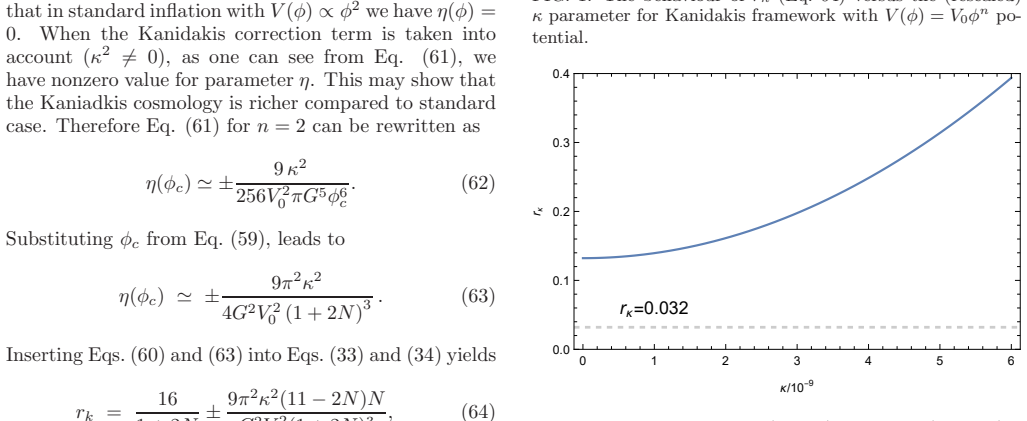
When the Kanidakis correction term is taken into account ( κ 2 ̸= 0), as one can see from Eq. (61), we have nonzero value for parameter η. This may show that the Kaniadkis cosmology is richer compared to standard case. Therefore Eq. (61) for n = 2 can be rewritten as η(φ c) ≃ ± 9 κ 2 256V 2 0 πG 5φ 6 c . (62) Substituting φ c from Eq. (59), leads to η(φ c...
-
[5]
71 × 10− 9, consistent with the constraint given in Eq. (67). In contrast, the dual branch yields no phys- ically valid solution. In conclusion, the Kaniadakis-modified inflationary scenario is consistent with current BICEP–Planck con- 7 straints, leading to a small but physically admissible value of the parameter κ ≲ O(10− 9), whereas its dual formulation ...
-
[6]
Standard slow-roll inflation with Mexican hat potential Using Eqs. (35) and (40), we obtain the following ex- pression for the Mexican hat potential, ˙φ ≃ − 2 √ λ 6πG φ. (68) Upon substituting this result into Eq. (36), the following expression is derived ǫ(φ) ≃ φ 2 πG (φ 2 − φ 2 0)2 . (69) As discussed in the previous sections, inflation ends when ǫ(φ f ) ...
-
[7]
(72) This equation can be rewritten in the following form φ f ≃ 1√ πG + φ 2 0 √ πG
(71) Assuming that φ 2 0 ≪ M 2 Pl = (8 πG)− 1, the second term is much smaller than the first term, and therefore the expression can be approximated as φ 2 f ≃ 2φ 2 0 + 1 πG . (72) This equation can be rewritten in the following form φ f ≃ 1√ πG + φ 2 0 √ πG . (73) Using Eq. (39), the number of e-folds N can be expressed as N = ∫ φ c φ f 2πG(φ 2 − φ 2 0) φ...
-
[8]
Substituting this expres- sion into Eq
(78) Higher-order terms in the expansion are much smaller and can therefore be neglected. Substituting this expres- sion into Eq. (75), yields N ≃ πG(φ 2 c − φ 2 f ) − πGφ 2 0 ln(πGφ 2 c ), (79) where we have neglected the term O(πGφ 2 0)2, since we have assumed πGφ 2 0 ≪ 1. Combining the expression of φ f from Eq. (73), we obtain N ≃ πGφ 2 c − 1 − πGφ 2 ...
-
[9]
(85) into this expression, yields η(φ c) ≃ 1 2(N + 1) − 5πGφ 2 0 2(N + 1)2
(87) Substituting φ c from Eq. (85) into this expression, yields η(φ c) ≃ 1 2(N + 1) − 5πGφ 2 0 2(N + 1)2 . (88) In order to estimate the tensor-to-scalar ratio and the scalar spectral index, we substitute these results into Eqs. (33) and (34). We find r ≈ 16 N + 1 − 64πGφ 2 0 (N + 1)2 , (89) ns ≈ N − 4 N + 1 + 19πGφ 2 0 (N + 1)2 . (90)
-
[10]
Kaniadakis-modified slow-roll inflation Mexican hat potential Following the approach used to analyze the Kaniadakis framework in Section 2.A, we now turn our attention to the Mexican hat potential, examining the results of this application. Substituting Eq. (50) into Eq. (40) and using the poten- tial, V (φ) = λ(φ 2 − φ 2 0)2, yields the following expressio...
-
[11]
dφ. (99) Using Eq. (98), the approximate solution of this relation becomes, N ≃ πGφ 2 c − (πGφ 2 0)2 [ 1 + 2 πGφ 2 0 ln ( φ c φ 2 0 √ πG )] ∓ 27π 2k2 128G2λ 2φ 4 0 . (100) To solve this equation, we assume that the second term inside the parentheses including both its numerator and denominator is of the same order. We will verify the validity of this assu...
-
[12]
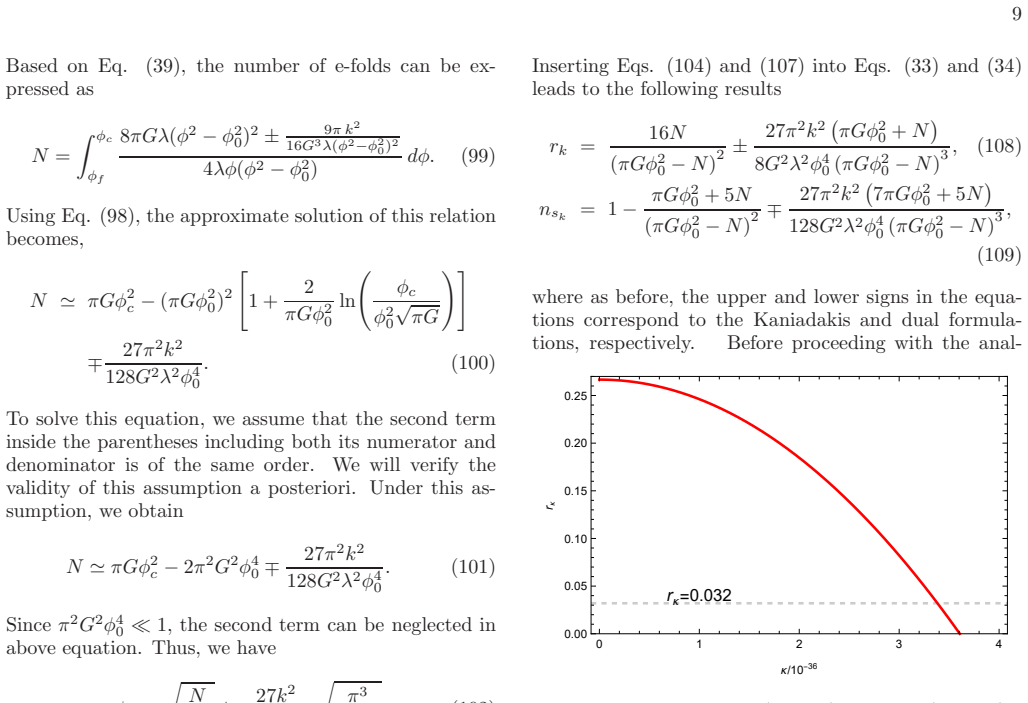
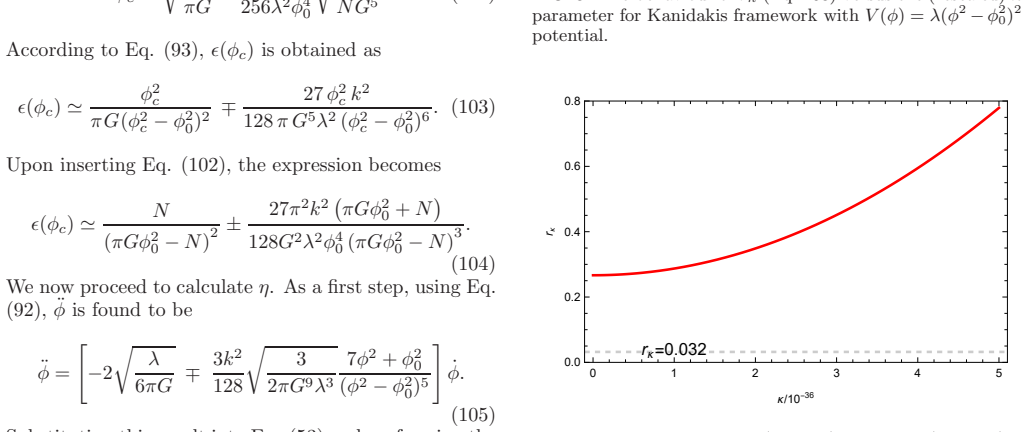
± 9k2(7φ 2 + φ 2 0) 256πG 5λ 2(φ 2 − φ 2 0)6 (106) Thus, we arrive at η(φ c) ≃ − 1 2 (πGΦ 2 0 − N ) ∓ 27π 2k2 256 G2λ 2Φ 4 0 (πGΦ 2 0 − N )2 . (107) Inserting Eqs. (104) and (107) into Eqs. (33) and (34) leads to the following results rk = 16N (πGφ 2 0 − N )2 ± 27π 2k2 ( πGφ 2 0 + N ) 8G2λ 2φ 4 0 (πGφ 2 0 − N )3 , (108) nsk = 1 − πGφ 2 0 + 5N (πGφ 2 0 − N...
-
[13]
Statistical mechanics in the context of special relativity
G. Kaniadakis, Statistical mechanics in the context of special relativity , Phys. Rev. E 66, 056125 (2002), [arXiv:cond-mat/0210467]
work page internal anchor Pith review Pith/arXiv arXiv 2002
-
[14]
Statistical mechanics in the context of special relativity II
G. Kaniadakis, Statistical mechanics in the context of special relativity. II , Phys. Rev. E 72, 036108 (2005), [arXiv:cond-mat/0507311]
work page internal anchor Pith review Pith/arXiv arXiv 2005
-
[15]
G. Lambiase, G. G. Luciano, A. Sheykhi, Slow-roll in- flation and growth of perturbations in Kaniadakis modifi- cation of Friedmann cosmology , Eur. Phys. J. C 83, 936 (2023)
work page 2023
-
[16]
On the Origin of Gravity and the Laws of Newton
E. Verlinde, On the Origin of Gravity and the Laws of Newton, JHEP 1104, 029 (2011), [arXiv:1001.0785]
work page internal anchor Pith review Pith/arXiv arXiv 2011
-
[17]
A. Sheykhi, A. Shabazi Sooraki, L. Liravi, Big-Bang nu- cleosynthesis constraints on (dual) Kaniadakis cosmol- ogy, Phys. Rev. D 112, 103546 (2025)
work page 2025
-
[18]
A. Lymperis, S. Basilakos, E. N. Saridakis, Modified cos- mology through Kaniadakis horizon entropy, Eur. Phys. J. C 81, 1037 (2021), [arXiv:2108.12366]
-
[19]
A. Hernandez-Almada, Observational constraints and dy- namical analysis of Kaniadakis horizon-entropy cosmol- ogy, Mon. Not. Roy. Astron. Soc. 512, 5122 (2022), [arXiv:2112.04615]
-
[20]
Sheykhi, Corrections to Friedmann equations inspired by Kaniadakis entropy, Phys
A. Sheykhi, Corrections to Friedmann equations inspired by Kaniadakis entropy, Phys. Lett. B 850, 138495 (2024), [arXiv:2302.13012]
-
[21]
M. Kord Zangeneh, A. Sheykhi, Modified cosmology through Kaniadakis entropy , Mod. Phys. Lett. A 39, 2450138 (2024), [arXiv:2311.01969]
-
[22]
N. Drepanou, et. al., Kaniadakis holographic dark en- ergy and cosmology, Eur. Phys. J. C 82, 449 (2022), [arXiv:2005.08258]
-
[23]
Suresh Kumar, et al, Holographic dark energy through Kaniadakis entropy in non flat universe , Eur. Phys. J. C 83, 143 (2023), [arXiv :2211 .15468]
work page 2023
-
[24]
A. Hernandez-Almada, Kaniadakis holographic dark en- ergy: observational constraints and global dynamics , Mont. Not. Royal Astro. Soci. 511 4147 (2022)
work page 2022
-
[25]
G. G. Luciano, Modified Friedmann equations from Kani- adakis entropy and cosmological implications on baryoge- nesis and 7Li-abundance, Eur. Phys. J. C, 82, 314 (2022)
work page 2022
-
[26]
E. M. C. Abreu, J. Ananias Neto, E. M. Barboza and R. C. Nunes, Jeans instability criterion from the view- point of Kaniadakis’ statistics , EPL 114, 55001 (2016), [arXiv:1603.00296]
work page internal anchor Pith review Pith/arXiv arXiv 2016
-
[27]
E. M. C. Abreu, J. A. Neto, E. M. Barboza and R. C. Nunes, Tsallis and Kaniadakis statistics from the viewpoint of entropic gravity formalism , Int. J. Mod. Phys. A 32, no.05, 1750028 (2017), [arXiv:1701.06898]
work page internal anchor Pith review Pith/arXiv arXiv 2017
-
[28]
E. M. C. Abreu, J. A. Neto, A. C. R. Mendes and A. Bonilla, Tsallis and Kaniadakis statistics from a point of view of the holographic equipartition law , EPL 121, 45002 (2018), [arXiv:1711.06513]
work page internal anchor Pith review Pith/arXiv arXiv 2018
-
[29]
E. M. C. Abreu, J. A. Neto, A. C. R. Mendes and R. M. de Paula, Loop Quantum Gravity Immirzi param- eter and the Kaniadakis statistics , Chaos, Solitons and Fractals 118, 307 (2019), [arXiv:1808.01891]
work page internal anchor Pith review Pith/arXiv arXiv 2019
-
[30]
W. H. Yang, Y. Z. Xiong, H. Chen and S. Q. Liu, Jeans gravitational instability with κ-deformed Kani- adakis distribution in Eddington-inspired Born Infield gravity, Chin. Phys. B 29, 110401 (2020). 13
work page 2020
-
[31]
E. M. C. Abreu and J. Ananias Neto, Black holes ther- modynamics from a dual Kaniadakis entropy , Euro. Phys. Lett. 133, no.4, 49001 (2021)
work page 2021
-
[32]
H. Moradpour, A. H. Ziaie and M. Kord Zangeneh, Generalized entropies and corresponding holographic dark energy models , Eur. Phys. J. C 80, 732 (2020), [arXiv:2005.06271]
-
[33]
E. M. C. Abreu and J. Ananias Neto, Statistical ap- proaches on the apparent horizon entropy and the gener- alized second law of thermodynamics Phys. Lett. B 824, 136803 (2022)
work page 2022
- [34]
-
[35]
M. Akbar and R. G. Cai, Thermodynamic Behavior of Friedmann Equations at Apparent Horizon of FR W Uni- verse, Phys. Rev. D 75, 084003 (2007)
work page 2007
-
[36]
S. A. Hayward, Unified first law of black-hole dynamics and relativistic thermodynamics , Class. Quant. Grav. 15, 3147 (1998), [arXiv:gr-qc/9710089]
work page internal anchor Pith review Pith/arXiv arXiv 1998
-
[37]
A. I. Keskin, The inflationary era of the universe via Tsallis cosmology , Int. J. Geom. Meth. Mod. Phys. 19, 2250005 (2022)
work page 2022
-
[38]
G. G. Luciano, Constraining barrow entropy-based cos- mology with power-law inflation , Eur. Phys. J. C 83, 329 (2023)
work page 2023
-
[39]
S. D. Odintsov and V. K. Oikonomou, Inflationary Dy- namics with a Smooth Slow-Roll to Constant-Roll Era Transition, JCAP 04, 041 (2017)
work page 2017
- [40]
-
[41]
J. c. Hwang and H. Noh, Classical evolution and quantum generation in generalized gravity theories including stri ng corrections and tachyon: Unified analyses , Phys. Rev. D 71, 063536 (2005)
work page 2005
-
[42]
M. Alhallak, N. Chamoun and M. S. Eldaher, Salvaging power-law inflation through warming , Eur. Phys. J. C 83, 533 (2023)
work page 2023
-
[43]
D. Baumann, TASI Lectures on Inflation , [arXiv:0907.5424]
work page internal anchor Pith review Pith/arXiv arXiv
-
[44]
G. N. Remmen and S. M. Carroll, How Many e-Folds Should We Expect from High-Scale Inflation? , Phys. Rev. D 90, 063517 (2014)
work page 2014
-
[45]
N. Aghanim et al. [Planck], Planck 2018 results. VI. Cos- mological parameters, Astron. Astrophys. 641, A6 (2020) [erratum: Astron. Astrophys. 652, C4 (2021)]
work page 2018
-
[46]
M. Tristram, A. J. Banday, K. M. G´ orski, R. Keski- talo, C. R. Lawrence, K. J. Andersen, R. B. Barreiro, J. Borrill, L. P. L. Colombo and H. K. Eriksen, et al. Im- proved limits on the tensor-to-scalar ratio using BICEP and Planck data , Phys. Rev. D 105, 083524 (2022)
work page 2022
-
[47]
H. M. Hodges and G. R. Blumenthal, Arbitrariness of inflationary fluctuation spectra , Phys. Rev. D 42, 3329 (1990)
work page 1990
-
[48]
D. Frolovsky and S. V. Ketov, Fitting Power Spectrum of Scalar Perturbations for Primordial Black Hole Pro- duction during Inflation , Astronomy 2, 47 (2023)
work page 2023
-
[49]
J. Garcia-Bellido and E. Ruiz Morales, Primordial black holes from single field models of inflation , Phys. Dark Univ. 18, 47 (2017)
work page 2017
-
[50]
D. M. de Blas and J. Olmedo, Primordial power spec- tra for scalar perturbations in loop quantum cosmology , JCAP 06, 029 (2016)
work page 2016
-
[51]
C. R. Contaldi, M. Peloso, L. Kofman and A. D. Linde, Suppressing the lower multipoles in the CMB anisotropies, JCAP 07, 002 (2003)
work page 2003
-
[52]
A. Hern´ andez-Almada, G. Leon, J. Maga˜ na, M. A. Garc ´ ıa-Aspeitia, V. Motta, E. N. Saridakis and K. Yesmakhanova, Kaniadakis-holographic dark energy: observational constraints and global dynamics , Mon. Not. Roy. Astron. Soc. 511, 4147 (2022)
work page 2022
-
[53]
A. Hern´ andez-Almada, G. Leon, J. Maga˜ na, M. A. Garc ´ ıa-Aspeitia, V. Motta, E. N. Saridakis, K. Yesmakhanova and A. D. Millano, Observational constraints and dynamical analysis of Kaniadakis horizon-entropy cosmology, Mon. Not. Roy. Astron. Soc. 512, 5122 (2022)
work page 2022
discussion (0)
Sign in with ORCID, Apple, or X to comment. Anyone can read and Pith papers without signing in.