Constraints on Kaniadakis Cosmology from Starobinsky Inflation and Primordial Tensor Perturbations
Pith reviewed 2026-05-21 03:44 UTC · model grok-4.3
The pith
Kaniadakis-deformed horizon entropy modifies the Friedmann equations during Starobinsky inflation, altering both slow-roll dynamics and the spectrum of primordial gravitational waves in ways that current observations can constrain.
A machine-rendered reading of the paper's core claim, the machinery that carries it, and where it could break.
Core claim
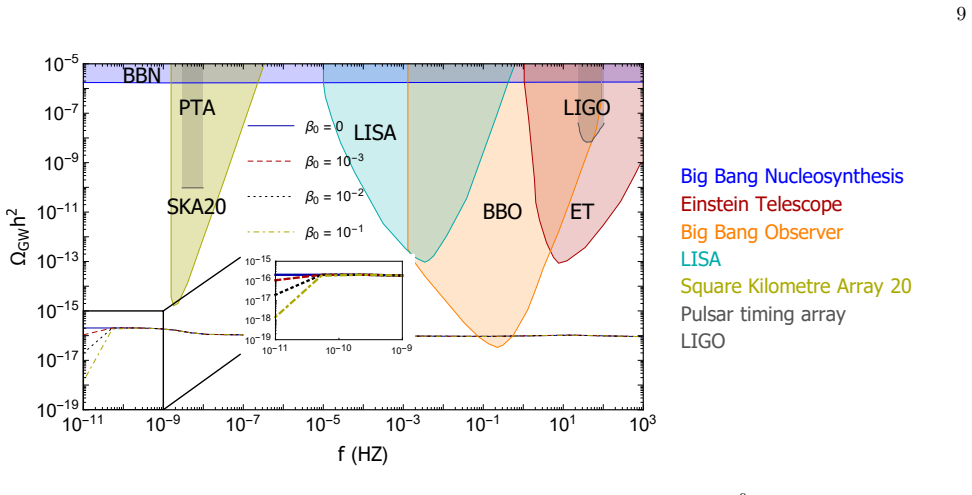
The generalized entropic corrections from Kaniadakis statistics simultaneously affect the evolution of tensor perturbations and the inflationary slow-roll dynamics in a Starobinsky-like scenario, inducing characteristic deviations in the PGW spectrum as well as nontrivial corrections to the main inflationary observables, which when compared to Planck and BICEP/Keck data yield stringent constraints on the Kaniadakis parameter.
What carries the argument
The Kaniadakis-deformed version of the horizon entropy, which via the gravity-thermodynamics conjecture leads to modified Friedmann equations applied to the early universe inflation.
If this is right
- The PGW spectrum exhibits deviations from the standard prediction due to the entropy modification.
- Inflationary observables such as the scalar spectral index and tensor-to-scalar ratio receive corrections.
- Stringent constraints on the Kaniadakis parameter are obtained by fitting to current cosmological data.
- The model provides a phenomenologically consistent extension of the standard cosmological paradigm.
Where Pith is reading between the lines
- This framework could be tested further with future gravitational wave detectors sensitive to the primordial background.
- Similar entropic modifications might influence other phases of cosmic evolution beyond inflation.
- Connecting generalized statistics to inflation offers a way to probe quantum effects in gravity through cosmology.
Load-bearing premise
The gravity-thermodynamics conjecture holds when the horizon entropy is replaced by its Kaniadakis-deformed counterpart, allowing consistent modification of the Friedmann equations during inflation.
What would settle it
An observation of the primordial gravitational wave spectrum or inflationary observables that matches the unmodified Starobinsky model exactly, without the predicted deviations for nonzero Kaniadakis parameter, would falsify the applicability of this modification.
Figures


read the original abstract
We investigate a generalized entropic cosmology obtained by applying the gravity-thermodynamics conjecture to the Universe horizon using Kaniadakis statistics, namely a relativistic extension of the standard Boltzmann--Gibbs formalism. The resulting deformation of the horizon entropy naturally modifies the Friedmann dynamics and provides a phenomenologically consistent extension of the $\Lambda$CDM paradigm. Within this framework, we explore the implications of the modified cosmological dynamics for the physics of the early Universe, focusing in particular on primordial gravitational waves (PGWs) and slow-roll inflation in a Starobinsky-like scenario. We show that the generalized entropic corrections simultaneously affect the evolution of tensor perturbations and the inflationary slow-roll dynamics, inducing characteristic deviations in the PGW spectrum as well as nontrivial corrections to the main inflationary observables. By confronting the theoretical predictions with the latest Planck and BICEP/Keck observations, we derive stringent constraints on the Kaniadakis parameter and assess the observational viability of the model. Our results establish a direct connection between generalized horizon thermodynamics and inflationary cosmology, showing that quantum-statistical modifications of the entropy-area law can propagate into potentially observable signatures in the physics of the early Universe.
Editorial analysis
A structured set of objections, weighed in public.
Referee Report
Summary. The paper investigates a generalized entropic cosmology obtained by applying the gravity-thermodynamics conjecture to the cosmological horizon using Kaniadakis statistics, which deforms the Bekenstein-Hawking entropy as S_K = (1/K) sinh(K S_BH). This leads to modified Friedmann equations that are then applied to a Starobinsky-like inflationary scenario. The work derives the resulting corrections to slow-roll parameters (n_s, r) and the tensor perturbation equation, showing characteristic deviations in the primordial gravitational wave spectrum. These predictions are confronted with Planck and BICEP/Keck data to obtain constraints on the Kaniadakis deformation parameter K.
Significance. If the central derivations hold, the manuscript provides a concrete link between quantum-statistical deformations of horizon entropy and observable inflationary quantities, including shifts in the tensor-to-scalar ratio and the PGW spectrum. This extends the reach of generalized entropic cosmologies into the early Universe and yields falsifiable bounds on K from existing data. The approach is noteworthy for attempting to propagate thermodynamic modifications directly into both background dynamics and perturbation equations rather than treating them as ad-hoc corrections.
major comments (2)
- [Sections 2–3 (modified Friedmann equations and Starobinsky application)] The central claim rests on the validity of the gravity-thermodynamics conjecture when the Kaniadakis entropy is substituted into the first law on the apparent horizon and the resulting modified Friedmann equations are extrapolated to the de Sitter-like background of Starobinsky inflation. During inflation the Hubble radius is nearly constant and the inflaton dominates, so the thermodynamic identification of temperature and entropy may require additional assumptions about the inflaton sector or the form of the first law. This step is load-bearing for the predicted deviations in slow-roll parameters and the tensor spectrum; without explicit justification or a consistency check, the subsequent constraints on K lack theoretical grounding.
- [Section on tensor perturbations and PGW spectrum] The derivation of the modified tensor mode equation and the resulting PGW spectrum (presumably in the section on primordial gravitational waves) assumes that the only change enters through the background Hubble evolution. It is not shown whether the Kaniadakis deformation also induces direct corrections to the Mukhanov-Sasaki equation for tensor modes or to the Bunch-Davies vacuum; if such terms are absent by construction, the claimed “characteristic deviations” in the spectrum may be smaller than stated and should be quantified with an explicit error budget.
minor comments (2)
- [Abstract and Introduction] The abstract and introduction should explicitly state the range of K values explored and whether the Starobinsky potential itself is left unmodified or receives entropic corrections.
- [Throughout] Notation for the Kaniadakis parameter (denoted K) should be distinguished from the curvature parameter or other constants appearing in the Starobinsky potential to avoid reader confusion.
Simulated Author's Rebuttal
We thank the referee for the careful and constructive review of our manuscript. The comments highlight important points regarding the theoretical foundations of our approach, and we address each one below. We have revised the manuscript to incorporate additional justifications and quantifications where needed.
read point-by-point responses
-
Referee: [Sections 2–3 (modified Friedmann equations and Starobinsky application)] The central claim rests on the validity of the gravity-thermodynamics conjecture when the Kaniadakis entropy is substituted into the first law on the apparent horizon and the resulting modified Friedmann equations are extrapolated to the de Sitter-like background of Starobinsky inflation. During inflation the Hubble radius is nearly constant and the inflaton dominates, so the thermodynamic identification of temperature and entropy may require additional assumptions about the inflaton sector or the form of the first law. This step is load-bearing for the predicted deviations in slow-roll parameters and the tensor spectrum; without explicit justification or a consistency check, the subsequent constraints on K lack theoretical grounding.
Authors: We appreciate the referee's concern about applying the gravity-thermodynamics conjecture in the inflationary regime. The derivation in Sections 2 and 3 follows the standard procedure established in the entropic cosmology literature: the first law is applied directly to the apparent horizon using the Kaniadakis entropy, yielding modified Friedmann equations that hold for any dominant energy component, including the inflaton. In the quasi-de Sitter background relevant to Starobinsky inflation, the apparent horizon radius approaches the Hubble radius, and the temperature is identified with the standard Hawking temperature T = H/(2π). We have added a new paragraph in Section 2 that explicitly discusses this identification, notes that the thermodynamic relation is independent of the inflaton sector at the horizon level, and provides a consistency check by recovering the exact standard Starobinsky slow-roll parameters in the K → 0 limit. While a microscopic derivation from quantum gravity is beyond the phenomenological scope of this work, the approach is consistent with prior studies on generalized entropies and grounds the subsequent constraints on K. revision: yes
-
Referee: [Section on tensor perturbations and PGW spectrum] The derivation of the modified tensor mode equation and the resulting PGW spectrum (presumably in the section on primordial gravitational waves) assumes that the only change enters through the background Hubble evolution. It is not shown whether the Kaniadakis deformation also induces direct corrections to the Mukhanov-Sasaki equation for tensor modes or to the Bunch-Davies vacuum; if such terms are absent by construction, the claimed “characteristic deviations” in the spectrum may be smaller than stated and should be quantified with an explicit error budget.
Authors: We thank the referee for this observation on the tensor sector. The Kaniadakis modification enters exclusively through the altered background Hubble evolution obtained from the modified Friedmann equations; at linear order, the tensor perturbation equation remains the standard wave equation in conformal time with the modified H(η) as the sole background input, and the Bunch-Davies initial condition is preserved for the quasi-de Sitter phase. No additional direct corrections to the Mukhanov-Sasaki variable or vacuum state arise from the entropy deformation. In the revised manuscript we have added an explicit derivation of the tensor mode equation confirming the absence of extra terms, together with a quantitative error budget: we compare the resulting PGW spectrum to the standard case for representative values of K, showing the relative deviation in amplitude as a function of wavenumber and demonstrating that the reported characteristic deviations are attributable to the changed expansion history. revision: yes
Circularity Check
No significant circularity detected
full rationale
The paper starts from the gravity-thermodynamics conjecture, replaces the horizon entropy with its Kaniadakis form to obtain modified Friedmann equations, then applies the resulting dynamics to a Starobinsky-like inflationary background to compute corrections to slow-roll parameters and the tensor power spectrum. These derived quantities are compared to Planck and BICEP/Keck data solely to place bounds on the free Kaniadakis parameter. No step reduces by construction to a fitted input renamed as a prediction, nor does any load-bearing premise collapse to a self-citation whose content is itself unverified within the paper. The derivation remains self-contained once the initial thermodynamic replacement is granted; the observational confrontation is standard parameter estimation rather than a tautological loop.
Axiom & Free-Parameter Ledger
free parameters (1)
- Kaniadakis deformation parameter
axioms (1)
- domain assumption Gravity-thermodynamics conjecture applied to the cosmological horizon remains valid under Kaniadakis statistics
Lean theorems connected to this paper
-
IndisputableMonolith/Cost/FunctionalEquation.lean and Foundation/AlphaCoordinateFixation.leanJcost definition and costAlphaLog hyperbolic identities echoes?
echoesECHOES: this paper passage has the same mathematical shape or conceptual pattern as the Recognition theorem, but is not a direct formal dependency.
S_κ = 1/κ sinh(κ A/4G) ... modified Friedmann ... H² cosh(κπ/H²G) − (κπ/G) Shi(κπ/H²G)
-
IndisputableMonolith/Foundation/Cosmology and Gravity moduleszero-parameter gravity certificate and structural cosmology lemmas refines?
refinesRelation between the paper passage and the cited Recognition theorem.
perturbative expansion ... κπ/(G H²) ≪ 1 ... corrections to ϵ, η, n_s, r
What do these tags mean?
- matches
- The paper's claim is directly supported by a theorem in the formal canon.
- supports
- The theorem supports part of the paper's argument, but the paper may add assumptions or extra steps.
- extends
- The paper goes beyond the formal theorem; the theorem is a base layer rather than the whole result.
- uses
- The paper appears to rely on the theorem as machinery.
- contradicts
- The paper's claim conflicts with a theorem or certificate in the canon.
- unclear
- Pith found a possible connection, but the passage is too broad, indirect, or ambiguous to say the theorem truly supports the claim.
Reference graph
Works this paper leans on
-
[1]
S. Capozziello and M. De Laurentis, Phys. Rept.509, 167 (2011), arXiv:1108.6266 [gr-qc]
work page internal anchor Pith review Pith/arXiv arXiv 2011
-
[2]
Akramiet al.(CANTATA),Modified Gravity and Cosmology
Y. Akramiet al.(CANTATA),Modified Gravity and Cosmology. An Update by the CANTATA Network, edited by E. N. Saridakis, R. Lazkoz, V. Salzano, P. Vargas Moniz, S. Capozziello, J. Beltrán Jiménez, M. De Laurentis, and G. J. Olmo (Springer, 2021) arXiv:2105.12582 [gr-qc]
-
[3]
K. A. Olive, Phys. Rept.190, 307 (1990)
work page 1990
-
[4]
Non-Gaussianity from Inflation: Theory and Observations
N. Bartolo, E. Komatsu, S. Matarrese, and A. Riotto, Phys. Rept.402, 103 (2004), arXiv:astro-ph/0406398
work page internal anchor Pith review Pith/arXiv arXiv 2004
-
[5]
Y.-F. Cai, E. N. Saridakis, M. R. Setare, and J.-Q. Xia, Phys. Rept.493, 1 (2010), arXiv:0909.2776 [hep-th]
work page internal anchor Pith review Pith/arXiv arXiv 2010
-
[8]
J. D. Bekenstein, Phys. Rev. D7, 2333 (1973)
work page 1973
-
[9]
J. D. Bekenstein, Phys. Rev. D9, 3292 (1974)
work page 1974
-
[10]
S. W. Hawking, Commun. Math. Phys.43, 199 (1975), [Erratum: Commun.Math.Phys. 46, 206 (1976)]
work page 1975
- [11]
-
[12]
Logarithmic Corrections to Black Hole Entropy from the Cardy Formula
S. Carlip, Class. Quant. Grav.17, 4175 (2000), arXiv:gr-qc/0005017
work page internal anchor Pith review Pith/arXiv arXiv 2000
-
[13]
C. Tsallis and L. J. L. Cirto, Eur. Phys. J. C73(2013), 10.1140/epjc/s10052-013-2487-6
- [14]
-
[15]
Non Linear Kinetics underlying Generalized Statistics
G. Kaniadakis, Physica A296, 405 (2001), arXiv:cond-mat/0103467
work page internal anchor Pith review Pith/arXiv arXiv 2001
-
[16]
A. Renyi, inProceedings of the Fourth Berkeley Symposium on Mathematical Statistics and Probability, Vol. 1 (University of California Press, 1961) pp. 547–561
work page 1961
- [17]
-
[18]
R. K. Kaul and P. Majumdar, Phys. Rev. Lett.84, 5255 (2000), arXiv:gr-qc/0002040
work page internal anchor Pith review Pith/arXiv arXiv 2000
-
[19]
L. Bombelli, R. K. Koul, J. Lee, and R. D. Sorkin, Phys. Rev. D34, 373 (1986)
work page 1986
-
[20]
M. Srednicki, Phys. Rev. Lett.71, 666 (1993), arXiv:hep-th/9303048
work page internal anchor Pith review Pith/arXiv arXiv 1993
-
[21]
Statistical mechanics in the context of special relativity
G. Kaniadakis, Phys. Rev. E66, 056125 (2002), arXiv:cond-mat/0210467
work page internal anchor Pith review Pith/arXiv arXiv 2002
-
[22]
A. Lymperis, S. Basilakos, and E. N. Saridakis, Eur. Phys. J. C81, 1037 (2021), arXiv:2108.12366 [gr-qc]
-
[23]
G. G. Luciano, Entropy24, 1712 (2022)
work page 2022
-
[24]
G. G. Luciano, Eur. Phys. J. C82, 314 (2022)
work page 2022
-
[25]
A. Hernández-Almada, G. Leon, J. Magaña, M. A. García-Aspeitia, V. Motta, E. N. Saridakis, and K. Yesmakhanova, Mon. Not. Roy. Astron. Soc.511, 4147 (2022), arXiv:2111.00558 [astro-ph.CO]
-
[26]
A. Hernández-Almada, G. Leon, J. Magaña, M. A. García-Aspeitia, V. Motta, E. N. Saridakis, K. Yesmakhanova, and A. D. Millano, Mon. Not. Roy. Astron. Soc.512, 5122 (2022), arXiv:2112.04615 [astro-ph.CO]
-
[27]
A. H. Guth, Phys. Rev. D23, 347 (1981)
work page 1981
-
[28]
A. A. Starobinsky, Phys. Lett. B91, 99 (1980)
work page 1980
-
[29]
A. D. Linde, Phys. Lett. B129, 177 (1983)
work page 1983
- [30]
-
[31]
A. A. Starobinsky, JETP Lett.30, 682 (1979)
work page 1979
-
[32]
L. P. Grishchuk, Sov. Phys. JETP40, 409 (1975)
work page 1975
-
[33]
V. A. Rubakov, M. V. Sazhin, and A. V. Veryaskin, Phys. Lett. B115, 189 (1982)
work page 1982
-
[34]
L. F. Abbott and M. B. Wise, Nucl. Phys. B244, 541 (1984)
work page 1984
- [35]
-
[36]
A. Hasegawa, K. Mima, and M. Duong-van, Physical Review Letters54, 2608 (1985)
work page 1985
- [37]
-
[38]
J. C. Carvalho, R. Silva, J. D. do Nascimento Jr., B. B. Soares, and J. R. De Medeiros, Europhysics Letters (EPL)91, 69002 (2010)
work page 2010
-
[39]
E. M. C. Abreu, J. Ananias Neto, E. M. Barboza, and R. C. Nunes, Europhysics Letters (EPL)114, 55001 (2016)
work page 2016
-
[40]
E. M. C. Abreu, J. A. Neto, E. M. Barboza, and R. C. Nunes, International Journal of Modern Physics A32, 1750028 (2017)
work page 2017
- [41]
-
[42]
N. Drepanou, A. Lymperis, E. N. Saridakis, and K. Yesmakhanova, Eur. Phys. J. C82, 449 (2022), arXiv:2109.09181 [gr-qc]
-
[43]
Thermodynamics of Spacetime: The Einstein Equation of State
T. Jacobson, Phys. Rev. Lett.75, 1260 (1995), arXiv:gr-qc/9504004 . 18
work page internal anchor Pith review Pith/arXiv arXiv 1995
-
[44]
A. V. Frolov and L. Kofman, JCAP05, 009 (2003), arXiv:hep-th/0212327
work page internal anchor Pith review Pith/arXiv arXiv 2003
-
[45]
First Law of Thermodynamics and Friedmann Equations of Friedmann-Robertson-Walker Universe
R.-G. Cai and S. P. Kim, JHEP02, 050 (2005), arXiv:hep-th/0501055
work page internal anchor Pith review Pith/arXiv arXiv 2005
-
[46]
M. Akbar and R.-G. Cai, Phys. Lett. B635, 7 (2006), arXiv:hep-th/0602156
work page internal anchor Pith review Pith/arXiv arXiv 2006
-
[47]
Thermodynamic Behavior of Friedmann Equation at Apparent Horizon of FRW Universe
M. Akbar and R.-G. Cai, Phys. Rev. D75, 084003 (2007), arXiv:hep-th/0609128
work page internal anchor Pith review Pith/arXiv arXiv 2007
-
[48]
G. W. Gibbons and S. W. Hawking, Phys. Rev. D15, 2738 (1977)
work page 1977
-
[49]
Gravity and the Thermodynamics of Horizons
T. Padmanabhan, Phys. Rept.406, 49 (2005), arXiv:gr-qc/0311036
work page internal anchor Pith review Pith/arXiv arXiv 2005
-
[50]
Thermodynamical Aspects of Gravity: New insights
T. Padmanabhan, Rept. Prog. Phys.73, 046901 (2010), arXiv:0911.5004 [gr-qc]
work page internal anchor Pith review Pith/arXiv arXiv 2010
-
[51]
Planck 2018 results. VI. Cosmological parameters
N. Aghanimet al.(Planck), Astron. Astrophys.641, A6 (2020), [Erratum: Astron.Astrophys. 652, C4 (2021)], arXiv:1807.06209 [astro-ph.CO]
work page internal anchor Pith review Pith/arXiv arXiv 2020
-
[52]
G. Efstathiou and S. Gratton, Mon. Not. Roy. Astron. Soc.496, L91 (2020), arXiv:2002.06892 [astro-ph.CO]
-
[53]
Improved Calculation of the Primordial Gravitational Wave Spectrum in the Standard Model
Y. Watanabe and E. Komatsu, Phys. Rev. D73, 123515 (2006), arXiv:astro-ph/0604176
work page internal anchor Pith review Pith/arXiv arXiv 2006
- [54]
-
[55]
S. Maity and M. R. Haque, JCAP04, 091 (2025), arXiv:2407.18246 [astro-ph.CO]
- [56]
-
[57]
Dark, Cold, and Noisy: Constraining Secluded Hidden Sectors with Gravitational Waves
M. Breitbach, J. Kopp, E. Madge, T. Opferkuch, and P. Schwaller, JCAP07, 007 (2019), arXiv:1811.11175 [hep-ph]
work page internal anchor Pith review Pith/arXiv arXiv 2019
-
[58]
Abbottet al.(KAGRA, Virgo, LIGO Scientific), Phys
R. Abbottet al.(KAGRA, Virgo, LIGO Scientific), Phys. Rev. D104, 022004 (2021), arXiv:2101.12130 [gr-qc]
-
[59]
R. M. Shannonet al., Science349, 1522 (2015), arXiv:1509.07320 [astro-ph.CO]
work page internal anchor Pith review Pith/arXiv arXiv 2015
-
[60]
Laser Interferometer Space Antenna
P. Amaro-Seoaneet al., arXiv:1702.00786 (2017)
work page internal anchor Pith review Pith/arXiv arXiv 2017
-
[61]
Scientific Objectives of Einstein Telescope
B. Sathyaprakashet al., Class. Quant. Grav.29, 124013 (2012), [Erratum: Class.Quant.Grav. 30, 079501 (2013)], arXiv:1206.0331 [gr-qc]
work page internal anchor Pith review Pith/arXiv arXiv 2012
-
[62]
Beyond LISA: Exploring Future Gravitational Wave Missions
J. Crowder and N. J. Cornish, Phys. Rev. D72, 083005 (2005), arXiv:gr-qc/0506015
work page internal anchor Pith review Pith/arXiv arXiv 2005
-
[63]
Gravitational wave astronomy with the SKA
G. Janssenet al., PoSAASKA14, 037 (2015), arXiv:1501.00127 [astro-ph.IM]
work page internal anchor Pith review Pith/arXiv arXiv 2015
-
[64]
L. A. Boyle and A. Buonanno, Phys. Rev. D78, 043531 (2008), arXiv:0708.2279 [astro-ph]
work page internal anchor Pith review Pith/arXiv arXiv 2008
-
[65]
Observational Constraints on Theories with a Blue Spectrum of Tensor Modes
A. Stewart and R. Brandenberger, JCAP08, 012 (2008), arXiv:0711.4602 [astro-ph]
work page internal anchor Pith review Pith/arXiv arXiv 2008
- [66]
- [67]
-
[68]
Y. Gouttenoire, G. Servant, and P. Simakachorn, (2021), arXiv:2108.10328 [hep-ph]
- [69]
-
[70]
R. Catenaet al., Phys. Rev. D81, 123522 (2010), arXiv:0912.4421 [astro-ph.CO]
work page internal anchor Pith review Pith/arXiv arXiv 2010
-
[71]
Akamaet al.(LISA Cosmology Working Group), (2026), arXiv:2603.03165 [astro-ph.CO]
S. Akamaet al.(LISA Cosmology Working Group), (2026), arXiv:2603.03165 [astro-ph.CO]
-
[72]
Keskin, International Journal of Geometric Methods in Modern Physics19, 2250005 (2022)
A. Keskin, International Journal of Geometric Methods in Modern Physics19, 2250005 (2022)
work page 2022
-
[73]
S. D. Odintsov and V. K. Oikonomou, JCAP04, 041 (2017), arXiv:1703.02853 [gr-qc]
work page internal anchor Pith review Pith/arXiv arXiv 2017
-
[74]
Modified Gravity Theories on a Nutshell: Inflation, Bounce and Late-time Evolution
S. Nojiri, S. D. Odintsov, and V. K. Oikonomou, Phys. Rept.692, 1 (2017), arXiv:1705.11098 [gr-qc]
work page internal anchor Pith review Pith/arXiv arXiv 2017
-
[75]
J.-c. Hwang and H. Noh, Phys. Rev. D71, 063536 (2005), arXiv:gr-qc/0412126
work page internal anchor Pith review Pith/arXiv arXiv 2005
-
[76]
M. Alhallak, N. Chamoun, and M. S. Eldaher, Eur. Phys. J. C83, 533 (2023), arXiv:2212.04935 [astro-ph.CO]
-
[77]
G. Lambiase, G. G. Luciano, and A. Sheykhi, Eur. Phys. J. C83, 936 (2023), arXiv:2307.04027 [gr-qc]
-
[78]
G. N. Remmen and S. M. Carroll, Phys. Rev. D90, 063517 (2014), arXiv:1405.5538 [hep-th]
work page internal anchor Pith review Pith/arXiv arXiv 2014
-
[79]
Slow-roll inflation in (dual) Kaniadakis cosmology
L. Liravi and A. Sheykhi, (2026), arXiv:2605.18070 [gr-qc]
work page internal anchor Pith review Pith/arXiv arXiv 2026
- [80]
- [81]
-
[82]
Planck 2018 results. X. Constraints on inflation
Y. Akramiet al.(Planck), Astron. Astrophys.641, A10 (2020), arXiv:1807.06211 [astro-ph.CO]
work page internal anchor Pith review Pith/arXiv arXiv 2020
discussion (0)
Sign in with ORCID, Apple, or X to comment. Anyone can read and Pith papers without signing in.