Anisotropic Ejecta from Binary Neutron Star Mergers: Self-Consistent Main Thermal and Late-Time Radio Emission of NS-Powered Kilonovae
Pith reviewed 2026-05-20 09:17 UTC · model grok-4.3
The pith
Bipolar and equatorial ejecta in neutron star mergers connect main thermal and late-time radio emissions through consistent two-peak features.
A machine-rendered reading of the paper's core claim, the machinery that carries it, and where it could break.
Core claim
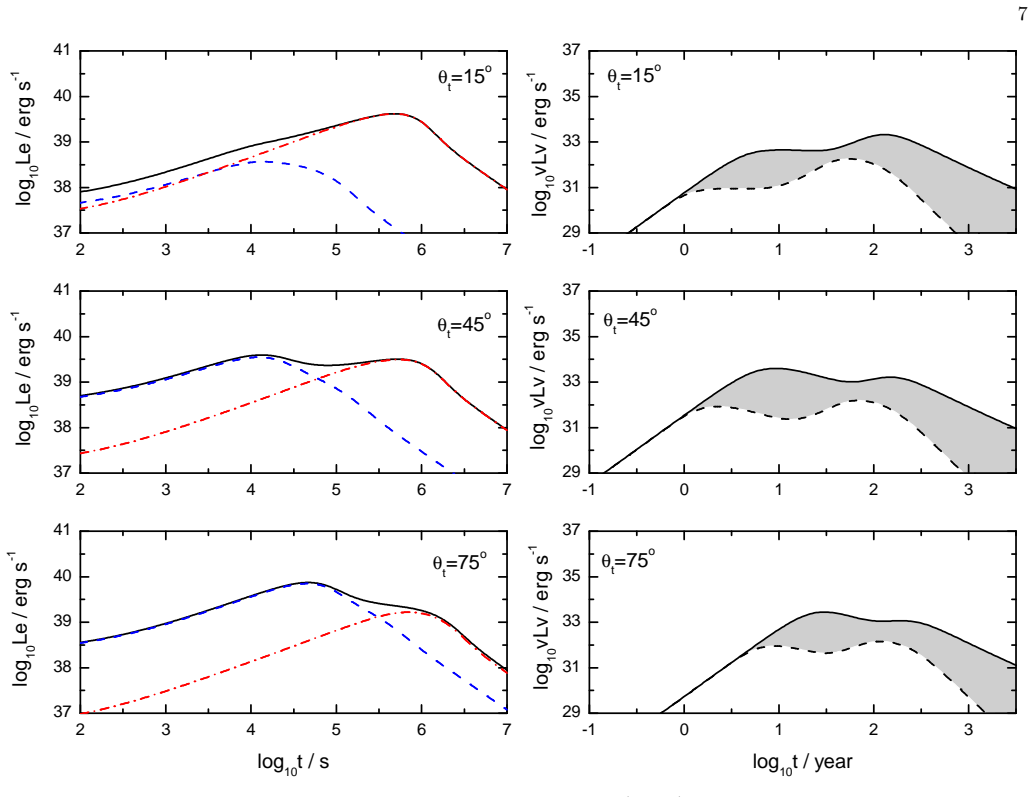
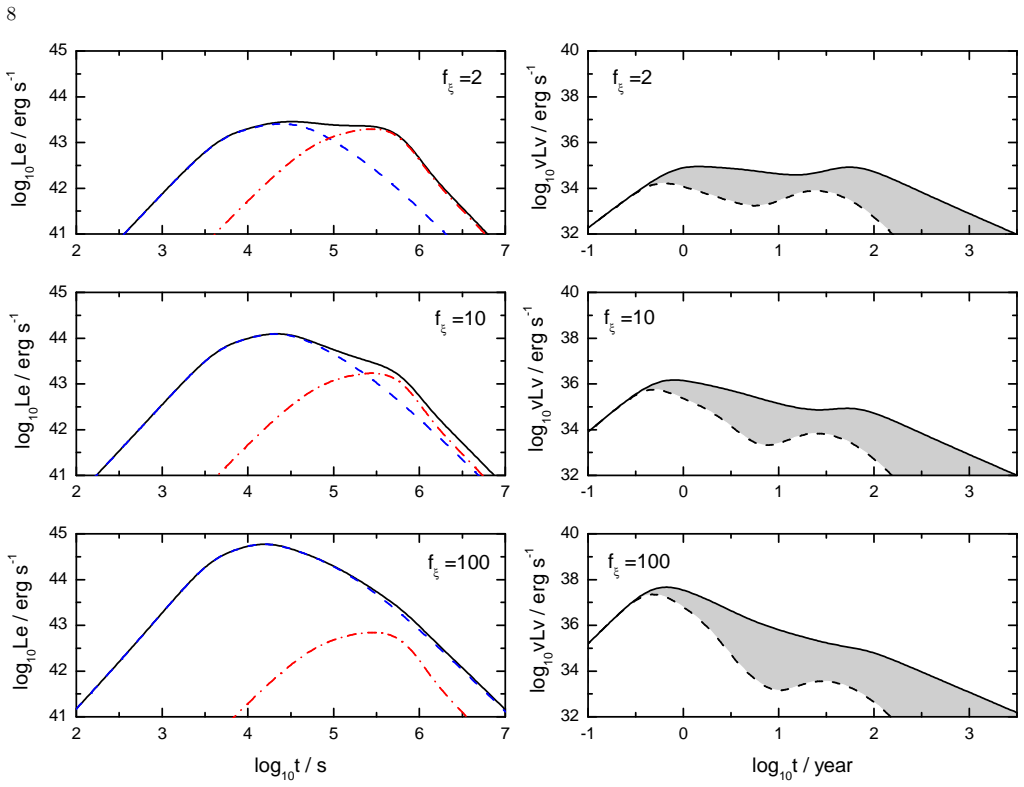
Under a bipolar and equatorial ejecta configuration, corresponding to the wind and dynamical components of the merger ejecta, the late-time radio light curves reveal distinct two-peak features, which are consistent with the main thermal light curves. The anisotropic distribution of the ejecta intrinsically connects the main thermal and late-time radio emissions, forming a self-consistent evolutionary picture. A combined analysis of the main thermal and late-time radio emissions provides a way to constrain the geometry of the merger ejecta and to probe the properties of the central engine. Furthermore, using the fitting parameters from the main thermal emission of AT 2017gfo, the calculated潜在
What carries the argument
Bipolar and equatorial ejecta configuration corresponding to wind and dynamical components of the merger ejecta.
If this is right
- Late-time radio light curves exhibit distinct two-peak features under the bipolar and equatorial ejecta configuration.
- These radio features are consistent with the main thermal light curves.
- Combined analysis of thermal and radio data constrains the geometry of the merger ejecta and the properties of the central engine.
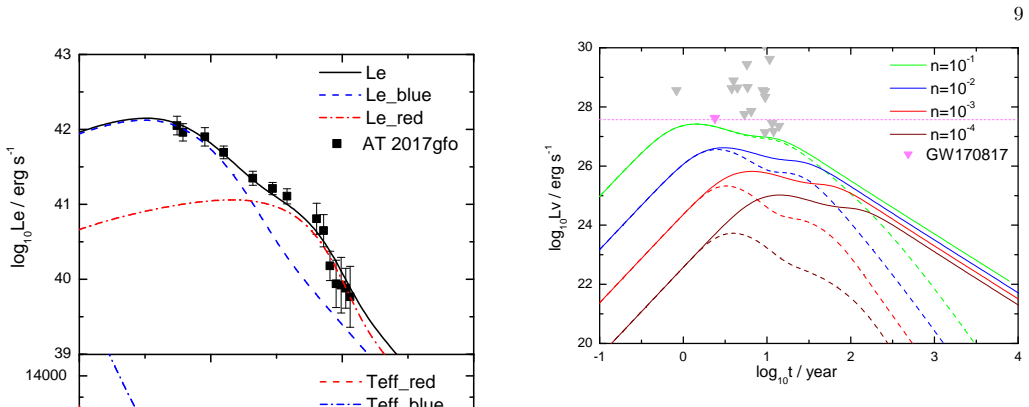
- Radio light curves calculated from AT 2017gfo thermal parameters are consistent with observed non-detections.
Where Pith is reading between the lines
- This unified model could be tested by searching for two-peak radio signals in future kilonova detections from neutron star mergers.
- The approach may help interpret multi-messenger data from short gamma-ray bursts associated with similar events.
- Incorporating ejecta anisotropy more broadly could refine forecasts for radio detectability in upcoming surveys.
Load-bearing premise
The central engine is a magnetar whose spin-down energy powers both the main thermal emission and the late-time radio emission, with the chosen bipolar and equatorial distributions accurately representing the wind and dynamical ejecta components.
What would settle it
Late-time radio monitoring of a new kilonova event that either detects or fails to detect a two-peak structure aligned with the timeline of its main thermal emission.
Figures



read the original abstract
The interaction between the fast-moving ejecta and the interstellar medium can produce long-lasting radio signals after binary neutron star mergers. Searching for such radio signals is a way to test the central engine of kilonovae and short gamma-ray bursts. With a magnetar as the central engine, the spin-down energy powers the main thermal and late-time radio emissions of the kilonova. However, both the thermal and radio emissions are strongly affected by the ejecta distribution, e.g., the two-component ``blue" and ``red" emissions of AT 2017gfo corresponding to the GW 170817 event. In this study, we investigate the distribution of the merger ejecta, analyzing several possible anisotropic distributions and demonstrating their impacts on the emission properties, particularly the late-time radio light curves. Under a bipolar and equatorial ejecta configuration, corresponding to the wind and dynamical components of the merger ejecta, the late-time radio light curves reveal distinct two-peak features, which are consistent with the main thermal light curves. The anisotropic distribution of the ejecta intrinsically connects the main thermal and late-time radio emissions, forming a self-consistent evolutionary picture. A combined analysis of the main thermal and late-time radio emissions provides a way to constrain the geometry of the merger ejecta and to probe the properties of the central engine. Furthermore, using the fitting parameters from the main thermal emission of AT 2017gfo, we calculate the corresponding potential late-time radio light curves. The results show that, under typical parameters, the non-detection of radio signals in observations is consistent with the theoretical expectation.
Editorial analysis
A structured set of objections, weighed in public.
Referee Report
Summary. The manuscript models thermal and late-time radio emission from NS-powered kilonovae with a magnetar central engine, focusing on anisotropic ejecta. It argues that a bipolar (wind) plus equatorial (dynamical) configuration produces distinct two-peak radio light curves whose morphology is intrinsically linked to the main thermal light curves, forming a self-consistent picture. Fits to the thermal data of AT 2017gfo are then used to predict radio light curves that are stated to be consistent with existing non-detections.
Significance. If the modeling assumptions hold, the work supplies a concrete mechanism by which ejecta geometry can simultaneously shape both thermal and radio signatures, offering a potential route to constrain merger ejecta structure and central-engine parameters from multi-wavelength data. The explicit linkage between the two epochs and the comparison to AT 2017gfo observations are useful contributions to the interpretation of future kilonova radio searches.
major comments (2)
- Abstract (final paragraph): the late-time radio light curves are computed directly from the best-fit parameters already obtained from the main thermal emission of AT 2017gfo. This makes the reported consistency with non-detections a post-diction rather than an independent test, weakening the claim that the anisotropic model provides a self-consistent evolutionary picture.
- Ejecta-distribution and radio-emission sections: the two-peak radio morphology is obtained by treating the bipolar and equatorial components as evolving independently with separate forward shocks. No hydrodynamic justification or test is supplied for the absence of lateral spreading, entrainment, or shock interaction between the fast polar and slower equatorial material; such interaction would plausibly erase or shift the second peak and is therefore load-bearing for the central claim.
minor comments (2)
- The manuscript does not report uncertainties or error bars on the predicted radio fluxes; adding these would strengthen the comparison with observational upper limits.
- Notation for the angular density profiles (bipolar vs. equatorial) should be defined once in a dedicated subsection with explicit functional forms to improve reproducibility.
Simulated Author's Rebuttal
We thank the referee for their constructive and detailed comments on our manuscript. We have carefully considered each point and revised the text to improve clarity and address the concerns raised. Below we respond point by point to the major comments.
read point-by-point responses
-
Referee: Abstract (final paragraph): the late-time radio light curves are computed directly from the best-fit parameters already obtained from the main thermal emission of AT 2017gfo. This makes the reported consistency with non-detections a post-diction rather than an independent test, weakening the claim that the anisotropic model provides a self-consistent evolutionary picture.
Authors: We agree that the radio light curves are derived using the same best-fit parameters obtained from modeling the thermal emission of AT 2017gfo, so the comparison to radio non-detections constitutes a consistency check rather than a fully independent prediction. The self-consistency we emphasize arises because the same anisotropic ejecta geometry and central-engine parameters simultaneously reproduce the thermal light curve morphology and yield radio light curves that remain below current detection thresholds. We have revised the abstract and added clarifying language in the discussion section to describe this explicitly as a post-diction that tests internal model consistency across wavelengths, while noting that future radio detections would provide independent constraints. revision: yes
-
Referee: Ejecta-distribution and radio-emission sections: the two-peak radio morphology is obtained by treating the bipolar and equatorial components as evolving independently with separate forward shocks. No hydrodynamic justification or test is supplied for the absence of lateral spreading, entrainment, or shock interaction between the fast polar and slower equatorial material; such interaction would plausibly erase or shift the second peak and is therefore load-bearing for the central claim.
Authors: We acknowledge that the model assumes independent evolution of the bipolar and equatorial components without explicit treatment of lateral spreading or shock interactions. This is a standard approximation in semi-analytic kilonova models when the components have distinctly different velocities and angular distributions. We have added a dedicated paragraph in the methods section that cites merger simulation literature indicating limited early interaction for the velocity contrasts considered here, and we discuss how significant entrainment would primarily affect the later radio peak. We also note the limitation explicitly and identify full hydrodynamic modeling of component interactions as an important avenue for future work. The two-peak feature remains a direct consequence of the adopted geometry under the stated assumptions. revision: partial
Circularity Check
Late-time radio light curves derived directly from thermal emission fit parameters of AT 2017gfo
specific steps
-
fitted input called prediction
[Abstract (final paragraph)]
"Furthermore, using the fitting parameters from the main thermal emission of AT 2017gfo, we calculate the corresponding potential late-time radio light curves."
Parameters are first fitted to thermal data of AT 2017gfo; the same values are then inserted to generate radio light curves whose two-peak morphology is presented as consistent with (and intrinsically connected to) the thermal curves. The radio result is therefore statistically forced by the thermal fit rather than derived independently or tested against separate observations.
full rationale
The paper's central claim is that anisotropic (bipolar/equatorial) ejecta distributions intrinsically connect main thermal and late-time radio emissions into a self-consistent picture, with radio curves showing two-peak features mirroring the thermal morphology. However, the derivation explicitly uses parameters fitted to the main thermal emission of AT 2017gfo to compute the radio light curves. This reduces the radio 'prediction' and its claimed consistency to a direct output of the thermal fit rather than an independent test or first-principles derivation. The model treats components with independent shock evolution under the same angular energy partition, but no external benchmark or parameter-free calculation is shown to establish the connection outside the fitted inputs. This matches the fitted-input-called-prediction pattern and justifies a moderate circularity score; the rest of the analysis (ejecta geometry exploration) appears self-contained.
Axiom & Free-Parameter Ledger
free parameters (1)
- ejecta mass and velocity for bipolar and equatorial components
axioms (1)
- domain assumption Spin-down energy from a long-lived magnetar powers both thermal and radio emissions
Reference graph
Works this paper leans on
-
[1]
doi:10.3847/1538-4357/adceb0 Horesh, A., Hotokezaka, K., Piran, T., et al. 2016, ApJL, 819, 2, L22. doi:10.3847/2041-8205/819/2/L22 Hotokezaka, K., Kiuchi, K., Kyutoku, K., et al. 2013, PhRvD, 87, 2, 024001. doi:10.1103/PhysRevD.87.024001 Kasen, D., Badnell, N. R., & Barnes, J. 2013, ApJ, 774, 1,
-
[2]
doi:10.1088/0004-637X/774/1/25 Kasen, D., Fern’andez, R., & Metzger, B. D. 2015, MNRAS, 450, 2, 1777. doi:10.1093/mnras/stv721 Kawaguchi, K., Shibata, M., & Tanaka, M. 2018, ApJL, 865, 2, L21. doi:10.3847/2041-8213/aade02 Khanam, T., Corsi, A., Coyne, R., et al. 2025, , arXiv:2511.21941. doi:10.48550/arXiv.2511.21941 Kiuchi, K., Cerd’a-Dur’an, P., Kyutoku...
work page internal anchor Pith review Pith/arXiv arXiv doi:10.1088/0004-637x/774/1/25 2015
-
[3]
doi:10.3847/1538-4357/ad81f4 Li, S.-Z., Liu, L.-D., Yu, Y.-W., et al. 2018, ApJL, 861, 2, L12. doi:10.3847/2041-8213/aace61 Li, S.-Z., Yu, Y.-W., Gao, H., et al. 2024b, ApJ, 961, 2,
-
[4]
doi:10.3847/1538-4357/ad1593 Liu, L.-D., Gao, H., & Zhang, B. 2020, ApJ, 890, 2, 102. doi:10.3847/1538-4357/ab6b24 L¨ u, H.-J., Zhang, B., Lei, W.-H., et al. 2015, ApJ, 805, 2,
-
[5]
doi:10.1088/0004-637X/805/2/89 Metzger, B. D. 2017, Living Reviews in Relativity, 20, 1, 3. doi:10.1007/s41114-017-0006-z Metzger, B. D. & Bower, G. C. 2014, MNRAS, 437, 2,
-
[6]
doi:10.1093/mnras/stt2010 Metzger, B. D. & Fern´ andez, R. 2014, MNRAS, 441, 4,
-
[7]
doi:10.1093/mnras/stu802 Metzger, B. D., Piro, A. L., & Quataert, E. 2008, MNRAS, 390, 2, 781. doi:10.1111/j.1365-2966.2008.13789.x Nakar, E. & Piran, T. 2021, ApJ, 909, 2, 114. doi:10.3847/1538-4357/abd6cd Nicholl, M., Berger, E., Kasen, D., et al. 2017, ApJL, 848, 2, L18. doi:10.3847/2041-8213/aa9029 Perego, A., Rosswog, S., Cabez’on, R. M., et al. 2014...
-
[8]
Mass ejection in neutron star mergers
doi:10.1093/mnras/staa3241 Rosswog, S., Liebend”orfer, M., Thielemann, F.-K., et al. 1999, A&A, 341, 499. doi:10.48550/arXiv.astro-ph/9811367 Sarin, N. & Lasky, P. D. 2021, General Relativity and Gravitation, 53, 6, 59. doi:10.1007/s10714-021-02831-1 Siegel, D. M. & Metzger, B. D. 2017, PhRvL, 119, 23, 231102. doi:10.1103/PhysRevLett.119.231102 Siegel, D....
work page internal anchor Pith review Pith/arXiv arXiv doi:10.1093/mnras/staa3241 1999
-
[9]
doi:10.1093/mnras/stae136 Wu, G.-L., Yu, Y.-W., & Li, S.-Z. 2022, Universe, 8, 12,
-
[10]
doi:10.3390/universe8120633 Xie, L., Wei, D.-M., Wang, Y., et al. 2022, MNRAS, 513, 1,
-
[11]
doi:10.1093/mnras/stac859 Yu, Y.-W., Zhang, B., & Gao, H. 2013, ApJL, 776, 2, L40. doi:10.1088/2041-8205/776/2/L40 Yu, Y.-W., Liu, L.-D., & Dai, Z.-G. 2018, ApJ, 861, 2, 114. doi:10.3847/1538-4357/aac6e5 Yuan, Y., Fan, X.-L., & L¨ u, H.-J. 2023, MNRAS, 522, 3,
-
[12]
doi:10.1093/mnras/stad1266 Zappa, F., Bernuzzi, S., Radice, D., et al. 2023, MNRAS, 520, 1, 1481. doi:10.1093/mnras/stad107 Zhang, B. & M´ esz´ aros, P. 2001, ApJL, 552, 1, L35. doi:10.1086/320255 Zhang, B., Fan, Y. Z., Dyks, J., et al. 2006, ApJ, 642, 1,
-
[13]
doi:10.1086/500723 Zhang, B. 2013, ApJL, 763, 1, L22. doi:10.1088/2041-8205/763/1/L22
discussion (0)
Sign in with ORCID, Apple, or X to comment. Anyone can read and Pith papers without signing in.