SDSS-V: Revealing a weak accretion state in X-ray selected red quasars
Pith reviewed 2026-05-20 09:57 UTC · model grok-4.3
The pith
Red quasars mark a phase of suppressed black hole accretion while host galaxies keep growing.
A machine-rendered reading of the paper's core claim, the machinery that carries it, and where it could break.
Core claim
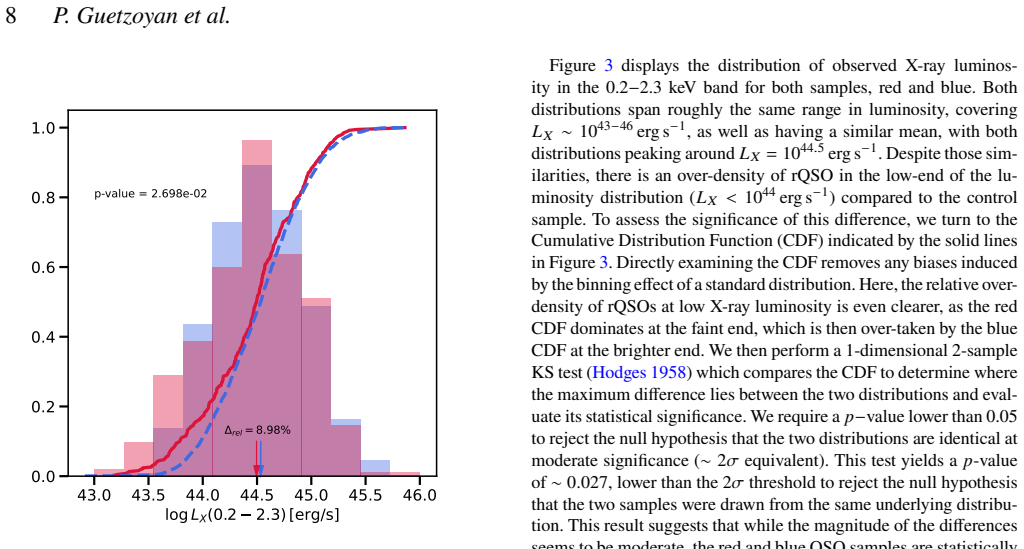
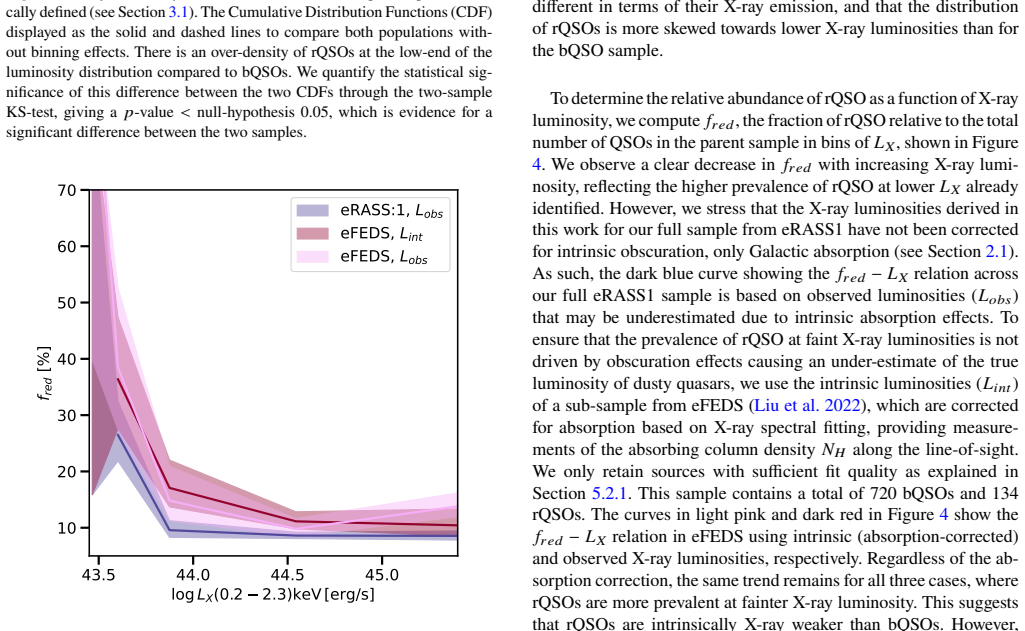
Red quasars are intrinsically X-ray weak compared to blue quasars, with over 50 percent of the sample at luminosities below 10^43.5 erg s^-1. They display low alpha_OX values despite bright optical continua, and their X-ray spectra show large gas column densities that exceed expectations from the observed optical reddening. These measurements imply that X-ray absorption arises from dust-free gas near the black hole while optical reddening occurs on larger host-galaxy scales or in disc winds. Overall the objects represent a phase of suppressed black hole assembly relative to stellar mass growth.
What carries the argument
The alpha_OX spectral slope indicator, which measures the relative strength of X-ray emission to the optical continuum at 2500 Angstroms and thereby reveals the X-ray weakness of red quasars.
If this is right
- More than half the red quasar population sits at low X-ray luminosities below 10^43.5 erg s^-1.
- X-ray absorption is produced by dust-free gas close to the black hole while optical reddening traces larger-scale host dust or winds.
- Red quasars are not optically faint yet show suppressed X-ray output relative to blue quasars.
- This configuration supports an evolutionary sequence in which black hole growth temporarily lags behind host-galaxy stellar mass assembly.
Where Pith is reading between the lines
- If the phase is real, models of AGN feedback must include intervals of reduced accretion that allow continued galaxy growth.
- Targeted multi-epoch X-ray monitoring could test whether the weak state is transient or long-lived.
- Similar X-ray weakness might appear in other red AGN populations selected by different criteria, extending the result beyond the current sample.
Load-bearing premise
The X-ray weakness and low alpha_OX values reflect an intrinsic low-accretion state rather than selection effects, variable absorption, or sample construction biases.
What would settle it
A direct comparison finding that alpha_OX values for red quasars match those of blue quasars at matched optical luminosity after correcting for column density would falsify the claim of an intrinsically weak accretion state.
Figures



read the original abstract
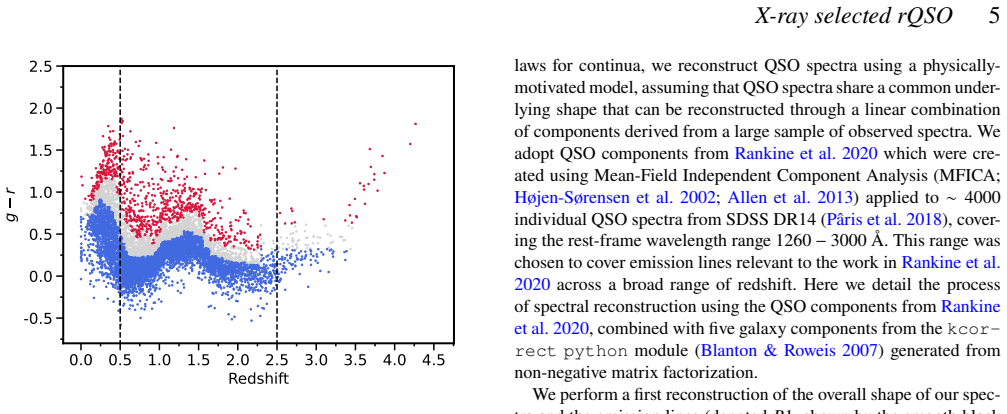
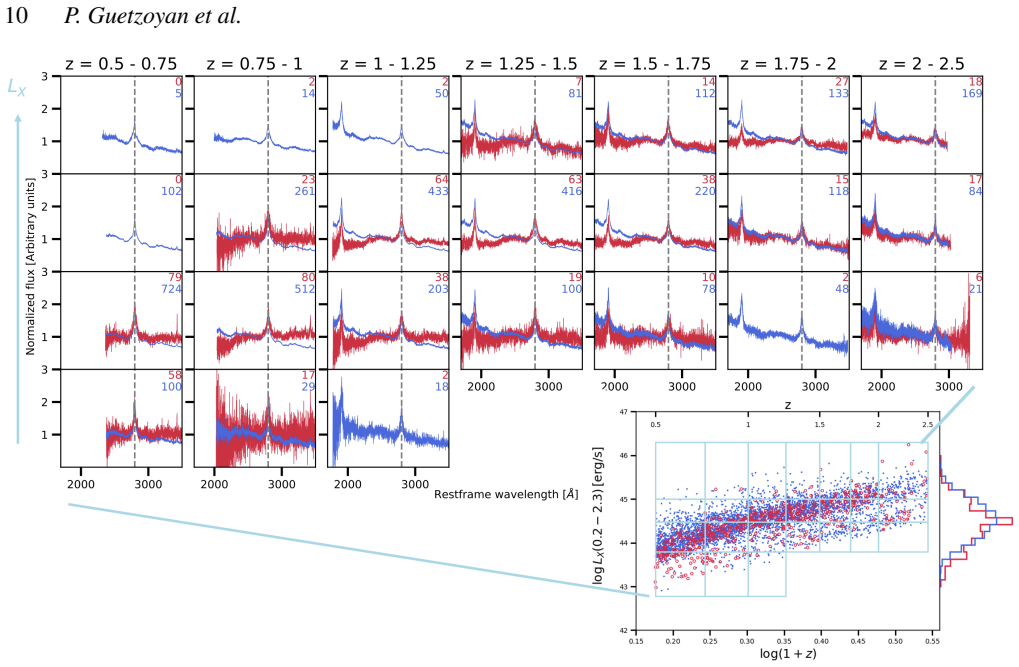
Red quasars (rQSOs) have been recognized as a short-lived, early stage in the evolutionary cycle of Active Galactic Nuclei (AGN), with fundamental differences in their intrinsic properties compared to blue quasars (bQSOs). In this work, we present the first large X-ray sample of 380 rQSOs, selected from the eROSITA/SDSS-V collaboration, providing uniform X-ray detection with optical spectroscopy accros half the sky, in the German hemisphere of eROSITA. We combine X-ray imaging, optical spectroscopy, and multi-wavelength photometry to fully probe the accretion, absorption and host properties of rQSOs. Independent Component Analysis is used to reconstruct optical spectra in a data-driven and non-parametric approach, while accounting for dust reddening and host contamination. rQSOs are intrinsically X-ray weak compared to bQSOs, with a higher fraction found at low X-ray luminosities (over 50$\%$ of the rQSO sample have $L_X < 10^{43.5} \, \rm erg \, s^{-1}$). We investigate the relative X-ray strength of rQSOs by measuring the spectral slope indicator $\alpha_{OX}$. Despite their suppressed X-ray emission, rQSOs are not optically faint, but show low $\alpha_{OX}$ values, indicating weak X-ray emission relative to their bright optical continua. X-ray spectral measurements reveal large gas column densities relative to optical reddening due to dust, implying that X-ray absorption could arise from dust-free gas close to the supermassive Black Hole (BH) rather than a classical dusty torus, while the dust responsible for optical reddening likely resides on larger host-galaxy scales or is associated with dusty gas carried in disc winds. rQSOs trace a phase of suppressed BH assembly relative to stellar mass growth, suggesting that they represent a distinct evolutionary stage where BH accretion is suppressed while the host galaxy continues to grow.
Editorial analysis
A structured set of objections, weighed in public.
Referee Report
Summary. The manuscript presents the first large X-ray sample of 380 red quasars (rQSOs) selected from the eROSITA/SDSS-V collaboration across half the sky. Using Independent Component Analysis (ICA) on optical spectra to reconstruct continua while accounting for dust reddening and host-galaxy contamination, the authors find that rQSOs are intrinsically X-ray weak relative to blue quasars (bQSOs), with >50% having L_X < 10^{43.5} erg s^{-1} and correspondingly low α_OX values despite bright optical continua. X-ray spectral fitting reveals large gas column densities (N_H) relative to the optical reddening, which the authors interpret as evidence for dust-free gas near the supermassive black hole rather than a classical dusty torus. They conclude that rQSOs trace a distinct evolutionary phase of suppressed black-hole assembly relative to ongoing stellar-mass growth in the host galaxy.
Significance. If the X-ray weakness is shown to be intrinsic rather than an artifact of selection or absorption biases, the result would provide direct observational support for a transitional AGN evolutionary stage in which black-hole accretion is suppressed while the host galaxy continues to grow. The uniform eROSITA coverage, large sample size, and data-driven ICA approach are clear strengths that could make this a reference sample for future multi-wavelength studies of red quasars and AGN feedback.
major comments (2)
- [Sample construction and X-ray selection function] The central claim that rQSOs represent a phase of suppressed BH accretion (Abstract and concluding section) rests on the observed low α_OX and L_X values being intrinsic. The manuscript must explicitly test whether the eROSITA detection probability, combined with the optical color cuts that define the rQSO sample and any luminosity thresholds, preferentially selects objects whose apparent X-ray weakness arises from variable absorption or survey sensitivity limits rather than from an intrinsically lower accretion rate. Without completeness simulations or selection-function modeling that varies N_H, redshift, and continuum slope, the separation between intrinsic state and selection bias remains under-constrained.
- [X-ray spectral analysis and absorption measurements] The argument that large N_H relative to optical reddening implies dust-free gas close to the BH (rather than a classical torus) requires a quantitative comparison. Please specify the X-ray spectral model used to derive N_H, the assumed geometry and covering fraction, and the statistical significance of the N_H–E(B–V) offset; also show how this offset changes when the sample is split by redshift or luminosity.
minor comments (3)
- [Abstract] The abstract contains a typographical error: 'accros' should read 'across'.
- [Optical spectral decomposition] Clarify whether any post-hoc choices in the ICA decomposition (e.g., number of components or reddening priors) were tested for robustness against the reported α_OX distribution.
- [Results] Add a table or figure that directly compares the α_OX distribution of the rQSO sample to a matched bQSO control sample at the same optical luminosity and redshift.
Simulated Author's Rebuttal
We thank the referee for their positive assessment of the manuscript and for the constructive comments that help clarify the robustness of our conclusions. We address each major point below and have revised the manuscript accordingly.
read point-by-point responses
-
Referee: [Sample construction and X-ray selection function] The central claim that rQSOs represent a phase of suppressed BH accretion (Abstract and concluding section) rests on the observed low α_OX and L_X values being intrinsic. The manuscript must explicitly test whether the eROSITA detection probability, combined with the optical color cuts that define the rQSO sample and any luminosity thresholds, preferentially selects objects whose apparent X-ray weakness arises from variable absorption or survey sensitivity limits rather than from an intrinsically lower accretion rate. Without completeness simulations or selection-function modeling that varies N_H, redshift, and continuum slope, the separation between intrinsic state and selection bias remains under-constrained.
Authors: We agree that explicit modeling of the selection function is necessary to firmly establish the intrinsic nature of the X-ray weakness. The optical color selection is independent of X-ray flux, and the eROSITA survey provides uniform sensitivity across the footprint, but we acknowledge that variable absorption could in principle affect detectability. In the revised manuscript we have added a dedicated subsection on selection effects. We constructed mock populations varying N_H, redshift, and continuum slope, then applied the eROSITA detection threshold and the SDSS-V optical color cuts. The resulting simulated α_OX distributions show that selection biases alone cannot reproduce the observed excess of low-α_OX sources; the data therefore support an intrinsically suppressed accretion state. A direct comparison with the blue quasar control sample, selected under identical optical criteria, further illustrates the difference. revision: yes
-
Referee: [X-ray spectral analysis and absorption measurements] The argument that large N_H relative to optical reddening implies dust-free gas close to the BH (rather than a classical torus) requires a quantitative comparison. Please specify the X-ray spectral model used to derive N_H, the assumed geometry and covering fraction, and the statistical significance of the N_H–E(B–V) offset; also show how this offset changes when the sample is split by redshift or luminosity.
Authors: We thank the referee for requesting these quantitative details. X-ray spectra were fitted in XSPEC with an absorbed power-law model (tbabs*powerlaw), with the photon index fixed at 1.8 for low-count sources and left free otherwise. We adopted a simple spherical absorber geometry with unity covering fraction, as is standard for line-of-sight column-density estimates when the data do not constrain more complex geometries. The median N_H–E(B–V) offset relative to the Galactic dust-to-gas ratio is significant at >4σ. In the revised manuscript we have added a new figure displaying N_H versus E(B–V) for the full sample together with panels split into three redshift and three luminosity bins; the offset remains statistically significant in all subsamples, supporting the interpretation that the X-ray absorbing gas is largely dust-free and located closer to the black hole than the dust responsible for the optical reddening. revision: yes
Circularity Check
No significant circularity in observational analysis of rQSO properties
full rationale
This is an empirical observational study relying on direct measurements from eROSITA/SDSS-V data, including X-ray luminosities, alpha_OX spectral slopes, column densities, and data-driven ICA for optical spectra. No equations, derivations, or first-principles results are presented that reduce to fitted parameters or self-referential inputs by construction. The central claim of a distinct evolutionary stage with suppressed BH accretion follows from comparative statistics against bQSOs and is not forced by any self-citation chain or ansatz. The analysis is self-contained against external survey benchmarks with no load-bearing self-referential steps.
Axiom & Free-Parameter Ledger
free parameters (1)
- L_X threshold
axioms (1)
- domain assumption Red quasars are a short-lived early stage in the AGN evolutionary cycle with fundamental differences from blue quasars
Lean theorems connected to this paper
-
IndisputableMonolith/Cost/FunctionalEquation.leanwashburn_uniqueness_aczel unclear?
unclearRelation between the paper passage and the cited Recognition theorem.
rQSOs trace a phase of suppressed BH assembly relative to stellar mass growth... low α_OX values... large gas column densities relative to optical reddening
-
IndisputableMonolith/Foundation/AlexanderDuality.leanalexander_duality_circle_linking unclear?
unclearRelation between the paper passage and the cited Recognition theorem.
over 50% of the rQSO sample have L_X < 10^43.5 erg s^{-1}
What do these tags mean?
- matches
- The paper's claim is directly supported by a theorem in the formal canon.
- supports
- The theorem supports part of the paper's argument, but the paper may add assumptions or extra steps.
- extends
- The paper goes beyond the formal theorem; the theorem is a base layer rather than the whole result.
- uses
- The paper appears to rely on the theorem as machinery.
- contradicts
- The paper's claim conflicts with a theorem or certificate in the canon.
- unclear
- Pith found a possible connection, but the passage is too broad, indirect, or ambiguous to say the theorem truly supports the claim.
Reference graph
Works this paper leans on
-
[1]
Publications of the Astronomical Society of Australia , author =
On the. Publications of the Astronomical Society of Australia , author =. 2011 , note =. doi:10.1071/AS10046 , abstract =
-
[2]
Pozzetti, L. and Bolzonella, M. and Zucca, E. and Zamorani, G. and Lilly, S. and Renzini, A. and Moresco, M. and Mignoli, M. and Cassata, P. and Tasca, L. and Lamareille, F. and Maier, C. and Meneux, B. and Halliday, C. and Oesch, P. and Vergani, D. and Caputi, K. and Kovač, K. and Cimatti, A. and Cucciati, O. and Iovino, A. and Peng, Y. and Carollo, M. a...
-
[3]
Optical spectra and spectral energy distribution modelling
Stalevski, Marko and Fritz, Jacopo and Baes, Maarten and Nakos, Theodoros and Popovic, Luka C. , month = mar, year =. Monthly Notices of the Royal Astronomical Society , publisher =. doi:10.1111/j.1365-2966.2011.19775.x , abstract =
-
[4]
The Astronomical Journal , author =
Overview of the. The Astronomical Journal , author =. 2022 , pages =. doi:10.3847/1538-3881/ac882b , abstract =
-
[5]
The Astronomical Journal , author =
Sloan. The Astronomical Journal , author =. 2026 , pages =. doi:10.3847/1538-3881/ae0576 , abstract =
-
[6]
Bentz, Misty C. and Denney, Kelly D. and Grier, Catherine J. and Barth, Aaron J. and Peterson, Bradley M. and Vestergaard, Marianne and Bennert, Vardha N. and Canalizo, Gabriela and De Rosa, Gisella and Filippenko, Alexei V. and Gates, Elinor L. and Greene, Jenny E. and Li, Weidong and Malkan, Matthew A. and Pogge, Richard W. and Stern, Daniel and Treu, T...
work page internal anchor Pith review doi:10.1088/0004-637x/767/2/149
-
[7]
and Netzer, Hagai and Maoz, Dan and Jannuzi, Buell T
Kaspi, Shai and Smith, Paul S. and Netzer, Hagai and Maoz, Dan and Jannuzi, Buell T. and Giveon, Uriel , month = apr, year =. Reverberation. The Astrophysical Journal , publisher =. doi:10.1086/308704 , abstract =
-
[8]
Peterson, B. M. and Ferrarese, L. and Gilbert, K. M. and Kaspi, S. and Malkan, M. A. and Maoz, D. and Merritt, D. and Netzer, H. and Onken, C. A. and Pogge, R. W. and Vestergaard, M. and Wandel, A. , month = oct, year =. Central. The Astrophysical Journal , publisher =. doi:10.1086/423269 , abstract =
-
[9]
Laird, E. S. and Nandra, K. and Georgakakis, A. and Aird, J. A. and Barmby, P. and Conselice, C. J. and Coil, A. L. and Davis, M. and Faber, S. M. and Fazio, G. G. and Guhathakurta, P. and Koo, D. C. and Sarajedini, V. and Willmer, C. N. A. , month = jan, year =. The Astrophysical Journal Supplement Series , publisher =. doi:10.1088/0067-0049/180/1/102 , ...
-
[10]
Cardelli, Jason A. and Clayton, Geoffrey C. and Mathis, John S. , month = oct, year =. The. The Astrophysical Journal , publisher =. doi:10.1086/167900 , abstract =
-
[11]
Elvis, Martin and Wilkes, Belinda J. and McDowell, Jonathan C. and Green, Richard F. and Bechtold, Jill and Willner, S. P. and Oey, M. S. and Polomski, Elisha and Cutri, Roc , month = nov, year =. Atlas of. The Astrophysical Journal Supplement Series , publisher =. doi:10.1086/192093 , abstract =
-
[12]
Neugebauer, G. and Green, R. F. and Matthews, K. and Schmidt, M. and Soifer, B. T. and Bennett, J. , month = mar, year =. Continuum. The Astrophysical Journal Supplement Series , publisher =. doi:10.1086/191175 , abstract =
-
[13]
Krimm, H. A. and Holland, S. T. and Corbet, R. H. D. and Pearlman, A. B. and Romano, P. and Kennea, J. A. and Bloom, J. S. and Barthelmy, S. D. and Baumgartner, W. H. and Cummings, J. R. and Gehrels, N. and Lien, A. Y. and Markwardt, C. B. and Palmer, D. M. and Sakamoto, T. and Stamatikos, M. and Ukwatta, T. N. , month = nov, year =. The. The Astrophysica...
-
[14]
Baumgartner, W. H. and Tueller, J. and Markwardt, C. B. and Skinner, G. K. and Barthelmy, S. and Mushotzky, R. F. and Evans, P. A. and Gehrels, N. , month = aug, year =. The 70. The Astrophysical Journal Supplement Series , publisher =. doi:10.1088/0067-0049/207/2/19 , abstract =
-
[15]
Space Science Reviews , author =
The. Space Science Reviews , author =. 2005 , note =. doi:10.1007/s11214-005-5096-3 , abstract =
work page internal anchor Pith review doi:10.1007/s11214-005-5096-3 2005
-
[16]
Giacconi, R. and Branduardi, G. and Briel, U. and Epstein, A. and Fabricant, D. and Feigelson, E. and Forman, W. and Gorenstein, P. and Grindlay, J. and Gursky, H. and Harnden, F. R. and Henry, J. P. and Jones, C. and Kellogg, E. and Koch, D. and Murray, S. and Schreier, E. and Seward, F. and Tananbaum, H. and Topka, K. and Van Speybroeck, L. and Holt, S....
-
[17]
Spiegelsysteme streifenden. Annalen der Physik , author =. 1952 , note =. doi:10.1002/andp.19524450108 , abstract =
-
[18]
Giacconi, R. and Reidy, W. P. and Zehnpfennig, T. and Lindsay, J. C. and Muney, W. S. , month = oct, year =. Solar. The Astrophysical Journal , publisher =. doi:10.1086/148404 , urldate =
-
[19]
Bondi, H. , month = jan, year =. On spherically symmetrical accretion , volume =. Monthly Notices of the Royal Astronomical Society , publisher =. doi:10.1093/mnras/112.2.195 , abstract =
-
[20]
Proceedings of the Cambridge Philosophical Society , author =
The effect of interstellar matter on climatic variation , volume =. Proceedings of the Cambridge Philosophical Society , author =. 1939 , note =. doi:10.1017/S0305004100021150 , urldate =
-
[21]
Bondi, H. and Hoyle, F. , month = jan, year =. On the mechanism of accretion by stars , volume =. Monthly Notices of the Royal Astronomical Society , publisher =. doi:10.1093/mnras/104.5.273 , urldate =
-
[22]
Baldwin, J. A. and Phillips, M. M. and Terlevich, R. , month = feb, year =. Classification parameters for the emission-line spectra of extragalactic objects. , volume =. Publications of the Astronomical Society of the Pacific , publisher =. doi:10.1086/130766 , abstract =
-
[23]
Living Reviews in Relativity , author =
Astrophysics with the. Living Reviews in Relativity , author =. 2023 , note =. doi:10.1007/s41114-022-00041-y , abstract =
-
[24]
Somerville, Rachel S. and Hopkins, Philip F. and Cox, Thomas J. and Robertson, Brant E. and Hernquist, Lars , month = dec, year =. A semi-analytic model for the co-evolution of galaxies, black holes and active galactic nuclei , volume =. Monthly Notices of the Royal Astronomical Society , publisher =. doi:10.1111/j.1365-2966.2008.13805.x , abstract =
-
[25]
M., Ward-Thompson, D., & Andr \'e , P.\ 2005, , 360, 4, 1506
Croton, Darren J. and Springel, Volker and White, Simon D. M. and De Lucia, G. and Frenk, C. S. and Gao, L. and Jenkins, A. and Kauffmann, G. and Navarro, J. F. and Yoshida, N. , month = jan, year =. The many lives of active galactic nuclei: cooling flows, black holes and the luminosities and colours of galaxies , volume =. Monthly Notices of the Royal As...
-
[26]
Hasinger, G. and Miyaji, T. and Schmidt, M. , month = oct, year =. Luminosity-dependent evolution of soft. Astronomy and Astrophysics , publisher =. doi:10.1051/0004-6361:20042134 , abstract =
-
[27]
Barger, A. J. and Cowie, L. L. and Mushotzky, R. F. and Yang, Y. and Wang, W.-H. and Steffen, A. T. and Capak, P. , month = feb, year =. The. The Astronomical Journal , publisher =. doi:10.1086/426915 , abstract =
-
[28]
Akins, Hollis B. and Casey, Caitlin M. and Lambrides, Erini and Allen, Natalie and Andika, Irham T. and Brinch, Malte and Champagne, Jaclyn B. and Cooper, Olivia and Ding, Xuheng and Drakos, Nicole E. and Faisst, Andreas and Finkelstein, Steven L. and Franco, Maximilien and Fujimoto, Seiji and Gentile, Fabrizio and Gillman, Steven and Gozaliasl, Ghassem a...
-
[29]
Astronomy & Astrophysics , author =
The. Astronomy & Astrophysics , author =. 2021 , pages =. doi:10.1051/0004-6361/202141745 , abstract =
-
[30]
and Glazebrook, Karl and Brinkmann, Jon and Ivezić, Željko and Lupton, Robert H
Baldry, Ivan K. and Glazebrook, Karl and Brinkmann, Jon and Ivezić, Željko and Lupton, Robert H. and Nichol, Robert C. and Szalay, Alexander S. , month = jan, year =. Quantifying the. The Astrophysical Journal , publisher =. doi:10.1086/380092 , abstract =
-
[31]
Tully, R. B. and Mould, J. R. and Aaronson, M. , month = jun, year =. A color-magnitude relation for spiral galaxies , volume =. The Astrophysical Journal , publisher =. doi:10.1086/160009 , abstract =
-
[32]
Thomas, Daniel and Maraston, Claudia and Bender, Ralf and Mendes de Oliveira, Claudia , month = mar, year =. The. The Astrophysical Journal , publisher =. doi:10.1086/426932 , abstract =
-
[33]
Bromm, Volker and Loeb, Abraham , month = oct, year =. Formation of the. The Astrophysical Journal , publisher =. doi:10.1086/377529 , abstract =
-
[34]
The Astrophysical Journal , publisher =
First. The Astrophysical Journal , publisher =. 2019 , note =. doi:10.3847/2041-8213/ab0ec7 , abstract =
-
[35]
Ghez, A. M. and Duchêne, G. and Matthews, K. and Hornstein, S. D. and Tanner, A. and Larkin, J. and Morris, M. and Becklin, E. E. and Salim, S. and Kremenek, T. and Thompson, D. and Soifer, B. T. and Neugebauer, G. and McLean, I. , month = apr, year =. The. The Astrophysical Journal , publisher =. doi:10.1086/374804 , abstract =
-
[36]
Cygnus. Science , author =. 2021 , note =. doi:10.1126/science.abb3363 , abstract =
-
[37]
Fabian, A. C. and Celotti, A. and Blundell, K. M. and Kassim, N. E. and Perley, R. A. , month = mar, year =. The properties of the. Monthly Notices of the Royal Astronomical Society , publisher =. doi:10.1046/j.1365-8711.2002.05182.x , abstract =
-
[38]
Alvarez, Marcelo A. and Wise, John H. and Abel, Tom , month = aug, year =. Accretion onto the. The Astrophysical Journal , publisher =. doi:10.1088/0004-637X/701/2/L133 , abstract =
-
[39]
Silk, Joseph and Mamon, Gary A. , month = aug, year =. The current status of galaxy formation , volume =. Research in Astronomy and Astrophysics , publisher =. doi:10.1088/1674-4527/12/8/004 , abstract =
-
[40]
Blandford, R. D. and Znajek, R. L. , month = may, year =. Electromagnetic extraction of energy from. Monthly Notices of the Royal Astronomical Society , publisher =. doi:10.1093/mnras/179.3.433 , abstract =
-
[41]
and Abolmasov, Pavel , month = may, year =
Poutanen, Juri and Lipunova, Galina and Fabrika, Sergei and Butkevich, Alexey G. and Abolmasov, Pavel , month = may, year =. Supercritically accreting stellar mass black holes as ultraluminous. Monthly Notices of the Royal Astronomical Society , publisher =. doi:10.1111/j.1365-2966.2007.11668.x , abstract =
-
[42]
Shakura, N. I. and Sunyaev, R. A. , month = jan, year =. Black holes in binary systems. Astronomy and Astrophysics , publisher =
-
[43]
The fuelling of active galactic nuclei , volume =. Nature , author =. 1990 , note =. doi:10.1038/345679a0 , abstract =
-
[44]
Carr, Bernard J. , editor =. Primordial. Quantum. 2003 , note =. doi:10.1007/978-3-540-45230-0_7 , urldate =
-
[45]
The Astrophysical Journal , author =
Can. The Astrophysical Journal , author =. 2008 , pages =. doi:10.1086/591636 , language =
-
[46]
Volonteri, Marta and Haardt, Francesco and Madau, Piero , month = jan, year =. The. The Astrophysical Journal , publisher =. doi:10.1086/344675 , abstract =
-
[47]
The Astrophysical Journal , author =
Massive. The Astrophysical Journal , author =. 2001 , pages =. doi:10.1086/319848 , number =
-
[48]
International Journal of Modern Physics D , author =
Observational evidence for intermediate-mass black holes , volume =. International Journal of Modern Physics D , author =. 2017 , pages =. doi:10.1142/S021827181730021X , abstract =
-
[49]
Peca, Alessandro and Cappelluti, Nico and LaMassa, Stephanie and Urry, C. Megan and Moscetti, Massimo and Marchesi, Stefano and Sanders, David and Auge, Connor and Ghosh, Aritra and Ananna, Tonima Tasnim and Torres-Albà, Núria and Treister, Ezequiel , month = oct, year =. Stripe 82-. The Astrophysical Journal , publisher =. doi:10.3847/1538-4357/ad6df4 , ...
-
[50]
Constraints on primordial black holes , volume =
Carr, Bernard and Kohri, Kazunori and Sendouda, Yuuiti and Yokoyama, Jun'ichi , month = nov, year =. Constraints on primordial black holes , volume =. Reports on Progress in Physics , publisher =. doi:10.1088/1361-6633/ac1e31 , abstract =
-
[51]
Omukai, Kazuyuki , month = jan, year =. Primordial. The Astrophysical Journal , publisher =. doi:10.1086/318296 , abstract =
-
[52]
Lodato, Giuseppe and Natarajan, Priyamvada , month = oct, year =. Supermassive black hole formation during the assembly of pre-galactic discs , volume =. Monthly Notices of the Royal Astronomical Society , publisher =. doi:10.1111/j.1365-2966.2006.10801.x , abstract =
-
[53]
The Astrophysical Journal , author =
Pair‐. The Astrophysical Journal , author =. 2001 , pages =. doi:10.1086/319719 , language =
-
[54]
and Hernquist, Lars and Martini, Paul and Cox, Thomas J
Hopkins, Philip F. and Hernquist, Lars and Martini, Paul and Cox, Thomas J. and Robertson, Brant and Di Matteo, Tiziana and Springel, Volker , month = jun, year =. A. The Astrophysical Journal , publisher =. doi:10.1086/431146 , abstract =
-
[55]
Martini, Paul , month = jan, year =. doi:10.48550/arXiv.astro-ph/0304009 , abstract =
work page internal anchor Pith review Pith/arXiv arXiv doi:10.48550/arxiv.astro-ph/0304009
-
[56]
Monthly Notices of the Royal Astronomical Society , publisher =
King, Andrew and Nixon, Chris , month = oct, year =. Monthly Notices of the Royal Astronomical Society , publisher =. doi:10.1093/mnrasl/slv098 , abstract =
-
[57]
Near-infrared flares from accreting gas around the supermassive black hole at the. Nature , author =. 2003 , note =. doi:10.1038/nature02065 , abstract =
-
[58]
Galactic. Nature , author =. 1969 , note =. doi:10.1038/223690a0 , abstract =
-
[59]
On the. Abh. Konigl. Preuss. Akad. Wissenschaften Jahre 1906,92, Berlin,1907 , author =. 1916 , note =
work page 1906
-
[60]
Dubois, Yohan and Devriendt, Julien and Slyz, Adrianne and Teyssier, Romain , month = mar, year =. Self-regulated growth of supermassive black holes by a dual jet-heating active galactic nucleus feedback mechanism: methods, tests and implications for cosmological simulations , volume =. Monthly Notices of the Royal Astronomical Society , publisher =. doi:...
-
[61]
Monthly Notices of the Royal Astronomical Society , author =
The cosmic evolution of massive black holes in the. Monthly Notices of the Royal Astronomical Society , author =. 2016 , pages =. doi:10.1093/mnras/stw1123 , language =
-
[62]
Stellar. Astronomy Letters , author =. 2018 , pages =. doi:10.1134/S1063773717120015 , language =
work page internal anchor Pith review doi:10.1134/s1063773717120015 2018
-
[63]
The Astrophysical Journal , author =. 2011 , pages =. doi:10.1088/0004-637X/730/2/61 , number =
-
[64]
Dubois, Y. and Pichon, C. and Welker, C. and Le Borgne, D. and Devriendt, J. and Laigle, C. and Codis, S. and Pogosyan, D. and Arnouts, S. and Benabed, K. and Bertin, E. and Blaizot, J. and Bouchet, F. and Cardoso, J.-F. and Colombi, S. and de Lapparent, V. and Desjacques, V. and Gavazzi, R. and Kassin, S. and Kimm, T. and McCracken, H. and Milliard, B. a...
work page internal anchor Pith review doi:10.1093/mnras/stu1227
-
[65]
Vanden Berk, Daniel E. and Richards, Gordon T. and Bauer, Amanda and Strauss, Michael A. and Schneider, Donald P. and Heckman, Timothy M. and York, Donald G. and Hall, Patrick B. and Fan, Xiaohui and Knapp, G. R. and Anderson, Scott F. and Annis, James and Bahcall, Neta A. and Bernardi, Mariangela and Briggs, John W. and Brinkmann, J. and Brunner, Robert ...
-
[66]
The Astrophysical Journal , author =. 2015 , pages =. doi:10.1088/0004-637X/804/2/104 , number =
-
[67]
Esin, Ann A. and McClintock, Jeffrey E. and Narayan, Ramesh , month = nov, year =. Advection-. The Astrophysical Journal , publisher =. doi:10.1086/304829 , abstract =
-
[68]
Schechter, P. , month = jan, year =. An analytic expression for the luminosity function for galaxies. , volume =. The Astrophysical Journal , publisher =. doi:10.1086/154079 , abstract =
-
[69]
Narayan, Ramesh and Yi, Insu , month = oct, year =. Advection-dominated. The Astrophysical Journal , publisher =. doi:10.1086/176343 , abstract =
-
[70]
Richards, Gordon T. and Kruczek, Nicholas E. and Gallagher, S. C. and Hall, Patrick B. and Hewett, Paul C. and Leighly, Karen M. and Deo, Rajesh P. and Kratzer, Rachael M. and Shen, Yue , month = may, year =. Unification of. The Astronomical Journal , publisher =. doi:10.1088/0004-6256/141/5/167 , abstract =
-
[71]
Rankine, Amy L. and Matthews, James H. and Hewett, Paul C. and Banerji, Manda and Morabito, Leah K. and Richards, Gordon T. , month = apr, year =. Placing. Monthly Notices of the Royal Astronomical Society , publisher =. doi:10.1093/mnras/stab302 , abstract =
-
[72]
Cicone, C. and Maiolino, R. and Sturm, E. and Graciá-Carpio, J. and Feruglio, C. and Neri, R. and Aalto, S. and Davies, R. and Fiore, F. and Fischer, J. and García-Burillo, S. and González-Alfonso, E. and Hailey-Dunsheath, S. and Piconcelli, E. and Veilleux, S. , month = feb, year =. Massive molecular outflows and evidence for. Astronomy and Astrophysics ...
work page internal anchor Pith review doi:10.1051/0004-6361/201322464
-
[73]
Feruglio, C. and Maiolino, R. and Piconcelli, E. and Menci, N. and Aussel, H. and Lamastra, A. and Fiore, F. , month = jul, year =. Quasar feedback revealed by giant molecular outflows , volume =. Astronomy and Astrophysics , publisher =. doi:10.1051/0004-6361/201015164 , abstract =
-
[74]
Tombesi, F. and Cappi, M. and Reeves, J. N. and Palumbo, G. G. C. and Yaqoob, T. and Braito, V. and Dadina, M. , month = oct, year =. Evidence for ultra-fast outflows in radio-quiet. Astronomy and Astrophysics , publisher =. doi:10.1051/0004-6361/200913440 , abstract =
-
[75]
Begelman, Mitchell C. and Volonteri, Marta and Rees, Martin J. , month = jul, year =. Formation of supermassive black holes by direct collapse in pre-galactic haloes , volume =. Monthly Notices of the Royal Astronomical Society , publisher =. doi:10.1111/j.1365-2966.2006.10467.x , abstract =
-
[76]
Barvainis, Richard , month = sep, year =. Hot. The Astrophysical Journal , publisher =. doi:10.1086/165571 , abstract =
-
[77]
Nikutta, Robert and Elitzur, Moshe and Lacy, Mark , month = dec, year =. On the 10 μm. The Astrophysical Journal , publisher =. doi:10.1088/0004-637X/707/2/1550 , abstract =
-
[78]
Tristram, K. R. W. and Meisenheimer, K. and Jaffe, W. and Schartmann, M. and Rix, H.-W. and Leinert, Ch. and Morel, S. and Wittkowski, M. and Röttgering, H. and Perrin, G. and Lopez, B. and Raban, D. and Cotton, W. D. and Graser, U. and Paresce, F. and Henning, Th. , month = nov, year =. Resolving the complex structure of the dust torus in the active nucl...
-
[79]
Elitzur, Moshe and Shlosman, Isaac , month = sep, year =. The. The Astrophysical Journal , publisher =. doi:10.1086/508158 , abstract =
-
[80]
Nenkova, Maia and Ivezić, Željko and Elitzur, Moshe , month = may, year =. Dust. The Astrophysical Journal , publisher =. doi:10.1086/340857 , abstract =
discussion (0)
Sign in with ORCID, Apple, or X to comment. Anyone can read and Pith papers without signing in.