JanusPipe: Efficient Pipeline Parallel Training for Machine Learning Interatomic Potentials
Pith reviewed 2026-05-20 08:31 UTC · model grok-4.3
The pith
JanusPipe introduces a tailored pipeline parallelism approach that handles the double-backward execution of conservative MLIPs to improve distributed training efficiency.
A machine-rendered reading of the paper's core claim, the machinery that carries it, and where it could break.
Core claim
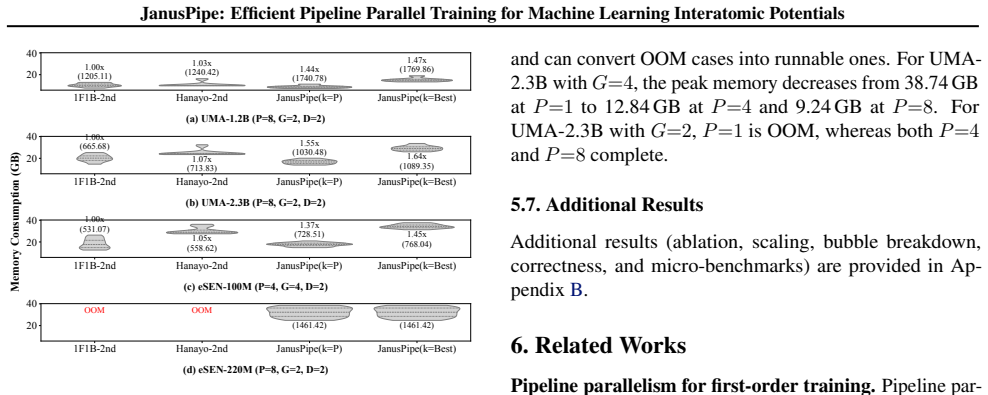
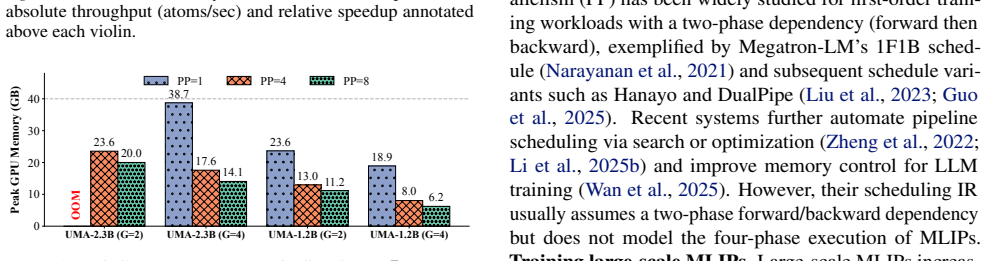
The authors develop JanusPipe, an efficient 3D-parallel training system for conservative MLIPs. It integrates SymFold to support memory-efficient pipeline parallelism despite the double-backward pattern and WaveK to reduce pipeline bubbles through balanced four-phase compute times. On 32 GPUs, this yields 1.51 times higher throughput than 1F1B and 1.45 times higher than Hanayo on average for conservative MLIP training.
What carries the argument
SymFold for memory-efficient pipeline parallelism adapted to double-backward execution and WaveK for balancing the four-phase compute time to reduce bubbles in the pipeline schedule.
Load-bearing premise
The double-backward execution pattern is the dominant source of inefficiency in existing pipeline-parallel systems for these models, and the overhead introduced by SymFold and WaveK remains negligible across the tested model sizes and GPU counts.
What would settle it
Running JanusPipe and a baseline like 1F1B on the same conservative MLIP model with 32 GPUs and comparing the measured training throughput; if the improvement is absent or reversed, the central claim would be falsified.
Figures




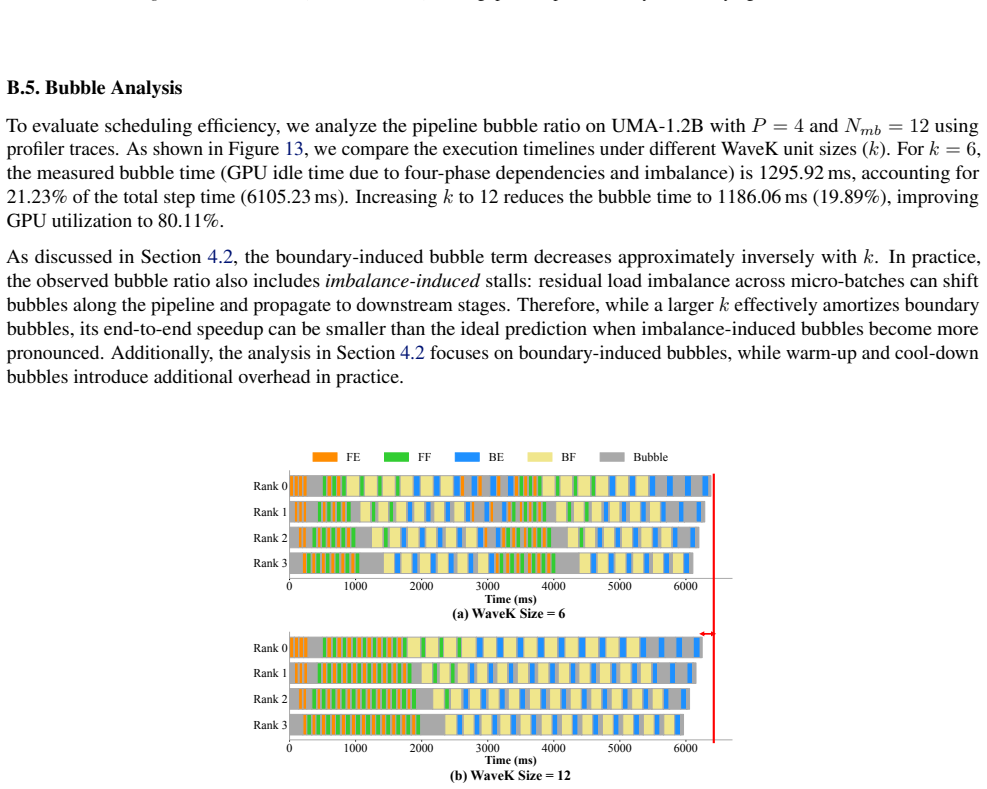


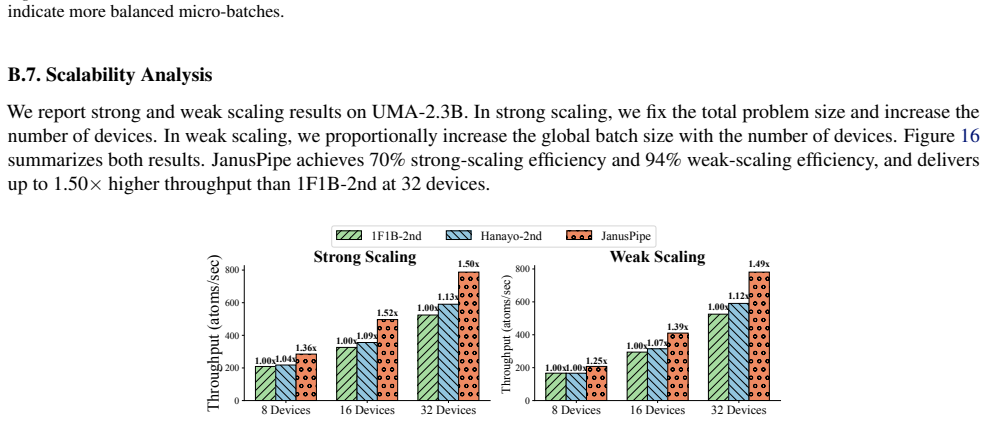

read the original abstract
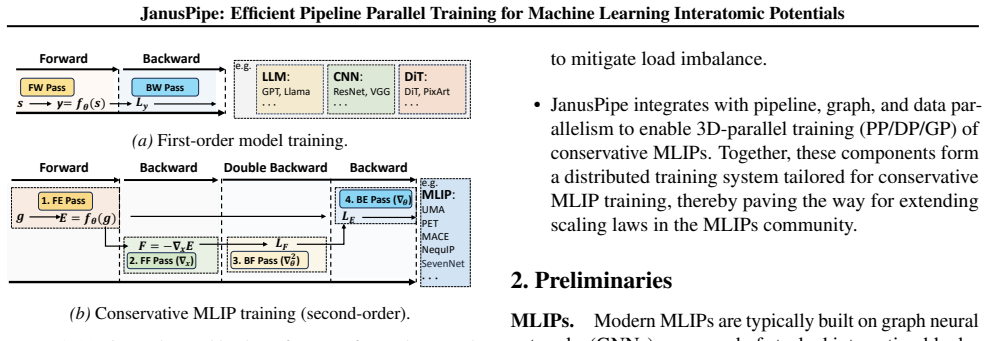
Discovering atom-level phenomena requires molecular dynamics (MD) simulations with ab initio accuracy. Machine learning interatomic potentials (MLIPs) enable stable, high-accuracy MD simulations, and their models exhibit scaling-law trends similar to large language models. However, the lack of scalable and efficient distributed training systems for conservative MLIPs makes them difficult to scale. This is because conservative MLIPs inherently follow a double-backward execution pattern, which involves computing gradients during the forward pass. This pattern creates a mismatch with existing distributed training systems, especially for pipeline parallelism. Therefore, we present JanusPipe, an efficient 3D-parallel (PP/DP/GP) training system tailored for conservative MLIPs. It integrates SymFold to enable memory-efficient pipeline parallelism for conservative MLIPs, and WaveK to reduce pipeline bubbles by balancing the four-phase compute time. Experimental results on 32 GPUs show that JanusPipe improves throughput by $1.51\times$ and $1.45\times$ on average over 1F1B and Hanayo, respectively.
Editorial analysis
A structured set of objections, weighed in public.
Referee Report
Summary. The manuscript introduces JanusPipe, a 3D-parallel (PP/DP/GP) training system for conservative machine learning interatomic potentials (MLIPs). It integrates SymFold to support memory-efficient pipeline parallelism that accommodates the double-backward execution pattern and WaveK to balance four-phase compute times and reduce pipeline bubbles. The central experimental claim is that JanusPipe delivers average throughput gains of 1.51× over 1F1B and 1.45× over Hanayo on 32 GPUs.
Significance. If the reported speedups are robust, the work would be significant for distributed systems supporting scalable MLIP training, which is needed for high-accuracy molecular dynamics simulations that follow scaling-law behavior. The paper receives credit for targeting a concrete mismatch between conservative MLIP computation and existing pipeline-parallel frameworks and for supplying named-baseline throughput numbers on a fixed GPU count.
major comments (2)
- [Experimental evaluation] Experimental evaluation: the abstract and results section report concrete 1.51×/1.45× throughput numbers on 32 GPUs but supply no information on model architectures, dataset sizes, exact hardware configuration, or statistical variance; without these the central performance claim cannot be fully evaluated.
- [Method (SymFold/WaveK)] SymFold and WaveK descriptions: the attribution of gains to resolution of the double-backward mismatch assumes that the overheads of SymFold folding and WaveK phase scheduling remain negligible, yet no ablation studies or per-component timing breakdowns are provided to confirm this for the evaluated MLIP sizes and GPU counts.
minor comments (2)
- [Abstract] The abstract would be clearer if it briefly indicated the scale or type of MLIP models used in the 32-GPU experiments.
- [Background] Notation for the four-phase execution pattern could be introduced with a small diagram or timing table to aid readers unfamiliar with conservative MLIP gradients.
Simulated Author's Rebuttal
We thank the referee for the constructive feedback on our manuscript. We appreciate the emphasis on strengthening the experimental claims and method validation. Below we respond point-by-point to the major comments and indicate the revisions made.
read point-by-point responses
-
Referee: [Experimental evaluation] Experimental evaluation: the abstract and results section report concrete 1.51×/1.45× throughput numbers on 32 GPUs but supply no information on model architectures, dataset sizes, exact hardware configuration, or statistical variance; without these the central performance claim cannot be fully evaluated.
Authors: We agree that these details are essential for full evaluation and reproducibility of the reported speedups. In the revised manuscript we have expanded the Experimental Setup section to specify the MLIP model architectures (including network depth, feature dimensions, and equivariant layers), the training dataset sizes and sources, the precise hardware configuration (32 NVIDIA A100 GPUs with NVLink interconnect), and statistical variance (mean and standard deviation across five independent runs). These additions directly support assessment of the 1.51× and 1.45× throughput gains. revision: yes
-
Referee: [Method (SymFold/WaveK)] SymFold and WaveK descriptions: the attribution of gains to resolution of the double-backward mismatch assumes that the overheads of SymFold folding and WaveK phase scheduling remain negligible, yet no ablation studies or per-component timing breakdowns are provided to confirm this for the evaluated MLIP sizes and GPU counts.
Authors: We acknowledge that explicit ablations and breakdowns would strengthen attribution of the gains. The original manuscript explains the design choices in SymFold and WaveK to keep overheads low for the double-backward pattern, but we have added a new subsection with per-component timing breakdowns on the 32-GPU configurations. These show SymFold and WaveK overheads remain below 4% of total time for the evaluated MLIP sizes, confirming the assumptions. A partial ablation isolating each component is also included based on existing experimental logs. revision: partial
Circularity Check
No circularity: throughput claims rest on external empirical measurements against 1F1B and Hanayo baselines.
full rationale
The paper introduces SymFold and WaveK as engineering mechanisms to address the double-backward pattern in conservative MLIPs under pipeline parallelism. Reported speedups (1.51× and 1.45×) are direct runtime measurements on 32 GPUs, not quantities derived from internal parameters, fitted constants, or self-referential equations. No load-bearing step reduces a claimed result to a definition or prior self-citation by construction; the central attribution is to measured net throughput after adding the new components. The derivation chain is therefore self-contained against external benchmarks.
Axiom & Free-Parameter Ledger
axioms (1)
- domain assumption Existing pipeline-parallel frameworks assume a single forward-then-backward execution pattern.
invented entities (2)
-
SymFold
no independent evidence
-
WaveK
no independent evidence
Reference graph
Works this paper leans on
-
[1]
A foundation model for atomistic materials chemistry
A foundation model for atomistic materials chemistry. arXiv e-prints , keywords =. doi:10.48550/arXiv.2401.00096 , archivePrefix =. 2401.00096 , primaryClass =
work page internal anchor Pith review Pith/arXiv arXiv doi:10.48550/arxiv.2401.00096
-
[2]
Open Materials 2024 (OMat24) Inorganic Materials Dataset and Models
Open Materials 2024 (OMat24) Inorganic Materials Dataset and Models. arXiv e-prints , keywords =. doi:10.48550/arXiv.2410.12771 , archivePrefix =. 2410.12771 , primaryClass =
work page internal anchor Pith review Pith/arXiv arXiv doi:10.48550/arxiv.2410.12771 2024
-
[3]
MatterSim: A Deep Learning Atomistic Model Across Elements, Temperatures and Pressures
MatterSim: A Deep Learning Atomistic Model Across Elements, Temperatures and Pressures. arXiv e-prints , keywords =. doi:10.48550/arXiv.2405.04967 , archivePrefix =. 2405.04967 , primaryClass =
work page internal anchor Pith review Pith/arXiv arXiv doi:10.48550/arxiv.2405.04967
-
[4]
Forty-second International Conference on Machine Learning , year=
Learning Smooth and Expressive Interatomic Potentials for Physical Property Prediction , author=. Forty-second International Conference on Machine Learning , year=
- [5]
-
[6]
Scaling deep learning for materials discovery
Merchant, Amil and Batzner, Simon and Schoenholz, Samuel S and Aykol, Muratahan and Cheon, Gowoon and Cubuk, Ekin Dogus. Scaling deep learning for materials discovery. Nature
- [7]
-
[8]
Matbench Discovery -- A framework to evaluate machine learning crystal stability predictions. arXiv e-prints , keywords =. doi:10.48550/arXiv.2308.14920 , archivePrefix =. 2308.14920 , primaryClass =
-
[9]
Ilyes Batatia and David Peter Kovacs and Gregor N. C. Simm and Christoph Ortner and Gabor Csanyi , booktitle=. 2022 , url=
work page 2022
-
[10]
Brandon M Wood and Misko Dzamba and Xiang Fu and Meng Gao and Muhammed Shuaibi and Luis Barroso-Luque and Kareem Abdelmaqsoud and Vahe Gharakhanyan and John R. Kitchin and Daniel S. Levine and Kyle Michel and Anuroop Sriram and Taco Cohen and Abhishek Das and Sushree Jagriti Sahoo and Ammar Rizvi and Zachary Ward Ulissi and C. Lawrence Zitnick , booktitle...
work page 2025
-
[11]
Scaling Laws for Neural Language Models
Scaling Laws for Neural Language Models. arXiv e-prints , keywords =. doi:10.48550/arXiv.2001.08361 , archivePrefix =. 2001.08361 , primaryClass =
work page internal anchor Pith review Pith/arXiv arXiv doi:10.48550/arxiv.2001.08361 2001
-
[12]
International Conference on Learning Representations , year=
Towards Training Billion Parameter Graph Neural Networks for Atomic Simulations , author=. International Conference on Learning Representations , year=
-
[13]
Towards Training Billion Parameter Graph Neural Networks for Atomic Simulations , author=. 2022 , eprint=
work page 2022
-
[14]
Zhao, Yanli and Gu, Andrew and Varma, Rohan and Luo, Liang and Huang, Chien-Chin and Xu, Min and Wright, Less and Shojanazeri, Hamid and Ott, Myle and Shleifer, Sam and Desmaison, Alban and Balioglu, Can and Damania, Pritam and Nguyen, Bernard and Chauhan, Geeta and Hao, Yuchen and Mathews, Ajit and Li, Shen , title =. Proc. VLDB Endow. , month = aug, pag...
-
[15]
A brief review on importance of DFT in drug design , author=. Res. Med. Eng. Sci , volume=
-
[16]
Drug Discovery Today , volume=
Applications of density functional theory in COVID-19 drug modeling , author=. Drug Discovery Today , volume=. 2022 , publisher=
work page 2022
-
[17]
npj Computational Materials , volume=
Computational understanding of Li-ion batteries , author=. npj Computational Materials , volume=. 2016 , publisher=
work page 2016
-
[18]
Energy & Environmental Materials , volume=
Density functional theory for battery materials , author=. Energy & Environmental Materials , volume=. 2019 , publisher=
work page 2019
-
[19]
The Open Catalyst 2022 (OC22) dataset and challenges for oxide electrocatalysts , author=. ACS Catalysis , volume=. 2023 , publisher=
work page 2022
-
[20]
Brabson and Abhishek Das and Zachary Ulissi and Matt Uyttendaele and Andrew J
Anuroop Sriram and Sihoon Choi and Xiaohan Yu and Logan M. Brabson and Abhishek Das and Zachary Ulissi and Matt Uyttendaele and Andrew J. Medford and David S. Sholl , title =. 2023 , journal=
work page 2023
-
[21]
Levine, Muhammed Shuaibi, Evan Walter Clark Spotte-Smith, Michael G
The Open Molecules 2025 (OMol25) Dataset, Evaluations, and Models. arXiv e-prints , keywords =. doi:10.48550/arXiv.2505.08762 , archivePrefix =. 2505.08762 , primaryClass =
-
[22]
Nature Machine Intelligence , volume=
CHGNet as a pretrained universal neural network potential for charge-informed atomistic modelling , author=. Nature Machine Intelligence , volume=. 2023 , publisher=
work page 2023
-
[23]
The Journal of Physical Chemistry Letters , volume=
Accurate band gaps for semiconductors from density functional theory , author=. The Journal of Physical Chemistry Letters , volume=. 2011 , publisher=
work page 2011
-
[24]
Lawrence and Ulissi, Zachary , title =
Chanussot*, Lowik and Das*, Abhishek and Goyal*, Siddharth and Lavril*, Thibaut and Shuaibi*, Muhammed and Riviere, Morgane and Tran, Kevin and Heras-Domingo, Javier and Ho, Caleb and Hu, Weihua and Palizhati, Aini and Sriram, Anuroop and Wood, Brandon and Yoon, Junwoong and Parikh, Devi and Zitnick, C. Lawrence and Ulissi, Zachary , title =. ACS Catalysi...
-
[25]
Advances in neural information processing systems , volume=
Large scale distributed deep networks , author=. Advances in neural information processing systems , volume=
-
[26]
PyTorch Distributed: Experiences on Accelerating Data Parallel Training
Pytorch distributed: Experiences on accelerating data parallel training , author=. arXiv preprint arXiv:2006.15704 , year=
work page internal anchor Pith review Pith/arXiv arXiv 2006
-
[27]
Horovod: fast and easy distributed deep learning in TensorFlow
Horovod: fast and easy distributed deep learning in TensorFlow , author=. arXiv preprint arXiv:1802.05799 , year=
work page internal anchor Pith review Pith/arXiv arXiv
-
[28]
Zero: Memory optimizations toward training trillion parameter models , author=. SC20: International Conference for High Performance Computing, Networking, Storage and Analysis , pages=. 2020 , organization=
work page 2020
-
[29]
Megatron-LM: Training Multi-Billion Parameter Language Models Using Model Parallelism
Megatron-lm: Training multi-billion parameter language models using model parallelism , author=. arXiv preprint arXiv:1909.08053 , year=
work page internal anchor Pith review Pith/arXiv arXiv 1909
-
[30]
DAPPLE: A pipelined data parallel approach for training large models , author=. Proceedings of the 26th ACM SIGPLAN Symposium on Principles and Practice of Parallel Programming , pages=
- [31]
-
[32]
Nature Computational Science , volume=
A universal graph deep learning interatomic potential for the periodic table , author=. Nature Computational Science , volume=. 2022 , publisher=
work page 2022
-
[33]
Jia, Weile and Wang, Han and Chen, Mohan and Lu, Denghui and Lin, Lin and Car, Roberto and E, Weinan and Zhang, Linfeng , title =. Proceedings of the International Conference for High Performance Computing, Networking, Storage and Analysis , articleno =. 2020 , isbn =
work page 2020
-
[34]
On the Opportunities and Risks of Foundation Models
On the opportunities and risks of foundation models , author=. arXiv preprint arXiv:2108.07258 , year=
work page internal anchor Pith review Pith/arXiv arXiv
-
[35]
ACS Applied Materials & Interfaces , year=
Performance assessment of universal machine learning interatomic potentials: Challenges and directions for materials’ surfaces , author=. ACS Applied Materials & Interfaces , year=
-
[36]
Advances in neural information processing systems , volume=
Gpipe: Efficient training of giant neural networks using pipeline parallelism , author=. Advances in neural information processing systems , volume=
-
[37]
Journal of machine learning research , volume=
Automatic differentiation in machine learning: a survey , author=. Journal of machine learning research , volume=
-
[38]
arXiv preprint arXiv:2003.03123 , year=
Directional message passing for molecular graphs , author=. arXiv preprint arXiv:2003.03123 , year=
-
[39]
Wang, Yujie and Wang, Shiju and Zhu, Shenhan and Fu, Fangcheng and Liu, Xinyi and Xiao, Xuefeng and Li, Huixia and Li, Jiashi and Wu, Faming and Cui, Bin , title =. Proceedings of the 30th ACM International Conference on Architectural Support for Programming Languages and Operating Systems, Volume 2 , pages =. 2025 , isbn =. doi:10.1145/3676641.3715998 , ...
-
[40]
The Journal of Physical Chemistry A , volume=
Machine learning interatomic potentials and long-range physics , author=. The Journal of Physical Chemistry A , volume=. 2023 , publisher=
work page 2023
-
[41]
A Graph Neural Network for the Era of Large Atomistic Models. arXiv e-prints , keywords =. doi:10.48550/arXiv.2506.01686 , archivePrefix =. 2506.01686 , primaryClass =
-
[42]
Model-Agnostic Meta-Learning for Fast Adaptation of Deep Networks
Model-Agnostic Meta-Learning for Fast Adaptation of Deep Networks. arXiv e-prints , keywords =. doi:10.48550/arXiv.1703.03400 , archivePrefix =. 1703.03400 , primaryClass =
work page internal anchor Pith review Pith/arXiv arXiv doi:10.48550/arxiv.1703.03400
-
[43]
Improved Training of Wasserstein GANs
Improved Training of Wasserstein GANs. arXiv e-prints , keywords =. doi:10.48550/arXiv.1704.00028 , archivePrefix =. 1704.00028 , primaryClass =
work page internal anchor Pith review Pith/arXiv arXiv doi:10.48550/arxiv.1704.00028
-
[44]
Physics-informed neural networks: A deep learning framework for solving forward and inverse problems involving nonlinear partial differential equations. Journal of Computational Physics , keywords =. doi:10.1016/j.jcp.2018.10.045 , adsurl =
- [45]
- [46]
-
[47]
Liu, Ziming and Cheng, Shenggan and Zhou, Haotian and You, Yang , title =. Proceedings of the International Conference for High Performance Computing, Networking, Storage and Analysis , articleno =. 2023 , isbn =. doi:10.1145/3581784.3607073 , abstract =
-
[48]
DeepSeek-R1 incentivizes reasoning in LLMs through reinforcement learning , author=. Nature , volume=. 2025 , publisher=
work page 2025
-
[49]
Hey, Tony and Tansley, Stewart and Tolle, Kristin and Gray, Jim , title =. 2009 , month =
work page 2009
-
[50]
The Feynman Lectures on Physics: The Complete Audio Collection , author=. 1998 , publisher=
work page 1998
- [51]
-
[52]
Li, Shigang and Hoefler, Torsten , title =. Proceedings of the International Conference for High Performance Computing, Networking, Storage and Analysis , articleno =. 2021 , isbn =. doi:10.1145/3458817.3476145 , abstract =
-
[53]
Lianmin Zheng and Zhuohan Li and Hao Zhang and Yonghao Zhuang and Zhifeng Chen and Yanping Huang and Yida Wang and Yuanzhong Xu and Danyang Zhuo and Eric P. Xing and Joseph E. Gonzalez and Ion Stoica , title =. 16th USENIX Symposium on Operating Systems Design and Implementation (OSDI 22) , year =
-
[54]
Rajbhandari, Samyam and Ruwase, Olatunji and Rasley, Jeff and Smith, Shaden and He, Yuxiong , title =. Proceedings of the International Conference for High Performance Computing, Networking, Storage and Analysis , articleno =. 2021 , isbn =. doi:10.1145/3458817.3476205 , abstract =
-
[55]
Seung Yul Lee and Hojoon Kim and Yutack Park and Dawoon Jeong and Seungwu Han and Yeonhong Park and Jae W. Lee , booktitle=. Flash. 2025 , url=
work page 2025
- [56]
-
[57]
Kohn-Sham equations for multiplets , author =. Phys. Rev. A , volume =. 1998 , month =. doi:10.1103/PhysRevA.57.1672 , url =
-
[58]
Computer Physics Communications , volume=
The analysis of a plane wave pseudopotential density functional theory code on a GPU machine , author=. Computer Physics Communications , volume=. 2013 , publisher=
work page 2013
-
[59]
Journal of Computational Physics , volume=
Fast plane wave density functional theory molecular dynamics calculations on multi-GPU machines , author=. Journal of Computational Physics , volume=. 2013 , publisher=
work page 2013
-
[60]
Zhao, Zhengji and Austin, Brian and Rrapaj, Ermal and Wright, Nicholas J. , title =. Proceedings of the SC '24 Workshops of the International Conference on High Performance Computing, Network, Storage, and Analysis , pages =. 2025 , isbn =. doi:10.1109/SCW63240.2024.00189 , abstract =
-
[61]
Physical review letters , volume=
Generalized neural-network representation of high-dimensional potential-energy surfaces , author=. Physical review letters , volume=. 2007 , publisher=
work page 2007
-
[62]
Yang, Shuangyan and Zhang, Minjia and Dong, Wenqian and Li, Dong , title =. Proceedings of the 28th ACM International Conference on Architectural Support for Programming Languages and Operating Systems, Volume 2 , pages =. 2023 , isbn =. doi:10.1145/3575693.3575725 , abstract =
-
[63]
Chen, Rong and Shi, Jiaxin and Chen, Yanzhe and Zang, Binyu and Guan, Haibing and Chen, Haibo , title =. ACM Trans. Parallel Comput. , month = jan, articleno =. 2019 , issue_date =. doi:10.1145/3298989 , abstract =
-
[64]
Forty-second International Conference on Machine Learning , year=
The dark side of the forces: assessing non-conservative force models for atomistic machine learning , author=. Forty-second International Conference on Machine Learning , year=
-
[65]
Yi-Lun Liao and Brandon Wood and Abhishek Das* and Tess Smidt* , booktitle=. 2024 , url=
work page 2024
-
[66]
The Twelfth International Conference on Learning Representations , year=
EquiformerV2: Improved Equivariant Transformer for Scaling to Higher-Degree Representations , author=. The Twelfth International Conference on Learning Representations , year=
-
[67]
npj Computational Materials , volume=
DPA-2: a large atomic model as a multi-task learner , author=. npj Computational Materials , volume=. 2024 , publisher=
work page 2024
-
[68]
Language models are unsupervised multitask learners , author=. OpenAI blog , volume=
-
[69]
The Thirty-eighth Annual Conference on Neural Information Processing Systems , year=
The Importance of Being Scalable: Improving the Speed and Accuracy of Neural Network Interatomic Potentials Across Chemical Domains , author=. The Thirty-eighth Annual Conference on Neural Information Processing Systems , year=
-
[70]
Narayanan, Deepak and Shoeybi, Mohammad and Casper, Jared and LeGresley, Patrick and Patwary, Mostofa and Korthikanti, Vijay and Vainbrand, Dmitri and Kashinkunti, Prethvi and Bernauer, Julie and Catanzaro, Bryan and Phanishayee, Amar and Zaharia, Matei , title =. Proceedings of the International Conference for High Performance Computing, Networking, Stor...
-
[71]
2025 62nd ACM/IEEE Design Automation Conference (DAC) , year=
Scaling Laws of Graph Neural Networks for Atomistic Materials Modeling* , author=. 2025 62nd ACM/IEEE Design Automation Conference (DAC) , year=
work page 2025
-
[72]
Scaling Laws of Graph Neural Networks for Atomistic Materials Modeling , author=. 2025 , eprint=
work page 2025
-
[73]
Machine learning pipelines for the design of solid-state electrolytes , author=. Materials Horizons , year=
-
[74]
Scaling deep learning for materials discovery , author=. Nature , volume=. 2023 , publisher=
work page 2023
-
[75]
Journal of the American Chemical Society , volume=
Mace-off: Short-range transferable machine learning force fields for organic molecules , author=. Journal of the American Chemical Society , volume=. 2025 , publisher=
work page 2025
-
[76]
Journal of Medicinal Chemistry , volume=
Innovative Medicinal Chemistry Strategies for Improving Target Binding Kinetics in Drug Discovery , author=. Journal of Medicinal Chemistry , volume=. 2025 , publisher=
work page 2025
-
[77]
Proceedings of the National Academy of Sciences , volume=
Following the dynamics of industrial catalysts under operando conditions , author=. Proceedings of the National Academy of Sciences , volume=. 2024 , publisher=
work page 2024
-
[78]
Chemical Society Reviews , volume=
Computational approach inspired advancements of solid-state electrolytes for lithium secondary batteries: from first-principles to machine learning , author=. Chemical Society Reviews , volume=. 2024 , publisher=
work page 2024
-
[79]
Nature communications , volume=
E (3)-equivariant graph neural networks for data-efficient and accurate interatomic potentials , author=. Nature communications , volume=. 2022 , publisher=
work page 2022
-
[80]
Forty-second International Conference on Machine Learning , year=
PipeOffload: Improving Scalability of Pipeline Parallelism with Memory Optimization , author=. Forty-second International Conference on Machine Learning , year=
discussion (0)
Sign in with ORCID, Apple, or X to comment. Anyone can read and Pith papers without signing in.