Comparing Contract-Based Support Mechanisms for Long-Duration Energy Storage
Pith reviewed 2026-05-20 09:03 UTC · model grok-4.3
The pith
Contract mechanisms for long-duration energy storage achieve capacity targets at varying costs and incentive levels.
A machine-rendered reading of the paper's core claim, the machinery that carries it, and where it could break.
Core claim
Using an equilibrium model that incorporates risk-averse investors and incomplete risk markets, the analysis demonstrates that contract-based support can overcome revenue volatility barriers to LDES investment. All four mechanisms reach the capacity target in the 2035 Great Britain case study, but they trade off between cost-effectiveness and the preservation of market-driven operational decisions.
What carries the argument
The equilibrium model with risk-averse investors facing incomplete risk markets, which determines investment and operation under each support contract.
If this is right
- Support contracts that shield investors from all volatility minimize the level of public support needed.
- Maintaining some market price exposure helps ensure storage assets respond optimally to system needs.
- The choice of contract affects how sensitive outcomes are to the degree of investor risk aversion.
- These results inform the design of policies to support LDES in renewable-heavy power systems.
Where Pith is reading between the lines
- Similar contract approaches might apply to other capital-intensive clean energy technologies facing revenue uncertainty.
- Real-world testing could compare actual investment levels and operational performance against the model's predictions.
- The findings highlight the need for policymakers to explicitly consider both cost and behavioral incentives when selecting mechanisms.
Load-bearing premise
The stylized model with risk-averse investors and incomplete markets accurately represents how real investors would respond to different contract structures in electricity markets.
What would settle it
If empirical data from LDES projects under similar contracts in Great Britain or comparable systems show substantially different cost-effectiveness or operational patterns than predicted, the central findings would be challenged.
Figures


read the original abstract
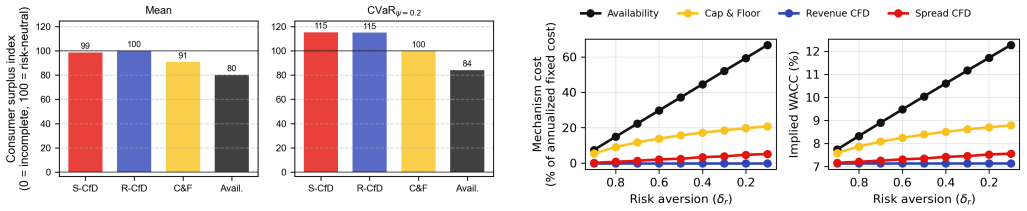
Long-duration energy storage (LDES) faces significant revenue volatility that impedes investment. This paper evaluates four contract-based support mechanisms using an equilibrium model with risk-averse investors and incomplete risk markets. Applied to a stylized 2035 Great Britain case, we find that all mechanisms can achieve the targeted LDES capacity but differ substantially in cost-effectiveness and risk-aversion sensitivity. Contracts that eliminate revenue volatility achieve the lowest costs but may weaken operational incentives, while contracts that preserve market exposure maintain incentives at higher costs.
Editorial analysis
A structured set of objections, weighed in public.
Referee Report
Summary. The manuscript develops an equilibrium model with risk-averse investors operating in incomplete risk markets to compare four contract-based support mechanisms for long-duration energy storage (LDES). Applied to a stylized 2035 Great Britain power system, the central claim is that all four mechanisms achieve the target LDES capacity but differ substantially in cost-effectiveness and sensitivity to risk aversion: volatility-eliminating contracts deliver the lowest costs yet may weaken operational incentives, while contracts preserving market exposure maintain stronger incentives at higher overall cost.
Significance. If the equilibrium framework and its behavioral assumptions hold, the results provide policy-relevant guidance on designing LDES support contracts by quantifying explicit trade-offs between cost, risk allocation, and operational performance. The equilibrium approach with endogenous investment and dispatch decisions is a methodological strength that allows direct comparison of incentive effects across mechanisms.
major comments (2)
- [§3.2] §3.2 (Investor utility and risk aversion): The model adopts a specific constant-absolute-risk-aversion utility (Eq. (7)) and a fixed risk-aversion coefficient whose calibration to LDES investors is not shown; the cost rankings in §4.1 reverse under modest changes to this parameter, making the claim that volatility-eliminating contracts are lowest-cost load-bearing on an untested behavioral assumption.
- [§4.3] §4.3 (Operational incentives): The assertion that volatility-eliminating contracts weaken operational incentives rests on qualitative discussion rather than reported differences in dispatch, availability, or energy-not-served metrics; without these quantitative results the incentive-compatibility trade-off central to the abstract cannot be evaluated.
minor comments (2)
- [Figure 3] Figure 3 axis labels and legend are too small to read the mechanism names clearly.
- [Abstract] The abstract does not name the four mechanisms or report the magnitude of cost differences, reducing immediate accessibility.
Simulated Author's Rebuttal
We are grateful to the referee for their insightful and constructive comments. We address each major comment below and describe the revisions we will make to the manuscript.
read point-by-point responses
-
Referee: [§3.2] §3.2 (Investor utility and risk aversion): The model adopts a specific constant-absolute-risk-aversion utility (Eq. (7)) and a fixed risk-aversion coefficient whose calibration to LDES investors is not shown; the cost rankings in §4.1 reverse under modest changes to this parameter, making the claim that volatility-eliminating contracts are lowest-cost load-bearing on an untested behavioral assumption.
Authors: We thank the referee for this observation. The CARA utility in Equation (7) is employed because it yields a tractable equilibrium formulation under incomplete risk markets, consistent with standard practice in the literature. The chosen risk-aversion coefficient is drawn from prior energy-investment studies rather than a bespoke LDES calibration, which was not reported in the original submission. We acknowledge that cost rankings are sensitive to this parameter. In the revised manuscript we will add a sensitivity subsection to §4.1 that varies the coefficient over a documented range, reports the resulting changes in cost rankings, and qualifies the conditions under which volatility-eliminating contracts remain lowest-cost. This will make the behavioral assumptions explicit and the policy conclusions more robust. revision: yes
-
Referee: [§4.3] §4.3 (Operational incentives): The assertion that volatility-eliminating contracts weaken operational incentives rests on qualitative discussion rather than reported differences in dispatch, availability, or energy-not-served metrics; without these quantitative results the incentive-compatibility trade-off central to the abstract cannot be evaluated.
Authors: We agree that quantitative evidence would strengthen the incentive analysis. The original manuscript discusses the potential weakening of operational incentives through the contract design but does not tabulate dispatch, availability, or energy-not-served differences. In the revision we will augment §4.3 with these metrics, computed from the equilibrium dispatch solutions for each mechanism, thereby providing direct numerical support for the incentive-compatibility trade-offs stated in the abstract. revision: yes
Circularity Check
No significant circularity; results follow from model assumptions
full rationale
The paper deploys an equilibrium model with risk-averse investors and incomplete risk markets to a stylized 2035 GB case. All reported outcomes on capacity achievement, cost rankings, and incentive effects are generated by solving that model under the four contract designs. No quoted step reduces a prediction to a fitted parameter by construction, invokes a self-citation as the sole justification for a uniqueness claim, or renames an input as an output. The derivation chain remains independent of the target results.
Axiom & Free-Parameter Ledger
Reference graph
Works this paper leans on
-
[1]
The design space for long-duration energy storage in decarbonized power systems,
N. A. Sepulveda, J. D. Jenkins, A. Edington, D. S. Mallapragada, and R. K. Lester, “The design space for long-duration energy storage in decarbonized power systems,”Nature Energy, vol. 6, no. 5, pp. 506– 516, Mar. 2021
work page 2021
-
[2]
Role of Long-Duration Energy Storage in Variable Renewable Electricity Systems,
J. A. Dowling, K. Z. Rinaldi, T. H. Ruggles, S. J. Davis, M. Yuan, F. Tong, N. S. Lewis, and K. Caldeira, “Role of Long-Duration Energy Storage in Variable Renewable Electricity Systems,”Joule, vol. 4, no. 9, pp. 1907–1928, Sep. 2020
work page 1907
-
[3]
Future Energy Scenarios: ESO Pathways to Net Zero,
ESO, “Future Energy Scenarios: ESO Pathways to Net Zero,” Tech. Rep., Jul. 2024
work page 2024
-
[4]
2024 Integrated System Plan for the National Electricity Market,
Australia Energy Market Operator (AEMO), “2024 Integrated System Plan for the National Electricity Market,” 2024
work page 2024
-
[5]
Electricity Markets and Long-Duration Energy Storage: A Survey of Grid Services and Revenue Streams,
B. Cheng, T. Levin, Z. Zhou, and A. Botterud, “Electricity Markets and Long-Duration Energy Storage: A Survey of Grid Services and Revenue Streams,”Current Sustainable/Renewable Energy Reports, vol. 12, no. 1, p. 16, Jun. 2025
work page 2025
-
[6]
A. Suski, E. Spyrou, and R. Green, “Missing Money and Market-Based Adequacy in Deeply Decarbonized Power Systems with Long-Duration Energy Storage,”IEEE Transactions on Energy Markets, Policy and Regulation, pp. 1–13, 2025
work page 2025
-
[7]
The value of long-duration energy storage under various grid conditions in a zero-emissions future,
M. Staadecker, J. Szinai, P. A. S ´anchez-P´erez, S. Kurtz, and P. Hidalgo- Gonzalez, “The value of long-duration energy storage under various grid conditions in a zero-emissions future,”Nature Communications, vol. 15, no. 1, p. 9501, Nov. 2024
work page 2024
-
[8]
F. Roques and D. Finon, “Adapting electricity markets to decarbonisation and security of supply objectives: Toward a hybrid regime?”Energy Policy, vol. 105, pp. 584–596, Jun. 2017
work page 2017
-
[9]
P. L. Joskow, “From hierarchies to markets and partially back again in electricity: responding to decarbonization and security of supply goals,” Journal of Institutional Economics, vol. 18, no. 2, pp. 313–329, Apr. 2022
work page 2022
-
[10]
Long duration electricity storage consultation: designing a policy framework to enable invest- ment,
Department for Energy Security & Net Zero, “Long duration electricity storage consultation: designing a policy framework to enable invest- ment,” Tech. Rep., 2024
work page 2024
-
[11]
Designing a Policy Mechanism for Long-Duration Energy Storage: The British Experience,
E. Spyrou, A. Suski, and R. Green, “Designing a Policy Mechanism for Long-Duration Energy Storage: The British Experience,”Current Sustainable/Renewable Energy Reports, vol. 13, no. 1, p. 5, Apr. 2026
work page 2026
-
[12]
Cap and floor regime: unlocking investment in electricity interconnectors,
Ofgem, “Cap and floor regime: unlocking investment in electricity interconnectors,” Tech. Rep., 2016
work page 2016
-
[13]
Long-Term Energy Service Agreement Design,
NSW Department of Planning, Industry and Environment, “Long-Term Energy Service Agreement Design,” Consultation paper, Aug. 2021
work page 2021
-
[14]
New York State Energy Research and Development Authority, “Bulk Energy Storage Program,” 2026
work page 2026
-
[15]
Cap and Floor Regime for Long Duration Electricity Storage: Setting the Cap and Floor,
CEPA, “Cap and Floor Regime for Long Duration Electricity Storage: Setting the Cap and Floor,” Tech. Rep., Mar. 2025
work page 2025
-
[16]
Incomplete Contracts: Where do We Stand?
J. Tirole, “Incomplete Contracts: Where do We Stand?”Econometrica, vol. 67, no. 4, pp. 741–781, 1999
work page 1999
-
[17]
A taxonomy to guide the next generation of support mechanisms for electricity storage,
P. Mastropietro, P. Rodilla, and C. Batlle, “A taxonomy to guide the next generation of support mechanisms for electricity storage,”Joule, vol. 8, no. 5, pp. 1196–1204, May 2024
work page 2024
-
[18]
Targeted Financial Incentives for Long-Duration Energy Storage,
J. Twitchell, P. Dave, D. Boff, D. Powell, and D. Bhatnagar, “Targeted Financial Incentives for Long-Duration Energy Storage,” in2025 IEEE Electrical Energy Storage Applications and Technologies Conference (EESAT), Jan. 2025, pp. 1–6
work page 2025
-
[19]
Asymmetric risk and fuel neutrality in electricity capacity markets,
J. Mays, D. P. Morton, and R. P. O’Neill, “Asymmetric risk and fuel neutrality in electricity capacity markets,”Nature Energy, vol. 4, no. 11, pp. 948–956, Nov. 2019
work page 2019
-
[20]
Financial Risk and Resource Adequacy in Markets With High Renewable Penetration,
J. Mays and J. D. Jenkins, “Financial Risk and Resource Adequacy in Markets With High Renewable Penetration,”IEEE Transactions on Energy Markets, Policy and Regulation, vol. 1, no. 4, pp. 523–535, Dec. 2023
work page 2023
-
[21]
Beyond capacity: Contractual form in electricity reliability obligations,
H. Shu and J. Mays, “Beyond capacity: Contractual form in electricity reliability obligations,”Energy Economics, vol. 126, p. 106943, Oct. 2023
work page 2023
-
[22]
Congestion Risk, Transmission Rights, and Investment Equilibria in Electricity Markets,
S. Risanger and J. Mays, “Congestion Risk, Transmission Rights, and Investment Equilibria in Electricity Markets,”The Energy Journal, vol. 45, no. 1, pp. 173–200, Jan. 2024
work page 2024
-
[23]
Generation Capacity Expansion in a Risky Environment: A Stochastic Equilibrium Analysis,
A. Ehrenmann and Y . Smeers, “Generation Capacity Expansion in a Risky Environment: A Stochastic Equilibrium Analysis,”Operations Research, vol. 59, no. 6, pp. 1332–1346, 2011
work page 2011
-
[24]
Risk Trading and Endogenous Probabilities in Investment Equilibria,
D. Ralph and Y . Smeers, “Risk Trading and Endogenous Probabilities in Investment Equilibria,”SIAM Journal on Optimization, vol. 25, no. 4, pp. 2589–2611, Jan. 2015
work page 2015
-
[25]
I. Abada, G. de Maere d’Aertrycke, and Y . Smeers, “On the multiplicity of solutions in generation capacity investment models with incomplete markets: a risk-averse stochastic equilibrium approach,”Mathematical Programming, vol. 165, no. 1, pp. 5–69, Sep. 2017
work page 2017
-
[26]
Optimization of conditional value- at-risk,
R. T. Rockafellar and S. Uryasev, “Optimization of conditional value- at-risk,”The Journal of Risk, vol. 2, no. 3, pp. 21–41, 2000
work page 2000
-
[27]
Using Cost Observation to Regulate Firms,
J.-J. Laffont and J. Tirole, “Using Cost Observation to Regulate Firms,” Journal of Political Economy, vol. 94, no. 3, pp. 614–641, 1986
work page 1986
-
[28]
Long Duration Electricity Storage: Technical Decision,
Ofgem, “Long Duration Electricity Storage: Technical Decision,” Tech. Rep., Mar. 2025
work page 2025
-
[29]
Steven A. Gabriel, Antonio J. Conejo, J. David Fuller, Benjamin F. Hobbs, and Carlos Ruiz,Complementarity Modeling in Energy Markets, ser. International Series in Operations Research & Management Science. Springer, 2013, vol. 130
work page 2013
-
[30]
Con- sequences of the missing risk market problem for power system emis- sions,
E. Dimanchev, S. A. Gabriel, L. Reichenberg, and M. Korp ˚as, “Con- sequences of the missing risk market problem for power system emis- sions,”Energy Economics, vol. 136, p. 107639, Aug. 2024
work page 2024
-
[31]
Electricity Market Design and Risk Trading with Flexible and Endogenous Demand,
C. Byers and F. Billimoria, “Electricity Market Design and Risk Trading with Flexible and Endogenous Demand,” Rochester, NY , Dec. 2025
work page 2025
-
[32]
An ADMM-Based Method for Computing Risk-Averse Equilibrium in Capacity Markets,
H. H ¨oschle, H. Le Cadre, Y . Smeers, A. Papavasiliou, and R. Belmans, “An ADMM-Based Method for Computing Risk-Averse Equilibrium in Capacity Markets,”IEEE Transactions on Power Systems, vol. 33, no. 5, pp. 4819–4830, Sep. 2018
work page 2018
-
[33]
Contract design for storage in hybrid electricity markets,
F. Billimoria and P. Simshauser, “Contract design for storage in hybrid electricity markets,”Joule, vol. 7, no. 8, pp. 1663–1674, Aug. 2023
work page 2023
-
[34]
Chronological Time-Period Clustering for Optimal Capacity Expansion Planning With Storage,
S. Pineda and J. M. Morales, “Chronological Time-Period Clustering for Optimal Capacity Expansion Planning With Storage,”IEEE Transactions on Power Systems, vol. 33, no. 6, pp. 7162–7170, Nov. 2018
work page 2018
-
[35]
Uncertainty, regulation and the pathways to net zero,
M. G. Pollitt, D. Duma, and A. Covatariu, “Uncertainty, regulation and the pathways to net zero,” inHandbook on Electricity Regulation. Edward Elgar Publishing, Jun. 2025, pp. 351–370, section: Handbook on Electricity Regulation
work page 2025
-
[36]
Designing contracts for the energy transition,
N. Fabra and G. Llobet, “Designing contracts for the energy transition,” International Journal of Industrial Organization, vol. 102, p. 103173, Sep. 2025
work page 2025
discussion (0)
Sign in with ORCID, Apple, or X to comment. Anyone can read and Pith papers without signing in.