Bayesian Sparse Regression for Microbiome-Metabolite Data Integration
Pith reviewed 2026-05-20 01:28 UTC · model grok-4.3
The pith
A Bayesian regression model imputes missing metabolite values by modeling two distinct missingness mechanisms and selects relevant microbiome predictors while respecting compositional constraints.
A machine-rendered reading of the paper's core claim, the machinery that carries it, and where it could break.
Core claim
The central claim is that a Bayesian regression model which explicitly represents two separate mechanisms for metabolite missingness and employs a prior that respects the compositional character of microbiome counts can accurately impute the unobserved true metabolite values and correctly select the relevant microbiome predictors.
What carries the argument
Bayesian sparse regression model that jointly models two missingness mechanisms for metabolites and uses a compositional prior on microbiome predictors.
If this is right
- True metabolite levels can be recovered even when a large fraction of observations are missing.
- Relevant microbiome predictors can be identified without violating the relative-scale nature of the counts.
- The same framework can be applied to real colorectal cancer datasets to map microbiome-metabolite associations.
Where Pith is reading between the lines
- The approach could be extended to other diseases where microbiome-metabolite links are studied.
- Independent validation on held-out real datasets would provide a stronger check on imputation quality.
- Incorporating time-series measurements might reveal how these associations evolve.
Load-bearing premise
Metabolite missingness arises from exactly two distinct and modelable mechanisms and a Bayesian prior can be built that respects the compositional constraint of microbiome data without distorting variable selection or imputation.
What would settle it
Simulating new datasets in which metabolite missingness follows a single mechanism or in which the microbiome counts violate the assumed compositional structure and then checking whether imputation error remains low and selected predictors remain accurate would test the claim.
Figures


read the original abstract
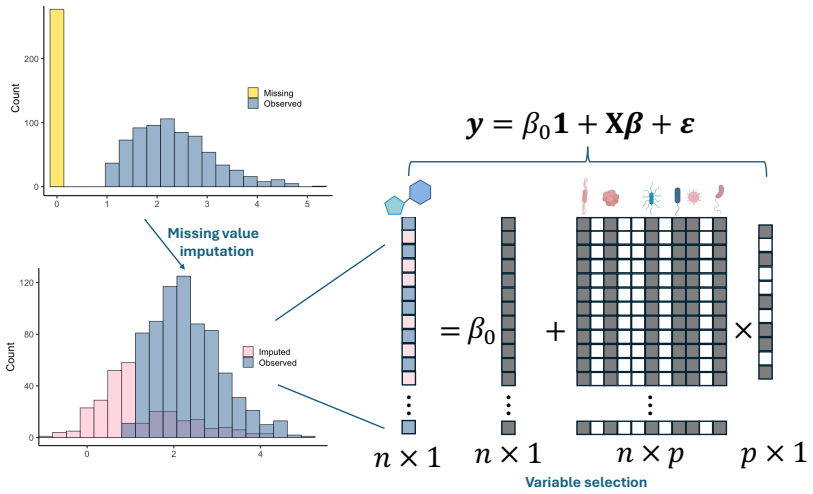
Numerous studies have shown that microbial metabolites, which represent the products of bacteria in the human gut, play a key role in shaping cancer risk and response to treatment. However, metabolite data typically contain a large proportion of missing values, which may result from either low abundance or technical challenges in data processing. Moreover, given the compositionality of microbiome data, where the observed abundances can only be interpreted on a relative scale, standard variable selection methods are not applicable. In this project, we propose a novel Bayesian regression method to address these challenges in the integration of metabolite and microbiome data. Key features of our proposed model include modeling the two different mechanisms of missingness for the metabolite data and adopting a Bayesian prior designed to address the compositional characteristics of microbiome data. We demonstrate on simulated data that our proposed model can accurately impute the unobserved true metabolite values and correctly select the relevant microbiome predictors. We further illustrate our method using real data from a study focused on understanding the interplay between the microbiome and metabolome in colorectal cancer.
Editorial analysis
A structured set of objections, weighed in public.
Referee Report
Summary. The manuscript proposes a Bayesian sparse regression model for integrating microbiome and metabolite data. It explicitly models two distinct missingness mechanisms in the metabolite data (low abundance versus technical challenges) and adopts a Bayesian prior to respect the compositional constraint of the microbiome abundances. The central claims are that the model accurately imputes unobserved true metabolite values and correctly selects relevant microbiome predictors, as demonstrated on simulated data, with an additional illustration on real colorectal cancer data.
Significance. If the performance claims hold under more stringent validation, the work would address practically important challenges in microbiome-metabolite integration studies, where missingness and compositionality routinely invalidate standard regression approaches. The explicit two-mechanism missingness model and the compositional prior are constructive features that could be adopted more broadly if shown to be robust.
major comments (2)
- [Simulation study] Simulation study section: the data-generating process follows the exact likelihood and prior of the proposed model (including the two-mechanism missingness and compositional constraint). Consequently, the reported imputation accuracy and predictor selection success are expected by construction and do not test robustness to realistic departures from these assumptions. This is load-bearing for the central claim that the method will succeed on real data.
- [Results on simulated data] Results on simulated data: no quantitative metrics (e.g., RMSE or MAE for imputation, precision/recall or false-positive rates for variable selection), error bars, or comparisons against baseline methods (standard imputation followed by sparse regression or existing compositional models) are reported. Without these, the assertions of “accurate imputation” and “correctly select” cannot be evaluated.
minor comments (2)
- [Abstract] Abstract: include at least one concrete performance number (e.g., imputation error or selection accuracy) from the simulation study to substantiate the claims.
- [Model specification] Model section: clarify the precise functional form of the compositional Bayesian prior and how its hyperparameters are set or estimated; the current description leaves the prior’s effect on variable selection ambiguous.
Simulated Author's Rebuttal
We thank the referee for the detailed and constructive review. The comments highlight important aspects of the simulation design and results presentation that we agree merit expansion. We address each major comment below and outline the corresponding revisions.
read point-by-point responses
-
Referee: [Simulation study] Simulation study section: the data-generating process follows the exact likelihood and prior of the proposed model (including the two-mechanism missingness and compositional constraint). Consequently, the reported imputation accuracy and predictor selection success are expected by construction and do not test robustness to realistic departures from these assumptions. This is load-bearing for the central claim that the method will succeed on real data.
Authors: We agree that the current simulation generates data directly from the proposed model, which primarily verifies that the MCMC procedure recovers parameters and imputes values correctly when assumptions hold. This is a necessary initial check for any new Bayesian method. To strengthen the evidence for robustness, we will add new simulation experiments that introduce controlled departures, such as alternative missingness mechanisms not matching the two-component model and microbiome data generated without the compositional prior. These will be reported alongside the existing results. revision: yes
-
Referee: [Results on simulated data] Results on simulated data: no quantitative metrics (e.g., RMSE or MAE for imputation, precision/recall or false-positive rates for variable selection), error bars, or comparisons against baseline methods (standard imputation followed by sparse regression or existing compositional models) are reported. Without these, the assertions of “accurate imputation” and “correctly select” cannot be evaluated.
Authors: We acknowledge that the simulated results section currently relies on qualitative descriptions rather than explicit metrics. In the revision we will add RMSE and MAE for imputation accuracy, precision/recall and false-positive rates for predictor selection, all averaged over repeated simulation replicates with standard error bars. We will also include direct comparisons to baseline pipelines such as mean or KNN imputation followed by lasso regression, as well as log-ratio based compositional regression methods. These additions will allow quantitative evaluation of performance gains. revision: yes
Circularity Check
No significant circularity; model features and simulation results presented as independent demonstration
full rationale
The paper proposes a Bayesian sparse regression model with explicit components for two missingness mechanisms in metabolites and a compositional prior for microbiome data. The abstract and strongest claim describe these as novel modeling choices, then report performance on simulated data as a demonstration. No quoted equations or sections reduce the imputation accuracy or variable selection success to a quantity fitted from the same data or defined by the evaluation procedure itself. The simulation is treated as external validation rather than a self-referential fit, and no self-citation chain or ansatz smuggling is invoked to justify the core claims. This is the standard non-circular structure for a methods paper whose central content is the model specification.
Axiom & Free-Parameter Ledger
free parameters (1)
- Hyperparameters of the compositional Bayesian prior
axioms (2)
- domain assumption Metabolite missingness occurs via two distinct mechanisms (low abundance or technical challenges) that can be separately modeled
- domain assumption Microbiome abundances are compositional and therefore require a specialized prior to avoid invalid inference
Lean theorems connected to this paper
-
IndisputableMonolith/Cost/FunctionalEquation.leanwashburn_uniqueness_aczel unclear?
unclearRelation between the paper passage and the cited Recognition theorem.
Key features of our proposed model include modeling the two different mechanisms of missingness for the metabolite data and adopting a Bayesian prior designed to address the compositional characteristics of microbiome data.
-
IndisputableMonolith/Foundation/RealityFromDistinction.leanreality_from_one_distinction unclear?
unclearRelation between the paper passage and the cited Recognition theorem.
We adopt a fully Bayesian approach to handling missing values in the regression outcome... truncated normal distribution
What do these tags mean?
- matches
- The paper's claim is directly supported by a theorem in the formal canon.
- supports
- The theorem supports part of the paper's argument, but the paper may add assumptions or extra steps.
- extends
- The paper goes beyond the formal theorem; the theorem is a base layer rather than the whole result.
- uses
- The paper appears to rely on the theorem as machinery.
- contradicts
- The paper's claim conflicts with a theorem or certificate in the canon.
- unclear
- Pith found a possible connection, but the passage is too broad, indirect, or ambiguous to say the theorem truly supports the claim.
Reference graph
Works this paper leans on
-
[1]
Microbiota in health and diseases
Kaijian Hou, Zhuo-Xun Wu, Xuan-Yu Chen, Jing-Quan Wang, Dongya Zhang, Chuanxing Xiao, Dan Zhu, Jagadish B Koya, Liuya Wei, Jilin Li, et al. Microbiota in health and diseases. Signal Transduction and Targeted Therapy , 7(1):1–28, 2022
work page 2022
-
[2]
Emanuele Rinninella, Pauline Raoul, Marco Cintoni, Francesco Franceschi, Giacinto Abele Donato Miggiano, Antonio Gasbarrini, and Maria Cristina Mele. What is the healthy gut microbiota composition? A changing ecosystem across age, environment, diet, and diseases. Microorganisms, 7(1):14, 2019
work page 2019
-
[3]
The intestinal metabolome: an intersection between microbiota and host
Luke K Ursell, Henry J Haiser, Will Van Treuren, Neha Garg, Lavanya Reddivari, Jairam Vanamala, Pieter C Dorrestein, Peter J Turnbaugh, and Rob Knight. The intestinal metabolome: an intersection between microbiota and host. Gastroenterology, 146(6):1470–1476, 2014
work page 2014
-
[4]
An expanded reference map of the human gut microbiome reveals hundreds of previously unknown species
Sigal Leviatan, Saar Shoer, Daphna Rothschild, Maria Gorodetski, and Eran Segal. An expanded reference map of the human gut microbiome reveals hundreds of previously unknown species. Nature Communications, 13(1):3863, 2022
work page 2022
-
[5]
Role of the gut microbiome in obesity and diabetes mellitus
Gillian M Barlow, Allen Yu, and Ruchi Mathur. Role of the gut microbiome in obesity and diabetes mellitus. Nutrition in Clinical Practice , 30(6):787–797, 2015
work page 2015
-
[6]
The role of gut microbiome in cancer genesis and cancer prevention
Noor Akbar, Naveed Ahmed Khan, Jibran Sualeh Muhammad, and Ruqaiyyah Sid- diqui. The role of gut microbiome in cancer genesis and cancer prevention. Health Sciences Review, 2:100010, 2022
work page 2022
-
[7]
Gut microbial metabolites on host immune responses in health and disease
Jong-Hwi Yoon, Jun-Soo Do, Priyanka Velankanni, Choong-Gu Lee, and Ho-Keun Kwon. Gut microbial metabolites on host immune responses in health and disease. Immune Network , 23(1):e6, 2023
work page 2023
-
[8]
Microbial metabolites deter- mine host health and the status of some diseases
Panida Sittipo, Jae-won Shim, and Yun Kyung Lee. Microbial metabolites deter- mine host health and the status of some diseases. International Journal of Molecular Sciences, 20(21):5296, 2019. 25
work page 2019
-
[9]
Microbiome, metagenomics, and high-dimensional compositional data analysis
Hongzhe Li. Microbiome, metagenomics, and high-dimensional compositional data analysis. Annual Review of Statistics and Its Application , 2:73–94, 2015
work page 2015
-
[10]
Trenton J Davis, Tarek R Firzli, Emily A Higgins Keppler, Matthew Richardson, and Heather D Bean. Addressing missing data in GC × GC metabolomics: Identifying missingness type and evaluating the impact of imputation methods on experimental replication. Analytical Chemistry, 94(31):10912–10920, 2022
work page 2022
-
[11]
Accounting for undetected compounds in statistical analyses of mass spectrometry ‘omic studies
Sandra L Taylor, Gary S Leiserowitz, and Kyoungmi Kim. Accounting for undetected compounds in statistical analyses of mass spectrometry ‘omic studies. Statistical Ap- plications in Genetics and Molecular Biology , 12(6):703–722, 2013
work page 2013
-
[12]
Statistical Analysis with Missing Data
Donald B Rubin. Statistical Analysis with Missing Data . Wiley, 1987
work page 1987
-
[13]
Jasmit S Shah, Shesh N Rai, Andrew P DeFilippis, Bradford G Hill, Aruni Bhatnagar, and Guy N Brock. Distribution based nearest neighbor imputation for truncated high dimensional data with applications to pre-clinical and clinical metabolomics studies. BMC Bioinformatics , 18:1–13, 2017
work page 2017
-
[14]
Runmin Wei, Jingye Wang, Erik Jia, Tianlu Chen, Yan Ni, and Wei Jia. Gsimp: A gibbs sampler based left-censored missing value imputation approach for metabolomics studies. PLoS Computational Biology , 14(1):e1005973, 2018
work page 2018
-
[15]
BayesMetab: Treatment of missing values in metabolomic studies using a bayesian modeling approach
Jasmit Shah, Guy N Brock, and Jeremy Gaskins. BayesMetab: Treatment of missing values in metabolomic studies using a bayesian modeling approach. BMC Bioinfor- matics, 20(Suppl 24):673, 2019
work page 2019
-
[16]
Mechanism-aware imputation: a two-step approach in handling missing values in metabolomics
Jonathan P Dekermanjian, Elin Shaddox, Debmalya Nandy, Debashis Ghosh, and Katerina Kechris. Mechanism-aware imputation: a two-step approach in handling missing values in metabolomics. BMC Bioinformatics , 23(1):179, 2022
work page 2022
-
[17]
The statistical analysis of compositional data
John Aitchison. The statistical analysis of compositional data. Journal of the Royal Statistical Society: Series B (Methodological) , 44(2):139–160, 1982. 26
work page 1982
-
[18]
Log contrast models for experiments with mixtures
John Aitchison and John Bacon-Shone. Log contrast models for experiments with mixtures. Biometrika, 71(2):323–330, 1984
work page 1984
-
[19]
Variable selection in regression with compositional covariates
Wei Lin, Pixu Shi, Rui Feng, and Hongzhe Li. Variable selection in regression with compositional covariates. Biometrika, 101(4):785–797, 2014
work page 2014
-
[20]
Bayesian compositional regression with structured priors for microbiome feature selection
Liangliang Zhang, Yushu Shi, Robert R Jenq, Kim-Anh Do, and Christine B Peter- son. Bayesian compositional regression with structured priors for microbiome feature selection. Biometrics, 77(3):824–838, 2021
work page 2021
-
[21]
The solution path of the generalized lasso
Ryan J Tibshirani and Jonathan Taylor. The solution path of the generalized lasso. The Annals of Statistics , 39(3):1335, 2011
work page 2011
-
[22]
Fan Li and Nancy R Zhang. Bayesian variable selection in structured high-dimensional covariate spaces with applications in genomics. Journal of the American Statistical Association, 105(491):1202–1214, 2010
work page 2010
-
[23]
The me- dian probability model and correlated variables
Maria M Barbieri, James O Berger, Edward I George, and Veronika Ročková. The me- dian probability model and correlated variables. Bayesian Analysis, 16(4):1085–1112, 2021
work page 2021
-
[24]
Vitamin B1 intake and the risk of colorectal cancer: a systematic review of observational studies
Yan Liu, Wen-jing Xiong, Lei Wang, Chuanhua YU, et al. Vitamin B1 intake and the risk of colorectal cancer: a systematic review of observational studies. Journal of Nutritional Science and Vitaminology , 67(6):391–396, 2021
work page 2021
-
[25]
John W. Erdman, Ian A. MacDonald, and Steven H. Zeisel. Present Knowledge in Nutrition: Tenth Edition . Wiley-Blackwell, United States, June 2012. ISBN 9780470959176. doi: 10.1002/9781119946045
-
[26]
Systematic genome assessment of b-vitamin biosynthesis suggests co-operation among gut microbes
Stefanía Magnúsdóttir, Dmitry Ravcheev, Valérie de Crécy-Lagard, and Ines Thiele. Systematic genome assessment of b-vitamin biosynthesis suggests co-operation among gut microbes. Frontiers in Genetics , 6:148, 2015. 27
work page 2015
-
[27]
Exploring the vita- min biosynthesis landscape of the human gut microbiota
Chiara Tarracchini, Gabriele Andrea Lugli, Leonardo Mancabelli, Douwe van Sin- deren, Francesca Turroni, Marco Ventura, and Christian Milani. Exploring the vita- min biosynthesis landscape of the human gut microbiota. mSystems, 9(10):e00929–24, 2024
work page 2024
-
[28]
Shinichi Yachida, Sayaka Mizutani, Hirotsugu Shiroma, Satoshi Shiba, Takeshi Naka- jima, Taku Sakamoto, Hikaru Watanabe, Keigo Masuda, Yuichiro Nishimoto, Masaru Kubo, et al. Metagenomic and metabolomic analyses reveal distinct stage-specific phe- notypes of the gut microbiota in colorectal cancer. Nature Medicine , 25(6):968–976, 2019
work page 2019
-
[29]
The gut microbiome- metabolome dataset collection: a curated resource for integrative meta-analysis
Efrat Muller, Yadid M Algavi, and Elhanan Borenstein. The gut microbiome- metabolome dataset collection: a curated resource for integrative meta-analysis. npj Biofilms and Microbiomes , 8(1):79, 2022
work page 2022
-
[30]
Yoshihiko Tomofuji, Toshihiro Kishikawa, Kyuto Sonehara, Yuichi Maeda, Kotaro Ogawa, Shuhei Kawabata, Eri Oguro-Igashira, Tatsusada Okuno, Takuro Nii, Makoto Kinoshita, et al. Analysis of gut microbiome, host genetics, and plasma metabolites reveals gut microbiome-host interactions in the japanese population. Cell Reports , 42 (11), 2023
work page 2023
-
[31]
IN Abdurasulova, EA Chernyavskaya, AB Ivanov, V A Nikitina, VI Lioudyno, AA Nar- tova, A V Matsulevich, E Yu Skripchenko, GN Bisaga, VI Ulyantsev, et al. Changes in gut microbiome taxonomic composition and their relationship to biosynthetic and metabolic pathways of b vitamins in children with multiple sclerosis. Journal of Evo- lutionary Biochemistry and...
work page 2024
-
[32]
Minsuk Kim, Emily Vogtmann, David A Ahlquist, Mary E Devens, John B Kisiel, William R Taylor, Bryan A White, Vanessa L Hale, Jaeyun Sung, Nicholas Chia, et al. Fecal metabolomic signatures in colorectal adenoma patients are associated with gut microbiota and early events of colorectal cancer pathogenesis. MBio, 11(1): 10–1128, 2020. 28
work page 2020
discussion (0)
Sign in with ORCID, Apple, or X to comment. Anyone can read and Pith papers without signing in.