Spectral Progressive Diffusion for Efficient Image and Video Generation
Pith reviewed 2026-05-20 11:03 UTC · model grok-4.3
pith:KLWO234Z Add to your LaTeX paper
What is a Pith Number?\usepackage{pith}
\pithnumber{KLWO234Z}
Prints a linked pith:KLWO234Z badge after your title and writes the identifier into PDF metadata. Compiles on arXiv with no extra files. Learn more
The pith
Diffusion models for images and videos can run faster by progressively increasing resolution as denoising advances from low to high frequencies.
A machine-rendered reading of the paper's core claim, the machinery that carries it, and where it could break.
Core claim
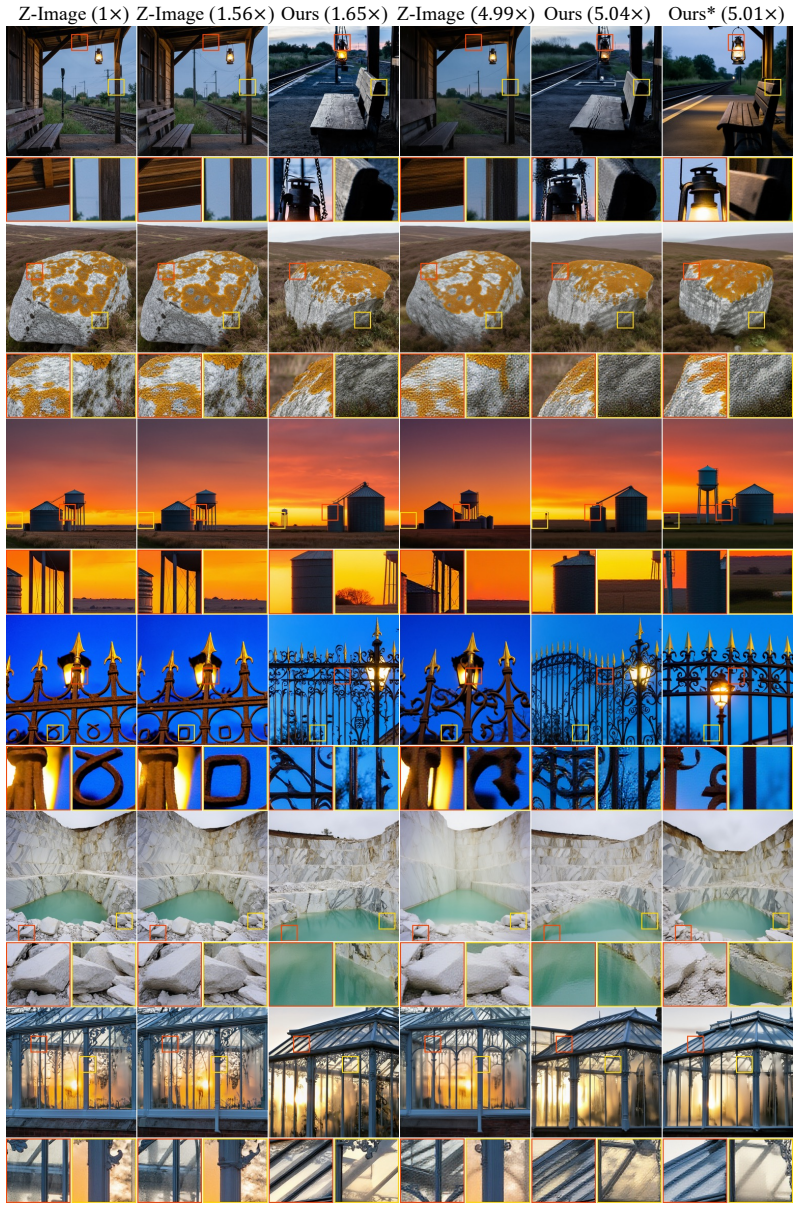
We propose Spectral Progressive Diffusion, a general framework that progressively grows resolution along the denoising trajectory of pretrained diffusion models. We develop a spectral noise expansion mechanism and derive an optimal resolution schedule from the model's power spectrum. Our framework supports training-free acceleration and a novel fine-tuning recipe that further improves efficiency and quality. We demonstrate significant speedups on state-of-the-art pretrained image and video generation models while preserving visual quality.
What carries the argument
Spectral noise expansion mechanism paired with a resolution schedule derived from the model's power spectrum, which allows progressive growth of spatial resolution during the denoising trajectory.
If this is right
- Pretrained diffusion models can generate images and videos with substantially lower compute cost without any retraining.
- Quality metrics and human evaluations remain comparable to standard full-resolution runs because high-frequency detail is still synthesized at the appropriate later timesteps.
- The same progressive schedule applies directly to both image and video generation models.
- An optional fine-tuning stage can further reduce generation time or improve output fidelity beyond the training-free version.
Where Pith is reading between the lines
- The approach could be combined with existing sampling accelerators such as fewer steps or distillation to compound speed gains.
- Similar progressive-resolution logic might transfer to other iterative generative models that operate across scales.
- Lower per-sample compute could make high-resolution generation more practical on hardware with limited memory or power.
Load-bearing premise
High-resolution computation on noise-dominated frequencies is largely redundant and can be skipped without degrading the final visual quality.
What would settle it
A side-by-side comparison on the same pretrained model showing either no speedup, visible quality loss measured by standard metrics, or both when the progressive resolution schedule replaces full-resolution denoising from the start.
Figures




read the original abstract
Diffusion models have been shown to implicitly generate visual content autoregressively in the frequency domain, where low-frequency components are generated earlier in the denoising process while high-frequency details emerge only in later timesteps. This structure offers a natural opportunity for efficient generation, as high-resolution computation on noise-dominated frequencies is largely redundant. We propose Spectral Progressive Diffusion, a general framework that progressively grows resolution along the denoising trajectory of pretrained diffusion models. To this end, we develop a spectral noise expansion mechanism and derive an optimal resolution schedule from the model's power spectrum. Our framework supports training-free acceleration and a novel fine-tuning recipe that further improves efficiency and quality. We demonstrate significant speedups on state-of-the-art pretrained image and video generation models while preserving visual quality.
Editorial analysis
A structured set of objections, weighed in public.
Referee Report
Summary. The manuscript introduces Spectral Progressive Diffusion, a general framework for accelerating pretrained diffusion models in image and video generation. It progressively grows resolution along the denoising trajectory via a spectral noise expansion mechanism and derives an optimal resolution schedule from the model's power spectrum. The approach supports training-free acceleration as well as a fine-tuning recipe, with empirical claims of significant speedups on state-of-the-art models while preserving visual quality.
Significance. If the central efficiency claims hold under rigorous controls, the work could offer a practical, general-purpose acceleration technique for diffusion-based generation by exploiting the frequency-domain structure of the denoising process. The training-free component would be particularly valuable for immediate deployment on existing large models. The significance is reduced, however, by the need for stronger evidence that the schedule derivation is robust rather than circular or content-dependent.
major comments (2)
- [Methods (resolution schedule derivation)] The derivation of the resolution schedule from the model's power spectrum (detailed in the methods section on schedule construction) risks circularity: if the spectrum is averaged or fitted using statistics from the target model or dataset, the 'optimal' schedule becomes model-specific rather than an independent prediction. This directly affects the load-bearing claim of quality-preserving speedups. Please clarify the exact computation procedure, whether any fitting or selection occurs, and provide ablations showing performance on out-of-distribution content with atypical frequency distributions.
- [Experiments (qualitative and quantitative results)] The central efficiency claim relies on the premise that high-resolution computation on noise-dominated frequencies is redundant. However, the experiments appear to lack controls for content where high-frequency components carry semantic weight (e.g., fine textures or text). Without such targeted evaluations, the no-degradation guarantee remains unverified and undermines the abstract's assertion of preserved visual quality across SOTA models.
minor comments (2)
- [Section 3] Notation for the spectral noise expansion operator should be defined more explicitly with a clear equation reference to avoid ambiguity in the progressive growth description.
- [Figure 4] Figure captions for the resolution schedule plots should include the exact power spectrum computation details and any averaging window used.
Simulated Author's Rebuttal
We thank the referee for their constructive and detailed feedback on our manuscript. We address each major comment point by point below, providing clarifications on the methods and strengthening the experimental evidence where needed. Revisions have been made to incorporate additional details and results.
read point-by-point responses
-
Referee: The derivation of the resolution schedule from the model's power spectrum (detailed in the methods section on schedule construction) risks circularity: if the spectrum is averaged or fitted using statistics from the target model or dataset, the 'optimal' schedule becomes model-specific rather than an independent prediction. This directly affects the load-bearing claim of quality-preserving speedups. Please clarify the exact computation procedure, whether any fitting or selection occurs, and provide ablations showing performance on out-of-distribution content with atypical frequency distributions.
Authors: We thank the referee for raising this important issue of potential circularity. The power spectrum used for the schedule is computed by applying the pretrained diffusion model to a small fixed set of standard Gaussian noise inputs (independent of any target images or datasets) and averaging the frequency power magnitudes over timesteps to determine when high-frequency content emerges. No fitting, optimization, or content-based selection is performed; the resulting schedule reflects the model's inherent denoising behavior. We have expanded the methods section with this exact procedural description. Additionally, the revised manuscript includes new ablations on out-of-distribution content with atypical frequency distributions, such as text and synthetic high-frequency patterns, which confirm that the schedule generalizes while preserving quality. revision: yes
-
Referee: The central efficiency claim relies on the premise that high-resolution computation on noise-dominated frequencies is redundant. However, the experiments appear to lack controls for content where high-frequency components carry semantic weight (e.g., fine textures or text). Without such targeted evaluations, the no-degradation guarantee remains unverified and undermines the abstract's assertion of preserved visual quality across SOTA models.
Authors: We agree that targeted controls for semantically important high-frequency content are necessary to fully substantiate the no-degradation claim. Our original experiments used standard benchmarks containing varied textures and details, but we acknowledge the benefit of more focused evaluations. The revised paper now includes dedicated quantitative (FID, perceptual metrics) and qualitative results on images with fine textures, text, and complex patterns. These demonstrate that progressive resolution growth maintains semantic fidelity and visual quality equivalent to full-resolution baselines, as high-frequency details are introduced at appropriate later timesteps via spectral expansion. revision: yes
Circularity Check
Derivation of resolution schedule from power spectrum is independent and self-contained
full rationale
The paper states it develops a spectral noise expansion mechanism and derives an optimal resolution schedule from the model's power spectrum. No equations, sections, or self-citations are presented that reduce this derivation to a fitted parameter renamed as prediction, a self-definitional loop, or a load-bearing self-citation chain. The central efficiency claim rests on the empirical premise that high-resolution computation on noise-dominated frequencies is redundant, which is tested via demonstrations on pretrained models rather than forced by construction from the schedule itself. This is a standard first-principles analysis of frequency content in diffusion trajectories and does not exhibit the enumerated circularity patterns.
Axiom & Free-Parameter Ledger
free parameters (1)
- resolution schedule thresholds
axioms (1)
- domain assumption Diffusion models implicitly generate low-frequency components earlier than high-frequency details during denoising.
Reference graph
Works this paper leans on
- [1]
-
[2]
Longformer: The Long-Document Transformer
Iz Beltagy, Matthew E Peters, and Arman Cohan. Longformer: The long-document transformer, 2020. URLhttps://arxiv.org/abs/2004.05150
work page internal anchor Pith review Pith/arXiv arXiv 2020
-
[3]
Spectral analysis of diffusion models with application to schedule design
Roi Benita, Miki Elad, and Joseph Keshet. Spectral analysis of diffusion models with application to schedule design. InAdv. Neural Inform. Process. Syst., volume 38, pages 2073–2127, 2026
work page 2073
-
[4]
Token merging for fast stable diffusion
Daniel Bolya and Judy Hoffman. Token merging for fast stable diffusion. InIEEE Conf. Comput. Vis. Pattern Recog., pages 4599–4603, 2023
work page 2023
-
[5]
Huanqia Cai, Sihan Cao, Ruoyi Du, Peng Gao, Steven Hoi, et al. Z-Image: An efficient image generation foundation model with single-stream diffusion transformer, 2025. URL https://arxiv.org/abs/2511. 22699
work page 2025
-
[6]
Spectral regularization for diffusion models, 2026
Satish Chandran, Nicolas Roque dos Santos, Yunshu Wu, Greg Ver Steeg, and Evangelos Papalexakis. Spectral regularization for diffusion models, 2026. URLhttps://arxiv.org/abs/2603.02447
-
[7]
δ-DiT: A training-free acceleration method tailored for diffusion transformers, 2024
Pengtao Chen, Mingzhu Shen, Peng Ye, Jianjian Cao, Chongjun Tu, Christos-Savvas Bouganis, Yiren Zhao, and Tao Chen. δ-DiT: A training-free acceleration method tailored for diffusion transformers, 2024. URLhttps://arxiv.org/abs/2406.01125
-
[8]
Rethinking attention with performers
Krzysztof Choromanski, Valerii Likhosherstov, David Dohan, Xingyou Song, Andreea Gane, Tamas Sarlos, Peter Hawkins, Jared Davis, Afroz Mohiuddin, Lukasz Kaiser, et al. Rethinking attention with performers. InInt. Conf. Learn. Represent., 2021
work page 2021
-
[9]
Diffusion is spectral autoregression
Sander Dieleman. Diffusion is spectral autoregression. Blog post, September 2024. URL https: //sander.ai/2024/09/02/spectral-autoregression.html
work page 2024
-
[10]
DemoFusion: Democratising high-resolution image generation with no $$$
Ruoyi Du, Dongliang Chang, et al. DemoFusion: Democratising high-resolution image generation with no $$$. InIEEE Conf. Comput. Vis. Pattern Recog., 2024
work page 2024
-
[11]
Flow along the k-amplitude for generative modeling, 2025
Weitao Du, Shuning Chang, Jiasheng Tang, Yu Rong, Fan Wang, and Shengchao Liu. Flow along the k-amplitude for generative modeling, 2025. URLhttps://arxiv.org/abs/2504.19353
-
[12]
Scaling rectified flow transformers for high-resolution image synthesis
Patrick Esser, Sumith Kulal, Andreas Blattmann, Rahim Entezari, Jonas Müller, Harry Saini, Yam Levi, Dominik Lorenz, Axel Sauer, Frederic Boesel, Dustin Podell, Tim Dockhorn, Zion English, and Robin Rombach. Scaling rectified flow transformers for high-resolution image synthesis. InInt. Conf. Mach. Learn., 2024
work page 2024
-
[13]
Spectrally-guided diffusion noise schedules
Carlos Esteves and Ameesh Makadia. Spectrally-guided diffusion noise schedules. InInt. Conf. Mach. Learn., 2026
work page 2026
-
[14]
A fourier space perspective on diffusion models, 2025
Fabian Falck, Teodora Pandeva, Kiarash Zahirnia, Rachel Lawrence, Richard Turner, Edward Meeds, Javier Zazo, and Sushrut Karmalkar. A fourier space perspective on diffusion models, 2025. URL https://arxiv.org/abs/2505.11278
-
[15]
Vchitect-2.0: Parallel transformer for scaling up video diffusion models,
Weichen Fan, Chenyang Si, Junhao Song, Zhenyu Yang, Yinan He, Long Zhuo, Ziqi Huang, Ziyue Dong, Jingwen He, Dongwei Pan, et al. Vchitect-2.0: Parallel transformer for scaling up video diffusion models,
- [16]
-
[17]
Attend to not attended: Structure-then-detail token merging for post-training dit acceleration
Haipeng Fang, Sheng Tang, Juan Cao, Enshuo Zhang, Fan Tang, and Tong-Yee Lee. Attend to not attended: Structure-then-detail token merging for post-training dit acceleration. InIEEE Conf. Comput. Vis. Pattern Recog., pages 18083–18092, 2025
work page 2025
-
[18]
Jean-Baptiste Joseph Fourier.Théorie Analytique de la Chaleur. Firmin Didot, 1822
-
[19]
GenEval: An object-focused framework for evaluating text-to-image alignment
Dhruba Ghosh, Hannaneh Hajishirzi, and Ludwig Schmidt. GenEval: An object-focused framework for evaluating text-to-image alignment. InAdv. Neural Inform. Process. Syst., 2023
work page 2023
-
[20]
Jiatao Gu, Shuangfei Zhai, Yizhe Zhang, Joshua M Susskind, and Navdeep Jaitly. Matryoshka diffusion models. InInt. Conf. Learn. Represent., 2023
work page 2023
-
[21]
Make a cheap scaling: A self-cascade diffusion model for higher-resolution adaptation
Lanqing Guo, Yingqing He, Haoxin Chen, Menghan Xia, Xiaodong Cun, Yufei Wang, Siyu Huang, Yong Zhang, Xintao Wang, Qifeng Chen, Ying Shan, and Bihan Wen. Make a cheap scaling: A self-cascade diffusion model for higher-resolution adaptation. InEur. Conf. Comput. Vis., 2024. 11
work page 2024
-
[22]
Wavelet score-based generative modeling
Florentin Guth, Simon Coste, Valentin De Bortoli, and Stephane Mallat. Wavelet score-based generative modeling. InAdv. Neural Inform. Process. Syst., volume 35, pages 478–491, 2022
work page 2022
-
[23]
Zur theorie der orthogonalen funktionensysteme.Mathematische Annalen, 69(3):331–371, 1910
Alfréd Haar. Zur theorie der orthogonalen funktionensysteme.Mathematische Annalen, 69(3):331–371, 1910
work page 1910
-
[24]
Infinity: Scaling bitwise AutoRegressive modeling for high-resolution image synthesis
Jian Han, Jinlai Liu, Yi Jiang, Bin Yan, Yuqi Zhang, Zehuan Yuan, Bingyue Peng, and Xiaobing Liu. Infinity: Scaling bitwise AutoRegressive modeling for high-resolution image synthesis. InIEEE Conf. Comput. Vis. Pattern Recog., 2025
work page 2025
-
[25]
Agglomerative token clustering
Joakim Bruslund Haurum, Sergio Escalera, Graham W Taylor, and Thomas B Moeslund. Agglomerative token clustering. InEur. Conf. Comput. Vis., pages 200–218. Springer, 2024
work page 2024
-
[26]
Denoising diffusion probabilistic models
Jonathan Ho, Ajay Jain, and Pieter Abbeel. Denoising diffusion probabilistic models. InAdv. Neural Inform. Process. Syst., 2020
work page 2020
-
[27]
Cascaded diffusion models for high fidelity image generation.J
Jonathan Ho, Chitwan Saharia, William Chan, David J Fleet, Mohammad Norouzi, and Tim Salimans. Cascaded diffusion models for high fidelity image generation.J. Mach. Learn. Res., 23(47):1–33, 2022
work page 2022
-
[28]
Hu, Yelong Shen, Phillip Wallis, Zeyuan Allen-Zhu, Yuanzhi Li, Shean Wang, Lu Wang, and Weizhu Chen
Edward J. Hu, Yelong Shen, Phillip Wallis, Zeyuan Allen-Zhu, Yuanzhi Li, Shean Wang, Lu Wang, and Weizhu Chen. LoRA: Low-rank adaptation of large language models. InInt. Conf. Learn. Represent., 2022
work page 2022
-
[29]
T2I-CompBench: A comprehensive benchmark for open-world compositional text-to-image generation
Kaiyi Huang, Kaiyue Sun, Enze Xie, Zhenguo Li, and Xihui Liu. T2I-CompBench: A comprehensive benchmark for open-world compositional text-to-image generation. InAdv. Neural Inform. Process. Syst., 2023
work page 2023
-
[30]
Wavedm: Wavelet-based diffusion models for image restoration.IEEE Trans
Yi Huang, Jiancheng Huang, Jianzhuang Liu, Mingfu Yan, Yu Dong, Jiaxi Lv, Chaoqi Chen, and Shifeng Chen. Wavedm: Wavelet-based diffusion models for image restoration.IEEE Trans. Multimedia, 26: 7058–7073, 2024
work page 2024
-
[31]
Spectralar: Spectral autoregressive visual generation
Yuanhui Huang, Weiliang Chen, Wenzhao Zheng, Yueqi Duan, Jie Zhou, and Jiwen Lu. Spectralar: Spectral autoregressive visual generation. InInt. Conf. Comput. Vis., pages 15842–15852, 2025
work page 2025
-
[32]
VBench: Comprehensive benchmark suite for video generative models
Ziqi Huang, Yinan He, Jiashuo Yu, Fan Zhang, Chenyang Si, Yuming Jiang, Yuanhan Zhang, Tianxing Wu, Qingyang Jin, Nattapol Chanpaisit, Yaohui Wang, Xinyuan Chen, Limin Wang, Dahua Lin, Yu Qiao, and Ziwei Liu. VBench: Comprehensive benchmark suite for video generative models. InIEEE Conf. Comput. Vis. Pattern Recog., 2024
work page 2024
-
[33]
Wongi Jeong, Kyungryeol Lee, Hoigi Seo, and Se Young Chun. Training-free mixed-resolution latent upsampling for spatially accelerated diffusion transformers, 2026. URLhttps://arxiv.org/abs/2507. 08422
work page 2026
-
[34]
Pyramidal flow matching for efficient video generative modeling
Yang Jin, Zhicheng Sun, Ningyuan Li, Kun Xu, Hao Jiang, Nan Zhuang, Quzhe Huang, Yang Song, Yadong Mu, and Zhouchen Lin. Pyramidal flow matching for efficient video generative modeling. InInt. Conf. Learn. Represent., 2025
work page 2025
-
[35]
C. Kapfer, K. Stine, B. Narasimhan, C. Mentzel, and E. Candès. Marlowe: Stanford’s GPU-based computational instrument, 2025. URLhttps://doi.org/10.5281/zenodo.14751899
-
[36]
Transformers are rnns: Fast autoregressive transformers with linear attention
Angelos Katharopoulos, Apoorv Vyas, Nikolaos Pappas, and François Fleuret. Transformers are rnns: Fast autoregressive transformers with linear attention. InInt. Conf. Mach. Learn., pages 5156–5165. PMLR, 2020
work page 2020
-
[37]
Token fusion: Bridging the gap between token pruning and token merging
Minchul Kim, Shangqian Gao, Yen-Chang Hsu, Yilin Shen, and Hongxia Jin. Token fusion: Bridging the gap between token pruning and token merging. InProceedings of the IEEE/CVF Winter Conference on Applications of Computer Vision, pages 1383–1392, 2024
work page 2024
-
[38]
DiffuseHigh: Training-free progressive high-resolution image synthesis through structure guidance
Younghyun Kim, Geunmin Hwang, Junyu Zhang, and Eunbyung Park. DiffuseHigh: Training-free progressive high-resolution image synthesis through structure guidance. InAAAI, 2025
work page 2025
-
[39]
Kingma, Tim Salimans, Ben Poole, and Jonathan Ho
Diederik P. Kingma, Tim Salimans, Ben Poole, and Jonathan Ho. Variational diffusion models. InAdv. Neural Inform. Process. Syst., 2021
work page 2021
-
[40]
Black Forest Labs. FLUX. Software repository, 2024. URL https://github.com/ black-forest-labs/flux
work page 2024
-
[41]
FLUX.2: Frontier Visual Intelligence
Black Forest Labs. FLUX.2: Frontier Visual Intelligence. Blog post, 2025. URL https://bfl.ai/ blog/flux-2. 12
work page 2025
-
[42]
Haeil Lee, Hansang Lee, Seoyeon Gye, and Junmo Kim. Beta sampling is all you need: Efficient image generation strategy for diffusion models using stepwise spectral analysis, 2024. URL https: //arxiv.org/abs/2407.12173
work page internal anchor Pith review Pith/arXiv arXiv 2024
-
[43]
Local representative token guided merging for text-to-image generation, 2025
Min-Jeong Lee, Hee-Dong Kim, and Seong-Whan Lee. Local representative token guided merging for text-to-image generation, 2025. URLhttps://arxiv.org/abs/2507.12771
-
[44]
Frecas: Efficient higher-resolution image generation via frequency-aware cascaded sampling
Ruihuang Li, Lei Zhang, et al. Frecas: Efficient higher-resolution image generation via frequency-aware cascaded sampling. InInt. Conf. Learn. Represent., volume 2025, pages 6400–6412, 2025
work page 2025
-
[45]
Radial attention: O(nlogn) sparse attention with energy decay for long video generation
Xingyang Li, Muyang Li, Tianle Cai, Haocheng Xi, Shuo Yang, Yujun Lin, Lvmin Zhang, Songlin Yang, Jinbo Hu, Kelly Peng, et al. Radial attention: O(nlogn) sparse attention with energy decay for long video generation. InAdv. Neural Inform. Process. Syst., 2025
work page 2025
-
[46]
Wf-vae: Enhancing video vae by wavelet-driven energy flow for latent video diffusion model
Zongjian Li, Bin Lin, Yang Ye, Liuhan Chen, Xinhua Cheng, Shenghai Yuan, and Li Yuan. Wf-vae: Enhancing video vae by wavelet-driven energy flow for latent video diffusion model. InIEEE Conf. Comput. Vis. Pattern Recog., pages 17778–17788, 2025
work page 2025
-
[47]
Tsung-Yi Lin, Michael Maire, Serge Belongie, James Hays, Pietro Perona, Deva Ramanan, Piotr Dollár, and C. Lawrence Zitnick. Microsoft COCO: Common objects in context. InEur. Conf. Comput. Vis., 2014
work page 2014
-
[48]
Yaron Lipman, Ricky T. Q. Chen, Heli Ben-Hamu, Maximilian Nickel, and Matt Le. Flow matching for generative modeling. InInt. Conf. Learn. Represent., 2023
work page 2023
-
[49]
Feng Liu, Shiwei Zhang, Xiaofeng Wang, Yujie Wei, Haonan Qiu, Yuzhong Zhao, Yingya Zhang, Qixiang Ye, and Fang Wan. Timestep embedding tells: It’s time to cache for video diffusion model, 2024. URL https://arxiv.org/abs/2411.19108
-
[50]
FreqCa: Accelerating diffusion models via frequency-aware caching, 2025
Jiacheng Liu, Peiliang Cai, Qinming Zhou, Yuqi Lin, Deyang Kong, Benhao Huang, Yupei Pan, Haowen Xu, Chang Zou, Junshu Tang, Shikang Zheng, and Linfeng Zhang. FreqCa: Accelerating diffusion models via frequency-aware caching, 2025. URLhttps://arxiv.org/abs/2510.08669
-
[51]
From reusing to forecasting: Accelerating diffusion models with TaylorSeers
Jiacheng Liu, Chang Zou, Yuanhuiyi Lyu, Junjie Chen, and Linfeng Zhang. From reusing to forecasting: Accelerating diffusion models with TaylorSeers. InInt. Conf. Comput. Vis., 2025
work page 2025
-
[52]
Flow straight and fast: Learning to generate and transfer data with rectified flow
Xingchao Liu, Chengyue Gong, and Qiang Liu. Flow straight and fast: Learning to generate and transfer data with rectified flow. InInt. Conf. Learn. Represent., 2023
work page 2023
-
[53]
ToMA: Token merge with attention for diffusion models
Wenbo Lu, Shaoyi Zheng, Yuxuan Xia, and Shengjie Wang. ToMA: Token merge with attention for diffusion models. InInt. Conf. Mach. Learn., 2025
work page 2025
-
[54]
Latent Consistency Models: Synthesizing High-Resolution Images with Few-Step Inference
Simian Luo, Yiqin Tan, Longbo Huang, Jian Li, and Hang Zhao. Latent consistency models: Synthesizing high-resolution images with few-step inference, 2023. URLhttps://arxiv.org/abs/2310.04378
work page internal anchor Pith review Pith/arXiv arXiv 2023
-
[55]
Deepcache: Accelerating diffusion models for free
Xinyin Ma, Gongfan Fang, and Xinchao Wang. Deepcache: Accelerating diffusion models for free. In IEEE Conf. Comput. Vis. Pattern Recog., 2024
work page 2024
-
[56]
PixelGen: Improving Pixel Diffusion with Perceptual Supervision
Zehong Ma, Ruihan Xu, and Shiliang Zhang. PixelGen: Pixel diffusion beats latent diffusion with perceptual loss, 2026. URLhttps://arxiv.org/abs/2602.02493
work page internal anchor Pith review Pith/arXiv arXiv 2026
-
[57]
SDEdit: Guided image synthesis and editing with stochastic differential equations
Chenlin Meng, Yutong He, Yang Song, Jiaming Song, Jiajun Wu, Jun-Yan Zhu, and Stefano Ermon. SDEdit: Guided image synthesis and editing with stochastic differential equations. InInt. Conf. Learn. Represent., 2022
work page 2022
-
[58]
Anish Mittal, Rajiv Soundararajan, and Alan C. Bovik. Making a “completely blind” image quality analyzer.IEEE Sign. Process. Letters, 20(3):209–212, 2013. doi: 10.1109/LSP.2012.2227726
-
[59]
Soumik Mukhopadhyay, Prateksha Udhayanan, and Abhinav Shrivastava. Scale space diffusion, 2026. URLhttps://arxiv.org/abs/2603.08709
-
[60]
DCTdiff: Intriguing properties of image generative modeling in the DCT space
Mang Ning, Mingxiao Li, Jianlin Su, Jia Haozhe, Lanmiao Liu, Martin Benes, Wenshuo Chen, Albert Ali Salah, and Itir Onal Ertugrul. DCTdiff: Intriguing properties of image generative modeling in the DCT space. InInt. Conf. Mach. Learn., volume 267, pages 46498–46524. PMLR, 2025
work page 2025
-
[61]
NVIDIA, Yuval Atzmon, Maciej Bala, Yogesh Balaji, Tiffany Cai, Yin Cui, Jiaojiao Fan, Yunhao Ge, Siddharth Gururani, Jacob Huffman, Ronald Isaac, Pooya Jannaty, Tero Karras, Grace Lam, J. P. Lewis, Aaron Licata, Yen-Chen Lin, Ming-Yu Liu, Qianli Ma, Arun Mallya, Ashlee Martino-Tarr, Doug Mendez, Seungjun Nah, Chris Pruett, Fitsum Reda, Jiaming Song, Ting-...
-
[62]
Harry Nyquist. Certain topics in telegraph transmission theory.Transactions of the American Institute of Electrical Engineers, 47(2):617–644, 1928
work page 1928
-
[63]
Scalable diffusion models with transformers
William Peebles and Saining Xie. Scalable diffusion models with transformers. InInt. Conf. Comput. Vis., 2023
work page 2023
-
[64]
Wavelet diffusion models are fast and scalable image generators
Hao Phung, Quan Dao, and Anh Tran. Wavelet diffusion models are fast and scalable image generators. In IEEE Conf. Comput. Vis. Pattern Recog., 2023
work page 2023
-
[65]
DiMSUM: Diffusion Mamba – a scalable and unified spatial-frequency method for image generation
Hao Phung, Quan Dao, Trung Dao, Hoang Phan, Dimitris Metaxas, and Anh Tran. DiMSUM: Diffusion Mamba – a scalable and unified spatial-frequency method for image generation. InAdv. Neural Inform. Process. Syst., 2024
work page 2024
-
[66]
FreeScale: Unleashing the resolution of diffusion models via tuning-free scale fusion
Haonan Qiu et al. FreeScale: Unleashing the resolution of diffusion models via tuning-free scale fusion. In Int. Conf. Comput. Vis., 2025
work page 2025
-
[67]
FlowAR: Scale-wise autoregressive image generation meets flow matching
Sucheng Ren, Qihang Yu, Ju He, Xiaohui Shen, Alan Yuille, and Liang-Chieh Chen. FlowAR: Scale-wise autoregressive image generation meets flow matching. InInt. Conf. Mach. Learn., 2025
work page 2025
-
[68]
Origins of scaling in natural images.Vis
Daniel L Ruderman. Origins of scaling in natural images.Vis. Res., 37(23):3385–3398, 1997
work page 1997
-
[69]
Pyramidal denoising diffusion probabilistic models, 2022
Dohoon Ryu and Jong Chul Ye. Pyramidal denoising diffusion probabilistic models, 2022. URL https: //arxiv.org/abs/2208.01864
-
[70]
Progressive distillation for fast sampling of diffusion models
Tim Salimans and Jonathan Ho. Progressive distillation for fast sampling of diffusion models. InInt. Conf. Learn. Represent., 2022
work page 2022
-
[71]
Claude E. Shannon. Communication in the presence of noise.Proceedings of the IRE, 37(1):10–21, 1949
work page 1949
-
[72]
Latent Wavelet Diffusion For Ultra-High-Resolution Image Synthesis
Luigi Sigillo, Shengfeng He, and Danilo Comminiello. Latent wavelet diffusion for ultra-high-resolution image synthesis, 2025. URLhttps://arxiv.org/abs/2506.00433
work page internal anchor Pith review Pith/arXiv arXiv 2025
-
[73]
Improving the diffusability of autoencoders
Ivan Skorokhodov, Sharath Girish, Benran Hu, Willi Menapace, Yanyu Li, Rameen Abdal, Sergey Tulyakov, and Aliaksandr Siarohin. Improving the diffusability of autoencoders. InInt. Conf. Mach. Learn., 2025
work page 2025
-
[74]
Kingma, Abhishek Kumar, Stefano Ermon, and Ben Poole
Yang Song, Jascha Sohl-Dickstein, Diederik P. Kingma, Abhishek Kumar, Stefano Ermon, and Ben Poole. Score-based generative modeling through stochastic differential equations. InInt. Conf. Learn. Represent., 2021
work page 2021
-
[75]
Lssgen: Leveraging latent space scaling in flow and diffusion for efficient text to image generation
Jyun-Ze Tang, Chih-Fan Hsu, Jeng-Lin Li, Ming-Ching Chang, and Wei-Chao Chen. Lssgen: Leveraging latent space scaling in flow and diffusion for efficient text to image generation. InInt. Conf. Comput. Vis., pages 5048–5057, 2025
work page 2025
-
[77]
Relay diffusion: Unifying diffusion process across resolutions for image synthesis
Jiayan Teng, Wendi Zheng, Ming Ding, Wenyi Hong, Jianqiao Wangni, Zhuoyi Yang, and Jie Tang. Relay diffusion: Unifying diffusion process across resolutions for image synthesis. InInt. Conf. Learn. Represent.,
-
[78]
Visual autoregressive modeling: Scalable image generation via next-scale prediction
Keyu Tian, Yi Jiang, Zehuan Yuan, Bingyue Peng, and Liwei Wang. Visual autoregressive modeling: Scalable image generation via next-scale prediction. InAdv. Neural Inform. Process. Syst., 2024
work page 2024
-
[79]
Training-free diffusion acceleration with bottleneck sampling, 2025
Ye Tian, Xin Xia, Yuxi Ren, Shanchuan Lin, Xing Wang, Xuefeng Xiao, Yunhai Tong, Ling Yang, and Bin Cui. Training-free diffusion acceleration with bottleneck sampling, 2025. URL https://arxiv.org/ abs/2503.18940
-
[80]
Hiwave: Training-free high- resolution image generation via wavelet-based diffusion sampling
Tobias V ontobel, Seyedmorteza Sadat, Farnood Salehi, and Romann Weber. Hiwave: Training-free high- resolution image generation via wavelet-based diffusion sampling. InProceedings of the SIGGRAPH Asia 2025 Conference Papers, pages 1–11, 2025
work page 2025
-
[81]
Wan: Open and Advanced Large-Scale Video Generative Models
Team Wan, Ang Wang, Baole Ai, Bin Wen, Chaojie Mao, Chen-Wei Xie, Di Chen, Feiwu Yu, Haiming Zhao, Jianxiao Yang, et al. Wan: Open and advanced large-scale video generative models, 2025. URL https://arxiv.org/abs/2503.20314
work page internal anchor Pith review Pith/arXiv arXiv 2025
discussion (0)
Sign in with ORCID, Apple, or X to comment. Anyone can read and Pith papers without signing in.