Symmetry in the Wild: The Role of Equivariance in Neural Fluid Surrogates
Pith reviewed 2026-05-20 22:58 UTC · model grok-4.3
The pith
Enforcing equivariance in neural fluid surrogates improves results on varied hemodynamic geometries but degrades in-distribution accuracy on strongly aligned aerodynamics data.
A machine-rendered reading of the paper's core claim, the machinery that carries it, and where it could break.
Core claim
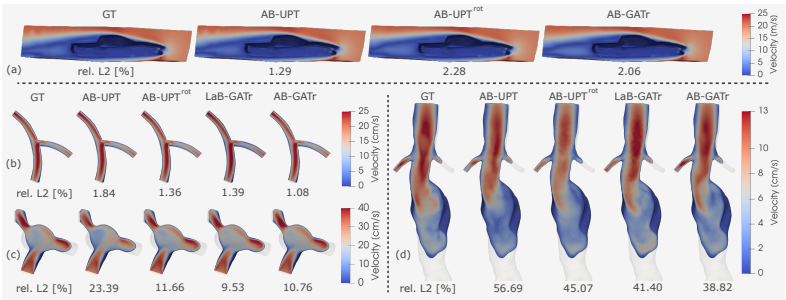
On strongly aligned aerodynamics datasets that break symmetry, enforcing equivariance degrades in-distribution performance, whereas on hemodynamic benchmarks with diverse geometries and varying alignment, equivariance is consistently beneficial, and the explicit equivariance of AB-GATr reliably outperforms implicit symmetry learning through data augmentation.
What carries the argument
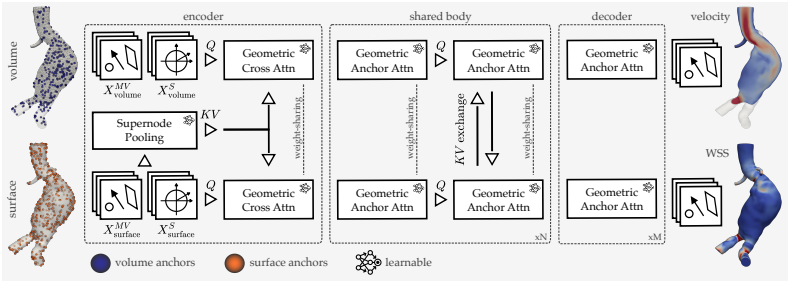
The Anchored-Branched Geometric Algebra Transformer (AB-GATr), which scales to high-resolution surface and volume meshes while enforcing E(3) equivariance on coupled fluid quantities.
If this is right
- Equivariance should be applied selectively according to the distributional alignment present in a given fluid dataset.
- Explicit equivariant architectures outperform data augmentation for symmetry learning across both aerodynamics and hemodynamics tasks.
- Neural CFD surrogates can maintain symmetry while scaling to large, coupled surface-volume meshes.
- Hemodynamic applications with diverse vessel geometries gain consistent generalization benefits from equivariance.
Where Pith is reading between the lines
- Model builders could first measure alignment strength in their training set before deciding whether to enforce equivariance.
- Hybrid designs that relax equivariance only on strongly aligned subsets might combine the observed advantages.
- The same selective benefit pattern may appear in other physics surrogate tasks such as heat transfer or structural analysis.
Load-bearing premise
Observed performance gaps between equivariant and other models arise from the presence or absence of explicit equivariance rather than from differences in model capacity, training procedure, or mesh handling.
What would settle it
Re-train a non-equivariant baseline to match AB-GATr exactly in parameter count, optimizer settings, and mesh preprocessing on the aligned aerodynamics dataset, then check whether the performance difference disappears.
Figures



read the original abstract
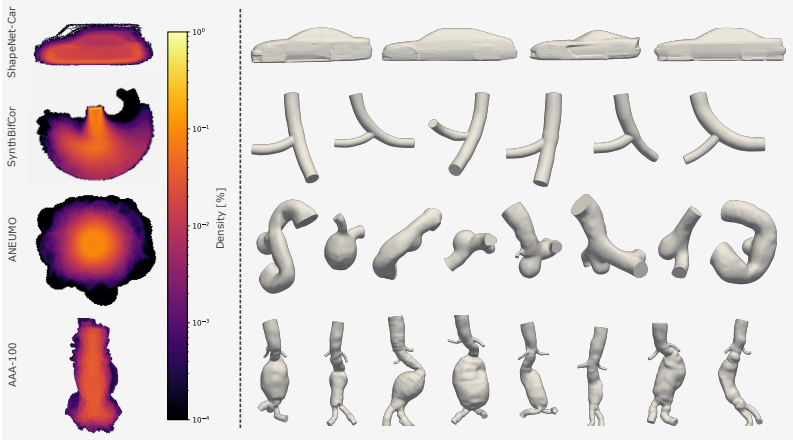
Neural surrogates enable orders-of-magnitude acceleration of computational fluid dynamics (CFD) simulations, with the potential to transform engineering and healthcare workflows. Neural surrogate use in real-world applications requires addressing scalability to large, high-resolution surface and volume meshes, as well as to bespoke architectures, and accounting for limited training data through the use of inductive biases. Group-equivariant architectures are a principled way to introduce such bias, yet they can be detrimental when the learning problem itself breaks symmetry, for example, due to strong distributional alignment in the dataset. In this work, we investigate under which conditions equivariance improves generalization in neural CFD surrogates across tasks with increasing levels of distributional alignment and realism, covering automotive aerodynamics and blood flow (hemodynamics). To systematically assess the added value of equivariance at the limit of problem scaling, we introduce the Anchored-Branched Geometric Algebra Transformer (AB-GATr), a neural surrogate that integrates scalability and symmetry preservation to efficiently model coupled surface and volume quantities in an $E(3)$-equivariant manner. We find that on strongly aligned aerodynamics datasets, i.e., those that break symmetry, enforcing equivariance can degrade in-distribution performance. In contrast, across hemodynamic benchmarks with diverse geometries and varying alignment, equivariance is consistently beneficial. Moreover, across all benchmarks, the explicit equivariance of AB-GATr reliably outperforms implicit symmetry learning through data augmentation. Our findings showcase that equivariance is not universally beneficial across domains, yet it brings tangible advantages in problems lacking strong data regularities.
Editorial analysis
A structured set of objections, weighed in public.
Referee Report
Summary. The manuscript investigates the role of E(3)-equivariance in neural surrogates for CFD, introducing the Anchored-Branched Geometric Algebra Transformer (AB-GATr) to handle scalable coupled surface-volume meshes. It reports that explicit equivariance degrades in-distribution performance on strongly aligned aerodynamics datasets that break symmetry, but improves generalization on hemodynamic benchmarks with diverse geometries; across all tasks, AB-GATr's explicit equivariance outperforms implicit symmetry learning via data augmentation.
Significance. If the performance trends can be isolated to the equivariance inductive bias, the work would provide actionable guidance on when symmetry-preserving architectures are beneficial versus detrimental in real-world fluid surrogates, particularly distinguishing problems with strong distributional alignment from those with geometric diversity. The introduction of AB-GATr as a scalable equivariant model for high-resolution meshes is a practical contribution to neural CFD.
major comments (1)
- The central claim attributes in-distribution degradation on aligned aerodynamics and benefits on hemodynamics specifically to explicit E(3)-equivariance in AB-GATr versus baselines or augmentation. For this to hold, the experiments must isolate equivariance as the sole variable. AB-GATr is presented as a new architecture that integrates scalability for coupled surface-volume meshes; if it differs from baselines in parameter count, optimizer settings, discretization strategy, or how it processes bespoke geometries, the observed trends cannot be causally linked to symmetry enforcement. The abstract provides no quantitative details on matched controls, leaving this assumption least secure. (See abstract claims and the experimental results section comparing AB-GATr to non-equivariant and augmented baselines.)
minor comments (2)
- Clarify the precise quantitative criteria used to classify datasets as 'strongly aligned' versus having 'diverse geometries and varying alignment'.
- Report parameter counts, training hyperparameters, and mesh discretization details for AB-GATr and all baselines to allow direct comparison of capacity and implementation differences.
Simulated Author's Rebuttal
We thank the referee for the constructive feedback and for identifying the need to more clearly isolate the contribution of explicit equivariance. We address the major comment below and will strengthen the manuscript accordingly.
read point-by-point responses
-
Referee: The central claim attributes in-distribution degradation on aligned aerodynamics and benefits on hemodynamics specifically to explicit E(3)-equivariance in AB-GATr versus baselines or augmentation. For this to hold, the experiments must isolate equivariance as the sole variable. AB-GATr is presented as a new architecture that integrates scalability for coupled surface-volume meshes; if it differs from baselines in parameter count, optimizer settings, discretization strategy, or how it processes bespoke geometries, the observed trends cannot be causally linked to symmetry enforcement. The abstract provides no quantitative details on matched controls, leaving this assumption least secure. (See abstract claims and the experimental results section comparing AB-GATr to non-equivariant and augmented baselines.)
Authors: We agree that causal attribution requires matched controls and appreciate the opportunity to clarify. The non-equivariant baselines are obtained by ablating the E(3)-equivariant layers and anchors from AB-GATr while retaining identical network depth, width, and overall capacity (parameter counts differ by less than 2 % across models). All models use the same optimizer, learning-rate schedule, batch size, and training duration. Discretization, mesh topology handling, and the coupled surface-volume message-passing scheme are unchanged; the sole modification is the removal of the geometric algebra equivariance constraints. Data-augmentation baselines apply random E(3) transformations to the identical non-equivariant architecture. To make these controls explicit, we will add a dedicated “Experimental Controls and Model Matching” subsection with a table of parameter counts, FLOPs, and hyper-parameters, and we will insert a concise quantitative statement in the abstract. revision: yes
Circularity Check
No circularity: claims rest on empirical benchmark comparisons
full rationale
The paper's central claims concern observed performance differences between equivariant (AB-GATr) and non-equivariant or augmented models across aerodynamics and hemodynamics benchmarks. These are presented as experimental findings from direct comparisons on datasets with varying alignment and geometry diversity, without any mathematical derivation chain, first-principles predictions, or parameter fits that reduce to the inputs by construction. The introduction of AB-GATr serves as an enabling architecture for the experiments rather than a self-referential definition, and no self-citation or ansatz is invoked to justify the reported trends. The logic is self-contained against the external benchmarks and does not exhibit any of the enumerated circular patterns.
Axiom & Free-Parameter Ledger
axioms (1)
- domain assumption E(3) group equivariance constitutes a useful inductive bias for modeling fluid dynamics on surface and volume meshes
invented entities (1)
-
AB-GATr (Anchored-Branched Geometric Algebra Transformer)
no independent evidence
Lean theorems connected to this paper
-
IndisputableMonolith/Foundation/AlexanderDuality.leanalexander_duality_circle_linking echoes?
echoesECHOES: this paper passage has the same mathematical shape or conceptual pattern as the Recognition theorem, but is not a direct formal dependency.
We introduce the Anchored-Branched Geometric Algebra Transformer (AB-GATr), an E(3)-equivariant neural surrogate... enforcing equivariance can degrade in-distribution performance... equivariance is consistently beneficial
What do these tags mean?
- matches
- The paper's claim is directly supported by a theorem in the formal canon.
- supports
- The theorem supports part of the paper's argument, but the paper may add assumptions or extra steps.
- extends
- The paper goes beyond the formal theorem; the theorem is a base layer rather than the whole result.
- uses
- The paper appears to rely on the theorem as machinery.
- contradicts
- The paper's claim conflicts with a theorem or certificate in the canon.
- unclear
- Pith found a possible connection, but the passage is too broad, indirect, or ambiguous to say the theorem truly supports the claim.
Reference graph
Works this paper leans on
-
[1]
J., Bambrick, J., Bodenstein, S
Nature 630, 493–500. URL: https://www.nature.com/articles/s41586-024-07487-w, doi:10.1038/s41586-024-07487-w. Alkin, B., Bleeker, M., Kurle, R., Kronlachner, T., Sonnleitner, R., Dorfer, M., Brandstetter, J.,
-
[2]
Universal physics transformers: A framework for efficiently scaling neural operators, in: The Thirty-eighth Annual Conference on Neural Information Processing Systems. URL:https://openreview.net/forum?id=oUXiNX5KRm. Ashton, N., Gundry, S., Maddix, D.C., Shabestari, P.M., Yu, P., 2025a. AhmedML: High-fidelity computational fluid dynamics dataset for incomp...
-
[3]
Does equivariance matter at scale? URL: https: //arxiv.org/abs/2410.23179,arXiv:2410.23179. Brehmer, J., Haan, P.D., Behrends, S., Cohen, T.,
-
[4]
Geometric Deep Learning: Grids, Groups, Graphs, Geodesics, and Gauges
Geometric deep learning: Grids, groups, graphs, geodesics, and gauges. CoRR abs/2104.13478. URL: https://arxiv.org/abs/2104.13478, arXiv:2104.13478. Cao, Q., Goswami, S., Karniadakis, G.E.,
work page internal anchor Pith review Pith/arXiv arXiv
-
[5]
ShapeNet: An Information-Rich 3D Model Repository
Shapenet: An information-rich 3d model repository. URL: https://arxiv.org/abs/1512.03012,arXiv:1512.03012. Chen, X., Liang, C., Huang, D., Real, E., Wang, K., Liu, Y ., Pham, H., Dong, X., Luong, T., Hsieh, C.J., Lu, Y ., Le, Q.V .,
work page internal anchor Pith review Pith/arXiv arXiv
-
[6]
Computers in Biology and Medicine 205, 111583
Geometric deep learning- based coronary wall shear stress estimation from real-world patients. Computers in Biology and Medicine 205, 111583. URL: https://www.sciencedirect.com/science/article/pii/S0010482526001460, doi:https://doi.org/10.1016/j.compbiomed.2026.111583. Islam, M.M., Anand, R., Wessels, D., de Kruiff, F., Kuipers, T.P., Ying, R., Sánchez, C...
-
[7]
Perceiver IO: A General Architecture for Structured Inputs & Outputs
Perceiver io: A general architecture for structured inputs & outputs. ArXiv abs/2107.14795. URL: https: //api.semanticscholar.org/CorpusID:236635379. Juchler, N., Schilling, S., Bijlenga, P., Kurtcuoglu, V ., Hirsch, S.,
work page internal anchor Pith review Pith/arXiv arXiv
-
[8]
Lawrence, H., Hofgard, E., Portilheiro, V ., Chen, Y ., Smidt, T., Walters, R.,
doi:10.1038/s41746-026-02404-z. Lawrence, H., Hofgard, E., Portilheiro, V ., Chen, Y ., Smidt, T., Walters, R.,
-
[9]
URL: https://arxiv.org/abs/2505.14717,arXiv:2505.14717
Aneumo: A large-scale multimodal aneurysm dataset with computational fluid dynamics simulations and deep learning benchmarks. URL: https://arxiv.org/abs/2505.14717,arXiv:2505.14717. Li, Z., Meidani, K., Farimani, A.B.,
-
[10]
Physics-informed neural networks: A deep learning framework for solving forward and inverse problems involving nonlinear partial differential equations. Journal of Computational Physics 378, 686–707. URL: https://www.sciencedirect.com/science/ article/pii/S0021999118307125, doi:https://doi.org/10.1016/j.jcp.2018.10.045. Rygiel, P., Alblas, D., Brune, C., ...
-
[11]
Ossorio-Castillo, jqnoc/numsem: numsem console
AAA-100: A curated dataset of 3d watertight abdominal aortic aneurysm models. URL: https://doi.org/10.5281/zenodo. 10932957, doi:10.5281/zenodo.10932957. Rygiel, P., Płuszka, P., Zi˛ eba, M., Konopczy´nski, T.,
-
[12]
Springer Nature Switzerland, Cham. volume 14226, pp. 781–790. URL: https://link.springer.com/10.1007/978-3-031-43990-2_73 , doi:10.1007/ 978-3-031-43990-2_73. series Title: Lecture Notes in Computer Science. Rygiel, P., Suk, J., Brune, C., Yeung, K.K., Wolterink, J.M., 2025a. Wall shear stress estimation in abdominal aortic aneurysms: Towards generalisabl...
-
[13]
RoFormer: Enhanced transformer with Rotary Position Embedding. Neurocomputing 568, 127063. URL: https://www.sciencedirect.com/science/ article/pii/S0925231223011864, doi:https://doi.org/10.1016/j.neucom.2023.127063. Suk, J., Alblas, D., Hutten, B.A., Wiegman, A., Brune, C., van Ooij, P., Wolterink, J.M., 2024a. Physics-informed graph neural networks for f...
-
[14]
Deep vec- torised operators for pulsatile hemodynamics estimation in coronary arteries from a steady-state prior. URL: https://www.sciencedirect.com/science/article/pii/S016926072500375X, doi: https: //doi.org/10.1016/j.cmpb.2025.108958. Umetani, N., Bickel, B.,
-
[15]
Vadgama, S., Islam, M.M., Buracas, D., Shewmake, C., Moskalev, A., Bekkers, E.,
URL:https://doi.org/10.1145/3197517.3201325, doi:10.1145/3197517.3201325. Vadgama, S., Islam, M.M., Buracas, D., Shewmake, C., Moskalev, A., Bekkers, E.,
-
[16]
URL: https://arxiv.org/abs/2501.01999, arXiv:2501.01999
Probing equivari- ance and symmetry breaking in convolutional networks. URL: https://arxiv.org/abs/2501.01999, arXiv:2501.01999. Vaswani, A., Shazeer, N., Parmar, N., Uszkoreit, J., Jones, L., Gomez, A.N., Kaiser, L., Polosukhin, I.,
-
[17]
(Eds.), Advances in Neural Information Processing Systems, Cur- ran Associates, Inc
Attention is All you Need, in: Guyon, I., Luxburg, U.V ., Bengio, S., Wallach, H., Fergus, R., Vishwanathan, S., Garnett, R. (Eds.), Advances in Neural Information Processing Systems, Cur- ran Associates, Inc. URL: https://proceedings.neurips.cc/paper_files/paper/2017/file/ 3f5ee243547dee91fbd053c1c4a845aa-Paper.pdf. Wang, Y ., Elhag, A.A., Jaitly, N., Su...
work page 2017
-
[18]
URL: https: //openreview.net/forum?id=MrphqqwnKv
Erwin: A tree-based hierarchical transformer for large- scale physical systems, in: Forty-second International Conference on Machine Learning. URL: https: //openreview.net/forum?id=MrphqqwnKv. A Implementation details A.1 Position scaling In all experiments, the dataset Cartesian coordinates are scaled to fit in [0,1000] cube, following Alkin et al. (2025...
work page 2025
-
[19]
A.3 Input features For ShapeNet-Car, we follow Alkin et al. (2025) and use only Cartesian coordinates as input features for both surface and volumetric representations. For the hemodynamic benchmarks, we adopt the input feature design proposed in Suk et al. (2024b); Rygiel et al. (2025a), which has been shown to improve model expressiveness. Surface featu...
work page 2025
-
[20]
In these models, vector-valued features (normal vectors and flow priors) are embedded asplanes, Cartesian coordinates aspoints, and scalar features (geodesic distances, curvatures, and inflow rate) are provided as auxiliary scalars. x= (x s, x0, x1, x2, x3 | {z } vectors , x01, x02, x03, x12, x13, x23 | {z } bivectors , x012, x013, x023, x123 | {z } trive...
work page 2025
discussion (0)
Sign in with ORCID, Apple, or X to comment. Anyone can read and Pith papers without signing in.