INSIGHTS: Demonstration-Based Summaries of Time Series Predictors
Pith reviewed 2026-05-20 20:48 UTC · model grok-4.3
The pith
INSIGHTS generates global explanations for time series models by selecting balanced sets of important and diverse samples.
A machine-rendered reading of the paper's core claim, the machinery that carries it, and where it could break.
Core claim
INSIGHTS is a model-agnostic, user-centric approach that generates sample summaries offering a comprehensive overview of model behavior. It balances the importance and diversity of time series samples to create informative subsets using utility functions that capture domain-specific aspects of time series behavior, such as exceeding domain norms. Evaluation shows the summaries are manageable for individual evaluation and preferred by domain experts for stable understanding of model behavior.
What carries the argument
INSIGHTS selection process that balances importance and diversity of time series samples via domain-specific utility functions to form global summaries.
If this is right
- The method produces comprehensive and diverse time series subsets for review.
- Summaries remain small enough for individual evaluation by stakeholders.
- Domain experts gain a stable understanding of model behavior from the selected samples.
- User study participants exhibit enhanced understanding of the model's overall behavior.
Where Pith is reading between the lines
- The user-centric design may support adoption in applied domains that rely on time series data.
- Similar balancing of importance and diversity could be tested on other sequential data types.
Load-bearing premise
Utility functions that capture domain-specific aspects of time series behavior can be defined and applied to reliably balance importance and diversity for informative global summaries.
What would settle it
A controlled study in which users given INSIGHTS summaries show no better understanding of overall model behavior than users given random samples or local explanations.
Figures


read the original abstract
Explainability methods have progressed rapidly, but global explanations for time-series models remain underdeveloped, with most approaches focusing on local, instance-level attributions. We introduce INSIGHTS, a model-agnostic, user-centric approach for providing global explanations of time series models. Our approach prioritizes simplicity, efficiency, and transparency in its design, ensuring that stakeholders can readily adopt its outputs. While current methods focus on local explanations, INSIGHTS generates sample summaries that offer a comprehensive overview of model behavior. It balances the importance and diversity of time series samples to create informative subsets using utility functions that capture domain-specific aspects of time series behavior, such as exceeding domain norms. We evaluate INSIGHTS through experiments, interviews, and a user study. Our results indicate INSIGHTS effectively constructs comprehensive, diverse time series subsets, producing summaries manageable for individual evaluation. It is preferred by domain experts for its ability to provide a stable understanding of model behavior and the quality of the samples identified. Moreover, user study participants presented with INSIGHTS-based summaries exhibit an enhanced understanding of the model's overall behavior.
Editorial analysis
A structured set of objections, weighed in public.
Referee Report
Summary. The paper introduces INSIGHTS, a model-agnostic, user-centric method for global explanations of time series predictors. It selects small, informative subsets of time series samples by balancing importance and diversity via domain-specific utility functions (e.g., those encoding norms such as exceeding thresholds). The approach is evaluated through experiments, expert interviews, and a user study; the authors claim that the resulting summaries are manageable for individual evaluation, preferred by domain experts, and improve understanding of overall model behavior.
Significance. If the empirical claims hold under more rigorous controls, INSIGHTS would address a genuine gap in global explainability for time series models, where most prior work remains local. The emphasis on simplicity, transparency, and domain-expert feedback is a practical strength that could aid adoption. The multi-method evaluation (experiments + interviews + user study) is a positive design choice that goes beyond purely synthetic metrics.
major comments (2)
- [§4.3] §4 (Evaluation) and §4.3 (User Study): The headline result that domain experts prefer INSIGHTS and gain a 'stable understanding' of model behavior rests on the domain-specific utility functions, yet no ablation isolates their contribution versus simpler alternatives such as pure diversity sampling, k-medoids on raw features, or random selection. Without this comparison, it remains unclear whether the observed preference is attributable to the utility design or to presentation format and sample size.
- [§4] §4 Experiments: The abstract and evaluation sections report positive outcomes from experiments, interviews, and the user study, but supply no quantitative metrics (e.g., diversity scores, coverage statistics, inter-rater agreement), baselines, statistical tests, or exclusion criteria. This absence makes it impossible to assess whether the evidence supports the central claim that INSIGHTS 'effectively constructs comprehensive, diverse time series subsets.'
minor comments (2)
- [§3.2] The definition of the utility functions in §3.2 would benefit from an explicit statement of how domain norms are elicited or validated across different time-series domains rather than appearing tailored per experiment.
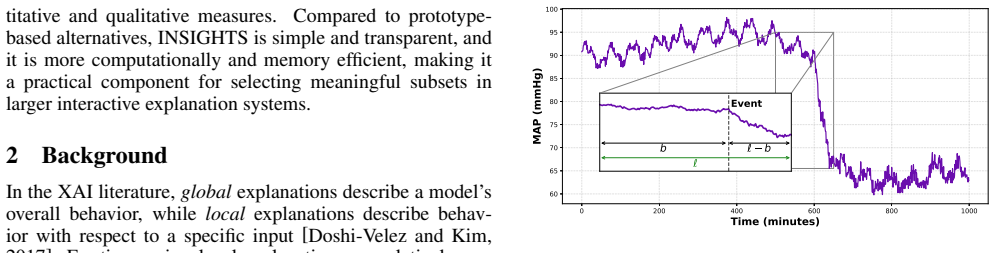
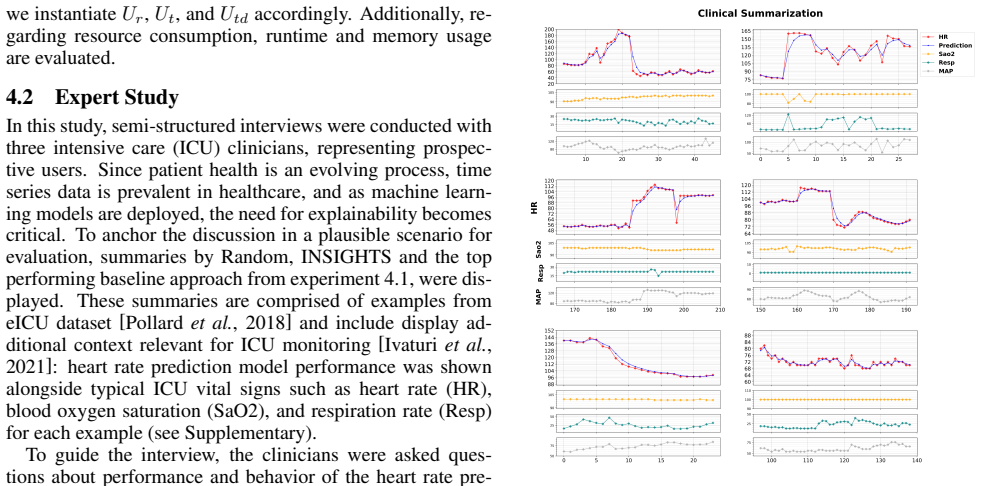
- [Figure 2] Figure 2 (example summaries) and the accompanying text would be clearer if the axes and color coding were described in the caption rather than only in the main body.
Simulated Author's Rebuttal
We thank the referee for their constructive and detailed comments. We address each major comment below and indicate the revisions we will make to improve the rigor and clarity of the evaluation sections.
read point-by-point responses
-
Referee: [§4.3] §4 (Evaluation) and §4.3 (User Study): The headline result that domain experts prefer INSIGHTS and gain a 'stable understanding' of model behavior rests on the domain-specific utility functions, yet no ablation isolates their contribution versus simpler alternatives such as pure diversity sampling, k-medoids on raw features, or random selection. Without this comparison, it remains unclear whether the observed preference is attributable to the utility design or to presentation format and sample size.
Authors: We agree that an explicit ablation isolating the domain-specific utility functions is necessary to strengthen the causal link to the observed expert preferences. The user study in the current manuscript compares full INSIGHTS summaries against other selection approaches and controls for sample size and presentation format, yet it does not include dedicated variants that remove or replace the utility functions with pure diversity sampling or k-medoids. We will add these ablation experiments to the revised §4.3, reporting quantitative preference differences and qualitative feedback to clarify the utility functions' contribution. revision: yes
-
Referee: [§4] §4 Experiments: The abstract and evaluation sections report positive outcomes from experiments, interviews, and the user study, but supply no quantitative metrics (e.g., diversity scores, coverage statistics, inter-rater agreement), baselines, statistical tests, or exclusion criteria. This absence makes it impossible to assess whether the evidence supports the central claim that INSIGHTS 'effectively constructs comprehensive, diverse time series subsets.'
Authors: We acknowledge that the evaluation would benefit from additional quantitative reporting and statistical support. The experiments section describes how INSIGHTS balances importance and diversity via the utility functions and reports qualitative outcomes from interviews and the user study, but does not include explicit numerical diversity or coverage scores, direct baselines such as random or k-medoids selection, inter-rater agreement statistics, or formal statistical tests. We will revise §4 to incorporate these elements, including computed diversity and coverage metrics, baseline comparisons, and appropriate statistical analyses where the study design permits. revision: yes
Circularity Check
No significant circularity; central claims rest on external user studies and experiments
full rationale
The paper introduces INSIGHTS as a method using utility functions for balancing importance and diversity in time series summaries. Evaluation relies on separate experiments, interviews, and a user study showing expert preference and improved understanding. No derivation step reduces a result to a fitted parameter or self-citation by construction; the utility functions are presented as domain-specific inputs defined externally rather than derived from the method's outputs. Claims about effectiveness are empirically tested rather than tautological.
Axiom & Free-Parameter Ledger
axioms (1)
- domain assumption Utility functions can be defined to capture domain-specific aspects such as exceeding domain norms
Lean theorems connected to this paper
-
IndisputableMonolith/Cost/FunctionalEquation.leanwashburn_uniqueness_aczel unclear?
unclearRelation between the paper passage and the cited Recognition theorem.
balances the importance and diversity of time series samples to create informative subsets using utility functions that capture domain-specific aspects of time series behavior, such as exceeding domain norms
-
IndisputableMonolith/Foundation/BranchSelection.leanbranch_selection unclear?
unclearRelation between the paper passage and the cited Recognition theorem.
We offer three general functions that capture utility from time series-specific properties... Overall trend, Exceeding normal range, Sudden changes
What do these tags mean?
- matches
- The paper's claim is directly supported by a theorem in the formal canon.
- supports
- The theorem supports part of the paper's argument, but the paper may add assumptions or extra steps.
- extends
- The paper goes beyond the formal theorem; the theorem is a base layer rather than the whole result.
- uses
- The paper appears to rely on the theorem as machinery.
- contradicts
- The paper's claim conflicts with a theorem or certificate in the canon.
- unclear
- Pith found a possible connection, but the passage is too broad, indirect, or ambiguous to say the theorem truly supports the claim.
Reference graph
Works this paper leans on
-
[1]
HIGH- LIGHTS: Summarizing agent behavior to people
[Amir and Amir, 2018] Dan Amir and Ofra Amir. HIGH- LIGHTS: Summarizing agent behavior to people. InPro- ceedings of the International Joint Conference on Au- tonomous Agents and Multiagent Systems, AAMAS, vol- ume 2, pages 1168–1176,
work page 2018
-
[2]
Summarizing agent strategies.Autonomous Agents and Multi-Agent Systems, 33(5):628–644, 9
[Amiret al., 2019 ] Ofra Amir, Finale Doshi-Velez, and David Sarne. Summarizing agent strategies.Autonomous Agents and Multi-Agent Systems, 33(5):628–644, 9
work page 2019
-
[3]
[Arsenaultet al., 2025 ] Pierre-Daniel Arsenault, Shengrui Wang, and Jean-Marc Patenaude. A survey of explainable artificial intelligence (xai) in financial time series forecast- ing.ACM Computing Surveys, 57(10):1–37,
work page 2025
-
[4]
[Aryaet al., 2019 ] Vijay Arya, Rachel K. E. Bellamy, Pin- Yu Chen, Amit Dhurandhar, Michael Hind, Samuel C. Hoffman, Stephanie Houde, Q. Vera Liao, Ronny Luss, Aleksandra Mojsilovi´c, Sami Mourad, Pablo Pedemonte, Ramya Raghavendra, John Richards, Prasanna Sattigeri, Karthikeyan Shanmugam, Moninder Singh, Kush R. Varshney, Dennis Wei, and Yunfeng Zhang. ...
work page 2019
-
[5]
Interpreting deep neural networks through prototype factorization
[Daset al., 2020 ] Subhajit Das, Panpan Xu, Zeng Dai, Alex Endert, and Liu Ren. Interpreting deep neural networks through prototype factorization. In2020 International Conference on Data Mining Workshops (ICDMW), pages 448–457. IEEE,
work page 2020
-
[6]
Towards A Rigorous Science of Interpretable Ma- chine Learning
[Doshi-Velez and Kim, 2017] Finale Doshi-Velez and Been Kim. Towards A Rigorous Science of Interpretable Ma- chine Learning. 2
work page 2017
-
[7]
[Eini-Poratet al., 2022 ] Bar Eini-Porat, Ofra Amir, Danny Eytan, and Uri Shalit. Tell me something interesting: Clinical utility of machine learning prediction models in the icu.Journal of Biomedical Informatics, 132:104107,
work page 2022
-
[8]
Aiming for relevance.AMIA Summits on Trans- lational Science Proceedings, 2024:145,
[Eini-Poratet al., 2024 ] Bar Eini-Porat, Danny Eytan, and Uri Shalit. Aiming for relevance.AMIA Summits on Trans- lational Science Proceedings, 2024:145,
work page 2024
-
[9]
Explaining deep clas- sification of time-series data with learned prototypes
[Geeet al., 2019 ] Alan H Gee, Diego Garcia-Olano, Joy- deep Ghosh, and David Paydarfar. Explaining deep clas- sification of time-series data with learned prototypes. In CEUR workshop proceedings, volume 2429, page
work page 2019
-
[10]
[Goldbergeret al., 2000 ] Ary L. Goldberger, Luis A. N. Amaral, Leon Glass, Jeffrey M. Hausdorff, Plamen Ch. Ivanov, Roger G. Mark, Joseph E. Mietus, George B. Moody, Chung-Kang Peng, and H. Eugene Stanley. Phys- ioBank, PhysioToolkit, and PhysioNet: Components of a new research resource for complex physiologic signals. Circulation, 101(23):e215–e220,
work page 2000
-
[11]
Ef- ficient data representation by selecting prototypes with im- portance weights
[Gurumoorthyet al., 2019 ] Karthik S Gurumoorthy, Amit Dhurandhar, Guillermo Cecchi, and Charu Aggarwal. Ef- ficient data representation by selecting prototypes with im- portance weights. In2019 IEEE International Conference on Data Mining (ICDM), pages 260–269. IEEE,
work page 2019
-
[12]
Metrics for Explainable AI: Challenges and Prospects
[Hoffmanet al., 2018 ] Robert R Hoffman, Shane T Mueller, Gary Klein, and Jordan Litman. Metrics for explain- able ai: Challenges and prospects.arXiv preprint arXiv:1812.04608,
work page internal anchor Pith review Pith/arXiv arXiv 2018
-
[13]
[Ivaturiet al., 2021 ] Praharsh Ivaturi, Matteo Gadaleta, Amitabh C Pandey, Michael Pazzani, Steven R Steinhubl, and Giorgio Quer. A comprehensive explanation frame- work for biomedical time series classification.IEEE jour- nal of biomedical and health informatics, 25(7):2398– 2408,
work page 2021
-
[14]
[Jacobset al., 2021 ] Maia Jacobs, Jeffrey He, Melanie F. Pradier, Barbara Lam, Andrew C Ahn, Thomas H Mc- Coy, Roy H Perlis, Finale Doshi-Velez, and Krzysztof Z Gajos. Designing ai for trust and collaboration in time- constrained medical decisions: a sociotechnical lens. In Proceedings of the 2021 chi conference on human factors in computing systems, pages 1–14,
work page 2021
-
[15]
[Jain and Wallace, 2019] Sarthak Jain and Byron C Wal- lace. Attention is not explanation.arXiv preprint arXiv:1902.10186,
work page internal anchor Pith review Pith/arXiv arXiv 2019
-
[16]
Examples are not Enough, Learn to Criticize! Criticism for Interpretability
[Kimet al., 2016 ] Been Kim, Rajiv Khanna, and Oluwasanmi Koyejo. Examples are not Enough, Learn to Criticize! Criticism for Interpretability. InNeural Information Processing Systems, pages 2280–2288,
work page 2016
-
[17]
Conceptual expla- nations of neural network prediction for time series
[K¨usterset al., 2020 ] Ferdinand K ¨usters, Peter Schichtel, Sheraz Ahmed, and Andreas Dengel. Conceptual expla- nations of neural network prediction for time series. In 2020 International joint conference on neural networks (IJCNN), pages 1–6. IEEE,
work page 2020
-
[18]
Toward robust policy summa- rization
[Lageet al., 2019 ] Isaac Lage, Finale Doshi-Velez, Daphna Lifschitz, and Ofra Amir. Toward robust policy summa- rization. InProceedings of the International Joint Con- ference on Autonomous Agents and Multiagent Systems, AAMAS, volume 4, pages 2081–2083,
work page 2019
-
[19]
A unified approach to interpreting model predictions
[Lundberg and Lee, 2017] Scott M Lundberg and Su-In Lee. A unified approach to interpreting model predictions. Advances in neural information processing systems, 30,
work page 2017
-
[20]
Interpretable and steerable sequence learning via prototypes
[Minget al., 2019 ] Yao Ming, Panpan Xu, Huamin Qu, and Liu Ren. Interpretable and steerable sequence learning via prototypes. InProceedings of the 25th ACM SIGKDD In- ternational Conference on Knowledge Discovery & Data Mining, pages 903–913,
work page 2019
-
[21]
[Pollardet al., 2018 ] Tom J Pollard, Alistair EW Johnson, Jesse D Raffa, Leo A Celi, Roger G Mark, and Omar Badawi. The eicu collaborative research database, a freely available multi-center database for critical care research. Scientific data, 5(1):1–13,
work page 2018
-
[22]
[Raykaret al., 2023 ] Vikas C Raykar, Arindam Jati, Sumanta Mukherjee, Nupur Aggarwal, Kanthi Sarpatwar, Giridhar Ganapavarapu, and Roman Vaculin. Tsshap: Robust model agnostic feature-based explainability for time series forecasting.arXiv preprint arXiv:2303.12316,
-
[23]
[Rojatet al., 2021 ] Thomas Rojat, Rapha ¨el Puget, David Filliat, Javier Del Ser, Rodolphe Gelin, and Na- talia D ´ıaz-Rodr´ıguez. Explainable artificial intelligence (xai) on timeseries data: A survey.arXiv preprint arXiv:2104.00950,
-
[24]
Interpretable time-series classification on few-shot sam- ples
[Tanget al., 2020 ] Wensi Tang, Lu Liu, and Guodong Long. Interpretable time-series classification on few-shot sam- ples. In2020 International Joint Conference on Neural Networks (IJCNN), pages 1–8. IEEE,
work page 2020
-
[25]
[Theissleret al., 2022 ] Andreas Theissler, Francesco Spin- nato, Udo Schlegel, and Riccardo Guidotti. Explainable ai for time series classification: a review, taxonomy and re- search directions.Ieee Access, 10:100700–100724,
work page 2022
-
[26]
[Tormeneet al., 2009 ] Paolo Tormene, Toni Giorgino, Sil- vana Quaglini, and Mario Stefanelli. Matching incomplete time series with dynamic time warping: an algorithm and an application to post-stroke rehabilitation.Artificial intel- ligence in medicine, 45(1):11–34,
work page 2009
-
[27]
Historical stock prices for microsoft corporation, general electric company, and amazon.com, inc.,
[Yahoo Finance, 2024] Yahoo Finance. Historical stock prices for microsoft corporation, general electric company, and amazon.com, inc.,
work page 2024
-
[28]
Time series shapelets: a new primitive for data mining
[Ye and Keogh, 2009] Lexiang Ye and Eamonn Keogh. Time series shapelets: a new primitive for data mining. InPro- ceedings of the 15th ACM SIGKDD international con- ference on Knowledge discovery and data mining, pages 947–956,
work page 2009
-
[29]
Tapnet: Multivariate time se- ries classification with attentional prototypical network
[Zhanget al., 2020 ] Xuchao Zhang, Yifeng Gao, Jessica Lin, and Chang-Tien Lu. Tapnet: Multivariate time se- ries classification with attentional prototypical network. In Proceedings of the AAAI conference on artificial intelli- gence, volume 34, pages 6845–6852, 2020
work page 2020
discussion (0)
Sign in with ORCID, Apple, or X to comment. Anyone can read and Pith papers without signing in.