Magnetic Prandtl number dependence of plasmoid-mediated reconnection
Pith reviewed 2026-05-20 07:24 UTC · model grok-4.3
pith:BPPVPRDD Add to your LaTeX paper
What is a Pith Number?\usepackage{pith}
\pithnumber{BPPVPRDD}
Prints a linked pith:BPPVPRDD badge after your title and writes the identifier into PDF metadata. Compiles on arXiv with no extra files. Learn more
The pith
In plasmoid-mediated magnetic reconnection the rate becomes nearly independent of the magnetic Prandtl number once the current sheet breaks into interacting plasmoids.
A machine-rendered reading of the paper's core claim, the machinery that carries it, and where it could break.
Core claim
In the fully plasmoid-mediated regime the reconnection rate remains nearly independent of the magnetic Prandtl number over the explored parameter range, whereas it decreases with increasing Prandtl number in the Sweet-Parker regime below the plasmoid instability threshold. The highest rates are tied to nonlinear plasmoid interactions and mergers. The two-dimensional coalescing-island configuration yields weaker Prandtl dependence than the boundary-driven Taylor problem, possibly because the former allows a freely evolving current sheet.
What carries the argument
The plasmoid instability that fragments the current sheet into multiple magnetic islands whose subsequent interactions and mergers sustain fast reconnection.
If this is right
- Reconnection-mediated decay in magnetically dominated turbulence should proceed at rates that do not require fine-tuning of the magnetic Prandtl number.
- Astrophysical systems with high Lundquist numbers can be modeled with a single, Prandtl-independent reconnection speed once plasmoids dominate.
- The choice of setup (free coalescing islands versus continuously driven boundaries) affects the apparent Prandtl scaling and must be considered when comparing simulations to observations.
Where Pith is reading between the lines
- If similar plasmoid-mediated independence appears in three-dimensional simulations, global models of magnetized turbulence could drop explicit Prandtl dependence in the reconnection term.
- The result suggests that observed rapid energy release in solar corona or accretion disks need not be explained by special values of viscosity or resistivity.
- Extending the same diagnostic to runs that vary the Lundquist number at fixed high Prandtl number would test whether the plateau persists into even more extreme regimes.
Load-bearing premise
The two-dimensional coalescing-island geometry produces current-sheet and plasmoid dynamics that are representative of reconnection in three-dimensional astrophysical plasmas.
What would settle it
A clear decrease in reconnection rate with rising magnetic Prandtl number measured inside a fully developed, plasmoid-unstable current sheet would contradict the reported independence.
Figures



read the original abstract
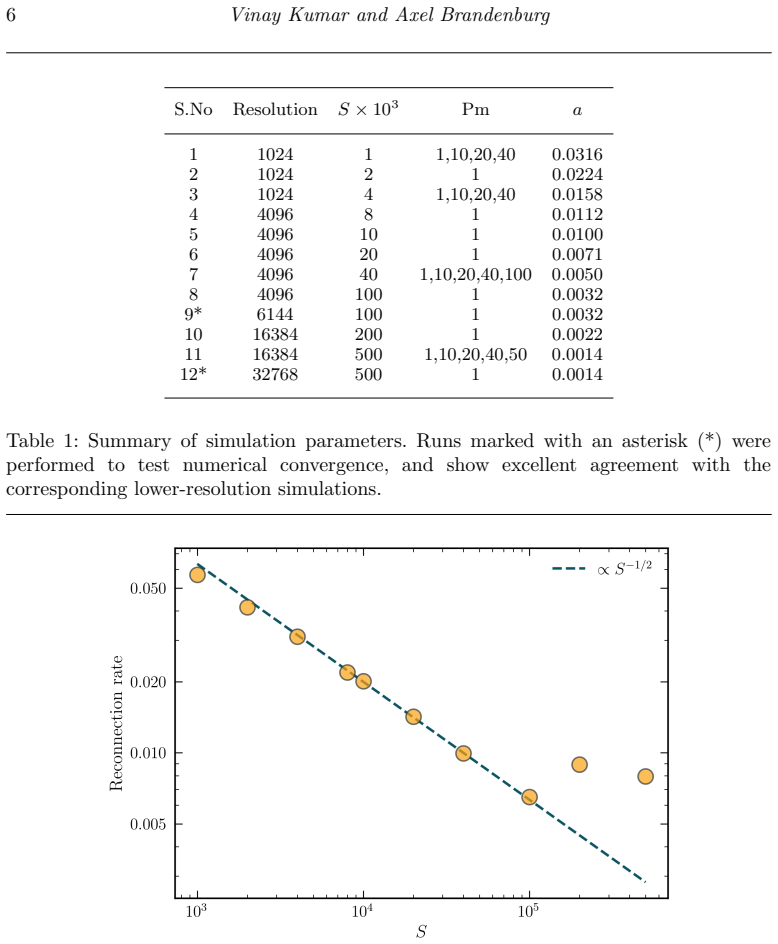
We investigate the dependence of the plasmoid-mediated magnetic reconnection rate on the magnetic Prandtl number using two-dimensional magnetohydrodynamic simulations of two coalescing magnetic islands. For Lundquist numbers below the onset of the plasmoid instability, the reconnection rate follows the expected Sweet-Parker scaling and decreases with increasing magnetic Prandtl number. However, once the current sheet becomes plasmoid unstable, the dependence on the magnetic Prandtl number weakens considerably. In the fully plasmoid-mediated regime, we find reconnection rates that remain nearly independent of the magnetic Prandtl number over the explored parameter range. We show that the largest reconnection rates are associated with strongly non-linear phases involving plasmoid interactions and mergers. We further compare our results with simulations of the boundary-driven Taylor problem, where previous studies reported a stronger magnetic Prandtl number dependence, and provide a possible explanation for the differing scalings obtained in the two setups. These results may have implications for reconnection-mediated decay in magnetically dominated turbulence and related astrophysical systems.
Editorial analysis
A structured set of objections, weighed in public.
Referee Report
Summary. The paper uses two-dimensional MHD simulations of coalescing magnetic islands to study the dependence of the plasmoid-mediated reconnection rate on the magnetic Prandtl number Pm at varying Lundquist numbers. Below the plasmoid instability threshold the rate follows Sweet-Parker scaling and decreases with Pm; once the sheet is fully plasmoid-unstable the rate becomes nearly independent of Pm over the explored range, with the largest values occurring during nonlinear plasmoid interactions and mergers. The authors also compare results to the boundary-driven Taylor problem and offer an explanation for the different Pm scalings obtained in the two setups.
Significance. If the numerical trends are robust, the work shows that plasmoid-mediated reconnection in 2D is largely insensitive to Pm once the instability is fully developed. This has potential implications for modeling reconnection-mediated decay in magnetically dominated turbulence and related astrophysical systems. The study is strengthened by its systematic parameter exploration and by the explicit identification of nonlinear phases as the source of the highest rates.
major comments (1)
- [§3.3] §3.3: The central claim of near Pm-independence in the fully plasmoid-mediated regime is supported by time-averaged reconnection-rate measurements, but the manuscript does not report grid-resolution convergence tests at the highest Lundquist numbers; without these it remains possible that numerical dissipation influences the reported independence.
minor comments (4)
- [Figure 4] Figure 4: the shaded intervals marking the nonlinear plasmoid-interaction phase are not defined in the caption; please add a brief description of how these intervals are chosen.
- [§5] §5: The qualitative discussion of why the coalescing-island setup yields weaker Pm dependence than the Taylor problem would be strengthened by a quantitative comparison of average current-sheet aspect ratios or plasmoid statistics between the two configurations.
- [§6] The astrophysical implications paragraph assumes that 2D plasmoid dynamics remain representative; a short caveat noting that 3D effects (oblique tearing, helical instabilities) are outside the present scope would clarify the reach of the conclusions.
- [Methods] Methods section: the precise numerical values of the Lundquist-number and Pm ranges, together with the definition of the reconnection rate (e.g., dΨ/dt normalized by what), should be stated explicitly rather than left to the figures.
Simulated Author's Rebuttal
We thank the referee for their careful reading of the manuscript and for the positive assessment of its potential implications. We address the major comment below.
read point-by-point responses
-
Referee: [§3.3] §3.3: The central claim of near Pm-independence in the fully plasmoid-mediated regime is supported by time-averaged reconnection-rate measurements, but the manuscript does not report grid-resolution convergence tests at the highest Lundquist numbers; without these it remains possible that numerical dissipation influences the reported independence.
Authors: We agree that explicit convergence tests strengthen the central claim. Although the original manuscript did not include a dedicated report of grid-resolution studies at the highest Lundquist numbers, the simulations were performed at resolutions chosen to adequately resolve the current-sheet thickness and plasmoid formation across the explored parameter space. To address the referee's concern, we have carried out additional runs at doubled resolution for the largest S values and across the Pm range. These tests show that the time-averaged reconnection rates and the near-independence on Pm remain unchanged within the reported uncertainties. We will add a brief description of these convergence checks, together with supporting figures, to the revised manuscript (most likely in §3 or a short appendix). revision: yes
Circularity Check
No circularity: results are direct numerical measurements
full rationale
The paper reports outcomes from direct numerical simulations of the 2D MHD equations in a coalescing-island geometry. Reconnection rates are extracted from the time evolution of the magnetic flux and current-sheet dynamics rather than obtained by fitting a parameter to a subset of the same data and then relabeling the fit as a prediction. No derivation chain exists that reduces the reported Pm-independence to an input definition, self-citation, or ansatz smuggled from prior work by the same authors. External comparisons to the Taylor problem are presented as contrasts with previous studies and do not serve as load-bearing justification for the central numerical finding.
Axiom & Free-Parameter Ledger
free parameters (2)
- Lundquist number
- Magnetic Prandtl number
axioms (2)
- standard math The incompressible MHD equations govern the evolution of the magnetic field and velocity.
- domain assumption Two-dimensional geometry is sufficient to capture the plasmoid-mediated reconnection rate.
Lean theorems connected to this paper
-
IndisputableMonolith/Cost/FunctionalEquation.leanwashburn_uniqueness_aczel unclear?
unclearRelation between the paper passage and the cited Recognition theorem.
For Lundquist numbers below the onset of the plasmoid instability, the reconnection rate follows the expected Sweet–Parker scaling and decreases with increasing magnetic Prandtl number.
What do these tags mean?
- matches
- The paper's claim is directly supported by a theorem in the formal canon.
- supports
- The theorem supports part of the paper's argument, but the paper may add assumptions or extra steps.
- extends
- The paper goes beyond the formal theorem; the theorem is a base layer rather than the whole result.
- uses
- The paper appears to rely on the theorem as machinery.
- contradicts
- The paper's claim conflicts with a theorem or certificate in the canon.
- unclear
- Pith found a possible connection, but the passage is too broad, indirect, or ambiguous to say the theorem truly supports the claim.
Reference graph
Works this paper leans on
-
[1]
, year = 2009, month = sep, volume =
Magnetic Reconnection in Astrophysical and Laboratory Plasmas. , year = 2009, month = sep, volume =. doi:10.1146/annurev-astro-082708-101726 , adsurl =
-
[2]
Physics of Plasmas , year = 1997, month = may, volume =
Study of driven magnetic reconnection in a laboratory plasma. Physics of Plasmas , year = 1997, month = may, volume =. doi:10.1063/1.872336 , adsurl =
-
[3]
In-Situ Observations of Reconnection in Space. , keywords =. doi:10.1007/s11214-012-9957-2 , adsurl =
-
[4]
, year = 2002, month = jan, volume =
The magnetic nature of solar flares. , year = 2002, month = jan, volume =. doi:10.1007/s001590100013 , adsurl =
-
[5]
Living Reviews in Solar Physics , keywords =
Solar Flares: Magnetohydrodynamic Processes. Living Reviews in Solar Physics , keywords =. doi:10.12942/lrsp-2011-6 , adsurl =
-
[6]
Tail Reconnection Triggering Substorm Onset. Science , keywords =. doi:10.1126/science.1160495 , adsurl =
-
[7]
Relativistic Magnetic Reconnection in Astrophysical Plasmas: A Powerful Mechanism of Nonthermal Emission. , keywords =. doi:10.1146/annurev-astro-020325-115713 , archivePrefix =. 2506.02101 , primaryClass =
-
[8]
Magnetic Reconnection: An Alternative Explanation of Radio Emission in Galaxy Clusters. , keywords =. doi:10.3847/2041-8213/ad9f2d , archivePrefix =. 2407.11156 , primaryClass =
-
[9]
Electromagnetic Phenomena in Cosmical Physics , year = 1958, editor =
The Neutral Point Theory of Solar Flares. Electromagnetic Phenomena in Cosmical Physics , year = 1958, editor =. doi:10.1017/S0074180900237704 , adsurl =
-
[10]
Sweet's Mechanism for Merging Magnetic Fields in Conducting Fluids. , keywords =. doi:10.1029/JZ062i004p00509 , adsurl =
-
[11]
Instability of current sheets and formation of plasmoid chains
Instability of current sheets and formation of plasmoid chains. Physics of Plasmas , keywords =. doi:10.1063/1.2783986 , archivePrefix =. astro-ph/0703631 , primaryClass =
work page internal anchor Pith review Pith/arXiv arXiv doi:10.1063/1.2783986
-
[12]
AGU Fall Meeting Abstracts , year = 2009, series =
Fast Reconnection in Extended High-Lundquist-Number Current Sheets Due to the Plasmoid Instability. AGU Fall Meeting Abstracts , year = 2009, series =
work page 2009
-
[13]
Scaling laws of resistive magnetohydrodynamic reconnection in the high-Lundquist-number, plasmoid-unstable regime. Physics of Plasmas , keywords =. doi:10.1063/1.3420208 , archivePrefix =. 1003.5951 , primaryClass =
work page internal anchor Pith review Pith/arXiv arXiv doi:10.1063/1.3420208
-
[14]
Fast magnetic reconnection in the plasmoid-dominated regime
Fast Magnetic Reconnection in the Plasmoid-Dominated Regime. , keywords =. doi:10.1103/PhysRevLett.105.235002 , archivePrefix =. 1008.3330 , primaryClass =
work page internal anchor Pith review Pith/arXiv arXiv doi:10.1103/physrevlett.105.235002
-
[15]
Magnetic reconnection and stochastic plasmoid chains in high-Lundquist-number plasmas
Magnetic reconnection and stochastic plasmoid chains in high-Lundquist-number plasmas. Physics of Plasmas , keywords =. doi:10.1063/1.3703318 , archivePrefix =. 1108.4040 , primaryClass =
work page internal anchor Pith review Pith/arXiv arXiv doi:10.1063/1.3703318
-
[16]
Reconnection in a Weakly Stochastic Field
Reconnection in a Weakly Stochastic Field. , keywords =. doi:10.1086/307233 , archivePrefix =. astro-ph/9811037 , primaryClass =
work page internal anchor Pith review Pith/arXiv arXiv doi:10.1086/307233
-
[17]
Numerical Tests of Fast Reconnection in Weakly Stochastic Magnetic Fields
Numerical Tests of Fast Reconnection in Weakly Stochastic Magnetic Fields. , keywords =. doi:10.1088/0004-637X/700/1/63 , archivePrefix =. 0903.2052 , primaryClass =
work page internal anchor Pith review Pith/arXiv arXiv doi:10.1088/0004-637x/700/1/63 2052
-
[18]
Reconnection Studies Under Different Types of Turbulence Driving
Reconnection studies under different types of turbulence driving. Nonlinear Processes in Geophysics , keywords =. doi:10.5194/npg-19-297-2012 , archivePrefix =. 1203.2971 , primaryClass =
work page internal anchor Pith review Pith/arXiv arXiv doi:10.5194/npg-19-297-2012 2012
-
[19]
Investigating Turbulence Effects on Magnetic Reconnection Rates through 3D Resistive Magnetohydrodynamic Simulations. , keywords =. doi:10.3847/1538-4357/addc62 , archivePrefix =. 2405.15909 , primaryClass =
-
[20]
The scaling of collisionless, magnetic reconnection for large systems. , keywords =. doi:10.1029/1999GL900481 , adsurl =
-
[21]
Physics of Plasmas , keywords =
The Hall fields and fast magnetic reconnection. Physics of Plasmas , keywords =. doi:10.1063/1.2901194 , adsurl =
-
[22]
Plasmoid instability in the semi-collisional regime
Plasmoid instability in the semi-collisional regime. Journal of Plasma Physics , keywords =. doi:10.1017/S002237781800106X , archivePrefix =. 1804.05145 , primaryClass =
work page internal anchor Pith review Pith/arXiv arXiv doi:10.1017/s002237781800106x
-
[23]
Collisionless Reconnection in an Electron-Positron Plasma. , keywords =. doi:10.1103/PhysRevLett.95.245001 , adsurl =
-
[24]
Reconnection of Quasi-singular Current Sheets: The ``Ideal'' Tearing Mode. , keywords =. doi:10.1088/2041-8205/780/2/L19 , adsurl =
-
[25]
General Theory of the Plasmoid Instability
General theory of the plasmoid instability. Physics of Plasmas , keywords =. doi:10.1063/1.4964481 , archivePrefix =. 1608.04692 , primaryClass =
work page internal anchor Pith review Pith/arXiv arXiv doi:10.1063/1.4964481
-
[26]
Physics of Fluids , keywords =
Reconnection rates of magnetic fields including the effects of viscosity. Physics of Fluids , keywords =. doi:10.1063/1.864502 , adsurl =
-
[27]
The Pencil Code, a modular MPI code for partial differential equations and particles: multipurpose and multiuser-maintained. JOSS , keywords =. doi:10.21105/joss.02807 , archivePrefix =. 2009.08231 , primaryClass =
-
[28]
Parallel Computing , keywords =
Scalable communication for high-order stencil computations using CUDA-aware MPI. Parallel Computing , keywords =. doi:10.1016/J.PARCO.2022.102904 , archivePrefix =. 2103.01597 , primaryClass =
-
[29]
Extended theory of the Taylor problem in the plasmoid-unstable regime
Extended theory of the Taylor problem in the plasmoid-unstable regime. Physics of Plasmas , keywords =. doi:10.1063/1.4918331 , archivePrefix =. 1502.06408 , primaryClass =
work page internal anchor Pith review Pith/arXiv arXiv doi:10.1063/1.4918331
-
[30]
Physical Review X , keywords =
Tearing Instability and Current-Sheet Disruption in the Turbulent Dynamo. Physical Review X , keywords =. doi:10.1103/PhysRevX.12.041027 , archivePrefix =. 2201.07757 , primaryClass =
-
[31]
Physical Review X , keywords =
Reconnection-Controlled Decay of Magnetohydrodynamic Turbulence and the Role of Invariants. Physical Review X , keywords =. doi:10.1103/PhysRevX.11.041005 , archivePrefix =. 2012.01393 , primaryClass =
-
[32]
Nature Communications , keywords =
Cosmic-void observations reconciled with primordial magnetogenesis. Nature Communications , keywords =. doi:10.1038/s41467-023-43258-3 , archivePrefix =. 2203.03573 , primaryClass =
-
[33]
The Open Journal of Astrophysics , keywords =
Quasi-two-dimensionality of three-dimensional, magnetically dominated, decaying turbulence. The Open Journal of Astrophysics , keywords =. doi:10.33232/001c.122855 , archivePrefix =. 2401.01965 , primaryClass =
-
[34]
Physical Review Research , keywords =
Magnetic island merger as a mechanism for inverse magnetic energy transfer. Physical Review Research , keywords =. doi:10.1103/PhysRevResearch.1.012004 , archivePrefix =. 1901.02448 , primaryClass =
-
[35]
Inverse energy transfer in decaying, three-dimensional, non-helical magnetic turbulence due to magnetic reconnection. , keywords =. doi:10.1093/mnras/staa3849 , archivePrefix =. 2007.07325 , primaryClass =
-
[36]
Spectral Evolution and Current Sheet Analysis as Probes of Reconnection-Mediated Decay in Magnetically Dominated Turbulence. arXiv e-prints , keywords =. doi:10.48550/arXiv.2601.17955 , archivePrefix =. 2601.17955 , primaryClass =
-
[37]
Resistively controlled primordial magnetic turbulence decay. , keywords =. doi:10.1051/0004-6361/202449267 , archivePrefix =. 2401.08569 , primaryClass =
-
[38]
Journal of Plasma Physics , keywords =
Hosking integral in non-helical Hall cascade. Journal of Plasma Physics , keywords =. doi:10.1017/S0022377823000028 , archivePrefix =. 2211.14197 , primaryClass =
-
[39]
Physical Review Research , keywords =
Decay law of magnetic turbulence with helicity balanced by chiral fermions. Physical Review Research , keywords =. doi:10.1103/PhysRevResearch.5.L022028 , archivePrefix =. 2302.00512 , primaryClass =
-
[40]
Loureiro, N. F. and Schekochihin, A. A. and Uzdensky, D. A. , title =. Physical Review E , publisher =. 2013 , doi =
work page 2013
-
[41]
and Kowal, Grzegorz and de Gouveia Dal Pino, Elisabete M
Vicentin, Giovani H. and Kowal, Grzegorz and de Gouveia Dal Pino, Elisabete M. and Lazarian, Alex , title =. The Astrophysical Journal , publisher =. 2026 , doi =
work page 2026
-
[42]
Journal of Plasma Physics , publisher =
Kumar, Vinay and Bhat, Pallavi , title =. Journal of Plasma Physics , publisher =. 2025 , doi =
work page 2025
-
[43]
and Mac Low, Mordecai-Mark and Collins, David C
Oishi, Jeffrey S. and Mac Low, Mordecai-Mark and Collins, David C. and Tamura, Moeko , title =. The Astrophysical Journal , publisher =. 2015 , doi =
work page 2015
-
[44]
Boundary shearing of an initially homogeneous magnetic field
Heating and activity of the solar corona 1. Boundary shearing of an initially homogeneous magnetic field. , keywords =. doi:10.1029/96JA00428 , adsurl =
-
[45]
Journal of Plasma Physics , keywords =
Scaling of the Hosking integral in decaying magnetically dominated turbulence. Journal of Plasma Physics , keywords =. doi:10.1017/S002237782200109X , archivePrefix =. 2206.07513 , primaryClass =
-
[46]
Nonhelical inverse transfer of a decaying turbulent magnetic field
Nonhelical Inverse Transfer of a Decaying Turbulent Magnetic Field. , keywords =. doi:10.1103/PhysRevLett.114.075001 , archivePrefix =. 1404.2238 , primaryClass =
work page internal anchor Pith review Pith/arXiv arXiv doi:10.1103/physrevlett.114.075001
-
[47]
Revision of upper bound on volume-filling intergalactic magnetic fields with LOFAR. arXiv e-prints , keywords =. doi:10.48550/arXiv.2412.14825 , archivePrefix =. 2412.14825 , primaryClass =
-
[48]
Formation of Plasmoid Chains in Fusion Relevant Plasmas
Comisso, L. and Grasso, D. and Waelbroeck, F.L. , title =. J.Phys.Conf.Ser. , year =. doi:10.1088/1742-6596/561/1/012004 , url =. 1412.0933 , archivePrefix =
work page internal anchor Pith review Pith/arXiv arXiv doi:10.1088/1742-6596/561/1/012004
discussion (0)
Sign in with ORCID, Apple, or X to comment. Anyone can read and Pith papers without signing in.