Astrometric exoplanet detection survives solar-like stellar contamination
Pith reviewed 2026-05-20 08:07 UTC · model grok-4.3
pith:2E3QO3HJ Add to your LaTeX paper
What is a Pith Number?\usepackage{pith}
\pithnumber{2E3QO3HJ}
Prints a linked pith:2E3QO3HJ badge after your title and writes the identifier into PDF metadata. Compiles on arXiv with no extra files. Learn more
The pith
Measurements of the Sun show stellar activity produces less astrometric jitter than an Earth-mass planet at 1 parsec
A machine-rendered reading of the paper's core claim, the machinery that carries it, and where it could break.
Core claim
High-resolution solar images yield a typical astrometric jitter of 0.342 μas pc at 607 nm, ranging from 0.058 μas pc in quiet periods to 1.294 μas pc at activity maximum; this floor lies below the approximately 3 μas signal expected from an Earth-mass planet at 1 pc around a Sun-like star, so stellar contamination does not prevent Earth-like detections once instrumental precision is reached.
What carries the argument
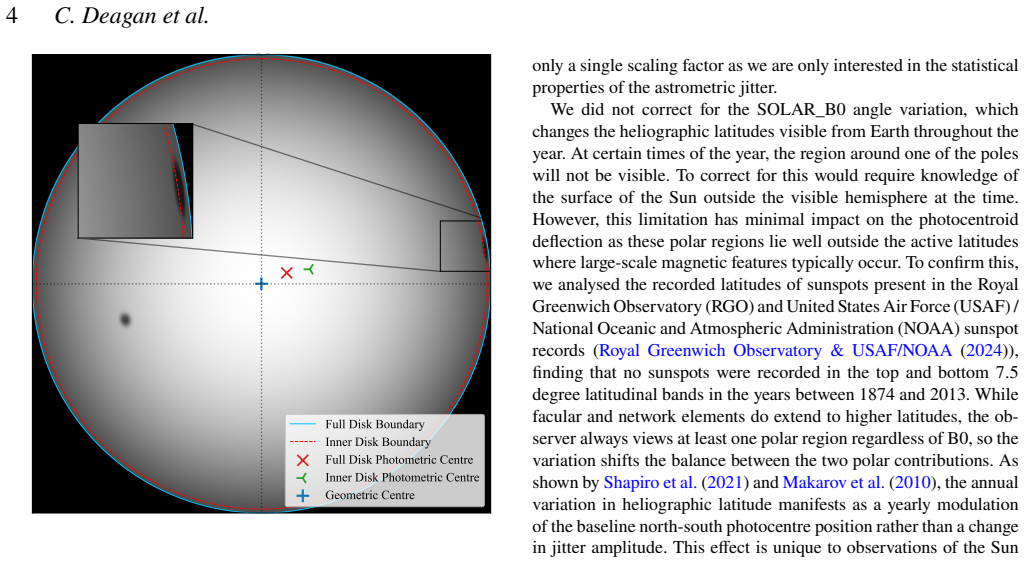
Photometric centroid jitter extracted from solar disk images and scaled to angular units per parsec to represent astrometric noise
If this is right
- Earth-mass planets around Sun-like stars at 1 pc produce a larger astrometric signal than the stellar noise floor in the studied wavelength.
- Mars-mass planets sit closer to or below the noise level during high-activity epochs, complicating their detection.
- Future astrometric missions can treat stellar activity as a secondary rather than primary error source for Earth analogs once they reach micro-arcsecond precision.
- The noise floor rises and falls with the stellar cycle, so scheduling observations during quieter phases improves sensitivity.
Where Pith is reading between the lines
- The same scaling approach could be applied to other stars with measured rotation periods to predict their individual jitter floors without new imaging.
- If the wavelength dependence observed here holds for other spectral types, near-infrared astrometry would see even lower relative jitter for cooler stars.
- Combining these solar-derived limits with existing radial-velocity surveys would tighten occurrence-rate estimates for low-mass planets.
Load-bearing premise
The centroid shifts seen in the Sun's visible light images scale directly to the astrometric jitter that other solar-like stars would show when viewed from Earth.
What would settle it
Repeated high-precision astrometric observations of a confirmed solar twin at known distance that measure jitter significantly higher than 0.342 μas pc across multiple activity cycles.
Figures





read the original abstract
Astrometric monitoring of stars provides a promising method for discovery of low-mass planets around nearby Sun-like stars. The astronomical community has proposed several telescopes designed to perform high-precision astrometric observations. One limiting factor intrinsic to stars is the astrometric noise - or "jitter" - induced by surface stellar activity such as starspots and faculae. Despite previous estimates, the relative size of this signal has not been empirically measured from direct photometric observations. We analyse high-resolution images of the Sun to quantify the photometric centroid jitter across three narrow wavelength regions over nearly a decade, spanning high and low activity periods of the Solar cycle. We compare our findings to previous theoretical estimates. We scale this jitter to simulate how a Solar-twin would appear at various distances, establishing an astrometric noise floor below which detection is significantly complicated by stellar activity. We also introduce starspot simulations that augment our data. We find the typical astrometric jitter of the Sun at \(\lambda = 607.2 \pm 0.25\text{nm}\) to be \(0.342\mu \text{as pc}\), ranging between \(0.058\mu \text{as pc}\) and \(1.294\mu \text{as pc}\) for low and high activity periods, respectively. This is lower than the expected \(\approx 3\mu \text{as}\) astrometric signal that an Earth-like planet would produce around a Sun-like star, at 1 pc. Therefore, the astrometric noise floor imposed by intrinsic stellar activity sets a detection limit below one Earth but greater than Mars around Solar-analog stars, making instrument precision the limiting factor for Earth-like exoplanet searches.
Editorial analysis
A structured set of objections, weighed in public.
Referee Report
Summary. The paper analyzes high-resolution solar images across three narrow wavelength bands over nearly a solar cycle to empirically measure photometric centroid jitter. It scales these measurements geometrically to astrometric jitter for solar-twin stars at various distances, augments the data with starspot simulations, and compares results to prior theoretical estimates. The central result is a typical jitter of 0.342 μas pc (range 0.058–1.294 μas pc) at 607.2 nm, which lies below the ~3 μas signal expected from an Earth-mass planet at 1 pc. The authors conclude that stellar activity imposes a noise floor permitting detection limits below one Earth but above Mars around solar analogs, leaving instrument precision as the dominant limitation.
Significance. If the scaling and representativeness hold, the work supplies a rare empirical benchmark for astrometric stellar noise rather than purely model-based estimates. The long-baseline solar observations and simulation augmentation constitute a concrete, falsifiable reference point that can inform design requirements for proposed astrometric missions targeting nearby solar-like stars.
major comments (1)
- [Abstract] Abstract: the central claim that instrument precision rather than activity sets the limit for Earth-like detections rests on the measured solar jitter (0.342 μas pc typical; 0.058–1.294 μas pc range) being representative of solar-analog stars at arbitrary distances. The manuscript provides no quantitative discussion of how differences in spot-size distribution, latitude preference, filling factor, or contrast among other solar-like stars could push typical jitter above the reported range, which would reverse the conclusion that activity is sub-dominant.
minor comments (2)
- The abstract states that results are compared to previous theoretical estimates but does not name the specific works or quantify the level of agreement; adding these references and a brief comparison table would improve clarity.
- The wavelength band 607.2 ± 0.25 nm is given as an example; the other two narrow bands should be specified explicitly, together with the rationale for their selection.
Simulated Author's Rebuttal
We thank the referee for their constructive and detailed review of our manuscript. The major comment raises an important point about the representativeness of solar measurements for the broader population of solar-analog stars. We address this directly below and have incorporated revisions to strengthen the discussion of this limitation while preserving the empirical focus of the work.
read point-by-point responses
-
Referee: [Abstract] Abstract: the central claim that instrument precision rather than activity sets the limit for Earth-like detections rests on the measured solar jitter (0.342 μas pc typical; 0.058–1.294 μas pc range) being representative of solar-analog stars at arbitrary distances. The manuscript provides no quantitative discussion of how differences in spot-size distribution, latitude preference, filling factor, or contrast among other solar-like stars could push typical jitter above the reported range, which would reverse the conclusion that activity is sub-dominant.
Authors: We agree that the central conclusion depends on the Sun serving as a reasonable proxy for solar analogs. Our approach uses direct, high-resolution observations of the Sun across a full activity cycle in three narrow bands, which provides an empirical anchor that is independent of many modeling assumptions used in prior theoretical work. The reported range already reflects substantial variation tied to activity level. We augmented the observations with starspot simulations to test sensitivity to spot parameters. Nevertheless, we acknowledge that other solar-like stars could exhibit different spot-size distributions, preferred latitudes, filling factors, or contrasts, potentially increasing jitter beyond the observed solar range. In the revised manuscript we have added a dedicated paragraph in the discussion section that explicitly addresses these factors, notes the absence of a full population-level quantitative model, and qualifies the detection-limit statements to reflect that the solar benchmark may represent a lower envelope rather than a universal value. This addition makes the limitations transparent without altering the core empirical result. revision: partial
Circularity Check
Empirical solar image analysis yields astrometric jitter floor with no circular reduction
full rationale
The paper measures photometric centroid jitter directly from high-resolution solar images across wavelengths and activity levels, then applies a geometric distance scaling to obtain astrometric units. This is an observational result grounded in external data (solar images) rather than any derivation that reduces to fitted parameters, self-definitions, or self-citation chains. The central claim—that activity noise lies below the Earth signal at 1 pc—follows from the measured values without circularity. No load-bearing self-citations or ansatzes are required for the reported numbers.
Axiom & Free-Parameter Ledger
free parameters (1)
- activity-period scaling
axioms (1)
- domain assumption The Sun is a representative solar-analog star for activity-induced astrometric jitter.
Reference graph
Works this paper leans on
-
[12]
Coulter R. L., Kuhn J. R., 1994, in Balasubramaniam K. S., Simon G. W., eds, Astronomical Society of the Pacific Conference Series Vol. 68, Solar Active Region Evolution: Comparing Models with Observations. p. 37
work page 1994
-
[45]
O., Labadie L., NEAT Team 2014, in European Planetary Science Congress
Malbet F., Leger A., Crouzier A., Shao M., Goullioud R., Lagage P. O., Labadie L., NEAT Team 2014, in European Planetary Science Congress. pp EPSC2014--794
work page 2014
-
[61]
Reffert S., Launhardt R., Hekker S., Henning T., Queloz D., Quirrenbach A., S \'e gransan D., Setiawan J., 2005, in Seidelmann P. K., Monet A. K. B., eds, Astronomical Society of the Pacific Conference Series Vol. 338, Astrometry in the Age of the Next Generation of Large Telescopes. p. 81
work page 2005
-
[63]
Ridpath I., 2012, in , A Dictionary of Astronomy, 2nd edn, Oxford University Press, https://www.oxfordreference.com/display/10.1093/oi/authority.20110803095905599
-
[65]
Royal Greenwich Observatory USAF/NOAA 2024, Sunspot Data: 1874–Present (RGO/USAF/NOAA), https://solarscience.msfc.nasa.gov/greenwch.shtml
work page 2024
-
[88]
Borgniet, S. and Meunier, N. and Lagrange, A.-M. , year =. Using the Sun to estimate Earth-like planets detection capabilities: V. Parameterizing the impact of solar activity components on radial velocities , volume =. doi:10.1051/0004-6361/201425007 , journal =
-
[89]
Reinhold, Timo and Shapiro, Alexander I. and Solanki, Sami K. and Montet, Benjamin T. and Krivova, Natalie A. and Cameron, Robert H. and Amazo-Gómez, Eliana M. , year =. The Sun is less active than other solar-like stars , volume =. Science , publisher =. doi:10.1126/science.aay3821 , number =
-
[90]
Pepe, F. and Cristiani, S. and Rebolo, R. and Santos, N. C. and Dekker, H. and Cabral, A. and Di Marcantonio, P. and Figueira, P. and Lo Curto, G. and Lovis, C. and Mayor, M. and Mégevand, D. and Molaro, P. and Riva, M. and Zapatero Osorio, M. R. and Amate, M. and Manescau, A. and Pasquini, L. and Zerbi, F. M. and Adibekyan, V. and Abreu, M. and Affolter,...
-
[91]
Theia: Faint objects in motion or the new astrometry frontier
Theia: Faint objects in motion or the new astrometry frontier , publisher =. 2017 , copyright =. doi:10.48550/ARXIV.1707.01348 , url =
work page internal anchor Pith review Pith/arXiv arXiv doi:10.48550/arxiv.1707.01348 2017
-
[92]
Structure design of the telescope for Small-JASMINE program , booktitle =
Utsunomiya, Shin and Yasuda, Susumu and Yano, Taihei and Niwa, Yoshito and Kobayashi, Yukiyasu and Kashima, Shingo and Goda, Naoteru and Yamada, Yoshiyuki , editor =. Structure design of the telescope for Small-JASMINE program , booktitle =. 2014 , month =. doi:10.1117/12.2055929 , url =
-
[93]
The Micro-arcsecond Astrometry Small Satellite: MASS , url =
Nemati, Bijan and Shao, Michael and Gonzalez, Guillermo and Zhai, Chengxing and Miskovish, Scott and Reardon, Patrick and Graves, Michael and Knutson, Kurt and Bendek, Eduardo and Hahn, Inseob , editor =. The Micro-arcsecond Astrometry Small Satellite: MASS , url =. 2020 , month = dec, pages =. doi:10.1117/12.2574986 , booktitle =
-
[94]
Tuthill, Peter G. and Bendek, Eduardo and Guyon, Olivier and Jeffries, Bryn and Jovanovic, Nemanja and Klupar, Pete and Larkin, Kieran and Norris, Barnaby and Pope, Ben and Shao, Michael and Horton, Anthony , editor =. The TOLIMAN space telescope , url =. 2018 , month = jul, pages =. doi:10.1117/12.2313269 , booktitle =
-
[95]
The Exoplanet Handbook , ISBN =
Perryman, Michael , year =. The Exoplanet Handbook , ISBN =. doi:10.1017/9781108304160 , publisher =
-
[96]
Ermolli, Ilaria and Giorgi, Fabrizio and Chatzistergos, Theodosios , year =. Rome Precision Solar Photometric Telescope: precision solar full-disk photometry during solar cycles 23–25 , volume =. doi:10.3389/fspas.2022.1042740 , journal =
-
[97]
Vogler, F.L. and Brandt, P.N. and Otruba, W. and Hanslmeier, A. , year =. Center-to-Limb Variation of Facular Contrast Derived from MLSO RISE/PSPT Full Disk Images , ISBN =. doi:10.1007/1-4020-2962-4_13 , booktitle =
-
[98]
Catanzarite, Joseph and Shao, Michael and Tanner, Angelle and Unwin, Stephen and Yu, Jeffrey , year =. Astrometric Detection of Terrestrial Planets in the Habitable Zones of Nearby Stars withSIM PlanetQuest , volume =. Publications of the Astronomical Society of the Pacific , publisher =. doi:10.1086/504442 , number =
-
[99]
Astrometric detection of exo-Earths in the presence of stellar noise , volume =
Catanzarite, Joseph and Law, Nicholas and Shao, Michael , year =. Astrometric detection of exo-Earths in the presence of stellar noise , volume =. doi:10.1117/12.787904 , booktitle =
-
[100]
Makarov, V. V. and Parker, D. and Ulrich, R. K. , year =. ASTROMETRIC JITTER OF THE SUN AS A STAR , volume =. The Astrophysical Journal , publisher =. doi:10.1088/0004-637x/717/2/1202 , number =
-
[101]
Lagrange, A.-M. and Meunier, N. and Desort, M. and Malbet, F. , year =. Using the Sun to estimate Earth-like planets detection capabilities: III. Impact of spots and plages on astrometric detection , volume =. doi:10.1051/0004-6361/201016354 , journal =
-
[102]
Meunier, N. and Lagrange, A.-M. and Boulet, T. and Borgniet, S. , year =. Activity time series of old stars from late F to early K: I. Simulating radial velocity, astrometry, photometry, and chromospheric emission , volume =. doi:10.1051/0004-6361/201834796 , journal =
-
[103]
Shapiro, Alexander I. and Solanki, Sami K. and Krivova, Natalie A. , year =. Predictions of Astrometric Jitter for Sun-like Stars. I. The Model and Its Application to the Sun as Seen from the Ecliptic , volume =. The Astrophysical Journal , publisher =. doi:10.3847/1538-4357/abd630 , number =
-
[104]
Meunier, N. and Lagrange, A. -M. and Borgniet, S. , keywords =. Activity time series of old stars from late F to early K. V. Effect on exoplanet detectability with high-precision astrometry , publisher =. 2020 , copyright =. doi:10.48550/ARXIV.2011.02158 , url =
-
[105]
Meunier, N. and Lagrange, A.-M. , year =. A new estimation of astrometric exoplanet detection limits in the habitable zone around nearby stars , volume =. doi:10.1051/0004-6361/202142702 , journal =
-
[106]
Spotting stellar activity cycles in Gaia astrometry , volume =
Morris, Brett M and Agol, Eric and Davenport, James R A and Hawley, Suzanne L , year =. Spotting stellar activity cycles in Gaia astrometry , volume =. Monthly Notices of the Royal Astronomical Society , publisher =. doi:10.1093/mnras/sty568 , number =
-
[107]
Bureau of Meteorology , title =
-
[108]
Meunier, N. and Desort, M. and Lagrange, A.-M. , year =. Using the Sun to estimate Earth-like planets detection capabilities: II. Impact of plages , volume =. doi:10.1051/0004-6361/200913551 , journal =
-
[109]
Remeasurement of Solar Observing Optical Network sunspot areas , volume =
Meadows, P J , year =. Remeasurement of Solar Observing Optical Network sunspot areas , volume =. Monthly Notices of the Royal Astronomical Society , publisher =. doi:10.1093/mnras/staa2007 , number =
-
[110]
Sowmya, K. and Nèmec, N.-E. and Shapiro, A. I. and Işık, E. and Witzke, V. and Mints, A. and Krivova, N. A. and Solanki, S. K. , year =. Predictions of Astrometric Jitter for Sun-like Stars. II. Dependence on Inclination, Metallicity, and Active-region Nesting , volume =. The Astrophysical Journal , publisher =. doi:10.3847/1538-4357/ac111b , number =
-
[111]
Krivova, N.A. and Solanki, S.K. and Unruh, Y.C. , year =. Towards a long-term record of solar total and spectral irradiance , volume =. Journal of Atmospheric and Solar-Terrestrial Physics , publisher =. doi:10.1016/j.jastp.2009.11.013 , number =
-
[112]
European Planetary Science Congress , year = 2014, volume =
NEAT: Nearby Earth Astrometric Telescope. European Planetary Science Congress , year = 2014, volume =
work page 2014
-
[113]
Ji, Jiang-Hui and Li, Hai-Tao and Zhang, Jun-Bo and Fang, Liang and Li, Dong and Wang, Su and Cao, Yang and Deng, Lei and Li, Bao-Quan and Xian, Hao and Gao, Xiao-Dong and Zhang, Ang and Li, Fei and Liu, Jia-Cheng and Qi, Zhao-Xiang and Jin, Sheng and Liu, Ya-Ning and Chen, Guo and Li, Ming-Tao and Dong, Yao and Zhu, Zi , year =. CHES: A Space-borne Astro...
-
[114]
Bendek, Eduardo A. and Noyes, Matthew and Flores, Catalina and Belikov, Ruslan and Sirbu, Dan and Mejia Prada, Camilo and Tuthill, Peter and Guyon, Olivier , editor =. Status of NASA’s stellar astrometry testbeds for exoplanet detection: Science and technology overview , url =. 2021 , month = jan, pages =. doi:10.1117/12.2562994 , booktitle =
-
[115]
Luger, Rodrigo and Foreman-Mackey, Daniel and Hedges, Christina and Hogg, David W. , year =. Mapping Stellar Surfaces. I. Degeneracies in the Rotational Light-curve Problem , volume =. The Astronomical Journal , publisher =. doi:10.3847/1538-3881/abfdb8 , number =
-
[116]
and Lindegren, Lennart , year =
Perryman, Michael and Hartman, Joel and Bakos, Gaspzr A. and Lindegren, Lennart , year =. ASTROMETRIC EXOPLANET DETECTION WITHGAIA , volume =. The Astrophysical Journal , publisher =. doi:10.1088/0004-637x/797/1/14 , number =
-
[117]
Gaudi, B. Scott , year =. Microlensing Surveys for Exoplanets , volume =. Annual Review of Astronomy and Astrophysics , publisher =. doi:10.1146/annurev-astro-081811-125518 , number =
-
[118]
Howard, Andrew W. and Marcy, Geoffrey W. and Bryson, Stephen T. and Jenkins, Jon M. and Rowe, Jason F. and Batalha, Natalie M. and Borucki, William J. and Koch, David G. and Dunham, Edward W. and Gautier, Thomas N. and Van Cleve, Jeffrey and Cochran, William D. and Latham, David W. and Lissauer, Jack J. and Torres, Guillermo and Brown, Timothy M. and Gill...
-
[119]
Saar, Steven H. and Donahue, Robert A. , year =. Activity‐Related Radial Velocity Variation in Cool Stars , volume =. The Astrophysical Journal , publisher =. doi:10.1086/304392 , number =
-
[120]
White, Oran R. and Fox, Peter A. and Meisner, Randy and Rast, Mark P. and Yasukawa, Eric and Koon, Darryl and Rice, Crystal and Lin, Haosheng and Kuhn, Jeff and Coulter, Roy , year =. Data from the Precision Solar Photometric Telescope (PSPT) in Hawaii from March 1998 to March 1999 , ISBN =. doi:10.1007/978-94-010-0888-4_7 , booktitle =
-
[121]
Solar Active Region Evolution: Comparing Models with Observations , year = 1994, editor =
RISE/PSPT as an Experiment to Study Active Region Irradiance and Luminosity Evolution. Solar Active Region Evolution: Comparing Models with Observations , year = 1994, editor =
work page 1994
-
[122]
Dumusque, X. , year =. Measuring precise radial velocities on individual spectral lines: I. Validation of the method and application to mitigate stellar activity, , volume =. doi:10.1051/0004-6361/201833795 , journal =
-
[123]
Boisse, I. and Bouchy, F. and Hébrard, G. and Bonfils, X. and Santos, N. and Vauclair, S. , year =. Disentangling between stellar activity and planetary signals , volume =. doi:10.1051/0004-6361/201014354 , journal =
-
[124]
de Beurs, Zoe. L. and Vanderburg, Andrew and Shallue, Christopher J. and Dumusque, Xavier and Cameron, Andrew Collier and Leet, Christopher and Buchhave, Lars A. and Cosentino, Rosario and Ghedina, Adriano and Haywood, Raphaëlle D. and Langellier, Nicholas and Latham, David W. and López-Morales, Mercedes and Mayor, Michel and Micela, Giusi and Milbourne, ...
-
[125]
Rajpaul, V. and Aigrain, S. and Osborne, M. A. and Reece, S. and Roberts, S. , year =. A Gaussian process framework for modelling stellar activity signals in radial velocity data , volume =. Monthly Notices of the Royal Astronomical Society , publisher =. doi:10.1093/mnras/stv1428 , number =
-
[126]
Modelling stellar activity with Gaussian process regression networks , volume =
Camacho, J D and Faria, J P and Viana, P T P , year =. Modelling stellar activity with Gaussian process regression networks , volume =. Monthly Notices of the Royal Astronomical Society , publisher =. doi:10.1093/mnras/stac3727 , number =
-
[127]
Cretignier, M. and Dumusque, X. and Pepe, F. , year =. Stellar activity correction using PCA decomposition of shells , volume =. doi:10.1051/0004-6361/202142435 , journal =
-
[128]
Sunspot Data: 1874–Present (RGO/USAF/NOAA) , year =
-
[129]
Hatzes, A.P. , year =. Starspots and exoplanets , volume =. Astronomische Nachrichten , publisher =. doi:10.1002/1521-3994(200208)323:3/4<392::aid-asna392>3.0.co;2-m , number =
-
[130]
Astrometric limits set by surface structure, binarity, microlensing
Bastian, U. and Hefele, H. , keywords =. Astrometric limits set by surface structure, binarity, microlensing , publisher =. 2004 , copyright =. doi:10.48550/ARXIV.ASTRO-PH/0411225 , url =
work page internal anchor Pith review doi:10.48550/arxiv.astro-ph/0411225 2004
-
[131]
Astrometry in the Age of the Next Generation of Large Telescopes , year = 2005, editor =
Choosing Suitable Target, Reference and Calibration Stars for the PRIMA Astrometric Planet Search. Astrometry in the Age of the Next Generation of Large Telescopes , year = 2005, editor =
work page 2005
-
[132]
Eriksson, U. and Lindegren, L. , year =. Limits of ultra-high-precision optical astrometry: Stellar surface structures , volume =. Astronomy & Astrophysics , publisher =. doi:10.1051/0004-6361:20078031 , number =
-
[133]
Lanza, A.F. and De Martino, C. and Rodonò, M. , year =. Astrometric effects of solar-like magnetic activity in late-type stars and their relevance for the detection of extrasolar planets , volume =. New Astronomy , publisher =. doi:10.1016/j.newast.2007.06.009 , number =
-
[134]
Makarov, V. V. and Beichman, C. A. and Catanzarite, J. H. and Fischer, D. A. and Lebreton, J. and Malbet, F. and Shao, M. , year =. STARSPOT JITTER IN PHOTOMETRY, ASTROMETRY, AND RADIAL VELOCITY MEASUREMENTS , volume =. The Astrophysical Journal , publisher =. doi:10.1088/0004-637x/707/1/l73 , number =
-
[135]
Muterspaugh, M. W. and Lane, B. F. and Konacki, M. and Burke, B. F. and Colavita, M. M. and Kulkarni, S. R. and Shao, M. , year =. PHASES differential astrometry and the mutual inclination of the V819 Herculis triple star system , volume =. Astronomy & Astrophysics , publisher =. doi:10.1051/0004-6361:20053749 , number =
-
[136]
Sozzetti, Alessandro , year =. Astrometric Methods and Instrumentation to Identify and Characterize Extrasolar Planets: A Review , volume =. Publications of the Astronomical Society of the Pacific , publisher =. doi:10.1086/444487 , number =
-
[137]
Ludwig, H.-G. , year =. Hydrodynamical simulations of convection-related stellar micro-variability: I. Statistical relations for photometric and photocentric variability , volume =. Astronomy & Astrophysics , publisher =. doi:10.1051/0004-6361:20042102 , number =
-
[138]
Kaplan-Lipkin, Avi and Macintosh, Bruce and Madurowicz, Alexander and Sowmya, Krishnamurthy and Shapiro, Alexander and Krivova, Natalie and Solanki, Sami K. , year =. Multiwavelength Mitigation of Stellar Activity in Astrometric Planet Detection , volume =. The Astronomical Journal , publisher =. doi:10.3847/1538-3881/ac56e0 , number =
-
[139]
Sozzetti, A. and Pinamonti, M. and Damasso, M. and Desidera, S. and Biazzo, K. and Bonomo, A. S. and Nardiello, D. and Gratton, R. and Lanza, A. F. and Malavolta, L. and Giacobbe, P. and Affer, L. and Bignamini, A. and Borsa, F. and Boschin, W. and Brogi, M. and Cabona, L. and Claudi, R. and Covino, E. and Di Fabrizio, L. and Ghedina, A. and Harutyunyan, ...
-
[140]
Stefánsson, Gudmundur and Mahadevan, Suvrath and Winn, Joshua N. and Marcussen, Marcus L. and Kanodia, Shubham and Albrecht, Simon and Fitzmaurice, Evan and Mikulskytė, Onė and Cañas, Caleb I. and Espinoza-Retamal, Juan I. and Zwart, Yiri and Krolikowski, Daniel M. and Hotnisky, Andrew and Robertson, Paul and Alvarado-Montes, Jaime A. and Bender, Chad F. ...
-
[141]
Curiel, Salvador and Ortiz-León, Gisela N. and Mioduszewski, Amy J. and Sanchez-Bermudez, Joel , year =. 3D Orbital Architecture of a Dwarf Binary System and Its Planetary Companion , volume =. The Astronomical Journal , publisher =. doi:10.3847/1538-3881/ac7c66 , number =
-
[142]
Sahlmann, J. and Lazorenko, P. F. and Ségransan, D. and Martín, E. L. and Queloz, D. and Mayor, M. and Udry, S. , year =. Astrometric orbit of a low-mass companion to an ultracool dwarf , volume =. doi:10.1051/0004-6361/201321871 , journal =
-
[143]
Baumann, I. and Solanki, S. K. , year =. On the size distribution of sunspot groups in the Greenwich sunspot record 1874–1976 , volume =. Astronomy & Astrophysics , publisher =. doi:10.1051/0004-6361:20053415 , number =
- [144]
-
[145]
Cegla, H. M. and Watson, C. A. and Shelyag, S. and Mathioudakis, M. and Moutari, S. , year =. Stellar Surface Magnetoconvection as a Source of Astrophysical Noise. III. Sun-as-a-Star Simulations and Optimal Noise Diagnostics , volume =. The Astrophysical Journal , publisher =. doi:10.3847/1538-4357/ab16d3 , number =
-
[146]
Predicting radial-velocity jitter induced by stellar oscillations based on Kepler data , volume =
Yu, Jie and Huber, Daniel and Bedding, Timothy R and Stello, Dennis , year =. Predicting radial-velocity jitter induced by stellar oscillations based on Kepler data , volume =. Monthly Notices of the Royal Astronomical Society: Letters , publisher =. doi:10.1093/mnrasl/sly123 , number =
-
[147]
Karoff, Christoffer and Metcalfe, Travis S. and Santos, undefinedngela R. G. and Montet, Benjamin T. and Isaacson, Howard and Witzke, Veronika and Shapiro, Alexander I. and Mathur, Savita and Davies, Guy R. and Lund, Mikkel N. and Garcia, Rafael A. and Brun, Allan S. and Salabert, David and Avelino, Pedro P. and Saders, Jennifer van and Egeland, Ricky and...
-
[148]
Sowmya, K. and Nèmec, N.-E. and Shapiro, A. I. and Işık, E. and Krivova, N. A. and Solanki, S. K. , year =. Predictions of Astrometric Jitter for Sun-like Stars. III. Fast Rotators , volume =. The Astrophysical Journal , publisher =. doi:10.3847/1538-4357/ac79b3 , number =
-
[149]
Probability Distribution Functions of Sunspot Magnetic Flux , volume =
Sakurai, Takashi and Toriumi, Shin , year =. Probability Distribution Functions of Sunspot Magnetic Flux , volume =. The Astrophysical Journal , publisher =. doi:10.3847/1538-4357/aca28a , number =
-
[150]
Katana , publisher =. 2010 , copyright =. doi:10.26190/669X-A286 , url =
-
[151]
Hanel, R. A. and Conrath, B. J. and Herath, L. W. and Kunde, V. G. and Pirraglia, J. A. , year =. Albedo, internal heat, and energy balance of Jupiter: Preliminary results of the Voyager Infrared Investigation , volume =. Journal of Geophysical Research: Space Physics , publisher =. doi:10.1029/ja086ia10p08705 , number =
-
[152]
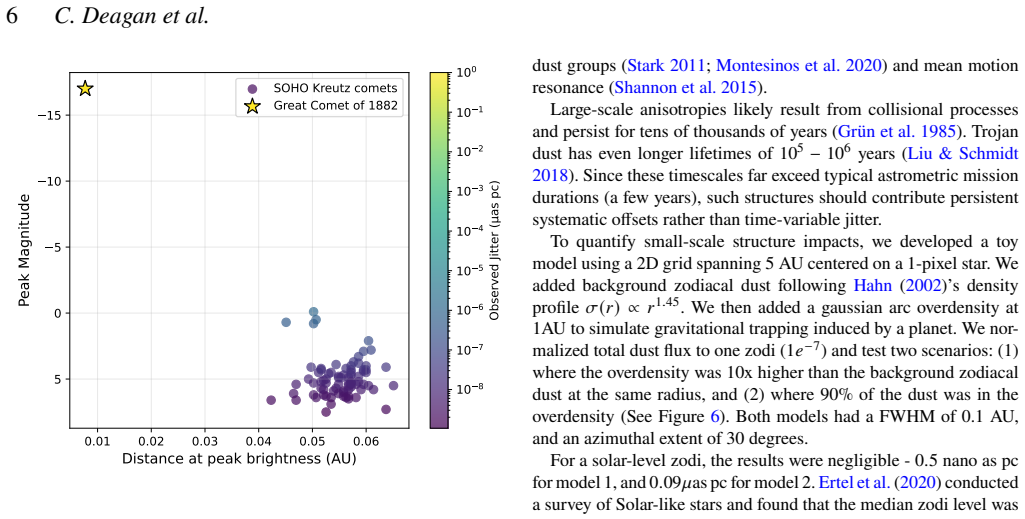
Jones, Geraint H. and Knight, Matthew M. and Battams, Karl and Boice, Daniel C. and Brown, John and Giordano, Silvio and Raymond, John and Snodgrass, Colin and Steckloff, Jordan K. and Weissman, Paul and Fitzsimmons, Alan and Lisse, Carey and Opitom, Cyrielle and Birkett, Kimberley S. and Bzowski, Maciej and Decock, Alice and Mann, Ingrid and Ramanjooloo,...
-
[153]
Knight, Matthew M. and A’Hearn, Michael F. and Biesecker, Douglas A. and Faury, Guillaume and Hamilton, Douglas P. and Lamy, Philippe and Llebaria, Antoine , year =. PHOTOMETRIC STUDY OF THE KREUTZ COMETS OBSERVED BYSOHOFROM 1996 TO 2005 , volume =. The Astronomical Journal , publisher =. doi:10.1088/0004-6256/139/3/926 , number =
-
[154]
Sekanina, Zdenek and Chodas, Paul W. , year =. Fragmentation Hierarchy of Bright Sungrazing Comets and the Birth and Orbital Evolution of the Kreutz System. II. The Case for Cascading Fragmentation , volume =. The Astrophysical Journal , publisher =. doi:10.1086/517490 , number =
-
[155]
A Dictionary of Astronomy , publisher =
Great September Comet (C/1882 R1) , author =. A Dictionary of Astronomy , publisher =. 2012 , edition =
work page 2012
-
[156]
Marsden, Brian G. , year =. Sungrazing Comets , volume =. Annual Review of Astronomy and Astrophysics , publisher =. doi:10.1146/annurev.astro.43.072103.150554 , number =
-
[157]
Currie, Miles H. and Debes, John and Hasegawa, Yasuhiro and Rebollido, Isabel and Faramaz, Virginie and Ertel, Steve and Danchi, William and Mennesson, Bertrand and Wyatt, Mark and Members, NASA SAG23 , keywords =. Exozodiacal dust as a limitation to exoplanet imaging and spectroscopy , publisher =. 2025 , copyright =. doi:10.48550/ARXIV.2503.19932 , url =
-
[158]
and Millan-Gabet, Rafael and Weinberger, Alycia J
Roberge, Aki and Chen, Christine H. and Millan-Gabet, Rafael and Weinberger, Alycia J. and Hinz, Philip M. and Stapelfeldt, Karl R. and Absil, Olivier and Kuchner, Marc J. and Bryden, Geoffrey , year =. The Exozodiacal Dust Problem for Direct Observations of Exo-Earths , volume =. Publications of the Astronomical Society of the Pacific , publisher =. doi:...
-
[159]
Hahn, J , year =. Clementine Observations of the Zodiacal Light and the Dust Content of the Inner Solar System , volume =. Icarus , publisher =. doi:10.1006/icar.2002.6881 , number =
-
[160]
Stark, Christopher C. , year =. THE TRANSIT LIGHT CURVE OF AN EXOZODIACAL DUST CLOUD , volume =. The Astronomical Journal , publisher =. doi:10.1088/0004-6256/142/4/123 , number =
-
[161]
and Cuadra, Jorge and Bayo, Amelia and Sucerquia, Mario and Cuello, Nicolás , year =
Montesinos, Matías and Garrido-Deutelmoser, Juan and Olofsson, Johan and Giuppone, Cristian A. and Cuadra, Jorge and Bayo, Amelia and Sucerquia, Mario and Cuello, Nicolás , year =. Dust trapping around Lagrangian points in protoplanetary disks , volume =. doi:10.1051/0004-6361/202038758 , journal =
-
[162]
Shannon, Andrew and Mustill, Alexander J. and Wyatt, Mark , year =. Capture and evolution of dust in planetary mean-motion resonances: a fast, semi-analytic method for generating resonantly trapped disc images , volume =. Monthly Notices of the Royal Astronomical Society , publisher =. doi:10.1093/mnras/stv045 , number =
discussion (0)
Sign in with ORCID, Apple, or X to comment. Anyone can read and Pith papers without signing in.