Hyrax: An Extensible Framework for Rapid ML Experimentation and Unsupervised Discovery in the Era of Rubin, Roman, and Euclid
Pith reviewed 2026-05-20 07:26 UTC · model grok-4.3
pith:QEZ5ZFS5 Add to your LaTeX paper
What is a Pith Number?\usepackage{pith}
\pithnumber{QEZ5ZFS5}
Prints a linked pith:QEZ5ZFS5 badge after your title and writes the identifier into PDF metadata. Compiles on arXiv with no extra files. Learn more
The pith
Hyrax framework manages the full machine learning pipeline for large astronomical surveys to support unsupervised discovery.
A machine-rendered reading of the paper's core claim, the machinery that carries it, and where it could break.
Core claim
Hyrax is an extensible open-source GPU-enabled Python framework that supports the full ML lifecycle in astronomy through modular components for data acquisition, multimodal datasets, integrated vector databases for similarity search, and interactive latent-space exploration, as demonstrated by applications such as unsupervised representation learning on approximately 400,000 Rubin DP1 galaxies that identifies new merger and low-surface-brightness candidates absent from existing catalogs while isolating artifacts without labeled data.
What carries the argument
Hyrax's modular architecture integrating vector databases and interactive two- and three-dimensional latent-space exploration tools that carry out similarity searches and unsupervised discovery on survey-scale data.
If this is right
- Unsupervised methods can surface previously uncatalogued galaxy mergers and low-surface-brightness objects in Rubin DP1 data.
- Hybrid density-based clustering can flag cluster-scale gravitational lens candidates directly from imaging.
- Multimodal inputs enable early-time classification of transients combining light curves, spectra, images, and metadata.
- Supervised filtering reduces false positives in searches for distant solar system objects using shift-and-stack techniques.
- Synthetic source injection supports detection of semi-resolved dwarf galaxies in high-resolution imaging surveys.
Where Pith is reading between the lines
- Smaller research teams could perform systematic discovery work on next-generation survey data without building large custom software stacks.
- The latent-space tools might generalize to other domains where unlabeled high-volume imaging data requires rapid candidate identification.
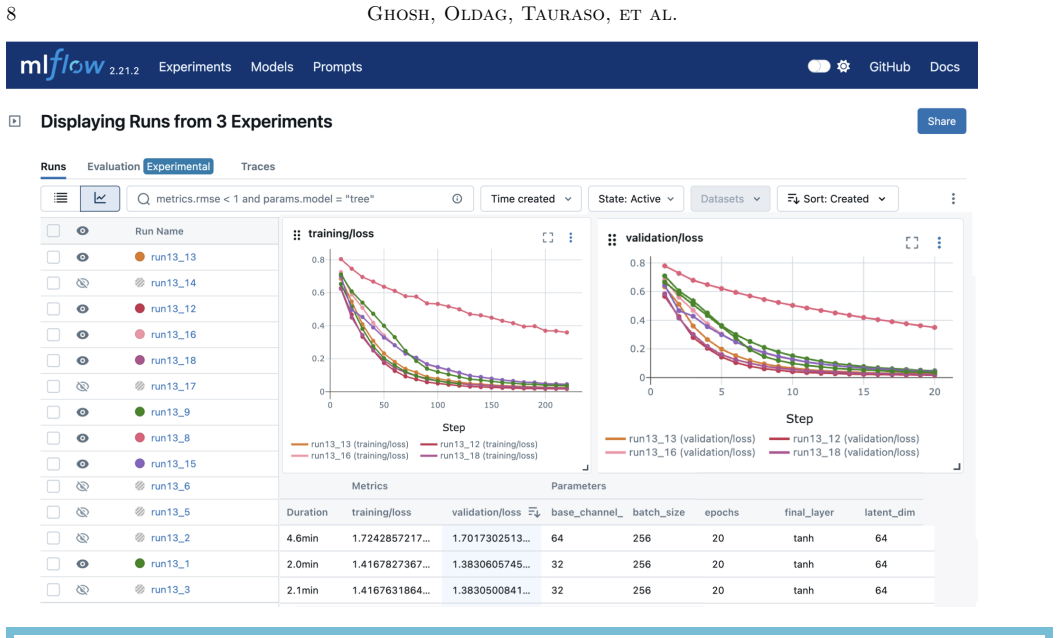
- Adoption could standardize experiment comparison across astronomy ML projects by providing built-in logging and visualization.
Load-bearing premise
That the modular design with built-in tools for vector search and latent exploration will shift the main effort from infrastructure setup to scientific model design for groups handling full volumes of data from Rubin, Roman, and Euclid.
What would settle it
A side-by-side timing comparison of setting up and running an unsupervised representation learning task on a 400,000-object galaxy catalog using Hyrax versus a standard custom pipeline without the framework's integrated components.
Figures




read the original abstract
The NSF-DOE Vera C. Rubin Observatory, Roman Space Telescope, Euclid, and other next-generation surveys will deliver imaging, spectroscopic, and time-domain data at scales that increasingly shift the bottleneck in astronomical machine learning (ML) projects from model design to infrastructure. We present Hyrax, an open-source, modular, GPU-enabled Python framework that supports the full ML lifecycle in astronomy: from data acquisition and training to inference and experiment comparison, with capabilities including multimodal dataset support, integrated vector databases for similarity search, and interactive two- and three-dimensional latent-space exploration for unsupervised discovery. We demonstrate Hyrax's versatility through five representative applications on real survey data: (i) unsupervised representation learning on $\sim 4\times10^5$ Rubin Legacy Survey of Space and Time (LSST) Data Preview 1 (DP1) galaxies, surfacing new merger and low-surface-brightness candidates missing from reference Euclid and Dark Energy Survey catalogs, while also isolating imaging artifacts -- all without labeled training data; (ii) hybrid density-based clustering for identifying cluster-scale gravitational lens candidates in DP1 data; (iii) multimodal early-time transient classification in the Zwicky Transient Facility leveraging light curves, spectra, images, and metadata; (iv) supervised false-positive filtering in shift-and-stack searches for distant solar system objects in the Dark Energy Camera Ecliptic Exploration Project survey; and (v) supervised detection of semi-resolved dwarf galaxies in Hyper Suprime-Cam and LSST-like imaging using synthetic source injection. Together, these results demonstrate that Hyrax provides astronomy-specific ML infrastructure that enables systematic discovery and rapid methodological iteration across next-generation astronomical surveys.
Editorial analysis
A structured set of objections, weighed in public.
Referee Report
Summary. The manuscript introduces Hyrax, an open-source modular GPU-enabled Python framework for the full machine-learning lifecycle in astronomy. It supports multimodal datasets, integrated vector databases for similarity search, and interactive latent-space exploration. The central claim is that this infrastructure shifts the bottleneck from model design to systematic discovery and rapid iteration for next-generation surveys. The paper demonstrates the framework via five applications on real data: (i) unsupervised representation learning on ~4e5 Rubin DP1 galaxies that identifies new merger and low-surface-brightness candidates absent from Euclid/DES catalogs while flagging artifacts; (ii) hybrid density-based clustering for cluster-scale gravitational lens candidates in DP1; (iii) multimodal early-time transient classification in ZTF using light curves, spectra, images, and metadata; (iv) supervised false-positive filtering for shift-and-stack solar-system-object searches in DECaLS; and (v) supervised dwarf-galaxy detection in HSC and LSST-like imaging via synthetic source injection.
Significance. If the modular design, vector-DB integration, and latent-space tools function at full survey scale, Hyrax could meaningfully reduce infrastructure overhead for typical research groups working with Rubin, Roman, and Euclid data volumes. The open-source release, use of real survey data, and focus on unsupervised discovery are concrete strengths. However, all five demonstrations operate on DP1-scale or smaller catalogs; without scaling benchmarks the claimed infrastructure advantage for petabyte-scale surveys remains unverified.
major comments (1)
- [Section 5] Section 5 (Applications): All five demonstrations use DP1-scale data (~4×10^5 galaxies) or smaller ZTF/DECaLS/HSC subsets. No scaling benchmarks, distributed-training results, memory profiles, or out-of-core performance figures are reported for the 10–100× larger catalogs and petabyte imaging expected from full LSST, Roman, or Euclid. This directly bears on the central claim that Hyrax shifts the infrastructure bottleneck for next-generation surveys.
minor comments (2)
- [Abstract] The abstract and introduction could more explicitly distinguish between framework capabilities that are already implemented versus those planned for future releases.
- Figure captions for the latent-space visualizations should state the exact dimensionality reduction method and any hyper-parameters used.
Simulated Author's Rebuttal
We thank the referee for their constructive review and for recognizing the strengths of the open-source release, real-data demonstrations, and focus on unsupervised discovery. We address the major comment below and have revised the manuscript to better contextualize the scope of our claims regarding next-generation survey infrastructure.
read point-by-point responses
-
Referee: [Section 5] Section 5 (Applications): All five demonstrations use DP1-scale data (~4×10^5 galaxies) or smaller ZTF/DECaLS/HSC subsets. No scaling benchmarks, distributed-training results, memory profiles, or out-of-core performance figures are reported for the 10–100× larger catalogs and petabyte imaging expected from full LSST, Roman, or Euclid. This directly bears on the central claim that Hyrax shifts the infrastructure bottleneck for next-generation surveys.
Authors: We agree that the lack of explicit scaling benchmarks, distributed-training results, memory profiles, and out-of-core performance figures for 10–100× larger catalogs weakens the direct support for our central claim about shifting infrastructure bottlenecks at full LSST, Roman, or Euclid scales. The five applications were selected to illustrate end-to-end workflows for unsupervised discovery and multimodal analysis using publicly available real survey data at computationally accessible volumes. In the revised manuscript we have added a dedicated subsection (5.6) on scalability considerations. This subsection describes the modular architecture built on PyTorch for GPU acceleration, integration with vector databases (FAISS/Milvus) that support efficient similarity search without full in-memory dataset loading, and data-loading utilities compatible with out-of-core and distributed frameworks such as Dask. We report basic peak-memory and runtime profiles measured on the DP1-scale experiments and provide order-of-magnitude extrapolations assuming linear scaling for embedding generation and indexing steps. We have also tempered the language in the abstract and introduction to emphasize that the current results validate core functionality and discovery utility on representative subsets, while the design is intended to extend to full-survey volumes. Full end-to-end benchmarks on petabyte-scale imaging and distributed training across multiple nodes remain outside the scope of this initial methods paper and would require dedicated large-scale computing allocations. revision: partial
- Comprehensive distributed-training benchmarks, detailed memory profiles, and out-of-core performance measurements on 10–100× larger catalogs or petabyte-scale imaging from full LSST, Roman, or Euclid
Circularity Check
No circularity: framework description and empirical demos are self-contained
full rationale
The paper presents an open-source software framework (Hyrax) together with five empirical applications on real survey data (DP1 galaxies, ZTF transients, DECaLS/DEEP, HSC). No mathematical derivations, fitted parameters renamed as predictions, or load-bearing self-citations appear in the abstract or described content. The central claim—that the modular design enables systematic discovery—is supported directly by the listed use cases rather than by any reduction to prior inputs or self-referential definitions. This is the expected non-finding for an infrastructure/tool paper.
Axiom & Free-Parameter Ledger
Lean theorems connected to this paper
-
IndisputableMonolith/Cost/FunctionalEquation.leanwashburn_uniqueness_aczel unclear?
unclearRelation between the paper passage and the cited Recognition theorem.
Hyrax is a modular, flexible, and extensible GPU-enabled framework that provides reusable infrastructure for ML projects in astronomy... integrated vector databases for similarity search, and interactive two- and three-dimensional latent-space exploration
-
IndisputableMonolith/Foundation/RealityFromDistinction.leanreality_from_one_distinction unclear?
unclearRelation between the paper passage and the cited Recognition theorem.
unsupervised representation learning on ∼4×10^5 Rubin DP1 galaxies... hybrid density-based clustering... multimodal early-time transient classification
What do these tags mean?
- matches
- The paper's claim is directly supported by a theorem in the formal canon.
- supports
- The theorem supports part of the paper's argument, but the paper may add assumptions or extra steps.
- extends
- The paper goes beyond the formal theorem; the theorem is a base layer rather than the whole result.
- uses
- The paper appears to rely on the theorem as machinery.
- contradicts
- The paper's claim conflicts with a theorem or certificate in the canon.
- unclear
- Pith found a possible connection, but the passage is too broad, indirect, or ambiguous to say the theorem truly supports the claim.
Reference graph
Works this paper leans on
-
[1]
Chen, Andrew and Chow, Andy and Davidson, Aaron and DCunha, Arjun and Ghodsi, Ali and Hong, Sue Ann and Konwinski, Andy and Mewald, Clemens and Murching, Siddharth and Nykodym, Tomas and Ogilvie, Paul and Parkhe, Mani and Singh, Avesh and Xie, Fen and Zaharia, Matei and Zang, Richard and Zheng, Juntai and Zumar, Corey , month =. 2020 , booktitle =
work page 2020
-
[2]
Parker, Liam and Lanusse, Francois and Golkar, Siavash and Sarra, Leopoldo and Cranmer, Miles and Bietti, Alberto and Eickenberg, Michael and Krawezik, Geraud and McCabe, Michael and Morel, Rudy and Ohana, Ruben and Pettee, Mariel and R. 2024 , journal =. doi:10.1093/mnras/stae1450 , issn =
-
[3]
International conference on machine learning , pages=
Making a science of model search: Hyperparameter optimization in hundreds of dimensions for vision architectures , author=. International conference on machine learning , pages=. 2013 , organization=
work page 2013
-
[4]
Experiment Tracking with Weights and Biases , year =
-
[5]
Crenshaw, John Franklin and Connolly, Andrew J. and Meyers, Joshua E. and Kalmbach, J. Bryce and Megias Homar, Guillem and Ribeiro, Tiago and Suberlak, Krzysztof and Thomas, Sandrine and Tsai, Te-Wei , number =. 2024 , journal =. doi:10.3847/1538-3881/ad1661 , issn =
-
[6]
The redMaPPer Galaxy Cluster Catalog From DES Science Verification Data
The RedMaPPer Galaxy Cluster Catalog From DES Science Verification Data. , keywords =. doi:10.3847/0067-0049/224/1/1 , archivePrefix =. 1601.00621 , primaryClass =
work page internal anchor Pith review Pith/arXiv arXiv doi:10.3847/0067-0049/224/1/1
-
[7]
Huertas-Company, M. and Gravet, R. and Cabrera-Vives, G. and P. 2015 , journal =. doi:10.1088/0067-0049/221/1/8 , issn =
-
[8]
Zaharia, M. and Chen, A. and Davidson, A. and Ghodsi, A. and Hong, S. and Konwinski, A. and Murching, Siddharth and Nykodym, Tomas and Ogilvie, Paul and Parkhe, Mani and Xie, Fen and Zumar, Corey , pages =. 2018 , journal =
work page 2018
-
[9]
Megan and Wang, Zhengdong and Schawinski, Kevin and Turp, Dennis and Powell, Meredith C
Ghosh, Aritra and Urry, C. Megan and Wang, Zhengdong and Schawinski, Kevin and Turp, Dennis and Powell, Meredith C. , number =. 2020 , journal =. doi:10.3847/1538-4357/ab8a47 , issn =
-
[10]
Hoyle, B. , month =. 2016 , journal =. doi:10.1016/J.ASCOM.2016.03.006 , issn =
-
[11]
Dieleman, Sander and Willett, Kyle W and Dambre, Joni , number =. 2015 , journal =. doi:10.1093/mnras/stv632 , keywords =
-
[12]
Villar, V. Ashley and Cranmer, Miles and Berger, Edo and Contardo, Gabriella and Ho, Shirley and Hosseinzadeh, Griffin and Lin, Joshua Yao-Yu , number =. 2021 , journal =. doi:10.3847/1538-4365/ac0893 , issn =
-
[13]
Fotopoulou, S. , month =. 2024 , journal =. doi:10.1016/j.ascom.2024.100851 , issn =
-
[14]
Storey-Fisher, Kate and Huertas-Company, Marc and Ramachandra, Nesar and Lanusse, Francois and Leauthaud, Alexie and Luo, Yifei and Huang, Song and Prochaska, J Xavier , number =. 2021 , journal =. doi:10.1093/mnras/stab2589 , issn =
-
[15]
Malanchev, K. L. and Pruzhinskaya, M. V. and Korolev, V. S. and Aleo, P. D. and Kornilov, M. V. and Ishida, E. E.O. and Krushinsky, V. V. and Mondon, F. and Sreejith, S. and Volnova, A. A. and Belinski, A. A. and Dodin, A. V. and Tatarnikov, A. M. and Zheltoukhov, S. G. , number =. 2021 , journal =. doi:10.1093/mnras/stab316 , issn =
-
[16]
Rizhko, M. and Bloom, J. S. , number =. 2025 , journal =. doi:10.3847/1538-3881/adcbad , issn =
-
[17]
Lochner, Michelle and Rudnick, Lawrence , number =. 2025 , journal =. doi:10.3847/1538-3881/ada14c , issn =
-
[18]
Reis, I. and Rotman, M. and Poznanski, D. and Prochaska, J.X. and Wolf, L. , month =. 2021 , journal =. doi:10.1016/j.ascom.2020.100437 , issn =
-
[19]
Mohale, Koketso and Lochner, Michelle , number =. 2024 , journal =. doi:10.1093/mnras/stae926 , issn =
-
[20]
Walmsley, Mike and Smith, Lewis and Lintott, Chris and Gal, Yarin and Bamford, Steven and Dickinson, Hugh and Fortson, Lucy and Kruk, Sandor and Masters, Karen and Scarlata, Claudia and Simmons, Brooke and Smethurst, Rebecca and Wright, Darryl , number =. 2020 , journal =. doi:10.1093/mnras/stz2816 , issn =
-
[21]
Ghosh, Aritra and Urry, C. Megan and Rau, Amrit and Perreault-Levasseur, Laurence and Cranmer, Miles and Schawinski, Kevin and Stark, Dominic and Tian, Chuan and Ofman, Ryan and Ananna, Tonima Tasnim and Auge, Connor and Cappelluti, Nico and Sanders, David B. and Treister, Ezequiel , number =. 2022 , journal =. doi:10.3847/1538-4357/ac7f9e , issn =
-
[22]
and Vanderburg, Andrew , number =
Shallue, Christopher J. and Vanderburg, Andrew , number =. 2018 , journal =. doi:10.3847/1538-3881/aa9e09 , issn =
-
[23]
Ivezi. 2019 , journal =. doi:10.3847/1538-4357/ab042c , issn =
-
[24]
Zhang, Gemma and Helfer, Thomas and Gagliano, Alexander T and Mishra-Sharma, Siddharth and Ashley Villar, V , number =. 2024 , journal =. doi:10.1088/2632-2153/ad990d , issn =
-
[25]
Akiba, Takuya and Sano, Shotaro and Yanase, Toshihiko and Ohta, Takeru and Koyama, Masanori , month =. 2019 , booktitle =
work page 2019
-
[26]
Ansel, Jason and Yang, Edward and He, Horace and Gimelshein, Natalia and Jain, Animesh and Voznesensky, Michael and Bao, Bin and Bell, Peter and Berard, David and Burovski, Evgeni and Chauhan, Geeta and Chourdia, Anjali and Constable, Will and Desmaison, Alban and DeVito, Zachary and Ellison, Elias and Feng, Will and Gong, Jiong and Gschwind, Michael and ...
work page 2024
-
[27]
Muthukrishna, Daniel and Mandel, Kaisey S and Lochner, Michelle and Webb, Sara and Narayan, Gautham , number =. 2022 , journal =. doi:10.1093/mnras/stac2582 , issn =
-
[28]
Huertas-Company, M. and Lanusse, F. , month =. 2023 , journal =. doi:10.1017/pasa.2022.55 , issn =
-
[29]
Tian, Chuan and Urry, C. Megan and Ghosh, Aritra and Ofman, Ryan and Ananna, Tonima Tasnim and Auge, Connor and Cappelluti, Nico and Powell, Meredith C. and Sanders, David B. and Schawinski, Kevin and Stark, Dominic and Tremblay, Grant R. , number =. 2023 , journal =. doi:10.3847/1538-4357/acad79 , issn =
-
[30]
Walmsley, Mike and Allen, Campbell and Aussel, Ben and Bowles, Micah and Gregorowicz, Kasia and Slijepcevic, Inigo Val and Lintott, Chris J. and Scaife, Anna M. M. and Jab. 2023 , journal =. doi:10.21105/joss.05312 , issn =
-
[31]
Kuiper Belt Objects: Relics from the Accretion Disk of the Sun. , keywords =. doi:10.1146/annurev.astro.40.060401.093818 , adsurl =
-
[32]
Tsiganis, K. and Gomes, R. and Morbidelli, A. and Levison, H. F. , date =. Origin of the orbital architecture of the giant planets of the Solar System , url =. Nature , number =. 2005 , bdsk-url-1 =. doi:10.1038/nature03539 , id =
-
[33]
Trilling, David E. and Gerdes, David W. and Juri. The Astronomical Journal , year =. doi:10.3847/1538-3881/ad1529 , archivePrefix =
-
[34]
Whidden, Peter J. and Kalmbach, J. Bryce and Connolly, Andrew J. and Jones, R. Lynne and Smotherman, Hayden and Bektesevic, Dino and Slater, Colin and Becker, Andrew C. and Ivezić, Željko and Jurić, Mario and Bolin, Bryce and Moeyens, Joachim and Förster, Francisco and Golkhou, V. Zach , year=. Fast Algorithms for Slow Moving Asteroids: Constraints on the...
-
[35]
Smotherman, Hayden and Connolly, Andrew J. and Kalmbach, J. Bryce and Portillo, Stephen K. N. and Bektesevic, Dino and Eggl, Siegfried and Juric, Mario and Moeyens, Joachim and Whidden, Peter J. , year=. Sifting through the Static: Moving Object Detection in Difference Images , volume=. The Astronomical Journal , publisher=. doi:10.3847/1538-3881/ac22ff , number=
-
[36]
Applying multimodal learning to Classify transient Detections Early (AppleCiDEr) I: Data set, methods, and infrastructure , author=. 2025 , eprint=
work page 2025
-
[37]
BOOM and Babamul: a real-time, multi-survey, optical alert broker system operating at scale , author=. 2025 , eprint=
work page 2025
-
[38]
AppleCiDEr II: SpectraNet -- A Deep Learning Network for Spectroscopic Data , author=. 2025 , eprint=
work page 2025
-
[39]
Tanoglidis, D. and Drlica-Wagner, A. and Wei, K. and Li, T. S. and S. 2021 , journal =. doi:10.3847/1538-4365/abca89 , issn =
-
[40]
Hinton, G. E. and Salakhutdinov, R. R. , number =. 2006 , journal =. doi:10.1126/science.1127647 , issn =
-
[41]
Grill, Jean-Bastien and Strub, Florian and Altch. 2020 , booktitle =
work page 2020
-
[42]
Chen, Ting and Kornblith, Simon and Norouzi, Mohammad and Hinton, Geoffrey , editor =. 2020 , booktitle =
work page 2020
-
[43]
Sevilla-Noarbe, I. and Bechtol, K. and Carrasco Kind, M. and Carnero Rosell, A. and Becker, M. R. and Drlica-Wagner, A. and Gruendl, R. A. and Rykoff, E. S. and Sheldon, E. and Yanny, B. and Alarcon, A. and Allam, S. and Amon, A. and Benoit-L. 2021 , journal =. doi:10.3847/1538-4365/abeb66 , issn =
-
[44]
doi:10.71929/RUBIN/2570308 , keywords =
2025 , author =. doi:10.71929/RUBIN/2570308 , keywords =
-
[45]
van der Maaten, Laurens J.P. and Hinton, Geoffrey E. , title =. Journal of Machine Learning Research , year =
-
[46]
Malkov, Yu. A. and Yashunin, D. A. , title =. IEEE Transactions on Pattern Analysis and Machine Intelligence , year =
-
[47]
Ester, Martin and Kriegel, Hans-Peter and Sander, J. A Density-Based Algorithm for Discovering Clusters in Large Spatial Databases with Noise , booktitle =. 1996 , pages =
work page 1996
- [48]
-
[49]
Caplar, Neven and Beebe, Wilson and Branton, Doug and Campos, Sandro and Connolly, Andrew and DeLucchi, Melissa and Jones, Derek and Juric, Mario and Kubica, Jeremy and Malanchev, Konstantin and Mandelbaum, Rachel and McGuire, Sean , title =. arXiv e-prints , year =. 2501.02103 , archivePrefix =
-
[50]
Zhang, T. and others , title =. arXiv e-prints , year =. 2510.07370 , archivePrefix =
-
[51]
Arnouts, S. and Cristiani, S. and Moscardini, L. and Matarrese, S. and Lucchin, F. and Fontana, A. and Giallongo, E. , title =. Monthly Notices of the Royal Astronomical Society , year =
-
[52]
Ilbert, O. and Arnouts, S. and McCracken, H. J. and Bolzonella, M. and Bertin, E. and. Accurate photometric redshifts for the. Astronomy & Astrophysics , year =
-
[53]
Harris, Charles R. and Millman, K. Jarrod and van der Walt, Stéfan J. and Gommers, Ralf and Virtanen, Pauli and Cournapeau, David and Wieser, Eric and Taylor, Julian and Berg, Sebastian and Smith, Nathaniel J. and Kern, Robert and Picus, Matti and Hoyer, Stephan and van Kerkwijk, Marten H. and Brett, Matthew and Haldane, Allan and del R. 2020 , journal =....
-
[54]
Virtanen, Pauli and Gommers, Ralf and Oliphant, Travis E. and Haberland, Matt and Reddy, Tyler and Cournapeau, David and Burovski, Evgeni and Peterson, Pearu and Weckesser, Warren and Bright, Jonathan and van der Walt, Stéfan J. and Brett, Matthew and Wilson, Joshua and Millman, K. Jarrod and Mayorov, Nikolay and Nelson, Andrew R. J. and Jones, Eric and K...
-
[55]
Astropy: A Community Python Package for Astronomy
Astropy: A community Python package for astronomy. , keywords =. 2013. doi:10.1051/0004-6361/201322068 , archivePrefix =. 1307.6212 , primaryClass =
work page internal anchor Pith review Pith/arXiv arXiv doi:10.1051/0004-6361/201322068 2013
-
[56]
The Astropy Project: Building an inclusive, open-science project and status of the v2.0 core package
The Astropy Project: Building an Open-science Project and Status of the v2.0 Core Package. , keywords =. doi:10.3847/1538-3881/aabc4f , archivePrefix =. 1801.02634 , primaryClass =
work page internal anchor Pith review Pith/arXiv arXiv doi:10.3847/1538-3881/aabc4f
-
[57]
D., 2007, @doi [Computing in Science & Engineering] 10.1109/MCSE.2007.55 , 9, 90
Hunter, John D. , number =. 2007 , journal =. doi:10.1109/MCSE.2007.55 , issn =
-
[58]
Research Notes of the AAS , volume=
A Python Project Template for Healthy Scientific Software , author=. Research Notes of the AAS , volume=. 2024 , publisher=
work page 2024
-
[59]
Real-bogus classification for the Zwicky Transient Facility using deep learning , author=. MNRAS , volume=. 2019 , doi=
work page 2019
-
[60]
van der Walt and Arien Crellin-Quick and Joshua S
Stéfan J. van der Walt and Arien Crellin-Quick and Joshua S. Bloom , title =. 2019 , publisher =. doi:10.21105/joss.01247 , url =
-
[61]
A Data Science Platform to Enable Time-domain Astronomy. , keywords =. doi:10.3847/1538-4365/acdee1 , archivePrefix =. 2305.00108 , primaryClass =
-
[62]
ViT-based Local Volume Dwarf Galaxy Identification (VIDA) in the CSST survey. , keywords =. doi:10.1093/mnras/staf1586 , archivePrefix =. 2506.04361 , primaryClass =
-
[63]
Wide-field Survey of Dwarf Satellite Systems around 10 Hosts in the Local Volume. , keywords =. doi:10.3847/1538-4357/ab7758 , archivePrefix =. 1909.07389 , primaryClass =
-
[64]
SEAMLESS Survey: Four Faint Dwarf Galaxies Tracing Low-Mass Galaxy Evolution Across Environments. arXiv e-prints , keywords =. doi:10.48550/arXiv.2512.02118 , archivePrefix =. 2512.02118 , primaryClass =
-
[65]
The Exploration of Local VolumE Satellites (ELVES) Survey: A Nearly Volume-limited Sample of Nearby Dwarf Satellite Systems. , keywords =. doi:10.3847/1538-4357/ac6fd7 , archivePrefix =. 2203.00014 , primaryClass =
-
[66]
ELVES-Dwarf I: Satellites Systems of Eight Isolated Dwarf Galaxies in the Local Volume. arXiv e-prints , keywords =. doi:10.48550/arXiv.2504.08030 , archivePrefix =. 2504.08030 , primaryClass =
-
[67]
Resolved Dwarf Galaxy Searches within 5 Mpc with the Vera Rubin Observatory and Subaru Hyper Suprime-Cam. , keywords =. doi:10.3847/1538-4357/ac0db8 , archivePrefix =. 2105.01658 , primaryClass =
-
[68]
Milky Way Satellite Census. II. Galaxy-Halo Connection Constraints Including the Impact of the Large Magellanic Cloud. , keywords =. doi:10.3847/1538-4357/ab846a , archivePrefix =. 1912.03303 , primaryClass =
-
[69]
Quenching of satellite galaxies of Milky Way analogues: reconciling theory and observations. , keywords =. doi:10.1093/mnras/stac183 , archivePrefix =. 2109.06215 , primaryClass =
-
[70]
Baryonic solutions and challenges for cosmological models of dwarf galaxies. Nature Astronomy , keywords =. doi:10.1038/s41550-022-01689-w , archivePrefix =. 2206.05295 , primaryClass =
-
[71]
The Suppression of Star Formation on the Smallest Scales: What Role Does Environment Play?
The suppression of star formation on the smallest scales: what role does environment play?. , keywords =. doi:10.1093/mnras/sty3357 , archivePrefix =. 1806.07891 , primaryClass =
work page internal anchor Pith review Pith/arXiv arXiv doi:10.1093/mnras/sty3357
-
[72]
EDGE: from quiescent to gas-rich to star-forming low-mass dwarf galaxies. , keywords =. doi:10.1093/mnras/staa1640 , archivePrefix =. 2004.09530 , primaryClass =
-
[73]
Small-Scale Challenges to the CDM Paradigm. , keywords =. doi:10.1146/annurev-astro-091916-055313 , archivePrefix =. 1707.04256 , primaryClass =
-
[74]
The DECam Local Volume Exploration Survey: Overview and First Data Release. , keywords =. doi:10.3847/1538-4365/ac079d , archivePrefix =. 2103.07476 , primaryClass =
-
[75]
Third data release of the Hyper Suprime-Cam Subaru Strategic Program. , keywords =. doi:10.1093/pasj/psab122 , archivePrefix =. 2108.13045 , primaryClass =
-
[76]
Rubin Observatory Science Pipelines Developers
Vera C. Rubin Observatory Science Pipelines Developers. The LSST Science Pipelines Software: Optical Survey Pipeline Reduction and Analysis Environment. 2025. doi:10.71929/rubin/2570545
-
[77]
Deep Residual Learning for Image Recognition
Deep Residual Learning for Image Recognition. 2016 IEEE Conference on Computer Vision and Pattern Recognition (CVPR) , year = 2016, month = jun, eid =. doi:10.1109/CVPR.2016.90 , archivePrefix =. 1512.03385 , primaryClass =
work page internal anchor Pith review Pith/arXiv arXiv doi:10.1109/cvpr.2016.90 2016
-
[78]
Line-of-Sight Structure Toward Strong Lensing Galaxy Clusters
Line-of-sight Structure toward Strong Lensing Galaxy Clusters. , keywords =. doi:10.1088/0004-637X/783/1/41 , archivePrefix =. 1312.3637 , primaryClass =
work page internal anchor Pith review Pith/arXiv arXiv doi:10.1088/0004-637x/783/1/41
-
[79]
COOL-LAMPS. I. An Extraordinarily Bright Lensed Galaxy at Redshift 5.04. , keywords =. doi:10.3847/1538-4357/abcb86 , archivePrefix =. 2011.06601 , primaryClass =
-
[80]
COOL-LAMPS. II. Characterizing the Size and Star Formation History of a Bright Strongly Lensed Early-type Galaxy at Redshift 1.02. , keywords =. doi:10.3847/1538-4357/ac9974 , archivePrefix =. 2203.11957 , primaryClass =
discussion (0)
Sign in with ORCID, Apple, or X to comment. Anyone can read and Pith papers without signing in.