Bulgeless Evolution And the Rise of Discs (BEARD) III. A numerical simulation view of satellites around Milky-Way analogues
Pith reviewed 2026-05-20 08:35 UTC · model grok-4.3
pith:NNTS5T76 Add to your LaTeX paper
What is a Pith Number?\usepackage{pith}
\pithnumber{NNTS5T76}
Prints a linked pith:NNTS5T76 badge after your title and writes the identifier into PDF metadata. Compiles on arXiv with no extra files. Learn more
The pith
Bulgeless galaxies host satellite systems that are more centrally concentrated, orbitally aligned with the disc, and dynamically colder than those around bulge-dominated galaxies.
A machine-rendered reading of the paper's core claim, the machinery that carries it, and where it could break.
Core claim
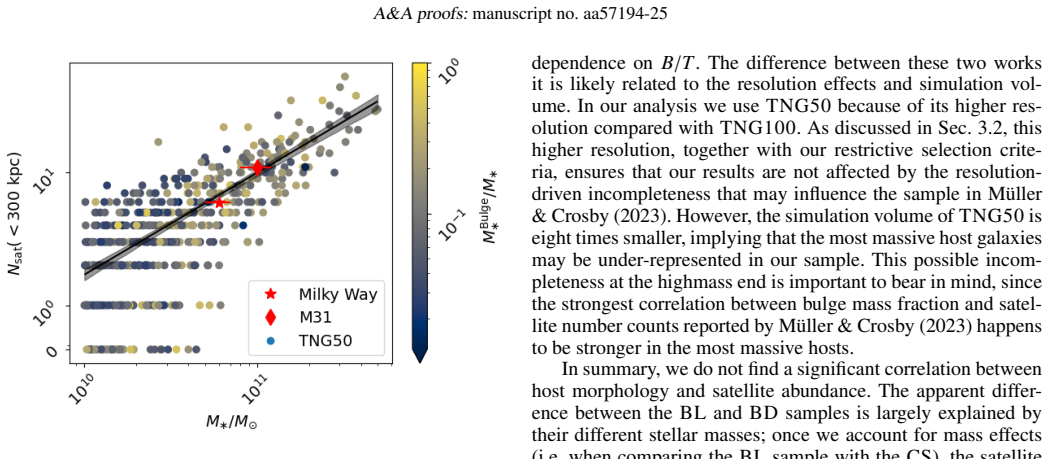
Using the TNG50-1 simulation, the satellite systems of 135 bulgeless galaxies were compared to a control sample of bulge-dominated galaxies with similar stellar masses. Satellite abundance does not depend strongly on morphology, but satellites around bulgeless galaxies display a steeper faint-end luminosity function, greater central concentration, and stronger alignment with the host disc plane. This orbital alignment results from coherent post-infall dynamical evolution that is sensitive to the host morphology, though infall of massive satellites can disrupt or stall the alignment. The results indicate that the morphology of the central galaxy imprints on its satellite system through their共
What carries the argument
Co-evolution of host galaxy morphology and post-infall satellite orbital dynamics, which transfers central structural properties to the satellite population's spatial and kinematic traits.
If this is right
- Satellite abundance is largely independent of whether the host galaxy has a bulge.
- Satellites around bulgeless galaxies exhibit a steeper faint-end slope in their luminosity function.
- Satellites are more centrally concentrated around bulgeless hosts.
- Orbital alignment with the disc plane is stronger for satellites of bulgeless galaxies due to morphology-dependent post-infall evolution.
- Infall of massive satellites can temporarily weaken or stall the secular alignment process.
Where Pith is reading between the lines
- Satellite alignment and concentration statistics could serve as indirect indicators of host bulge fraction in surveys where central morphology is difficult to measure directly.
- The results connect to questions of assembly bias by suggesting that quieter merger environments preserve more coherent satellite systems around disc galaxies.
- Extending the comparison to higher redshifts in simulations might reveal when the morphological imprint on satellites first appears during galaxy growth.
- Accurate modeling of central potential effects on satellite orbits will be required in future simulations to match observed satellite distributions around real bulgeless galaxies.
Load-bearing premise
The simulation accurately captures how a host galaxy's central morphology shapes the orbits and distributions of its satellites after they fall in.
What would settle it
A large observational survey of Milky Way analogue galaxies finding no difference in satellite orbital alignment angles or radial concentration between bulgeless and bulge-dominated hosts.
Figures




read the original abstract
$Aims$. The existence of massive disc galaxies with little or no bulge challenges conventional $\Lambda$ cold dark matter model, which typically favours dynamically hot central structures due to early collapse and mergers. The study of these bulgeless disc galaxies is the aim of the Bulgeless Evolution And the Rise of Discs (BEARD) survey, as they offer a unique opportunity to investigate the link between galaxy morphology and the properties of their satellite systems. $Methods$. Using the high-resolution cosmological hydrodynamical simulation TNG50-1, we studied the satellite populations of 135 bulgeless galaxies. We compared their satellite properties to those of a bulge-dominated control sample with matched stellar masses. Our analysis focuses on satellite abundance, luminosity functions, spatial distribution, orbital alignment, and infall histories. $Results$. We find that satellite abundance is largely independent of host galaxy morphology. However, satellites around bulgeless galaxies exhibit luminosity functions with a steeper faint-end slope, are more centrally concentrated, and show stronger orbital alignment with the host disc plane. The orbital alignment originates from coherent post-infall dynamical evolution that depends on host galaxy morphology. The infall of more massive satellites can additionally perturb this process, contributing to a weakening or temporary stalling of the secular alignment. $Conclusions$. Due to the co-evolution of the host galaxy and the satellite system, the morphology of the central galaxy leaves a clear imprint on its satellite system. Bulgeless galaxies tend to have dynamically colder, more aligned, and more centrally concentrated satellite populations. These trends reflect a more quiet merger history and support the use of satellite properties as tracers of host galaxy formation pathways.
Editorial analysis
A structured set of objections, weighed in public.
Referee Report
Summary. The manuscript uses the TNG50-1 cosmological hydrodynamical simulation to compare the satellite populations of 135 bulgeless galaxies against a stellar-mass-matched control sample of bulge-dominated galaxies. It reports that satellite abundance is largely independent of host morphology, while bulgeless hosts exhibit satellites with steeper faint-end luminosity functions, greater central concentration, and stronger orbital alignment with the host disc plane. These differences are attributed to co-evolution, with orbital alignment arising from coherent post-infall dynamical evolution that depends on host morphology and is modulated by massive satellite infall.
Significance. If robust, the results provide a controlled numerical view of how central galaxy morphology imprints on satellite system properties, supporting the use of satellites as tracers of host formation history in the context of the BEARD survey. The direct comparison of simulation outputs for abundance, luminosity functions, spatial distributions, and alignments is a clear strength, as is the focus on post-infall processes rather than fitted parameters.
major comments (1)
- [Methods and Results (orbital alignment and spatial distribution)] The central claim that differences in satellite alignment, concentration, and faint-end slope arise from morphology-dependent post-infall co-evolution (Results and Conclusions) requires that TNG50-1 accurately captures orbital evolution for low-mass satellites. The simulation has baryonic mass resolution ~8.5e4 Msun and softening ~0.3 kpc; satellites driving the steeper faint-end slope experience rapid decay and stripping whose rates depend on central potential shape. Bulgeless hosts have shallower potentials, so numerical heating or force inaccuracies could preferentially affect alignment and concentration relative to bulge-dominated hosts. The manuscript should include explicit resolution convergence tests or comparisons to higher-resolution runs to rule out artifacts.
minor comments (1)
- [Methods] The exact criteria used to classify bulgeless galaxies in the simulation and the precise matching procedure for the control sample (stellar mass, redshift range, etc.) would benefit from a concise summary table or explicit list in the Methods to aid reproducibility.
Simulated Author's Rebuttal
We thank the referee for their careful and constructive review of our manuscript. We address the major comment on numerical resolution and potential artifacts below, providing our honest assessment while committing to revisions where feasible.
read point-by-point responses
-
Referee: The central claim that differences in satellite alignment, concentration, and faint-end slope arise from morphology-dependent post-infall co-evolution (Results and Conclusions) requires that TNG50-1 accurately captures orbital evolution for low-mass satellites. The simulation has baryonic mass resolution ~8.5e4 Msun and softening ~0.3 kpc; satellites driving the steeper faint-end slope experience rapid decay and stripping whose rates depend on central potential shape. Bulgeless hosts have shallower potentials, so numerical heating or force inaccuracies could preferentially affect alignment and concentration relative to bulge-dominated hosts. The manuscript should include explicit resolution convergence tests or comparisons to higher-resolution runs to rule out artifacts.
Authors: We appreciate the referee highlighting this important caveat regarding TNG50-1's resolution for low-mass satellite orbital evolution. The quoted mass resolution and softening length are accurate, and we agree that dynamical friction, tidal stripping, and numerical heating could in principle be influenced by the shallower central potentials in bulgeless hosts. However, the morphological differences in the potential are physical, and our reported trends in alignment and concentration arise from the coherent post-infall evolution we measure directly in the simulation. Prior TNG50 studies have validated satellite dynamics in this mass regime against both observations and higher-resolution zoom simulations. To address the concern, we will add a new paragraph in the Methods section discussing resolution limitations, citing relevant TNG convergence literature on satellite stripping and orbits, and explicitly noting that the trends are unlikely to be dominated by numerical artifacts. We cannot add new explicit convergence tests, as no higher-resolution run with a comparable statistical sample of bulgeless galaxies is available. revision: partial
- We lack access to higher-resolution cosmological hydrodynamical simulations containing a statistically equivalent sample of bulgeless Milky Way analogues, preventing direct resolution convergence tests.
Circularity Check
No significant circularity in simulation-based satellite comparison
full rationale
The paper reports direct outputs from the TNG50-1 simulation: satellite abundance, luminosity functions, spatial distributions, orbital alignments, and infall histories are measured for 135 bulgeless galaxies versus a mass-matched bulge-dominated control sample. No parameters are fitted to data subsets and then re-predicted, no quantities are defined in terms of the results they are claimed to produce, and no load-bearing steps reduce to self-citations or imported uniqueness theorems. The central claim that host morphology imprints on satellite properties follows from the numerical experiment itself rather than any re-derivation or renaming of inputs.
Axiom & Free-Parameter Ledger
axioms (1)
- domain assumption The TNG50-1 simulation provides a sufficiently accurate model of galaxy and satellite co-evolution in a Lambda-CDM cosmology.
Reference graph
Works this paper leans on
-
[1]
Baryonic imprints on DM haloes: population statistics from dwarf galaxies to galaxy clusters. , keywords =. doi:10.1093/mnras/stab3177 , archivePrefix =. 2109.02713 , primaryClass =
-
[2]
Rigorous luminosity function determination in the presence of a background: theory and application to two intermediate redshift clusters ^ *. , keywords =. doi:10.1111/j.1365-2966.2005.09063.x , archivePrefix =. astro-ph/0503704 , primaryClass =
-
[3]
Frequency and properties of bars in cluster and field galaxies at intermediate redshifts
Frequency and properties of bars in cluster and field galaxies at intermediate redshifts. , keywords =. doi:10.1051/0004-6361/200810352 , archivePrefix =. 0902.4080 , primaryClass =
work page internal anchor Pith review Pith/arXiv arXiv doi:10.1051/0004-6361/200810352
-
[4]
Bulge Formation via Mergers in Cosmological Simulations
Bulge Formation via Mergers in Cosmological Simulations. Galactic Bulges , year = 2016, editor =. doi:10.1007/978-3-319-19378-6_12 , archivePrefix =. 1511.04095 , primaryClass =
work page internal anchor Pith review Pith/arXiv arXiv doi:10.1007/978-3-319-19378-6_12 2016
-
[5]
Stellar population synthesis at the resolution of 2003
, year =. arXiv , doi =:astro-ph/0309134 , keywords =
work page internal anchor Pith review Pith/arXiv arXiv
-
[6]
, year =. arXiv , doi =:astro-ph/9710107 , keywords =
work page internal anchor Pith review Pith/arXiv arXiv
-
[7]
Milky Way-est: Cosmological Zoom-in Simulations with Large Magellanic Cloud and Gaia Sausage Enceladus Analogs. , keywords =. doi:10.3847/1538-4357/ad554c , archivePrefix =. 2404.08043 , primaryClass =
-
[8]
A universal angular momentum profile for galactic halos
A Universal Angular Momentum Profile for Galactic Halos. , keywords =. doi:10.1086/321477 , archivePrefix =. astro-ph/0011001 , primaryClass =
work page internal anchor Pith review Pith/arXiv arXiv doi:10.1086/321477
-
[9]
Reionization and the abundance of galactic satellites
Reionization and the Abundance of Galactic Satellites. , keywords =. doi:10.1086/309279 , archivePrefix =. astro-ph/0002214 , primaryClass =
work page internal anchor Pith review Pith/arXiv arXiv doi:10.1086/309279
-
[10]
Journal of Statistical Software , author=
Bambi: A Simple Interface for Fitting Bayesian Linear Models in Python , volume=. Journal of Statistical Software , author=. 2022 , pages=. doi:10.18637/jss.v103.i15 , number=
-
[11]
Optical spectra and spectral energy distribution modelling
Dark halo response and the stellar initial mass function in early-type and late-type galaxies. , keywords =. doi:10.1111/j.1365-2966.2011.19038.x , archivePrefix =. 1012.5859 , primaryClass =
-
[12]
The dependence of the galaxy stellar-to-halo mass relation on galaxy morphology. , keywords =. doi:10.1093/mnras/staa3053 , archivePrefix =. 2010.01186 , primaryClass =
-
[13]
Dynamical evidence for a morphology-dependent relation between the stellar and halo masses of galaxies. , keywords =. doi:10.1051/0004-6361/202040256 , archivePrefix =. 2102.11282 , primaryClass =
-
[14]
On the Lack of Evolution in Galaxy Star Formation Efficiency
On the Lack of Evolution in Galaxy Star Formation Efficiency. , keywords =. doi:10.1088/2041-8205/762/2/L31 , archivePrefix =. 1209.3013 , primaryClass =
work page internal anchor Pith review Pith/arXiv arXiv doi:10.1088/2041-8205/762/2/l31 2041
-
[15]
Galactic star formation and accretion histories from matching galaxies to dark matter haloes
Galactic star formation and accretion histories from matching galaxies to dark matter haloes. , keywords =. doi:10.1093/mnras/sts261 , archivePrefix =. 1205.5807 , primaryClass =
work page internal anchor Pith review Pith/arXiv arXiv doi:10.1093/mnras/sts261
-
[16]
Symfind: Addressing the Fragility of Subhalo Finders and Revealing the Durability of Subhalos
SYMFIND : Addressing the Fragility of Subhalo Finders and Revealing the Durability of Subhalos. , keywords =. doi:10.3847/1538-4357/ad4e33 , archivePrefix =. 2308.10926 , primaryClass =
work page internal anchor Pith review Pith/arXiv arXiv doi:10.3847/1538-4357/ad4e33
-
[17]
Radial Distributions of Dwarf Satellite Systems in the Local Volume. , keywords =. doi:10.3847/1538-4357/abb60b , archivePrefix =. 2006.02444 , primaryClass =
-
[18]
The Exploration of Local VolumE Satellites (ELVES) Survey: A Nearly Volume-limited Sample of Nearby Dwarf Satellite Systems. , keywords =. doi:10.3847/1538-4357/ac6fd7 , archivePrefix =. 2203.00014 , primaryClass =
-
[19]
2003, PASP, 115, 763, doi: 10.1086/376392
Galactic Stellar and Substellar Initial Mass Function. , keywords =. doi:10.1086/376392 , archivePrefix =. astro-ph/0304382 , primaryClass =
work page internal anchor Pith review Pith/arXiv arXiv doi:10.1086/376392
-
[20]
, url =. in prep. , note =. doi:, abstract =
-
[21]
A Duality in the Origin of Bulges and Spheroidal Galaxies. , keywords =. doi:10.3847/1538-4357/abef72 , archivePrefix =. 2103.10438 , primaryClass =
-
[22]
From Naked Spheroids to Disky Galaxies: How Do Massive Disk Galaxies Shape Their Morphology?. , keywords =. doi:10.3847/1538-4357/ac5a57 , archivePrefix =. 2202.02332 , primaryClass =
-
[23]
Astronomy & Astrophysics , author =
Untangling stellar components of galaxies:. Astronomy & Astrophysics , author =. 2024 , pages =. doi:10.1051/0004-6361/202451202 , abstract =
-
[24]
Optical spectra and spectral energy distribution modelling
Times, environments and channels of bulge formation in a Lambda cold dark matter cosmology. , keywords =. doi:10.1111/j.1365-2966.2011.18475.x , archivePrefix =. 1102.3186 , primaryClass =
-
[25]
NIHAO XXI: The emergence of Low Surface Brightness galaxies
NIHAO XXI: the emergence of low surface brightness galaxies. , keywords =. doi:10.1093/mnras/stz985 , archivePrefix =. 1901.08559 , primaryClass =
work page internal anchor Pith review Pith/arXiv arXiv doi:10.1093/mnras/stz985 1901
-
[26]
Dark matter halos and scaling relations of extremely massive spiral galaxies from extended H I rotation curves. , keywords =. doi:10.1093/mnras/stac3424 , archivePrefix =. 2207.02906 , primaryClass =
-
[27]
An introduction to generalized linear models , author=. 2018 , publisher=
work page 2018
-
[28]
Quenched fractions in the IllustrisTNG simulations: comparison with observations and other theoretical models. , keywords =. doi:10.1093/mnras/stab1950 , archivePrefix =. 2008.00004 , primaryClass =
-
[29]
The Evolutionary Pathways of Disk-, Bulge-, and Halo-dominated Galaxies. , keywords =. doi:10.3847/1538-4357/ac0e98 , archivePrefix =. 2101.12373 , primaryClass =
-
[30]
Cold dark matter haloes in the Planck era: evolution of structural parameters for Einasto and NFW profiles. , keywords =. doi:10.1093/mnras/stu742 , archivePrefix =. 1402.7073 , primaryClass =
work page internal anchor Pith review Pith/arXiv arXiv doi:10.1093/mnras/stu742
-
[31]
Gas Loss by Ram Pressure Stripping and Internal Feedback From Low Mass Milky Way Satellites
Gas Loss by Ram Pressure Stripping and Internal Feedback from Low-mass Milky Way Satellites. , keywords =. doi:10.3847/0004-637X/826/2/148 , archivePrefix =. 1605.02746 , primaryClass =
work page internal anchor Pith review Pith/arXiv arXiv doi:10.3847/0004-637x/826/2/148
-
[32]
Satellites of Milky Way- and M31-like galaxies with TNG50: quenched fractions, gas content, and star formation histories. , keywords =. doi:10.1093/mnras/stad1357 , archivePrefix =. 2211.00010 , primaryClass =
-
[33]
The abundance of satellites around Milky Way- and M31-like galaxies with the TNG50 simulation: a matter of diversity. , keywords =. doi:10.1093/mnras/stab2437 , archivePrefix =. 2101.12215 , primaryClass =
-
[34]
Can cosmological simulations capture the diverse satellite populations of observed Milky Way analogues?. , keywords =. doi:10.1093/mnras/stab1332 , archivePrefix =. 2011.12974 , primaryClass =
-
[35]
Quenching of satellite galaxies of Milky Way analogues: reconciling theory and observations. , keywords =. doi:10.1093/mnras/stac183 , archivePrefix =. 2109.06215 , primaryClass =
-
[36]
Daniel Foreman-Mackey , title =. 2016 , month =. doi:10.21105/joss.00024 , url =
-
[37]
Monthly Notices of the Royal Astronomical Society , author =
The subhalo populations of CDM dark haloes. , keywords =. doi:10.1111/j.1365-2966.2004.08360.x , archivePrefix =. astro-ph/0404589 , primaryClass =
-
[38]
Not so lumpy after all: modeling the depletion of dark matter subhalos by Milky Way-like galaxies
Not so lumpy after all: modelling the depletion of dark matter subhaloes by Milky Way-like galaxies. , keywords =. doi:10.1093/mnras/stx1710 , archivePrefix =. 1701.03792 , primaryClass =
work page internal anchor Pith review Pith/arXiv arXiv doi:10.1093/mnras/stx1710
-
[39]
The SAGA Survey. IV. The Star Formation Properties of 101 Satellite Systems around Milky Way mass Galaxies. , keywords =. doi:10.3847/1538-4357/ad61e7 , archivePrefix =. 2404.14499 , primaryClass =
-
[40]
The SAGA Survey. I. Satellite Galaxy Populations around Eight Milky Way Analogs. , keywords =. doi:10.3847/1538-4357/aa8626 , archivePrefix =. 1705.06743 , primaryClass =
work page internal anchor Pith review Pith/arXiv arXiv doi:10.3847/1538-4357/aa8626
-
[41]
Charles R. Harris and K. Jarrod Millman and St. Array programming with. 2020 , month = sep, journal =. doi:10.1038/s41586-020-2649-2 , publisher =
-
[42]
The Magellanic Clouds Are Very Rare in the IllustrisTNG Simulations. Universe , keywords =. doi:10.3390/universe10100385 , archivePrefix =. 2409.17259 , primaryClass =
-
[43]
Hunter, J. D. , Title =. Computing in Science & Engineering , Volume =
-
[44]
Statistics of Dark Matter Substructure: III. Halo-to-Halo Variance
Statistics of dark matter substructure - III. Halo-to-halo variance. , keywords =. doi:10.1093/mnras/stx1979 , archivePrefix =. 1610.02399 , primaryClass =
work page internal anchor Pith review Pith/arXiv arXiv doi:10.1093/mnras/stx1979
-
[45]
The AGORA High-resolution Galaxy Simulations Comparison Project. V. Satellite Galaxy Populations in a Cosmological Zoom-in Simulation of a Milky Way Mass Halo. , keywords =. doi:10.3847/1538-4357/ad245b , archivePrefix =. 2402.05392 , primaryClass =
-
[46]
The quenched satellite population around Milky Way analogues. , keywords =. doi:10.1093/mnras/stad2208 , archivePrefix =. 2210.03748 , primaryClass =
-
[47]
Edge-on disk galaxies in the SDSS DR6: Fractions of bulgeless and other disk galaxies. Astron. Nachr. , keywords =. doi:10.1002/asna.200811132 , archivePrefix =. 0901.1894 , primaryClass =
work page internal anchor Pith review Pith/arXiv arXiv doi:10.1002/asna.200811132
-
[48]
Where are the missing galactic satellites?
Where Are the Missing Galactic Satellites?. , keywords =. doi:10.1086/307643 , archivePrefix =. astro-ph/9901240 , primaryClass =
work page internal anchor Pith review Pith/arXiv arXiv doi:10.1086/307643
-
[49]
Halos and galaxies in the standard cosmological model: results from the Bolshoi simulation
Dark Matter Halos in the Standard Cosmological Model: Results from the Bolshoi Simulation. , keywords =. doi:10.1088/0004-637X/740/2/102 , archivePrefix =. 1002.3660 , primaryClass =
work page internal anchor Pith review Pith/arXiv arXiv doi:10.1088/0004-637x/740/2/102
-
[50]
Bulgeless Giant Galaxies Challenge our Picture of Galaxy Formation by Hierarchical Clustering
Bulgeless Giant Galaxies Challenge Our Picture of Galaxy Formation by Hierarchical Clustering. , keywords =. doi:10.1088/0004-637X/723/1/54 , archivePrefix =. 1009.3015 , primaryClass =
work page internal anchor Pith review Pith/arXiv arXiv doi:10.1088/0004-637x/723/1/54
-
[51]
The formation and assembly history of the Milky Way revealed by its globular cluster population
The formation and assembly history of the Milky Way revealed by its globular cluster population. , keywords =. doi:10.1093/mnras/sty1609 , archivePrefix =. 1806.05680 , primaryClass =
work page internal anchor Pith review Pith/arXiv arXiv doi:10.1093/mnras/sty1609
-
[52]
Ravin Kumar and Colin Carroll and Ari Hartikainen and Osvaldo Martin , title =. 2019 , publisher =. doi:10.21105/joss.01143 , url =
-
[53]
Proceedings of the Second Workshop on the LLVM Compiler Infrastructure in HPC , articleno =
Lam, Siu Kwan and Pitrou, Antoine and Seibert, Stanley , title =. Proceedings of the Second Workshop on the LLVM Compiler Infrastructure in HPC , articleno =. 2015 , isbn =. doi:10.1145/2833157.2833162 , abstract =
-
[54]
Improved Estimates of the Milky Way's Stellar Mass and Star Formation Rate from Hierarchical Bayesian Meta-Analysis. , keywords =. doi:10.1088/0004-637X/806/1/96 , archivePrefix =. 1407.1078 , primaryClass =
work page internal anchor Pith review Pith/arXiv arXiv doi:10.1088/0004-637x/806/1/96
-
[55]
The SAGA Survey. III. A Census of 101 Satellite Systems around Milky Way mass Galaxies. , keywords =. doi:10.3847/1538-4357/ad64c4 , archivePrefix =. 2404.14498 , primaryClass =
-
[56]
The SAGA Survey. II. Building a Statistical Sample of Satellite Systems around Milky Way-like Galaxies. , keywords =. doi:10.3847/1538-4357/abce58 , archivePrefix =. 2008.12783 , primaryClass =
-
[57]
First results from the IllustrisTNG simulations: radio haloes and magnetic fields
First results from the IllustrisTNG simulations: radio haloes and magnetic fields. , keywords =. doi:10.1093/mnras/sty2206 , archivePrefix =. 1707.03396 , primaryClass =
work page internal anchor Pith review Pith/arXiv arXiv doi:10.1093/mnras/sty2206
-
[58]
Physical drivers of the mass-size relation for Milky Way-like galaxies
Bulgeless Evolution And the Rise of Discs (BEARD): I. Physical drivers of the mass-size relation for Milky Way-like galaxies. , keywords =. doi:10.1051/0004-6361/202557193 , adsurl =
-
[59]
Simultaneous ram pressure and tidal stripping; how dwarf spheroidals lost their gas. , keywords =. doi:10.1111/j.1365-2966.2006.10403.x , archivePrefix =. astro-ph/0504277 , primaryClass =
-
[60]
The observed properties of dwarf galaxies in and around the Local Group
The Observed Properties of Dwarf Galaxies in and around the Local Group. , keywords =. doi:10.1088/0004-6256/144/1/4 , archivePrefix =. 1204.1562 , primaryClass =
work page internal anchor Pith review Pith/arXiv arXiv doi:10.1088/0004-6256/144/1/4
-
[61]
McCullagh, Peter and Nelder, John A. , title =. 1989 , edition =. doi:10.1007/978-1-4899-3242-6 , isbn =
-
[62]
The Distribution of Satellite Galaxies in the IllustrisTNG100 Simulation. , keywords =. doi:10.3847/1538-4357/ac752d , archivePrefix =. 2206.00045 , primaryClass =
-
[63]
The origin of bulges and discs in the CALIFA survey - I. Morphological evolution. , keywords =. doi:10.1093/mnras/stab1064 , archivePrefix =. 2104.07743 , primaryClass =
-
[64]
Dark Matter Substructure in Galactic Halos
Dark Matter Substructure within Galactic Halos. , keywords =. doi:10.1086/312287 , archivePrefix =. astro-ph/9907411 , primaryClass =
work page internal anchor Pith review Pith/arXiv arXiv doi:10.1086/312287
-
[65]
Examining the relationship between the bulge-to-total stellar mass ratio and dwarf galaxy count in the context of CDM. , keywords =. doi:10.1051/0004-6361/202346827 , archivePrefix =. 2307.09015 , primaryClass =
-
[66]
Modeling the Connection Between Subhalos and Satellites in Milky Way-like Systems
Modeling the Connection between Subhalos and Satellites in Milky Way-like Systems. , keywords =. doi:10.3847/1538-4357/ab040e , archivePrefix =. 1809.05542 , primaryClass =
work page internal anchor Pith review Pith/arXiv arXiv doi:10.3847/1538-4357/ab040e
-
[67]
First results from the IllustrisTNG simulations: a tale of two elements - chemical evolution of magnesium and europium. , keywords =. doi:10.1093/mnras/sty618 , archivePrefix =. 1707.03401 , primaryClass =
work page internal anchor Pith review Pith/arXiv arXiv doi:10.1093/mnras/sty618
-
[68]
The Inner Structure of LambdaCDM Halos III: Universality and Asymptotic Slopes
, year =. arXiv , doi =:astro-ph/0311231 , keywords =
work page internal anchor Pith review Pith/arXiv arXiv
-
[69]
The luminosity of cluster galaxies in the Cluster-EAGLE simulations. , keywords =. doi:10.1093/mnras/stac1481 , archivePrefix =. 2205.13553 , primaryClass =
-
[70]
Computational Astrophysics and Cosmology , keywords =
The IllustrisTNG simulations: public data release. Computational Astrophysics and Cosmology , keywords =. doi:10.1186/s40668-019-0028-x , archivePrefix =. 1812.05609 , primaryClass =
-
[71]
First results from the IllustrisTNG simulations: the galaxy color bimodality
First results from the IllustrisTNG simulations: the galaxy colour bimodality. , keywords =. doi:10.1093/mnras/stx3040 , archivePrefix =. 1707.03395 , primaryClass =
work page internal anchor Pith review Pith/arXiv arXiv doi:10.1093/mnras/stx3040
-
[72]
First results from the TNG50 simulation: galactic outflows driven by supernovae and black hole feedback. , keywords =. doi:10.1093/mnras/stz2306 , archivePrefix =. 1902.05554 , primaryClass =
work page internal anchor Pith review Pith/arXiv arXiv doi:10.1093/mnras/stz2306 1902
-
[73]
Mass loss of galaxies due to an ultraviolet background. , keywords =. doi:10.1111/j.1365-2966.2008.13830.x , archivePrefix =. 0806.0378 , primaryClass =
-
[74]
The Open Journal of Astrophysics , keywords =
The Local Volume Database: a library of the observed properties of nearby dwarf galaxies and star clusters. The Open Journal of Astrophysics , keywords =. doi:10.33232/001c.144859 , archivePrefix =. 2411.07424 , primaryClass =
- [75]
-
[76]
Simulating galaxy formation with the
Simulating galaxy formation with the IllustrisTNG model. , keywords =. doi:10.1093/mnras/stx2656 , archivePrefix =. 1703.02970 , primaryClass =
work page internal anchor Pith review Pith/arXiv arXiv doi:10.1093/mnras/stx2656
-
[77]
First results from the IllustrisTNG simulations: the stellar mass content of groups and clusters of galaxies. , keywords =. doi:10.1093/mnras/stx3112 , archivePrefix =. 1707.03406 , primaryClass =
work page internal anchor Pith review Pith/arXiv arXiv doi:10.1093/mnras/stx3112
-
[78]
Monthly Notices of the Royal Astronomical Society , volume =
First results from the TNG50 simulation: the evolution of stellar and gaseous discs across cosmic time. , keywords =. doi:10.1093/mnras/stz2338 , archivePrefix =. 1902.05553 , primaryClass =
-
[79]
Planck 2015 results. XXVII. The Second Planck Catalogue of Sunyaev-Zeldovich Sources
, year =. arXiv , doi =:1502.01598 , keywords =
work page internal anchor Pith review Pith/arXiv arXiv
-
[80]
pynbody: Astrophysics Simulation Analysis for Python
discussion (0)
Sign in with ORCID, Apple, or X to comment. Anyone can read and Pith papers without signing in.