How High-Specific-Energy Winds Regulate the Circumgalactic Medium of Dwarf Galaxies
Pith reviewed 2026-05-20 08:44 UTC · model grok-4.3
The pith
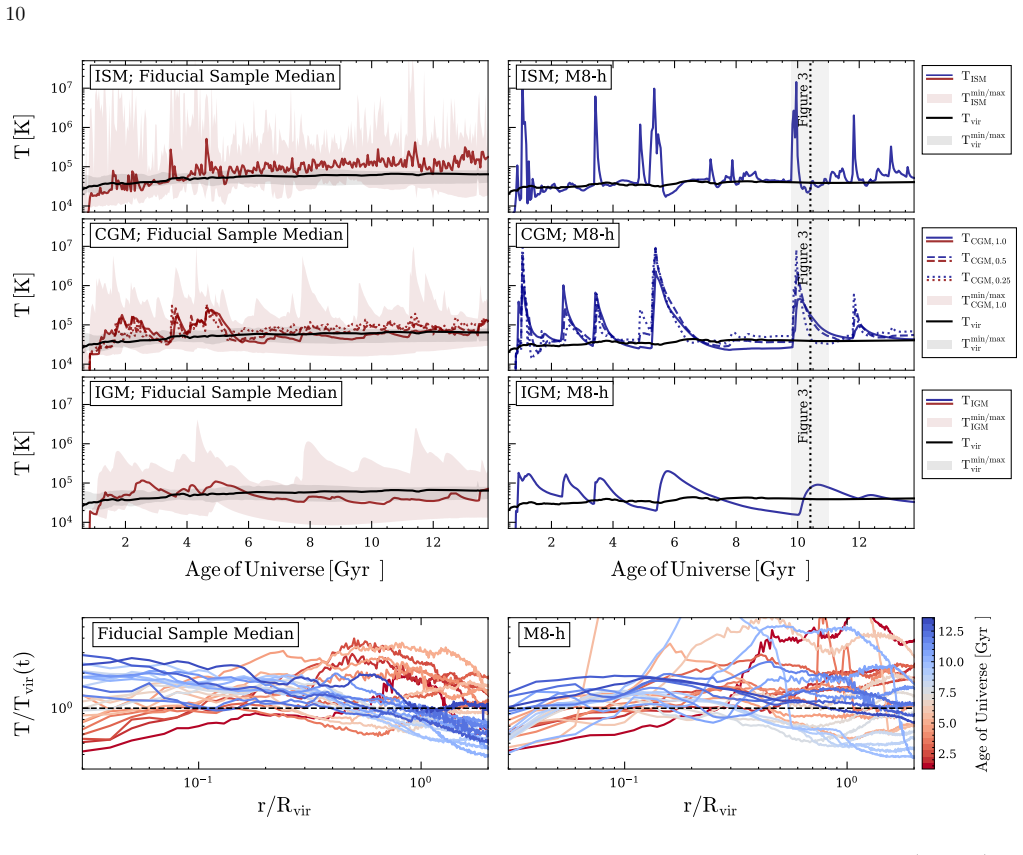
Episodic supernova shocks sustain the circumgalactic medium of dwarf galaxies at virial temperature and trigger a shift to preventive feedback after 5 Gyr.
A machine-rendered reading of the paper's core claim, the machinery that carries it, and where it could break.
Core claim
Episodic, SNe-driven shock heating sustains the CGM at approximately the virial temperature. This process increases the ratio t_cool/t_ff above 10 in the outer CGM and IGM, placing the gas in a radiatively stable regime. Hot outflows with temperatures greater than or equal to 10^5 K dominate the energy budget and can escape the halo to heat the IGM. Warm outflows dominate the mass budget and are recycled back into the ISM. A gradual transition occurs at about 5 Gyr from ejective feedback, where outflows sweep up mass, to preventive feedback that maintains the high t_cool/t_ff ratio and suppresses approximately 75 percent of the expected baryon accretion rate.
What carries the argument
The ratio of cooling time to free-fall time (t_cool/t_ff) maintained above 10 by high-specific-energy supernova outflows, which enables the transition to preventive feedback.
If this is right
- The CGM in these dwarf halos stays hot and stable for long periods despite cooling tendencies.
- Hot gas escapes the halo and contributes to heating the surrounding intergalactic medium.
- Most baryons are prevented from accreting onto the galaxy at late cosmic times.
- The feedback mode changes from removing gas to stopping gas from arriving.
Where Pith is reading between the lines
- This could account for the low baryon content observed in many dwarf galaxies today.
- The mechanism might scale to slightly larger galaxies but with a later transition time.
- Future observations of CGM temperatures and densities around dwarfs could test the predicted stability.
Load-bearing premise
That the numerical method with discrete supernovae and adaptive mesh refinement accurately tracks the energy deposition and propagation of outflows without artificial effects changing the cooling time ratio or the timing of the feedback transition.
What would settle it
Detection of a substantial cool gas component in the outer CGM of dwarf galaxies at late times with t_cool/t_ff below 10, or a baryon fraction much higher than 0.1.
Figures




read the original abstract
We investigate the role of ejective and preventive feedback in $\mathrm{\sim10^{10}-10^{11}\,M_\odot}$ dwarf halos using cosmological zoom-in simulations. These simulations use adaptive mesh refinement to capture high-specific-energy outflows, together with an implementation of discrete supernovae (SNe). We show that episodic, SNe-driven shock heating sustains the circumgalactic medium (CGM) at $\mathrm{\sim T_{vir}}$. This process also increases the ratio $\mathrm{t_{cool}/t_{ff} > 10}$ in the outer CGM and intergalactic medium (IGM), placing the gas in a radiatively stable regime. Hot outflows ($\mathrm{\gtrsim10^5\, K}$) dominate the energy budget, and their high specific energy allows them to traverse the CGM, escape the halo, and heat the IGM. In contrast, warm outflows ($\mathrm{\lesssim10^5\, K}$) dominate the mass budget and are largely recycled back into the interstellar medium (ISM), where they fuel future star formation. We identify a gradual transition at $\mathrm{\sim 5\, Gyr}$ that marks a shift in the balance between ejective and preventive feedback. At early times ($\mathrm{< 5\, Gyr}$), although the CGM cooling rate dominates for a larger fraction of time, the infrequent yet powerful SNe energy injection into the CGM is able to quickly dominate the cumulative energy balance. These outflows and their high specific energy are able to 'sweep' up mass in the CGM and IGM. At late times ($\mathrm{> 5\, Gyr}$), the CGM baryon fraction is only $\mathrm{\sim0.1}$, leading to a transition toward a preventive feedback mode in which SNe maintain $\mathrm{t_{cool}/t_{ff} > 10}$ and prevent $\mathrm{\sim75\%}$ of the expected baryon accretion rate.
Editorial analysis
A structured set of objections, weighed in public.
Referee Report
Summary. The manuscript presents cosmological zoom-in simulations of ~10^{10}-10^{11} M_⊙ dwarf halos using adaptive mesh refinement and discrete supernova implementations. It claims that episodic SNe-driven shock heating sustains the CGM at ~T_vir, elevates t_cool/t_ff >10 in the outer CGM and IGM to a radiatively stable regime, with hot outflows (≳10^5 K) dominating the energy budget and escaping while warm outflows (≲10^5 K) dominate the mass budget and recycle to the ISM. The work identifies a gradual transition at ~5 Gyr from ejective to preventive feedback, where the CGM baryon fraction drops to ~0.1 and SNe prevent ~75% of the expected baryon accretion rate.
Significance. If the quantitative results hold under numerical scrutiny, the paper provides a concrete mechanism linking high-specific-energy outflows to CGM regulation, low baryon fractions, and the shift to preventive feedback in dwarfs. The emergence of episodic behavior from discrete SNe (rather than imposed continuous injection) and the falsifiable prediction of a ~5 Gyr transition with 75% suppression are strengths that could be tested against observations of CGM kinematics and baryon content.
major comments (2)
- [§4] §4 (results on feedback transition): The central claim of a transition to preventive feedback at ~5 Gyr with ~75% accretion suppression and sustained t_cool/t_ff >10 rests on the accuracy of hot outflow propagation and phase separation. No resolution or subgrid variation tests are shown to demonstrate that AMR numerical diffusion or artificial mixing between hot (≳10^5 K) and warm phases does not artificially shorten cooling times or alter the reported CGM baryon fraction evolution and transition timing.
- [Methods] Methods (discrete SNe implementation): The distinction that hot outflows dominate energy while warm dominate mass (and the resulting ejective vs. preventive balance) is load-bearing for the overall picture. Without quantified sensitivity to supernova energy per event or mass-loading scaling, it is unclear whether the reported 75% suppression and t_cool/t_ff threshold are robust or depend on the specific subgrid choices whose effects are not varied.
minor comments (2)
- [Figures 3-5] Figure captions and text should explicitly state the temperature threshold used to separate hot (≳10^5 K) and warm outflows and show that results are insensitive to small changes in this cut.
- [Abstract and §5] The abstract and §5 would benefit from a brief statement on how the expected baryon accretion rate is defined for the 75% suppression calculation.
Simulated Author's Rebuttal
We thank the referee for their positive assessment of the significance of our work and for the constructive major comments. We address each point below and have incorporated revisions to enhance the robustness of our conclusions.
read point-by-point responses
-
Referee: [§4] §4 (results on feedback transition): The central claim of a transition to preventive feedback at ~5 Gyr with ~75% accretion suppression and sustained t_cool/t_ff >10 rests on the accuracy of hot outflow propagation and phase separation. No resolution or subgrid variation tests are shown to demonstrate that AMR numerical diffusion or artificial mixing between hot (≳10^5 K) and warm phases does not artificially shorten cooling times or alter the reported CGM baryon fraction evolution and transition timing.
Authors: We agree that demonstrating numerical convergence is crucial for claims involving phase separation and cooling times in the CGM. In response, we have performed additional simulations at higher resolution and included a new appendix (Appendix C) showing that the key results—the timing of the transition around 5 Gyr, the CGM baryon fraction dropping to ~0.1, and t_cool/t_ff remaining above 10—are robust to changes in resolution. We also discuss how the AMR refinement criteria minimize artificial mixing between phases, and provide quantitative measures of the hot and warm phase separation in the revised manuscript. revision: yes
-
Referee: [Methods] Methods (discrete SNe implementation): The distinction that hot outflows dominate energy while warm dominate mass (and the resulting ejective vs. preventive balance) is load-bearing for the overall picture. Without quantified sensitivity to supernova energy per event or mass-loading scaling, it is unclear whether the reported 75% suppression and t_cool/t_ff threshold are robust or depend on the specific subgrid choices whose effects are not varied.
Authors: We acknowledge the importance of testing sensitivity to subgrid parameters such as supernova energy injection and mass loading. Our current study focuses on a fiducial discrete SN implementation with standard values calibrated to observations. To address this, we have added a discussion in Section 2.2 explaining the rationale for our choices and why the qualitative distinction between hot and warm outflows is expected to persist across reasonable parameter variations. However, a full parameter study would require significant additional computational resources and is planned for future work. We believe the core mechanism is physically motivated and not overly sensitive to exact values within the explored regime. revision: partial
Circularity Check
Simulation outcomes measured from numerical evolution; no reduction of claims to inputs by construction
full rationale
The paper reports results from cosmological zoom-in simulations using AMR and discrete supernova implementation. Claims such as episodic SNe-driven shock heating sustaining CGM at ~T_vir, t_cool/t_ff >10 in outer regions, transition at ~5 Gyr, CGM baryon fraction ~0.1, and prevention of ~75% baryon accretion are direct measurements of quantities evolved in the simulation runs. These are not analytic derivations, parameter fits renamed as predictions, or self-citation chains; the reported fractions and timings emerge from the time-dependent hydrodynamics and feedback implementation rather than being imposed tautologically. The paper is self-contained against external benchmarks as a numerical experiment whose outputs can be reproduced or falsified by independent simulations.
Axiom & Free-Parameter Ledger
free parameters (2)
- supernova energy injection per event
- mass loading factor or wind velocity scaling
axioms (2)
- domain assumption The cooling function and radiative losses are accurately captured by the simulation's subgrid model at CGM densities and temperatures.
- domain assumption Adaptive mesh refinement sufficiently resolves the shock heating and propagation of high-specific-energy winds without excessive numerical mixing.
Reference graph
Works this paper leans on
-
[1]
Abruzzo, M. W., Fielding, D. B., & Bryan, G. L. 2024, ApJ, 966, 181, doi: 10.3847/1538-4357/ad1e51 Angl´ es-Alc´ azar, D., Faucher-Gigu` ere, C.-A., Kereˇ s, D., et al. 2017, MNRAS, 470, 4698, doi: 10.1093/mnras/stx1517
-
[2]
Applebaum, E., Brooks, A. M., Christensen, C. R., et al. 2021, ApJ, 906, 96, doi: 10.3847/1538-4357/abcafa Arjona-G´ alvez, E., Di Cintio, A., & Grand, R. J. J. 2024, A&A, 690, A286, doi: 10.1051/0004-6361/202449439 Astropy Collaboration, Robitaille, T. P., Tollerud, E. J., et al. 2013, A&A, 558, A33, doi: 10.1051/0004-6361/201322068
-
[3]
2023, MNRAS, 524, 5391, doi: 10.1093/mnras/stad2046
Ayromlou, M., Nelson, D., & Pillepich, A. 2023, MNRAS, 524, 5391, doi: 10.1093/mnras/stad2046
-
[4]
Barai, P., & de Gouveia Dal Pino, E. M. 2019, MNRAS, 487, 5549, doi: 10.1093/mnras/stz1616
-
[5]
Baumschlager, B., Shen, S., Wadsley, J. W., et al. 2025, arXiv e-prints, arXiv:2508.19396, doi: 10.48550/arXiv.2508.19396
-
[6]
Behroozi, P., Wechsler, R. H., Hearin, A. P., & Conroy, C. 2019, MNRAS, 488, 3143, doi: 10.1093/mnras/stz1182
-
[7]
Behroozi, P. S., Wechsler, R. H., & Wu, H.-Y. 2013a, ApJ, 762, 109, doi: 10.1088/0004-637X/762/2/109
work page internal anchor Pith review doi:10.1088/0004-637x/762/2/109
-
[8]
Behroozi, P. S., Wechsler, R. H., Wu, H.-Y., et al. 2013b, ApJ, 763, 18, doi: 10.1088/0004-637X/763/1/18
-
[9]
Bennett, J. S., Smith, M. C., Fielding, D. B., et al. 2025, MNRAS, 543, 1456, doi: 10.1093/mnras/staf1440
-
[10]
Birnboim, Y., & Dekel, A. 2003, MNRAS, 345, 349, doi: 10.1046/j.1365-8711.2003.06955.x
-
[11]
Bordoloi, R., Prochaska, J. X., Tumlinson, J., et al. 2018, ApJ, 864, 132, doi: 10.3847/1538-4357/aad8ac
-
[12]
Bordoloi, R., Tumlinson, J., Werk, J. K., et al. 2014, ApJ, 796, 136, doi: 10.1088/0004-637X/796/2/136
-
[13]
Bryan, G. L., & Norman, M. L. 1998, ApJ, 495, 80, doi: 10.1086/305262
work page internal anchor Pith review doi:10.1086/305262 1998
-
[14]
Ostriker, J. P. 1995, Computer Physics Communications, 89, 149, doi: 10.1016/0010-4655(94)00191-4
-
[15]
Bryan, G. L., Norman, M. L., O’Shea, B. W., et al. 2014, ApJS, 211, 19, doi: 10.1088/0067-0049/211/2/19
-
[16]
Somerville, R. S. 2023, ApJ, 949, 21, doi: 10.3847/1538-4357/acc4c7
-
[17]
2003, PASP, 115, 763, doi: 10.1086/376392
Chabrier, G. 2003, PASP, 115, 763, doi: 10.1086/376392
work page internal anchor Pith review doi:10.1086/376392 2003
-
[18]
Chen, H.-W., Lanzetta, K. M., Webb, J. K., & Barcons, X. 1998, ApJ, 498, 77, doi: 10.1086/305554
-
[19]
Chisholm, J., Tremonti, C. A., Leitherer, C., & Chen, Y. 2017, MNRAS, 469, 4831, doi: 10.1093/mnras/stx1164
-
[20]
Cioffi, D. F., McKee, C. F., & Bertschinger, E. 1988, ApJ, 334, 252, doi: 10.1086/166834
-
[21]
2022, MNRAS, 513, 2535, doi: 10.1093/mnras/stac1026
Concas, A., Maiolino, R., Curti, M., et al. 2022, MNRAS, 513, 2535, doi: 10.1093/mnras/stac1026
-
[22]
2025, Nature Astronomy, 9, 1226, doi: 10.1038/s41550-025-02566-y 31
Connor, L., Ravi, V., Sharma, K., et al. 2025, Nature Astronomy, 9, 1226, doi: 10.1038/s41550-025-02566-y 31
-
[23]
Cook, A. W. S., van de Voort, F., Pakmor, R., & Grand, R. J. J. 2025, MNRAS, 543, 1224, doi: 10.1093/mnras/staf1537
-
[24]
Correa, C. A., Schaye, J., Wyithe, J. S. B., et al. 2018, MNRAS, 473, 538, doi: 10.1093/mnras/stx2332
-
[25]
Crain, R. A., & van de Voort, F. 2023, ARA&A, 61, 473, doi: 10.1146/annurev-astro-041923-043618
-
[26]
Crain, R. A., Schaye, J., Bower, R. G., et al. 2015, MNRAS, 450, 1937, doi: 10.1093/mnras/stv725
-
[27]
Dekel, A., & Birnboim, Y. 2006, MNRAS, 368, 2, doi: 10.1111/j.1365-2966.2006.10145.x
-
[28]
1986, ApJ, 303, 39, doi: 10.1086/164050
Dekel, A., & Silk, J. 1986, ApJ, 303, 39, doi: 10.1086/164050
-
[29]
Donahue, M., & Voit, G. M. 2022, PhR, 973, 1, doi: 10.1016/j.physrep.2022.04.005
-
[30]
Eisenstein, D. J., & Hu, W. 1998, ApJ, 496, 605, doi: 10.1086/305424
-
[31]
Eisenstein, D. J., & Hut, P. 1998, ApJ, 498, 137, doi: 10.1086/305535
-
[32]
2018a, MNRAS, 473, 1930, doi: 10.1093/mnras/stx2482
El-Badry, K., Quataert, E., Wetzel, A., et al. 2018a, MNRAS, 473, 1930, doi: 10.1093/mnras/stx2482
-
[33]
2018b, MNRAS, 477, 1536, doi: 10.1093/mnras/sty730
El-Badry, K., Bradford, J., Quataert, E., et al. 2018b, MNRAS, 477, 1536, doi: 10.1093/mnras/sty730
-
[34]
Emami, N., Siana, B., Weisz, D. R., et al. 2019, ApJ, 881, 71, doi: 10.3847/1538-4357/ab211a
-
[35]
J., Chatzikos, M., Guzm´ an, F., et al
Ferland, G. J., Chatzikos, M., Guzm´ an, F., et al. 2017, RMxAA, 53, 385, doi: 10.48550/arXiv.1705.10877
-
[36]
Fielding, D., Quataert, E., McCourt, M., & Thompson, T. A. 2017, MNRAS, 466, 3810, doi: 10.1093/mnras/stw3326
-
[37]
Fielding, D. B., & Bryan, G. L. 2022, ApJ, 924, 82, doi: 10.3847/1538-4357/ac2f41
-
[38]
Forbes, J. C., Krumholz, M. R., Goldbaum, N. J., & Dekel, A. 2016, Nature, 535, 523, doi: 10.1038/nature18292
-
[39]
Goldbaum, N. J., Krumholz, M. R., & Forbes, J. C. 2015, ApJ, 814, 131, doi: 10.1088/0004-637X/814/2/131 —. 2016, ApJ, 827, 28, doi: 10.3847/0004-637X/827/1/28
-
[40]
Gronke, M., & Oh, S. P. 2020, MNRAS, 494, L27, doi: 10.1093/mnrasl/slaa033
-
[41]
2012, ApJ, 746, 125, doi: 10.1088/0004-637X/746/2/125
Haardt, F., & Madau, P. 2012, ApJ, 746, 125, doi: 10.1088/0004-637X/746/2/125
-
[42]
2019, MNRAS, 488, 1248, doi: 10.1093/mnras/stz1773
Hafen, Z., Faucher-Gigu` ere, C.-A., Angl´ es-Alc´ azar, D., et al. 2019, MNRAS, 488, 1248, doi: 10.1093/mnras/stz1773
-
[43]
Hahn, O., & Abel, T. 2011, MNRAS, 415, 2101, doi: 10.1111/j.1365-2966.2011.18820.x
-
[44]
Hummels, C. B., Smith, B. D., & Silvia, D. W. 2017, ApJ, 847, 59, doi: 10.3847/1538-4357/aa7e2d
-
[45]
Straka, L. A. 2017, ApJL, 850, L10, doi: 10.3847/2041-8213/aa9370
-
[46]
2024, ApJ, 966, 129, doi: 10.3847/1538-4357/ad3042
Kado-Fong, E., Geha, M., Mao, Y.-Y., et al. 2024, ApJ, 966, 129, doi: 10.3847/1538-4357/ad3042
-
[47]
Katz, N., Weinberg, D. H., & Hernquist, L. 1996, ApJS, 105, 19, doi: 10.1086/192305
-
[48]
Kim, C.-G., Kim, W.-T., & Ostriker, E. C. 2011, ApJ, 743, 25, doi: 10.1088/0004-637X/743/1/25
-
[49]
Kim, C.-G., & Ostriker, E. C. 2015, ApJ, 802, 99, doi: 10.1088/0004-637X/802/2/99
-
[50]
Kim, C.-G., Ostriker, E. C., Somerville, R. S., et al. 2020, ApJ, 900, 61, doi: 10.3847/1538-4357/aba962
-
[51]
2016, ApJ, 833, 202, doi: 10.3847/1538-4357/833/2/202
Kim, J.-h., Agertz, O., Teyssier, R., et al. 2016, ApJ, 833, 202, doi: 10.3847/1538-4357/833/2/202
-
[52]
Koudmani, S., Sijacki, D., Bourne, M. A., & Smith, M. C. 2019, MNRAS, 484, 2047, doi: 10.1093/mnras/stz097
-
[53]
Krumholz, M. R., Dekel, A., & McKee, C. F. 2012, ApJ, 745, 69, doi: 10.1088/0004-637X/745/1/69
-
[54]
Krumholz, M. R., & Tan, J. C. 2007, ApJ, 654, 304, doi: 10.1086/509101
-
[55]
T., Nagai, D., Bogd´ an,´A., et al
Lau, E. T., Nagai, D., Bogd´ an,´A., et al. 2025, ApJ, 984, 190, doi: 10.3847/1538-4357/adc450
-
[56]
2014, ApJS, 212, 14, doi: 10.1088/0067-0049/212/1/14
Leitherer, C., Ekstr¨ om, S., Meynet, G., et al. 2014, ApJS, 212, 14, doi: 10.1088/0067-0049/212/1/14
-
[57]
Leitherer, C., Schaerer, D., Goldader, J. D., et al. 1999, ApJS, 123, 3, doi: 10.1086/313233
work page internal anchor Pith review doi:10.1086/313233 1999
-
[58]
Li, M., & Bryan, G. L. 2020, ApJL, 890, L30, doi: 10.3847/2041-8213/ab7304
-
[59]
Li, Y., Bryan, G. L., Ruszkowski, M., et al. 2015, ApJ, 811, 73, doi: 10.1088/0004-637X/811/2/73
-
[60]
Liang, C. J., & Chen, H.-W. 2014, MNRAS, 445, 2061, doi: 10.1093/mnras/stu1901
-
[61]
Lochhaas, C., Tumlinson, J., O’Shea, B. W., et al. 2021, ApJ, 922, 121, doi: 10.3847/1538-4357/ac2496
-
[62]
Loken, C., Norman, M. L., Nelson, E., et al. 2002, The Astrophysical Journal, 579, 571, doi: 10.1086/342825
-
[63]
2023, A&A, 670, A92, doi: 10.1051/0004-6361/202244895
Marasco, A., Belfiore, F., Cresci, G., et al. 2023, A&A, 670, A92, doi: 10.1051/0004-6361/202244895
-
[64]
2015, MNRAS, 450, 504, doi: 10.1093/mnras/stv562
Martizzi, D., Faucher-Gigu` ere, C.-A., & Quataert, E. 2015, MNRAS, 450, 504, doi: 10.1093/mnras/stv562
-
[65]
P., O’Leary, R., & Madigan, A.-M
McCourt, M., Oh, S. P., O’Leary, R., & Madigan, A.-M. 2018, MNRAS, 473, 5407, doi: 10.1093/mnras/stx2687
-
[66]
McCourt, M., Sharma, P., Quataert, E., & Parrish, I. J. 2012, MNRAS, 419, 3319, doi: 10.1111/j.1365-2966.2011.19972.x
-
[67]
McQuinn, K. B. W., van Zee, L., & Skillman, E. D. 2019, ApJ, 886, 74, doi: 10.3847/1538-4357/ab4c37
-
[68]
Mina, M., Shen, S., Keller, B. W., et al. 2021, A&A, 655, A22, doi: 10.1051/0004-6361/202039420
-
[69]
Mishra, N., Johnson, S. D., Rudie, G. C., et al. 2024, ApJ, 976, 149, doi: 10.3847/1538-4357/ad7b0a 32
-
[70]
Mitchell, P. D., & Schaye, J. 2022, MNRAS, 511, 2600, doi: 10.1093/mnras/stab3686
-
[71]
Mitchell, P. D., Schaye, J., & Bower, R. G. 2020a, MNRAS, 497, 4495, doi: 10.1093/mnras/staa2252
-
[72]
Mitchell, P. D., Schaye, J., Bower, R. G., & Crain, R. A. 2020b, MNRAS, 494, 3971, doi: 10.1093/mnras/staa938
-
[73]
Mo, H., van den Bosch, F. C., & White, S. 2010, Galaxy Formation and Evolution
work page 2010
-
[74]
2022, ApJ, 933, 133, doi: 10.3847/1538-4357/ac70c6
Moser, E., Battaglia, N., Nagai, D., et al. 2022, ApJ, 933, 133, doi: 10.3847/1538-4357/ac70c6
-
[75]
Moster, B. P., Somerville, R. S., Maulbetsch, C., et al. 2010, ApJ, 710, 903, doi: 10.1088/0004-637X/710/2/903
-
[76]
Munshi, F., Brooks, A. M., Applebaum, E., et al. 2021, ApJ, 923, 35, doi: 10.3847/1538-4357/ac0db6
-
[77]
L., Kereˇ s, D., Faucher-Gigu` ere, C.-A., et al
Muratov, A. L., Kereˇ s, D., Faucher-Gigu` ere, C.-A., et al. 2015, MNRAS, 454, 2691, doi: 10.1093/mnras/stv2126
-
[78]
2016, MNRAS, 460, 2881, doi: 10.1093/mnras/stw1191
Nelson, D., Genel, S., Pillepich, A., et al. 2016, MNRAS, 460, 2881, doi: 10.1093/mnras/stw1191
-
[79]
2013, MNRAS, 429, 3353, doi: 10.1093/mnras/sts595
Nelson, D., Vogelsberger, M., Genel, S., et al. 2013, MNRAS, 429, 3353, doi: 10.1093/mnras/sts595
-
[80]
2018, MNRAS, 477, 450, doi: 10.1093/mnras/sty656
Nelson, D., Kauffmann, G., Pillepich, A., et al. 2018, MNRAS, 477, 450, doi: 10.1093/mnras/sty656
discussion (0)
Sign in with ORCID, Apple, or X to comment. Anyone can read and Pith papers without signing in.