Ringdown Signatures of Dehnen Dark Matter Halos: Fluid Modes and Detectability with Space-Based Detectors
Pith reviewed 2026-05-20 08:49 UTC · model grok-4.3
pith:5UTRJIKD Add to your LaTeX paper
What is a Pith Number?\usepackage{pith}
\pithnumber{5UTRJIKD}
Prints a linked pith:5UTRJIKD badge after your title and writes the identifier into PDF metadata. Compiles on arXiv with no extra files. Learn more
The pith
Dark matter halos around supermassive black holes add late-time fluid modes to ringdown gravitational-wave signals.
A machine-rendered reading of the paper's core claim, the machinery that carries it, and where it could break.
Core claim
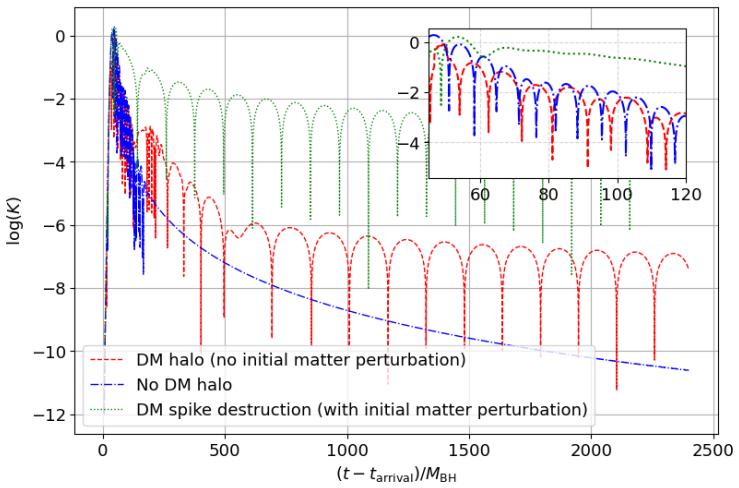
The presence of dark matter induces sizable modifications to the waveforms through the appearance of fluid modes at late times, with dark-matter profiles that have more pronounced spikes leaving stronger imprints on the gravitational-wave signal.
What carries the argument
Minimal coupling of dark-matter fluid degrees of freedom to the gravitational sector, which introduces additional fluid-mode solutions in the linear perturbation equations governing the ringdown.
If this is right
- Fluid modes appear at late times and alter the waveform tail in a profile-dependent way.
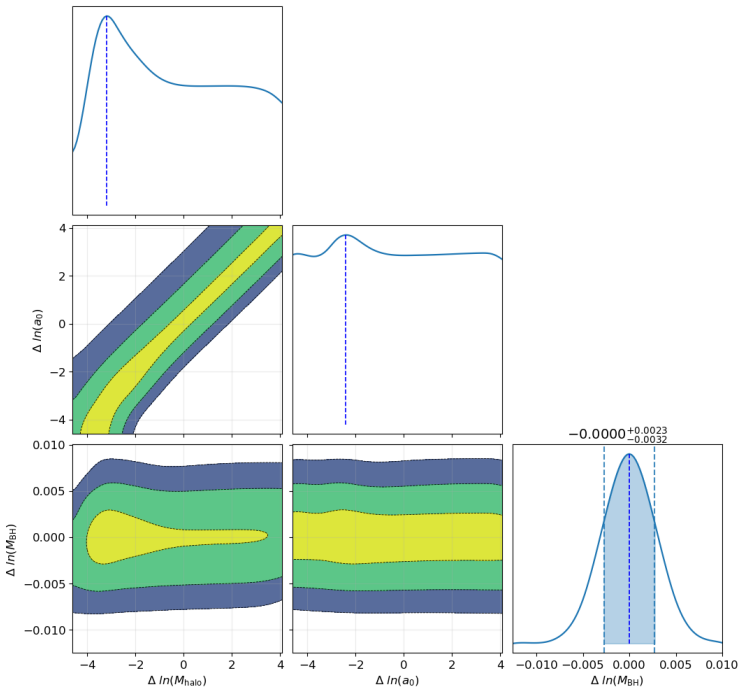
- Sharper central spikes in the dark-matter density produce larger waveform deviations and tighter parameter constraints.
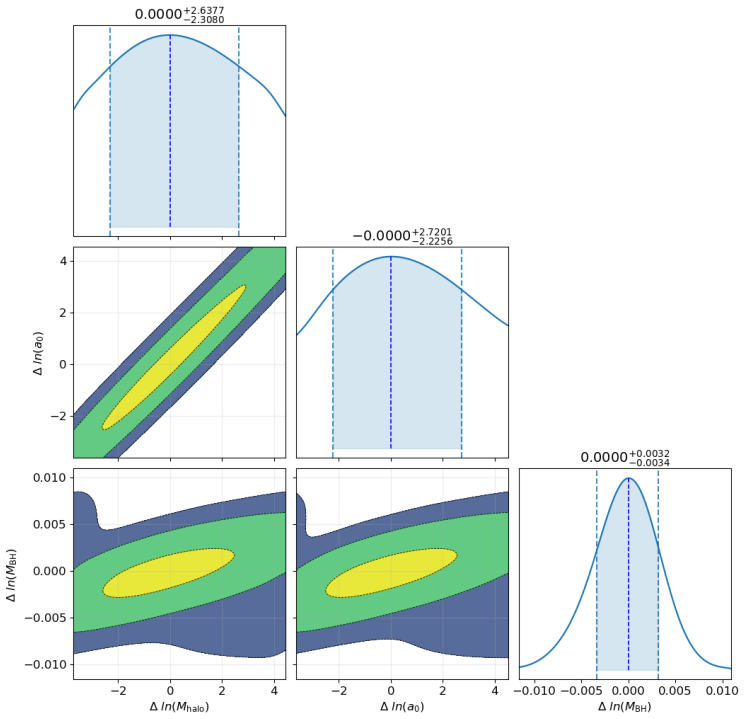
- Bayesian recovery of both black-hole and dark-matter parameters becomes feasible with LISA, Taiji, and TianQin data streams.
- Signal-to-noise ratios stay high enough for detection even after the fluid-mode modifications are included.
Where Pith is reading between the lines
- Late-time fluid modes could serve as a new observable to discriminate among competing dark-matter density models in galactic centers.
- Applying the same coupling framework to the inspiral or merger phases might reveal additional dark-matter effects before ringdown begins.
- Future multi-messenger observations combining gravitational waves with electromagnetic data on galactic nuclei could cross-check the inferred halo parameters.
Load-bearing premise
Dark matter is modeled as a fluid that couples only minimally to gravity inside the existing relativistic perturbation setup.
What would settle it
A high-signal-to-noise ringdown observation from a supermassive black hole merger that lacks any late-time oscillatory or decaying fluid-mode component inconsistent with the predicted Dehnen-halo modifications.
Figures






read the original abstract
In this work, we investigate the feasibility of using ringdown waveforms from supermassive black holes immersed in dark-matter halos to extract both the intrinsic black-hole parameters and those characterizing the surrounding matter distribution with future space-based gravitational-wave detectors. Building on the fully relativistic framework developed by Cardoso {\it et al.}, in which the dark-matter degrees of freedom are explicitly accounted for by minimal coupling to the gravitational sector, we construct numerical waveforms for a variety of Dehnen-type dark-matter profiles. We then convert these simulated waveforms into realistic data streams for future space-based gravitational-wave observatories, consistently implementing the second-generation Time-Delay Interferometry scheme in the analysis. We calculate the signal-to-noise ratios and perform a Bayesian parameter estimation to infer the model parameters, quantifying their measurability through the resulting posterior distributions. Our results indicate that the presence of dark matter can induce sizable modifications to the waveforms through the appearance of fluid modes at late times. Furthermore, dark-matter profiles with more pronounced spikes leave stronger imprints on the gravitational-wave signal, thereby enhancing the prospects for parameter inference with future space-based detectors such as LISA, Taiji, and TianQin.
Editorial analysis
A structured set of objections, weighed in public.
Referee Report
Summary. This manuscript investigates ringdown waveforms from supermassive black holes immersed in Dehnen dark matter halos. Building on the relativistic framework of Cardoso et al. with minimal coupling of DM degrees of freedom to gravity, the authors numerically construct waveforms for several Dehnen profiles, embed them in simulated data streams for space-based detectors using second-generation TDI, compute SNRs, and perform Bayesian parameter estimation to assess measurability of both BH and DM parameters. The central claim is that DM induces sizable late-time fluid-mode modifications whose strength increases with spike prominence, thereby improving prospects for inference with LISA, Taiji, and TianQin.
Significance. If the numerical results and inference hold, the work offers a concrete pathway to probe DM halo properties around SMBHs via GW ringdowns, a potentially falsifiable signature distinct from vacuum Kerr ringdowns. Credit is due for the explicit numerical waveform construction, consistent TDI implementation, and Bayesian posteriors that quantify parameter measurability; these elements make the detectability claims more actionable than purely analytic studies.
major comments (2)
- [§4] §4 (numerical waveforms): the construction of fluid modes for Dehnen profiles reports frequencies and damping times but provides no convergence tests, resolution studies, or error budgets on the extracted mode parameters; without these, the claim of 'sizable modifications' and their growth with spike strength cannot be quantitatively validated.
- [§6] §6 (Bayesian inference): the posterior distributions for DM parameters (gamma, rho_s, r_s) are presented, yet the likelihood function, noise model for the TDI channels, and MCMC convergence diagnostics are not specified; these details are load-bearing for the assertion that stronger spikes enhance parameter inference.
minor comments (3)
- [Abstract] Abstract: the phrase 'sizable modifications' would be strengthened by quoting one concrete example (e.g., fractional frequency shift for a fiducial Dehnen profile).
- [Figures] Figure captions: several waveform figures lack explicit indication of the time window used to isolate the late-time fluid mode, making visual assessment of the claimed imprint harder.
- [§2] Notation: the definition of the Dehnen density profile parameters is introduced in §2 but the mapping to the fluid perturbation variables is not restated when the waveforms are shown, which could confuse readers.
Simulated Author's Rebuttal
We thank the referee for the careful and constructive review of our manuscript. The comments highlight important aspects of the numerical and statistical methodology that require clarification and expansion. We address each major comment point by point below and will revise the manuscript accordingly.
read point-by-point responses
-
Referee: [§4] §4 (numerical waveforms): the construction of fluid modes for Dehnen profiles reports frequencies and damping times but provides no convergence tests, resolution studies, or error budgets on the extracted mode parameters; without these, the claim of 'sizable modifications' and their growth with spike strength cannot be quantitatively validated.
Authors: We agree that the current presentation of the numerical results in §4 lacks explicit convergence tests, resolution studies, and error budgets for the extracted fluid-mode frequencies and damping times. This omission limits the quantitative support for the reported modifications and their dependence on spike strength. In the revised manuscript we will add a dedicated subsection to §4 that documents the numerical grid resolutions employed, convergence of the mode parameters under successive refinements, and estimated uncertainties on the frequencies and damping times. These additions will allow readers to assess the robustness of the sizable late-time modifications. revision: yes
-
Referee: [§6] §6 (Bayesian inference): the posterior distributions for DM parameters (gamma, rho_s, r_s) are presented, yet the likelihood function, noise model for the TDI channels, and MCMC convergence diagnostics are not specified; these details are load-bearing for the assertion that stronger spikes enhance parameter inference.
Authors: We concur that the likelihood function, the precise noise model for the second-generation TDI channels, and MCMC convergence diagnostics were not adequately detailed in §6. These elements are necessary to substantiate the claim that stronger spikes improve parameter inference. The revised version will expand §6 to include the explicit likelihood expression, a description of the TDI noise power spectral densities, and standard MCMC diagnostics (e.g., Gelman–Rubin statistics and autocorrelation times). The updated text will thereby provide firmer grounding for the reported enhancement in measurability with spike prominence. revision: yes
Circularity Check
No significant circularity: derivation uses external framework and forward numerical simulation
full rationale
The paper adopts the minimal-coupling framework from Cardoso et al. (external prior work) to set up the perturbation equations for a black hole in a Dehnen halo, then performs explicit numerical integration to generate ringdown waveforms that exhibit fluid modes. These waveforms are injected into simulated TDI data streams for LISA/Taiji/TianQin, followed by standard Bayesian parameter estimation on the resulting posteriors. The reported late-time fluid-mode modifications and their dependence on spike strength are direct outputs of this forward simulation pipeline rather than quantities defined by or fitted to the target observables inside the paper. No equation reduces the claimed waveform imprint to a self-referential fit, no uniqueness theorem is imported from the authors' own prior work, and the central detectability conclusions rest on numerically solved dynamics against an independent external benchmark. The analysis is therefore self-contained against external benchmarks with no load-bearing circular step.
Axiom & Free-Parameter Ledger
free parameters (1)
- Dehnen profile parameters (gamma, rho_s, r_s)
axioms (1)
- domain assumption Dark-matter degrees of freedom are minimally coupled to the gravitational sector as formulated by Cardoso et al.
Lean theorems connected to this paper
-
IndisputableMonolith/Foundation/AbsoluteFloorClosure.lean, IndisputableMonolith/Cost/FunctionalEquation.leanreality_from_one_distinction, washburn_uniqueness_aczel unclear?
unclearRelation between the paper passage and the cited Recognition theorem.
the polar sector is intrinsically coupled with the matter degrees of freedom... three wavelike equations... Lax-Wendroff method... second-generation TDI... Bayesian parameter estimation
-
IndisputableMonolith/Foundation/AlexanderDuality.leanalexander_duality_circle_linking unclear?
unclearRelation between the paper passage and the cited Recognition theorem.
Dehnen family ρ(r) ∝ r^−γ (r+a0)^(γ−4) with geometric correction (1−2MBH/r)
What do these tags mean?
- matches
- The paper's claim is directly supported by a theorem in the formal canon.
- supports
- The theorem supports part of the paper's argument, but the paper may add assumptions or extra steps.
- extends
- The paper goes beyond the formal theorem; the theorem is a base layer rather than the whole result.
- uses
- The paper appears to rely on the theorem as machinery.
- contradicts
- The paper's claim conflicts with a theorem or certificate in the canon.
- unclear
- Pith found a possible connection, but the passage is too broad, indirect, or ambiguous to say the theorem truly supports the claim.
Reference graph
Works this paper leans on
-
[1]
multipoles. −2Y ℓm(θ, ϕ) is the spin-weighted spherical harmonics. 18 Space-borne detectors such as Lisa and Taiji consist of three spacecraft (S/Cs), and laser beams are exchanged between each pair of them. The latter is referred to as laser links, also known as arms, denoted by a pair of indices,ij∈ I 2 ≡ {12,23,31,21,32,13}, corresponding to the two S/...
work page 2023
-
[2]
G. Bertone and D. Hooper, History of dark matter, Rev. Mod. Phys.90, 045002 (2018), arXiv:1605.04909 [astro-ph.CO]
work page internal anchor Pith review Pith/arXiv arXiv 2018
-
[3]
The Waning of the WIMP? A Review of Models, Searches, and Constraints
G. Arcadi, M. Dutra, P. Ghosh, M. Lindner, Y. Mambrini, M. Pierre, S. Profumo, and F. S. Queiroz, The waning of the WIMP? A review of models, searches, and constraints, Eur. Phys. J. C78, 203 (2018), arXiv:1703.07364 [hep-ph]. 36
work page internal anchor Pith review Pith/arXiv arXiv 2018
-
[4]
Strongest model-independent bound on the lifetime of Dark Matter
B. Audren, J. Lesgourgues, G. Mangano, P. D. Serpico, and T. Tram, Strongest model- independent bound on the lifetime of Dark Matter, JCAP2014(12), 028, arXiv:1407.2418 [hep-ph]
work page internal anchor Pith review Pith/arXiv arXiv
-
[6]
B. P. Abbottet al.(LIGO Scientific Collaboration and Virgo Collaboration), GWTC-1: A Gravitational-Wave Transient Catalog of Compact Binary Mergers Observed by LIGO and Virgo during the First and Second Observing Runs, Phys. Rev. X9, 031040 (2019), arXiv:1811.12907 [astro-ph.HE]
work page internal anchor Pith review Pith/arXiv arXiv 2019
-
[7]
V. Cardoso, K. Destounis, F. Duque, R. P. Macedo, and A. Maselli, Gravitational waves from extreme-mass-ratio systems in astrophysical environments, Phys. Rev. Lett.129, 241103 (2022), arXiv:2203.11228 [gr-qc]
-
[9]
K. Eda, Y. Itoh, S. Kuroyanagi, and J. Silk, New Probe of Dark-Matter Properties: gravi- tational waves from an intermediate mass black hole embedded in a dark matter mini-spike Minispike, Phys. Rev. Lett.110, 221101 (2013), arXiv:1212.3727 [astro-ph.HE]
work page internal anchor Pith review Pith/arXiv arXiv 2013
- [10]
-
[11]
W.-R. Hu and Y.-L. Wu, The Taiji Program in Space for gravitational wave physics and the nature of gravity, Natl. Sci. Rev.4, 685 (2017)
work page 2017
- [12]
-
[13]
Laser Interferometer Space Antenna
P. Amaro-Seoane, H. Audley, S. Babak, J. Baker, E. Barausse, P. Bender, E. Berti, P. Bi- netruy, M. Born, D. Bortoluzzi,et al.(LISA Consortium), Laser interferometer space an- tenna, (2017), arXiv:1702.00786 [astro-ph.IM]
work page internal anchor Pith review Pith/arXiv arXiv 2017
-
[14]
Black hole spectroscopy: from theory to experiment
E. Bertiet al., Black hole spectroscopy: from theory to experiment, (2025), arXiv:2505.23895 [gr-qc]. 37
work page internal anchor Pith review Pith/arXiv arXiv 2025
-
[15]
C. V. Vishveshwara, Stability of the Schwarzschild metric, Phys. Rev. D1, 2870 (1970)
work page 1970
-
[16]
Gravitation as a Quantum Diffusion
H.-P. Nollert, Quasinormal modes: the characteristic ‘sound’ of black holes and neutron stars, Class. Quant. Grav.16, R159 (1999), arXiv:gr-qc/9906079 [gr-qc]
work page internal anchor Pith review Pith/arXiv arXiv 1999
-
[17]
E. S. C. Ching, P. T. Leung, W. M. Suen, and K. Young, Wave propagation in gravitational systems: Late time behavior, Phys. Rev. D52, 2118 (1995), arXiv:gr-qc/9507035 [gr-qc]
work page internal anchor Pith review Pith/arXiv arXiv 1995
-
[18]
Quasinormal modes of black holes and black branes
E. Berti, V. Cardoso, and A. O. Starinets, Quasinormal modes of black holes and black branes, Class. Quant. Grav.26, 163001 (2009), arXiv:0905.2975 [gr-qc]
work page internal anchor Pith review Pith/arXiv arXiv 2009
-
[19]
Producing ultra-strong magnetic fields in neutron star mergers
E. Berti, V. Cardoso, and C. M. Will, Gravitational-wave spectroscopy of massive black holes with the space interferometer LISA, Phys. Rev. D73, 064030 (2006), arXiv:astro-ph/0603845 [astro-ph]
work page internal anchor Pith review Pith/arXiv arXiv 2006
- [20]
- [21]
-
[22]
A survey of infrared supernova remnants in the Large Magellanic Cloud
E. Barausse, V. Cardoso, and P. Pani, Can environmental effects spoil precision gravitational- wave astrophysics?, Phys. Rev. D89, 104059 (2014), arXiv:1312.0460 [gr-qc]
work page internal anchor Pith review Pith/arXiv arXiv 2014
-
[23]
C. Shi, J. Bao, H.-T. Wang, J.-d. Zhang, Y.-M. Hu, A. Sesana, E. Barausse, J. Mei, and J. Luo (TianQin Collaboration), Science with the TianQin observatory: Preliminary results on testing the no-hair theorem with ringdown signals, Phys. Rev. D100, 044036 (2019), arXiv:1902.08922 [gr-qc]
-
[24]
V. Cardoso, K. Destounis, F. Duque, R. P. Macedo, and A. Maselli, Black holes in galaxies: Environmental impact on gravitational-wave generation and propagation, Phys. Rev. D105, L061501 (2022), arXiv:2109.00005 [gr-qc]
- [25]
- [26]
- [27]
-
[28]
Imprint of Accretion Disk-Induced Migration on Gravitational Waves from Extreme Mass Ratio Inspirals
N. Yunes, B. Kocsis, A. Loeb, and Z. Haiman, Imprint of Accretion Disk-Induced Migration on Gravitational Waves from Extreme Mass Ratio Inspirals, Phys. Rev. Lett.107, 171103 (2011), arXiv:1103.4609 [astro-ph.CO]
work page internal anchor Pith review Pith/arXiv arXiv 2011
- [29]
-
[30]
R. H. Price and J. Pullin, Colliding black holes: The close limit, Phys. Rev. Lett.72, 3297 (1994), arXiv:gr-qc/9402039 [gr-qc]
work page internal anchor Pith review Pith/arXiv arXiv 1994
-
[31]
De Amiciset al., Late-Time Tails in Nonlinear Evolutions of Merging Black Holes, Phys
M. De Amiciset al., Late-Time Tails in Nonlinear Evolutions of Merging Black Holes, Phys. Rev. Lett.135, 171401 (2025), arXiv:2412.06887 [gr-qc]
-
[32]
S.-F. Shen, G.-R. Li, R. G. Daghigh, J. C. Morey, M. D. Green, W.-L. Qian, and R.-H. Yue, Asymptotic quasinormal modes, echoes and black hole spectral instability: A brief review, Int. J. Mod. Phys. D35, 2630001 (2026), arXiv:2507.11663 [gr-qc]
-
[33]
About the Significance of Quasinormal Modes of Black Holes
H.-P. Nollert, About the significance of quasinormal modes of black holes, Phys. Rev.D53, 4397 (1996), arXiv:gr-qc/9602032 [gr-qc]
work page internal anchor Pith review Pith/arXiv arXiv 1996
-
[34]
J. L. Jaramillo, R. Panosso Macedo, and L. Al Sheikh, Pseudospectrum and Black Hole Quasinormal Mode Instability, Phys. Rev. X11, 031003 (2021), arXiv:2004.06434 [gr-qc]
work page internal anchor Pith review Pith/arXiv arXiv 2021
- [35]
- [36]
- [37]
-
[38]
K. Destounis, R. P. Macedo, E. Berti, V. Cardoso, and J. L. Jaramillo, Pseudospectrum of Reissner-Nordstr¨ om black holes: Quasinormal mode instability and universality, Phys. Rev. D104, 084091 (2021), arXiv:2107.09673 [gr-qc]. 39
-
[39]
V. Boyanov, V. Cardoso, K. Destounis, J. L. Jaramillo, and R. Panosso Macedo, Structural aspects of the anti–de Sitter black hole pseudospectrum, Phys. Rev. D109, 064068 (2024), arXiv:2312.11998 [gr-qc]
-
[40]
Warnick, (In)stability of de Sitter Quasinormal Mode spectra, (2024), arXiv:2407.19850 [gr-qc]
C. Warnick, (In)stability of de Sitter Quasinormal Mode spectra, (2024), arXiv:2407.19850 [gr-qc]
- [41]
- [42]
-
[43]
S.-F. Shen, G.-R. Li, R. G. Daghigh, J. C. Morey, M. D. Green, W.-L. Qian, and R.-H. Yue, Spectral Instability in Modified P¨ oschl–Teller Effective Potential Triggered by Deterministic and Random Perturbations, Universe12, 5 (2026), arXiv:2509.23372 [gr-qc]
-
[44]
W.-L. Qian, Q. Pan, R. G. Daghigh, B. Wang, and R.-H. Yue, Reflectionless and echo modes in asymmetric Damour-Solodukhin wormholes, (2025), arXiv:2511.00565 [gr-qc]
work page internal anchor Pith review Pith/arXiv arXiv 2025
- [45]
- [46]
- [47]
-
[48]
A. Ianniccari, A. J. Iovino, A. Kehagias, P. Pani, G. Perna, D. Perrone, and A. Riotto, Deciphering the Instability of the Black Hole Ringdown Quasinormal Spectrum, Phys. Rev. Lett.133, 211401 (2024), arXiv:2407.20144 [gr-qc]
-
[49]
Y. Yang, Z.-F. Mai, R.-Q. Yang, L. Shao, and E. Berti, Spectral instability of black holes: Relating the frequency domain to the time domain, Phys. Rev. D110, 084018 (2024), arXiv:2407.20131 [gr-qc]. 40
-
[50]
W.-L. Qian, G.-R. Li, R. G. Daghigh, S. Randow, and R.-H. Yue, Universality of instability in the fundamental quasinormal modes of black holes, Phys. Rev. D111, 024047 (2025), arXiv:2409.17026 [gr-qc]
- [51]
- [52]
- [53]
- [54]
-
[55]
Gravitational waves and pulsating stars: What can we learn from future observations?
N. Andersson and K. D. Kokkotas, Gravitational waves and pulsating stars: What can we learn from future observations?, Phys. Rev. Lett.77, 4134 (1996), arXiv:gr-qc/9610035
work page internal anchor Pith review Pith/arXiv arXiv 1996
-
[57]
Dehnen, A family of potential–density pairs for spherical galaxies and bulges, Mon
W. Dehnen, A family of potential–density pairs for spherical galaxies and bulges, Mon. Not. Roy. Astron. Soc.265, 250 (1993)
work page 1993
-
[58]
Dark matter annihilation at the galactic center
P. Gondolo and J. Silk, Dark matter annihilation at the galactic center, Phys. Rev. Lett.83, 1719 (1999), arXiv:astro-ph/9906391 [astro-ph]
work page internal anchor Pith review Pith/arXiv arXiv 1999
-
[59]
J. F. Navarro, C. S. Frenk, and S. D. M. White, A universal density profile from hierarchical clustering, Astrophys. J.490, 493 (1997), arXiv:astro-ph/9611107 [astro-ph]
work page internal anchor Pith review Pith/arXiv arXiv 1997
-
[60]
Dark matter distributions around massive black holes: A general relativistic analysis
L. Sadeghian, F. Ferrer, and C. M. Will, Dark-matter distributions around massive black holes: a general relativistic analysis, Phys. Rev. D88, 063522 (2013), arXiv:1305.2619 [gr- qc]
work page internal anchor Pith review Pith/arXiv arXiv 2013
-
[61]
Analytical Models For Galactic Nuclei
H. Zhao, Analytical models for galactic nuclei, Mon. Not. Roy. Astron. Soc.278, 488 (1996), arXiv:astro-ph/9509122 [astro-ph]
work page internal anchor Pith review Pith/arXiv arXiv 1996
-
[62]
The Structure of Dark Matter Haloes in Dwarf Galaxies
A. Burkert, The structure of dark matter halos in dwarf galaxies, Astrophys. J.447, L25 (1995), arXiv:astro-ph/9504041 [astro-ph]. 41
work page internal anchor Pith review Pith/arXiv arXiv 1995
-
[63]
"Kludge" gravitational waveforms for a test-body orbiting a Kerr black hole
S. Babak, H. Fang, J. R. Gair, K. Glampedakis, and S. A. Hughes, “Kludge” gravitational waveforms for a test-body orbiting a Kerr black hole, Phys. Rev. D75, 024005 (2007), arXiv:gr-qc/0607007 [gr-qc]
work page internal anchor Pith review Pith/arXiv arXiv 2007
-
[64]
K. Destounis, A. G. Suvorov, and K. D. Kokkotas, Testing spacetime symmetry through gravitational waves from extreme-mass-ratio inspirals, Phys. Rev. D102, 064041 (2020), arXiv:2008.03282 [gr-qc]
-
[66]
G. Allen, N. Andersson, K. D. Kokkotas, and B. F. Schutz, Gravitational waves from pul- sating stars: Evolving the perturbation equations for a relativistic star, Phys. Rev. D58, 124012 (1998), arXiv:gr-qc/9704023 [gr-qc]
work page internal anchor Pith review Pith/arXiv arXiv 1998
- [67]
-
[68]
L. Pezzella, K. Destounis, A. Maselli, and V. Cardoso, Quasinormal modes of black holes embedded in halos of matter, Phys. Rev. D111, 064026 (2025), arXiv:2412.18651 [gr-qc]
- [69]
-
[70]
A. Mollicone and K. Destounis, Superradiance of charged black holes embedded in dark matter halos, Phys. Rev. D111, 024017 (2025), arXiv:2410.11952 [gr-qc]
-
[71]
Baghiet al.(LDC Working Group), The LISA Data Challenges, (2022), arXiv:2204.12142 [gr-qc]
Q. Baghiet al.(LDC Working Group), The LISA Data Challenges, (2022), arXiv:2204.12142 [gr-qc]
-
[72]
M. Tinto and S. V. Dhurandhar, Time-delay interferometry, Living Rev. Rel.24, 1 (2021)
work page 2021
-
[73]
J. W. Armstrong, F. B. Estabrook, and M. Tinto, Time-delay interferometry for space-based gravitational wave searches, Astrophys. J.527, 814 (1999)
work page 1999
-
[74]
W.-L. Qian, P.-P. Wang, Z.-Q. Wu, C.-G. Shao, B. Wang, and R.-H. Yue, Second- order combinatorial algebraic time-delay interferometry, Phys. Rev. D108, 022002 (2023), arXiv:2301.00814 [astro-ph.IM]
- [75]
-
[76]
M. Tinto and S. Dhurandhar, Higher-order time-delay interferometry, Phys. Rev. D108, 082003 (2023), arXiv:2307.07585 [gr-qc]
-
[77]
FINDCHIRP: an algorithm for detection of gravitational waves from inspiraling compact binaries
B. Allen, W. G. Anderson, P. R. Brady, D. A. Brown, and J. D. E. Creighton, FINDCHIRP: An Algorithm for detection of gravitational waves from inspiraling compact binaries, Phys. Rev. D85, 122006 (2012), arXiv:gr-qc/0509116 [gr-qc]
work page internal anchor Pith review Pith/arXiv arXiv 2012
-
[78]
B. P. Abbottet al.(LIGO Scientific, Virgo), Observation of Gravitational Waves from a Binary Black Hole Merger, Phys. Rev. Lett.116, 061102 (2016), arXiv:1602.03837 [gr-qc]
work page internal anchor Pith review Pith/arXiv arXiv 2016
- [79]
-
[80]
T. Regge and J. A. Wheeler, Stability of a Schwarzschild singularity, Phys. Rev.108, 1063 (1957)
work page 1957
-
[81]
F. J. Zerilli, Effective potential for even-parity Regge-Wheeler gravitational perturbation equations, Phys. Rev. Lett.24, 737 (1970)
work page 1970
-
[82]
Here, we follow Nollert’s terminology [15], although all of these basis functions are referred to as tensor harmonics by Zerilli [80]
-
[83]
Hernquist, An analytical model for spherical galaxies and bulges, Astrophys
L. Hernquist, An analytical model for spherical galaxies and bulges, Astrophys. J.356, 359 (1990)
work page 1990
-
[84]
Google Android: A State-of-the-Art Review of Security Mechanisms
A. Zengino˘ glu and G. Khanna, Null infinity waveforms from extreme-mass-ratio inspirals in Kerr spacetime, Phys. Rev. X1, 021017 (2011), arXiv:0912.5101 [gr-qc]
work page internal anchor Pith review Pith/arXiv arXiv 2011
discussion (0)
Sign in with ORCID, Apple, or X to comment. Anyone can read and Pith papers without signing in.